

Saved Bookmarks
This section includes 7 InterviewSolutions, each offering curated multiple-choice questions to sharpen your Current Affairs knowledge and support exam preparation. Choose a topic below to get started.
| 1. |
NH_4 OH is a weak base because |
|
Answer» it has low VAPOUR pressure |
|
| 2. |
NH_(4)^(+) is kept in group zero because |
|
Answer» Its salts are highly solublr in WATER `therefore` © and (d) are not correct. |
|
| 3. |
NH_4 CNS can be used to test one or more out of Fe^(3+), Co^(2+), Cu^(2+)e |
|
Answer» `Fe^(3+)` only `FeCl_(3) +3NH_(4)CNS to underset("Blood red colour")(Fe(CNS)_(3))+3NH_(4)Cl` |
|
| 4. |
NH_(3)C"OO"NH_(4) overset(Delta)to 2NH_(3) + CO_(2) If 6 moles of NH_(3) is produced then find moles of NH_(2) C"OO"NH_(4) intially taken. |
|
Answer» 3 |
|
| 5. |
NH_(3),CO_(2) are readily adsorbed where as, H_(2),N_(2) are slowly adsorbed. Give reason. |
|
Answer» Solution :The NATURE of adsorbate can influece the adsorption. Gases like `NH_(3)" "CO_(2)` are EASILY liquefiable as have greater Van der Waals forces of attraction and hence readily adsorbed due to high critical TEMPERATURE. But permanent gases like `H_( 2),N_(2)` can not be easily liquefied and having low critical temperature and adsorbed slowly . |
|
| 6. |
{:([(NH_(3))_(5)Co-O-O-Co(NH_(3))_(5)]^(4+)underset("oxidise")overset([S_(2)O_(8)]^(2-))to [(NH_(3))_(5)Co-O-O-Co(NH_(3))_(5)]^(5+)),("""(Brown)""""(Green)"):} The magnetic moment of green complex is 1.7 BM and for brown complexes magnetic moment is zero. (O-O) is same in all respect in both the complexes. The oxidation state of Co in brown complex and green complex respectively are : |
|
Answer» `{:(III" "III" and "IV" "III),(""BROWN""""GREEN"):}` |
|
| 7. |
NH_(3)+underset("(excess)")(X_(2)) rarr NX_(3) + HX rarr"---------------------"1 NH_(3)+underset("(excess)")(X_(2)) rarr N_(2) + NH_(4) X "------2 list out the halogen which reacts according 1 & 2 |
|
Answer» `F_(2)` |
|
| 8. |
NH_(3) solutionwas added to four semple solution in difference test tube and found the following observation about the precipitate. a. White ppt which is solution in oxcess of NH_(3) solution b.On heating whichis white in cold but yellow on heating c. The cationpresent in (b) forms white ppt , with hypo solutionwhich give black ppt on heating d. The cation present in (c ) forms soluble complex withexcess of NH_(3) solution White ppt in (c) and the soluble complex fromwhite ppt withthe type solution is//are |
|
Answer» `Pb(OH)_(2),[Pb(S_(2)O_(3))_(2)]^(2)` |
|
| 9. |
NH_(3) solutionwas added to four semple solution in difference test tube and found the following observation about the precipitate. a. White ppt which is solution in oxcess of NH_(3) solution b. On heating whichis white in cold but yellow on heating c. The cationpresent in (b) forms white ppt , with hypo solutionwhich give black ppt on heating d. The cation present in (c ) forms soluble complex withexcess of NH_(3) solution The solution initialy present in (a) + H_(2)S (basic medium) gives ppt , then (a) may have |
|
Answer» `Zn^(2+)` |
|
| 10. |
NH_(3) solutionwas added to four semple solution in difference test tube and found the following observation about the precipitate. a. White ppt which is solution in oxcess of NH_(3) solution b.On heating whichis white in cold but yellow on heating c. The cationpresent in (b) forms white ppt , with hypo solutionwhich give black ppt on heating d. The cation present in (c ) forms soluble complex withexcess of NH_(3) solution White ppts in (a),(b) and (c ) respectively obtained are |
|
Answer» `Zn(OH)_(2),Zn(OH)_(2),HgOHg(NH_(2))NO_(3)` 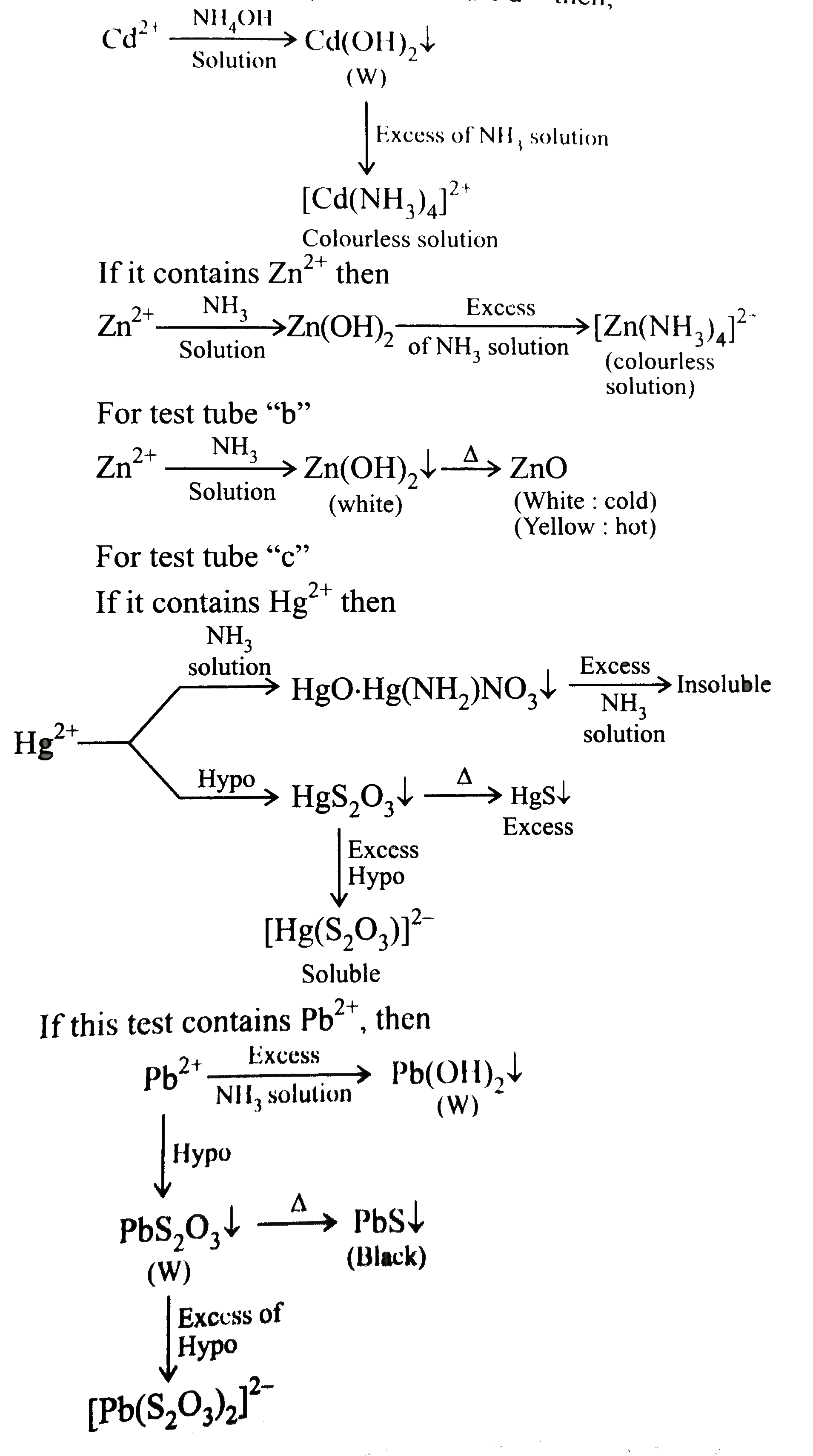
|
|
| 11. |
NH_3 reacts with a gas fumes produced when methanol is passed through Cu tube at 573 K The compound obtained is polycyclic. How many rings does it contain = [X]. The number of Nitrogen atoms it has = [Y] ? |
Answer» 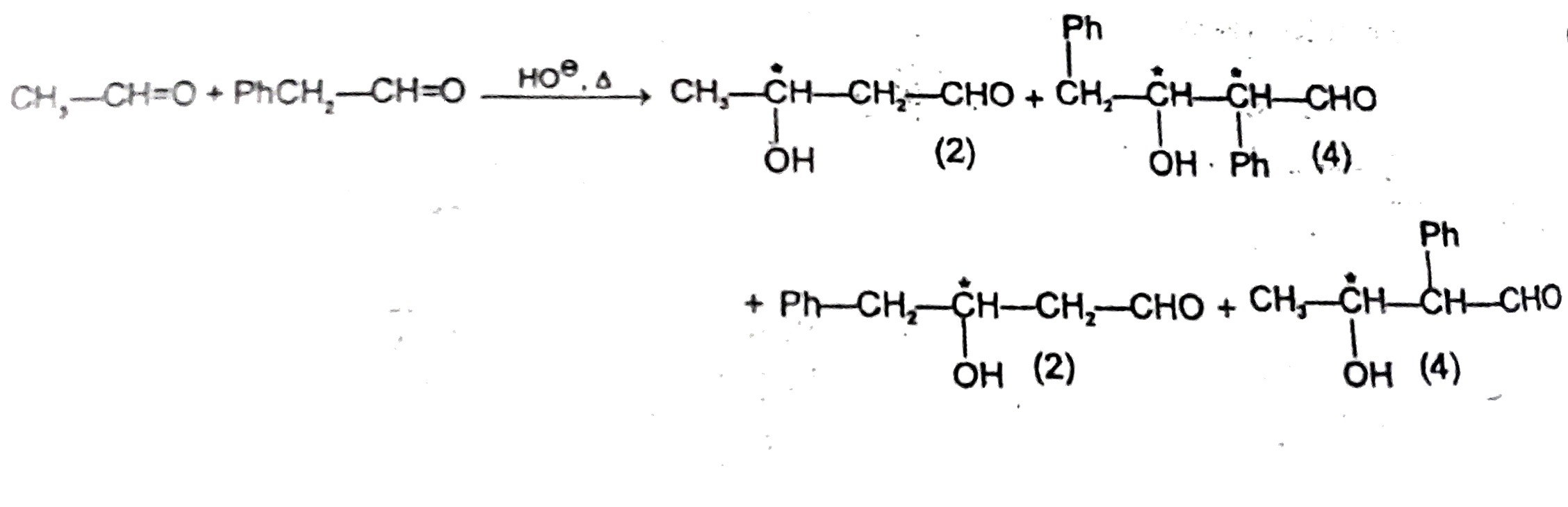
|
|
| 12. |
NH_(3) reacts with Cl_(2) to give N_(2) gas . How many number of moles of Cl_(2) are required ? |
|
Answer» |
|
| 13. |
NH_(3)+O_(2)underset(Delta) overset(Pt)to A+H_(2)O, A+O_(2)to B, B+O_(2)+H_(2)O to C Substances A, B and C of the above sequence of reactions are |
|
Answer» `N_(2)O, NO_(2) and HNO_(3)` |
|
| 14. |
NH_(3)+NaOCl → NH_(2)-NH_(2)+NH_(4)Cl To obtain this product in large amount, we should use |
|
Answer» Tap water as medium |
|
| 15. |
NH_3 molecule can enter into complex formation through: |
|
Answer» IONIC bond |
|
| 16. |
NH_(3) is liquefied more easily than N_(2) Hence. |
|
Answer» `a and b" of "NH_(3) gt" that of "N_(2)` |
|
| 17. |
NH_3is an example of: |
|
Answer» MOLECULAR hydride |
|
| 18. |
NH_(3) has a much higher bp than PH_(3) because |
|
Answer» `NH_(3)` has a larger molecular weight |
|
| 19. |
NH_3 has a much higher boiling point than PH_3 because: |
|
Answer» `NH_3` has a higher MOLECULAR weight |
|
| 20. |
NH_(3) has a higher proton affinity than PH_(3). Explain. Or NH_(3) is more basic than PH_(3). |
Answer» Solution :Due the presence of a lone pair of ELECTRONS on N and P, both `NH_(3) and PH_(3)` act as Lewis bases and accept a proton to form an additional N-H and P-H bonds respectively  However, due to smaller size of N over P, N-H bond thus formed is MUCH stronger than the P-H bond. Therefore, `NH_(3)` has HIGHER proton AFFINITY than `PH_(3)`. In other words, `NH_(3)` is more basic than `PH_(3)`. |
|
| 22. |
NH_3 forms complex with: |
|
Answer» `CuSO_4` |
|
| 23. |
NH_(3)(excess)+3CltoA+N_(2)uarr , the bonds present in compound A is |
|
Answer» IONIC, COVALENT and dative |
|
| 24. |
NH_(3) ,CO_(2) are readily adsorbed where as H_(2), N_(2)are slowly adsorbed. Give reason. |
|
Answer» Solution :• The nature of adsorbate can influence the adsorption. Gases like `NH_(3) CO_(2)` are easily liquefiable as have greater van der Waals forces of ATTRACTION and HENCE readily adsorbed due to high critical temperature. • But PERMANENT gases like `H_(2) ,N_(2)`can not be easily liquefied and having low critical temperature and adsorbed slowly. |
|
| 25. |
NH_(3) does not form complex with |
|
Answer» AgBr |
|
| 26. |
NH_3 does not from complex with: |
|
Answer» Agl |
|
| 27. |
NH_3 can be collected by the displacement of: |
|
Answer» Mercury |
|
| 28. |
NH_(3) and HCl gas are introduced simultaneously from the two ends of a long tube. A white ring of NH_(3)Cl appears first |
|
Answer» A) nearer to the HCL end `(r_(1))/(r_(2))=SQRT((d_(2))/(d_(1)))=sqrt((m_(2))/(m_(1))),(r_(NH_(3)))/(r_(HCl))=sqrt((36.7)/(17))` HENCE rate of diffusion of `NH_(3)` is more than HCl. This means `NH_(3)` reach first to HCl end. hence white ring of `NH_(4)Cl` appears first at HCl end. |
|
| 29. |
NH_(3)and BF_(3) form adduct readily because they form : |
| Answer» Answer :C | |
| 30. |
NH_3 + 3F_2 to A+ 3HF The correct statement regarding A is |
|
Answer» `SP^(3)`, Tetra hedral , I.P. =0 |
|
| 31. |
NH_(2) - underset(CH_(3))underset(|)CH-overset(O) overset(||)C-NH-CH_(2)-CO_(2)H Identify the amino acid obtianed by hydrolysis of the above compound : |
|
Answer» GLYCINE 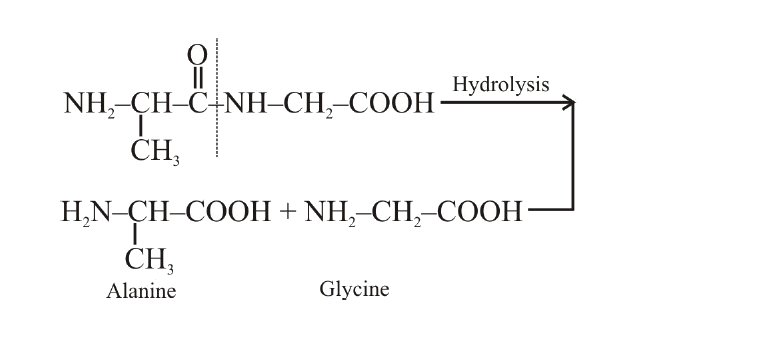
|
|
| 32. |
NH_2NH_2 serves as : |
|
Answer» MONODENTATE LIGAND |
|
| 33. |
NH overset(KOH)rarrAoverset(C_(2)H_(5)Br)rarrBunderset(H^(+))overset(HOH)rarrC+D C and D in the above sequence are |
|
Answer» BENZOIC acid+aniline |
|
| 34. |
NF_(3), is possible, but NF_(5), is not. Why? |
|
Answer» Solution :(1) Nitrogen has electronic configuration, `""_(7)N 1s^(2) 2s^(2)2p_(x)^(1) 2p_(y)^(1)2p_(z)^(1)` (2) Since N has three unpaired ELECTRONS, it forms three N-F BONDS.(3) Nitrogen does not contain d-orbital to expand and HENCE cannot accommodate 10 electrons of five N-F bonds. Hence it does not form `NF_(5)` |
|
| 35. |
Newman projection of Butane is given, C-2 is rotated by 120^(º) along C_(2)-C_(3) bond in anticloclwise direction, the conformation formed is : |
|
Answer» anti |
|
| 36. |
Newly shaped glass articles when cooled suddenly becomebrittle, therefore these are cooled slowly , this process in known as : |
|
Answer» Tempering |
|
| 37. |
New industrial plants for acetic acid react liquid methanol with carbon monoxide in the presence of a catalyst.CH_3OH + CO to CH_3COOHIn the experiment, 15 g of methanol and 10 g of carbon monoxide were placed in a reaction vessel. What is the theoretical yield of acetic acid? If the actual yield is 19.1 g, what is the percentage yield? |
| Answer» SOLUTION :21.4 G, 89.1% | |
| 38. |
New carbon - carbon bond formation does not take place in |
|
Answer» Gatterman - KOCH reaction 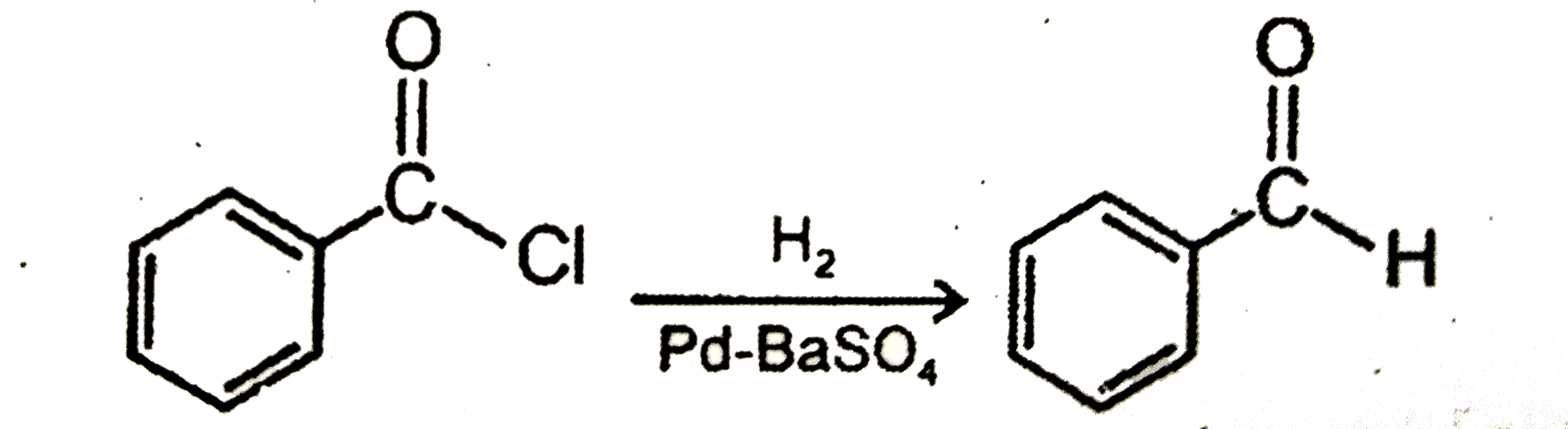
|
|
| 39. |
Neutron scattering experiments have shown that the radius of the nucleus of an atom is directly proporitonal to the cube root of the number of nucleons in the nucleus. From _(3)^(7)Li to _(76)^(189)Os the radius is: |
|
Answer» Halved |
|
| 40. |
Neutrons are obtained by |
|
Answer» Bombardment of RA with `beta-`particles |
|
| 41. |
Neutron was discovered by: |
|
Answer» J.J Thomson |
|
| 42. |
Neutrino has |
|
Answer» Charge +1, MASS 1 |
|
| 43. |
Neutralization of an acid with base invariably results in the production of |
|
Answer» `H_(3)O^(+)` |
|
| 44. |
Neutrino can be detected during the emission of: |
|
Answer» `ALPHA`-RAYS |
|
| 45. |
...............neutralise the acid in the stomach that causes acidity. |
| Answer» SOLUTION :ANTACIDS | |
| 46. |
Neutralisation of 30 gm of a mixture of acetic acid and phenol solutions required 100 ml of 2M sodium hydroxide solution. When the same mixture was treated with bromine water, 33.1 gm of precipitate was formed. Determine the mass percentage of acetic acid and phenol in the given solution. |
Answer» Solution :i.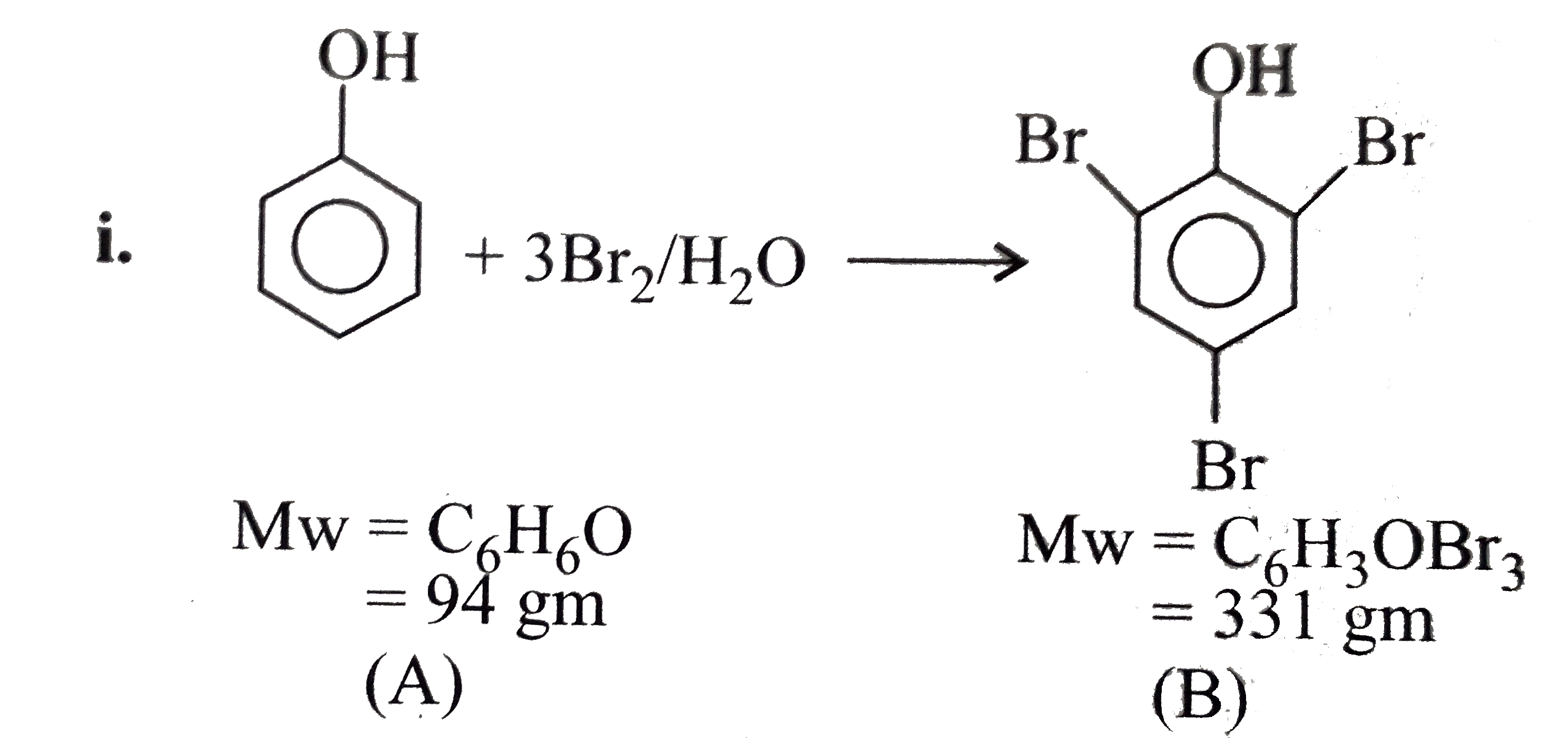 331 gm of (B) is obtained form 94 gm of (A). `33.1` gm (B) is obtained form `= (94)/(331)xx33.1` `= 9.4` gm of PHENOL Weight of phenol `=9.4` gm `= (9.4)/(9.4)= 0.1` mol ii.NaOH will react with both `CH_(3)COOH` and phenol. Total MOLAR equivalent of NaOH `= 100xx2` `= 200` mEq `= (200)/(1000)= 0.2` Eq. .of NaOH `= 0.2` mol of NaOH ACID + Phenol `= 0.2` mol Acid + `0.1` mol `= 0.2` mol `:.` Acid `= 0.2 - 0.1 = 0.1` mol `=0.1` Eq. 1 Eq. of `CH_(3)COOH = 60` gm `0.1` Eq. of `CH_(3)COOH = 6` gm Weight of acid = 6 gm Weight of phenol `= 9.4` gm Mass percentage of acid `= (6)/(30)xx100 = 20%` Mass percentage of phenol `= (9.4)/(30)xx100=31.3%` |
|
| 47. |
Neutralwater with pH about 7 becomes slightly acidic when aerated this is because |
|
Answer» it is a redox REACTION |
|
| 48. |
Neutral ferric chloride is added to the aqueous solution of acetate. The blood red colour is obtained, it is due to the compound |
|
Answer» `Fe(OH)_(2)` |
|
| 49. |
Neutral refractory material used in furnaces is |
|
Answer» Graphite |
|