

Saved Bookmarks
This section includes 7 InterviewSolutions, each offering curated multiple-choice questions to sharpen your Current Affairs knowledge and support exam preparation. Choose a topic below to get started.
| 1. |
Nickelocene, [Ni(eta^(5)-C_(5)H_(5))_(2)] is a bright green reactive solid conveniently prepared by adding a solution of NiCl_(2) in dimethyl sulphoxide to a solution to a of KC_(5)H_(5) in 1, 2 dimethoxyethane. What is the E.A.N of Ni in above complex ? |
|
Answer» 35 |
|
| 2. |
Nickelocene, [Ni(eta^(5)-C_(5)H_(5))_(2)] is a bright green reactive solid conveniently prepared by adding a solution of NiCl_(2) in dimethyl sulphoxide to a solution to a of KC_(5)H_(5) in 1, 2 dimethoxyethane. What is the oxidation state of nickel in the above complex ? |
|
Answer» 0 |
|
| 3. |
Nickeloy is an alloy containing : |
|
Answer» NI + CU +Cr |
|
| 4. |
Nicker crystallizes in an fcc unit cell with a cell-edge length of 0.3524nm. Calcualte the radius of the nickel atom |
|
Answer» 0.1624nm or `4r_(Ni)=asqrt(2)` `r_(Ni)=(asqrt(2))/(4)=sqrt(2)/(4)xx0.3524=0.1246` NM |
|
| 5. |
Nickel (Z= 28) combines with a uninegative monodentate ligand X^(-) to form a paramagnetic complex [Nix_(4)]^(2-). The number of unpaired electron(s) in the nickel and geometry of this complex ion are, respectively : |
|
Answer» ONE, tetrahedral `d^(8) , sp^(3) , 2` unpaired electron |
|
| 7. |
Nickel metal is in highest oxidation state in: |
| Answer» Answer :B | |
| 8. |
Nickel is purified by thermal decomposition of its |
|
Answer» Hydride `Ni(CO)_(4) overset("Heat") to Ni+4CO`. |
|
| 9. |
Nickel is purified using the concept of complex compounds. The complex related is |
|
Answer» `Ni(CO)_6` |
|
| 10. |
Nickel is purified by…. |
|
Answer» MOND process |
|
| 11. |
Nickel is purified by thermal decomposition of its : |
|
Answer» HYDRIDE |
|
| 12. |
Nickel formate is best used as a catalyst in: |
|
Answer» PRESERVATION of fruits |
|
| 13. |
Nickel (II) tetracyanide complex has …..geometry: |
|
Answer» Linear |
|
| 14. |
Nickel combines with a uninegative monodentate ligand X to form a paramagnetic complex [NiX_4]^(2-) .The number of unpaired electron/s in the nickel and geometry of this complex ion are respectively |
|
Answer» TWO, SQUARE PLANAR |
|
| 15. |
Nickel chloride, when treated with dimethyl gyloxime in presence of ammonium hydroxide, a bright red precipitate is obtained Answer the following (a) Draw the structure of the complex showing H-bonds (b) Give oxidation state of nickel and its hybridization (c) Predict the magnetic behaviour of the complex |
|
Answer» SOLUTION :Oxidation state of nickel is +2 and hybridization is `DSP^(2) mu_(s) =sqrt( n(ni+2)) BM n = 0 .therefour mu_(s) = 0` (b) `+2, dsp^(2) (c)` diamagnetic 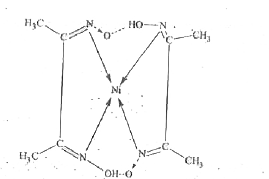
|
|
| 16. |
[NiC_(4)]^(2-)It is paramagnetic while Ni[CO_(4)] is diamagnetic though both are tetrahedral Why |
| Answer» Solution :In `[Nicl_(4)]^(2-), Ni^(2+)`is co-ordinated with FOUR `Cl^(-)` ligands and follows `sp_(3)` HYBRIDIZATION with two unpaired electrons on `Ni^(2+)` whereas in `[Ni(CO)]_(4)`, the Ni atom is co-ordinated with four CO ligands follows `sp^(3)`hybridization having no unpaired electrons on Ni atom as `Cl(-)` is weak field ligand and CO is strong field. | |
| 17. |
Ni^(2+)is identified using alcoholic solution of dimethyl glyoxime.Write the structural formula for the rosy red precipitate of a complex formed in the reaction. |
| Answer» Solution :Addition of an alcoholic solution of DIMETHYLGLYOXIME to an ammonical solution of Ni (II) gives rose-red preipitate` Ni (ONCC NOH]`_2` NICKEL Cis (dimethylglyoximate) | |
| 18. |
Ni^(2+) is identified using alcoholic solution of dimethyl glyoxime. Write the structural formula for the rosy and precipitate of a complex formed in the reaction. |
|
Answer» Solution :`(i) Ni^(2+)` ions present in Nickel chloride solution is ESTIMATED accurately for forming an INSOLUBLE complex called `[Ni(DMG)_(2)]` `(II)` Nickel ion reacts with alocholic solution of `DMG` in the presence of ammonical medium, to give rosy RED PRECIPITATE of `[Ni(DMG)_(2)]` complex. 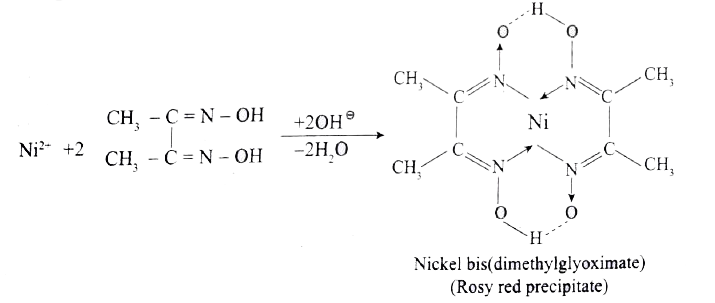
|
|
| 19. |
Niacin is …………………. |
|
Answer» Vitamin `B_(3)` |
|
| 20. |
Ni^(+) ion can be estimated by using dimethyl glyoxime and forms a cherry-red precipitate. The complex is stablized by: |
|
Answer» IOINC bonds |
|
| 21. |
Ni+H_(2)SO_(4) (hot and concentrated) to X(g) The liberated gas (select the correct statement) |
|
Answer» develops blue colour spots on the filter paper moistened with potassium iodate and strach solution (B)`2H^(+)+3SO_(2)+Cr_(2)O_(7)^(2-) to 2Cr^(3+) ("green")+3SO_(4)^(2-) +H_(2)O` ( C)`Pb^(2+)+SO_(3)^(2-) to PbSO_(3) darr `(white) (D)`SO_(2)+2H_(2)O +CI_(2) to H_(2)SO_(4) + HCl` `HCl+NH_(3) to NH_(4)Cl` `NI+H_(2)SO_(4) +2H^(+) to Ni^(2+) +SO_(2) uarr [X] + 2H_(2)O` With dilute `H_(2)SO_(4)`, hydrogen gas is liberated. |
|
| 22. |
Ni (II) compounds are more stable than Pt (II) compounds. Give reason. |
|
Answer» SOLUTION :(1) The ionisation enthalpy values can be used to predict the thermodynamic stability of their compounds. (ii) For NICKEL,`IE_(1)+ IE_(2)= 737+1753` `=2490 kj MOL^(-1)` for platinium`IE_(1)+ IE_(2)= 864+ 1791= 2655kj mol^(-1)` Since, the ENERGY REQUIRED to form Ni2+ is less than that of P127, Ni(II) compounds are thermodynamically more stable than Pt(II) compounds. |
|
| 23. |
Ni (II) compounds are thermodynamically…………. than Pt (II) compounds. |
| Answer» SOLUTION :more STABLE | |
| 24. |
Ni^(+2) form a complex inon in water having the formula [Ni(H_(2)O)_(6)]^(+2). How many of the following statement are true for the complex ion ? (i) The complex is octahedral in shape(ii) The complex is diamagnetic in nature . (iii) Ni^(+2) has incompletely filled 3d subshell. (iv). Secodary valency of Ni^(+2) is 6 (v) All the bonds (metal-ligand ) are perpendicular to each other.(vi) All the 3d orbitals of Ni^(+2) are degenerate (vii) Total spin of the complex is 1.(viii) The hybridisation of Ni^(+2) is d^(2)sp^(3) (ix) The complex is more stable than [Ni(en)_(3)]^(+2) (x) Effective atomic number of Ni^(+2) is 36. |
|
Answer» |
|
| 25. |
Ni^(+2) ion forms a searlet red ppt with DMG. It is a …………. Memberd ring. |
|
Answer» Dimethyl glyoxime (DMG) The .N. atoms donate a LONE pair each to the metal atom and thus two 5-membered rings are formed through CHELATION in `[Ni(dmg)_(2)]` COMPLEX. 
|
|
| 26. |
Ni is best used as catalyst in : |
|
Answer» Preservation of FRUITS |
|
| 27. |
Ni + CO overset(330-350 K)to Ni(CO)_(4) No(CO)_(4) overset(450-470K) to Ni + 4CO This sequence of reactions are involved in |
|
Answer» VAN Arkel methalforrefiningof nickel |
|
| 28. |
How many unpaired electrons are there in Ni^(2+) ion ? |
|
Answer» DIAMAGNETIC |
|
| 29. |
Mn^(2+) ion is: |
|
Answer» DIAMAGNETIC |
|
| 30. |
NH_(4),SCN givesred colour with (s) ____ due to the formationof (b) _____. |
|
Answer» |
|
| 31. |
[NH(CH_2)_4NHCO(CH_2)_4CO]_4 is a : |
|
Answer» ADDITION POLYMER |
|
| 32. |
NH_(4)SCN can be usedto test ion ormoreout of Fe^(3+) ,Co^(2+),Cu^(2+) |
| Answer» Answer :d | |
| 33. |
NH_(4)SCN can be used to makedistanctionbetween Cu^(2+) and Co^(2+). |
|
Answer» `CuCI_(2) + 2NH_(4)SCN rarr underset(Black ppt)(CU(SCN)_(2) + 2NH_(4)CI` |
|
| 34. |
NH_(4)OH is a weak base because |
|
Answer» it has low vapour pressure |
|
| 35. |
NH_(4)COONH_(2(s))hArr2NH_(3(g))+CO_(2(g)) if eqilibrium prassure is 3 atm for the above reaction K_(p) for the reaction is |
|
Answer» <P>4 `thereforeP_(NH_(3))=2ATM, P_(CO_(2))=1` `K_(p)=[P_(NH_(3))]^(2).[P_(CO_(2))]=2^(2)xx1=4` |
|
| 36. |
NH_(4)HF_(2) ionises in aqueous medium as |
|
Answer» `NH_(4)HF^(+)F^(-)` |
|
| 37. |
NH_(4)HS(s) hArr NH_(3)(g)+H_(2)S(g) In the above reaction, if the pressure at equilibrium and at 300K is 100atm then what will be equilibrium constant K_(p) ? |
|
Answer» `2500atm^(2)` `{:(1,0,0,"INITIALLY"),(1-alpha,alpha,alpha,"at equlibrium"):}` ACCORDING to question at the equlibrium `alpha+alpha=100impliesalpha=50` atm. `thereforeK_(P)=P_(NH_(3))xxP_(H_(2)S)=50xx50=2500atm^(2)` |
|
| 39. |
NH_4ClO_4 + NHO_3 to (A) + (B) oversetDeltato (C ) (neutral oxide) The summation of number of lone pairs and atomicities of compound B and C is . |
|
Answer» |
|
| 40. |
NH_(4)Cl(s) rarr NH_(3)(g)+HCl(g)when the above reaction occurs, the entropy |
|
Answer» Remains same `NH_(4)CL(s)rarrNH_(3)(g)+HCl(g)` In above reaction, the disorder increases with the FORMATION of `NH_(3)` and HCl. |
|
| 42. |
NH_(4)Cl+NaOH rarr "(Gas A)", NaCl+H_(2)SO_(4)rarr "(Gas B)" Discuss the acid-base nature of these gases, when dissolved in water. What is the product formed between these gases when mixed together? |
| Answer» SOLUTION :`NH_(4)CL` | |
| 43. |
NH_(4)Cl is added along with NH_(4)OH is group (a)_____to (b)____ conecentration of (c ) ____. |
|
Answer» |
|
| 44. |
NH_(4)Cl is acidic, because |
|
Answer» On HYDROLYSIS `NH_(4)Cl` gives WEAK base `NH_(4)OH` and STRONG acid HCl `NH_(4)Cl` is a salt of weak base & strong acid so SODIUM will be acidic. |
|
| 45. |
NH_4Cl is used to clean metal surfaces because: |
|
Answer» It dissociates into `NH_3` and HCL on HEATING |
|
| 46. |
NH_(4)CI can be replaced by (NH_(4))_(2)SO_(4) in group III. |
|
Answer» |
|
| 47. |
(NH_(4))_(2)Cr_(2)O_(7) on heating gives a gas which is also given by |
|
Answer» HEATING `NH_(4)NO_(2)` |
|
| 48. |
(NH_(4))_(2)Cr_(2)O_(7) on heating gives |
|
Answer» `Cr_(2)O_(3)` |
|
| 49. |
(NH_(4))_(2)Cr_(2)O_7on heating gives: |
|
Answer» `Cr_(2)O_3` |
|