

Saved Bookmarks
This section includes 7 InterviewSolutions, each offering curated multiple-choice questions to sharpen your Current Affairs knowledge and support exam preparation. Choose a topic below to get started.
| 1. |
Name the process of removing dissolved substance from a colloidal solution by means of diffusion through a membrane. |
| Answer» SOLUTION :DIALYSIS | |
| 2. |
Name the process of removing an adsorbed substance from the surface on which it is absorbed. |
| Answer» SOLUTION :DESORPTION | |
| 3. |
Name the process involved in the extraction of copper from low grade ore. |
| Answer» SOLUTION :HYDROMETALLURGY. | |
| 5. |
Name the process for the manufacture of ammonia from nitrogen and hydrogen. |
| Answer» SOLUTION :Haber.s | |
| 6. |
Name the process for isolation of metal from its ore. |
| Answer» SOLUTION :METALLURGY | |
| 8. |
Name the process by which soaps are obtained by heating fat with aqueous sodium hydroxide solution. |
| Answer» SOLUTION :SAPONIFICATION | |
| 9. |
Name the principle involved in the desilverisation of lead by Parke's process. |
| Answer» SOLUTION :NERNST DISTRIBUTION LAW or distribution law or PARTITION law. | |
| 10. |
Name the polymers used in laminated sheets and give the name of monomeric units involved in its formation. |
| Answer» SOLUTION :UREA -formaldehyde resin is USED for laminated sheets. Monomers are urea and formaldehyde. | |
| 11. |
Name the polymers used in (l) bullet vests (ii) protective clothing for fire- fighters (iii) bulttet proof windows or crash helmets. |
|
Answer» Solution :(i) KEVLAR is a polymide obtained by condensation copolymerization of terephthalic acid and p-phenylenediamine (1,4-diaminobenzene).The fibres of this polymer are so strong that they are used to MAKE light weight bullet -proof vests. (ii) NOMEX uis a polyamide made from m-phthalic acid and m-diaminobenzene. it is known for it is fire- resistant properties and is used in PROTECTIVE clothing for fire- fighters, astronauts ,and race - car drivers. (iii) Lexan is a polycarbonate3 (or a polyester) and is obtained by condensation of diethyl carbonate and bisphenol-A. It has unsaually highe impact STRENGTH and is used for bullet -proof windows and safety or crash helmets. |
|
| 12. |
Name the polymer which is used for making electrical switches and combs. |
| Answer» SOLUTION :BAKELITE. | |
| 13. |
Name the polymer used in laminating sheets and give the name of monomeric units involved in its formation. |
Answer» Solution :Urea formaldehyde resin is used for LAMINATED SHEETS. The MONOMER of this resin is urea `(NH_(2)CONH_(2))` and formaldehyde `(HCHO)`. 
|
|
| 14. |
Name the polymer used for making contact lenses ? |
| Answer» SOLUTION :POLY (METHYL methacrylate), PMMA. | |
| 15. |
Name the polymer used for making non-stick cooking utensils. |
| Answer» SOLUTION :TEFLON, `(-F_2 C - CF_2-)_n` | |
| 16. |
Name the polymer that is used to manufacture conveyor belts, gaskets and hoses. |
| Answer» SOLUTION :NEOPRENE | |
| 17. |
Name the polymer obtained from HMDA and Adipic acid. |
|
Answer» Nylon-6 |
|
| 18. |
Name the polymer obtained from the combination of monomers hexamethylene diamine and adipic acid. |
| Answer» SOLUTION :NYLON 6,6 | |
| 19. |
Name the pigment responsible for photosynthesis. |
| Answer» SOLUTION :CHLOROPHYLL | |
| 20. |
Name the phenomenon of flow of solvent through the semi-permeable membrane. |
| Answer» SOLUTION :OSMOSIS | |
| 21. |
Name the phenomenon involved: A raw mango in a concentrated salt solution loses water and shrinks. |
| Answer» SOLUTION :OSMOSIS process is involved when RAW mango in a CONCENTRATED SALT solution LOSES water and shrinks. | |
| 22. |
Name the phenomenon/effect for the following : When an electrical potential is applied across two platinum electrodes dipping in colloidal solution, particles moves towards one or the other electrodes |
| Answer» SOLUTION :ELECTROPHORESIS | |
| 23. |
Name the phenomenon/effect for the following : Scattering of light by colloidal sol |
| Answer» SOLUTION :TYNDALL EFFECT | |
| 24. |
Name the phenomenon/effect for the following : Colloidal particles are in zig-zag motion |
| Answer» SOLUTION :Brownian MOVEMENT | |
| 25. |
Name the phenomenon/effect for the following i) Collidal particles are in zig zag motion. ii) When an electrical potential is applied across two platinum electrodes dipping in a collidal solution, particles move towards one or the other electrodes. iii) Scattering of light by collidal sol. |
|
Answer» SOLUTION :b) i) Brownian MOMENT.. ii) ELECTROPHORESIS. III) Tyndal effect. |
|
| 26. |
Name the phenomenon behind this. |
|
Answer» |
|
| 27. |
Name the phenol with molecular formula C_(7)H_(8)O which on treatment with Br_(2) water readily gives a precipitate of C_(7)H_(5)OB r_(3). |
| Answer» SOLUTION :m-Cresol forms a TRIBROMO DERIVATIVE because it has two o- and one p-position free w.r.t. OH GROUP. | |
| 28. |
Name the person with whom would you associate the following slogans? a. Aya Ram and Gaya Ram______________ ltBrgt b. Total revolution____________ |
|
Answer» Solution :AYA Ram Gaya Ram----Gaya LAL Total Revolution------JAI PRAKASH Narayan |
|
| 30. |
Name the oxometal anions of the first seris of the transitoin metals in which the metal exihibits the oxidation state equal to its group number. |
| Answer» SOLUTION :`Cr_(2)O_(7)^(2-) ` and `CrO_(4)^(2-)` ( GROUP No.`=` Oxidation STATE of `Cr = 6) , MnO_(4)^(-) ` ( Group No `=` Oxidation state of `MN= 7)` | |
| 31. |
Name the parameters that characterise a unit cell. |
|
Answer» Solution :The length of the EDGES or edge LENGTHS a, b, and C The angles between the PAIR of edges, `alpha, BETA` and `gamma.` |
|
| 32. |
Name the oxometal anions of the first series of transition metals in which metal exhibits oxidation state equal to its group number. |
|
Answer» Solution :(1) Dichromate ION `(Cr_(2)O_(7)^(2-))`O.S. = + 6 Group no. = VIA PERMANGANATE ion (`MnO_(4)^(-)`) O.S. = + 7 Group no. = VII A |
|
| 33. |
Name the oxometal anions of the first series of the transition metals in which the metal exhibits the oxidation state equal to its group number. |
|
Answer» SOLUTION :`Cr_(2)O_(7)^(2-)` and `CrO_(4)^(2-)` (Group NUMBER = Oxidation state of Cr = 6) `MnO_(4)^(-)` (Group = Oxidation state of Mn = 7) |
|
| 34. |
Name the oxides of nitrogen causing pollution . |
Answer» SOLUTION :
|
|
| 35. |
Name the oxides of chlorine used to bleach paper pulp. |
| Answer» SOLUTION :`ClO_2`and `Cl_2O`are USED to BLEACH PAPER PULP. | |
| 36. |
Name the organic compound obtained when aniline is added to dilute HCI at 0^(@)C . Give the equation for the reaction . |
Answer» SOLUTION :BENZENE DIAZONIUM CHLORIDE 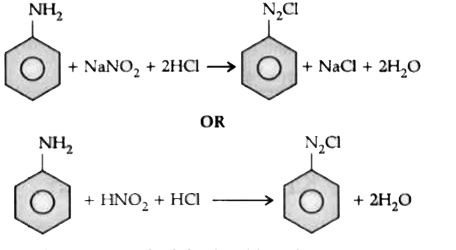
|
|
| 37. |
Name the organic compound formed when chlorobenzene is treated with sodium in dry ether. |
| Answer» SOLUTION :DIPHENYL | |
| 38. |
Name the ore that can be concentrated by magnetic separation method. |
| Answer» Solution :Magnetite `(Fe_(3)O_(4))`, Haematite `(Fe_(2)O_(3))` are the ORES which can be separated by the MAGNETIC separation method. In these ores, one component is magnetic in NATURE. | |
| 40. |
Name the only heterocyclic nitrogen base, which is present in DNA but not is RNA. |
| Answer» Solution :The heterocyclic nitrogen BASE, thymine (T) is not present in RNA. | |
| 42. |
Name the noble gas which is obtained from ._(86)^(226)Ra. Write its main use. Or Name the noble gas used in radiotherapy. |
|
Answer» Solution :DECAY of `._(86)^(226)Ra` GIVES the noble gas radon (Rn) with release of an `alpha`-particle, i.e., `._(2)^(4)He`. `._(86)^(226)Ra RARR ._(86)^(226)Rn + ._(2)^(4)He` It is used in treatment of CANCER and athritis. |
|
| 43. |
Name the noble gas used in Magnetic Resonance Imaging (MRI) Systems. |
| Answer» Solution :He is USED in MAGNETIC Resonance Imaging (MRI) SYSTEMS. | |
| 46. |
Name the noble gas having ns^(2)np^(6) electronic configuration but does not have d-orbitals in its valence shell. |
| Answer» SOLUTION :NEON or NE. | |
| 47. |
Name the nitrogen base present only in DNA not in RNA. |
| Answer» SOLUTION :The NITROGEN base PRESENT in DNA not in RNA is Thymine | |
| 48. |
Name the nitrogenous base present in DNA but not in RNA. |
| Answer» Solution :THYMINE is the nitrogenous BASE PRESENT in DNA but not in RNA. | |