

Saved Bookmarks
This section includes 7 InterviewSolutions, each offering curated multiple-choice questions to sharpen your Current Affairs knowledge and support exam preparation. Choose a topic below to get started.
| 1. |
Name the reagent in the following conversion? CH_(3)-CO-CH_(3) overset(?)to CH_(3)-underset(OH)underset(|)(C)H-CH_(3) |
| Answer» SOLUTION :Lithium aluminium HYDRIDE `(LiAlH_(4))` or SODIUM BOROHYDRIDE `(NaBH_(4))`. | |
| 2. |
Name the reagent for the conversion of an amide to amine containing the same number of carbon atoms. |
|
Answer» |
|
| 3. |
Name the reagent for the conversion of acid chlorides to the corresponding aldehydes. |
| Answer» SOLUTION :`H_2` in PRESENCE of PD over `BaSO_4` | |
| 4. |
Name the reaction when hydrolysis of ester in an alkaline medium takes place. |
| Answer» SOLUTION :First ORDER reaction with MOLECULARITY TWO. | |
| 5. |
Name the reaction used to prepare alcohol by the reaction between alkene and diborane. |
| Answer» SOLUTION :Hydroboration-oxidation | |
| 6. |
Name the reaction of prop- halogenation of prop- carboxylic acid. |
| Answer» Solution :The REACTION of `prop`- halogenation of `prop`- CARBOXYLIC acid is termed as HVZ reaction. | |
| 7. |
Name the reaction that takes place when a mixture of potassium dichromate and potassium chloride (or sodium chloride) crystals is warmed with conc. sulphuric acid. Give the equation for the reaction. |
|
Answer» SOLUTION :CHROMYL CHLORIDE EQUATION: `K_2Cr_2 O_7 + 4KCl + 6H_2SO_4 to 6KHSO_4 + 2CrO_2Cl+2 + 3H_2O`. |
|
| 8. |
Name the reaction in which platinised asbestos is used as catalyst. |
| Answer» SOLUTION :Manufacture of SULPHURIC acid by CONTACT PROCESS. | |
| 9. |
Name the reaction for the preparation of ethers using alkyl halide and sodium ethoxide. |
| Answer» SOLUTION :WILLIAMSON SYNTHESIS | |
| 10. |
Name the reaction C_10H_22overset"900 K"to C_4H_8+C_6H_14 |
|
Answer» Alkylation |
|
| 11. |
Name the reaction and the reagent used for the conversion of acid chloride to the corresponding aldehydes. |
|
Answer» Solution :Name: Resenmund reaction. Reagent: `H_(2)` in presence of Pd (supported over `BaSO_4`) and partially POISONED by addition of sulphur or quinoline. `underset("Acid chloride")(R-overset(O)overset(||)(C)-Cl)+H_(2) underset("+S or quinoline")overset(Pd//BaSO_(4))to underset("Aldehyde")(R-overset(O)overset(||)(C)-H)+HCL` WRITE the structures of A and B in the following: |
|
| 12. |
Name the purest form of commercial iron. |
| Answer» Solution :The purest FORM of commercial iron is WROUGHT (or) MALLEABLE iron. | |
| 15. |
Name the proteins which are folded to form special structure and have intramolecular hydrogen bonding. |
| Answer» SOLUTION :The proteins which are folded to form special structure and have INTRAMOLECULAR HYDROGEN bonding are CALLED GLOBULAR proteins. | |
| 16. |
Name the products when anisole is heated with HI. |
|
Answer» Solution :In ANISOLE `(C_(6)H_(5)-O-CH_(3)),C_(6)H_(5)-O` bond has some double bond character due to resonance and hence more difficult to break. As a result, nucleophilic attack by `I^-` ION occurs on `CH_(3)` group FORMING methyl iodide and phenol. `UNDERSET("Anisole")(C_(6)H_(5)O-CH_(3))+HI overset(373K)to underset("Phenol")(C_(6)H_(5)OH)+underset("Methyl iodide")(CH_(3)I)`. |
|
| 17. |
Name the promoter used in the Haber's process for the manufacture of ammonia. |
| Answer» Solution :MOLYBDENUM ACTS as a promoter for IRON in the Haber.s process for MANUFACTURE of ammonia. | |
| 18. |
Namethe products of hydrolysisof sucrose . Why is sucrose not a reducingsugar ? |
|
Answer» Solution :`C_(12) underset("Sucrose")(H_(22)O_(11)) + H_(2)O overset(H^(+))to underset("Glucose")(C_(6)H_(12)O_(6)) + underset("Fructose ")(C_(6)H_(12)O_(6))` Thetwomonosaccharides,glucose and fructoseare held togetherby a glycosidic linkage BETWEENC -1 of `alpha` - glucoseand C-2 of ` beta`- fructose . As the reducing GROUPS of glucoseand fructoseare INVOLVED in glycosidic areinvolved in glycosidic bond,SUCROSEIS a non - reducingsugar . |
|
| 19. |
Name the products obtained when benzaldehyde is made to undergo Cannizzaro's reaction using a concentrated solution of potassium hydroxide. Give the equation of the reaction. |
Answer» SOLUTION : 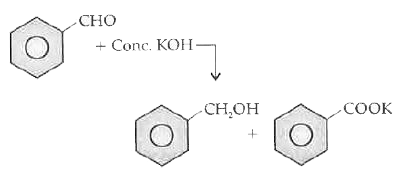
|
|
| 20. |
Name the products obtained in the following reaction |
Answer» SOLUTION :
|
|
| 21. |
Name the products obtained in the following reaction |
Answer» SOLUTION :
|
|
| 22. |
Name the products formed when ethanoic acid is heated with ethanol in the presence of conc. H_(2)SO_(4)? |
| Answer» SOLUTION :ETHYL ethanoate or ETHYLACETATE. | |
| 23. |
Name the product when ethene is treated with Br_(2) " in " C Cl_(4) . |
| Answer» SOLUTION :1, 2- DIBROMOETHANE | |
| 24. |
Name the product obtained when toluene is chlorinated in the presence of light and the intermediate product is hydrolysed with water. |
| Answer» SOLUTION :BENZALDEHYDE | |
| 25. |
Name the product of hydrolysis of sucrose. Why is sucrose not a reducing sugar ? |
| Answer» Solution :On hydrolysis , sucrose gives equimolar MIXTURE of D-(+)-glucose and D-(-)-FRUCTOSE. Sucrose is not a REDUCING SUGAR as glucose and fructose are LINKED through their reducing centres in structure of sucrose. | |
| 26. |
Name the product obtained when sucrose is hydrolysed accompanied by change in sign of rotation. |
| Answer» SOLUTION : INVERT SUGAR | |
| 27. |
Name the product of the aqueous solution of formal - dehyde. |
| Answer» SOLUTION :The PRODUCT of the AQUEOUS solution of FORMAL dehyde is FORMALIN. | |
| 28. |
Name the product obtained when acetaldehyde reacts with hydroxyl amine. |
| Answer» SOLUTION :ACETALDOXIME | |
| 29. |
Name the product obtained by the followingreaction ? CH_(3)-CH_(2)-CH_(2)-CH=CH_(2) underset(H_(2)O_(2)//OH^(+))overset((BH_(3))_(2))to ? |
|
Answer» Pentan-3-ol |
|
| 30. |
Name the product obtained initially when phenol and formaldehyde are condensed. |
| Answer» SOLUTION :NOVOLAC | |
| 31. |
Name the product obtained by reductive ozonolysis of ethene. |
| Answer» SOLUTION :FORMALDEHYDE | |
| 32. |
Write down the products of the following reactions : Toluene is treated with alkaline KMnO_4 . |
|
Answer» |
|
| 33. |
Name the product formed when tertiary butyl alcohol is treated with Cu at 573 K? |
|
Answer» 2-methyl PROP-1-ene |
|
| 34. |
Name the product formed when phenol is treated wilh acidified solution of Na_2Cr_2O_7 Give equation. |
Answer» Solution :PHENOL undergoes OXIDATION with CHROMIC acid and produces a conjugated diketone KNOWN as benzoquinone. 
|
|
| 35. |
Name the product formed when phenol is heated with ammonia in the presence of anhydrous ZnCl_2 . |
| Answer» Solution :Anisole | |
| 36. |
Name the product formed when ethan-1, 2-diol is treated with anhydrous ZnCl_2. |
| Answer» Solution :Ethanal | |
| 37. |
Name the product formed when chlorobenzene is heated with aqueous ammonia in presence of cuprous oxide. |
Answer» SOLUTION :
|
|
| 39. |
Name the product formed when aniline reacts with carbonyl chloride in the presence of pyridine. |
|
Answer» Phenylcyanate 
|
|
| 40. |
Name the product formed when Benzaldehyde reacts with N,N- dimethyl aniline in the presence of conc.H_2SO_4? |
|
Answer» Cinnamic acid |
|
| 41. |
Name the product formed when acetone is warmed with sodium hypoiodite solution |
| Answer» SOLUTION :IODOFORM and SODIUM ACETATE | |
| 42. |
Nametheprocessesfromwhichchlorineisobtained asabye-product. Whatwill happenif an aqueoussolution ofNaCl issubjectedto electrolysis ? |
|
Answer» SOLUTION :SodiummetalispreparedbyDown'sprocess.Itinvolves theelectrolysisofafusedmixtureofNaCland` CaCl_ 2`at 873 K.Duringelectrolysis, sodiumisdischarged at thecathodewhile` Cl _ 2 `isobtained at theanodeasabye-product. ` "" NaCl(l)overset ("Electrolysis")to Na^(+) ("MELT ") + Cl^( - )("melt" )` Atcathode :`Na^(+) ("melt" )+e ^(- )TONA (s) ` At anode:` "" Cl^( -)("melt") toCl(g) +e ^( - ) , 2Cl (g) toCl_ 2 (g)` If, however, an AQUEOUS solutionofNaCl iselectrolysed, `H_2 `isevolved atthe cathodewhile` Cl_ 2 `isobtainedattheanode.Thereasonbeingthatthe`E^(@) `of`Na^(+)//Na` redox coupleis much LOWER ` (E^(@) =- 2*71V) `thanthatof` H_2O(E^(@)""_(H_2 O // H_2) =- 0*83 V) `andhencewaterisreducedto` H_ 2 `in preferenceto`Na^(+) `ions. NaOH is, however,obtainedin thesolution. `"" NaCl (aq) overset ("Electrolysis") toNa^(+) (aq) +Cl^(- ) (aq)` At anode :`Cl^( - ) (aq) toCl (g) +e ^(-),2 Cl (g) toCl_ 2 (g)` At cathode :`2 H_2O(l) +2 e^( - ) toH_ 2 (g) +2 OH^(- ) (aq) ` |
|
| 43. |
Name the processes from which chlorine is obtained as a by-product. What will happen if an aqueous solution of NaCl is subjected to electrolysis? |
|
Answer» Solution :Sodium METAL is prepared by Down.s process. It involves the electrolysis of a fused mixture of NaCl and `CaCl_(2)` at 873 K. During electrolysis sodium is discharged at the cathode while `Cl_(2)` is obatained at the anode as a by-product. `NaCl(l) overset(" Electrolysis ")(to) Na^(+) (" melt ")+Cl^(-) (" melt ")` At cathode : `Na^(+) (" melt ")+e^(-) to Na(s)` At anode : `Cl^(-) (" melt ")to Cl(G) +e^(-)` `2Cl(g) to Cl_(2)(g)`. If, however, an aqueous solution of NaCl is electrolysed, `H_(2)` is evolved at the cathode while `Cl_(2)` is obtained at the anode. The reason being that the `E^(0)" of "Na^(+)"/"Na` redox couple is much lower `(E^(0)= -2.71 V)` than that of `H_(2)O (E_(H_(2)O"/"H_(2))^(0)= -0.83V)` and HENCE water is reduced of `H_(2)` in preference to `Na^(+)` IONS. Lower the reduction potential `(E^(0))`, greater is the EASE of deposition at cathode. NaOH is obtained in the solution. `NaCl(aq) overset(" Electrolysis ")(to) Na^(+) (aq)+ Cl^(-)(aq)` At anode : `Cl^(-)(aq) to Cl (g) +e^(-)` `Cl(g) to Cl_(2)(g)` At cathode : `2H_(2)O(l)+2e^(-) to H_(2)(g)+2OH^(-)(aq)`. |
|
| 44. |
Name the processes from which chlorine is obtained as a by-product. What will happen if an aqueous solution of NaCl is subjected to electrolysis ? |
|
Answer» Solution :Down.s PROCESS is used for PREPARATION of sodium metal where dichlorine is OBTAINED as a by-product. In this process, molten NaCl containing `CaCl_2` (flux) is electrolysed. `CaCl_2` lowers the melting point of NaCl. `NaCl_((l))overset(873 K)(rarr) Na_((l))^(+) + Cl_((l))^(+)` Cathode : `2Na_((l))^(+) + 2E^(-) to 2Na_((l))` Anode : `2Cl_((l))^(-) to Cl_(2(g)) + 2e^(-)` (ii) When aqueous NaCl is electrolysed `H_2` is evolved at cathode an `Cl_2` at anode. The `H_2` is evolved because `E_(H_2O//H_2)^(Theta)`is less negative than `E_(Na^(+)//Na)^(Theta)`Thus, preferentially, water will be reduced to H, at cathode. Anode : `2Cl_((aq))^(-) to Cl_(2(g)) + 2e^(-)` Cathode : `2H_2 O_((l)) + 2e^(-) to H_(2(g)) + 2OH_((aq))^(-)`. |
|
| 45. |
Name the product formed Acetaldehyde reacts with Zinc amalgam and conc.HCI? |
| Answer» SOLUTION :Ethane | |
| 46. |
Name the process which is used to improve upon the physical properties of rubber. |
| Answer» SOLUTION :VULCANISATION | |
| 47. |
Name the process usually employed for the purifacation of -Nickel. |
| Answer» SOLUTION :Mond.s PROCESS | |
| 48. |
Name the process used for the benefaction of ores if the ore is soluble in some suitable solvent. |
| Answer» SOLUTION :LEACHING. | |
| 49. |
Name the process to prepare polythene from ethene. |
|
Answer» ADDITION |
|
| 50. |
Name the process that is employed to refine aluminium? |
|
Answer» Hall's process |
|