

Saved Bookmarks
This section includes 7 InterviewSolutions, each offering curated multiple-choice questions to sharpen your Current Affairs knowledge and support exam preparation. Choose a topic below to get started.
| 1. |
Match the thermodynamic processes given under Column I with the expressions given under Column II{:(,"Column I",,"Column II"),((A),"Freezing of water at 273 K and 1 atm",(p),q=0),((B),"Expansion of 1 mole of an ideal gas into a vacuum under isolated conditions",(q),w=0),((C),"Mixing of equal volumes of two ideal gases at constant temperature and pressure in an isolated container",(r),DeltaS_("sys")lt0),((D),"Reversible heating of "H_(2)(g) " at 1 atm from 300 K to 600 K, followed by reversible cooling to 300 K at 1 atm",(s),DeltaU=0),(,,(t),DeltaG=0):} |
|
Answer» `DeltaH=-ve=q` `DeltaS_(sys)lt0, DeltaG=0` `wne0` (as water expands on freezing), `DeltaUne0` (B) FREE expansion of ideal gas q=0 w=0 `DeltaU=0` `DeltaS_(sys)gt0` `DeltaGlt0` (C ) Mixing of equal volume of ideal gases at constant pressure & temp in an ISOLATED container `q=0, w=0, DeltaU=0, DeltaS_(sys)gt0, DeltaGlt0` (D)`H_(2)(g)300 K underset("HEATING, 1 atm")overset("Reversible")rarr600 K underset("Cooling, 1 atm")overset("Reversible")rarr300 K` `q=0, w=0, DeltaU=0, DeltaG=0, DeltaS_(sys)=0` |
|
| 2. |
Match the thermodynamic properties (List-I) with their relation (List-II): Select the correct answer. |
|
Answer» `{:(A,B,C,D),("i","ii","III","IV"):}` |
|
| 3. |
Match the terms of List-I with those of List -II |
|
Answer» <P>`{:(P,Q,R,S),(4,3,1,2):}` |
|
| 4. |
Match the terms given in Column I with the units given in Column II. |
|
Answer» |
|
| 5. |
Match the terms given in Column-I with the items given in Column-II. |
| Answer» SOLUTION :`(A to 4),(Bto1),(Cto2),(Dto3)` | |
| 6. |
Match the terms given in Column I with the items given in Column II. |
|
Answer» |
|
| 7. |
Match the terms given in Column-I with items given in Column-II. |
| Answer» SOLUTION :`(Ato3),(Bto4),(Cto1),(Dto2)` | |
| 8. |
Match the terms given in Column I with expressions given in Column II. {:("Column I","Column II"),("(i) Mass percentage","(a) "("Number of moles of the solute component")/("Volume of solution in litres")),("(ii) Volume percentage","(b) "("Number of moles of a component")/("Total number of moles of all the components")),("(iii) Mole fraction","(c) "("Volume of the solute component in solution")/("Total volume of solution")xx100),("(iv) Molality ","(d) "("Mass of the solute component in solution")/("Total mass of the solution")xx100),("(v) Molarity","(e) "("Number of moles of the solute coponents")/("Mass of solvent in kilograms")):} |
|
Answer» |
|
| 9. |
Match the terms given in Column - I with express ions given in Column - II.{:(,"Column - I",,"Column - II"),((A),"Mass percentage",(1),("Number of moles the solute component")/("Volume of solution in litre")),((B),"Volume percentage",(2),("Number of moles a component")/("Total number all components")),((C ),"Mole fraction",(3),("Volume of the solute in solution")/("Total volume of solution")xx100),((D),"Molality",(4),("Mass of solute")/("Mass of solution")xx100),((E ),"Molarity",(5),("Number of moles of the solute")/("Mass of solvent in kilograms")):} |
| Answer» Solution :(A - 4), (B - 3), (C - 2), (D - 5), (E - 1) | |
| 10. |
Match the structureso of the compounds given in Column I with the name of compounds given in Column II. |
|
Answer» |
|
| 11. |
Match the terms given in Column (I) with expressions gives in Column (II) |
|
Answer» |
|
| 12. |
Match the structures of compounds given in Column - I with the classes of compounds given in Column - II. |
| Answer» Solution :(i - b), (II - d), (III - a), (iv - C) | |
| 13. |
Match the structures of compounds given in column I with the classes of compounds given in column II. . |
|
Answer» |
|
| 14. |
Match the structures given in Column - I with the names in Column - II. |
| Answer» SOLUTION :(I - a), (ii - B), (iii - C), (iv - d) | |
| 16. |
Match the stoichiometric coefficients listed in Column II with the species listed in Column I that are involved in the balanced equation of the reaction : {:(,"LIST -I",,"LIST -II"),((P),FeC_(2)O_(4),(1),10),((Q),MnO_(4)^(-),(2),24),((R),H^(+),(3),5),((S),CO_(2),(4),3):} |
|
Answer» <P>`{:(P,Q,R,S),(1,2,4,3):}` |
|
| 17. |
Match the statements of ColumnI with values of Column II |
|
Answer» |
|
| 18. |
Match the statements given in ColumnI with the oxidation states given in Column II. {:(,"Column I ",,"Column II"),((i),"Oxidation state of Mn in "MnO_(2) "is",(a),+2),((ii),"Most stable oxidationstate of Mn is ",(b),+3),((iii), "Most stable oxidation state of Mn in oxides is",(c ), +4),((iv),"Characteristic oxidation state of lanthanoids is",(d),+5),(,,(e ),+7):} |
|
Answer» |
|
| 19. |
Match the statements given in Colunm I with the oxidation states given in Column II. |
|
Answer» |
|
| 20. |
Match the statements (A,B,C,D) in column I with the statements (p,q,r,s) is column II. The answers to the question have to be properly bubbled. |
|
Answer» |
|
| 21. |
Match the statements given in Column I and Column II {:(,,"Column I",,,,,,"Column II"),((i),,"Catalyst alters the rate of reaction",,,,(a),,"cannot be fraction or zero"),((ii),,"Molecularity",,,,(b),,"proper orientation is not there always"),((iii),,"Second half life of first order reaction",,,,(c),,"by lowering the activation energy"),((iv),,e^(-E_(a)//"RT"),,,,(d),,"is same as the first"),((v),,"Energetically favourable reactions are",,,,(e),,"total probability is one"),(,,"sometimes slow",,,,,,),((vi),,"Area under the Maxwell Boltzmann curve",,,,(f),,"refers to the fraction of molecules with energy"),(,,"is constant",,,,,,"equal to or greater than activation energy"):} |
|
Answer» |
|
| 23. |
Match the statements (A,B,C,D) in column I with statements (p,q,r,s) in column II. The answers to the questions have to property bubbed. |
| Answer» | |
| 24. |
Match the statement given in Column I. with the phenomenon given in column II. |
|
Answer» |
|
| 25. |
Match the statement ( A,B, C,D)in column I with statements (p,q,r,s) in comumn II, The answers to the questions have to be properly bubbled. {:("Column I",,"Column II"),((A)"Lyophilic colloid ",(p),"Gold sol"),((B)"Lyophobic colloid",(q),As_(2)S_(3)"sol"),((C)"Natural colloid",(r),"Gelatin"),((D)"Artificial colloid",(s),"Latex"):} |
| Answer» | |
| 26. |
Match the starting material given in Column I with the products formed by these (Column II) in the reaction with HI. |
|
Answer» |
|
| 27. |
Match the species listed in column-I with the characteristics/propertie listed in column-II. {:("Column-I","Column-II"),((A)C_2,(p)"Diamagnetic"),((B)N_2,(q)"Undergoes oxidation"),((C )O_2^(2-),(r)"Undergoes reduction"),((D )F_2,(s)"Bond order"ge2),(,(t)"No mixing of 's' and 'p' orbitals"):} |
|
Answer» (B)`N_2` bond order `=(10-4)/2=3` , All electrons are paired so diamagnetic.Undergoes oxidation as well as reduction.Mixing of 2s and 2p orbitals takes place. (C )`O_2^(2-)` bond order `=(10-8)/2=1` , All electrons are paired so diamagnetic.Undergoes oxidation as well as reduction.Mixing of 2s and 2p orbitals does not takes place. (D)`F_2` bond order `=(10-8)/2=1` , All electrons are paired so diamagnetic.Undergoes reduction only.Mixing of 2s and 2p orbitals does not takes place. |
|
| 28. |
Match the species given in Column I with the shape given in Column II and mark the correct option. {:("Column I","Column II"),((A)SF_(4),(1)"Tetrahedral"),((B)BrF_(3),(2)"Pyramidal"),((C)BrO_(3)^(-),(3)"See-saw shaped"),((D)NH_(4)^(+),(4)"Bent T-shaped"):} |
|
Answer» `{:(A(3),B(2),C(1),D(4)):}` |
|
| 29. |
Match the species given in Column-I with the shape given in Column-II and mark the correct option. |
|
Answer» A-(3), B-(2), C-(1), D-(4) |
|
| 30. |
Match the species given in Column I with the shape given in Column II and mark the correct option. |
|
Answer» |
|
| 31. |
Match the solutions given in Column I and the colours given in Column II. |
|
Answer» |
|
| 32. |
Match the significant products of electrolysis of species in column I with those in column II. {:("Column-I","Column-II"),((A)Aq.CuSO_4("dilute"),"Using Pt electrodes",(p)O_2 "gas is evolved at anode"),((B)Aq.CuSO_4("dilute"),"Using Cu electrodes",(q)"Gas other than"O_2 "is (also) evolved at anode"),(( C)Aq.MgCl_2,"Using Pt electrodes",(r)"pH of solution changes due to electrolysis"),((D)"Molten" MgCl_2,"Using C electrodes",(s)"Metal is deposited at the cathode"),(,(t)Cl_2 "gas is evolved at anode") :} |
|
Answer» (B)`CU(a)+Cu^(2+)toCu^(2+)+Cu(c )` (C )`MgCl_2+2H_2OtoMg(OH)_2+H_2+Cl_2` PARTLY `O_2` will always be LIBERATED due to oxidation of water. (D)`MgCl_2 to Mg+Cl_2` |
|
| 33. |
Match the salts listed in column I with the colour of the precipitate and reagent listed in column II. {:("Column I","Column II"),((A)FeSO_4,(p)"Green precipitate with NaOH"),((B)Bi(NO_3)_3,(q)"White precipitate with" Pb(NO_3)_2),(( C)Ni(NO_3)_2,(r)"Yellow precipitate with"NH_4NO_2 and CH_3COOH "on warming"),((D)CoCl_2,(s)"Black precipitate with"H_2S),(,(t)"White precipitate with excess of water"):} |
|
Answer» (B)Black precipitate of `Bi_2S_3` , White precipitate of `BiO^(+)NO_3^(-)` (C )Green precipitate of `Ni(OH)_2` , Black precipitate of NiS (D)YELLOW precipitate of `(NH_4)_3[Co(NO_2)_6]` , Black precipitate of CoS |
|
| 34. |
Match the salls in List-I with their use in List-II. |
|
Answer» <P>P- 2, Q-2,3 R-2,4 S-1,3 |
|
| 35. |
Match the refining methods (Column I) with metals (Column II) |
|
Answer» (I) - (Q), (II) - (r ), (III) - (s), (IV) - (p) |
|
| 36. |
Match the reagent which are used in qualitative analysis of given anions : |
|
Answer» |
|
| 38. |
Match the reactions products of the reactions listed in column-I with the colour of the precipitate (product/characteristics listed in column II. {:(Column-I,Column-II),((A),(p)"One of the products is a red precipitate"),((B),(q)"One of the product is diamagnetic"),((C )Co(SCN)_2+Hg^(2+)to,(r)"One of the products is a deep blue precipitate."),((D)CrO_4^(2-)+Hg_2^(2+)to,(s)"One of the products has intramolecular H-bonding"):} |
Answer» 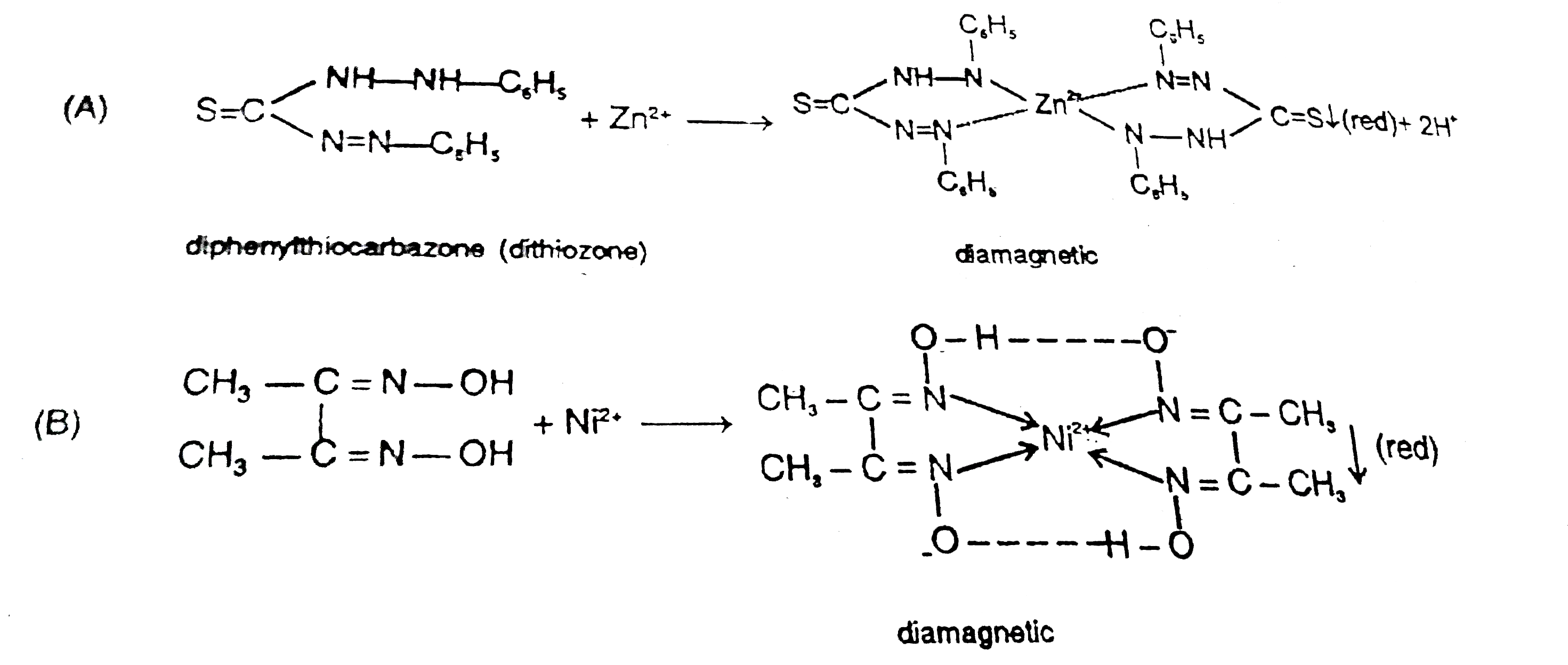 (C )`Co(SCN)_2+Hg^(2+)toCo[Hg(SCN)_4]darr` DEEP blue crystalline precipitate, DIAMAGNETIC (D)`CrO_4^(2-)+Hg_2^(2-)toHg_2[CrO_4]darr` (red), diamagnetic |
|
| 39. |
Match the reactions mentioned in column-I with the nature of the reaction/characteristics of the products mentioned in column-II. {:("Column I","Column II"),((A)(NH_4)_2S_2O_8+H_2Ooverset("distillation")to,(p)"Hydrolysis"),((B)NaBO_2+H_2O+H_2O_2overset(OH^(-))to,(q)"One of the products has peroxide linkage" ),(( C)Na_2SO_3underset("temperature")overset("fusior")to,(r)"Disproportionation"),((D)"2-Ethyl anthraquinol+air"to,(s)"In one of the products the central atom has" sp^3 "hybridisation"),(,(t)"One of the products is used as brighter in washing powder".):} |
|
Answer» (B)`2NaBO_2+H_2O_2+6H_2Ooverset("Alkaline hydrolysis")TONA[(OH)_2B_2(O-O)_2(OH)_2]6H_2O` Peroxoborate is USED as brighter in WASHING power. (C )`4Na_2SO_3 OVERSET("disproportionation")toNa_2S+Na_2SO_4` (D)2-Ethylanthraqunol + air `(O_2)to`2-ethylanthraquinone +`H_2O_2` |
|
| 40. |
Match the reactions of Column-I with the factors in Column-II : {:("Column -I","Column-II"),(N_2(g)+3H_2hArr2NH_3(g)"Exothermic","Forward shift by rise of pressure"),(2SO_2(g)+O_2(g)hArr2SO_3(g)"Exothermic","Unaffecte by change in pressure"),(N_2(g)+O_2(g)hArr2NO(g)"Endothermic","Forward shift by rise in temperature"),(PCI_5(g)+CI_2(g)hArrPCI_5(g)"Endothermic","Forward shift by lowering the temperature"),("",Deltan lt 0):} |
|
Answer» |
|
| 41. |
Match the reactions listed in column (I) with the colour of the precipitate(s) listed in column (II). {:("Column I","Column II"),((A)Cu^(2+)(aq)overset("allow to stand for sometime")to,(p)"Brown"),((B)"Hot" Bi^(3+)(aq)+C_6H_3(OH_3)to,"(q)Brownish-red"),(( C)Ag^+(aq)+AsO_4^(3-)(aq.)to,"(s)Yellow"),((D)Mn^(2+)(aq.)+2OH^(-)(aq.)overset("air")to,"(s)White"),(,"(t)Green"):} |
|
Answer» `2Cu(SCN)_2darrto2CuSCNdarr("WHITE")+(SCN)_2uarr` (B)`"Hot"Bi^(3+)(aq)+C_6H_3(OH)_3overset(H^+)toBi(C_6H_3O_3)darr("YELLOW")+3H^(+)` (C )`2AG^(+)(aq)+AsO_4^(3-)(aq)toAg_3AsO_4darr`(brownish-red) (D)`Mn^(2+)(aq.)+2OH^(-)(aq)toMn(OH)_2darr`(white) `Mn(OH)_2darr+O_2to2MnO(OH)_2darr`(brown) |
|
| 42. |
Match the reactions in Column with nature of the reactions type of the products in Column Il Indicate your answer by dating the appropriate bubbles of the 4xx4matrix given in the ORS |
| Answer» SOLUTION :`ATOP`,`Btor`:`Ctop`,`DTOS` | |
| 43. |
Match the reactions in Column I with type of the products/applications in Column II. {:("Column I","Column II"),((A),(p)"Turnbull's blue pigment"),((B)BaCl_2(s)+K_2Cr_2O_7(s)+H_2SO_4("conc.")to,(q)"Schwitzer's reagent"),(( C)FeSO_4(aq)+K_3[Fe(CN)_6](aq)to,(r)"Reimann's green pigment"),((D)Cu(OH)_2(s)+NH_4OH(aq)+(NH_2)_2SO_4(s)to,(s)"Chromyl chloride test"),((E)ZnO(s)+Co(NO_3)_2(s)oversetDeltato,"(t)Photography"):} |
Answer»  Hydroquinone acts as developer (B)`BaCl_2+K_2Cr_2O_7+3H_2SO_7+3H_2SO_4 to K_2SO_4 + 2CrO_2Cl_2 + 2BaSO_4 + 3H_2O` (chromyl chloride TEST) (C )`FeSO_4 + K_3[Fe(CN)_6]to K Fe^(II)[Fe^(III)(CN)_6]`(Turns bull's blue ) +`K_2SO_4` (D)`Cu(OH)_2+2NH_4OH+(NH_4)_2SO_4 to [Cu(NH_3)_4]SO_4` (Schwitezer's reagent) +`4H_2O` (E)`Co(NO_3)_2 +ZnO oversetDeltato CoZnO_3 or Co O. ZnO`(Rinmann's green PIGMENT) |
|
| 44. |
Match the reactions in Column I with nature of the reactions / type of the products in Column II |
|
Answer» `{:(,"Column I",,"Column II"),((A), O_(2)^(-) rarr O_(2) +O_(2)^(2-) ,(P), "Redox reaction"):}` |
|
| 45. |
Match the reactions in Column I with nature of the reactions // type of the products in Column II. |
|
Answer» `O_(2)^(-)rarrO_(2)+O_(2)^(2)""(p)` redox REACTION |
|
| 46. |
Match the reactions in Column I with nature of the reactions/type of the products in Column II |
|
Answer» `{:(A,B,C,D),(2,1","4,3,4):}` |
|
| 47. |
Match the reactions in column I with nature of the reaction/type of the products in column II. |
Answer» SOLUTION : 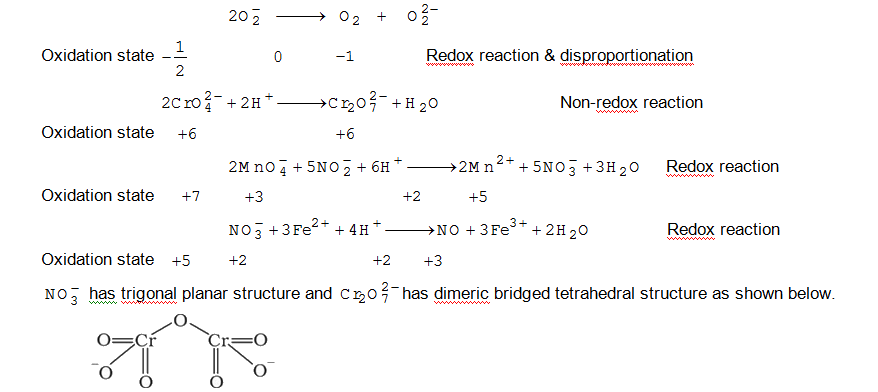
|
|
| 48. |
Match the reactions in Column I with approprate option in Column II. |
|
Answer» |
|
| 49. |
Match the reactions given in Column - I with the types of reactions given in Column - II. |
| Answer» Solution :(i - b), (II - d), (iii - e), (IV - a), (V -c) | |