

Saved Bookmarks
This section includes 7 InterviewSolutions, each offering curated multiple-choice questions to sharpen your Current Affairs knowledge and support exam preparation. Choose a topic below to get started.
| 1. |
Match the following. {:("List - I","List - II"),(A.N_(2)O(g)hArr N_(2)(g)+1//2O_(2)(g),"1. Order = 1"),(B.SO_(2)Cl_(2)(g)rarrSO_(2)(g)+Cl_(2)(g),"2. Order = 4"),(C.CH_(3)CHO(g)rarrCH_(4)(g)+CO(g),"3. Order = 0"),(D.5Br_((aq))^(-)+BrO_(3(aq))^(-)+6H^(+)rarr 3B_(2(l))+3H_(2)O_((l)),"4. Order = 3/2"):} |
|
Answer» `{:(A,B,C,D),(3,1,4,2):}` |
|
| 2. |
Match the following. {:("List - I","List - II"),("A . Schottky defect",1.AgBr),("B. Frenkel defect",2.FeO),("C. Metal excess defect ",3.NaCl),("D. Metal deficiency defect" ,"4. ZnO"):} |
|
Answer» `{:("CODE",A,B,C,D),((a),2,4,3,1):}` |
|
| 3. |
Match the following {:("List - I","List - II"),((A) CH_3COCH_3overset(Zn- Hg)underset(conc HCl)rarr,(1)CH_3CH_2OH),((B)CH_3CHOoverset(H_2.Ni)rarr,(2) CH_3CHO),((C)CH_3-CH=CH_2overset(H_2.Ni)rarr,(3) CH_3COCH_3),(,(4)CH_3CH_2CH_3),(,(5) CH_3CH_3):} The correct match is |
|
Answer» `{:(A,B,C),(5,1,3):}` |
|
| 4. |
Match the following :{:("List - I","List - II"),((A) CH_(3)-CH(OH)-CHO,"(p) Carbohydrate"),((B) HOCH_(2)-CH(OH).CHO,"(q) Amino acid"),((C ) CH_(3)-CH(NH_(2)).COOH,"(r ) Positive Tollen's test"),((D) Ph.CH(CH_(2)NH_(2)).COOH,"(s) Ninhydrint test"):} |
|
Answer» (B)`H-overset(CH_(2)OH)overset("|")underset("CHO ")underset("|")("C")-OH rarr` It is a Carbohydrate, It gives positive Tollen.s test (C )`overset(CH_(3)" ")overset("|")underset("COOH")underset("|")("C")H-NH_(2) rarr`It is an Amino acid, It gives Ninhydrint test. (D) 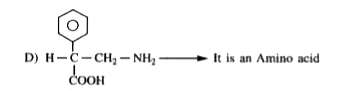
|
|
| 5. |
Match the following {:("List -I (Polymer)",, "List -II(type of monomers"),((1) "Terylene",,(a)"aldehyde aromatic alcohol"), ( (2) " Nylon " - 66 ,, (b)"Diaminealiphatic dioic acid "),( (3) "Bakellite",, (c)"Diol , aromatic dioic acid "),((4)"Buna -N" ,, (d) "Unsaturated ester "),(,, (e)"Diene and unsaturated cyanide"):} |
|
Answer» `{:(1,2,3,4),(C,B,a,E):}` |
|
| 6. |
Match the following {:("List-I (ore)","List-II(Metal)"),((1)"Malachite",(a)Cu),((2)"Siderite",(b)Zn),((3)"Sphalerite",(c)Fe),((4)"Kaolinite",(d)Al):} |
|
Answer» `{:(1,2,3,4),(B,C,a,d):}` |
|
| 7. |
Match the following {:("List-I (mineral)","List-II)(type of mineral)"),((1)"Zircon",(a)"Sulphate"),((2)"Monazite",(b)"Silicate"),((3)"Pentlandite",(c)"Sulphide"),((4)"Anglesite",(d)"Phosphate"):} Corect match is |
|
Answer» `{:(1,2,3,4),(B,d,C,a):}` |
|
| 8. |
{:("List - I","List - II"),("A) Phenol "+CH_(2)O,"1) Synthetic rubber"),("B) Terephthalic acid and ethylene glycol","2) Bakelite"),("C) Caprolactum","3) Nylon - 6"),("D) Butadiene and styrene","4) Terylene"):} |
|
Answer» `{:(A,B,C,D),(2,3,4,1):}` |
|
| 9. |
{:("List - I","List - II"),("A) PHBV","1) Synthetic fibres"),("B) Teflon","2) Orthopaedic devices"),("C) Nylon - 66","3) For making laminates"),("D) Bakelite","4) non - sticking utensils"),(,"5) Automobie tyres"):} |
|
Answer» `{:(A,B,C,D),(2,4,1,3):}` |
|
| 10. |
Match the following : List-IList-II (P) N_(2) (g) + 3H_(2) ( g) rarr 2NH_(3)(g)(1)Increase in volume favours forward reaction ( Q )2NO(g) rarr N_(2)(g) + O_(2)(g)( 2) Increase in pressure accelerate the forward reaction ( R ) CaCO_(3) (s) rarr CaO(s) + CO_(2)(g)(3) K_(p)= P _("total") ( S) PCl_(5)(g) rarr PCl_(3)_(g) + Cl_(2)(g)(4) At constant volume introduction of inert gas, has no effect. Codes: |
|
Answer» `{:(P,Q,R,S),(2,4,3,1):}` |
|
| 11. |
{:("List - I (polymer)","List - II (use)"),("1) Urea formalde hyde resin","a) Unbreakable cups"),("2) Nylon - 6","b) TV cabinets"),("3) Polystyrene","c) Oils seals"),("4) GRN","d) Tyre cords"):} |
|
Answer» `{:(1,2,3,4),(a,d,B,C):}` |
|
| 12. |
Match the following :- List-IList -II (P) Plot of lot t_(1//2) vs log[A_(0)] is a straight line with a slope of '-1'(1) Zero order ( Q ) Plotof log t_(1//2) vs log [ A_(0) ] is a straight line with a slope of '1'(2) 2^(nd) order ( R ) Plot of log K_(p) vs 1//Tis a straight line with a negative slope(3) Delta H^(@) is negative ( S ) Plot of log K_(p)vs 1//Tis a straight line with a positive slope(4) Delta H^(@)is positive |
|
Answer» <P>`{:(P,Q,R,S),(1,2,3,4):}` |
|
| 13. |
Match the following{:("List-I ","List-II "),("A) Zone refining ","I) Indium "),("B) Poling ","II) Titanium "),("C) Van-Arkel method ","III) Nickel "),("D) Mond process ","IV) Blister copper "),(,"V) Zinc "):} Thecorrect answer is |
|
Answer» `{:(A,B,C,D),(I,III,II,IV):}` |
|
| 14. |
Match the following {:("List -I",, "List -II" ),( (A) "Epimers " ,, (i) "Glucose "),((B)"Anomers ",, (2) "Fructose" ), ((C) "Aldohexose",, (3) "Glucose and mannose" ),((D) "Laevulose" ,,(4)alpha -and beta " forms of glucose") , (-,, (5) "Glucose and fructose"):} The correct match is |
|
Answer» `{:(A,B,C,D) ,(3,4,1,2):}` |
|
| 15. |
Match the following {:(List -I,, List -II) , ( (A) "Conversion of amide to amine ",, (1) "Hinsberg reagent"), ((B) C_6H_5SO_2Cl ,, (2) "Hoffmann's bromamide reaction" ),((C)"Conversio of primary amine to isocyanide ",, (3) "Hoffmann's method"),( (D)" Diethyl oxalate",, "Carbylamine reaction "),( -,,(4)"Hoffmann mustard oil reaction"):} |
|
Answer» `{:(A,B,C,D) ,(2,1,4,3):}` |
|
| 16. |
Match the following List-I (Concentration method) 1) Hydraulic washing 2) Magnetic separation 3) Froth flotation 4)Leaching List-II (Principle) a) Difference in solubility of gangue and ore particles in a specfic substance b) Difference in wetting property of ore andgangue particles c) Difference in gravities of ore and gangue particlesd) Difference in magnetic property of gangue and ore particles The correct match is |
|
Answer» `{:(1,2,3,4),(B,d,C,a):}` |
|
| 17. |
Match the following : {:((i),"Riboflavin",(a),"Beriberi"),((ii),"Thiamine" ,(b),"Scurvy"),((iii),"Pyridoxine",(c),"Glossitis"),((iv),"Ascorbic acid ",(d),"Dermatitis "):} |
|
Answer» `(i)-(a),(II)-(d),(iii)-(c),(iv)-(b)` |
|
| 18. |
Match the following{:((i),"Paints",(P),"Solid sol"),((ii),"Cloud",(Q),"Foam"),((iii),"Hair cream",(R ),"Sol"),((iv),"Whipped cream",(S),"Emulsion"),(,,(T),"Aerosol"):} |
|
Answer» <P>`(i)to(P), (II)to(R ),(iii)to(S),(iv)to(Q)` |
|
| 19. |
Match the following : Indicate the color produced in the following reactions. Shade the color code . |
|
Answer» |
|
| 20. |
Match the following in column I with their main uses in column II and choose the correct answer: |
|
Answer» A-q, B-p, C-r, D-s |
|
| 21. |
Match the following if the molecular weights of X, Y and Z are the same : {:("Solvent","Boiling point","K"_(b)),(X,100^(@)C,0.68),(Y,27^(@)C,0.53),(Z,253^(@)C,0.98):} |
|
Answer» Solution :Higher BOILING POINT of a liquid means greater polarity and greater the polarity, higher is the VALUE for `K_(b)`. Hence, the CORRECTLY mathced values will be `{:("Solvent","Boiling point","K"_(b)),(X,100^(@)C,0.68),(Y,27^(@)C,0.53),(Z,253^(@)C,0.98):}` |
|
| 22. |
Match the following : If k_a of HCN=5xx10^(-10), k_a of HOCN =3.2xx10^(-4), k_b of NH_3=1.8xx10^(-5), k_a of CH_3COOH=1.8xx10^(-5) (All data at 25^@ C) {:("Column-I","Column-II"),((A)10^(-2) M NaCN, (p)pH gt 7),((B)"100 ml of" 10^(-1) M NaCl + "100 ml of"10^(-1) M "HCl+300 ml of" 10^(-1)M NaOH ,(q)pH ne7),((C )10^(-1) "M HCl +" 10^(-1) "M HCN",(r)pH lt 7),((D)10^(-1) M NH_4OCN,(s)pH=7),(,(t)"pOH lt 7"):} |
|
Answer» (B)`(N_1V_1)_(NaOH) GT (N_2V_2)_(HCL)` ( C)strong acid + weak acid, so `pH lt 7` (D) Hydrolysis of cation leads to the formation of `H^+` due to which `pH lt 7` |
|
| 23. |
Match the following if moleculat weight of X, Y and Z are same {:(,"B.Pt.",K_(b)),("X",100,0.68),("Y",27,0.53),("Z",253,0.98):} |
|
Answer» Solution :`K_(b)=(RT_(b)^(2))/(1000l_(V))=(RT_(b)^(2)M)/(1000DeltaH_(v))=(RT_(b)M)/(1000DeltaS_(v))(becauseDeltaS_(v)=(DeltaH_(v))/(T_(b)))` Where `DeltaS_(v)` is entropyo f vaporisation at the boiling point `T_(b)`. Entropy of vaporisation, `DeltaS_(v)=S_(v)-S_(L)` is almost constant. This is because though entropy of liquid `(S_(l))` VARIES from liquid to liquid but entropy of vapour `(S_(v))` is ABNORMALLY higher. As M and R are also constant, hence `K_(b) prop T_(b)`. Thus, the values reported in the table are in the correct order. |
|
| 24. |
Match the following : {:((i) XeF_4, (a) sp^3),((ii) XeOF_2, (b) sp^2d^2),((iii) XeO_3, (c ) sp^3d^3), ((iv) XeF_6, (d) sp^3 d):} |
|
Answer» |
|
| 25. |
Match the following if molecular masses of X, Y, Z are same |
|
Answer» SOLUTION :`K_(b) = (RT_(b)^(2))/(1000 l_(vap))` = `(RT_(b)^(2))/(1000 l_(vap)) = (RT_(b)M)/(1000 DELTA S_(vap))` `("because" (Delta H_(vap))/(T_(b)) = Delta S_(vap))` The conversion of LIQUID to gas at the boiling pointis accompanied by large increase in randomness. However, degree of randomness in vapours at their boiling point may be taken approximately constant, other factors being constant, we can use the approximation that `k_(b) PROP T_(b)`. Thus. `K_(b) (X) = 0.68 , K_(b) (Y) = 0.53 and K_(b) (Z) = 0.98` . |
|
| 26. |
Match the following : {:("(i) Tetragens","(a) Oxygen"),("(ii) Icosagens","(b) Carbon"),("(iii) Chalcogens","(c ) Nitrogen"),("(iv) Pnictogens","(d) Boron"):} |
|
Answer» |
|
| 27. |
Match the following : (i) {:((A),"carbon tetrachloride",,1.,"Antiseptic"),((B), "Chloretone",,2.,"Refrigerant"),((C),"Westrosol",,3.,"Chloroform"),((D),"Freon",,4.,"Polymer"),((E),"Iodoform",,5.,"Hypnotic"),((F),"Teflon",,6.,"Pyrene"),((G),"Carbylamine reaction",,7.,"Solvent"):} (ii) {:((A),"Acetone",,1.,"Plastic"),((B), "Chloropicrin",,2.,"Gem-dihalide"),((C),"PVC",,3.,"Vic-dihalide"),((D),RCHCI_(2),,4.,"Iodoform test"),((E),CH_(2)CI-CH_(2)CI,,5.,"Grignard reagent"),((F),"RMgX",,6.,CHCI_(3)+HNO_(3)):} |
|
Answer» SOLUTION :`(I) (A-6), (B-5),(C -7), (D-2) ,(E-1),(F-4),(G-3)` `(II) (A-4),(B-6),(C -1),(D-2),(E-3),(F-5).` |
|
| 28. |
Match the following : {:((i)"88 g of CO"_(2),(a)" 0.25 mol"),((ii)" "6.02xx10^(23)" molecules of "H_(2)O,(b)"2 mol"),((iii)"5.6 litres of CO"_(2)" at STP",(c)"1 mol"),((vi)"96 g of O"_(2),"(d)"6.022xx10^(23)" molecules"),((v) "1 mol of any gas",(e)"3 mol"):} |
|
Answer» `6.022xx10^(23)" molecules of "H_(2)O="1 mol. Hence, (II)-(b)"` `"5.6 L of O"_(2)" at STP = 5.6/22.4 mol = 0.25 mol. Hence, (iii)-(a)"` `"96 go of O"_(2)=" 96/32 mol = 3 mol. Hence, (iv)-(e)."` `"1 mol of any gas"=6.022xx10^(23)" molecules. Hence, (v)-(d)"` |
|
| 29. |
Match the following. {:("(i) Li - ion battery","(a) Pacemakers"),("(ii) Mercury button cell","(b) Fuel cell"),("(iii) Lead storage battery","(c ) Cell phone"),("(iv) "H_(2)-O_(2)" cell","(d) Inverter"):} |
|
Answer» `{:(A,B,C,D),(a,b,c,d):}` |
|
| 30. |
Match thefollowing : {:("(i) Graphene",,"(a) Honeycomb crystal"),("(ii) Diamond",,"(b) Aromatic character"),("(iii) Fullerene",,"(c) Lubricant"),("(iv) Graphite",,"(d) Very hard"),(,,):} |
|
Answer» |
|
| 31. |
Match the following- During lassaigne's test the colour of the solution obtained, indicates the presence of :-{:((P)"Prussian blue colour",,(1)"Sulphur is present",),((Q)"Black colour",,(2)"Nitrogen is present",),((R )"Blood Red",,(3)"Chlorine is present",),((S)"White ppt",,(4)"Both nitrogen and sulphur are present",):} |
|
Answer» `{:(P,Q,R,S,),(2,1,4,3,):}` `NACL, Mg F_(2) rarr`IONIC bond (non - DIRECTIONAL) |
|
| 32. |
Match the following : (d) HOCH_(2)CHOHCH_(2)OH underset(("excess"))overset(HI)(rarr)""(s) CH_(3)I "is one of the product" |
|
Answer» |
|
| 33. |
Match the following considering the reaction of CH_3MgBr with the compounds in column A and products as written in column B. {:("Column I","Column II"),((A)Br-CH_2-C-=C-CH_3,(p)CH_3OH),((B)CICN,(q)CH_3-CH_2-C-=C-CH_3),(( C)CH_3COCl,(r)C_2H_5COOH_3),((D)C_2H_5COOC_2H_5,(s)CH_3COCH_3),(,(t)PhCOCH_3):} |
|
Answer» (B)`ClCN UNDERSET(S_N2)overset(CH_3MgBr)toCH_3CN` (C )`CH_3COClunderset(H_3O^(+))overset(CH_3MgBr)toCH_3COCH_3` (D)`C_2H_5COOC_2H_5underset(H_3O^(+))overset(CH_3MgBr)toC_2H_5COCH_3` |
|
| 34. |
Match the following correctly |
|
Answer» `{:(A,B,C,D),(4,1,2,3):}` |
|
| 35. |
Match the following : Complex |
|
Answer» |
|
| 36. |
Match the following Columns :{:(,"Column - I",,"Column - II"),((m),Zn_((s))to Zn_((aq))^(+2)+2e^(-),(i),"Lead storage cell"),((n),Zn(Hg)+2OH_((aq))^(-)to ZnO_((s))+H_(2)O+2e^(-),(ii),"Leclanche cell"),((o),Pb_((s))+SO_(4(aq))^(-2)to PbSO_(4)+2e^(-),(iii),"Mercury cell"),((p),2H_(2(aq))+4OH_((aq))^(-)to 4H_(2)O+4e^(-),(iv),"Fuel cell of " H_(2)),(,,(v),"Ni - Cd cell"):} |
|
Answer» <P>`m to (v), N to (iii), o to (i), p to (ii)` |
|
| 37. |
Match the following colums : |
|
Answer» |
|
| 38. |
Match the following columns : |
|
Answer» (C ) Abnormal R.T.R.(d) BECKMANN rearrangement |
|
| 39. |
Match the following columns : |
|
Answer» |
|
| 40. |
Match the following columns : |
|
Answer» |
|
| 41. |
Match the following columns : |
|
Answer» |
|
| 42. |
Match the following columns : |
|
Answer» |
|
| 43. |
Match the following columns : |
|
Answer» |
|
| 44. |
Match the following columns : |
Answer» 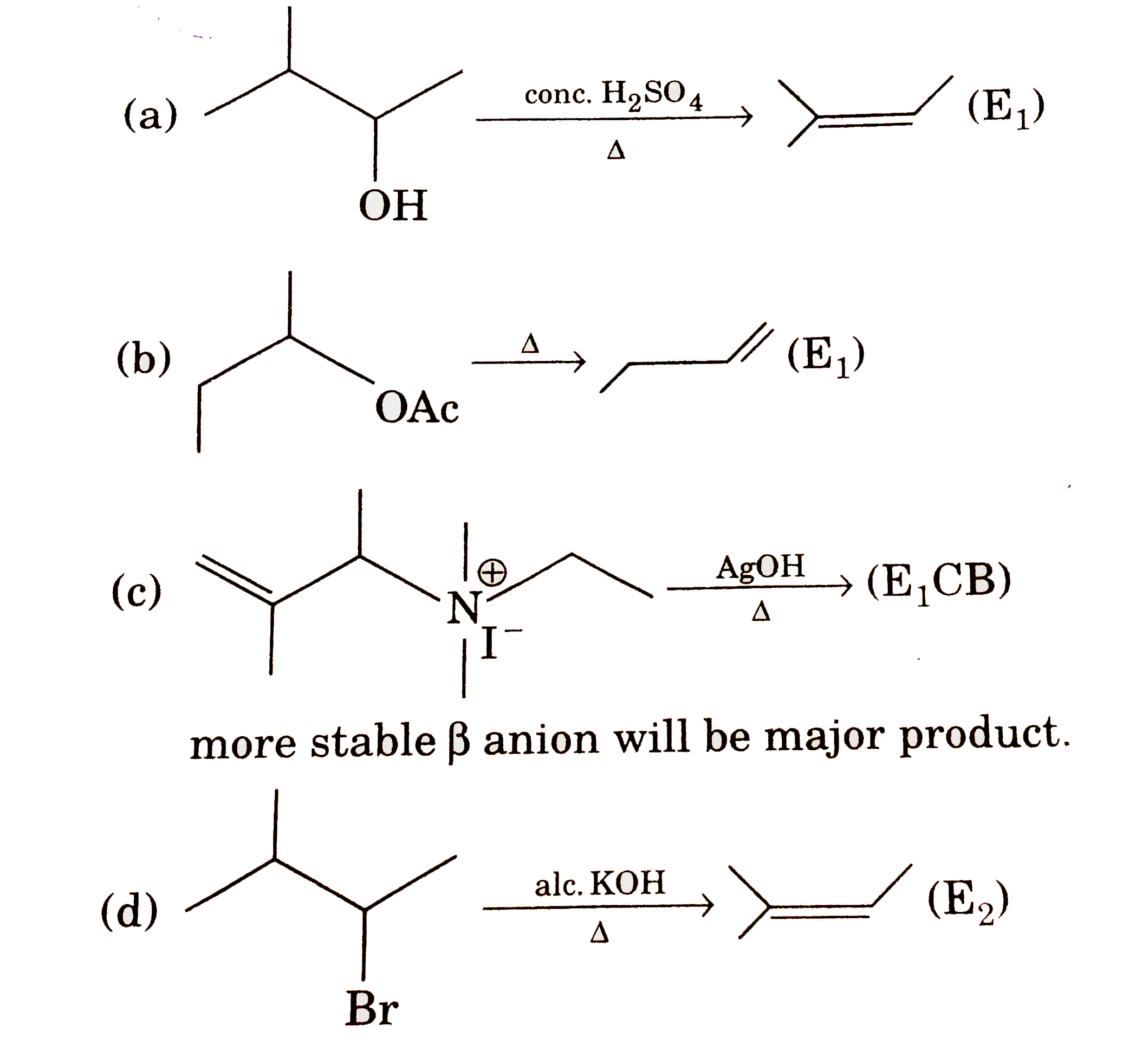
|
|
| 45. |
Match the following columns : |
|
Answer» |
|
| 46. |
Match the following columns : |
|
Answer» |
|
| 47. |
Match the following columns : |
|
Answer» |
|
| 48. |
Match the following columns : |
|
Answer» |
|
| 49. |
Match the following columns : |
|
Answer» |
|
| 50. |
Match the following columns : |
|
Answer» `(b) H_(3)C-CH_(2)-underset(O)underset(||)(C)-NH_(2)overset((i)LAH)underset((ii)H_(2)O)rarrH_(3)C-CH_(2)-CH_(2)-NH_(2)+H-underset(O)underset(||)(C)-OH` `(b) H_(3)C-underset(O)underset(||)(C)-CH_(2)-underset(O)underset(||)(C)-OMeoverset((i)OME)underset((ii)CH_(2)-underset(O)underset(||)(C)-Cl)rarrH_(3)C-underset(H)underset(|)(C)-underset(COCH_(3))underset(|)(CH)-underset(O)underset(||)(C)-OMeoverset((i)H^(+)//H_(2)O)underset((ii)Delta)rarr` |
|