

Saved Bookmarks
This section includes 7 InterviewSolutions, each offering curated multiple-choice questions to sharpen your Current Affairs knowledge and support exam preparation. Choose a topic below to get started.
| 1. |
Lead salts react with K_2CrO_4 to give precipitates of : |
|
Answer» WHITE COLOUR |
|
| 2. |
Lead sulfide has fcc structure. The edge length of the unit cell of PbS crystal is 500 pm What is its density ? |
|
Answer» Solution :MOLECULAR mass of PBS = 207.2+32 = 239.2 Edge length, a = 500 , pm NUMBER of molecules per unit cell, Z=4 (for fcc structure) Density of unit cell, `d= (Zxx M)/(N_A XX a^3 xx 10^(-30)) g cm^(-3)` `therefore d = (4xx239.2 g "mol"^(-1))/(6.022 xx 10^(23) "mol"^(-1) xx (500)^3 xx 10^(-30) cm^3)` `= (956.8)/(75.275) g cm^(-3) = 12.7 g cm^(-3)` |
|
| 4. |
Lead poisoning in the body can be removed by: |
|
Answer» EDTA in the FORM of clacium dihydrogen SALT |
|
| 5. |
Lead pipes can be used for: |
|
Answer» SOFT water |
|
| 8. |
Lead pipes are not suitable for drinking water, because : |
|
Answer» LEAD forms basic lead carbonate |
|
| 9. |
Lead pencil contains: |
|
Answer» Pb |
|
| 11. |
Lead (P) causes |
|
Answer» RADIOACTIVE pollution |
|
| 12. |
Lead pencil is manufactured by mixing clay with : |
|
Answer» Lead |
|
| 13. |
Lead nitrate of heating gives lead oxide, nitrogen dioxide and oxygen. This reaction is known as |
|
Answer» COMBUSTION It is decomposition REATION because lead nitrite on heating DECOMPOSES to Lead oxide, nitrogen dioxide and oxygen. |
|
| 14. |
Lead nitrate on heating gives lead oxide, nitrogen dioxide and oxygen. The reaction is known as: |
|
Answer» Combustion |
|
| 15. |
Lead (IV) oxide is obtained by |
|
Answer» heating LEAD (II) oxide STRONGLY in air |
|
| 17. |
Lead is only slightly attacked dilute hydrochloric acid , because |
|
Answer» Pb is less ELECTROPOSITIVE than HYDROGEN |
|
| 18. |
Lead is not affected by dilute HCl in cold, because: |
|
Answer» PB is less electronegative than H |
|
| 20. |
Lead has been placed in qualitative group analysis Ist and 2nd because |
|
Answer» It shown the valency one and two |
|
| 21. |
Lead has been placed in the group I and II because |
|
Answer» it shows the valency of one and two |
|
| 22. |
Lead exhausted in the atmosphere by automobiles using leaded petrol (i.e.,tetraethyl lead for improving octant number ) is a lethal air pollutant, which causes : |
|
Answer» PARALYSIS of MUSCLES and LOSS of appetite |
|
| 23. |
Lead containers are generally used for storing radioactive materials. This is because : |
|
Answer» LEAD is stable |
|
| 24. |
Lead accumulator cell consists of |
|
Answer» `20% H_(2)SO_(4)` solution |
|
| 25. |
Lead accumulator is a secondary storage cell because |
|
Answer» it is an irreversible cell |
|
| 26. |
Lead accumulator cell can be maintained in good working condition when |
|
Answer» the CELL is allowed to run upto 1.7 V |
|
| 27. |
Lead accumulator. |
Answer» SOLUTION :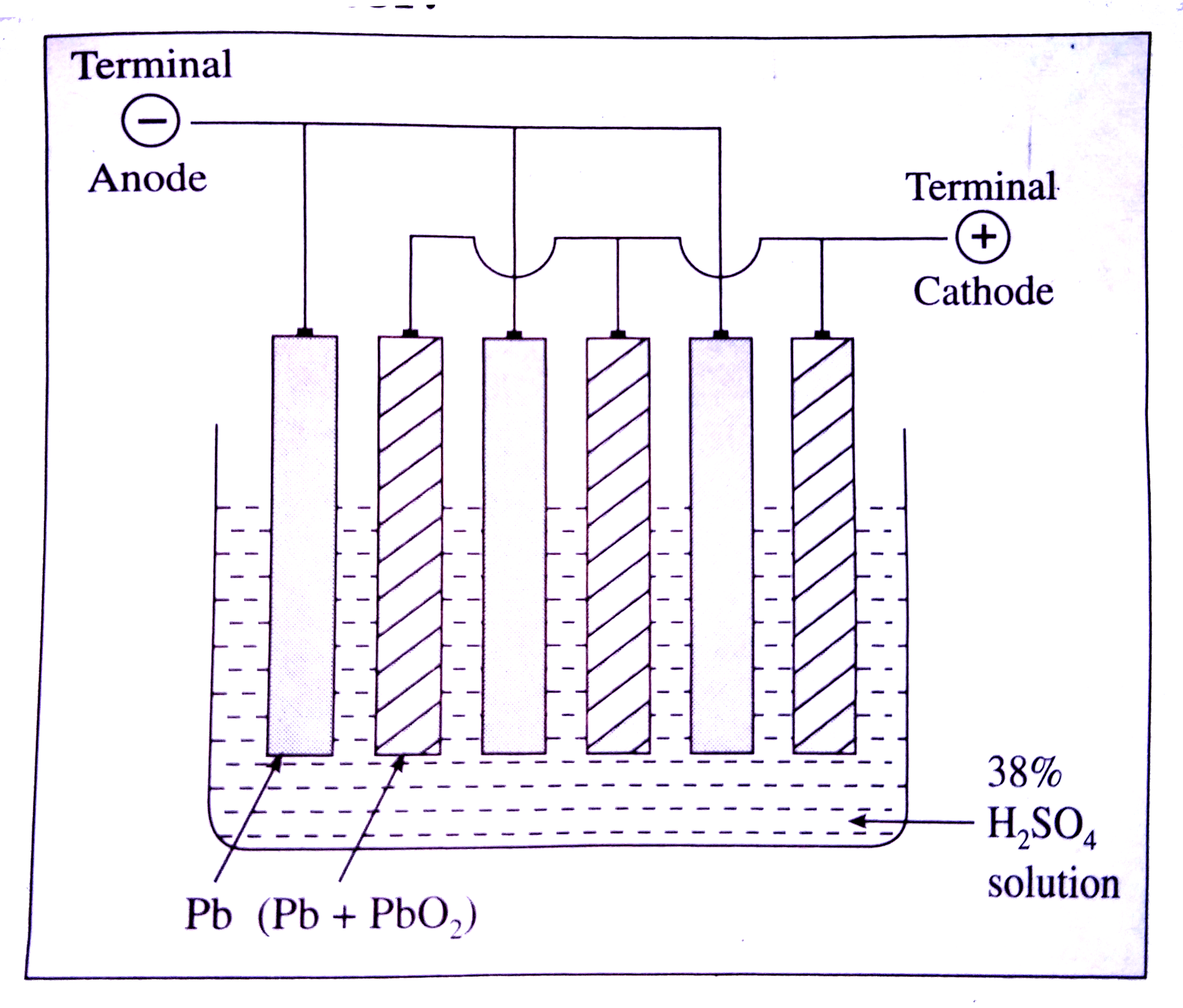
|
|
| 28. |
Leaching process is used to get :- |
|
Answer» Ag |
|
| 30. |
Leaching of an ore is done by |
|
Answer» HALL's process |
|
| 31. |
Leaching is commercially carried out for in the concentration of : |
|
Answer» Galena (i) `Ag_(2)S+4NaCN overset("AIR")to 2Na[Ag(CN)_(2)]^(-)+Na_(2)S overset("Air")to Na_(2)SO_(4)+S` |
|
| 32. |
Leaching is also called as…….. |
|
Answer» HAND picking |
|
| 33. |
Leaching . |
| Answer» Solution :It is a (CHEMICAL) process used in the concentration of an ore by EXTRACTING soluble maerial from an insoluble solid by dissolving in a suitable solvent. This method is used in the concentration process of ores of AL, Ag, AU, etc. | |
| 34. |
Leaching is a process of concentration of ores. Explain the leaching ofalumina from bauxite. |
|
Answer» |
|
| 35. |
Leaching is a process of: |
|
Answer» Reduction |
|
| 36. |
Le-Chatelier's principle is not applicable to which of the following reaction? |
|
Answer» `N_2(g)+3H_2(g) ltimplies 2NH_3(g)` |
|
| 37. |
Le-Chatelier's principle is applicable only to a |
|
Answer» SYSTEM in equlibrium |
|
| 38. |
Le chatelier's principle If a system at equilibrium is subjected to a change of any one of the factors such as concentration, pressure or temperature, the system adjusts itself in such a way so as to minimise the effect of that change. Change of pressure: If a system in equilibrium consists of gases, then the concentrations of all the components can be altered by changing the pressure.When the pressure on the system is increased, the volume decreases proportionately.The total number of moles per unit volume will now be more and the equilibrium will shift in the direction in which there is decrease in number of moles i.e., towards the direction in which there is decrease in volume. Effect of pressure on melting point : There are two types of solids : (a)Solids whose volume decreases on melting e.g. ice, diamond , carborundum, magnesium nitride and quartz. Solid (higher volume)hArr Liquid (lower volume) The process of melting is facilitated at high pressure, thus melting point is lowered. (b)Solids whose volume increase on melting, e.g. Fe,Cu, Ag,Au, etc. Solid (lower volume)hArr Liquid (higher volume) In this case the process of melting becomes difficult at high pressure, then melting point becomes high. (c )Solubility of subtances : When solid substance are dissolved in water, either heat is evolved (exothermic) or heat is absorbed (endothermic). KCl+aq hArr KCl(aq)-heat In such cases,solubility increase with increase in temperature. Consider the case of KOH, when this is dissolved heat is evolved. KOH+aq hArr KOH(aq)+heat In such cases, solubility decrease with increase in temperature. (d)Solubility of gases in liquids : When a gas dissolves in liquid, there is decreases in volume. Thus, increases of pressure will favour the dissolution of gas in liquid. Effect of temperature: Le-Chatelier's principle predicts a system at equilibrium will tend to shift in the endothermic direction when temperature is raised, for then energy is absorbed as heat and the rise in temperature is opposed.Conversely, an equilibrium will shift in the exothermic direction if the temperature is lowered, for then energy is released and the reduction in temperture is opposed Van't Hoff equation shows the dependence of equilibrium constant K on temperaure as : d/(dT)lnK=(DeltaH^@)/(RT^2) or ln K="constant"-(DeltaH^@)/R.1/T The plot of log K against 1/T is a straight line with positive slope ( K being the equilibrium constant of a reaction ), which of the following is then correct ? |
|
Answer» The reaction is endothermic in nature |
|
| 39. |
Le chatelier's principle If a system at equilibrium is subjected to a change of any one of the factors such as concentration, pressure or temperature, the system adjusts itself in such a way so as to minimise the effect of that change. Change of pressure: If a system in equilibrium consists of gases, then the concentrations of all the components can be altered by changing the pressure.When the pressure on the system is increased, the volume decreases proportionately.The total number of moles per unit volume will now be more and the equilibrium will shift in the direction in which there is decrease in number of moles i.e., towards the direction in which there is decrease in volume. Effect of pressure on melting point : There are two types of solids : (a)Solids whose volume decreases on melting e.g. ice, diamond , carborundum, magnesium nitride and quartz. Solid (higher volume)hArr Liquid (lower volume) The process of melting is facilitated at high pressure, thus melting point is lowered. (b)Solids whose volume increase on melting, e.g. Fe,Cu, Ag,Au, etc. Solid (lower volume)hArr Liquid (higher volume) In this case the process of melting becomes difficult at high pressure, then melting point becomes high. (c )Solubility of subtances : When solid substance are dissolved in water, either heat is evolved (exothermic) or heat is absorbed (endothermic). KCl+aq hArr KCl(aq)-heat In such cases,solubility increase with increase in temperature. Consider the case of KOH, when this is dissolved heat is evolved. KOH+aq hArr KOH(aq)+heat In such cases, solubility decrease with increase in temperature. (d)Solubility of gases in liquids : When a gas dissolves in liquid, there is decreases in volume. Thus, increases of pressure will favour the dissolution of gas in liquid. Effect of temperature: Le-Chatelier's principle predicts a system at equilibrium will tend to shift in the endothermic direction when temperature is raised, for then energy is absorbed as heat and the rise in temperature is opposed.Conversely, an equilibrium will shift in the exothermic direction if the temperature is lowered, for then energy is released and the reduction in temperture is opposed Van't Hoff equation shows the dependence of equilibrium constant K on temperaure as : d/(dT)lnK=(DeltaH^@)/(RT^2) or ln K="constant"-(DeltaH^@)/R.1/T For the reaction 1/2N_2(g)+1/2O_2(g)hArrNO(g) |
|
Answer» Total PRESSURE at EQUILIBRIUM will CHANGE |
|
| 40. |
Le chatelier's principle is |
|
Answer» if a system in equilibrium is subjected to a change of concentration, pressure of TEMPERATURE , the equilibrium SHIFTS in the direction that tends to a null the effect of change. |
|
| 41. |
Le-Chatelier's principle is |
|
Answer» if a system in equilibrium is SUBJECTED to a CHANGE of concentration, pressure or temperature, the equilibrium shifts in the direction that tends to undo the effect of change |
|
| 42. |
Le chatelier's principle If a system at equilibrium is subjected to a change of any one of the factors such as concentration, pressure or temperature, the system adjusts itself in such a way so as to minimise the effect of that change. Change of pressure: If a system in equilibrium consists of gases, then the concentrations of all the components can be altered by changing the pressure.When the pressure on the system is increased, the volume decreases proportionately.The total number of moles per unit volume will now be more and the equilibrium will shift in the direction in which there is decrease in number of moles i.e., towards the direction in which there is decrease in volume. Effect of pressure on melting point : There are two types of solids : (a)Solids whose volume decreases on melting e.g. ice, diamond , carborundum, magnesium nitride and quartz. Solid (higher volume)hArr Liquid (lower volume) The process of melting is facilitated at high pressure, thus melting point is lowered. (b)Solids whose volume increase on melting, e.g. Fe,Cu, Ag,Au, etc. Solid (lower volume)hArr Liquid (higher volume) In this case the process of melting becomes difficult at high pressure, then melting point becomes high. (c )Solubility of subtances : When solid substance are dissolved in water, either heat is evolved (exothermic) or heat is absorbed (endothermic). KCl+aq hArr KCl(aq)-heat In such cases,solubility increase with increase in temperature. Consider the case of KOH, when this is dissolved heat is evolved. KOH+aq hArr KOH(aq)+heat In such cases, solubility decrease with increase in temperature. (d)Solubility of gases in liquids : When a gas dissolves in liquid, there is decreases in volume. Thus, increases of pressure will favour the dissolution of gas in liquid. Effect of temperature: Le-Chatelier's principle predicts a system at equilibrium will tend to shift in the endothermic direction when temperature is raised, for then energy is absorbed as heat and the rise in temperature is opposed.Conversely, an equilibrium will shift in the exothermic direction if the temperature is lowered, for then energy is released and the reduction in temperture is opposed Van't Hoff equation shows the dependence of equilibrium constant K on temperaure as : d/(dT)lnK=(DeltaH^@)/(RT^2) or ln K="constant"-(DeltaH^@)/R.1/T Au(s)hArrAu(l) |
|
Answer» HIGH PRESSURE, low temperature |
|
| 43. |
Le-Chatelier principle is not applicable to |
|
Answer» `H_(2(g))+I_(2(g))hArr2HI_((g))` |
|
| 44. |
Le-blanc process is employed in the manufacturing of |
|
Answer» BAKING SODA |
|
| 45. |
LDPE is a homopolymer, while nylon 6, 6 is a copolymer. Explain |
|
Answer» Solution :Polymer formed by the polymerisation of one type of monomer is known as homopolymer. LDPE 9 or LDP) is formed by the polymerisation of ETHENE `(CH_2=CH_2)`. So it is a homopolymer. Polymer formed by the polymerisation of two or more different monomers is called copolymer. Since nylon 6,6 is formed by the polymerisation of ADIPIC acid and HEXAMETHYLENE DIAMINE, it is a copolymer. |
|
| 46. |
ldentify the monohydrie unsaturated alcohol. |
|
Answer» `CH_3-CH_2OH` |
|
| 47. |
ldentify the incorrect statement(s)? |
|
Answer» <P>The ratio of the OBSERVED molar volume to ideal molar volume is called compressibility factor |
|
| 48. |
Layers of carbon atoms in graphite are held together by : |
|
Answer» 1. Covalent bonds |
|
| 49. |
Law of raciprocd proportions can be used to determine : |
|
Answer» ATOMIC WEIGHT of gas |
|
| 50. |
Law of multiple proportion was given by |
|
Answer» Lavosivier |
|