Saved Bookmarks
This section includes 7 InterviewSolutions, each offering curated multiple-choice questions to sharpen your Current Affairs knowledge and support exam preparation. Choose a topic below to get started.
| 1. |
It is known that entropy of neutralisation of a strong acid and strong base is -13.68kcal/mol.If enthalpy of neutralisation of N_2H_4(hydrazine) with strong acid is equal to -11.68 kcal/mol, then enthalpy of the reaction N_2H_4+H_2OtoN_2H_5^+(aq)+OH^(-)(aq) in Kcal/mol is : |
|
Answer» ENTHALPY of neutralisation is less than-13.68 kcal/mol, because some ENERGY is CONSUMED for ionisation `:. DeltaH_("ion")=13.68-11.68=2` kcal/mol |
|
| 2. |
Inversion of sucrose is…… |
|
Answer» Zero ORDER reaction |
|
| 3. |
It is known that 1g of .^(226)Ra emits 11.6 xx 10^(17) atoms of alpha per years. Given, the half life of .^(236)Ra to be 1600 years, compute the value of Avogadro's number. |
|
Answer» SOLUTION :Rate `= lambda xx` number of ATOMS in one gram `= lambda xx ("Avogadro's number")/(226)` |
|
| 4. |
Inversion of resistance is known as: |
|
Answer» CONDUCTIVITY |
|
| 5. |
Inversion of cane sugar is an example of a………………………..reaction. |
| Answer» SOLUTION :PSEUDOUNIMOLECULAR | |
| 6. |
It is impossible to measure the actual voltage of any half cell by itselft because : |
|
Answer» Both HALF cell reactions TAKES PLACE simultaneously |
|
| 7. |
It is impossible to measure the actual voltage of any half cell by itself because |
|
Answer» both half CELL reactions take PLACE SIMULTANEOUSLY |
|
| 8. |
It is impossible to measure the actual voltage of any half cel by itself because |
|
Answer» both HALF cell reactions OCCUR simultaneously . |
|
| 9. |
It is given that for conformational isomers, the net dipole moment mu_(obs)=sum mu_(i)x_(i) Where mu_(obs) = obsereved dipole moment of the compound mu_(i) = dipole moment of the stable conformational isomersX_(1) = mole fraction of stable conformers of the compound Z-CH_(2)-CH_(2)-Z draw the Newman projection formula of all stable conformational isomers, if mu_(obs) = 1D, " and " X_(anti) = 0.82, " find " mu_(gauche). Now draw the Newman projection formula of the most stable conformation of meso Y-CHD-CHD-Y. (a) If Y is CH_(3) ("rotation about "C_(2)-C_(3) " bond") (b) If Y is OH ("rotation about "C_(1)-C_(2) " bond") |
|
Answer» `mu_(obs)=1D ""X_(GAUCHE) =0.18` `rArrmu_(obs)=summu_(i)X_(i) ""rArr "" 1 = mu_(gauche) xx 0.18 + 0.82 xx 0 "" rArr""mu_(gauche) = (1)/(0 . 18) = 5.55D ""X_(gauche) =0.18` `(##RES_CHM_SIM_E03_005_A02##)` (a) If Y is `CH_(3)`, the Newman projection is `(##RES_CHM_SIM_E03_005_A03##)` (b) If Y is OH, the Newman projection is `(##RES_CHM_SIM_E03_005_A04##)` |
|
| 10. |
Inversion of a sugar follows first order rate equation which can be followed by noting the change in rotation of the plane of polarization of light in the polarimeter if r_infty,r_t and t=oo, t=t and t=0, then, first order reaction can be written as: |
|
Answer» `K=1/t"LOG"(r_1-r_infty)/(r_0-r_infty)` |
|
| 11. |
It is impossible to attain the lowest temperature known as zero degree absolute. This is a simple statement of: |
|
Answer» FIRST LAW of thermodynamics |
|
| 12. |
It is general principle that the less energy a system contains, it is |
|
Answer» LESS stable |
|
| 13. |
It is found that in 11.2 litres of any gaseous compound of phosphorus at NTP, there is never less than 15.5 g of P. Also, this volume of the vapour of phosphorus itself at NTP lueighs 62 g. What should be the atomic weight and molecular weight of phosphorus? |
| Answer» SOLUTION :Since 1 mole of any phosphorus COMPOUND contains at least 1 mole of P atoms, and also `22.4` litres (at NTP) of the gaseous compound contains 31 g of phosphorus, therefore, 1 mole of phosphorus WEIGHS 31 g, i.e., 31 is the atomic weight of phosphorus. SIMILARLY, the molecular weight of phosphorus is 124 as 1 mole of its vapour weighs 124 g. | |
| 14. |
Invar' is an alloyof : |
|
Answer» STEEL and chromium |
|
| 15. |
Invar steel, which is very little affected by temperature changes, contains 36%: |
|
Answer» Co |
|
| 16. |
Invaris an alloyof : |
|
Answer» STEEL and chromium |
|
| 18. |
Invar, an alloy of Fe and Ni is used in watches and meter scale, its characteristic property is |
|
Answer» SMALL COEFFICIENT of expansion |
|
| 19. |
Introductionof fluoridegroup inbenzeneringis moreeasyby |
|
Answer» electrophilicsubstitution |
|
| 20. |
Intramolecular hydrogen bonding is not present in :- |
|
Answer» Urea |
|
| 21. |
Intramolecular hydrogen bonding is formed in |
|
Answer» `H_(2)O` 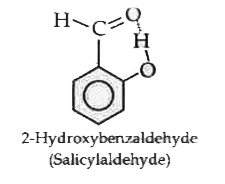
|
|
| 22. |
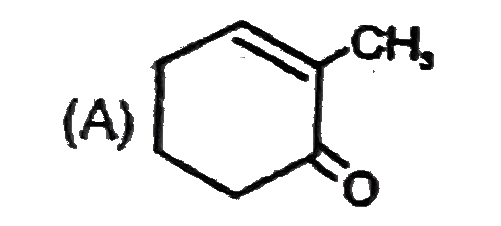
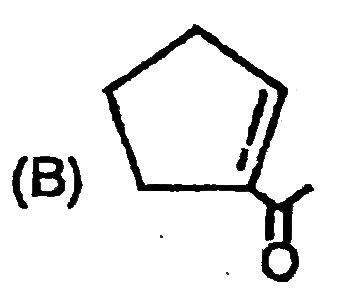
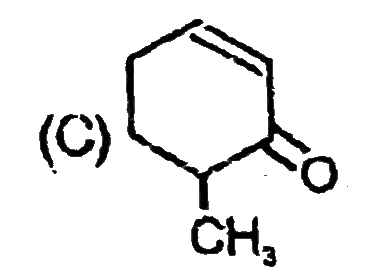
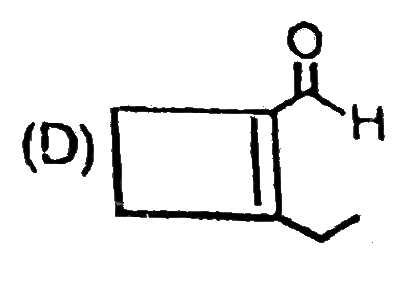
Intramolecular aldol condensation : The aldol condensation also offer a convenient way to synthesize molecules with five and six membered ring.This can be done by an intramolecular aldol condensation using a dialdehyde, a keto aldehyde or a diketone as the substrate.The major product is formed by the attack of the enolate from the ketone side of the molecule that adds to the aldehyde group.The reason the aldehyde group undergoes addition preferentially may arise from the greater reactivity of aldehyde towards nucleophilic addition.In reaction of this type five membered rings from far more readily than seven membered rings and six membered rings are more favourable than four or eight membered rings when possible. 1-Etylcyclopent-1-ene on reductive ozonolysis followed by aq. NaOH//Delta gives |
|
Answer»

|
|
| 23. |
Intramolecular aldol condensation : The aldol condensation also offer a convenient way to synthesize molecules with five and six membered ring.This can be done by an intramolecular aldol condensation using a dialdehyde, a keto aldehyde or a diketone as the substrate.The major product is formed by the attack of the enolate from the ketone side of the molecule that adds to the aldehyde group.The reason the aldehyde group undergoes addition preferentially may arise from the greater reactivity of aldehyde towards nucleophilic addition.In reaction of this type five membered rings from far more readily than seven membered rings and six membered rings are more favourable than four or eight membered rings when possible. Which of the following compound on reaction with O_3//Zn, H_2O followed by aq. NaOH//Delta will form |
|
Answer»
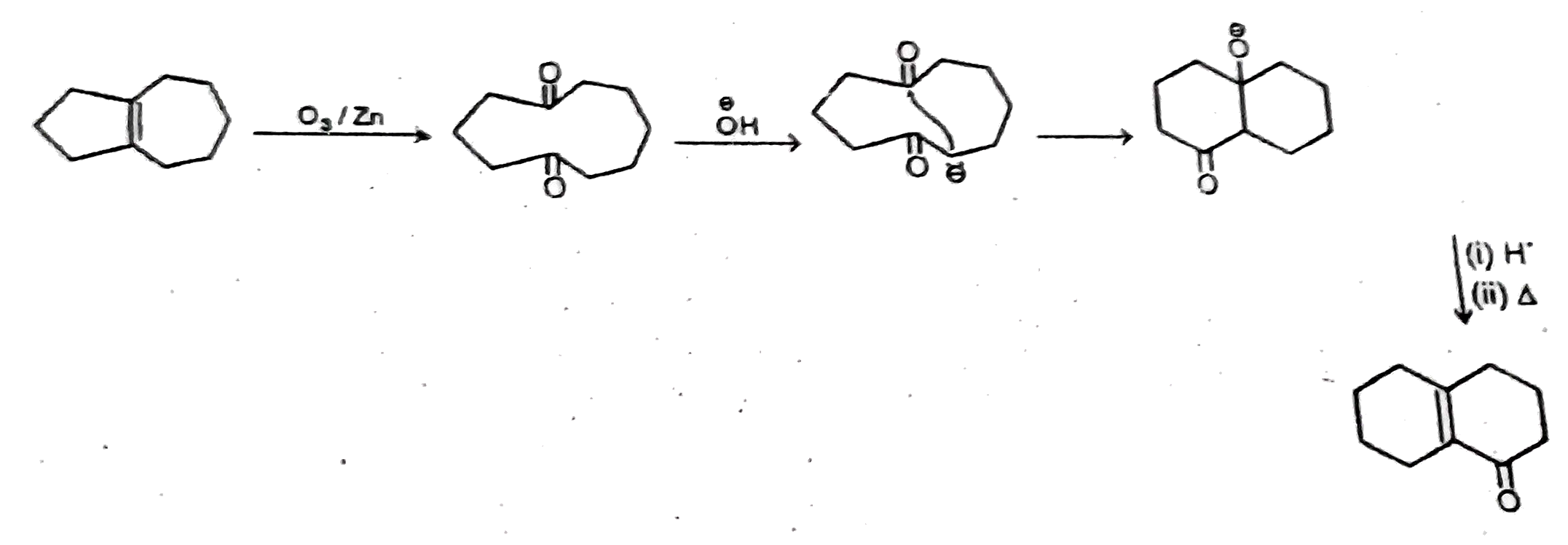
|
|
| 24. |
Intramolecular aldol condensation : The aldol condensation also offer a convenient way to synthesize molecules with five and six membered ring.This can be done by an intramolecular aldol condensation using a dialdehyde, a keto aldehyde or a diketone as the substrate.The major product is formed by the attack of the enolate from the ketone side of the molecule that adds to the aldehyde group.The reason the aldehyde group undergoes addition preferentially may arise from the greater reactivity of aldehyde towards nucleophilic addition.In reaction of this type five membered rings from far more readily than seven membered rings and six membered rings are more favourable than four or eight membered rings when possible. The true statement about the major product of CH_3-oversetOoverset(||)C-CH_2-CH_2-CH_2-CH_2-oversetoverset(O)(||)C-H in reaction with aq.NaOH followed by heating is. |
|
Answer» It gives yellow ppt with `I_2//overset(THETA)OH` 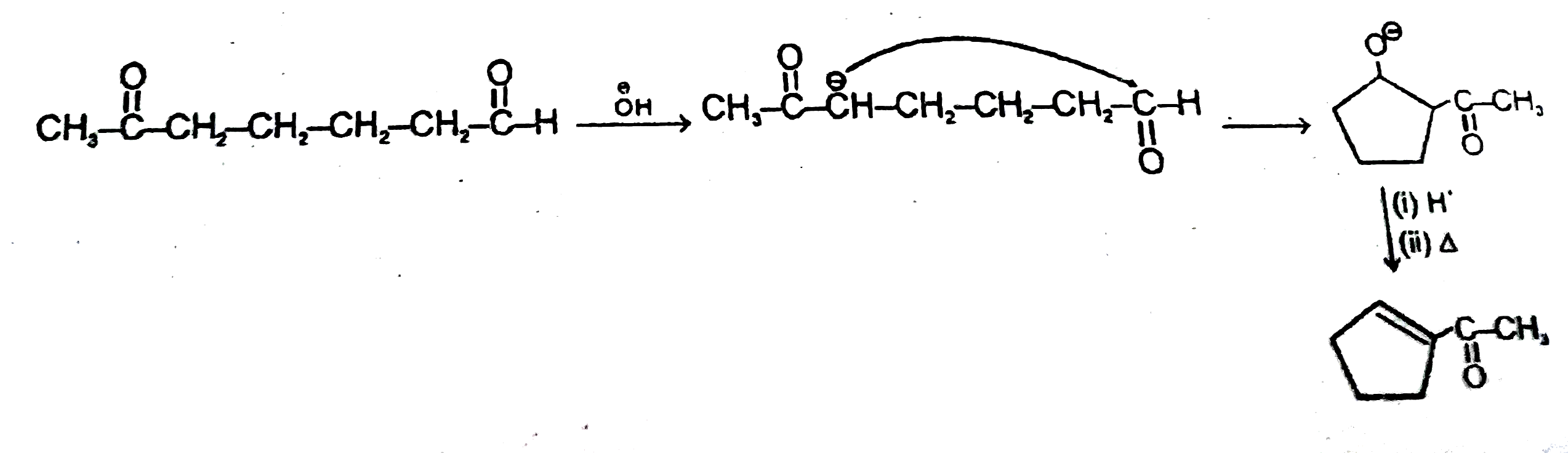
|
|
| 25. |
Into a gas bulb of 2.83 litres, are introduced 0.174 g of H_(2) and 1.365 g of N_(2) which can be assumed to behave ideally. The temperature is 0^(@)C. What are the partial pressures of H_(2) and N_(2) and what is the total gas pressure ? What are the mole fractions of each gas ? What are pressure fractions ? |
|
Answer» <P> SOLUTION :`pH_(2)//p = nH_(2)//N = 0.639` |
|
| 26. |
Intra-molecular H-bonding is possible in which of the following. |
|
Answer» cis-cyclohexane-1,2-diol |
|
| 27. |
Interstitial compounds are formed when small atoms are trapped inside the crystal lattice of metals. Which of the following is not the characteristic property of interstitial compounds ? |
|
Answer» They have high MELTING points in comparison to PURE metals. |
|
| 28. |
Interstitial compounds are formed when small atoms are trapped inside the crystal lattic of metals . Which of the followings is not the characteristic property of interstitial compounds ? |
|
Answer» They have high MELTING points in comparison to PURE metals |
|
| 29. |
Interparticle forces present in nylon-6, 6 are |
|
Answer» van der WAAL 's |
|
| 31. |
Intersititial compounds are formed when small atoms are trapped inside the crystal lattice of metals. Which of the following is not th echaracteristic property of interstitial compounds? |
|
Answer» They have high melting points in comparison to PURE metals |
|
| 32. |
Interparticle forces present In Nylon -66 are |
|
Answer» VANDER Waal's |
|
| 33. |
Internal Energy (E,also denoted by U): Every system having some quantity of matter is associated with a definite amount of energy, called internal energy. E=E_("Transiational")+E_("Rotational")+E_("Vibrational")+E_("bonding")+.... DeltaE=E_("Final")-E_("initial") DeltaE=q_v, heat supplied to a gas at constant volume, since all the heat supplied goes to increase the internal energy to the gas. It is an extensive property & a state function.It is exclusively a function of temperature. If DeltaT=0 , DeltaE=0 as well. The internal energy of a certain substance is given by the following equation : U=3 PV+84 where U is given in kJ/kg, P is in kPa, and V is in m^3//kg A system composed of 3 kg of this substance expands from an initial pressure of 400 kPa and a volume of A 0.2 m^3 to a final pressure 100 kPa in a process in which pressure and volume are related by PV^2=constant. Explain the difference in work transfer in question (6.25) and (6.26). |
| Answer» SOLUTION :The work in (6.25) is not equal to `INT PDV` since the PROCESS is not quasi-static | |
| 34. |
Internal Energy (E,also denoted by U): Every system having some quantity of matter is associated with a definite amount of energy, called internal energy. E=E_("Transiational")+E_("Rotational")+E_("Vibrational")+E_("bonding")+.... DeltaE=E_("Final")-E_("initial") DeltaE=q_v, heat supplied to a gas at constant volume, since all the heat supplied goes to increase the internal energy to the gas. It is an extensive property & a state function.It is exclusively a function of temperature. If DeltaT=0 , DeltaE=0 as well. The internal energy of a certain substance is given by the following equation : U=3 PV+84 where U is given in kJ/kg, P is in kPa, and V is in m^3//kg A system composed of 3 kg of this substance expands from an initial pressure of 400 kPa and a volume of A 0.2 m^3 to a final pressure 100 kPa in a process in which pressure and volume are related by PV^2=constant. In another process the same system expands according to the same pressure-volume relationship as in above question, but from the same initial state of the final state as in above question, but the heat transfer in this case is +30 kJ.Then the work transfer for this process is : |
|
Answer» `-80 kJ` `W=DeltaU-q` `W= -120-30= -150 kJ` |
|
| 35. |
Internal energy of an ideal gas depends on |
|
Answer» VOLUME |
|
| 36. |
Internal energy of an ideal gas depends on: |
|
Answer» Pressure |
|
| 37. |
Internal Energy (E,also denoted by U): Every system having some quantity of matter is associated with a definite amount of energy, called internal energy. E=E_("Transiational")+E_("Rotational")+E_("Vibrational")+E_("bonding")+.... DeltaE=E_("Final")-E_("initial") DeltaE=q_v, heat supplied to a gas at constant volume, since all the heat supplied goes to increase the internal energy to the gas. It is an extensive property & a state function.It is exclusively a function of temperature. If DeltaT=0 , DeltaE=0 as well. The internal energy of a certain substance is given by the following equation : U=3 PV+84 where U is given in kJ/kg, P is in kPa, and V is in m^3//kg A system composed of 3 kg of this substance expands from an initial pressure of 400 kPa and a volume of A 0.2 m^3 to a final pressure 100 kPa in a process in which pressure and volume are related by PV^2=constant. If the expansion is quasi-static, then the value of q is : |
|
Answer» Solution :U=3PV+84 `DeltaU=U_2-U_1=3(P_2V_2-P_1V_1)` `THEREFORE DeltaU=3(P_2V_2-P_1V_1)` Now, `P_1V_1^2=P_2V_2^2` `:. V_2=V_1(P_1/P_2)^(1//2)=0.2(4/1)^(1//2)=0.4` `DeltaU=300(1xx0.4-4xx0.2)kJ = -120 kJ` For a quasi-static process `W=intPdV=(P_2V_2-P_1V_1)/(n-1)` `=((1xx0.4-4xx0.2)100)/(2-1)=-40 kJ` `:. DeltaU=q+W` q=-120+40=-80 kJ |
|
| 38. |
Internal energy does not include |
|
Answer» Nuclear ENERGY |
|
| 39. |
Internal energy does NOT include ____________ . |
|
Answer» NUCLEAR energy |
|
| 40. |
Internal energy and pressure of a gas per unit volume are related as |
|
Answer» `P=(2)/(3) E` `:. P=(2)/(3) (E)/(V)` for unit VOLUME `(V =1 ) impliesP=(2)/(3) E ` |
|
| 41. |
Internal energy and pressure of a gas of unit volume are related as: |
|
Answer» `P=2//3U` |
|
| 42. |
internal energy and pressure ofa gas of unit valume are related as |
|
Answer» <P>`P =2/3E` |
|
| 43. |
Intermolecular hydrogen bonds are not present in _________ |
|
Answer» `CH_(3)COOH` |
|
| 44. |
Intermolecular hydrogen bonding is strongest in: |
|
Answer» Methylanine In `H-CHO`, Ois not having H atom so it shows very LITTLE H-bonding. (ii) N is less electronegative than 0, so .H-bond formed by amines will be weak lhan that by alcohols. (iii) `C_(6)H_(5)OH` forms weak H-bonding due to steric hinderance due to bulky phenyl group. |
|
| 45. |
Intermolecular hydrogen bondig in ethylene glycol leads to its |
|
Answer» HIGH VISCOSITY |
|
| 46. |
Intermolecular hydrogen bond is present in which of the following pair of molecules ? |
|
Answer» `SiH_4 and SiF_4` |
|
| 47. |
Intermolecular H-bonding in strongest in: |
|
Answer» Methylamine |
|
| 48. |
Intermolecular forces between two benzene molecules are nearly of same strength as those between two toluene molecules. For a mixture of benzene and toluene, which of the following are not true ? |
|
Answer» `Delta_(mix)H=` ZERO |
|
| 49. |
Intermolecular forces in solid hydrogen are : |
|
Answer» Covalent FORCES |
|
| 50. |
Intermolecular forces betweentwo benzene molecules are nearly of same strength as those between two toluene molecules. For a mixture of benzene and toluene, which of the following are not true? |
|
Answer» `Delta_("mix")H="ZERO"` |
|