Saved Bookmarks
This section includes 7 InterviewSolutions, each offering curated multiple-choice questions to sharpen your Current Affairs knowledge and support exam preparation. Choose a topic below to get started.
| 1. |
In which of the following species presence of lone pair does not affect idealized bond angle ? (I) PF_(3) (II) BrF_(3) (III) IF_(5) (IV) I Cl_(4)^(-) (V) XeF_(2) |
|
Answer» I,II,III |
|
| 2. |
In which of the following compounds central atom has same number of lone pairs of electrons? (a) XeF_2(b) XeF_4(c) XeO_3 (d) XeOF_4 |
|
Answer» (a)&(B) |
|
| 3. |
In which of the following species the central carbon atom is negatively charged ? |
|
Answer» CARBONIUM ion |
|
| 4. |
In which of the following compounds crystal have axial distance relation is different from other ? |
|
Answer» `KNO_3` |
|
| 5. |
In which of the following species only half filled and full filled orbitals of central atom participate in hybridisation |
|
Answer» `SO_(3)` |
|
| 6. |
In which of the following compounds carbon exhibits valency of 4 but oxidation state - 2 |
|
Answer» `HCHO` |
|
| 7. |
In which of the following compounds C-X bond length is shortest |
|
Answer»
|
|
| 8. |
In which of the following species maximum atom can lie in same plane ? |
|
Answer» `XeF_(2)O_(2)` 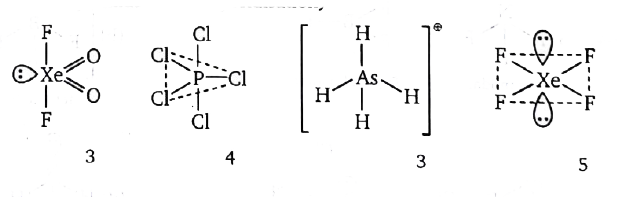
|
|
| 9. |
In which of the following compounds B-O bond length is shortest? |
|
Answer» `H_(3)BO_(3)` |
|
| 10. |
In which of the following species is the underlined carbon having sp^(3)hybridisation ? |
|
Answer» `CH_(3)-ul(C )OOH` |
|
| 11. |
In which of the following species central atom is NOT surrounded by exactly 8 valence electrons ? |
|
Answer» `BF_(4)^(-)` 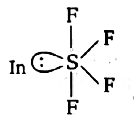 molecule central S-atom is surrounded by 10 valence electrons and it is hypervalent COMPOUND. |
|
| 12. |
In which of the following compounds B atoms are in sp^(2) and sp^(3) hybridisation states both? |
|
Answer» BORAX |
|
| 13. |
In which of the following species d-orbitals having xz and yz two nodel planes involved in hyridisation of central atom? |
| Answer» Solution :`N//A` | |
| 14. |
In which of the following compounds , back bonding is possible |
|
Answer» `PF_(3)` |
|
| 15. |
In which of the following species, d-obitals having xz an yz two nodal planes involved in hybridization of central atoms? |
|
Answer» `IO_(2)F_(2)^(-)` `ClF_(4)^(-): Hyb. sp^(3)d^(2)[equivsp_(x)d_(y)d_(z)d_(x^(2)-y^(2))d_(x^(2)]` `IF_(7): Hyb. sp^(3)d^(3))[equivsp_(x)d_(y)d_(z)d_(x^(2)-y^(2))d_(xy)d_(x^(2)]` `d_(xy)` : orbitals has two nodal planes xz and zy |
|
| 16. |
In which of the following compounds, all Glucose units are not joined by C_(1)- O-C_(4) linkage ? |
|
Answer» Maltose |
|
| 17. |
In which of the following species, all the three types of hybrid carbons are present ? |
|
Answer» `CH_(2)=C=CH_(2)` |
|
| 18. |
In which of the following compounds, all bond lengths are not equal ? |
|
Answer» `SF_(4)` |
|
| 19. |
In which of the following compound the bonds have the largest percentage of ionic character ? |
|
Answer» `H_2O` |
|
| 20. |
In which of the following solvents will AgBr have the highest solubility |
|
Answer» `10^(-3)` M NaBr |
|
| 21. |
In which of the following compound sulphur atom has sp^(3) hybridisation but bent shape ? |
|
Answer» `H_(2)SO_(4)` 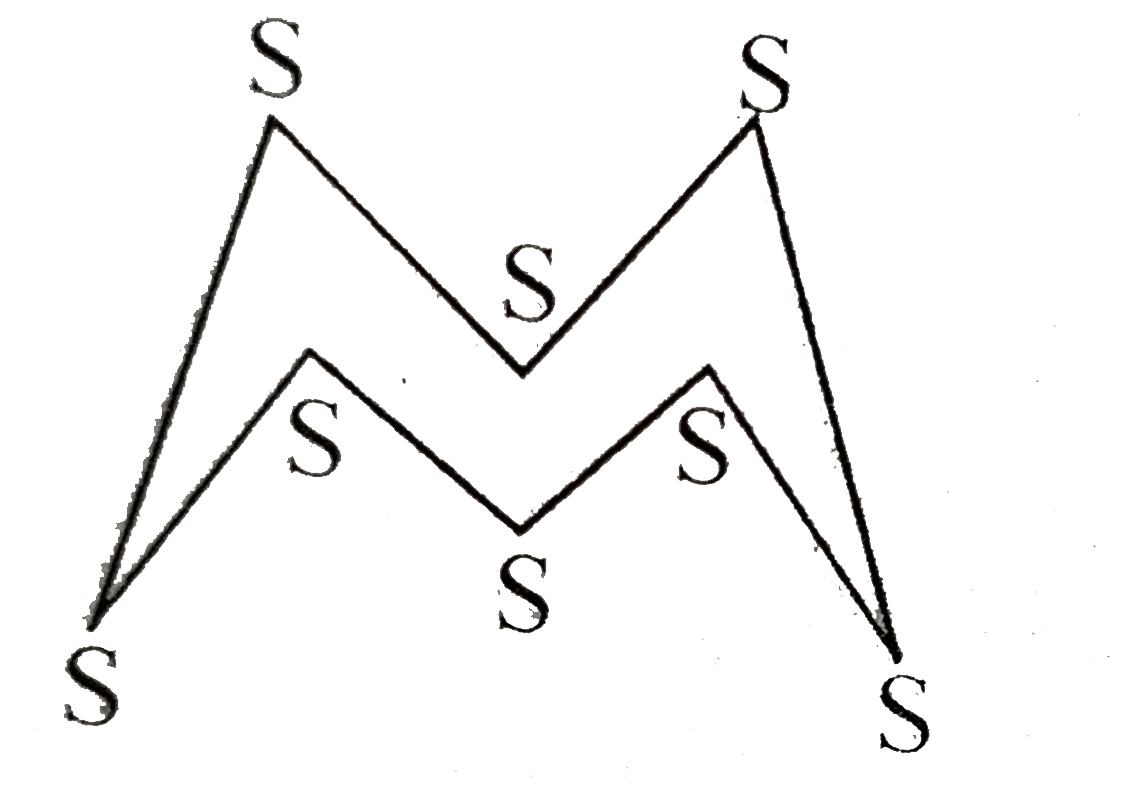
|
|
| 22. |
In which of the following solvents will AgBr has highest solubility ? |
|
Answer» `10^(-3)` M NABR |
|
| 23. |
In which of the following compound, ℓp. doesn't participate in resonance ? |
|
Answer» a and B |
|
| 24. |
In which of the following solutions, the solubility of AgCN will be greater than that in pure water? (Given : K_(sp)(AgCN)4xx10^(-16),K_(a)(HCN)=5xx10^(-10)) |
|
Answer» `0.01MAgNO_(3)` SOLUTION |
|
| 25. |
In which of the following compound O^18 exchange can be observed on keeping it in H_(2)O^(18) |
|
Answer»
 In WATER , CARBONYL compounds form HYDRATES |
|
| 26. |
In which of the following solution, solubility of AgCl will be maximum? |
|
Answer» 0.1 M `AgNO_(3)` |
|
| 27. |
In which of the following compound antimarkownikoff's rule is not possible |
|
Answer» `CH_(2)-CH-CH_(3)` |
|
| 28. |
In which of the following solutions, the solubility of solute decreases on heating the solution ? |
|
Answer» Aqueous SOLUTION of ETHYLENE glycol |
|
| 29. |
In which of the following compound, all the monosaccharide units are not joined by C_(1)-O-C_(4) chain. |
|
Answer» MALTOSE |
|
| 30. |
In which of the following solid substance dispersion forces exist ? |
|
Answer» `SiO_2` |
|
| 31. |
In which of the following solids, constituent particles are atoms ? |
|
Answer» `SiO_2 ` |
|
| 32. |
In which of the following compound all the bond angles are equal :- |
|
Answer» `SF_(4)` `C Cl_(4)`tetrahedral, no lp at CA & all TERMINAL ATOM are same, so all bond angle are same `CHCl_(3)` , HYB. `sp^(3)` but all terminal atom are not same `XeF_(6)` hyb `sp^(3)d^(3)`(all bond angles are not same) |
|
| 33. |
In which of the following smelting is carried out ? |
|
Answer» Open hearth FURNACE |
|
| 34. |
In which of the following compound all the monosaccharide units are NOT joined by C-1-O-C-4 chain? |
|
Answer» Maltose |
|
| 35. |
In which of the following sets of molecule is the order of increasing boiling points not correct ? |
|
Answer» 1. HBR, HCl, HF |
|
| 36. |
In which of the following compounds, oxygen exhibits +2 oxidation state ? |
|
Answer» `H_(2)O` |
|
| 37. |
In which of the following silicates, only two corners per tetrahedron are shared ? I. Pyrosilicate II. Cyclic silicate III Double chain silicate IV Single chain silicate V 3D Silicate |
|
Answer» (i),(II)and(V) 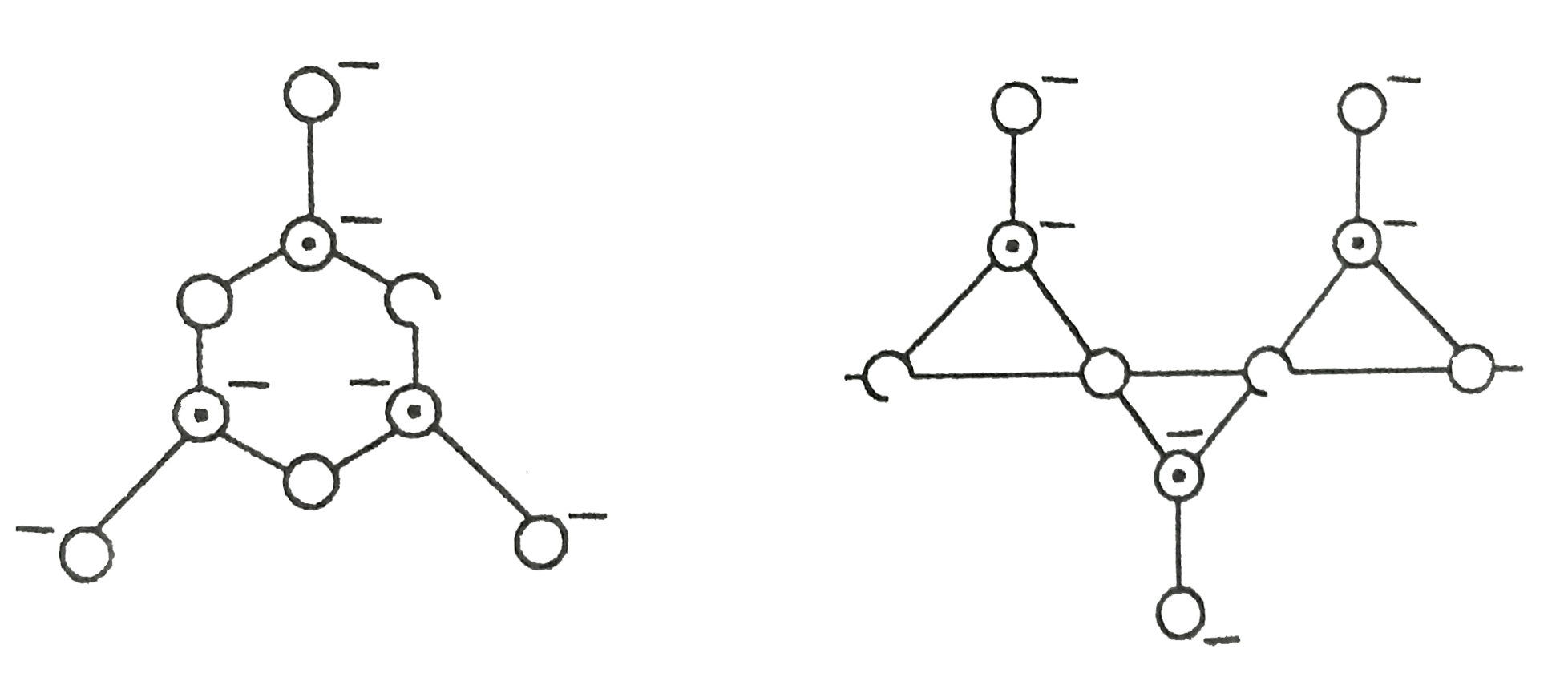
|
|
| 38. |
In which of the following complex(s) spin only magnetic moment is independent, from the nature of ligand. (L=monodentate ligand) : |
|
Answer» `[OVERSET(II)NiL_(4)]`  CN=6 Only `sp^(3)d^(2)` `FE^(3+)(d^(6))C.N.=6` both `sp^(3)d^(2)` and `d^(2)sp^(3)` POSSIBLE `Cr^(3+)(d^(3))` only `d^(2)sp^(3)` (C.N.=6) |
|
| 39. |
In which of the following sets, all the given species are isostructural ? |
|
Answer» `CO_(2),NO_(2),ClO_(2), SiO_(2)` |
|
| 40. |
In which of the following set do all the three compounds have bonds that are mainly ionic:- |
|
Answer» `NACL, NCl_(3), C Cl_(4)` |
|
| 41. |
In which of the following salt hydrolysis takes place |
|
Answer» KCl |
|
| 42. |
In which of the following complexes the nickel metal is in highest oxidation state? |
|
Answer» `NI(CO)_(4)` |
|
| 43. |
In which of the following S has highest oxidation state? |
|
Answer» `Na_(2)S_(4)O_(6)` |
|
| 44. |
In which of the following roasting is carried out? |
|
Answer» BESSEMER CONVERTER |
|
| 45. |
In which of the following ring expansion/ring contraction takes place when protic acid is added to the compound ? |
|
Answer»
|
|
| 46. |
In which of the following regions hydrogen and helium are found? |
|
Answer» Stratosphere |
|
| 47. |
In which of the following reactions ZSM-5 is useful ? |
|
Answer» TOLUENE from BENZENE |
|
| 48. |
In whichof the following reactions would the yield of the products be increased by the application of high pressure? |
|
Answer» `2SO_(2)+O_(2)iff2SO_(3)` |
|
| 49. |
In which of the following reactions, the value of K_(p) will be equal to K_(c)? |
|
Answer» `N_(2(G))+O_(2(g))iff2NO_((g))` <BR>`PCl_(5(g))iffPCl_(3(g))+Cl_(2(g))` When`Deltan=0,K_(p)=K_(c)` |
|