Saved Bookmarks
This section includes 7 InterviewSolutions, each offering curated multiple-choice questions to sharpen your Current Affairs knowledge and support exam preparation. Choose a topic below to get started.
| 1. |
In which of the following reactions , the stoichiometric ratio of H_(2)SO_(4) " to " H_(2) is the same ? |
|
Answer» `Zn (s) " and " H_(2)SO_(4)` |
|
| 2. |
In which of the following reactions, the product is racemic mixture |
|
Answer»

|
|
| 3. |
In which of the following reactionsthe product is not formed according to Markownikoff's rule- |
|
Answer» `CH_3CH=CH_2+HCl to` |
|
| 4. |
In which of the following reactions , the intermediate species acyl nitene (R-oversetoverset(O)(||)C-ddotN: )and intermediate compound alkyl isocyanate (R-N=C=O) are involved ? |
|
Answer» `R-oversetoverset(O)(||)C-NH_2overset(Br_2+KOH)tooverset(H_2O)toR-NH_2` (B)is Lossen rearreangement reaction (C )is Curtius REARRANGEMENT reaction (D) is Schmidt rearrangement reaction |
|
| 5. |
In which of the following complexes the metal ion has the lowest ionic radius ? |
|
Answer» `[Ti(H_(2)O)_(6)]^(2+)` |
|
| 6. |
In which of the following reactions, the heat liberated is known as ''heat of combustion''. |
|
Answer» `H_((AQ))^(+)+OH_((aq))^(-)rarrH_(2)O_((l))+"heat"` |
|
| 7. |
In which of the following complexes the metal ion is in zero oxidation state ? |
|
Answer» `[Cu(NH_3)_4]Cl_2` |
|
| 8. |
In which of the following reactions the graph of concentration vs time for reactants and products will be difficult to plot. |
|
Answer» `N_(2)O_(5)(G)rarr2NO_(2)(g)+(1)/(2)O_(2)(g)` |
|
| 9. |
In which of the following complexes, the EAN is NOT equal to the atomic number of Krypton ? |
|
Answer» `[Co(NH_3)_6]^(3+)` |
|
| 10. |
In which of the following reactions, the forward reaction is favoured by increase of pressure ? |
|
Answer» `N_(2)+O_(2)hArr 2NO` |
|
| 11. |
In which of the following complexes of the Co (At. no. 27), will the magnitude of Delta_(a) be the highest ? |
|
Answer» `[Co(CN)_(6)]^(3-)` |
|
| 12. |
In which of the following reactions, the final product is 2-methyl-2-propanol ? |
|
Answer» `CH_(3)CHO underset((II)H_(3)O^(+))overset((i) CH_(3)MgBr//"DRY ether")RARR` |
|
| 13. |
In which of the following complexes, nickel is in the highest oxidation state ? |
|
Answer» `K_(4)[NI(CN)_(4)]` |
|
| 14. |
In which of the following reactions, the enthalpy is the least? |
|
Answer» `CH_(3)COOH+NaOH to CH_(3)COONa+H_(2)O` |
|
| 15. |
In which of the following complexes nickel is in the highest oxidation state? |
|
Answer» `NI(CO)_(4)` |
|
| 16. |
In which of the following reactions, the concentration of product is higher than the concentration of reactant at equilibrium? (K = equilibrium constant) |
|
Answer» `MhArrB,K=0.001` `If K_(c)lt1,"then [Product]"gt"[Reactant"]` |
|
| 17. |
In which of the following complexes more than one type of structural isomers is possible : |
|
Answer» `[Co(NH_3)_5(NO_2)]Cl` B`to`hydrate, LINKAGE isomerism C`to` linkage , COORDINATION isomerism (B)STP REFERS to a TEMPERATURE of 273 K & Nermst EQN. mentioned is at 298 K (D)`lambda_(mBa(OH_2))^(oo)=lambda_(mBa^(2+))^(oo)+2lambda_(mOH^(-))^(oo)` |
|
| 18. |
In which of the following reactions, standard reaction entropy change (DeltaS^(@)) is positive and standard Gibb's energy change (DeltaG^(@)) decreases sharply with increasing temperature |
|
Answer» `C" graphite"+(1)/(2)O_(2)(g)rarrCO(g)` THEREFORE `DeltaG^(@)=DeltaH^(@)-TDeltaS` that MEANS the value of `DeltaG` DECREASE on INCREASE on increasing temperature. |
|
| 19. |
In which of the following complexes more than one type of structural isomerism is possible ? |
|
Answer» `[Co(NH_(3))_(5)(NO_(2))]Cl` (c ) linkage,co-ordination (d) linkage, co-ordiantion |
|
| 20. |
In which of the following reactions, SO_(2) acts as an oxidising agent? |
|
Answer» `I_(2)+SO_(2) +2H_(2)O to SO_(4)^(2-)+4H^(+)+2I^(-)` |
|
| 21. |
In which of the following complex the nickel metal is in highest oxidation state? |
|
Answer» `Ni(CO)_(4)` |
|
| 22. |
In which of the following reactions, standard reaction entropy change (Delta S^(@)) is positive and standard Gibb's energy (Delta G^(@)) decreases sharply with increasing temperature ? |
|
Answer» `(1)/(2) C("graphite") + (1)/(2)O_(2)(g) rarr (1)/(2)CO_(2)(g)` `Delta G = Delta H - T delta S` Since, `Delta S` is +ve, increase in temperature will make `T Delta S` more negative and `Delta G` will DECREASE. |
|
| 23. |
In which of the following reactions, propanenitrile is obtained as the major product- |
|
Answer» ethylbromide+alcoholic KCN |
|
| 24. |
In which of the following reactions ozone acts as a reducing agent? |
|
Answer» `BaO_(2) +O_(3) to BAO+2O_(2)` |
|
| 25. |
In which of the following reaction(s) overset(12)CO_(2) is released ? |
|
Answer»
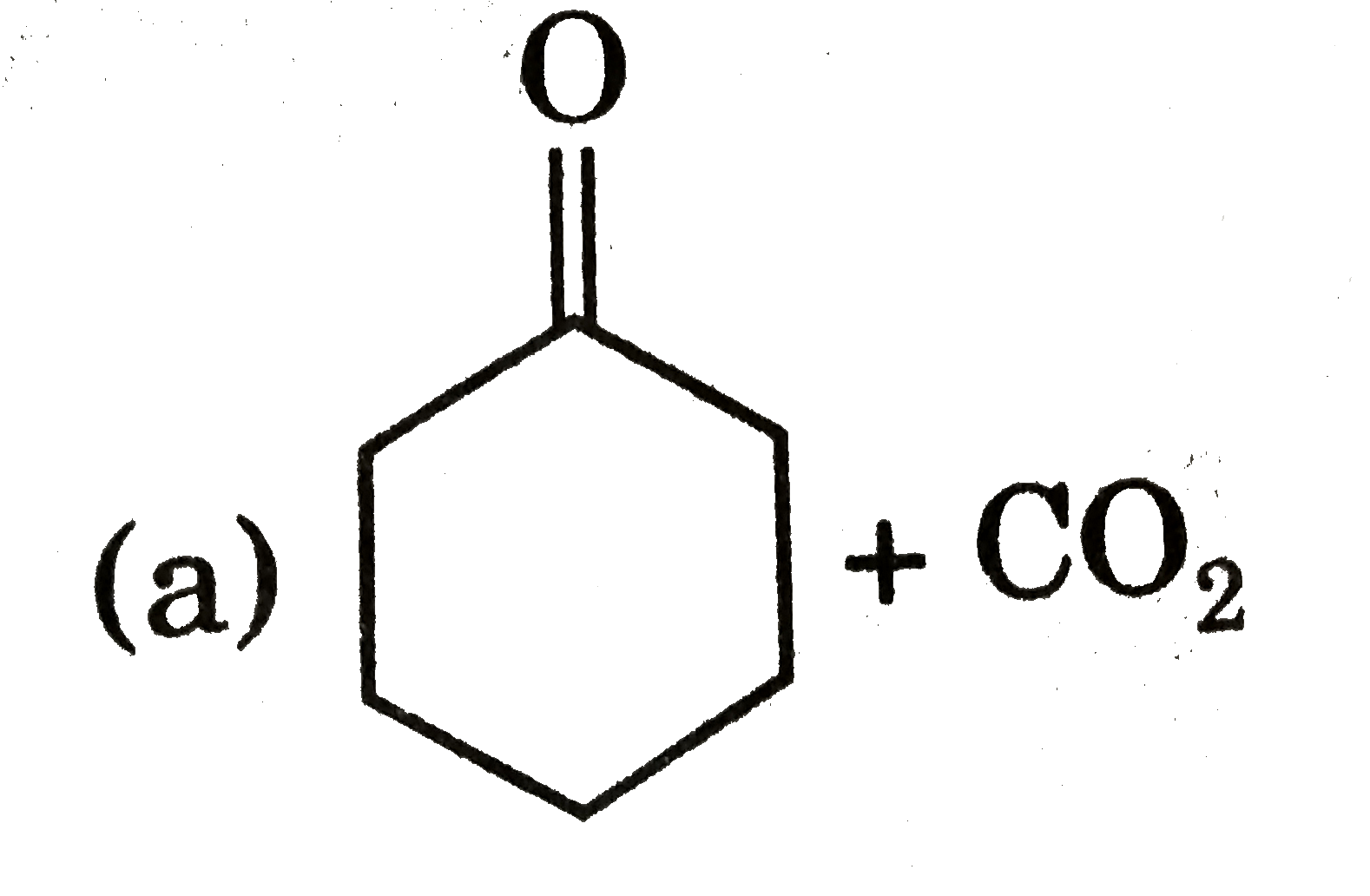 (B) `Ph-CH=CH-Br+CO_(2)+overset(14)CO_(2)`(C ) `Meoverset(14)COONa+CO_(2)`(d) (B) `Ph-CH=CH-Br+CO_(2)+overset(14)CO_(2)`(C ) `Meoverset(14)COONa+CO_(2)`(d) 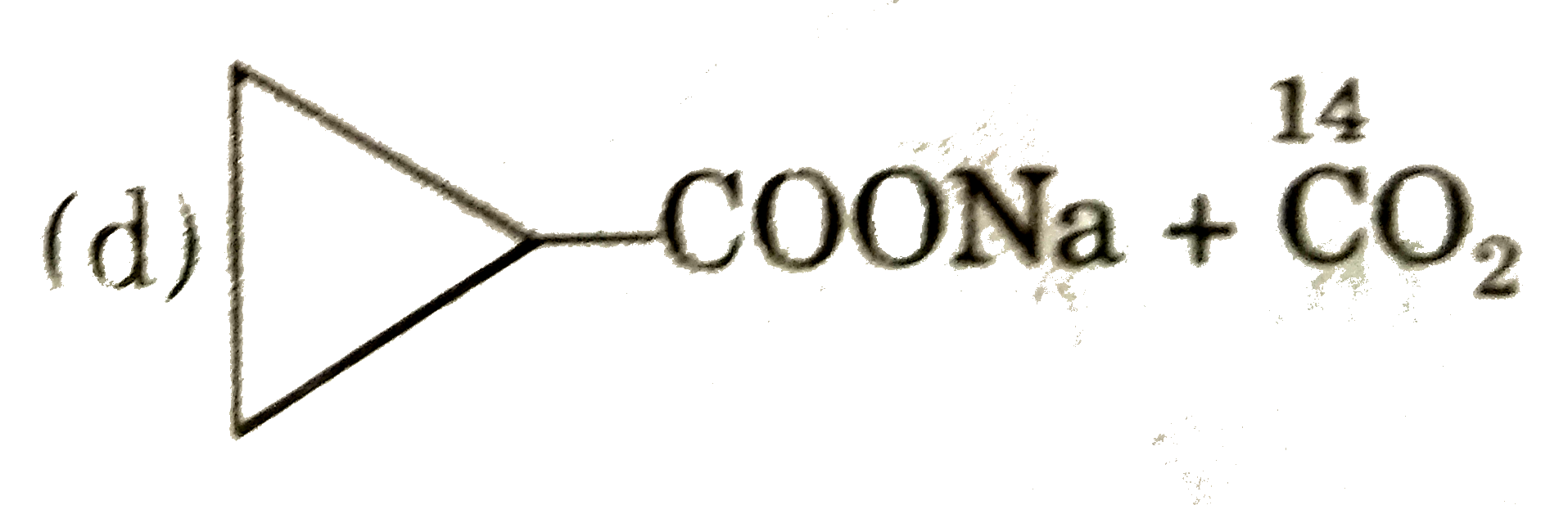
|
|
| 26. |
In which of the following reactions of alcohol there is no cleavage of C-O bond |
|
Answer» Oxidation REACTION of ALCOHOL `R-CH_(2)-Ohoverset("pcc")to R-CHO` |
|
| 27. |
In which of the following reactions of alcohol there is no cleavage of C-O bond ? |
|
Answer» OXIDATION REACTION of ALCOHOL |
|
| 28. |
In which of the following reactions new carbon – carbon bond is not formed? |
|
Answer» ALDOL condensation |
|
| 29. |
In which of the following complex, the metal ion In which of the following complex, the metal ion t_(2g)^(0),e_(g)^(0), configuration according to CFT |
|
Answer» `[FeF_(6)]^(3-)` |
|
| 30. |
In which of the following complex ions, the magnitude of Delta_(@) (CFSE in octahedral field ) will be minimum ? |
|
Answer» `[CO(en)_3]^(3+)` |
|
| 31. |
In which of the following complex ion the value of magnetic moment (spin only) is sqrt(3)B.M. and oute rd-orbitals is used in hybridization: |
|
Answer» `[Fe(NH_(3))_(6)]^(3+)` `[Fe(NH_(3))_(6)]^(3+),[Mn(CN)_(6)]^(4-) and [Co(NH_(3))_(6)]^(2+)` are inner orbital complexes and are ALSO paramagnetic in nature having magnetic moment of `sqrt(3)B.M.` |
|
| 32. |
In which of the following complex ion, the central metal ion is in a state of sp^(3)d^(2) hybridisation ? |
|
Answer» `[CoF_(6)]^(3-)` 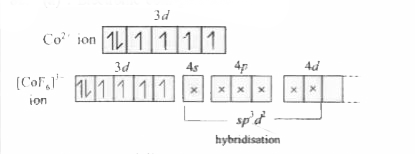 `F^(-)`, being a weak LIGAND cannot cause forcible PAIRING of ELECTRONS within d subshell and forms outer orbital octahedral complex. `[Co(NH_(3))_(6)]^(3+)` ion : 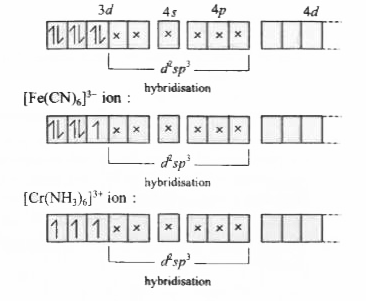 `NH_(3)` and `CN^(-)` are strong ligands, so they form inner orbital octahedral complex. |
|
| 33. |
In which of the following reactions new carboncarbon bond is not formed? |
|
Answer» CANNIZZARO REACTION |
|
| 34. |
In which of the following reactions new carbon-carbon bond is not formed |
|
Answer» CANNIZZARO reaction |
|
| 35. |
In which of the following reactions new carbon-carbon bond is not formed. |
|
Answer» Cannizzaro's reaction |
|
| 36. |
In which of the following reactions migration of alkyl group from carbon to oxygen is observed ? |
|
Answer» Pinacol-pinacolone rearrangement |
|
| 37. |
In which of the following reactions, increase in the volume t constant temperaturee don't affect the number of moles at equlibrium |
|
Answer» `2NH_(3)hArrN_(2)+3H_(2)` |
|
| 38. |
In which of the following reactions K_p = K_c ? |
|
Answer» `N_2(G)+3H_2(g) HARR 2NH_3(g)` |
|
| 39. |
In which of the following reactions, increase in the pressure at constant temperature does not affect the moles at equilibrium? |
|
Answer» `H_2(g)+ 1/2 O_2(g) ltimpliesH_2O(g)` |
|
| 40. |
In which of the following reactions, increase in the pressure at constant temperature does not affect the moles at equilibrium. |
|
Answer» `2NH_(3)(G)hArrN_(2)(g) + 3H_(2)(g)` |
|
| 41. |
In which of the following reactions heterogenous catalysis is involved ? (i) 2SO_(2)(g)+O_(2)(g)overset(No(g))to 2SO_(3)(g) (ii) 2SO_(2)(g)overset(Pt(s))to2SO_(3)(g) (iii) N_(2)(g)+3H_(2)(g)overset(Fe(s))to2NH_(3)(g) (iv) CH_(3)COOCH_(3)(l)+H_(2)O(l)overset(HCl(l))toCH_(3)CJJOH(aq)+CH_(3)OH(aq) |
|
Answer» (II),(III) |
|
| 42. |
In which of the followingcombination of reagents precipitate is not formed. |
|
Answer» `Mn^(2+)(aq).+H_(2)O_(2)+NH_(3)" solution"` HI follows markovnikov's addition in the presence or ABSENCE of peroxide. |
|
| 43. |
In which of the following reactions HNO_3will not act as an oxidizing agent? |
|
Answer» `HNO_3 + H_2SO_4 to ` In this reaction `HNO_3` is acting as `OH^-` donor and `H_2SO_4` as `H^+`donor. This is not a redox reaction. |
|
| 44. |
In which of the following combination , beta-hydroxy carbonyl is obtained ? |
|
Answer» <P>(I)(i)(P) |
|
| 45. |
In which of the following reactions hydrogen gas is liberated ? |
|
Answer» `CH_(3) COOH + Na` |
|
| 46. |
In which of the following combination hybridisation of central atom (**) does not change ? |
|
Answer» `H_(2)O+ overset(**)CO_(2)` |
|
| 47. |
In which of the following reactions heterogeneous catalysis is involved?(i) 2SO_(2)(g)+O_(2)(g) overset(NO(g))(to) 2SO_(3)(g) (ii) 2SO_(2)(g) overset(Pt(s))(to) 2SO_(3)(g) (iii) N_(2)(g)+3H_(2)(g) overset(Fe(s))(to) 2NH_(3)(g) (iv) CH_(3)COOCH_(3)(l)+H_(2)O(l) overset(HCl(l))(to)CH_(3)COOH(aq)+CH_(3)OH(aq) |
|
Answer» (II), (III) |
|
| 48. |
In which of the following Cl- is not easily replaced? |
|
Answer» `CH_(3)CH_(2)Cl` |
|
| 49. |
In which of the following reactions heterogeneous catalysis is involved ? (i)2SO_(2(g))+O_(2(g))overset(NO_((g)))rarr 2SO_(3(g)) (ii) 2SO_(2(g))overset(Pt_(s))rarr 2SO_(3(g)) (iii) N_(2(g))+3H_(2(g))overset(Fe_(s))rarr 2NH_(3(g)) (iv) CH_(3)COOCH_(3(l))+H_(2)O_((l))overset(HCl_((l)))rarr CH_(3)COOH_((aq))+CH_(3)OH_((aq)) |
|
Answer» (ii), (iii) |
|