Saved Bookmarks
This section includes 7 InterviewSolutions, each offering curated multiple-choice questions to sharpen your Current Affairs knowledge and support exam preparation. Choose a topic below to get started.
| 1. |
In the following reaction , CH_2 = CH underset((ii) Zn//H_2O)overset((i) O_3)(to) X overset(NH_3)(to) Y'y' is |
|
Answer» formaldehyde `Y- (CH_2)_6N_4` |
|
| 2. |
In the bleaching action of SO_(2) ________ |
|
Answer» `SO_(2)` is REDUCED |
|
| 3. |
In the following reaction, C_(6)H_(5)CH_(2)Br underset((ii)H_(3)O^(+))overset((i)" Mg, ether")toX, the product 'X' is |
|
Answer» `C_(6)H_(5)CH_(2)OCH_(2)C_(6)H_(5)` |
|
| 4. |
In the blast furnace, the reaction that is taking place at the temperature zone of 900 K to 1500 K is |
|
Answer» `FEO + CO to Fe + CO_(2)` |
|
| 5. |
In the following reaction , C_(6)H_(5)CH_(2)Broverset(1.Mg,Ether)underset(2.H_(3)O^(+))rarrX, the product 'X' is |
|
Answer» `C_(6)H_(5)CH_(2)OCH_(2)C_(6)H_(5)` |
|
| 6. |
In the blast furnace for manufacturing iron, most of the reduction is carried out by CO rather than C (coke). How can you account for this? |
|
Answer» |
|
| 7. |
In the Bessemer Converter process, Bessemer Converter is line with 'X' when pig iron contains phosphrous, while it is lined with 'Y' when pig iron contains manganese as impurity. Here substances X and Y are |
|
Answer» `SiO_(2) " and " SiO_(2)` |
|
| 8. |
In the following reaction, C_(2)H_(5)OC_(2)H_(5) overset("Red P"+HI)to 2X+H_(2)O X is |
|
Answer» ethane |
|
| 9. |
In the Bessemer and open-hearth process for the manufacture of steel, which one of the following is used for the removal of carbon in part or whole |
|
Answer» `{:("BESSEMER","Open-hearth"),("(a)Ferric oxide","Air"):}` |
|
| 10. |
In the following reaction C_(2)H_(5)OC_(2)H_(5) + 4[H] overset("red " P+HI)to 2X + H_(2)O, X is |
|
Answer» Ethane |
|
| 11. |
In the following reaction C_2H_6C(CH_3)(C_6H_5)Br |
|
Answer» `C_6H_5CH_3` |
|
| 12. |
In the following reaction C_2H_5OC_2H_5+4[H]overset(Red P+HI)to 2X+H_2O X is |
|
Answer» Ethane |
|
| 13. |
In the Bayer's process of purification of red bauxtile leaching agent is |
| Answer» Answer :1 | |
| 14. |
In the following reaction, C_(2)H_(5)OC_(2)H_(5)+4H overset("Red "P+HI)to 2X+H_(2)O X is |
|
Answer» ethane |
|
| 15. |
In the balanced equation - [Zn+H^(+)+NO_(3)^(-)rarr NH_(4)^(-) rarr NH_(4)^(+) +Zn^(+2)+H_(2)O] coefficient of NH_(4)^(+) is :- |
|
Answer» 4 |
|
| 16. |
In the following reaction, C is CH_(3) - CH = CH_(2) overset(HI)(to) A overset(KCN)(to) B overset(H_(2)O//H^(+))(to) C |
|
Answer» `CH_(3) CH_(2) COOH` 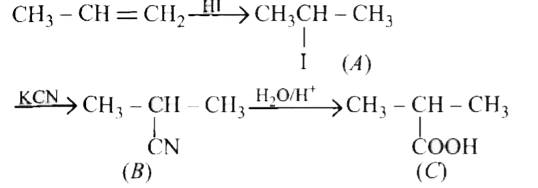
|
|
| 17. |
In the Bayer's process of purification of red hauxite the leaching agent is |
| Answer» ANSWER :A | |
| 18. |
In the following reaction C_2H_5OC_2H_5+ 4[H] overset( "Red" P+ HI) to 2X +H_2O, Xis |
|
Answer» ETHANE |
|
| 19. |
In the following reaction, B is ltBrgt A overset("Bromination")to B overset(NaNO_(2)//HCl)toCunderset(C_(2)H_(5)OH)overset("Boiling")tosym-tribromobenzene |
|
Answer» SALICYCLIC acid 
|
|
| 20. |
In the Bacyer's process, the leaching of alumina is done by using |
|
Answer» `Na_(2)CO_(3)` `Al_(2)O_(3)+2NaOH+3H_(2)Orarr 2Na[Al(OH)_(4)]` `2Na[Al(OH)_(4)]+2CO_(2)rarrAl_(2)O_(3).xH_(2)O+2NaHCO_(3)` `Al_(2)O_(3).xH_(2)O overset(1470K)rarr Al_(2)O_(3)+xH_(2)O` |
|
| 21. |
in thefollowingreaction "Aldeyde +ALcohol "overset( HCl) to " Acetal " {:("Aldehyde ","Alcohol"),(HCHO,""^(t)BuOH),(CH_(3)CHO,MeOH):} the bestcombination is : |
|
Answer» HCHO and MEOH |
|
| 22. |
In the balance chemical equation : IO_(3)^(-)aI^(-)+bH^(+)tocH_(2)O+dI_(2)a,b,c and d respectively correspond to |
|
Answer» 5,6,3,3 |
|
| 23. |
In the Avogadro's number 6.023xx10^(23) the number of significant figures will be: |
|
Answer» |
|
| 25. |
In the Auto oxidation taking place in Bessemer converter during the extraction of copper. The change in oxidation state of sulphur in this process is |
|
Answer» |
|
| 26. |
In the atmosphere, carbon dioxide is found in two forms, i.e., .^(12)CO_(2) and .^(14)CO_(2). Plants absorb CO_(2) during photosynthesis. In presence of chlorophyll, plants synthesise glucose. 6 CO_(2) + 6 H_(2) O to overset(hv)(to) C_(6)H_(12)O_(6) + 6O_(2) uarr Half life of .^(14)C is 5760 years. The analysis of wooden artifacts for .^(14)C and .^(12)C gives useful information for deermination of its age. all living organisms, because of their constant exchange of CO_(2) with the surrounding have the same ratio of .^(14)C to .^(12)C, i.e., 1.3 xx 10^(-12). When an organism dies, the .^(14)C in it keeps on decaying as follows: ._(6)^(14)C to ._(7)^(14)N + ._(-1)^(0)e + Energy Thus, the ratio .^(14)C//^(12)C decrease with the passage of time. we can be used to date anything made of organic matter, e.g., bone, skeleton, wood, etc. Using carbon dating material have been dated to about 50,000 years with accuracy. A piece of wood from an archaeological source shows a .^(14)C activity which is 60% of the activity found in fresh wood today. The age of archaeological sample will be: |
|
Answer» 4246 yrs |
|
| 27. |
In the following reaction : [AI](H_(2)O)_(6)]^(3)+H_(2)O hArr H_(3)O+[AI(H_(2)O)_(5)OH]^(+2) |
|
Answer» A is an acid, B is a base |
|
| 28. |
In the atomic spectrum of hydrogen the series of lines observed in the visible region is: |
|
Answer» BALMER series |
|
| 29. |
In the following reaction: (AAK_MCP_37_NEET_CHE_E37_013_Q01) The major product, P is |
|
Answer»
|
|
| 30. |
In the atmosphere, carbon dioxide is found in two forms, i.e., .^(12)CO_(2) and .^(14)CO_(2). Plants absorb CO_(2) during photosynthesis. In presence of chlorophyll, plants synthesise glucose. 6 CO_(2) + 6 H_(2) O to overset(hv)(to) C_(6)H_(12)O_(6) + 6O_(2) uarr Half life of .^(14)C is 5760 years. The analysis of wooden artifacts for .^(14)C and .^(12)C gives useful information for deermination of its age. all living organisms, because of their constant exchange of CO_(2) with the surrounding have the same ratio of .^(14)C to .^(12)C, i.e., 1.3 xx 10^(-12). When an organism dies, the .^(14)C in it keeps on decaying as follows: ._(6)^(14)C to ._(7)^(14)N + ._(-1)^(0)e + Energy Thus, the ratio .^(14)C//^(12)C decrease with the passage of time. we can be used to date anything made of organic matter, e.g., bone, skeleton, wood, etc. Using carbon dating material have been dated to about 50,000 years with accuracy. A sample of ancient wooden boat is found to undergo 9 dpm g^(-1) of .^(14)C What is the approximate age of the boat? The rate of disintegration of wood recently cut down is 15 dpm g^(-1) of .^(14)C |
|
Answer» 4246.5 years |
|
| 31. |
In the following reaction A and B, respectively are Aoverset"HBr"to C_2H_5BroversetB to A |
|
Answer» `C_2H_4, ALC. KOH//Delta` |
|
| 32. |
In the atmosphere, carbon dioxide is found in two forms, i.e., .^(12)CO_(2) and .^(14)CO_(2). Plants absorb CO_(2) during photosynthesis. In presence of chlorophyll, plants synthesise glucose. 6 CO_(2) + 6 H_(2) O to overset(hv)(to) C_(6)H_(12)O_(6) + 6O_(2) uarr Half life of .^(14)C is 5760 years. The analysis of wooden artifacts for .^(14)C and .^(12)C gives useful information for deermination of its age. all living organisms, because of their constant exchange of CO_(2) with the surrounding have the same ratio of .^(14)C to .^(12)C, i.e., 1.3 xx 10^(-12). When an organism dies, the .^(14)C in it keeps on decaying as follows: ._(6)^(14)C to ._(7)^(14)N + ._(-1)^(0)e + Energy Thus, the ratio .^(14)C//^(12)C decrease with the passage of time. we can be used to date anything made of organic matter, e.g., bone, skeleton, wood, etc. Using carbon dating material have been dated to about 50,000 years with accuracy. .^(14)C exists in atmosphere due to |
|
Answer» conversion of `.^(12)C` to `.^(14)C` |
|
| 33. |
In the following reaction X and Y respectively CH_3 COOH + NH_3 to X underset(Delta)to Y + H_2 O |
|
Answer» `CH_3CONH_2 , CH_4` |
|
| 34. |
In the atmosphere, carbon dioxide is found in two forms, i.e., .^(12)CO_(2) and .^(14)CO_(2). Plants absorb CO_(2) during photosynthesis. In presence of chlorophyll, plants synthesise glucose. 6 CO_(2) + 6 H_(2) O to overset(hv)(to) C_(6)H_(12)O_(6) + 6O_(2) uarr Half life of .^(14)C is 5760 years. The analysis of wooden artifacts for .^(14)C and .^(12)C gives useful information for deermination of its age. all living organisms, because of their constant exchange of CO_(2) with the surrounding have the same ratio of .^(14)C to .^(12)C, i.e., 1.3 xx 10^(-12). When an organism dies, the .^(14)C in it keeps on decaying as follows: ._(6)^(14)C to ._(7)^(14)N + ._(-1)^(0)e + Energy Thus, the ratio .^(14)C//^(12)C decrease with the passage of time. we can be used to date anything made of organic matter, e.g., bone, skeleton, wood, etc. Using carbon dating material have been dated to about 50,000 years with accuracy. In the process of photosythesis, O_(2) gas is released form: |
|
Answer» `CO_(2)` |
|
| 35. |
In the following reaction, 3Br_(2) + 6CO_(3)^(2-) + H_(2)O to 5Br^(-) + BrO_(3)^(-) + 6HCO_(3)^(-) |
|
Answer» |
|
| 36. |
In the atmosphere N_2 is present as element with O_2 because |
|
Answer» `N_2` is more REACTIVE |
|
| 37. |
In the artificial transmutation of elements, Alchemists was interested to convert basic metals like iron into precious metals like gold. A number of subatomic particles was used as projectiles to hit the nuclei after accelerating these particles in cyclotron. The ejectiles were also generally some subatomic particles or in some cases, only gamma-radiation were emitted. These nuclear reactions are generally represented by Bethe's notation. In certain cases it is observed that artificial transmutation of a stable nucleus gives a radioisotope which disintegrates by itself like a natural radioactive element. The phenomenon is called induced radioactivity. Which one of the following is not an example of induced radioactivity |
|
Answer» `{:(._(2)^(4) He +,._(12)^(24)Mg rarr ._(14)^(27)Si + ._(0)n^(1)),(,._(14)^(27)Si rarr ._(13)^(27)Al + ._(+1)e^(0)):}` |
|
| 38. |
In the following reaction 2X +B_(2)H_(6) to [BH_(2)(X)_(2)]^(+) [BH_(4)]^(-) then X will be : - |
|
Answer» `NH_(3)` if `X=CO`,THF then `2[BH_(3) LARR X]` |
|
| 39. |
In the following reaction 2CH_2=CH_2 +S_2Cl_2 to Prouduct . The Product is |
| Answer» Solution :`2CH_2=CH_2 +S_2Cl_2 to ` Mustard gas | |
| 40. |
In the assembly as shown below, the potential difference across the plates is 4 volts.A positive particle of charge +4e is projected from the negative plate with an initial kinetic energy of 4ev and the negative particle of charge (-2e) is projected from the positive plate.Both the particles reach point 'A' with zero kinetic energy.Find the initial kinetic energy of the negative particle in eV. |
|
Answer» Solution :For the positive particle , applying energy CONSERVATION initially and at a POINT A `K.E._1+P.E._1=K.E._1+P.E._1` `implies 4eV+(+4E)(0V)=0+(+4e)(x"VOLT") " " (x="potential at point A")` `implies x=1` volt Now applying energy conservation for the negative particle at point 'A' and initially `implies K.E._1+(-2e)(4V)=0+(-2e)(1"volt")` `K.E._1-8eV=-2eV` `implies K.E._1=6eV` |
|
| 41. |
In the following radioactive decay : ""_(92)X^(232)to_(89)Y^(220) how many alpha and beta-particles are ejected? |
|
Answer» `3alpha` and `3beta` |
|
| 42. |
In the artificial transmutation of elements, Alchemists was interested to convert basic metals like iron into precious metals like gold. A number of subatomic particles was used as projectiles to hit the nuclei after accelerating these particles in cyclotron. The ejectiles were also generally some subatomic particles or in some cases, only gamma-radiation were emitted. These nuclear reactions are generally represented by Bethe's notation. In certain cases it is observed that artificial transmutation of a stable nucleus gives a radioisotope which disintegrates by itself like a natural radioactive element. The phenomenon is called induced radioactivity. Which one of the following notations shows the product incorrectly |
|
Answer» `._(96)Cm^(242) (alpha, 2n) ._(97)Bk^(243)` |
|
| 43. |
In the following questions, a statement of assertion is followed by a statement of reason. Mark the Correct choice as: Assertion: The order of basicity of amnines in the gaseous phase follows the order : 3^(@)" amines" gt 2^(@)" amines"gt 1^(@)gt" amines". Reason: Amines have an unshared pair of electrons on nitrogen atom due to which they behave as lewis abse. |
|
Answer» If both ASSERTION and REASON are true and reason in the CORRECT explanation of assertion |
|
| 44. |
In the artificial transmutation of elements, Alchemists was interested to convert basic metals like iron into precious metals like gold. A number of subatomic particles was used as projectiles to hit the nuclei after accelerating these particles in cyclotron. The ejectiles were also generally some subatomic particles or in some cases, only gamma-radiation were emitted. These nuclear reactions are generally represented by Bethe's notation. In certain cases it is observed that artificial transmutation of a stable nucleus gives a radioisotope which disintegrates by itself like a natural radioactive element. The phenomenon is called induced radioactivity. The following nuclear transmutation ._(11)Na^(23) + ._(1)H^(1) rarr ._(12)Mg^(23) + ._(0)n^(1) belongs to |
|
Answer» <P>(n,p) Type |
|
| 45. |
In the following questions, a statement of assertion (A) is following by a statement of reason (R ) A : when chloroform is obtained from bleaching powder and ethanol then chlorine acts as oxidising agent only. R : It oxidises ethanol into acetic acid. |
|
Answer» If both ASSERTION & Reason are the reason is the correct explanation of the assertion, then mark (1). |
|
| 46. |
In the artificial transmutation of elements, Alchemists was interested to convert basic metals like iron into precious metals like gold. A number of subatomic particles was used as projectiles to hit the nuclei after accelerating these particles in cyclotron. The ejectiles were also generally some subatomic particles or in some cases, only gamma-radiation were emitted. These nuclear reactions are generally represented by Bethe's notation. In certain cases it is observed that artificial transmutation of a stable nucleus gives a radioisotope which disintegrates by itself like a natural radioactive element. The phenomenon is called induced radioactivity. What is X in the following nuclear reaction ._(7)^(14)N + ._(1)^(1)H rarr ._(8)^(15)O + 'X' |
|
Answer» `._(0)N^(1)` |
|
| 47. |
In the following questions, a statement of assertion (A) is following by a statement of reason (R ) A: In benzyne the hybridisation of triply bonded carbon is SP^(2) . R: The second pi-bondis formed by sp^(2) hybrid orbital . |
|
Answer» If both Assertion & Reason are the reason is the CORRECT explanation of the assertion, then mark (1). |
|
| 48. |
In the following questions, a statement of assertion (A) is following by a statement of reason (R ) A : The number oif optically active isomers of tartaric acid contains two asymmetric carbon . |
|
Answer» If both Assertion & Reason are the reason is the correct explanation of the assertion, then mark (1). |
|
| 49. |
In the following questions, a statement of assertion (A) is followed by a statement of reason (R ) A : O_(2) is paramagnetic . R : N_(2) is paramagnetic . |
|
Answer» If both ASSERTION & Reason are TRUE and the reason is the correct EXPLANATION of the assertion, then mark (1) |
|
| 50. |
In the Arrhenius plot of ln k vs (1)/(T) , a linear plot is obtained with a slope of -2 xx 10^(4) K . The energy of activationof the reaction (in kJ "mole"^(-1)) is (R value is 8.3 JK^(-1) mol^(-1)) |
|
Answer» 83 ln k= ln A - `E_(a)//RT`For ln k vs 1/T ln A = INTERCEPT `-E_(a)//R` = slope = `-2 xx 10^(4)` K `E_(a) = R xx 2 xx 10^(4) K = 8.3 xx 2 xx 10^(4) J "MOL"^(-1)` `16.6 xx 10^(4) J mol^(-1)` or 166 kJ `mol^(-1)` |
|