

Saved Bookmarks
This section includes 7 InterviewSolutions, each offering curated multiple-choice questions to sharpen your Current Affairs knowledge and support exam preparation. Choose a topic below to get started.
| 1. |
In solid state PCl_(5) is a ........ . |
|
Answer» covalent solid |
|
| 2. |
In solid state PCl_(15)is a............ |
|
Answer» Covalent SOLID `2PC_(5) to [PCl_(4)]^(+) + [PCl_(6)]^(-)` |
|
| 3. |
Aluminium chloride exists as a dimer, Al_(2)Cl_(6) in solid state as well as in solution of non-polar solvents such as benzene. When dissolved in water, it gives : |
|
Answer» `AL^(3+) +3Cl^(-)` |
|
| 4. |
In solid state, PCI_5, is a |
|
Answer» COVALENT SOLID |
|
| 5. |
In solid N_(2)O_(3) and solid N_(2)O_(5),N-O hybridization in cationic part are respectively: |
|
Answer» `SP^(2)` and `sp` |
|
| 6. |
In solid PCl_(5) exist as |
|
Answer» `PCl_(3)` |
|
| 7. |
In solid cyclic form of SO_(3), each sulphur atom is surrounded by …… oxygen atoms |
|
Answer» 4 |
|
| 8. |
Intramolecular hydrogen bonding is found in : |
|
Answer» IONIC |
|
| 9. |
In solid CuSO_4.5H_2O,copper is coordinated to: |
|
Answer» 4 WATER molecules |
|
| 10. |
In solid CuSO_(4).5H_(2)O copper is coordinated to |
|
Answer» 4 WATER molecules 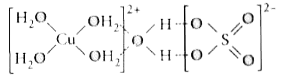
|
|
| 11. |
In solid CuSO_(4).5H_(2)O |
|
Answer» Five molecules of `H_(2)O` are COORDINATE bonded to `Cu^(2+)` (b) Is not possible `because CL^(Theta)` is not a reducing agent Is CORRECT because `I^(-)` is a reducing agent `2CuSO_(4)+4KIrarr Cu_(2)I_(2)+I_(2)+K_(2)SO_(4)` |
|
| 12. |
in solid CuSO_4 .5H_2O copper is co-ordinated to: |
|
Answer» 4 WATER molecules |
|
| 13. |
In solid argon, the atoms are held together by: |
|
Answer» Ionic bonds |
|
| 14. |
In sodium tetrafluorooxochromate (…...),Na_3[Cr(O)F_4]- the left out place should be filled with which of the following Roman numerals: |
| Answer» Answer :B | |
| 15. |
In sodium nitroprusside the oxidation number, coordination number and EAN of iron are respectively. [If your answer is 1, 2, 24 then write the answer as 1224] |
|
Answer» EAN=26-2+12=36 |
|
| 17. |
In sodium nitroprusside, The oxidation number coordination No. and effective atomic number of iron are respectively: |
|
Answer» `+3, 6, 36` |
|
| 18. |
In sodium fusion tests why excess of sodium is taken? |
| Answer» Solution :If sulphur and nitrogen both are present SODIUM thiocyanate (NACNS) MAY be PRODUCED this may GIVE a red coloration with `Fe^(3+)` but will not respond to tests for cyanide or sulphide ions. With excess of sodium the thiocyanate if formed will be decomposed like this `NaCNS+2Na to NaCN+Na_(2)S`. | |
| 19. |
In sodium fusion test of roganilc compound, the nitrogen of a organic compound is converted into [If only C,H,N are present |
|
Answer» `NaCN` (B), (c) and (d) are RULED out |
|
| 20. |
In sodium fusion test of organic compounds, the nitrogen of an organic compound is converted to : |
|
Answer» SODIUM cyanide |
|
| 21. |
In SOCl_2, the Cl-S-Cl and Cl-S-O bond angles are |
|
Answer» `130^(@)` and `115^(@)` |
|
| 22. |
In sodium extract test of organic compounds, the nitrogen of an organic compound is converted into: |
|
Answer» SODAMIDE |
|
| 23. |
In SOCl_(2), the Cl-S-Cl and Cl-S-O bond angles are |
|
Answer» `130^(@) and 115^(@)` Hybridization of `S = (1)/(2) [1 XX 6 (S) + 0 (=0) + 2 xx 1 (Cl) ] = 4` Thus, S is `sp^(3)`-hydridized. Since `SOCl_(2)` has only three `sigma`-bonds, therefore, it has one lone pair and hence its shape is pyramidal. Further, since `pi`- electrons of the S = O bond are more polarized, therefore, they repel the bond pair of S-Cl bonds. In other words, Cl-S-O bond angle `(106^(@))` is larger than Cl-S-Cl bond angle `(96^(@))`. Hence, option (d) is correct. 
|
|
| 24. |
In SOCl_(2) and SO_(2)Cl_(2) |
|
Answer» The OXIDATION STATE of sulphuris different |
|
| 25. |
In SOCI_(2) , the CI-S-CI and CI-S-O bond angles are |
|
Answer» `130^@` and `115^@` |
|
| 27. |
In SO_(3), a double bond arises between S and O is due to …………………overlapping. |
| Answer» SOLUTION :`ppi-dpi` | |
| 28. |
In S_(N)l ( substitution nucleophilie unimolecular) reaction, the racemisation takes place, It is due to |
|
Answer» inversion of configuration |
|
| 29. |
In reactions the incorrect order of reactivity of nucleophies is |
|
Answer» ` I^(-) gt Br ^(-) gt CL^(-) gt F^(-) ` |
|
| 30. |
In SO_(2) two oxygen atoms are linked to the sulphur atom through double bonds. The two pi bonds are |
|
Answer» <P>both `p _(PI) -p_(pi)` |
|
| 31. |
In S_(N)2 reactions, the correct order of reactivity for the following compounds : CH_(3)Cl,CH_(3)CH_(2)Cl,(CH_(3))_(2)CHCland(CH_(3))_(3)C Cl is : |
|
Answer» `CH_(3)Clgt(CH_(3))_(2)CHClgtCH_(3)CH_(2)Clgt(CH_(3))_(3)C Cl` `CH_(3)ClgtCH_(3)CH_(2)Clgt(CH_(3))_(2)CHClgt(CH_(3))_(3)C Cl` |
|
| 32. |
In S_(N)2 reactions, the correct order of reactivity for the following compounds :CH_(3)Cl, CH_(3)CH_(2)Cl,(CH_(3))_(2)CHCl and (CH_(3))_(3)C Cl is : |
|
Answer» `CH_(3)CH_(2)CL GT CH_(3)Cl gt (CH_(3))_(2)CHCL gt (CH_(3))_(3)C Cl` |
|
| 33. |
In S_(N^(2)) reactions, the correct order of reactivity for the compounds CH_(3)Cl,CH_(3)CH_(2)Cl,(CH_(3))_(2)CHCl and (CH_(3))_(3)C Cl is: |
|
Answer» `CH_(3)Cl gt (CH_(3))_(2) CHCL gt CH_(3)CH_(2)Cl gt (CH_(3))_(3) C Cl` |
|
| 34. |
In SN_(2) reactions, the correct order of reactivity for the following compounds ? CH_(3)CI,CH_(3)CH_(2)CI,(CH_(3))_(3)CHCI"and"(CH_(3))_(3)"CCI" is |
|
Answer» `CH_(3)CH_(2)Cl GT CH_(3) Cl gt (CH_(3) )_(2)CHCl gt (CH_(3) )_(3)"CCl"` Reactivity of `SN^(2) prop (1)/("Steric HINDRANCE ")` ORDER of reactivity towards `S_(N)^(2)` . `CH_(3)CIgtCH_(3)-CH_(2)-CI gt (CH_(3))_(2)CH-CI gt(CH_(3))_(3) C-CI` |
|
| 35. |
In S_(N)2 reactions, the correct order of reactivity for the following compounds: CH_(3)CI,CH_(3)CH_(2)CI,(CH_(3))_(2)CHCI and (CH_(3))_(2)C CI is: |
|
Answer» `CH_(3)CL GT (CH_(3))_(2)CHCl gt CH_(3)Cl_(2)Cl gt (CH_(3))_(3)"CC"L` |
|
| 36. |
In S_(N)2 reactions, the correct order of reactivity for the compounds: CH_(3)CI,CH_(3)CH_(2)CI,(CH_(3))_(2)CHCIand(CH_(3))_(3)C CI- |
|
Answer» `(CH_(3))_(2)CHCIgtCH_(3)CH_(2)CIgtCH_(3)CIgt(CH_(3))_(3)C CI` `underset("methyl")(CH_(3)CI)gtunderset("primary"(1^(@)))(CH_(3)CH_(2)CI)gtunderset("secondary"(2^(@)))((CH_(3))_(2)CHCI)gtunderset("tertiary"(3^(@)))((CH_(3))_(3)C CI)` |
|
| 37. |
In S_(N)2 reaction, the correct order of reactivity for the following compounds: CH_(3)Cl,CH_(3)CH_(2)Cl,(CH_(3))_(2)CHCl and (CH_(3))_(3)C Cl is |
|
Answer» `(CH_(3))_(2)CHCl GT CH_(3)CH_(2)CL gt CH_(3)CL gt (CH_(3))_(3)C Cl` |
|
| 38. |
In S_(N)^(2) reaction the correct order of reactivity of the following compounds: (i) CH_(3)CI(ii) (CH_(3))_(3) C CI (iii) (CH_(3))_(2) CHCI(iv) CH_(3)CH_(2) - CI |
|
Answer» I > II > iii > iv |
|
| 39. |
In S_(N^(1)) (substitution, nucleophilic, unimolecular) reaction, the reacemization takes place, it is due to |
|
Answer» INVERSION of CONFIGURATION |
|
| 40. |
In S_(N)1 type mechanism, the intermediate species is : |
| Answer» Answer :B | |
| 41. |
In S_(N^(1)) (substitution, nucleophilic unimolecular) reaction, the racemization takes place. It is due to |
|
Answer» INVERSION of configuration |
|
| 42. |
In S_(N)1 reactions, the order of reactivity of halides is : |
|
Answer» `3^(@)GT2^(@)GT1^(@)GT` methyl |
|
| 43. |
In S_N1 reactions, rate of reaction depends on a) Concentration of alkyl halide b) Concentration of nucleophile c) Nature of alkyl halide |
|
Answer» All |
|
| 44. |
In SN^(1) reaction the hybridisation changes in rate determination step select the correct change among the following |
|
Answer» from `SP^(3)" to "sp^(2)` |
|
| 45. |
In SN^(1) reaction the first step is the formation of, |
|
Answer» CARBOCATION |
|
| 46. |
In S_(N^1) reaction the first step involves the formation of: |
|
Answer» FREE radical |
|
| 47. |
In S_(N)1 reaction of (S)-2 bromobutane with water Two subsitution products are formed one has the same relative configuration as the reactant and the other has the inverted configuration. This is in most S_(N)1 reactions, the recemic product is non-50:50 mixture i.e, recemization takes place the inverted product is more than 50% . the formation of different composition of the product is due to following stpes involved in S_(N) reactions. R-X "" to R^(+) X^(-) to R^(+) "" "solvent" X^(-) "" to R^(+)+X^(-) {:("Undissociated Molecule", "Intimate ion pair", "solvent-sperated ion pair", "dissociated ions"),(I,II,III,IV):} In the above reaction the non-50 :50 racemic mixturecontains more amount of |
|
Answer» original CONFIGURATION |
|
| 48. |
In S_(N)1 reaction on chiral centres, there is |
|
Answer» INVERSION more than retention reading to PARTIAL racemization |
|
| 49. |
In S_(N)1 reaction of (S)-2 bromobutane with water Two subsitution products are formed one has the same relative configuration as the reactant and the other has the inverted configuration. This is in most S_(N)1 reactions, the recemic product is non-50:50 mixture i.e, recemization takes place the inverted product is more than 50% . the formation of different composition of the product is due to following stpes involved in S_(N) reactions. R-X "" to R^(+) X^(-) to R^(+) "" "solvent" X^(-) "" to R^(+)+X^(-) {:("Undissociated Molecule", "Intimate ion pair", "solvent-sperated ion pair", "dissociated ions"),(I,II,III,IV):} the non-50:50 racemic mixture during S_(N) reaction of an alkyl halide is formed due to the attack of the nucleophile on species |
|
Answer» I |
|
| 50. |
In S_(N)1 reaction of (S)-2 bromobutane with water Two subsitution products are formed one has the same relative configuration as the reactant and the other has the inverted configuration. This is in most S_(N)1 reactions, the recemic product is non-50:50 mixture i.e, recemization takes place the inverted product is more than 50% . the formation of different composition of the product is due to following stpes involved in S_(N) reactions. R-X "" to R^(+) X^(-) to R^(+) "" "solvent" X^(-) "" to R^(+)+X^(-) {:("Undissociated Molecule", "Intimate ion pair", "solvent-sperated ion pair", "dissociated ions"),(I,II,III,IV):} 50 : 50 racemic mixture is formed due to the attack of nucleophil on which intermeidate species of the reaction ? |
|
Answer» I |
|