

Saved Bookmarks
This section includes 7 InterviewSolutions, each offering curated multiple-choice questions to sharpen your Current Affairs knowledge and support exam preparation. Choose a topic below to get started.
| 1. |
In NaCl the CI^(-) ions occupy the space in : |
|
Answer» fcc |
|
| 2. |
In NaCl lattice structure if one of the sodium ion is removed from corner, the formula of the resulting compound is ..... |
|
Answer» `Na_7Cl_(24)` Number of `Cl^(-)` ions = `(6 xx 1/2) = 3` `THEREFORE Na^(+) : Cl^(-) = 7/8 : 3 = 7 : 24`. |
|
| 3. |
In NaCl crystal, distance between Na^(+) and Cl^(-) is X pm, then edge length of unit cell = .......... pm. |
| Answer» ANSWER :A | |
| 4. |
In Na_(2)[Fe(CN)_(5)NO], sodium nitroprusside: |
|
Answer» oxidation STATE of FE is +2 |
|
| 5. |
In 'Na_2 O' structure |
|
Answer» `O^2-` IONS CONSTITUTE CCP and 'Na^+' ions occupy all the OCTAHEDRAL holes |
|
| 7. |
In N_(2)O, the N - N distance corresponds to |
|
Answer» N = N  `N_2O` exists in above canonical - FORMS . So N - N BONDS `N_2O` is intermediate b/w N = N and `N-=N`. |
|
| 8. |
In multiplication and division the significant figures of answer must be same as that in the quantity with ……. number of significant figures |
|
Answer» maximum |
|
| 9. |
In N_2 +2H_2O rarr NH_4^+ +NO_2^-,Nis: |
|
Answer» Oxidised |
|
| 10. |
In Mond's process following chemcial changes occurs: underset(("Impure"))(Ni)+CO overset(330-350K)(rarr)[P] [P] overset (450-470K)(rarr) underset(("Pure")) (Ni)+CO Coordination number of Ni in [P] is…... |
|
Answer» |
|
| 11. |
In most close-packed lattices, ______ % of space is filled. |
| Answer» SOLUTION :`74%` of SPACE is FILLED | |
| 12. |
In molecules of the type AX_(2)I_(n) (where L represents lone pair and n is its number) there exists a bond between element A and X. The angle XAX bond angle |
|
Answer» ALWAYS DECREASE if N increase |
|
| 13. |
Predict the percentage of space filled by particles in simple cubic lattice. |
| Answer» SOLUTION :`74%` of SPACE is FILLED | |
| 14. |
In molecular solids, the neutral molecules are held together by weak ……………… |
| Answer» SOLUTION :VANDER WAALS FORCE | |
| 15. |
In moist air copper corrodesto produce a green layer on the surface. What is that layer ? |
| Answer» Solution :Copper, in the presence of MOISTURE, oxygen and carbon dioxide ofatmosphere, is converted into a basic carbonate, called malachite of composition, `CuCO_(3). Cu(OH)_(2)`. Thisbasic carbonate is deposited as green layer on its SURFACE. | |
| 16. |
In moist air copper corrodes to produce a green layer on the suface. Explain. |
|
Answer» Solution :In presence of moist air, a thin film of green basic copper carbonate is formed on its SURFACE and hence copper CORRODES. `2Cu + O_(2) + H_(2)O + CO_(2) rarr underset("Green")(CuCO_(3).Cu(OH)_(2))` |
|
| 17. |
In modern process phosphorus is manufactured by: |
|
Answer» Heating a MIXTURE of PHOSPHORITE mineral with sand and coke in ELECTRIC furnace. |
|
| 18. |
In modern periodic table,the basic character of oxides |
|
Answer» DECREASES from LEFT to right INCREASES from BOTTOM to TOP |
|
| 19. |
In modern periodic table, the position of the element with atomic number '84' is |
|
Answer» 6TH GROUP, 6th period |
|
| 20. |
In Minamata Bay, Japan, which of the following animals remained tree from Minamata disease |
|
Answer» Dogs |
|
| 21. |
In mixture A and 8 components show -ve deviation as |
|
Answer» `Delta V_(MIX) gt0` |
|
| 22. |
In milk which acts as an emulsifier? |
|
Answer» Gelatin |
|
| 23. |
In MgSO_(4) (At. Mass: Mg = 24, S = 32, O = 16), the mass percentage of |
|
Answer» MG = 80% Mass % of Mg `=24/120 xx 100 = 20%` Mass % of S `=32/100 xx 100 = 26.7%` |
|
| 24. |
In methanol, -OH group attached to carbon is ……………….. . |
|
Answer» SP hybridised ATOM |
|
| 25. |
In metropolitan cities like Mumbai and Calcutta, the major atmospheric pollutants are |
|
Answer» CARBON MONOXIDE and OXIDES of sulphur |
|
| 26. |
In metallurgy if iron, charge introduced in the blast furnace consists of __________. |
|
Answer» roasted ORE, SILICA and CALCIUM hydroxide |
|
| 27. |
In metallurgy the metal used to displace silver from its cyano complex is |
|
Answer» Zn |
|
| 28. |
In metallurgy of iron hot air is blown in blast furnacethrough _________ . |
|
Answer» an INLET |
|
| 29. |
In metallurgy, flux is a substance used to convert |
|
Answer» MINERAL into silicate |
|
| 30. |
In metallurgy , flux is a substance used to convert_________. |
|
Answer» INFUSIBLE IMPURITIES to FUSIBLE METERIAL |
|
| 31. |
In metallurgy , flux is a substance used to convert : |
|
Answer» INFUSIBLE IMPURITIES to FUSIBLE mass |
|
| 32. |
In metallurgy , carbon is important reducing agent, because for the formation of CO_(2) |
|
Answer» `DELTAS` is positive |
|
| 33. |
In metallurgical process, the flux used for removing acidic impurities is : |
|
Answer» SILLICA |
|
| 34. |
In metallurgy, ane may be dissolved in water and the element may be displaced from solution using mother cheap element An E mple for this |
|
Answer» SOLUTION of CD + ZN metal<BR>Sea water CONTAINING `Br_(2)+Cl_(2)` |
|
| 35. |
In metallurgical process of Al, cryolite is mixed in its molten state, because it |
|
Answer» decreases the AMOUNT of alumina |
|
| 36. |
In metallic conductor the current is conducted by flow of |
|
Answer» ions |
|
| 37. |
In metal carbonyls, there is synergic bonding interaction between metal and carbon monoxide.This leads to increase in strength of metal ligand bond and decrease in bond order of CO in carbonyl complex as compared to bond order in carbon monoxide. Simple carbonyls are invariably spin-paired complexes except for vanadium metal. Which one of the following metal carbonyls involves the d^2sp^3 hybridisation for the formation of metal-carbon sigma bonds and is paramagnetic ? |
|
Answer» `[Cr(CO)_6]` 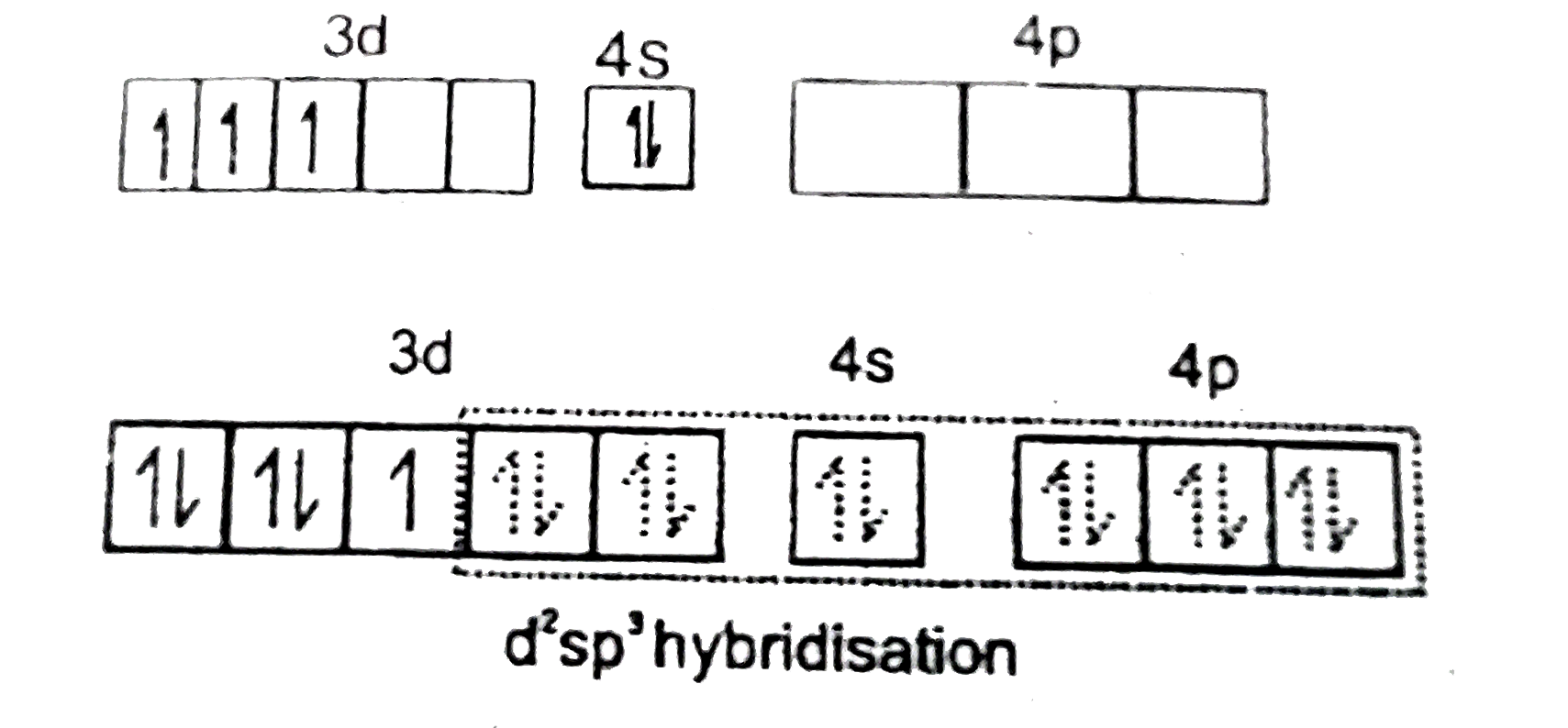
|
|
| 38. |
In metal carbonyls, there is synergic bonding interaction between metal and carbon monoxide.This leads to increase in strength of metal ligand bond and decrease in bond order of CO in carbonyl complex as compared to bond order in carbon monoxide. Simple carbonyls are invariably spin-paired complexes except for vanadium metal. Which amongst the following metal carbonyls are inner orbital complexes with diamagnetic property ? (I)Ni(CO)_4 , (II)Fe(CO)_5 , (III)V(CO)_6 , (IV)Cr(CO)_6 Select the correct answer from the codes given below : |
|
Answer» I and II only `Ni(CO)_4-sp^3`, diamagnetic `Fe(CO)_5-dsp^3`, diamagnetic `V(CO)_6-d^2sp^3` paramagnetic with one unpaired electron `Cr(CO)_6-d^2sp^3`, diamagnetic |
|
| 39. |
In metal carbonyls, there is synergic bonding interaction between metal and carbon monoxide.This leads to increase in strength of metal ligand bond and decrease in bond order of CO in carbonyl complex as compared to bond order in carbon monoxide. Simple carbonyls are invariably spin-paired complexes except for vanadium metal. In metal carbonyls, the increase in C-O bond length in CO as compared to carbon monoxideis due to : |
|
Answer» The donation of lone PAIR of electrons on the carbon into a vacant orbital of the metal atom Bond order `PROP 1/("Bond length")` |
|
| 40. |
In metal lattices the co-ordination number of metal atom is usually |
| Answer» Answer :D | |
| 41. |
In metal carbonyls, there is synergic bonding interaction between metal and carbon monoxide. This leads to increase in strength of metal ligands bond and decrease in bond order of CO in carbonyl complex as compared to bond order in carbon monoxide. Simple carbonyls are invariably spin-paired complexes except for vanadium metal. Which one of the following metal carbonyl involves the d^(2)sp^(3) hybridization for the formation of metal-carbon sigma" "bonds and is paramagnetic ? |
|
Answer» `[Cr(CO)_(6)]` |
|
| 42. |
In metal carbonyls, there is synergic bonding interaction between metal and carbon monoxide. This leads to increase in strength of metal ligands bond and decrease in bond order of CO in carbonyl complex as compared to bond order in carbon monoxide. Simple carbonyls are invariably spin-paired complexes except for vanadium metal. Which of the following statement is correct for metal carbonyls ? |
|
Answer» <P>In general, the effective ATOMIC number for a stable monomeric of the next INERT gas except `[V(CO)_(6)]`. |
|
| 43. |
In metal carbonyls, there is synergic bonding interaction between metal and carbon monoxide. This leads to increase in strength of metal ligands bond and decrease in bond order of CO in carbonyl complex as compared to bond order in carbon monoxide. Simple carbonyls are invariably spin-paired complexes except for vanadium metal. Which one of the following metal carbonyls are inner orbital complexes with diamagnetic property ? (P) Ni(CO)_(4)""(Q) Fe(CO)_(5) (R ) V(CO)_(6)""(S) Cr(CO)_(6) Select the correct answer from the codes given below : |
|
Answer» P and Q only |
|
| 44. |
In metal carbonyls, there is synergic bonding interaction between metal and carbon monoxide. This leads to increase in strength of metal ligands bond and decrease in bond order of CO in carbonyl complex as compared to bond order in carbon monoxide. Simple carbonyls are invariably spin-paired complexes except for vanadium metal. Which of the following statement is false for nickel carbonyl [Ni(CO)_(4)]? |
|
Answer» It is a colourless compound. |
|
| 45. |
In metal carbonyls, there is synergic bonding interaction between metal and carbon monoxide. This leads to increase in strength of metal ligands bond and decrease in bond order of CO in carbonyl complex as compared to bond order in carbon monoxide. Simple carbonyls are invariably spin-paired complexes except for vanadium metal. The increase in bond length in CO as compared to carbon monoxide is due to : |
|
Answer» the donation of lone pair of electrons on the carbon into a VACANT ORBITAL of the metla atom. |
|
| 46. |
In metal carbonyls the metal carbon bond length is found to be less than the expected bond length. Explain why ? |
Answer» Solution :It is due to SYNERGIC interaction between metal and CO which develops partial double BOND CHARACTER between metal and CO. 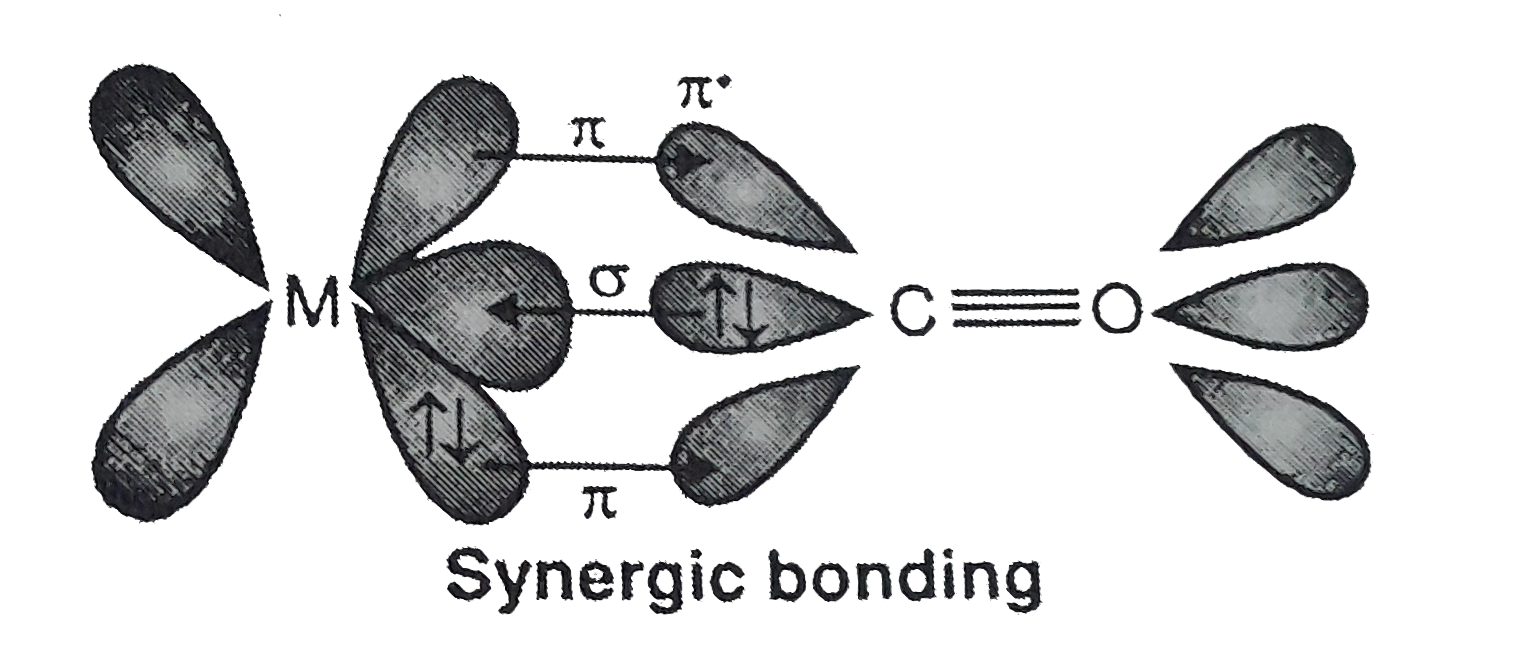
|
|
| 48. |
In metal carbonyls, metal ligand sigma bond is formed by : |
|
Answer» VACANT orbital of metal and LONE pair of carbon |
|
| 49. |
In metal carbonyl , there is __________. |
|
Answer» no `PI` BOND between CO and METAL atom |
|
| 50. |
In metabolic process the maximum energy is given by |
|
Answer» carbohydrates |
|