

Saved Bookmarks
This section includes 7 InterviewSolutions, each offering curated multiple-choice questions to sharpen your Current Affairs knowledge and support exam preparation. Choose a topic below to get started.
| 1. |
If the mole fraction of solute is 0.5 and molar mass of solvent is 50 than molality of solution will be |
|
Answer» 20m |
|
| 2. |
Ifthe molarionicconductivities of K^(+) and I^(-)at zeroconcentrationare 73.4and76.3 Omega^(-1) cm^(2) mol^(-1) respectivelycalculatethe molarconductivityof K1at zeroconcentration |
| Answer» SOLUTION :` 149. 7 OMEGA^(-1)CM^(2) mol^(-1)` | |
| 3. |
If the molar conductivities at infinite dilution of NaCl, HCl and CH_(3)COONa(NaAc) are 126.4, 425.9 and 91.0 S cm^(2)mol^(-1) respectively, what will be that of acetic acid (Hac)? |
|
Answer» Solution :According to KOHLRAUSCH's law, `wedge^(@)` for `CH_(3)COOH=lamda_(CH_(3)COO^(-))^(@)+lamda_(H^(+))^(@)` `wedge^(@)` for NaCl=`lamda_(Na^(+))^(@)+lamda_(Cl^(-))^(@)=126.4" S "cm^(2)mol^(-1)`. . . (i) `wedge^(@)` for `HCl=lamda_(H^(+))^(@)+lamda_(Cl^(-))^(@)=425.9" S "cm^(2)mol^(-1)`. . . (ii) `wedge^(@)` for `CH_(3)COONa=lamda_(CH_(3)COO^(-))^(@)+lamda_(Na^(+))^(@)=91.0" S "cm^(2)mol^(-1)`. . . (III) ADDING eqns. (ii) and (iii) and subtracting (i), we get `lamda_(H^(+))^(@)+lamda_(Cl^(-))^(@)+lamda_(CH_(3)COO^(-))^(@)-lamda_(Na^(+))^(@)-lamda_(Na^(+))^(@)-lamda_(Cl^(-))^(@)=425.9+91.0-126.4" S "cm^(2)mol^(-1)` or `lamda_(CH_(3)COO^(-))^(@)+lamda_(H^(+))^(@)=390.5" S "cm^(2)mol^(-1)` i.e., `wedge^(@)` for `CH_(3)COOH=390.5" S "cm^(2)mol^(-1)`. |
|
| 4. |
If the molar conductivities at infinite dilution at 293K for aqueous hydrochloric acid, sodium acetate and sodium chloride solution are 383.5, 78.4 and 102.0 S cm^(2) respectively, calculate themolar conductivity or acetic acid at this temperature and dilution. if the molar conductivity of acetic acid at some other dilution is 100.0 S cm^(2) at 293K, calculate the degree of ionization of acetic acid at this dilution. |
|
Answer» |
|
| 5. |
If the messenger shaped drug is used then receptor accept it and under the impression of natural messenger the communication process occurs, such drugs are called ........ |
|
Answer» antagonists |
|
| 6. |
If the masses of Cr and O are in the ratio 13:12Cr_2O_3, then the ratio of O that cobines with the same mass of Cr in Cr_2O_3 and Cr_2O_7 is |
| Answer» ANSWER :C | |
| 7. |
If the mass defet of ""_(4)^(9)X is 0.090 amu, their binding energy per nucleon is (1 amu = 931.5 MeV) |
|
Answer» 9.315 MEV `= 9.314 MeV`. |
|
| 8. |
If the mass of 1 mole of water containing x % of heavy water is 19 g then the value of 'x is |
|
Answer» 0.3 Number of moles of `D_2O xx ` mass of `D_2O + `number of moles of `H_2O xx ` mass of `H_2O = 19` `0.01 x xx 20 +(1 - 0.01 x) xx 18 = 19` `0.01 x xx 20 + 18 - 0.01x xx 18 = 19` ` 2 xx 0.01 x = 1` x= 50 |
|
| 9. |
If the mass defect of ""_(4)^(9)X is a.m.u., then binding energy per nucleon is (1 a.m.u. = 931.5 MeV): |
|
Answer» 9.315 MeV Binding energy per NUCLEON `=(0.09xx931.5)/(9)` MeV, =9.315 MeV |
|
| 10. |
In electrorefining of metal the impure metal is made the anode and strip of pure metal the cathode during the electrolysis of an aqueous solution of a complex metal salt. This method cannot be used for refining of |
|
Answer» Silver |
|
| 11. |
In electrorefining of coppersome gold isdeposited at |
|
Answer» CATHODE |
|
| 12. |
In electroplating, the article to be electroplated serves are |
|
Answer» Cathode |
|
| 13. |
In electrorefiningof copper , pure copper is obtained : |
|
Answer» at CATHODE |
|
| 14. |
In electroplating copper with silver the bath solution used is of K[Ag(CN)_2] instead of AgNO_3 because on account of complex formation. |
|
Answer» A thinner COATING of silver is OBTAINED |
|
| 15. |
In electrophlaing , the metal that is not used for plating is |
|
Answer» Fe |
|
| 16. |
In electrophilic substitution reactions of haloarenes, halogen atom is |
|
Answer» SLIGHTLY ACTIVATING and o, p-directing |
|
| 17. |
In electronic watch zinc/silver oxidation cell is used, which gives following reactioni : Zn^(2+)+2e^(-) to Zn,E^(@)=-0.760V Ag_(2)O+H_(2)O+2e^(-) to 2Ag+2OH^(-),E^(@)=0.344V If F=96500 C mol^(-1) then find out DeltaG^(@)of cell. |
|
Answer» 113.072 KJ `mol^(-1)` `DeltaG^(@)=-nFE_(cell)^(@)` `=-2xx96500xx1.104` `=213072" J "mol^(-1)=213.072` kJ/mol |
|
| 18. |
In electrophilic aromatic substitution reaction, the nitro group is meta directing because it : |
|
Answer» decreases ELECTRON density at meta POSITION 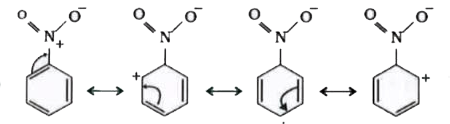
|
|
| 19. |
In electron capture (radioactive process): |
|
Answer» a neutron is formed |
|
| 20. |
In electrometallurgy of aluminium, why is the graphite rod used? |
|
Answer» Solution :(1) In the electrometallurgy, aluminium is obtained by the electrolysis of fused electrolyte of alumina `(Al_(2)O_(3))` in cryolite and `CaF_(2).` (2) At high temperature, the carbon rods are used as anode which give high efficiency of electrolytic process. (3) During electrolysis `O_(2)` is LIBERATED by the REACTION of `F_(2)` formed at anode with alumina, `Al_(2)O_(3)`. This OXYGEN reacts with carbon forming CO and further `CO_(2)`. |
|
| 21. |
In electrolytic refining the impure metal is used to make |
|
Answer» Cathode |
|
| 22. |
In electrolytic refining, the impure metal is made |
|
Answer» cathode |
|
| 23. |
In electrolytic refining of metals, electrolysis of an aqueous solution of its complex salt is done with impure metal as anode and a strip of pure metal as cathode. This method cannot be used for the refining of the metal |
|
Answer» SILVER |
|
| 24. |
In electrolytic refining of lead, Sb, Cu, Ag and Au are found: |
|
Answer» on ANODE |
|
| 25. |
In electrolyticrefining of lead, relectrolyte consists of: |
|
Answer» `H_(2)SiF_(6)` only |
|
| 26. |
In electrolytic refining of copper, what would be the anode? |
| Answer» SOLUTION :IMPURE COPPER will ACT as ANODE. | |
| 27. |
In electrolytic cell, if Cl_(2) gas at anode and H_(2) gas at cathode liberated, then in such cell. . . . Solution is present. |
|
Answer» Aqueous solution of `FeCl_(3)` On cathode : `Na^(+)+2E^(-) +2H^(+) to 2Na^(+)+H_(2(g))` `underline("On ANODE : "2Cl_((a))^(-) to Cl_(2(g))+2e^(-))` `2Na^(+)+2Cl^(-) +2H^(+) to Cl_(2)+H_(2)+2Na^(+)` |
|
| 28. |
In electrolytic cell, cathode acts as an/a |
|
Answer» Oxidising agent E.g., At cathode, `Na^(+)+e^(-)TONA` (reduction) At anode: `underline("Cl^(-)toCl+e^(-)("oxidation")"")` `Na^(+)+Cl^(-)tounderset(("Cathode"))(Na)+underset(("anode"))(Cl)` |
|
| 30. |
In electrolysis, oxidation takes place at: |
|
Answer» ANODE |
|
| 31. |
In electrolysis of water under alkaline conditions a total of 1 mole of gases is evolved . The amount of water decomposed would be |
|
Answer» 2 mol 1 mole of water =1.5 mole of gas `THEREFORE` 1 mole of gas =`(1)/(1.5) = 0.66 = (2)/(3)` mol. of water should be DECOMPOSED. |
|
| 32. |
In electrolysis , oxidation takes place at |
|
Answer» anode |
|
| 33. |
In electrolysis of dil. H_(2)SO_(4) the ratio by weight of gases evolved at anode and cathode respectively are |
|
Answer» `1:16` `H_(2)O hArr H^(+)+OH^(-)` At anode `"" 2OH^(-) to H_(2)O+[O]+2e^(-)` At cathode `"" 2H^(+)+2e^(-) to 2[H]` `therefore W+[O]:W+2[H^(+)] therefore 16:2 therefore 8:1` |
|
| 34. |
In electrolysis of NaCl when Pt electode is taken then H_2 is liberated at cathode while with Hg cathode, it forms sodium amalgam. This is because |
|
Answer» Hg is more inert than Pt |
|
| 35. |
In electrolysis of dilute H_(2)SO_(4) using platinum electrodes |
|
Answer» `H_(2)` is evolved at cathode |
|
| 36. |
In electrolysis of dil. H_(2) SO_(4) using platinum electrodes: |
|
Answer» `H_(2)` is EVOLVED at cathode |
|
| 37. |
In electrolysis of a fused salt, the weight of the deposite on an electrode will not depend on ……………. |
|
Answer» temeperature of the bath |
|
| 38. |
In electroefining of copper a minor percentage of gold accumulates in |
|
Answer» Anode MUD `=(2xx96500xx2)/(63.5xx0.5)=12157.68s`. |
|
| 39. |
In electrolysis of a fused salt, the weight deposited on an electrode will not depend on: |
|
Answer» TEMPERATURE of the bath |
|
| 40. |
In electrochemical corrosion of metals, the metal undergoing corrosion: |
|
Answer» ACTS as anode |
|
| 41. |
In electro-refining of metal the impure metal is made the anode and a strip of pure metal, the cathode, during the electrolysis of an aqueous solution of a complex metal salt. This method cannot be used for retining of |
|
Answer» silver |
|
| 42. |
In electro-refining of metal the impure metal is made the anode and a strip of pure metal the cathode during the electrolysis of an aqueous solution of a complex metal salt. This method cannot be used for refining of: |
|
Answer» silver |
|
| 44. |
In elastomeric polymers, the polymer chains are held together by the____________ intermolecular forces. |
| Answer» SOLUTION :WEAKEST | |
| 47. |
In elastomer, intermolecular forces are |
|
Answer» strong |
|
| 48. |
In E.Coli DNA, the AT/GC ratio is 0-93. If the number of moles of adenine in the DNA sample is 465,000, calculate the number of moles of guanine present. |
|
Answer» Solution :Since the number of MOLES of adenine MUST be equal to that of thymine, therefore , `(A+T)=465,000+465,000=930,000`. Since `(A+T)//(C+G)=0.93`, therefore, number of moles of `C+G=(930,000)/(0.93)=10,00,000` Further since the number of moles of C=number of MOLECULE of G. `therefore` No. of moles of GUANINE (G)`=1000,000//2=500,000`. |
|
| 49. |
In Each unit cell of NaCl chlorine atoms are present at 14 lattice points then at how many lattice point, 'Na' will be present - |
|
Answer» 13 NA ATOMS |
|
| 50. |
In each of the following two questions two statements are given one labelled as the Assertion(A) or Statement I and the other labelled as the reason (R) or statement II. Examine these statements carefully and mark the correct choice as per following instructions Assertion (A) - In a gaseous reaction, the ratio by volumes of reactant and gaseous products is in agreement with their molar ratio Reason (R) - Volume of gas is inversely proportional to its number of moles at particular temperature and pressure. |
|
Answer» Both A and R are true and R is the correct EXPLANATION of A |
|