

Saved Bookmarks
This section includes 7 InterviewSolutions, each offering curated multiple-choice questions to sharpen your Current Affairs knowledge and support exam preparation. Choose a topic below to get started.
| 1. |
If the radius of the octahedral void is r and radius of the atoms in close-packing is R, derive relation between r and R. |
|
Answer» Solution :The relation between R and R for OCTAHEDRAL void is derived as under : A sphere fitting into an octahedral void is shown in the Fig. For CLARITY, the spheres above and below have been REMOVED. ABC is a right angled triangle. `therefore""BC^(2)=AB^(2)+AC^(2)` `"or"(2R)^(2)=(R+r)^(2)+(R+r)^(2)=2(R+r)^(2)` `"or"((2R)^(2))/(2)=(R+r)^(2)` `"or"(2sqrt2R)^(2)=(R+r)^(2)` `"or"R+r=sqrt2R` `"or"r=sqrt2R-R` `"or"r=R(sqrt2-1)` `"or"r=0.414R` 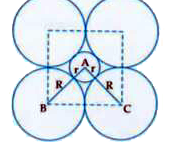
|
|
| 2. |
If the radius of the first Bohr orbit is r, then the deBroglie wavelength in the third bohr orbit is |
|
Answer» |
|
| 3. |
If the radius of the bromide ion is 0.182 nm, how large a cation can fit in each of the tetrahedral holes ? |
|
Answer» `:. r_(+)` (radius of tetrahedral hole) = `0.225 xx r_(-) =0.225 xx 0.182 NM= 4.01 xx 10^(-2)` nm Therefore, CATION having radius of `4.01 xx 10^(-2)` nm will just FIT in the tetrahedral hole. |
|
| 4. |
If the radius of Mg2+ ion, Cs^(+) ion, O^(2–) ion, S2^(–) ion and Cl^(–) ion are 0.65 Å, 1.69 Å, 1.40 Å, 1.84 Å, and 1.81 Å respectively. Calculate the co-ordination numbers of the cations in the crystals of MgS, MgO and CsCl. |
|
Answer» |
|
| 5. |
If the radius of K^(+) and F^(-) are 133 pm and 136 pm respectively, the distance between K^(+) and F^(-) in KF is......... pm |
|
Answer» 269 |
|
| 6. |
If the radius of first Bohr orbit is r, the wavelength of an electron in the third orbit of a hydrogen atom is equal to |
| Answer» Answer :A | |
| 7. |
If the radius of an octahedral void is r and the radius of atom is close packing is R, derive the relationship between r and R. |
|
Answer» Solution :The RADIUS of the sphere representing an octahedral void can be CALCULATED by considering the cross-section through void. The cross-section of the octahedron is a square and it is shown in FIG. Let the radius of octahedral void is r and the radius of sphere is R. In the isosceles TRIANGLE ABC, `(AC)/(AB)= (sqrt(2))/(1)` 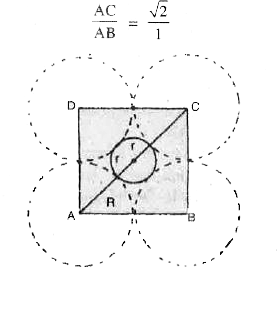 Now, AB = 2R AC = R + 2r +R `:.(2R+ 2r)/(2R)= (sqrt(2))/(1)` or `1+ (r)/(R)= (sqrt(2))/(1)` or ` (r)/(R)= sqrt(2)-1= 0.414` orr= 0.414 R Thus, for an atom to occupy an octahedral void, its radius must be 0.414 TIMES the radius of the sphere. |
|
| 8. |
If the radius of an octahedral void is r and the radius of atom in close packing is R, then the relation between r and R is : |
|
Answer» R = 0.414r |
|
| 9. |
If the quantum numbers n,l,m and s were defined as: R=shell number =1,2,3,4,. . . . In integral steps. l=Type of subshell =0,1,2,3,. . .To n in integral steps. m=Number of orbitals corresponding to any subshell =-(l+1)to+(l+1), in integral steps, incuding zero. s= Spin quantum number =-(1)/(2) or +(1)/(2) The l-values correspond to the subshells as actual representations, like l=0 (s-subshell). l=1(p-subshell),l=2(d-subshell),and so on. In the modern long form of periodic table, the 2nd period should (Assume that (n+l)rule is perfectly obeyed). |
|
Answer» 8 elements `=0m=-1,0,+1=3` orbital =1 m=02,01,0,+1,+2=5 orbital =2 m=-3,-2,-1,0,+1,+2,+3=7 orbital =3 m=-4,-3,-2,-1,0,+1+2,+1,+4=9 orbital ltbr. Total ORBITALS =3+5+7+9=24 orbitals `s=-(1)/(2) "or" +(1)/(2)` (i.e. two electrons) Total electrons =24xx2=48 electrons (ii) lr 2nd PERIOD Given: n=2,l=0,1,2 l=0 l=0s in n=1,l=0,1 l=0,1 l=1 p l=2 d Now `1s^(2)1P^(6)2S^(6)2p^(6)=16` electron (as electron will not enter in 2d) |
|
| 10. |
If the radius of Bohr's 4th orbit is a, then the radius of Bohr's first orbit is |
| Answer» Answer :D | |
| 11. |
If the quantum numbers n,l,m and s were defined as: R=shell number =1,2,3,4,. . . . In integral steps. l=Type of subshell =0,1,2,3,. . .To n in integral steps. m=Number of orbitals corresponding to any subshell =-(l+1)to+(l+1), in integral steps, incuding zero. s= Spin quantum number =-(1)/(2) or +(1)/(2) The l-values correspond to the subshells as actual representations, like l=0 (s-subshell). l=1(p-subshell),l=2(d-subshell),and so on. The maximum number of electrons is 3^(rd) shell should be: |
|
Answer» 18 `=0m=-1,0,+1=3` orbital =1 m=02,01,0,+1,+2=5 orbital =2 m=-3,-2,-1,0,+1,+2,+3=7 orbital =3 m=-4,-3,-2,-1,0,+1+2,+1,+4=9 orbital LTBR. Total orbitals =3+5+7+9=24 orbitals `s=-(1)/(2) "or" +(1)/(2)` (i.e. two electrons) Total electrons =24xx2=48 electrons (ii) lr 2nd period Given: n=2,l=0,1,2 l=0 l=0s in n=1,l=0,1 l=0,1 l=1 p l=2 d Now `1s^(2)1p^(6)2s^(6)2P^(6)=16` ELECTRON (as electron will not enter in 2d) |
|
| 12. |
If the pressure of hydrogen gas is increased from 1 atm. To 100 atm, keeping the hydrogen ion concentration constant at 1 M, the reduction potential of the hydrogen half cell is at 25^(@)C will be |
|
Answer» 0.059 V |
|
| 13. |
If the pressure of hydrogen gas is increased from 1atm to 100atm, keepimng the hydrogen ion concentratioin constant at 1M, the new reduction potential of the hydrogen half cell is at 25^(@)C will be: |
|
Answer» `0.059V` |
|
| 14. |
If the pressure of a given mass of a gas is reduced to half and temperature is doubled simultaneously, the volume will be |
|
Answer» same as before |
|
| 15. |
If the pressure of a given mass of gas is reduced to half and temperature is doubled simultaneous the volume will be |
|
Answer» same as before |
|
| 16. |
If the pressure of 2 litres of an ideal gas is 4 atm then what will be the pressure of the gas if the volume is reduced to one- fourth of its present value? |
| Answer» Solution :`P_(1)V_(1) = P_(2)V_(2)`. As per the data GIVEN, `4 XX 2 = P × (0.5)`. So, `P = 16"atm"`. | |
| 17. |
If the pressure of a gas contained in a closed vessel is increased by 0.4 % when heated by 1°C then its initial temperature must be |
|
Answer» 250 K |
|
| 18. |
If the pressure is halved and absolute temperature doubled the volume of the gas will be : |
|
Answer» 4 |
|
| 19. |
If the pressure and temperature of 2 litre of CO_2are doubled, the volume of CO_2 would become : |
|
Answer» 5 litre |
|
| 20. |
If the pressure and density of CO_(2) gas in adiabatic process changes from (P^(1)d) to (P^(1).d^(1)) where P=32 P^(1) than d/d_(1) is equal to |
|
Answer» <P>`(1/32)^(1.33)` (As `V propto 1/d`) `rArr 32 = (d/d^(1))^(y) rArr d/d^(1) = (32)^(1/y) = (32)^(1/1.33)` Hence, ( c) is the correct option. |
|
| 21. |
If the position of Na^+ and Cl^- are interchanged in NaCl, the crystal Iattice with respect toNa^+ and Cl^- is : |
|
Answer» Both fcc |
|
| 22. |
If the Planck's constant is h=6.6xx10^(-34)J ,the de Broglie wavelength ofa particle having momentum of 3.3xx10^(-24)kgms^(-1) will be |
|
Answer» `0.02Å` `=2xx10^(-10)m=2Å` |
|
| 23. |
If the Planck's constant, h= 6.6xx10^(-34) Js, the de Broglie's wavelength of a particle having momentum of 3.3xx10^(-24) kg m s(-1)will be: |
|
Answer» 0.02 `OVERSET@A` |
|
| 24. |
If the pH value is 4.5 for a solution then what is the value of H^(+) concentration |
|
Answer» `3.162 XX 10^(-5)` mol/L `= 10^(-4.5) mol//K, = 10^(0.5) xx 10^(-5)` `= sqrt(10) xx 10^(-5)` `3.162 xx 10^(-5) mol//L`. |
|
| 25. |
If the pH of a solution of an alkali metal hydroxide is 13.6, the concentration of hydroxide is |
|
Answer» Between 0.1 M and 1M POH = 14 - 13.6 = 0.4 `[OH^(-)]` = Antilog (0.4) = 0.3979. So the value of `[OH^(-)]` between 0.1 M and 1 M. |
|
| 26. |
If the pH of a solution is increased from 3 to 6, then H^+ ion concentration of the solution will be |
|
Answer» INCREASED by 1000 times |
|
| 27. |
If the pH of a solution is 4.0 a 25^(@)C, its pOH would be (K_(w) = 10^(-14)) |
|
Answer» `4.0` pOH = 14 - pH , pOH = 14 - 4.0 = 10.0. |
|
| 28. |
If the pH of a solution is 2, its normality will be |
|
Answer» 2N `[H^(+)] = 10^(-2) = 0.01 N`. |
|
| 29. |
If the pH of a solution is 2 , its normality will be |
| Answer» Answer :D | |
| 30. |
If the Pb^(2+) concentration is maintained at 1.0M what is the [Cu^(2+)] , when the cell potential drops to zero ?E_("cell")^@ = 0.473V, Pb(s) // Pb^(2+) // Cu^(2+) // Cu(s) |
|
Answer» `1 XX 10^(-16) M` |
|
| 31. |
If the partition is removed the average molar mass of the sample will be (Assume ideal behaviour). |
|
Answer» `1/2` g/mol `:.N=(RT)/(PV)` Moles of `H_(2)=(3xx16.42)/(0.0821xx300)=2` Moles of `D_(2)=(6xx16.42)/(0.0821xx300)=4` AVERAGE moleclar weight `=(2xx2+4xx4)/(4+2)=10/3` |
|
| 32. |
If the oxidation potential be defined with reference to Ag |Ag^(+) half cell (for which oxidation potential is taken to be zero) , which of the following will give the correct value of oxidation potential of Cu | Cu^(2+) half cell (Given that Cu | Cu^(2+) = -0.34V and Ag | Ag^(+) = -0.80 V ) |
|
Answer» `-0.46` VOLTS `Cu + 2 Ag ^(+) to Cu^(2+) + 2 Ag` `E_(cell)^(@) = E_(Ag^(+) |Ag)^(@) - E_(Cu^(2+)|Cu)^(@)` = `0.80 - 034 = 0.46` V . This is the difference of reduction POTENTIALS of Ag and Cu electrodes . Taking ELECTRODE potential of Ag = 0 and `E_(Cu^(2+)| Cu)^(@) = - 0.46` V or `therefore E_(Cu| Cu^(2+))^(@) = 0.46` V . |
|
| 33. |
If the osmatic pressure of human blood is 7.53 atm at 37^@C. Calculate the concentration non electrolytic solutes in the blood ? |
|
Answer» 0.296 MOL `L^(-1)` |
|
| 34. |
If the organic compound contains more than two similar terminal groups and all of them are directly attached to the principal chain, then none of them forms a part of the principal chain. Special suffixes are used to name these. {:("Functional group", "Suffix"),(-CONH_(2), "Carboxamide"),(-CN, "Carbonitrile"),(-CHO, "Carbaldehyde"),(-COOH, "Carboxylic acid"):} Carbon atoms of these terminal groups are not counted in the principal chain. If any one of these terminal groups is not directly attached to the parent chain and forms the part of side chain, then the longest chain is selected containing two such similar groups at its two ends. The groups present in the side chain are treated as substituents and are indicated by suitable prefixes. Indicate whether the following IUPAC name are true (a) or false (b). {:("""Compound",, ""IUPAC " Name"),(""CONH_(2),,),(""|,,),(H_(2)NOC - CH_(2) - CH - CH_(2) - CONH_(2),, """Propane-1,2,3-tricarboxamide"),("""True (a)",, """False (b)"):} |
|
Answer» |
|
| 35. |
If the organic compound contains more than two similar terminal groups and all of them are directly attached to the principal chain, then none of them forms a part of the principal chain. Special suffixes are used to name these. {:("Functional group", "Suffix"),(-CONH_(2), "Carboxamide"),(-CN, "Carbonitrile"),(-CHO, "Carbaldehyde"),(-COOH, "Carboxylic acid"):} Carbon atoms of these terminal groups are not counted in the principal chain. If any one of these terminal groups is not directly attached to the parent chain and forms the part of side chain, then the longest chain is selected containing two such similar groups at its two ends. The groups present in the side chain are treated as substituents and are indicated by suitable prefixes. Indicate whether the following IUPAC name are true (a) or false (b). {:("""Compound",, ""IUPAC " Name"),(""CH_(2)CHO,,),(""|,,),(OHC - CH_(2) - CH - CH_(2) - CHO,, """3-(formylmethyl)pentane-1,5-dial"),("""True (a)",, """False (b)"):} |
|
Answer» |
|
| 36. |
If the organic compound contains more than two similar terminal groups and all of them are directly attached to the principal chain, then none of them forms a part of the principal chain. Special suffixes are used to name these. {:("Functional group", "Suffix"),(-CONH_(2), "Carboxamide"),(-CN, "Carbonitrile"),(-CHO, "Carbaldehyde"),(-COOH, "Carboxylic acid"):} Carbon atoms of these terminal groups are not counted in the principal chain. If any one of these terminal groups is not directly attached to the parent chain and forms the part of side chain, then the longest chain is selected containing two such similar groups at its two ends. The groups present in the side chain are treated as substituents and are indicated by suitable prefixes. Indicate whether the following IUPAC name are true (a) or false (b). {:("""Compound",, ""IUPAC " Name"),(""CH_(2)-COOH,,),(""|,,),(HOOC - CH_(2) - CH - CH_(2) - COOH,, """3-(carboxymethyl)pentane-1,5-dioic acid"),("""True (a)",, """False (b)"):} |
|
Answer» |
|
| 37. |
If the organic compound contains more than two similar terminal groups and all of them are directly attached to the principal chain, then none of them forms a part of the principal chain. Special suffixes are used to name these. {:("Functional group", "Suffix"),(-CONH_(2), "Carboxamide"),(-CN, "Carbonitrile"),(-CHO, "Carbaldehyde"),(-COOH, "Carboxylic acid"):} Carbon atoms of these terminal groups are not counted in the principal chain. If any one of these terminal groups is not directly attached to the parent chain and forms the part of side chain, then the longest chain is selected containing two such similar groups at its two ends. The groups present in the side chain are treated as substituents and are indicated by suitable prefixes. Indicate whether the following IUPAC name are true (a) or false (b). {:("""Compound",, ""IUPAC " Name"),(""CN,,),(""|,,),(NC - CH_(2) - CH - CH_(2) - CN,, """3-cyanopentane-1,5-dinitrile"),("""True (a)",, """False (b)"):} |
|
Answer» |
|
| 38. |
If the organic compound contains more than two similar terminal groups and all of them are directly attached to the principal chain, then none of them forms a part of the principal chain. Special suffixes are used to name these. {:("Functional group", "Suffix"),(-CONH_(2), "Carboxamide"),(-CN, "Carbonitrile"),(-CHO, "Carbaldehyde"),(-COOH, "Carboxylic acid"):} Carbon atoms of these terminal groups are not counted in the principal chain. If any one of these terminal groups is not directly attached to the parent chain and forms the part of side chain, then the longest chain is selected containing two such similar groups at its two ends. The groups present in the side chain are treated as substituents and are indicated by suitable prefixes. Indicate whether the following IUPAC name are true (a) or false (b). {:("""Compound",, ""IUPAC " Name"),(""COOH,,),(""|,,),(HOOC - CH_(2) - CH - CH_(2) - COOH,, """Propane - 1,2,3-tricarboxylic acid"),("""True (a)",, """False (b)"):} |
|
Answer» |
|
| 39. |
If the orders of reduction potential isthen : |
|
Answer» Y will oxidize X only `Rightarrow E_(X)^(@)Rightarrow` Strongest oxidising agent . `Rightarrow Y` will oxidising X but not Z. ALSO , Z will oxidise both X and Y. |
|
| 40. |
If order of reaction A+B overset(hv)rarrAB is zero. It means that |
|
Answer» Reaction is INDEPENDENT of temperature |
|
| 41. |
If the number of values of m is seven, the value of azimuthal quantum number should be: |
|
Answer» 3 |
|
| 42. |
If the number of moles of electrons involved in a reaction is doubled by multiplying all of the species appearing in the overall reaction by 2 then the potential is |
|
Answer» HALVED |
|
| 43. |
If the number of silicon atoms is restricted to 23 only, what would be the number of oxygen atoms and magnitude of negative charges respectively in the structure of pyroxene (single chain silicate)? [If your answer are 11 and 12 respectively then write the answer as 1112.] |
|
Answer» |
|
| 44. |
If the number of Chiral carbon in camphor is X and total number of racemic form is Y then, report your answer is 4[X+Y] |
|
Answer» |
|
| 45. |
If the nitrogen atom had electronic configuration 1s^(7), it would have energy lower than that of the normal ground state configuration 1s^(2), 2s^(2) 2p^(3), because the electrons would be closer to the nucleus. Yet, 1s^(7) is not observed because it violates |
|
Answer» HEISENBERG UNCERTAINTY principle |
|
| 46. |
If the nitrogen atoms are in a cyclic arrangement in hydrazoic acid, the oxidation states of N are |
|
Answer» `+3, +3, +3` |
|
| 47. |
If the nitrogen atom had electronic configuration is 1s^7, it would have energy lower than that of the normal ground state configuration1s^2 2s^2 2p^3 because the electrons would be closer to the nucleus. Yet 1s^7 is not observed. It violates: |
|
Answer» HUND's rule |
|
| 48. |
If the molecular weight of H_(3) PO_(3) is M, its equivalent weight will be |
|
Answer» M |
|
| 49. |
If the mole fraction of X in a solution of X and Y is 0.69, what is the mole fraction of Y? |
| Answer» SOLUTION :MOLE FRACTION of Y = 1 -0.69 = 0.31. | |