

Saved Bookmarks
This section includes 7 InterviewSolutions, each offering curated multiple-choice questions to sharpen your Current Affairs knowledge and support exam preparation. Choose a topic below to get started.
| 1. |
Illustrate the Sandmeyer reaction with example. |
Answer» SOLUTION :
|
|
| 2. |
“If system A is the thermal equilibrium with B and B is in thermal equilibrium with C then A and C are in equilibrium with each other." This is a statement of |
|
Answer» Gauss's law of THERMODYNAMICS |
|
| 3. |
Illustrate the reducing property of acetaldehyde with examples. |
|
Answer» SOLUTION :(i) Clemmensen REDUCTION : Aldehydes and Ketones when heated with zinc amalgam and concentrated hydrochloric acid GIVES hydrocarbons. Example : `underset("Acetaldehyde")(CH_(3)-underset(O)underset(||)(C)-H^(+)4(H))underset("Conc."HCl)overset(Zn^(-)Hg)tounderset("Ethane")(CH_(3)-CH_(3)pmH_(2)O)` `underset("Acetone")(CH_(3)-underset(O)underset(||)(C)-CH_(3))+4(H)underset("Conc."HCl)overset(Zn^(-)Hg)tounderset("Propane")(CH_(3)CH_(2)CH_(3)+H_(2)O)` (ii) Wolff-Kishner Reduction : Aldehydes and Ketones when heated with hydrazine `(NH_(2)NH_(2))` and sodium ethoxide, hydrocarbons are formed Hydrazine acts as a reducing AGENT and sodium ethoxide as a catalyst. Example : `underset("Acetaldehyde")(CH_(3)-underset(O)underset(||)(C)-H)+4(H)underset(C_(2)H_(5)ONa)overset(NH_(2)NH_(2))tounderset("Ethane")(CH_(3)-CH_(3)+H_(2)O)+N_(2)` `underset("Acetone")(CH_(3)-underset(O)underset(||)(C)-CH_(3))+4(H)underset(C_(2)H_(5)ONa)overset(NH_(2)NH_(2))toCH_(3)CH_(2)CH_(3)+H_(2)O+N_(2)` Aldehyde (or) ketones is first converted to its hydrazone which on heating with strong base gives hydrocarbons. (iii) Reduction to pinacols : Ketones, on reduction with magnesium amalgam and water, are reduced to symmetrical diols known as pinacol. `underset("Acetone")(CH_(3)-underset(CH_(3))underset(|)(C)=O)+underset("Acetone")(O=underset(CH_(3))underset(|)(C)-CH_(3))+2(H)underset(H_(2)O)overset(Mg//Hg)tounderset("(pinacol)")underset("2,3 dimethyl butane 2,3-diol")(CH_(3)-underset(OH)underset(|)overset(CH_(3))overset(|)(C)-underset(OH)underset(|)overset(CH_(3))overset(|)(C)-CH_(3))` |
|
| 4. |
If suitable light is allowed to fall on a clean metal surface, electrons are emitted from the surface. This phenomenon is called the photo - electric effect. Usually a radiation in the UV region and also in some cases in the visible region produces such an effect. The velocity and K.E. of the emitted electrons are measured by electric field . If wavelength of 470 nm falls on the surface of potassium metals, electrons are emitted with a velocity of 6.4 xx 10^(4) m sec^(-1)If bombarded light frequency is twice, then K.E. of emitted electrons is : |
|
Answer» `1.86 XX 10^(-21) J` |
|
| 5. |
Illustrate the law of reciprocal proportions from the following data: KCl contains 52.0% potassium, KI contains 23.6% potassium and Icl contains 78.2% iodine. |
|
Answer» Solution :In KCL: Potassium 52.0% Chlorine (100-52)=48% In KI: Potassium 23.6%. IODINE (100-23.6)=76.4% 23.6 parts of potassium combine with 76.4 parts of iodine 52.0 parts of potassium will combine with (76.4/23.6)`xx52.0=168.3` parts of iodine. The RATIO of masses of chlorine and iodine which combines with same mass of potassium =48:168.3 or 1:3.5 In ICI: Iodine =78.2% and chlorine `=(100-78.2)=21.8%` The ratio of chlorine and iodine in ICI=21.8:78.2=1:3.5. Hence, the DATA ILLUSTRATE the law of reciprocal proportions. |
|
| 6. |
If suitable light is allowed to fall on a clean metal surface, electrons are emitted from the surface. This phenomenon is called the photo - electric effect. Usually a radiation in the UV region and also in some cases in the visible region produces such an effect. The velocity and K.E. of the emitted electrons are measured by electric field . If wavelength of 470 nm falls on the surface of potassium metals, electrons are emitted with a velocity of 6.4 xx 10^(4) m sec^(-1) Stopping potential of given circuit is , |
|
Answer» `1.86 xx 10^(-21) J` |
|
| 7. |
Illustrate the geometrical isomerism with the help of an example [Pt(NH_(3))_(4)Cl_(2)]^(2+). |
Answer» SOLUTION :When the identical GROUPS are on the same side of the metal ion, it is cis-isomer. When they are on opposite sides of the metal ion, it is TRANS- isomer. 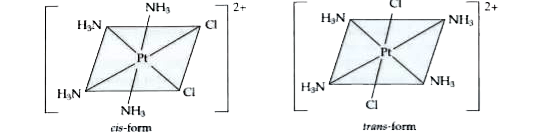
|
|
| 8. |
If suitable light is allowed to fall on a clean metal surface, electrons are emitted from the surface. This phenomenon is called the photo - electric effect. Usually a radiation in the UV region and also in some cases in the visible region produces such an effect. The velocity and K.E. of the emitted electrons are measured by electric field . If wavelength of 470 nm falls on the surface of potassium metals, electrons are emitted with a velocity of 6.4 xx 10^(4) m sec^(-1)The work function of potassium metal is : |
|
Answer» `4.2 xx 10^(-19) J` |
|
| 9. |
Illustrate the geometrical isomers of [Pt(NH_(3))_(4)Cl_(2)]^(2+) |
Answer» SOLUTION :
|
|
| 10. |
Illustrate the following with an example of reaction in each case : (i) Sandmeyer reaction. "" (ii) Coupling reaction. |
Answer» SOLUTION :(i) SANDMEYER REACTION :  (II) COUPLING reaction : 
|
|
| 11. |
If sucrose is treated with conc. H_(2)SO_(4), the product formed is |
|
Answer» `CO_(2)` |
|
| 12. |
If steel is heated to a temperature well below red hot and is then cooled slowly, the process is called |
|
Answer» Tempering |
|
| 13. |
Illustrate the following with an example : Acetylation reaction. |
Answer» SOLUTION :
|
|
| 14. |
If starting compound is laevo rotatory , after the S_(N)1 reaction, product is _________. |
|
Answer» LAEVO ROTATORY |
|
| 15. |
Illustrate the following with an example : Acetylationreaction. |
Answer» SOLUTION :
|
|
| 16. |
If standard potential of M,N,O,P and Q half cells are in increasing order in standard condition, then on attaching which two half cels will produce maximum potential ? |
|
Answer» M and N |
|
| 17. |
Illustrate the following reactions giving a chemical equation for each : (i) Koble.s reaction, (ii) Williamson synthesis. |
Answer» SOLUTION :(i) Koble.s reaction :  (ii) Williamson.s synthesis : `CH_(3)CH_(2)Br+CH_(3)CH_(2)ON a overset(Delta)rarr UNDERSET("DIETHYL ether")(CH_(3)CH_(2)OCH_(2)CH_(3))+NaBr` `C_(6)H_(5)ON a+CH_(3)Br overset(Delta)rarr underset("Anisole")(C_(6)H_(5)OCH_(3))+NaBr` |
|
| 18. |
If S_(R) +O_(2)(g)rarrSO_(2)(g),DeltaH = -71.1 kcal ….. (i)S_(M)+O_(2)(g) rarr SO_(2)(g),DeltaH = 71.7 …. (ii) The heat of transition for S_(M) rarr S_(R) is …. |
|
Answer» A) `-1.2` |
|
| 19. |
ILLustrate the following name reactions : Hell - Volhard Zelinsky reaction |
| Answer» SOLUTION :`RCH_(2)COOH overset((i)X_(2)//RED P)underset((ii)H_2O)to Roverset(X)overset(|) ( C) HCOOH X=CI,BR` | |
| 20. |
If specific conductivity of N/50 KCl solution at 298 K is 0.002765 ohm^(-1)cm^(-1) and resistance of a cell containing this solution is 100 ohms, calculate the cell constant. |
|
Answer» SOLUTION :Cell constant`=("Sp. CONDUCTIVITY")/("Obs. CONDUCTANCE")=`specific conductivity`xx`Obs. RESISTANCE `=0.002765Omega^(-1)cm^(-1)xx100Omega=0.2765cm^(-1)` |
|
| 21. |
Illustratethe following name reactions giving suitable exaple in each case : (i) Clemmensen reduction (ii) Hell-Volhard-Zelinskyreaction. (b) How are the following conversions carried out ? (i) Ethylcyanide to ethanoic acid (ii) Butanol to Butanoic acid (iii) Benzoic acid to m-bromobenzoic acid |
|
Answer» <P> Solution :(a) (i)Clemmensenreduction :`underset("Ethanol")(CH_(3)-overset(O)overset(||)C-H)overset(Zn(HG)"in")underset("Conc.HCl")rarrunderset("Ethane")(H_(3)C-CH_(3))` (ii) Hell-Volheard. `underset("PROPANOIC acid")(H_(3)C-CH_(2)-COOH)underset(2.H_(2)O)overset(1.Cl_(2)//"Red".P)rarrunderset(alpha-"Chloropropanic")(H_(3)C-underset(Cl)underset(|)CH-COOH)` 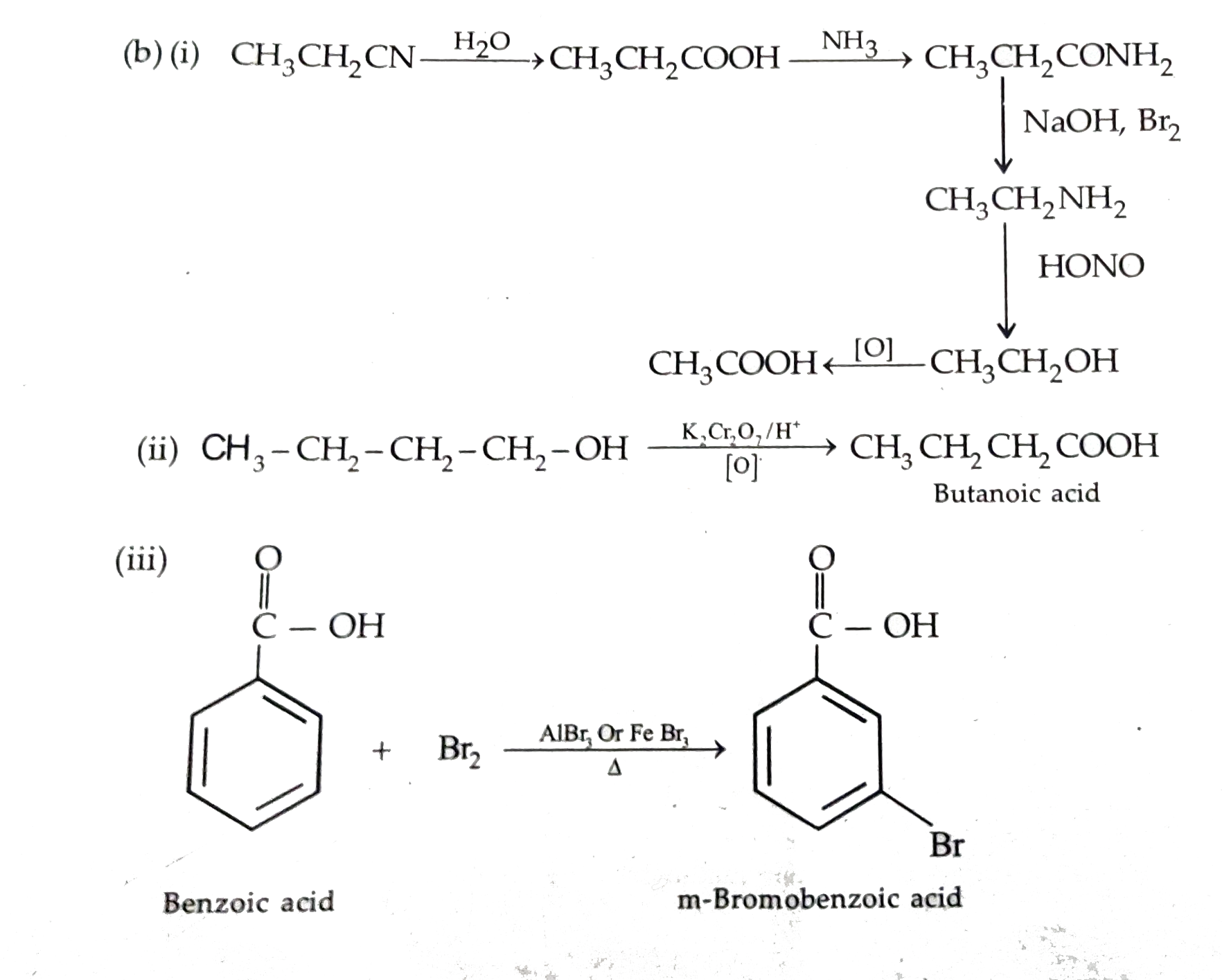
|
|
| 22. |
Illustrate the following name reactions : (a) Cannizzaro's reaction(b) Clemmensen reduction |
|
Answer» Solution :(a) Cannizzaro.s reaction `:` Aldehydes which do not have an `alpha`- hydrogen atom, undergoes selfoxidation and reduction reaction on treatment with concentrated alkali. `2HCHO overset( NaOH ) ( rarr)underset( "Methanol")(CH_(3)OH ) + underset( " Sodium methanoate")(HCOONa)` `C_(6) H_(5) CHO overset( NaOH ) ( rarr) underset("Benzyl ALCOHOL")(C_(6) H_(5) CH_(2) OH) + underset("Sodium benzoate")(C_(6) H_(5) COONA)` (b) Clemmensen reduction `:` Aldehydes on reduction with Zn and HCl are reduced to alkanes. `underset("Ethanal ")(CH_(3)CHO) overset( Zn//HCl)(rarr) underset( "Ethane")(CH_(3)CH_(3))` `underset("Propanal")(CH_(3) CH_(2) CHO )overset( Zn//HCl)(rarr) underset("Propane")(CH_(3) CH_(2) CH_(3))` |
|
| 23. |
Illustrate the decarboxylation reaction giving a suitable example. |
|
Answer» Solution :Decarboxylation refers to the reaction in which carboxylic ACID lose carbon dioxide to form hydrocarbons when their sodium SALTS are heated with SODA lime. E.g. `CH_(3)COONaoverset(NaOH+CaO)(to)CH_(4)+Na_(2)CO_(3)` |
|
| 24. |
Illustrate how copper metal can give different products on reaction with HNO_3. |
|
Answer» Solution :The OXIDIZING nature of `HNO_3` depends on (i) CONCENTRATION of an acid (II) Nature of metal (iii) Temperature of the reaction: `UNDERSET("dilute")(3Cu + 8HNO_(3) to 3Cu(NO_(3))_(2) + 2NO + 4H_(2)O` `underset("conc")(Cu + 4HNO_(3) to Cu(NO_(3))_(2) + 2NO_(2) + 2H_(2)O` |
|
| 25. |
Illustrate how copper metal can give different products on reaction with HNO_3 |
|
Answer» Solution :Copper reacts with dil. `HNO_3` to GIVE different products under different conditions (i) On heating with dil. `HNO_3`, copper gives copper nitrate and nitric oxide `3Cu + 8HNO_3(dil.) overset("Heat")to 3Cu(NO_3)_2 + 4H_2O + UNDERSET("Nitric oxide")(2NO)` (ii) With conc. `HNO_3` , instead of NO, `NO_2` is EVOLVED. `Cu + 4HNO_3 ( conc. ) overset("Heat")to Cu(NO_3)_2 + 2H_2O + underset("NITROGEN DIOXIDE")(2NO_2)` |
|
| 26. |
If some moles of O_(2) diffuse in 18 sec and same moles of other gas diffuse in 45 sec then what is the molecular weight of the unknown gas |
|
Answer» `(45^(2))/(18^(2))xx32` `M_(g)=M_(O_(2))((r_(O_(2)))/(r_(g)))^(2) = 32 ((x)/(18) xx(45)/(x))^(2) = 32 xx (45^(2))/(18^(2))` |
|
| 27. |
If solvent is adsorbed from a solutin on the adsorbent, it is called …….. Adsorption. |
| Answer» SOLUTION :negnative | |
| 28. |
If solution prepared by adding 6.1 gm of benzoic acid in 500 gm benzene is freeze at -0.290^(@)C. Then find out association percentage ? (K_(f) of water = 5.52^(@)K kg/mol.) |
|
Answer» |
|
| 29. |
Illustrate how copper metal can give different products on reaction with HNO_3 . |
|
Answer» SOLUTION :Concentrated nitric ACID is a strong oxidising agent and reacts with metals. The products of oxidation depend upon the concentration of the acid, temperature and the nature of the material undergoing oxidation. For EXAMPLE, copper reacts with `HNO_3`giving different products as : Conc. `HNO_3`gives copper nitrate and NITROGEN dioxide. `Cu + 4HNO_3toCu(NO_3)_2 + 2NO_2 + 2H_2O` Dilute `HNO_3` gives copper nitrate and nitric oxide. `3Cu + 8HNO_3to3Cu(NO_3)_2 + 2NO+2H_2O.` |
|
| 30. |
If solution have osmotic pressure of 0.82 bar at 27^(@)C, then find out concentration of such solution ? |
|
Answer» |
|
| 31. |
Illustrate each of the following with an example of reaction. (i) Sandmeyer reaction. "" (ii) Diazotisation reaction. |
Answer» Solution :(i) Sandmeyer REACTION.  (II) DIAZOTISATION : When aniline is treated with `NaNO_(2)` and conc. HCl at 273-278 K, we get benzene DIAZONIUM chloride. 
|
|
| 32. |
If solubility product of HgSO_(4) is 6.4 xx 10^(-5), then its solubility is |
|
Answer» `8 xx 10^(-3)` mole/litre |
|
| 33. |
If solutbility of CH_(3) COOAg(s) in a buffer solution of pH equal to 5 is 1.414 xx10^(-y) then calculate the value of y. Given : K_(sp)(CH_(3)COOAg)=10^(-10),K_(a)(CH_(3)COOH)=10^(-5) |
|
Answer» `CH_(3)COO^(-)(aq)+H_(2)O IFF CH_(3)COOH+OH^(-)` `{:(x-z,,,,,,,,z,,,10^(-9)):}` `K_(h)=(10^(-14))/(10^(-5))=(zxx10^(-9))/(x-z)"",""x-z=zimplies z=(x)/(2)` `K_(sp)=10^(-10)=(x-z)XX x" ",10^(-10)=(x)/(2)xxx` Solubility `x=sqrt(2)xx10^(-5)` Solubility `x=1.414xx10^(-y)` y=5 |
|
| 34. |
illustrate: Fitting reaction in haloarine. |
Answer» Solution :Only haloarenes are TREATED with NA in etheral medium to form diaryl PRODUCTS.
|
|
| 35. |
If solubility product of A_3 B_2 is 'K' then the solubility of A_3 B_2 will be |
|
Answer» `K^1`/`5` |
|
| 36. |
Illustrate Cross-aldolcondensation with a suitable example. |
| Answer» SOLUTION :For ANSWER, CONSULT SECTION 8. | |
| 37. |
If solubility of calcium hydroxide is sqrt(3), then its solubility product will be |
|
Answer» 27 `K_(sp) = 4S^(3) = 4 XX sqrt(3)xx sqrt(3) xx sqrt(3) =12sqrt(3)`. |
|
| 38. |
Iilustrate how copper metal can give different products on reaction with HNO_(3). |
|
Answer» Solution :On heating with dil. `HNO_(3)`, copper GIVES copper NITRATE and nitric oxide. `3 Cu + 8 HNO_(3)("dil") overset("Heat")rarr 3 Cu(NO_(3))_(2) + 4H_(2)O + UNDERSET("Nitric oxide")(2NO)` With CONC. `HNO_(3)`, instead of `NO, NO_(2)` is evolved. `Cu + 4HNO_(3)(conc) overset("Heat")rarr Cu(NO_(3))_(2) + 2H_(2)O + underset("Nitrogen dioxide")(2NO_(2))` |
|
| 39. |
If sodium sulphate is considered to be completely dissociated into cations and anions in aqueous solution, the change in freezing point of water (DeltaT_(f)), when 0.01 mol of sodium sulphate is dissolved in 1 kg of water, is (K_(f)=1.86Kkgmol^(-1)) |
|
Answer» 0.0372 K |
|
| 40. |
I,II,III are three isotherms respectively at T_(1),T_(2) and T_(3) for a fixed mass of gas, as shown in graph. Temperature will be in order : |
|
Answer» `T_(1) = T_(2) = T_(3)` |
|
| 41. |
If sodium sulphate is considered to be completely dissociated into cations and anions in aqueous solution, the chagne in freezing point of water (Delta T_(f)), when 0.01 mol of sodium sulphate is dissolved in 1 kg of water, is (K_(f) =1.86 kg mol^(-1)) |
|
Answer» 0.0186 K `Na_(2)SO_(4)(alpha = 100%)` i=3 `k_(F)=1.86` `W//m=0.01` W = 1 kg = 1000 G `Delta T_(f)=(1000xx k_(f)xx i xx w)rArr Delta T_(f)=(1000xx1.86xx3xx0.01)/(1000)` `Delta T_(f)=5.58xx0.01=0.0558 K` |
|
| 42. |
IIfan alkanehasnumberof carbonatomsequalton, thenthe numberof moles of oxygenrequiredforits complete combustion is : |
| Answer» Solution :`C_(n)H_(2n+2)+((3n+1))/(2)O_(2) tonCO_(2) +((2n+2))/(2)H_(2)O`] | |
| 43. |
If sodium sulphate is considered to be completely dissociated into cations and anions in aqueous solution, the change in freezing point of water (Delta T_(f)), when 0.01 mol of sodium sulphate is dissolved in 1 kg of water, is ( K_(f)=1.86 "K kg mol"^(-1) ) : |
|
Answer» 0.0744 K `Na_(2)SO_(4) RARR 2NA^(+)+SO_(4)^(2-)` `i=3` `m=(0.01)/(1)xx1=0.01` `DeltaT_(F)=iK_(f)m=3xx1.86xx0.01` `DeltaT_(f)=0.0558`. |
|
| 44. |
(ii) Why is the boiling point of acid anhydride higher than the acid from which it is obtained ? |
| Answer» Solution :ACID anhydride bigger size than CORRESPONDING ACIDS and STRONGER van der Wall's forces of attraction than their corresponding acids. | |
| 45. |
If sodium sulphate is considered to be completely dissociated into cations and anions in aqueous solution, the change in freezing point of water (DeltaT_(f)), when 0.01 mol of sodium sulphate is dissolved in 1 kg of water, is (K_(f)="1.86 K kg mol"^(-1)) |
|
Answer» 0.0744 K `DeltaT_(F)=iK_(f)m=3xx1.86xx(0.01)/(1)=0.0588^(@)C` |
|
| 46. |
IIB (arsenic group ) sulphides are solution in YAS if cone HCI isadded to this soluble portion colour red pptare formed Write reaction |
|
Answer» Solution :`underset("SOLUBLE")((NH_(4))_(3))AsS_(4) + 6HCI rarr As_(2)S_(2) darr + 6NH_(4)CI + 3H_(2)S` `(NH_(4))_(2) SnS_(3) + 2HCI rarr SnS_(2) darr 2NH_(4)CI + H_(2)S` |
|
| 47. |
If soap has high alkali content it irritates skin. How can the amount of excess alkali be determined ? What can be the source of excess alkali? |
| Answer» Solution :ACID base TITRATION can be used to determine the excess amount of alkali in soap. The excess alkali left after hydrolysis of OIL can be the SOURCE of ALKALINITY in soap. | |
| 48. |
Which of the following is an example of a molecular solid? Diamond, ZnS, Solid Iodine, gold |
| Answer» SOLUTION :ii) Solid IODINE is an EXAMPLE of a MOLECULAR solid. | |
| 49. |
If soap has high alkal content it irritates skin. How can amount of excess alkali be determind? What can be the source of excess alkali ? |
Answer» Solution :A solution of SOAP is titrated with STANDARD HYDROCHLORIC acid. It isan acid-base titration. In this titration, PHENOLPTHALEIN is used as an indicator. During the preparation of soap, fat (i.e., glyceryl ester of fatty acid) is heated with aqueous sodium hydroxide 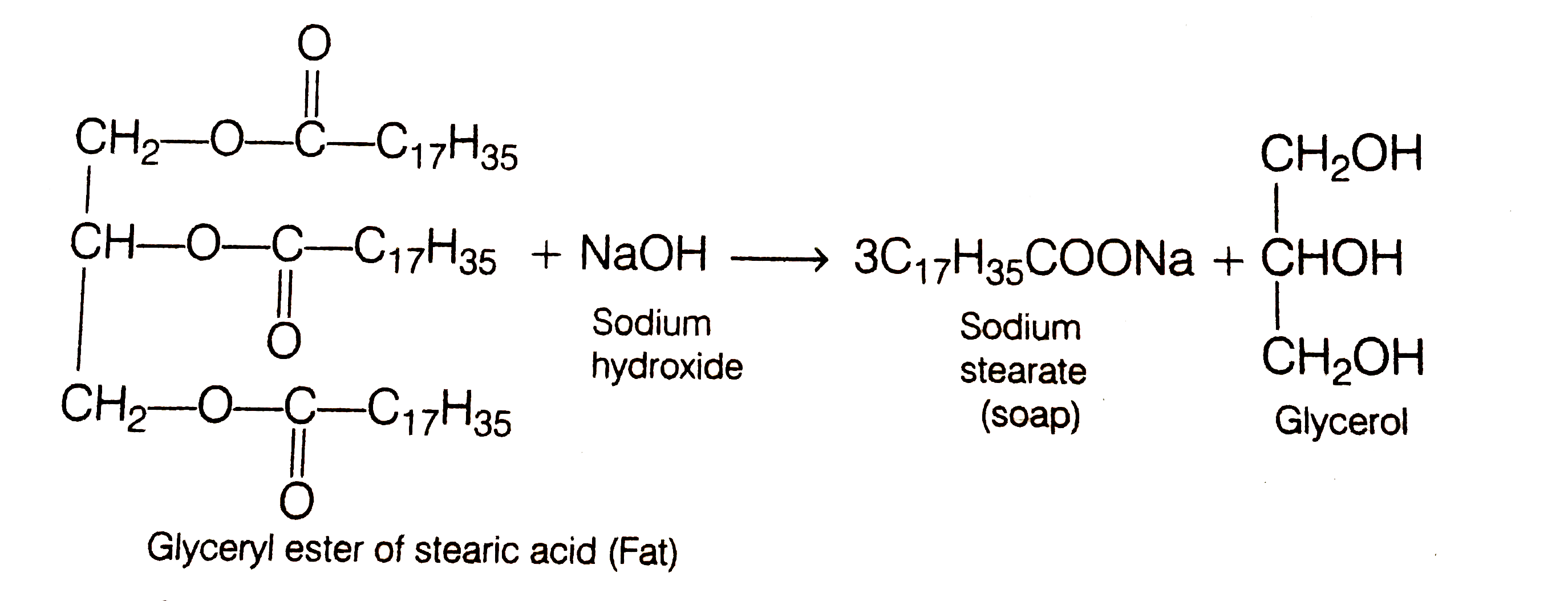 Thus, the source of this excess alkali (which irritates skin) is the alkali left UNUSED when the soap is preparedby hydrolyis of fat. |
|
| 50. |
ii) What Faraday of current is required to electrolyse one mole of water? |
| Answer» SOLUTION :ii) 2 Faraday of CURRENT is required to ELECTROLYSE ONE mole of water. | |