Saved Bookmarks
This section includes 7 InterviewSolutions, each offering curated multiple-choice questions to sharpen your Current Affairs knowledge and support exam preparation. Choose a topic below to get started.
| 1. |
If the bond dissociation energies of XY,X_(2) and Y_(2) (all diatomic molecules) are in the ratio of 1:1:0.5 and DeltaH_(f) for the formation of XY is -200 kJ mol^(-1). The bond dissociation energy of X_(2) will be |
|
Answer» 400 kJ `MOL^(-1)` `X_(2)+Y_(2) to 2XY` `DeltaH=(BE)_(X-X)+(BE)_(Y-Y)-2(BE)_(X-Y)` ,brgt If `(BE)` of `X-Y=a` then (B E) of (X-X)=a and (B E) of (Y-Y)=`(a)/(2)` `therefore DeltaH_(f)(X-Y)=-200KJ` `therefore-400` (for 2 mol XY)`=a+(a)/(2)-2a` `-400=-(a)/(2)impliesa=+800kJ` The bond DISSOCIATION ENERGY of `X_(2)=800" kJ "mol^(-1)` |
|
| 2. |
Impure copper containing Fe, Au and Ag as impurities is electrolytically refined. A current of 140 A for 482.5 s decreased the mass of the anode by 22.26 g and increased the mass of the cathode by 22.011g. Calculate the percentage of iron in impure copper. (Given molar mass of Fe=55.5g mol^(-1), molar mass of Cu=63.54 g mol^(-1)). |
|
Answer» Solution :In the purification of copper, impure copper is anode and pure copper is cathode. Increase in the mass of cathode is due to Cu deposited on it. Decrease in the mass of anode is due to `CutoCu^(2+)`(deposited on cathode), `FetoFe^(2+)` (remain dissolved int he solution) (Fe being more reactive than Cu), AG and Au (being less reactive than Cu do not undergo oxidation) and fall below anode as anode mud. Cu deposited on cathode (Pure Cu) can be calculated as follows: `Cu^(2+)+2e^(-)toCu` Quantity of ELECTRICITY passed=`140xx482.5`coulombs=67550C ltbr `2xx96500C` deposit Cu=63.54g `therefore67550C` will deposit Cu`=(63.54)/(2xx96500)xx67550g=22.239g` Actual increase in the mass of cathode=22.011g Cu not deposited due to Fe passing into the solution`=22.239-22011=0.228g` Equivalent AMOUNT of Fe that passed into the solution`=(55.5)/(63.54)xx0.228g=0.199g` Thus, Fe PRESENT as impurity=0.119g Decrease in the mass of anode=Total impure `Cu(Cu+Fe+Au+Ag)=22.26g` `therefore%` of Fe in impure `Cu=(0.199)/(22.26)xx100=0.89cong0.90` |
|
| 3. |
If the bond dissociation energies of XY, X_(2) and Y_(2) (all diatomic molecules) are in the ratio of 1 : 1 : 0.5 and Delta_(f) H for the formation of XY is - 200 kJ " mole"^(-1). The bond dissociation energy of X_(2) will be |
|
Answer» 100 KJ `mol^(-1)` `X_(2)rarr2X, DeltaH=+" a kJ/mole.....(ii)"` `Y_(2)rarr2Y, DeltaH=+0.5" a kJ/mole.......(III)"` `(1)/(2)XX(ii)+(1)/(2)xx(iii)-(i)`, gives `(1)/(2)X_(2)+(1)/(2)Y_(2)rarrXY,` `DeltaH=(+(a)/(2)+(0.5)/(2)a-a)"kJ/mole"` `+(a)/(2)+(0.5a)/(2)-a=-200` a = 800 |
|
| 4. |
If the bond dissociation energies of XY, X_(2) and Y_(2) (all diatomic molecules) are in the ratio of 1 : 1 : 0.5 and Delta_(f)H for the formation of XY is –200 kJ mol^(-1). The bond dissociation energy of X_(2) will be |
|
Answer» 200 kJ `MOL^(-1)` |
|
| 5. |
Impure coppercontaining Fe,Au ,Ag as impuritiesis elecrolyticallyrefined A currentof 140 A for 482.25 s decreasedthe massof theanodeby 22.26 g and increased the mass of cathode by 22.011 g percentageof iron in impure copper is (Given molar mass of Fe =55.5 mol^(-1) molar mass of Cu =63.54 g mol^(-1)) |
|
Answer» 0.95 =decreased mass of anode - increased mass of cathode amountof pure Cu DEPOSITED `W=Zit =(C )/(96500)xxit` `=(63.54)/(2xx96500)xx140 xx482.5`=22.239 g `therefore`amountof impurity (Fe) = 22.239 -22.011 = 0.228 g Now from FARADAY SECOND law of electrolysis `("weightof fe deposited")/(0.228) =(27.55)/(31.77)` `therefore` Weight of Fe `=(27.75 xx0.288)/(22.26) xx100=0.88 =0.09` |
|
| 6. |
If the boiling point of ethanol (molecular weight = 46) is 78^(@)C, the boiling point of diethyl ether (molecular weight = 74) is |
| Answer» Answer :D | |
| 7. |
Impure copper containing Fe, Au, Ag as impurities is electrolytically refined. A current of 140 A for482.5 s decreased the mass of the anode by 22.26 g and increased the mass of cathode by 22.011 g. Percentage of iron in impure copper is (Given molar mass Fe= 55.5 g "mol"^(-1), molar mass Cu = 63.54 g "mol"^(-1)) |
|
Answer» 0.95 EQUIVALENT wt. `=(63.54)/(2)=31.77` `Fe^(2+)+2e^(-)rarr Fe`, equivalent wt.`=(55.5)/(2)=27.75` Mass inceased at cathode is due to deposition of Cu. Hence, no. of gram equivalents of Cu deposited `=(22.011)/(31.77)=0.6928` Now, using Faraday's FIRST law, `Q=it = 140 A xx 482.2 s = 67550C` `96,500C-31.77 g Cu` `67550 C - ?` `(31.77)/(96, 500)xx(67550)/(1)=22.239` g of pure Cu deposited But, according to the question, the mass of cathode only increases `= 22.011g` Hence, `22.239-22.011=0.228g` Now, `31.77g Cu -= 0.228` g deposited `27.75 g Fe -= (0.228)/(31.77)xx27.75=0.199` g Fe deposited % of Fe `= ("Mass of Fe")/("Mass of impurities (at anode)")xx100` `= (0.199)/(22.26)xx100=0.894~~0.90%` |
|
| 8. |
if the atoms touching one of the reactangular planes of symmetry and one of the 4-fold axis of symmetry are removed , then formula of compound is ______ |
|
Answer» Solution :Here, two cases are possible . Rectangular plane and 4-fold AXIS are (i)Either coinciding each other (ii)or PERPENDICULAR to each other . Hence, two FORMULAE are possible  (i)Contribution of A =`8xx1/8=1` Contribution of B =`(6-4)xx1/2`=1 Contribution of C =1-1=0 Contribution of D =`(12-4)xx1/4`=2 Formula = `ABD_2` (ii)Contribution of A=`8xx1/8`=1 Contribution of B =`(6-6)xx1/2`=0 Contribution of C=1-1=0 Contribution of D =`(12-4)xx1/4=2` Formula =`AD_2` |
|
| 9. |
If the aufbau principle had not been followed, Ca (Z=20) would have been placed in the: |
|
Answer» s-block |
|
| 10. |
Impossible orbital among the following is |
|
Answer» 2s |
|
| 11. |
If the atomic mass of M is x , the electrochemical equivalent of M in the solution of M_(2)(SO_(4))_(3) will be |
|
Answer» `(3x)/(F)` Eq. mass of M = `("ATOMIC mass")/("valency") = (x)/(3)` `THEREFORE` ELECTROCHEMICAL equivalent = `("Equivalent mass")/(96500) = (E)/(F) = (x)/(3F)` |
|
| 12. |
Important ore of Mg is: |
|
Answer» Dolomite |
|
| 13. |
If the atomic number of an element is 33, it will be placed in Mendeleev's periodic table in the : |
|
Answer» FIRST group |
|
| 14. |
If the anions (X) form hexagonal closed packing and cations (Y) occupy only 3/8th of octahedral voids in it, then the general formula of the compound is |
|
Answer» `XY` |
|
| 16. |
Ifthe anthalpy of vaporization for water is 186.5 kJ mol^(-1), the entropy of its vaporization will be |
|
Answer» 0.5 `JK^(-1)mol^(-1)` |
|
| 17. |
If the amount of radioactive substance is increased three times, the number of atoms disintegrated per unit time would |
|
Answer» Be double |
|
| 19. |
If the amount of radioactive substance is increased three times, the number of atoms distintegrated per gram per unit time would be |
|
Answer» doubel |
|
| 20. |
If the amino group of Glycine and carboxylic acid group of Alanine undergo elimination of wter molecule, the name of the compound thus formed is |
|
Answer» Alanylglycine(DIPEPTIDE) |
|
| 21. |
If the adsorbate is held on a surface by weak Vander Waal’s force, the adsorption process is called: |
|
Answer» PHYSICAL adsorption |
|
| 22. |
Important allotropic forms of phosphorus are white phosphorus, red phosphorus and black phosphorus. Among these which allotropic form is more reactive ? Why ? |
|
Answer» Solution :White phosphorus is the most reactive because of the following two reasons : (i) White phosphorus consists of `P_(4)` molecules which are HELD together by WEAK VAN der Walls forces of attraction. (ii) The `P_(4)` molecules have considerable ANGLE strain because in them PPP angle is just `60^(@)`. Therefore, due to considerable angle strain and weaker forces of attraction, white phosphorus is most reactive. |
|
| 23. |
If the activation of forward reaction In a simple chemical reaction A to B is E_(a),then what will be activation energy for reverse reaction? |
|
Answer» `-E_(a)` |
|
| 25. |
If the alignment of magnetic moments in a substance is in a compensatory way so as to give zero net magnetic moment, then the substance is said to be |
|
Answer» FERROMAGNETIC |
|
| 26. |
If the activation energy is high, then the rate of the reaction is |
| Answer» Answer :C | |
| 27. |
If the activation energy is decreased by (5x) % by using a catalyst (300K) to achieve the same effectas of increasing the temperature from 300K-400K in a reaction, then find x. |
|
Answer» |
|
| 29. |
If the activation energy for the forward reaction is 150kJ mol^(-1) and that of the reverse reaction is 260kJ mol^(-1). What is the enthalpy change for the reaction |
|
Answer» `410kJ mol^(-1)` |
|
| 31. |
If the activation energy for the forward reaction is 150 kJ mol^(-1) and that of the reverse reaction is 260 kJ mol^(-1) , what is the enthalpy change for the reaction |
|
Answer» 410 kJ `mol^(-1)` `DELTA H = E_(a)` (forward) `- E_(a)` (backward) `DeltaH = 150 - 260 = -110 kJ mol^(-1)`. |
|
| 32. |
Important allotropic forms of phosphorus are white phosphorus, red phosphorus and black phosphorus. Among these, which allotropic' form is more reactive? Why |
| Answer» Solution :White phosphorus. It is less STABLE than other ALLOTROPES because of the ANGULAR strain ;in `P_4` molecules.. So it is more reactive. X | |
| 33. |
If the activation energy for the forward reaction is 150 "kJ mol"^(-1)and that of the reverse reaction is 260 "kJ mol"^(-1), what is the enthalpy change for the reaction ? |
|
Answer» 410 `"kJ mol"^(-1)` 
|
|
| 34. |
Imino group is present in |
|
Answer» `1^(0)` amins |
|
| 35. |
If the absolute temperature of an ideal gas become double and pressure become half , the volume of gas would be |
|
Answer» Remain unchange `P_(2)=(P)/(2),V_(2)=? , T_(2)=2T` According to gas EQUATION `(P_(1)V_(1))/(T_(1))=(P_(2)V_(2))/(T_(2))`or `(PV)/(T)=(PV_(2))/(4T)IMPLIES V_(2)=4V` |
|
| 36. |
Imine formation using an aldehyde/ketone and primary amine is acid - catalyzed, yet the rate drops below pH 4.5. Why does the rate drop below this pH? |
|
Answer» The CARBINOLAMINE intermediate is stable at LOW pH |
|
| 37. |
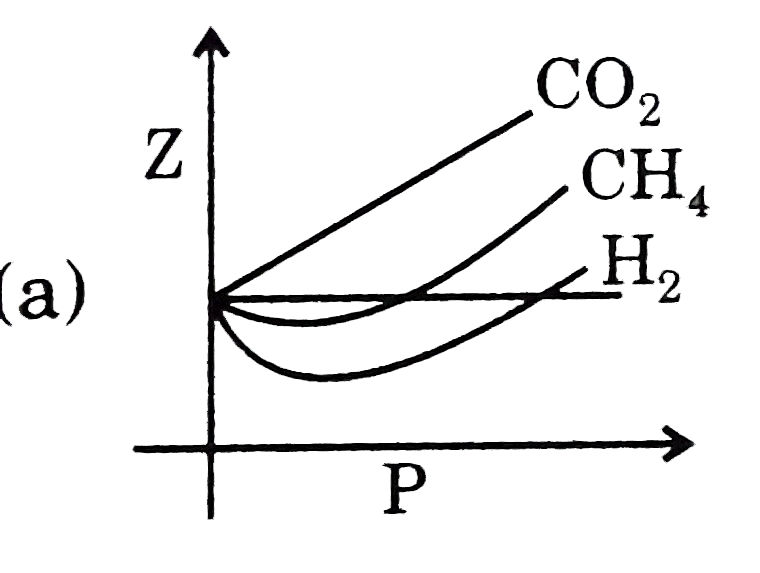
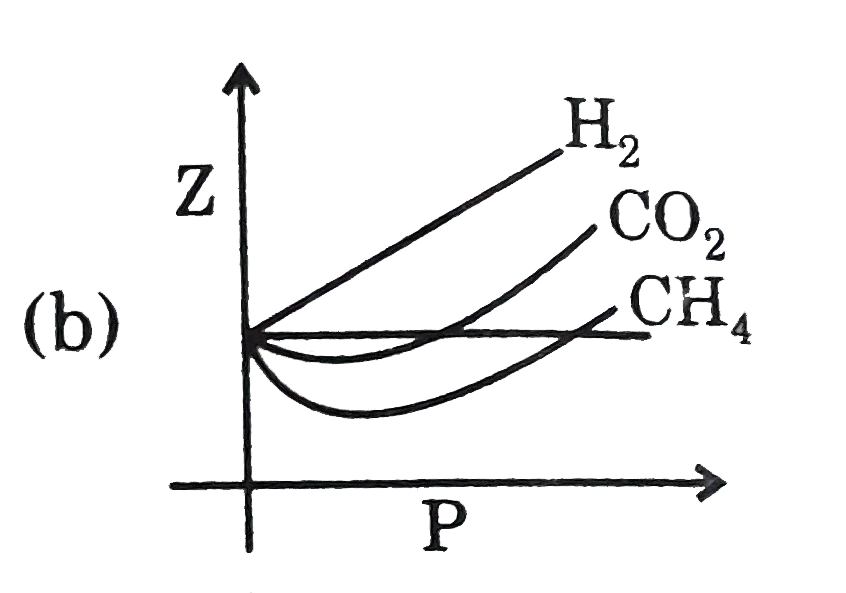
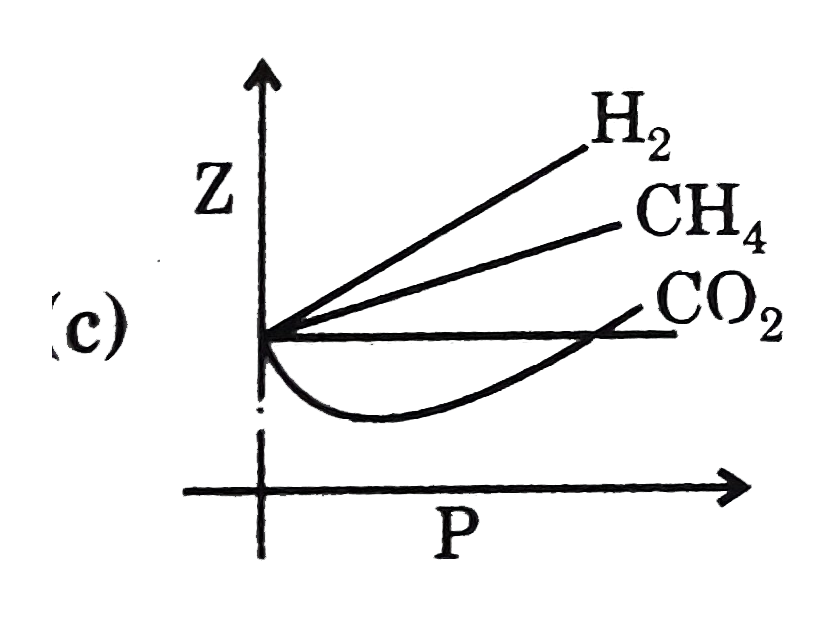
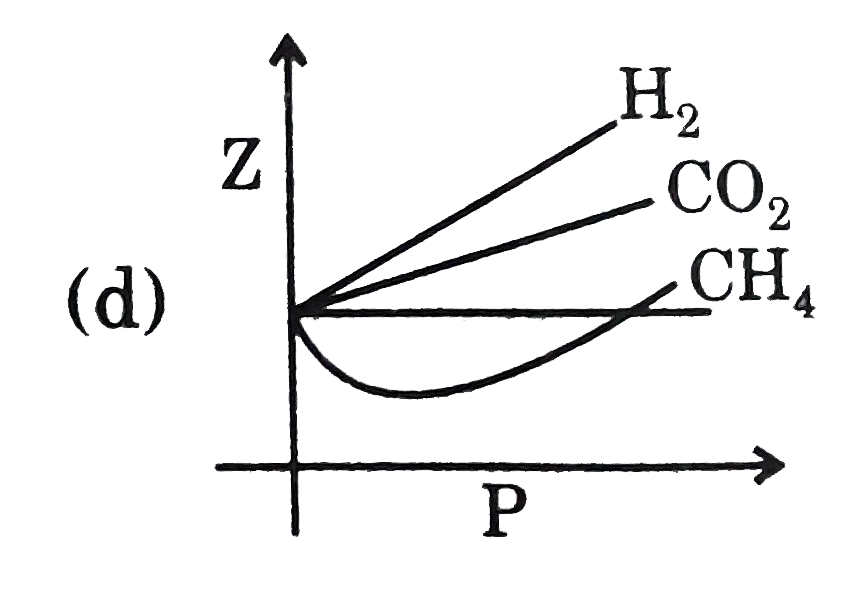
If the above plot is replotted at 373 K, then which of the following plots may show the correct behaviour at 373 K ? |
|
Answer»
|
|
| 38. |
Imines or enamines are selectively reduced to 1^(@) or 2^(@) amines with: |
|
Answer» a.`NaBH_(4)` |
|
| 39. |
If the 0.05 molar solution of M^(+) is replaced by a 0.0025 molar M^(+) solution, then the magnitude of the cell potential would be |
|
Answer» 35 mV `(2.303RT)/(F)"LOG(1)/(0.05)=70mV` `=70xx10^(-3)V=0.07V` `therefore(2.303RT)/(F)(1.301)=0.07` or `(2.303RT)/(F)=(0.07)/(1.301)=0.0538` For the NEW concentration, `E_(CELL)=(2.303RT)/(F)"log"(1)/(0.0025)` `=0.0538log400=0.0538xx2.6021` `=0.140V=140mV` |
|
| 40. |
Imine derivatives of aldehyde and ketone is called as |
|
Answer» Schiff's reagent |
|
| 41. |
(i)Magnetic moment of [Ag(CN)_(2)] is zero .How many unpaired electrons arepresent in this compound?(ii) 'Silver nitrate is usually supplied in brown coloured bottles. Explain. |
|
Answer» Solution :(i) ZERO (II) It DECOMPOSES on exposure to LIGHT and thus stored in brown coloured bottles. |
|
| 42. |
If temperature remains contant during a reaction the process is called: |
|
Answer» Isothermal |
|
| 43. |
Im Kjedahl's method, the nitrogen present in the organic compound is quantitatively converted into |
|
Answer» Gaseous ammonia `CH_(3)CONH_(3) +NaOH overset(Delta)rarr CH_(3)COONa + H_(2)O + NH_(3)` |
|
| 44. |
If temperature remains constant during the process. It is called an : |
|
Answer» ISOTHERMAL process |
|
| 45. |
If temperature is 10^(@)C, what is temperature in Fahrenheit? |
| Answer» Solution :`.^(@)F=(9)/(5)(.^(@)C)+32=(9)/(5)xx10+32=50^(@)` | |
| 46. |
Illustrate with examples the limitations of Williamson synthesis for the preparation of certain types of ethers. |
|
Answer» Solution :`to` The Williamson synthesis is not a SUITABLE method for the preparation of unsymmetrical ETHERS where compound contains secondary or tertiary ALKYL groups. For example, the reaction between tert-butyl bromide and sodium methoxide yield alkenes. This is because of sodium methoxide is strong base apart from a nucleophile and as a result, the elimination dominates over substitution reaction. `CH_(3)- underset(CH_(3))underset(|)OVERSET(CH_(3))overset(|)C- Br+ overset(+)Nabar(underset(* *)overset(* *)O)-CH_(3) to CH_(3)- underset(CH_(3))underset(|)C= CH_(2)+NaBr+ CH_(3)OH` |
|
| 47. |
If te solubility product of BaSO_(4) is 1.5 xx 10^(-9) in water, its solubility in moles per litre, is |
|
Answer» `1.5 xx 10^(-9)` Solubility constant `= S xx S` `1.5 xx 10^(-19) = S^(2), S = sqrt(1.5 xx 10^(-19)), S = 3.9 xx 10^(-5)`. |
|
| 48. |
Illustrate: Wurtz fitting reaction |
Answer» SOLUTION :Haloarenes REACTS with etheral solution of an ALKYL halide in the presence of SODIUM from alkyl derivatives of benzene.
|
|
| 49. |
Illustrate with examples - (i) Lyophilic and Lyophobic sols (ii) Homogeneous and Heterogeneous catalysis. |
|
Answer» SOLUTION :(i) The substances such as proteins, starch, RUBBER, etc. directly passes into the colloidal statewhen brought in contact with the solvent. Such colloids are known as lyophillic sols. The substances like metals, their sulphides, hydroxides, etc. do not form colloidal sol READILY when mixed with dispersion medium. The colloidal sols can only be PREPARED by some special methods. Such sols are called lyophobic sols. (ii) Homogeneous catalysis: Here the reactants and catalyst are present in the same phase. For example, lead chamber process for the manufacture of `H_2SO_4` . `2SO_(2)(g)+ O_2 (g) overset(NO_((g)))to 2SO_(3)(g)` Heterogeneous catalysis: Here the reactants and catalyst are present in different PHASES. For example, contact process for manufacture of `H_2SO_4` . `2SO_(2)(g) + O_(2)(g) overset(V_2O_(5(s)))to 2SO_(3)(g)` |
|