Saved Bookmarks
This section includes 7 InterviewSolutions, each offering curated multiple-choice questions to sharpen your Current Affairs knowledge and support exam preparation. Choose a topic below to get started.
| 1. |
Identify compounds A,B and C in the following sequence of reactions. C_6H_5NO_2overset(Fe"/"HCl)(to)A underset(273K)overset(HNO_2)(to)B overset(C_6H_5OH)(to)C |
|
Answer» Solution :`{:(C_6H_5NO_2 underset(6(H))OVERSET(FE"/"HCl)(to)C_6H_5NH_2),("""(A) ANILINE "):}` `{:(C_6H_5NH_2+HNO_2 underset(273 K)overset(HCl)(to)C_6H_5N=N-Cl),("(A) Aniline"" Nitrous Acid "" (B) Benzene Diazonium "):}` The reaction is known as CHLORIDE DIAZOTISATION.  The reaction is known as coupling reaction. |
|
| 2. |
Identify compounds A,B and C in the following sequence of reactions. CH_3CH_2Ioverset(NaCN)(to)A underset(" Partial hydrolysis ")overset(OH^-)(to)B overset(NaOH+Br_2)(to)C |
| Answer» Solution :`underset("iodide)")underset("(Ethyl")(CH_(3)CH_(2)I)overset(NaCN)underset(-NaI)rarrunderset("(A)")underset("cyanide)")underset("(Ethyl")(CH_(3)CH_(2)CN)underset(underset("hydrolysis)")("(Partial"))overset(OH^(-))rarrunderset("(B)")underset("(ACETAMIDE)")(CH_(3)-CONH_(2))overset(NaOH+Br_(2))underset(underset(underset("reaction)")("bromamide"))"(HOFMANN")rarrunderset("(C)")underset("(Methylamine)")(CH_(3)NH_(2))` | |
| 3. |
Identify compound A, B and C in the following sequence of reactions. i. C_(6)H_(5)NO_(2)overset(Fe//HCl)rarrAoverset(HNO_(2))underset(273K)rarr Boverset(H_(2)O)rarr C ii. C_(6)H_(5)N_(2)Cloverset(CucN)rarrAoverset(H_(2)O //H^(+))rarrBoverset(NH_(3))rarrC |
Answer» Solution :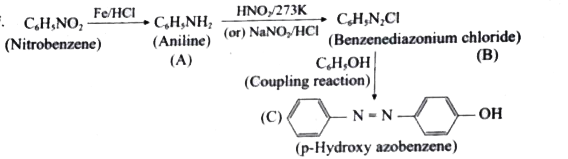 ii.`underset("chloride)")underset("(Benzenediazonium")(C_(6)H_(5)N_(2)Cl)overset(CuCN)rarrunderset("(A)")underset("(CYANOBENZENE)")(C_(6)H_(5)CN)overset(H_(2)O //H^(+))rarrunderset("(B)")underset("(Benzoic acid)")(C_(6)H_(5)COOH)overset(NH_(3)//DELTA)rarrunderset("(C)")underset("(Benzamide)")(C_(6)H_(5)CONH_(2))` |
|
| 4. |
Identifycompound(A) in thefollowingoxidationreaction |
|
Answer»
|
|
| 5. |
Identify compound A |
|
Answer» `ZnSO_(4)7H_(2)O` `FeSO_(4)+BaCl_(2)tounderset((B))(BaSO_(4)darr)+FeCl_(2)` `2FeSO_(4)overset(Delta)tounderset((E))(Fe_(2)O_(3))+underset((C))(SO_(2))+underset((D))(SO_(3))` `Fe_(2)O_(3)+6HCl tounderset((F))(2FeCl_(3))+3H_(2)O` `2FeCl_(3)+H_(2)Stounderset((H))(2FeCl_(2))+2HCl+underset((G))(S)` `2FeCl_(3)+SnCl_(2)to 2FeCl_(2)+SnCl_(4)` `4FeCl_(3)+3K_(4)Fe(CN)_(6)tounderset("Prussian BLUE")(Fe_(4)[Fe(CN)_(6)]_(3))+12KCl` |
|
| 6. |
Identify (C) in the following sequence of reactions : H-overset(O) overset("||")C-H underset((2)H_(2)O //H^(+))overset((1)CH_(3)Mgl)rarr(A) underset(C_(2)H_(5)OH)overset(NH_(3))rarr(C) |
|
Answer» `CH_(3)NH_(2)` `(B)=CH_(3)CH_(2)Cl`, Ethyl chloride `(C)=CH_(3)CH_(2)NH_(2)`, ETHYLAMINE |
|
| 7. |
Identify C in the given reaction: C_(2)H_(6)O underset(170^(@)C)overset("conc." H_(2)SO_(4))to A underset(H_(2)//Zn)overset(O_(3))to B underset("[O]")overset(KmnO_(4)//H^(+))to C |
|
Answer» `HCHO` |
|
| 8. |
Identify the monosaccharide among the following |
|
Answer» ISOPROPYL alcohol |
|
| 9. |
Identify chiral molecule among the following : |
|
Answer» ISOPROPYL alcohol |
|
| 10. |
Identify C in the following sequence of reactions: C_(6)H_(5)-NO_(2) overset(Sn+HCl)to A overset(NaNO_(2)//HCl)underset(0^(@)C)to B overset(H_(3)PO_(2)//H_(2)O)to C |
|
Answer» `C_(6)H_(5)CH_(3)` `B=C_(6)H_(5)-overset(+)(N_(2))overset(-)(C)l` (benzene DIAZONIUM chloride) `C=C_(6)H_(6)` (benzene) |
|
| 11. |
Identify C in the following reactions : CH_3 - CH= CH_(2) overset(HBr)(to) A overset(KOH "(alc.)")(to) B overset(HBr) underset(H_2O_2)(to) C |
|
Answer» `CH_3 CH = CH_2` 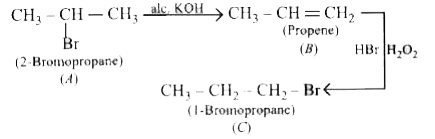
|
|
| 12. |
Identify C in the following sequence of reactions: CH_3COONH_4 to overset(Delta)A overset(P_2O_5) to B overset(H_3O^(+) ) to C |
|
Answer» ` CH_3 CH_2CONH_2` |
|
| 13. |
Identify C in the following reaction sequence. C_(2)H_(5)-OH underset(350^(@)C)overset(Al_(2)O_(3))to A overset(HBr)to B overset(Na//ether)to |
|
Answer» Ethane<BR>Ethene |
|
| 14. |
Identify C in the following reaction. "Ethanol"overset(PBr_(3))rarrAoverset("alc. KOH")rarrBoverset("(i) "H_(2)SO_(4)" R.T.")underset("(ii) "H_(2)SO_(4)Delta)rarrC |
| Answer» Solution :`C=CH_(3)-UNDERSET("Ethanol")(CH_(2)-OH)` | |
| 15. |
Identify C in the following reaction : CH_3- CH = CH_2 overset(HBr)underset(H_2O_2)(to) A overset(KOH(aq))(to)B overset(K_(2) Cr_(2) O_(7)//H^(+))underset(Delta)(to) C |
|
Answer» `CH_3 CH_3` |
|
| 17. |
Identify C in the following reaction. |
|
Answer» `CH_(3)CHO` |
|
| 18. |
Identify C and D. |
Answer» SOLUTION :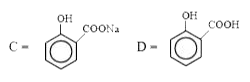
|
|
| 19. |
Identify C |
|
Answer» `Na_(2)ZnO_(2)` `ZnO +2HCI rarr underset((B))(ZnCI_(2)) +H_(2)O` `ZnO +2NaOH rarr underset((C))(Na_(2)ZnO_(2))+H_(2)O` `ZnO` is amphoteric. `underset((B))(ZnCI_(2))+H_(2)S rarr` No ppt. This is because `ZnS` is precipitated in basic medium with sufficient `[S^(2-)]` concentration. `underset(("Neutral or basic solution"))(ZnCI_(2)+H_(2)S) overset(NH_(4)OH)rarr underset((D))(ZnSdarr) +2HCI` |
|
| 20. |
Identify C and D. |
Answer» SOLUTION :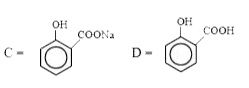
|
|
| 21. |
Identify C |
|
Answer» `Fe(OH)_(3)`<BR>`Fe_(2)O_(3)` `FeBr_(3)+3H_(2)SO_(4)tounderset((B))(Fe_(2)(SO_(4))_(3)+3Br_(2)` `FeBr_(3)+3NH_(4)OHtounderset((C))(Fe(OH)_(3) darr)+3NH_(4)Br` |
|
| 22. |
Identify C |
|
Answer» `Na_(2)Cr_(2)O_(7)` `Na_(2)O_(2) +H_(2)O rarr 2NaOH +[O] xx 3` `2Cr(OH)_(3) +NaOH +3[O] rarr 2Na_(2)CrO_(4) +5H_(2)O` `ulbar(2Cr(OH)_(3)+3Na_(2)O_(2)rarrunderset("Yellow solution")(2Na_(2)CrO_(4))+2NaOH+2H_(2)O)` `underset(Yellow)(2CrO_(4)^(2-))+2H^(o+)rarrunderset("ORANGE")(2CrO_(7)^(2-))+H_(2)O` `Cr_(2)O_(7)^(2-) +2OH^(Theta) +2Pb^(2+) rarr underset(("BRIGHT yellow ppt"))(2PbCrO_(4)+H_(2)O)` |
|
| 23. |
Identify 'C' : |
|
Answer» `C_(2)H_(5)OVERSET(Theta)O,CH_(3)CH_(2)-I` |
|
| 24. |
Identify C |
|
Answer» `[Fe(H_(2)O)_(5)NO]SO_(4)` `underset("Light GREEN (A)")(FeSO_(4).7H_(2)O)overset("Gentle heating")tounderset("Colourless")(FeSO_(4))+7H_(2)O` `FeSO_(4)+NO to underset("Brown (C)")(FeSO_(4).NO)` `FeSO_(4)+NO to overset(Delta)underset((D))(Fe_(2)O_(3))+underset((E))(SO_(2))+underset((F))(SO_(3))` `2KMnO_(4)+3H_(2)SO_(4)toK_(2)SO_(4)+2MnSO_(4)+3H_(2)O+5[O]` `SO_(2)+H_(2)O+O to [H_(2)SO_(4)]xx5` `ulbar(underset("(PINK)")(2KMnO_(4))+2H_(2)O+5SO_(2) underset("(Almost colourless)")(to) K_(2)SO_(4)+2MnSO_(4)+2H_(2)SO_(4)+2H_(2)SO_(4))` `SO_(3)+H_(2)Oto H_(2)SO_(4)` `H_(2)SO_(4)+BaCl_(2)toBaSO_(4)darr+2HCl` |
|
| 25. |
Identify B, X and R respetectivelly in the following sequence of reactions C_(2)H_(5)MgBroverset(ClCN)rarrAoverset(H_(3)O^(+))rarrB, CH_(3)COCH_(3)underset(NaOH)overset(I_(2))rarrXoverset(Ag)rarrY C_(6)H_(5)NH_(2)underset(HCl)overset(NaNO_(2))rarrPoverset(CuCN)rarrQoverset(+4H)rarrR |
|
Answer» `C_(2)H_(5)COOH, CHI_(3),C_(6)H_(5)CH_(2)NH_(2)` |
|
| 26. |
Identify 'B' from the following reaction : CH_(2)=CH_(2) overset(HBr)rarrA overset("hydrolysis")rarr B underset(I_(2) "excess")overset(Na_(2)CO_(3))rarr C |
| Answer» Answer :B::C | |
| 27. |
Identify 'B' in the reaction Acetamide underset(Delta)overset(P_(2)O_(5))rarrAoverset(4H)RarrB |
|
Answer» `CH_(3)NH_(2)` |
|
| 28. |
Identify B in the following reaction: C_(6)H_(5)CH_(2)OH underset((ii)NaOH)overset((i)K_(2)Cr_(2)O_(7))(to)B |
| Answer» SOLUTION :`B=C_(6)H_(5)COONA` | |
| 29. |
Identify 'B' from the following reaction : |
|
Answer» Propan-1-amine |
|
| 30. |
Identify B, C, D and E in the following reactions CH_3-underset(CH_3)underset(|)CH-CH_2-CH_2-Brunderset((ii) D_20)underset(rarr)"(i)Mg/Ether"(B) (A) (A) underset(rarr)(LiAlH_4) (C) (A) underset(rarr)(Wurtz) (D) (A) underset((ii) Cu underset(rarr)"(i)Li" (E) |
|
Answer» Solution :`CH_3-underset(CH_3)underset(|)CH-CH_2-CH_2-Broverset((i) Mg//Ether)rarrCH_3-underset(CH_3)underset(|)CH-CH_2-CH_2-MgBroverset(D_2O)rarrCH_3-underset(CH_3)underset(|)CH-CH_2-CH_2D` (B) `CH_3-underset(CH_3)underset(|)CH-CH_2-CH_2-Broverset(LiAlH_4)rarrCH_3-underset(CH_3)underset(|)CH-CH_2-CH_3` (C) 2 MOL of (A) `overset(Wartz)underset(Na//Ether)rarrCH_3-underset(CH_3)underset(|)CH-CH_2-CH_2-CH_2-CH_2-underset(CH_3)underset(|)CH-CH_3` (D) `CH_3-underset(CH_3)underset(|)CH-CH_2CH_2-Broverset((i)Li)underset((ii)Cut)rarr(CH_3-underset(CH_3)underset(|)CH-CH_2-CH_2)_2CuLi` `DARR(A)` `CH_3-underset(CH_3)underset(|)CH-CH_2-CH_2-CH_2-CH_2-underset(CH_3)underset(|)CH-CH_3` (E) |
|
| 31. |
Identify (B), ( C) and (D) CH_(3)-overset(O)overset(||)(C)-CH_(3)(A)overset(LiAlH_(4))to(B)overset(SOCl_(2))to(C)overset("alc."KOH)to(D) |
|
Answer» SOLUTION :(B) `CH_(3)-overset(OH)overset(|)(CH)-CH_(3)` Isopropyl alcohol ( C) `CH_(3)-overset(Cl)overset(|)(CH)-CH_(3)` Isopropyl CHLORIDE (D) `CH_(3)-CH-CH_(2)` propylene |
|
| 32. |
Identify (B), (C) and (D) underset("Acetone")(CH_(3)-overset(O)overset(||)C-CH_(3))(A) overset(LiAlH_(4))rarr (B) overset(SoCl_(2))rarr (C ) overset("alc. KOH")rarr (D) |
|
Answer» SOLUTION :(B) `CH_(3)-overset(OH)overset("|")"CH"-CH_(3)":Isopropyl alcohol"` (C ) `CH_(3)-overset(CL)overset(|)CH-CH_(3)":Isopropyl chloride"` (D) `CH_(3)-CH=CH_(2)": propylene"` |
|
| 33. |
Identify B |
|
Answer» `CI_(2)` `FeBr_(3)+3H_(2)SO_(4)tounderset((B))(Fe_(2)(SO_(4))_(3)+3Br_(2)` `FeBr_(3)+3NH_(4)OHtounderset((C))(Fe(OH)_(3) darr)+3NH_(4)Br` |
|
| 34. |
Identify B and D in the following sequence of reactions |
|
Answer» ethanol and BROMOETHANE 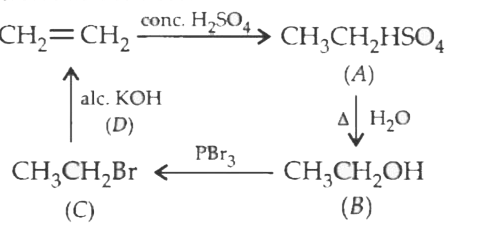 In the sequence of reactions ,B is ethanol and D is alc.KOH. |
|
| 35. |
Identify B |
|
Answer» `CrC1_(3)` `Na_(2)O_(2) +H_(2)O rarr 2NAOH +[O] xx 3` `2Cr(OH)_(3) +NaOH +3[O] rarr 2Na_(2)CrO_(4) +5H_(2)O` `ulbar(2Cr(OH)_(3)+3Na_(2)O_(2)rarrunderset("Yellow solution")(2Na_(2)CrO_(4))+2NaOH+2H_(2)O)` `underset(Yellow)(2CrO_(4)^(2-))+2H^(o+)rarrunderset("Orange")(2CrO_(7)^(2-))+H_(2)O` `Cr_(2)O_(7)^(2-) +2OH^(Theta) +2Pb^(2+) rarr underset(("Bright yellow ppt"))(2PbCrO_(4)+H_(2)O)` |
|
| 36. |
Identify B |
|
Answer» `ZnSO_(4)` `underset("Light green (A)")(FeSO_(4).7H_(2)O)overset("Gentle heating")tounderset("Colourless")(FeSO_(4))+7H_(2)O` `FeSO_(4)+NO to underset("Brown (C)")(FeSO_(4).NO)` `FeSO_(4)+NO to overset(Delta)underset((D))(Fe_(2)O_(3))+underset((E))(SO_(2))+underset((F))(SO_(3))` `2KMnO_(4)+3H_(2)SO_(4)toK_(2)SO_(4)+2MnSO_(4)+3H_(2)O+5[O]` `SO_(2)+H_(2)O+O to [H_(2)SO_(4)]XX5` `ulbar(underset("(PINK)")(2KMnO_(4))+2H_(2)O+5SO_(2) underset("(Almost colourless)")(to) K_(2)SO_(4)+2MnSO_(4)+2H_(2)SO_(4)+2H_(2)SO_(4))` `SO_(3)+H_(2)Oto H_(2)SO_(4)` `H_(2)SO_(4)+BaCl_(2)toBaSO_(4)darr+2HCl` |
|
| 37. |
Identify B |
|
Answer» `FeCI_(2)` `ZnO +2HCI rarr UNDERSET((B))(ZnCI_(2)) +H_(2)O` `ZnO +2NaOH rarr underset((C))(Na_(2)ZnO_(2))+H_(2)O` `ZnO` is amphoteric. `underset((B))(ZnCI_(2))+H_(2)S rarr` No ppt. This is because `ZNS` is precipitated in basic MEDIUM with sufficient `[S^(2-)]` concentration. `underset(("Neutral or basic solution"))(ZnCI_(2)+H_(2)S) overset(NH_(4)OH)rarr underset((D))(ZnSdarr) +2HCI` |
|
| 38. |
Identify axis of symmetry in the given compound. |
|
Answer» |
|
| 39. |
Identify and write the organic compounds A and B. CH_(4) +Cl_(2) overset" Sun light "rightarrow A overset"Na metal" rightarrow B. |
|
Answer» SOLUTION :`ArightarrowCH_(2)C` LOR Methtylchloride or chloromethane1 `Brightarrow C_(2)H_(6)` or Ethane. |
|
| 40. |
Identify and write the following in the complex [CO(NH_(3))_(4)Cl_(2)]Cl (i) Cation (ii) Ligands (iii) Name of the ligand (iv) central metal (v) Oxidation state of central metal (vi) Anion (vii) IUPAC name |
Answer» Solution :`[CO(NH_(3))_(4)Cl_(2)]Cl` 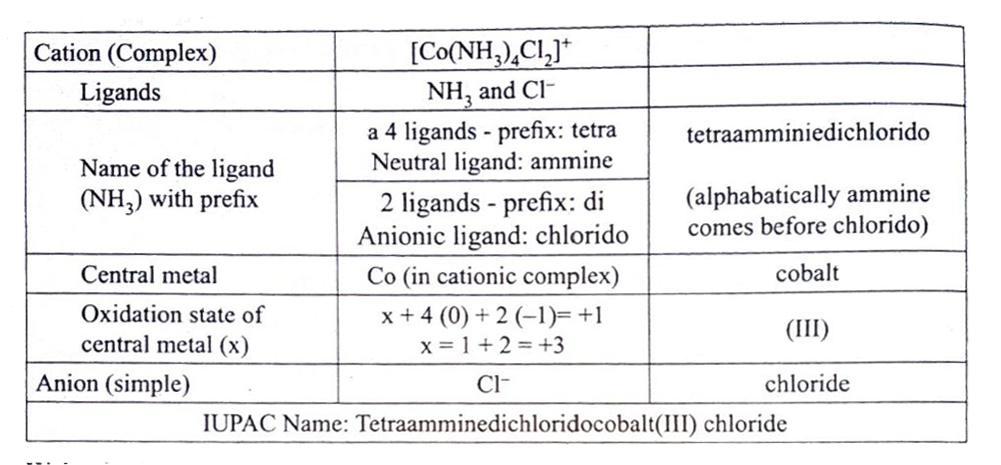
|
|
| 41. |
Identify and write the name of the shaded parts of A and B? |
|
Answer» Solution :SHADED PART in A)is octaherdral void,in B)is TETRA hedral void |
|
| 42. |
Identify and indicate the presence of center of chirality, if any, in the following molecules? How many stereoisomers are possible for each. (i) 2-Aminobutane (ii) 3-Bromopent-1-ene (iii) 1,2-Dichloropropane. (iv) 3-Methyl-1-pentene |
Answer» SOLUTION : . .
|
|
| 43. |
Identify and indicate the presence of centre of chirality, if any, in the following molecules. How many stereoisomers are possible for those containing chiral centre ? (i) 1, 2 dichloropropane (ii) 3-bromo -pent -1-ene |
Answer» Solution :(i) `underset("as given below: ") (ClCH_(2) - underset(Cl) underset(|)overset(***)CH - CH_(3)) `has one CENTRE of CHIRALITY denoted by`***` MARK . It has two stereoisomers as given below : <BR>  (II) `underset("stereoisomers as shown below:") (CH_(3) - CH_(2) - underset(Br) underset(|) overset(***) CH - CH = CH_(2)) `has one centre of chirality denoted by `***` mark and has two 
|
|
| 45. |
Identify an extensive property amongst the following. |
|
Answer» Viscosity |
|
| 46. |
Identify an intensive property among the following |
| Answer» Answer :D | |
| 47. |
Identify an extensive property amongst the following |
|
Answer» VISCOSITY |
|
| 48. |
Identify an analgesic from the following |
|
Answer»
|
|
| 49. |
Identify allylic alcohols in the above examples |
| Answer» SOLUTION :(ii) and (vi) are allylic ALCOHOLS because they contain-OH group ATTACHED to `sp^3` CARBON next to C=C | |