

Saved Bookmarks
This section includes 7 InterviewSolutions, each offering curated multiple-choice questions to sharpen your Current Affairs knowledge and support exam preparation. Choose a topic below to get started.
| 2. |
How many years it would take to spend one Avogadro number of rupees at a rate of 10 lakh of rupees in one second? |
|
Answer» Solution :Number of RUPEES SPENT in one secodn `=10^(6)` Number of rupees spent in one year `=10^(6)xx60xx60xx24xx365` Avogadro's number of rupees will be spent. `=(6.02xx10^(23))/(10^(6)xx60xx60xx24xx365)` `=19.089xx10^(9)` years =1.9089`xx10^(10)` years. |
|
| 3. |
How many water of crystallisition is/are present in the ore camallite? |
|
Answer» |
|
| 4. |
How many water molecules are there in a drop of volume 0.05mL? (Density of water is 1g/mL) |
|
Answer» `1.67xx10^(21)` |
|
| 5. |
How manywater molecule(s) is/are present in microcomics salt ? |
|
Answer» |
|
| 6. |
How many water moleculer(s) is/arepresentsin compoiund whichin usingin boraxbead test? |
|
Answer» |
|
| 7. |
How many varieties of heavy water are possible in terms of 3 different isotopes of oxygen |
|
Answer» `(II) H-overset(17)(O)-D` `(III) H-overset(18)(O)-D` `(iv) D-overset(16)(O)-D` (V)`D-overset(17)(O)-D` `(vi) D-overset(18)(O)-D` |
|
| 8. |
How many unpaired electrons present in the square planar [Pt(CN)_4]^(2-) ion ? |
Answer» Solution : In `[PT(CN)_6]^(2-)` , no unpaired electrons are present and it is DIAMAGNETIC. |
|
| 9. |
How many unpaired electrons are there is Ni^(2+) |
|
Answer» 2 |
|
| 10. |
How many unpaired electrons are present in the central metal ion [CoCl_4]^(2-) |
|
Answer» |
|
| 11. |
How many unpaired electrons are present in tin (z=50)? |
|
Answer» 3 |
|
| 12. |
How many unpaired electrons are present in Co^(3+), Fe^(2+)? Calculate their magnetic moment. |
|
Answer» Solution :`Co (Z = 27)Co^(3+)[Ar] 3d^(6)` `Fe (Z = 26)Fe^(2+)[Ar]3d^(6)` The number of unpaired ELECTRONS are 4 as FOLLOWS: Ar 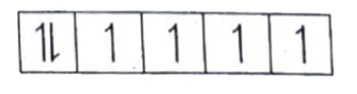 Their magnetic moment is `mu= SQRT(4(4+2)) = sqrt(24) = 4.89 mu_(B)` |
|
| 13. |
How many unpaired electrons are present in N_2^+ |
|
Answer» 1 |
|
| 14. |
How many unit cells of KBr are present in a 1.00 mm^(3) of KBr, KBr crystallizes in NaCl type of crystal lattice and its density is 2.75 g/cm^(3) |
|
Answer» Solution :In aunit CELL of KBr, there are four FORMULA units of KBr. Therefore, density`(rho)=(4xx119)/(6.023xx10^(23)xxa^(3))=2.75 `implies a^(3)=2.778xx10^(-22) cm^(3)=2.778xx10^(-19)MM^(3)` `implies` No. of unit CELLS per `mm^(3)=(10^(19))/(2.778)=3.6xx10^(18)` |
|
| 15. |
How many unit cells are present in a cube-shaped ideal crystal ofNaCI of mass 1 .00 g? [Atomic masses : Na = 23, Cl = 35.5] |
|
Answer» `5.14xx10^(21)` unit CELLS `=(1.0)/(58.5)xx6.02xx10^(23)` since in NACL TYPE of structure. 4 formula units form 'a' cell `therefore `unit cells`=(1.0xx6.02xx10^(23))/(58.5xx4)=2.57xx10^(21)` unit cells. |
|
| 16. |
How many unit cells are there in 1.00 gm cube shaped ideal crystal AB (MF = 60) having NaCl type lattice. |
|
Answer» `6.02 XX 10^(23)` |
|
| 17. |
How many unit cells are present in a cube shaped ideal crystal of NaCl of mass 1.00 g ? [Atomic masses : Na = 23, Cl = 35.5] |
|
Answer» `2.57 xx 10^(21)` Number of NaCl units in 1 g NaCl `= 1/58.5 xx N_A` `therefore`Number of unit cell in 1 g NaCl `= (N_A)/(58.5 xx 4)` |
|
| 18. |
How many unit cells are present in a cube-shaped ideal crystal of NaCl of mass 1.00 g ? |
|
Answer» `5.14xx10^(21)` |
|
| 19. |
How many unit cells are present in 2 gm of potassium (Atomic mass = 39) ? (bcc arrangement) |
|
Answer» `2.88 xx 10^(20)` |
|
| 20. |
How many unit cells are present in a cube shaped ideal crystal of NaCl of mass 1.0 g ? |
|
Answer» `2.57 xx 10^(21)` MASS of unit cell `= ( 4 xx 58.5)/( 6.022 xx 10^(23))` No. of unit CELLS in 1 g ` = ( 1 xx 6.022 xx 10^(23))/( 4 xx 58.5) = 2.57 xx 10^(21)` unit cells |
|
| 21. |
How many uncharged resosnace structures are possible for given azulene (including given structure)? |
|
Answer» |
|
| 22. |
How many unit cells are possible for the crystallographic dimensions as a ne b ne c alpha=gamma =90^(@),alphane beta |
|
Answer» 1 |
|
| 23. |
How many types of substituted alcohols (stereoisomers arenot considered) are possible in the given reaction ? |
|
Answer» |
|
| 24. |
How many types of solutions are formed ? |
| Answer» SOLUTION :THREE TYPES of SOLUTIONS are FORMED . | |
| 25. |
How many types of functional groups are present in the given compound? |
|
Answer»
|
|
| 26. |
How many types of particles among the following are emitted during the decay of sulphur-35 nucleus , beta - emmission, e^(-) capture , positron emission , neutron emission |
|
Answer» <P> `(n)/(p) = (19)/(16) = 1.1875 } implies` high `((n)/(p))` to DECREASE `((n)/(p))` RATIO |
|
| 27. |
How many types of primitive unit cells are there ? |
| Answer» Solution :There are SEVEN TYPES of PRIMITIVE uit CELLS. | |
| 28. |
Howmany typesof carbon - carbon bonds are present in 1-butyne ? |
|
Answer» 4 |
|
| 29. |
Howmanytypesofcarbonatomsarepresentin2,2,3 - trimethylpentane ? |
| Answer» Answer :D | |
| 30. |
How many tripeptides can be prepared by linking the amino acids glycine,alanine and phenyl alanine? |
| Answer» Answer :C | |
| 31. |
How many triatomic species has/have two lone pairs on the central atom ? SF_(4), I_(3)^(-), XeF_(2), NCl_(3), NO_(2)^(-), H_(2)O, OF_(2), OCl_(2), NF_(3), BCl_(3), XeF_(4), ClF_(3) |
Answer» 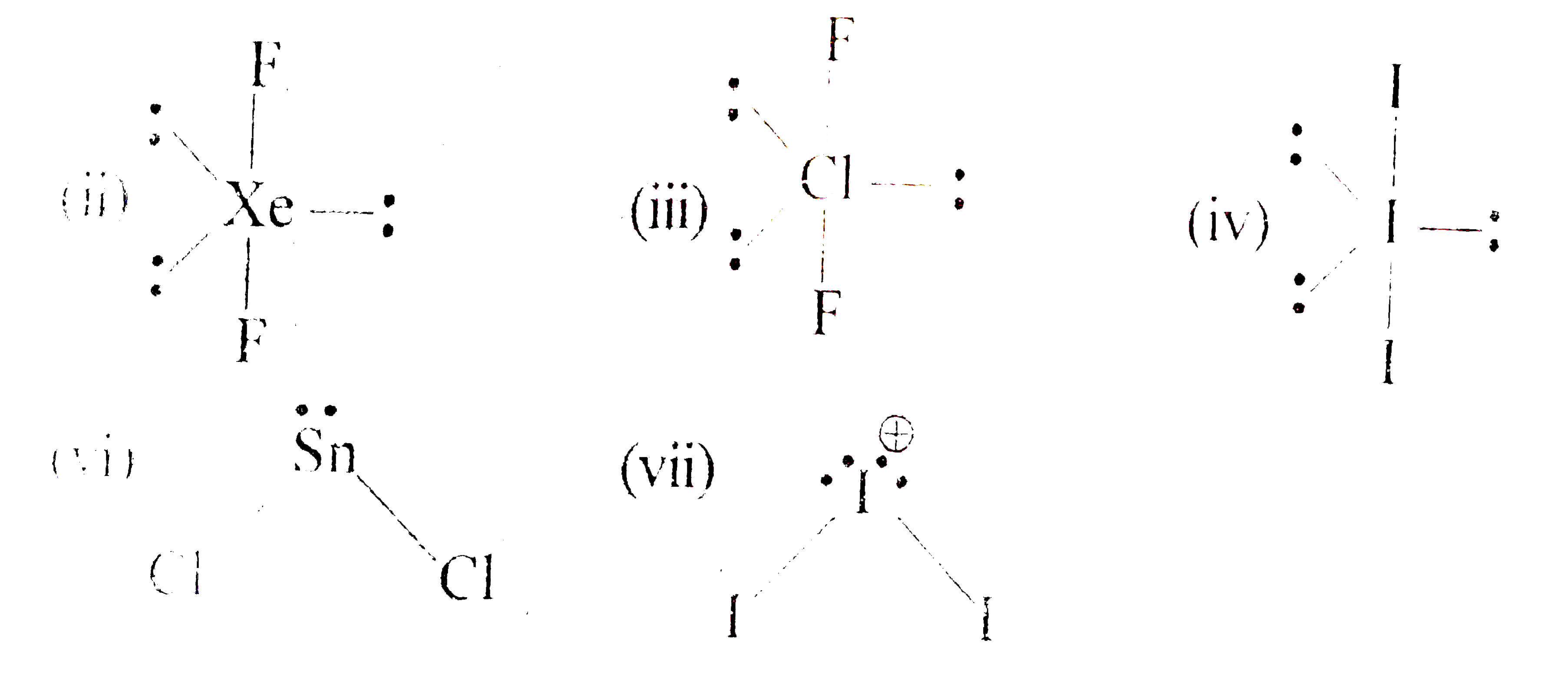
|
|
| 32. |
How many trichloroethanes would be produced when 1, 1-dichloroethane reacts with chlorine ? |
| Answer» ANSWER :B | |
| 33. |
How many transition states are formed during formation of major product in above reaction ? |
|
Answer» |
|
| 34. |
How many transition series of elements are there in the periodic table. |
| Answer» Solution :There are four main series of transition elements CORRESPONDING to the filling of 3D, 4d, 5d and 6d sublevels in 4TH, 5th, 6TH and 7th periods. The four series are known as first transition series or 3d series, second transition or 4d series, THIRD transition or 5d series and fourth transition or 6d series. | |
| 35. |
How many transiiton series of elementsare there in the periodictable ? Name them. |
| Answer» Solution :There are four main transition series of ELEMENTS correspong to filling of 3D, 4d, 5d and 6d SUBLEVELS in4th, 5TH, 6th and7th periods. They are known as first transition series , second transition or 4d series, third transition or 5dseries and FOURTH transition or 6d series. | |
| 36. |
How many total sodium ions are present in oneformula uint of sodium ethane-1,2-diaminetetraacetatochromate (II) and sodium hexanitrito cobaltate (III) ? |
|
Answer» |
|
| 37. |
How many total possible isomers are present in the following complex ? [Co(gly)NH_(3)H_(2)O(CN)(NO_(2))] |
|
Answer» 24 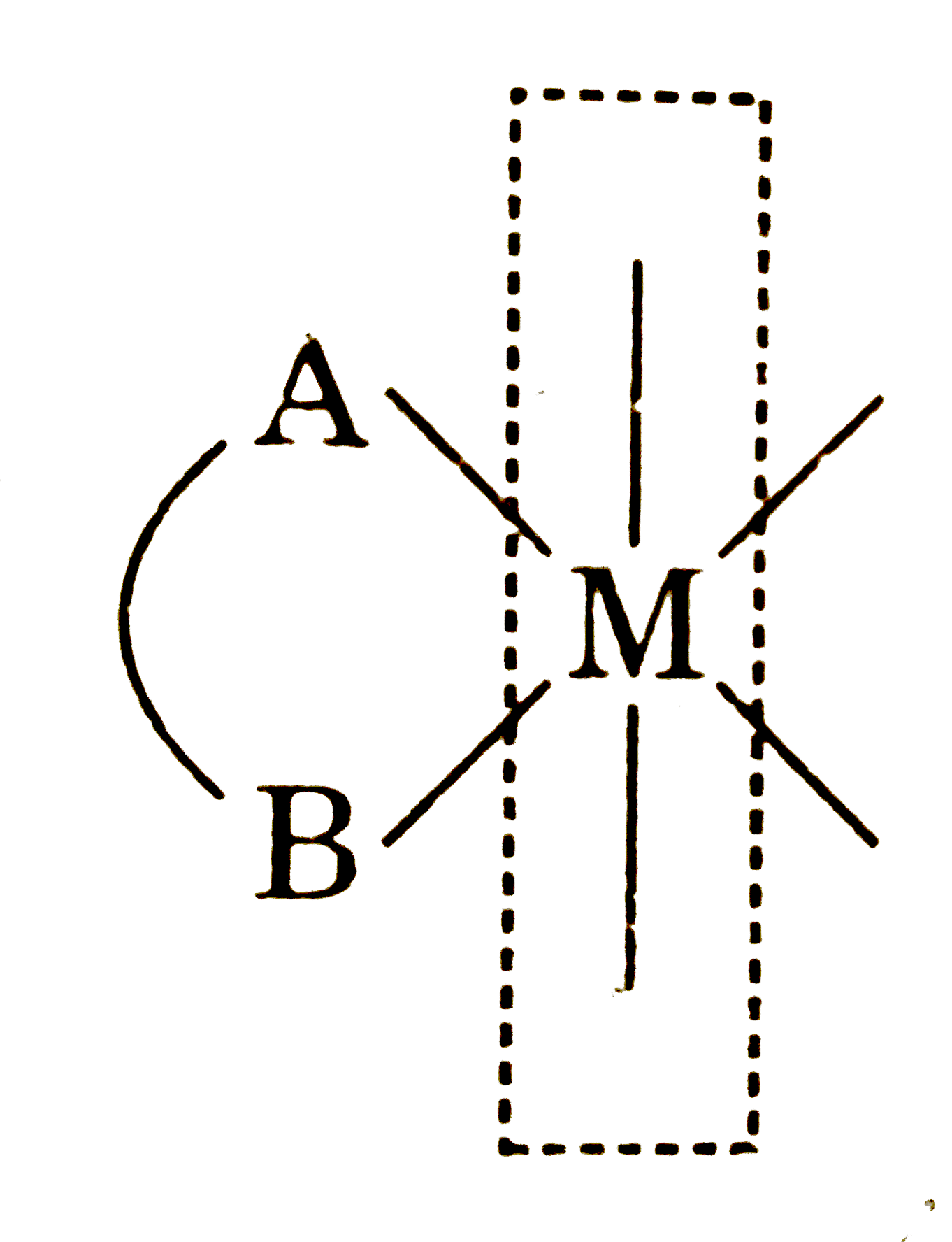 `[M(AB)abcd]` (a opp B) `IMPLIES` C, d and d, c]2 (a opp c) `implies` (b, d)(d, c)=2 (a opp d) `implies=2` (b opp c) `implies=2` (b opp d) `implies=2` (c opp d) `implies=(2)/(12)`  All are O.A. So, 48xx2=96 |
|
| 38. |
How many total possible isomers are present in the following complex ? [Co(en)NH_(3)(H_(2)O)(Cl)(NO_(2))] |
|
Answer» 24 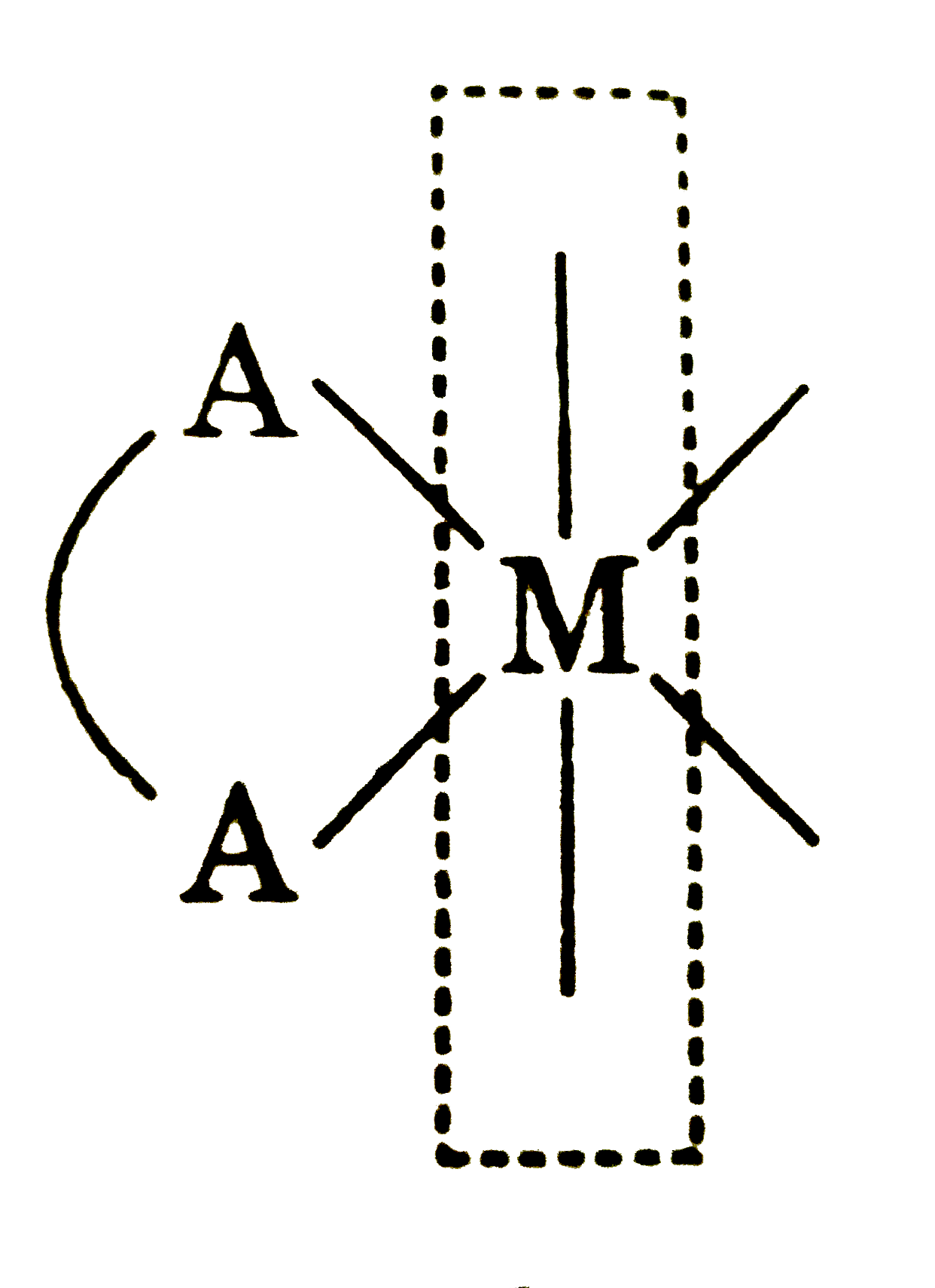 `"a OPP" b to 1` `"a opp C" to 1` `"a opp d" to 1` `" opp c" to 1` `b "opp d" to 1` `"b opp d" to (1)/(ul6)` 
|
|
| 39. |
How many total possible isomers are present for [Pt(CN)_(2)(NO_(2))_(2)]^(2-) ? |
|
Answer» Solution :`[Pt(CN)_(2)(NO_(2))_(2)]^(2-)` `leftarrow EQUIV N' rightarrow` `O=underset(downarrow)N-O^(Ɵ)rightarrow` (C, C)[(N, N) or (N, O) or (O, N) or (O, O)]= 4 `(C, N') IMPLIES 4` `(N', N') implies 4` (C, N) `implies` [(C, N), (N', N), (C, O), (N', O)] = 4 (C, O) `implies` [(N', N), (N', O)] = 2 (N', N) `implies` [N', O] = 1 `(N', O) `implies` - Total = 19 |
|
| 40. |
How many total number of optically active products are formed.The given compound is (S)-2-Chloro-2-methylbutane. |
|
Answer» |
|
| 41. |
How many total isomers including constitutional isomers and stereoisomers are possible for the complex [Rh (en)_2 (NO_2)(SCN)]^(+)? |
Answer» 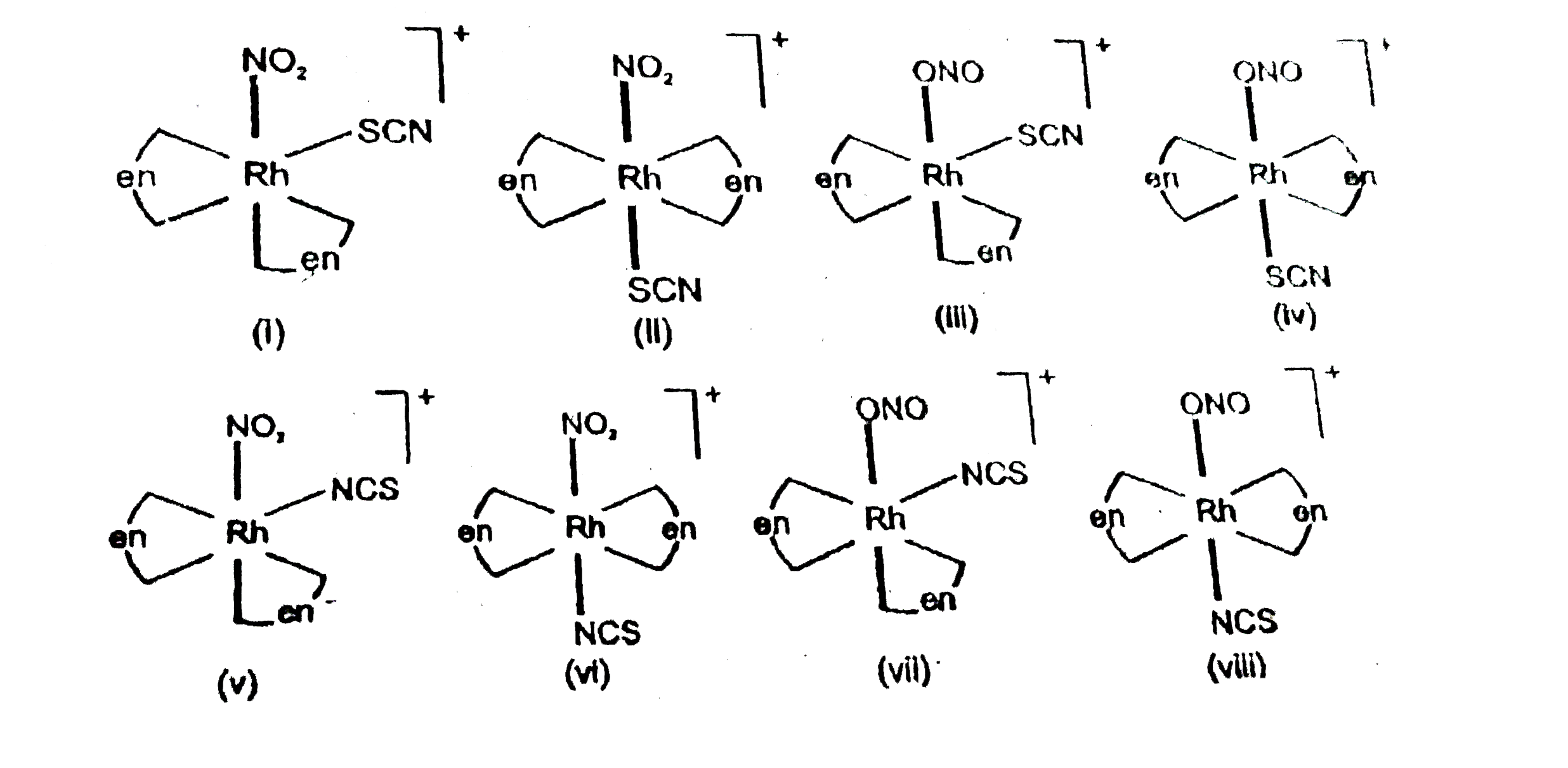
|
|
| 42. |
How many total number of alkenes are possible by dehydrobromination of 3-bromo-3-cyclopentylhexane using alcoholic KOH? |
Answer» 
|
|
| 43. |
How many times the number of tetrahedral voids are there as compared to octahedral voids? |
| Answer» ANSWER :B | |
| 44. |
How many times rate of reaction increases when temperature is incereased from - 4.2""^(@)C to 25.8""^(@)C. |
| Answer» SOLUTION :8 TIMES. | |
| 45. |
How many times larger is a hydrogen atom than the radius of an H atom in its ground state if the H atom with an electron characterised by a quantum number of 106? |
|
Answer» 106 |
|
| 46. |
How many times is a kg heavier than a mg? |
|
Answer» `10^3` |
|
| 47. |
How many times does the t_(1//2) of zero order reaction increases if the initial concentration of the reactant is doubled ? |
| Answer» SOLUTION :`t_(1//2)` GETS DOUBLED. | |
| 48. |
How many times an atom of sulphur is heavierthan an atom of carbon ? |
|
Answer» 32 times |
|
| 49. |
How many times a solution of pH =2 has higher acidic nature than the solution of pH=6 ? |
|
Answer» 1000 |
|
| 50. |
How many time is required to complete reaction when initial concentration of reactant is [R]_(0) zero order reaction? |
|
Answer» `([R]_(0))/(K)` If the zero order reaction BECOMES 100% ,then final concentration R will be zero. `therefore [R]`=zero=[R] If we put this VALUE in the EQUATION, `t=([R]_(0)-0.0)/(k)` `therefore t=([R]_(0))/(k)` ,So option (C) is correct |
|