

Saved Bookmarks
This section includes 7 InterviewSolutions, each offering curated multiple-choice questions to sharpen your Current Affairs knowledge and support exam preparation. Choose a topic below to get started.
| 2. |
How many pairs are, in which first species has lower ionisation enegy than second species: (i) N and O (ii) Br and K (iii) Be and B (iv) I and I^(-) (V) Li and Li^(+) (vi) and O and S (vii) Ba and Sr. |
|
Answer» (VII) `Ba lt SR` |
|
| 3. |
How many P- P - P angle are present in P_(4) molecule ? |
|
Answer» 8 |
|
| 4. |
Give the number of characteristic bond(s) found in the various oxy-acids of phosporous as given below. (a) Number of P-O-P bond(s) in tricyclometaphosphoric acid. (b) Number of P-P bond(s) in hypophosphoric acid (c) Number of P-OH bond(s) in pyrophosphoric acid. (d) Number of P-H bond(s) in hypophosphorous acid. |
| Answer» Answer :C | |
| 5. |
How many P-OH bonds are present in H_3PO_2 |
|
Answer» 1 |
|
| 6. |
How many oxygen atoms are shared per SIO_4 tetrahedral in Beryl ? |
Answer» 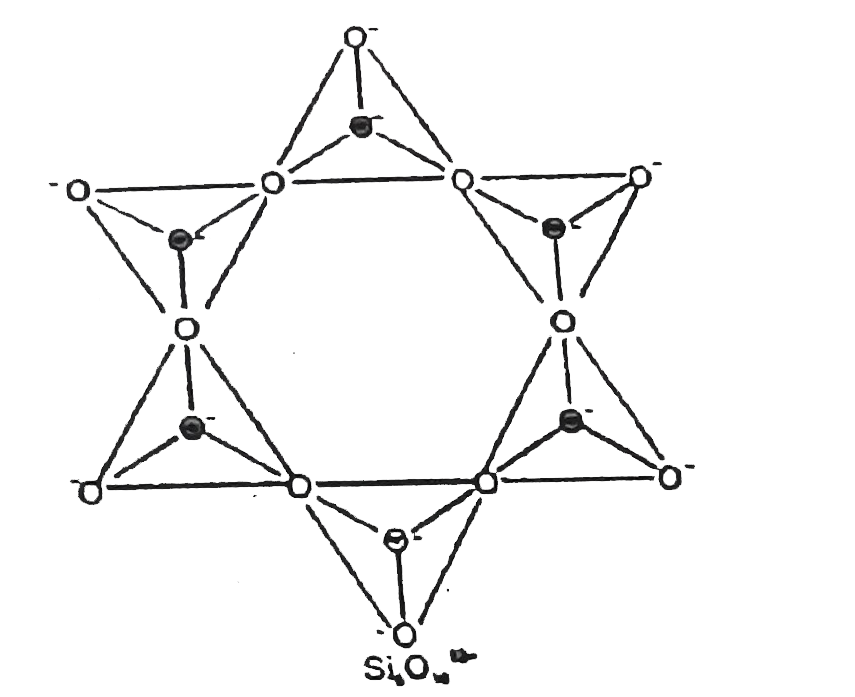 BERYL is CYCLIC SILICATE with `[Si_6O_18]^(-12)` anion. In which two oxygen atoms are shared per `SiO_4` TETRAHEDRAL. |
|
| 7. |
How many p =O bondsandP - OH bonds (respectively )are present in orthophosphoric acid ? |
|
Answer» 2,1 |
|
| 8. |
How many oxides are soluble in moderaterly concentrated aqueous solution of NaOH. {:(SO_3",",Cl_2O_7",",N_2O_5",",CO),((1),(2),(3),"(4)"),(K_2O",",Cr_2O_3",",BaO",",GeO_2),((5),(6),(7),"(8)"):} |
|
Answer» `Cr_2O_3` Amphoteric `K_2O` Bao Basic CO , Neutral Reactions : `SO_2+2NaOHtoNa_2SO_4+H_2O` `Cl_2O_7+2NaOHto2NaClO_4+H_2O` `N_2O_5+2NaOHto2NaClO_4+H_2O` CO+NaOH`to` No reaction `K_2O+NaOHto` No reaction but `K_2O+H_2Oto2KOH` BaO+NaOH`to` No reactionbut BaO +`H_2OtoBa(OH)_2` `Cr_2O_3+2NaOH+3H_2Oto2Na(CR(OH)_4]` `GeO_2+2NaOHtoNa_2GeO_3+H_2O` |
|
| 9. |
How many out of the following reagents will change 1- propanol into propanaldehyde? (a ) H^(+)//KMnO_(4)//(/_\) (b )TsCl / DMSO + NaHCO_(3) (c ) P.C.C(pyridinium chloro chromate) (d ) Bendict solution (e )Red hot Cu tube ( f) H^(+)//K_(2)Cr_(2)O_(7)//(/_\) ( g) NBS//(/_\) ( h) SeO_(2)//(/_\) |
|
Answer» |
|
| 10. |
How many out of [TiF_6]^(2-), [CoF_6]^(3-) , Cu_2Cl_2 and [NiCl_4]^(2-) are colourless ? (Ti =22, Co = 27 , Cu = 29 , Ni = 28) |
|
Answer» 0 |
|
| 11. |
How many orders among following are correct with respect to the properties indicated : {:((1)NH_3ltH_2OltH_2S,"Boiling point"),((2)PH_3ltAsH_3ltNH_3ltSbH_3,"Boiling point"),((3)BF_3ltBCl_3ltB Br_3,"Extent of hydrolysis"),((4)CH_3ClgtCH_3FgtCH_3BrgtCH_3I,"Dipole moment"),((5)BF_3ltBCl_3ltB Br_3,"Lewis acidic strength"),((6)Na^+ gtMg^(+2)Al^(+3),"Extent of hydration"):} |
|
Answer» |
|
| 12. |
How many orbitals, contains at least one electron in the ground state electronic configuration of Chromium atom? [Divide answer by 5] |
Answer» SOLUTION :`CR[24]=  0015 |
|
| 13. |
How many optically active stereoisomers are possible for butane-2,3-diol |
|
Answer» 2 |
|
| 14. |
How many optically active stereoisomers are possible for butane-2,3-idol: |
|
Answer» 1 |
|
| 15. |
How many optically active stereomers are possible for butane-2,3-diol |
|
Answer» 3 |
|
| 16. |
How many optically active stereomers are possible for butane - 2,3- diol ? |
|
Answer» 3 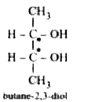 No. of asymmetric or chiral carbon= 2 THEREFORE no. of OPTICAL ISOMERS `=2^(n)=2^(n)=4` No . Ofoptically ACTIVE steremers `=4-1=3`, because SESO compound is optically inactive due to internal compensation. |
|
| 17. |
How many optically active stereoisomers are possible for butane-2, 3 diol |
|
Answer» 1 In it two asymmetric C-atoms and a plane of symmetry are present. So optically ACTIVE ISOMERS `= 2^(N+1) = 2^(2-1) = 2` (n = No. of asymmetric carbon atoms.) 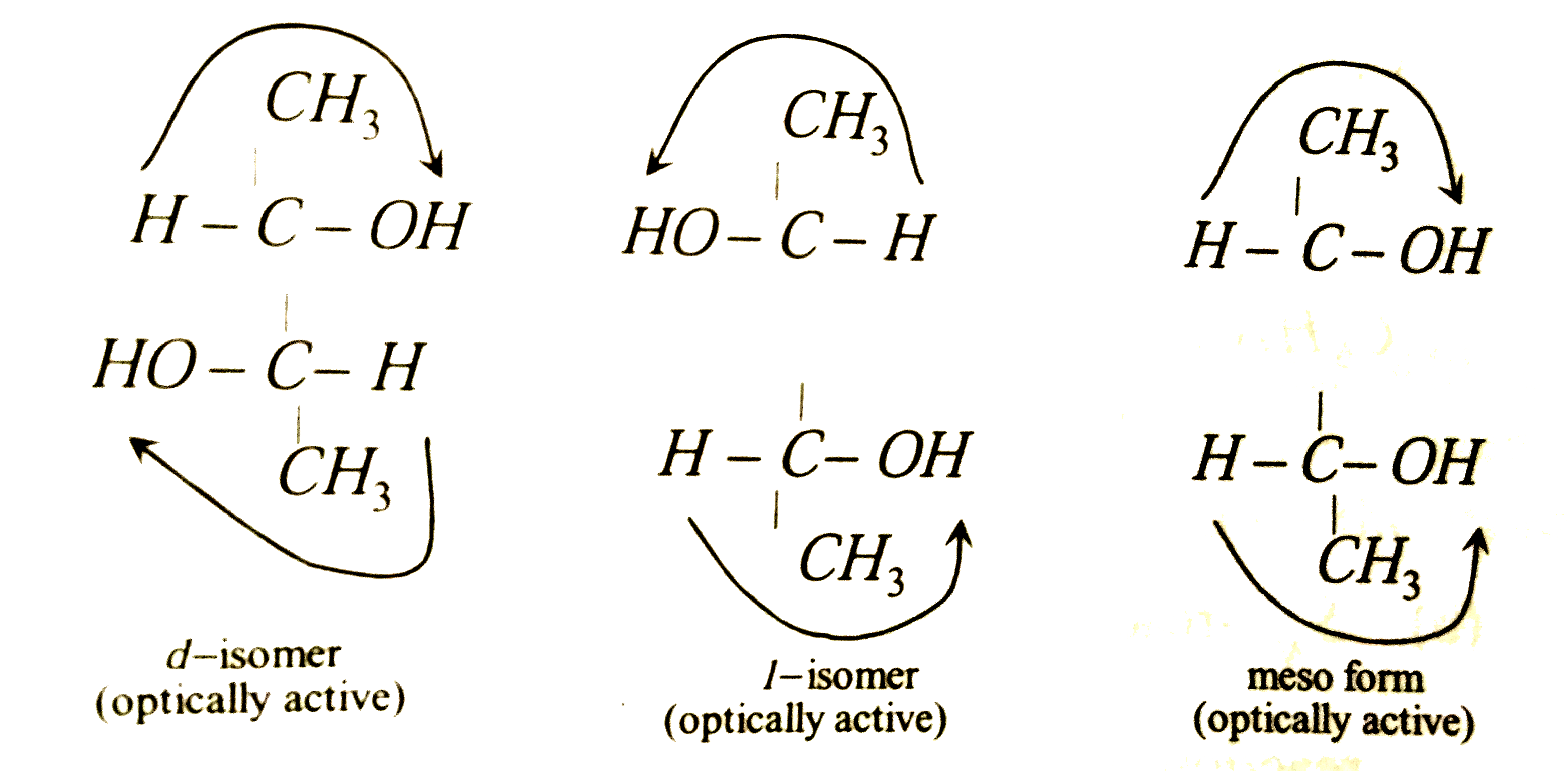
|
|
| 18. |
How many of these reactions are homogeneously catalyzed ? (i) 2SO_(2)(g) + O_(2)(g) overset(NO(g))to 2SO_(3)(g) (ii) C_(12)H_(22)O_(11)(aq.) + H_(2)O(l) overset(H_(2)SO_(4)(l))to underset("Glucose")(C_(6)H_(12)O_(6)(aq.)) + underset("Fructose")(C_(6)H_(12)O_(6)(aq.)) (iii) 2SO_(3)(g) + O_(2)(g) overset(Pt(s))to 2SO_(3)(g) (iv) N_(2)(g) + 3H_(2)(g) overset(Fe(s))to 2NH_(3)(g) (v) 4NH_(3)(g) + 5O_(2)(g) overset(Pt(s))to 4NO(g) + 6H_(2)O(g) (vi) CH_(3)COOCH_(3)(l) overset(HCl(l))to CH_(3)COOH(aq) (vii) Vegetable oils (l) + H_(2)(g)overset(Ni(s))to Vegetable ghee (s). |
|
Answer» |
|
| 19. |
How many optically active isomers of 2,3-Dichlorobutandioic acid are possible ? |
|
Answer» THREE ISOMERS (R,R), (S,S) and (R,S) MESO are possible . Out of which only two are optically active. |
|
| 20. |
How many optically active forms are possible for a compound of the formula, |
|
Answer» 2 |
|
| 21. |
How many optical isomers are possible for C_(5)H_(11)Cl? |
| Answer» SOLUTION :The NUMBER of OPTICAL ISOMERS : 3. | |
| 22. |
How many one pairs of electrons are present on the chlorine atom in ClO_(4)^(-) |
|
Answer» 0 |
|
| 23. |
How many of these orbitals have maximum orbital angular distribution is maximum at an angle of 45^(@) to the axial direction. d_(xy), d_(x^(2)-y^(2)) d_(yz), d_(xz), d_(z^(2)), P_(x) P_(y)P_(z), s |
|
Answer» |
|
| 24. |
How many -OH groups are present in a trimetaphosphoric acid ? |
|
Answer» 4 |
|
| 25. |
How many of these molecules can have any type of hydrogen bonding. Glucose, HF, -OH, R-COOH, R_(2)NH, "CCl"_(3)CHO,Ph-Br, " o - nitro phenol", PH_(3). |
|
Answer» |
|
| 26. |
How many of these molecules are diamagnetic and have bond order more than 2 O_(2)^(2+), CO, overset(-)CN, NO, NO^(+), N_(2), O_(2)^(+), N_(2)^(2-), O_(2)^(2-) |
|
Answer» |
|
| 27. |
How many of these metals carbon reduction is used during their extraction. Ag, Au, Fe, Sn, Zn, Pb, Al |
|
Answer» |
|
| 28. |
How many of these metals can be purified by vapour phase refining Ni, Ti, Zr, Ge, In, Fe, Cu, Au |
|
Answer» |
|
| 29. |
How many of these acids are here? H_(3)PO_(2), H_(3)PO_(3), H_(2)CO_(3), H_(2)SO_(4), H_(2)S_(2)OP_(4), H_(2)CrO_(4), H_(3)BO_(3), HNO_(2) |
|
Answer» |
|
| 30. |
How many of these gives name osazone with PhNHNH_(2): |
|
Answer» |
|
| 31. |
Howmany of these days acids are mobobasic in nature? H_(2)S, H_(2)O_(2), H_(3)O_(2), HCOOH,H_(3)BO_(3),H_(3)PO_(2), HXO_(4), Ph-SO_(3)H |
|
Answer» |
|
| 32. |
How many of these compounds are more reactive towards electrophilic substitution reaction than toluene. Phenol, Anlline, Anisole, Benzaldehyde, Chorobenzene, |
|
Answer» |
|
| 33. |
How many of the structurally isomeric pentyl alcohols will produces immediate turbidity in Lucas test |
|
Answer» `CH_(3)-underset(OH)underset(|)overset(CH_(3))overset(|)C-CH_(2)CH_(3)` |
|
| 34. |
How many of the structurally isomeric pentyl alcohols will produce immediate turbidity in Lucas test? |
|
Answer» |
|
| 35. |
How many of the given statements are true for potash alum. (1) it is a white crystalline solid (2) it swells up on heating (3) it imparts a golden yellow colour to the bunsen flame (4) An aqueous solution of the above given a white gelatinous precipitate with BaCl_(2) solution soluble only in concentrated sulphuric acid. (5) An aqueous solution of the above given a white gelatinous precipitate on treatment with NH_(4)OH. Which dissolves in aqueous NaOH in excess and reappears, On boiling with concentrated NH_(4)Cl solution. (6) It gives a yellow precipitate with Cobalt nitrile solution. (7) White precipitate in 5^(th) state can also be obtained by passing H_(2)S gas in aqueous solution of the above. |
|
Answer» Solution :(1)`K_(2)SO_(4)Al_(2)(SO_(4))_(3)` is a white crystaline solid. (2)upon HEATING it swells up DUE to the evolution of water MOLECULES. `K_(2)SO_(4)Al_(2)(SO_(4))_(3).24H_(2)O overset(Delta)toK_(2)SO_(4)Al_(2)(SO_(4))_(3).24H_(2)O` (3)because of presence of potassium it imparts.Voilet color to bunsen flame. (4)`Ba^(2+)+SO_(4)^(2-)to underset("whiteppt.")(BaSO_(4)darr` `BaSO_(4)+H_(2)SO_(4) to Ba(HSO_(4))_(2)` Soluble (5)`Al^(3+)+30H^(-)to underset("white")(Al(OH)_(3))darr overset(NaOH)to underset("soluble")(NaAeO_(2)) overset(NH_(4)Cl)to Al(OH)_(3) darr` (6)`4K^(+)+[CO(NO_(2))_(6)]^(4+)to underset("yellow ppt")(K_(4)[CO(NO_(2))_(6)])` (7)`2AL^(3+)+3S^(-2)to Al_(2)S_(3)underset("Hydrolysis")overset(H_(2)O)to underset("whiteppt.")(Al(OH)_(3) darr)` |
|
| 36. |
How manyof thegivennucleophiles will predominantly givesubstitutionreactionwith 3-bromo -cyclohexene? overset(Theta)(NH_(2)) HC = overset(Theta)(C ) CH_(3)CO bar(O), overset(Theta)(N_(3)) bar (O)H, C bar(N) , (CH_(3))_(3) C bar(O) , CH_(3) bar(O) , bar(B )H |
| Answer» | |
| 37. |
How many of the isomeric ketones having the molecular formula C_(6)H_(12)O undergo iodoform test? |
|
Answer» `CH_(3)COCH_(2)CH_(2)CH_(2)CH_(3),CH_(3)COCH(CH_(3))CH_(2)CH_(3),CH_(3)COCH_(2)CH(CH_(3))_(2) and CH_(3)COC (CH_(3))_(3)` UNDERGO iodoform test. |
|
| 38. |
How many of the given reaction will form tert-Butyl ethyl ether? I) tert - Butanol + Ethanol overset(H^(+)) to (II) tert-Butyl bromide + Sodium ethoxide to (III)Sodium tot-butoxide + Ethyl bromide to (iv)Isobutene + Ethanol overset(H^(+)) to |
|
Answer» `(CH_(3))_(3)CBr overset(""^(-)OC_(2)H_(5))to (CH_(3))_(2)C = CH_(2) + HBr` Rest other forms tert-Butyl ethyl ether. |
|
| 39. |
How many of the given complexes follow E.A.N rule ? (a) [Fe(CO)_(5)](b) [Co_(2)(CO)_(8)] ( c) [Fe(C_(5)H_(5))_(2)] (d) K_(3)[Fe(CN)_(6)] ( e)[Fe(NO)_(2)9CO)_(2)] (f)[CoF_(6)]^(4-) |
|
Answer» (f) `[CoF_(6)]^(4-)=27-2+2xx6=37` does not follow E.A.N. rule. |
|
| 40. |
How many of the given metals can be obtained by carbon reduction in their extractive metallurgy |
|
Answer» |
|
| 41. |
How many of the following will volatilize on heating leaving no solid residue ? (i) NaNO_(3) "" (ii) NH_(4)NO_(3) "" (iii)Ca(H_(2)PO_(2)) "" (iv) NH_(4)HCO_(3) (v)N_(2)H_(5)HSO_(3) "" (vi)AlCl_(3) "" (vii) [Cu(NH_(3))_(4)]SO_(4) "" (viii) FeSO_(4), 7H_(2)O |
|
Answer» `NH_(4)HCO_(3) UNDERSET(Delta)to NH_(3) uarr +H_(2)O uarr+CO_(2)uarr` `N_(2)H_(5)HSO_(3) underset(Delta)to N_(2)H_(4) uarr + H_(2)O uarr+SO_(2) uarr` `AlCl_(3) underset(Delta)to AlCl_(3)(g)`(sublimes) |
|
| 42. |
How many of the following will have (M-O-M) oxylinkage ? P_(4)O_(6), P_(4)O_(8), P_(4)O_(10), P_(4)S_(6), P_(4)S_(3), H_(2)S_(3)O_(6), H_(7)P_(5)O_(16), H_(4)P_(2)O_(8), H_(2)S_(2)O_(8), H_(2)S_(2)O_(6) |
|
Answer» |
|
| 43. |
How many of the following will give O_2 on heating ? KMnO_4, K_2,Cr_2O_7, ZnO,Na_2O, PbO_2,Pb_3O_4,Pb(NO_3)_2 , NH_4NO_3 |
|
Answer» `K_2 Cr_2O_7 overset(Delta) rarr K_2CrO_4 + Cr_2 O_3 + O_2` `ZnO overset(Delta) rarr O^(-2) rarr O_2+ 2E^(-)` (CRYSTAL deffect ) `PbO_2 rarr PbO + O_2` `Pb_(3)O_4 rarr PbO + O_2` `PB(NO_3)_2 rarr PbO + NO_2 + O_2` `NH_4 NO_3 rarr N_2O + H_2O` |
|
| 44. |
How many of the following will give 2,4-DNP test. 1.CH_(3)CH=O "" (2) CH_(3)-overset(O)overset(||)(C)-CH_3 "" (3) Ph-CH=O "" (4) Ph-overset(O)overset(||)(C)-CH_(3) Glucose (Aldose)(6) Fructose (Ketose)(7) HCOOH(8) Ph-NH-OH |
|
Answer» |
|
| 45. |
How many of the following terms are directly associated with Pb(lead)?(Pattinson process,Sindoor,Calcium plumbate,Cinnabar,Solder,Bronze,Wolframite Liquation,Self reduction |
|
Answer» |
|
| 46. |
How many of the following the second element has higher density than the first one? 1) Ag, Au 2) Hf, Zr, 3) Zn, Hg 4) Na, Cu 5) Ca, Co 6) Ta, Nb |
|
Answer» |
|
| 48. |
How many of the following substances are more acidic than phenol? O-cresol, m-cresol, water, methyl alcohol, ethyl alcohol, 2,4-dimethylphenol, p-ethylphenol, diimethylcarbinol. |
|
Answer» |
|
| 49. |
Which of the following substance gives a positively charged sol? |
|
Answer» |
|
| 50. |
How many of the following statements is/are INCORRECT regarding ortho hydrogen and para hydrogen? (i) number of neutron in ortho hydrogen is greater than that in para hydrogen. (ii) nuclear spins are parallel in para hydrogen while opposite in ortho hyudrogen. (iii) classification of these two is done based upon electronic spin. (iv) chemical properties are same for both. (v) physical properties are different for them. (vi) para hydrogen is more stable compared to ortho hydrogen. (vii) conversion of 100% ortho hydrogen is possible at high temperature. |
|
Answer» |
|