

Saved Bookmarks
This section includes 7 InterviewSolutions, each offering curated multiple-choice questions to sharpen your Current Affairs knowledge and support exam preparation. Choose a topic below to get started.
| 1. |
How is orange-I prepared ? |
| Answer» SOLUTION :It is OBTAINED by the coupling reaction between diazotised sulfanilic ACID and alkaline solution of `BETA `-naphthol. | |
| 2. |
How is O_3 estimated quantitatively? |
|
Answer» Solution :When `O_3` is treated with excess of KI solution BUFFERED with borate buffer (pH 9.2), `I_2` is liberated QUANTITATIVELY, according to the following equation: `2I^(-) (aq) + H_2O (l) + O_3 (G) to 2OH^(-) (aq) + I_2(s) + O_2 (g)` The `I_2` thus liberated is titrated against a standard solution of sodium thiosulphate USING starch as an indicator . `underset("Sodium thiosulphate")(2Na_2S_2O_3) + I_2 to Na_2S_4O_6 + underset("Sodium tetrathionate")(2NaI)` Quantitative estimation of `O_3` is thus carried out. |
|
| 3. |
How is O_(3)estimated quantitatively ? |
| Answer» Solution :Ozone is treated with excess of potassium IODIDE solution buffere H with a BORATE BUFFER (pH - 9.2), IODINE is liberated which is titrated against standard solution of sodium thiosulphate. | |
| 4. |
How is nylon 6,6 synthesized ? |
| Answer» Solution :By CONDENSATION polymerization of ADIPIC acid and HEXAMETHYLENEDIAMINE at `525K`. | |
| 5. |
How is O_(3) estimated quantitatively ? |
|
Answer» Solution :When `O_(3)` is treated with excess of KI solution BUFFERED with borate buffer, `I_(2)`is liberated quantitatively. `2 I^(-) (aq) + H_(2)O (l) + O_(3)(g) rarr 2 OH^(-) (aq) + I_(2)(s) + O_(2)(g)` The `I_(2)` thus liberated is titrated against a standard solution of sodium thiosulphate using starch as an indicator and the AMOUNT of OZONE can thus be calculated. `UNDERSET("Sod. thiosulphate")(2Na_(2)S_(2)O_(3))+I_(2) rarr underset("Sod. tetrathionate")(Na_(2)S_(4)O_(6))+2 Nal` |
|
| 6. |
How is nylon 6, 6 synthesised ? |
| Answer» SOLUTION :By CONDENSATION POLYMERIZATION of hexamethy lenediamine and ADIPIC ACID. | |
| 7. |
How is Novolac prepared? OR Write the reaction to prepare Novolac polymer. |
Answer» Solution :The monomers PHENOL and FORMALDEHYDE undergo polymerisation in the presence of alkali or acid as castalyst. Phenol reacts with formaldehyde to form ORTHO or p-hydroxy methyl phenols, which FURTER reacts with phenol to form a linear POLYMER called Novolac. It is used in paints. 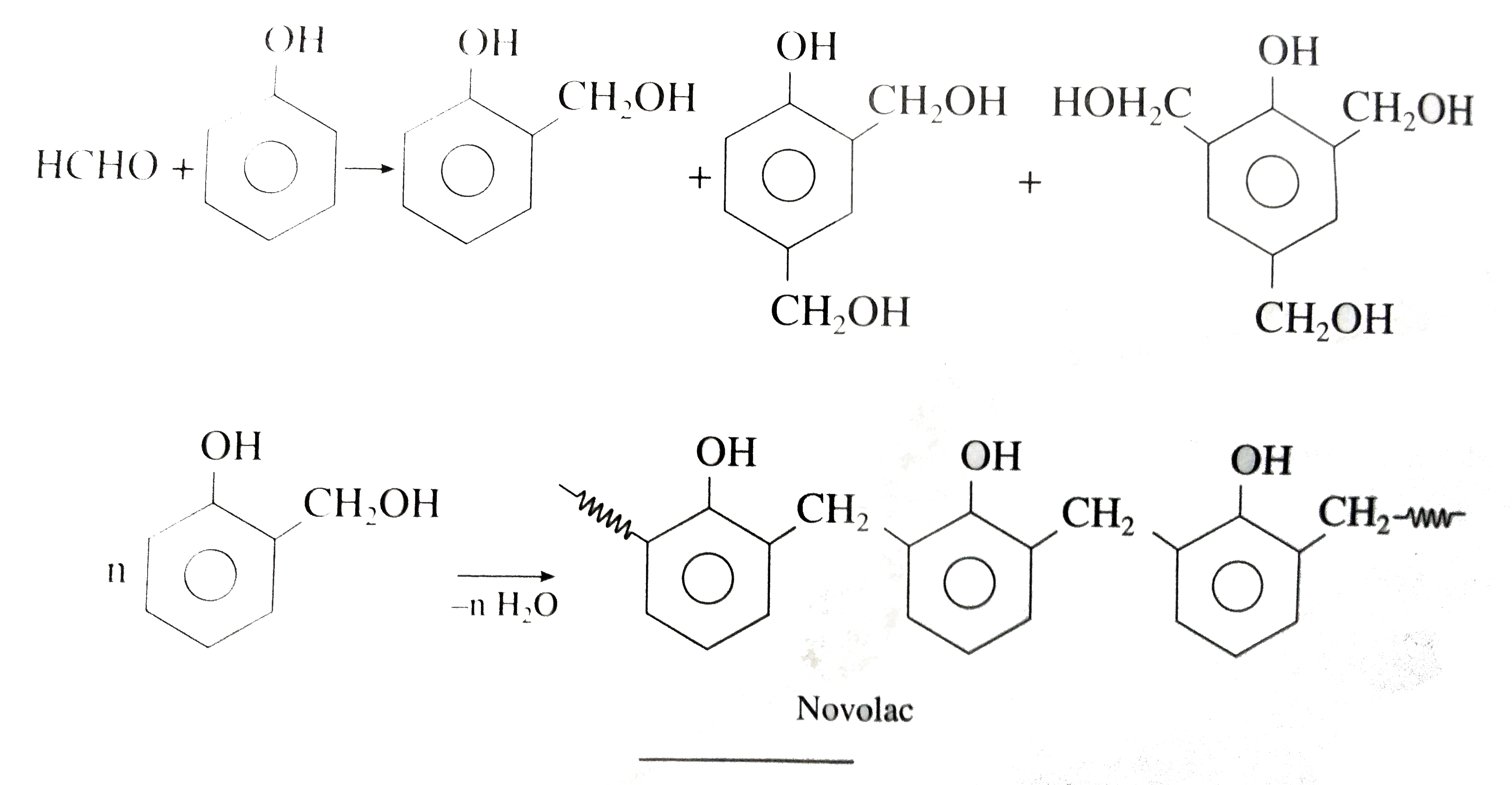
|
|
| 8. |
How is nitroglycerine prepared from glycerol? |
|
Answer» Solution :When glycerol is treated with a well COOLED mixture of CONCENTRATED sulphuric acid and fuming nitric acid, nitroglycerine is formed. `underset(CH_(2)OH)underset(|)overset(CH_(2)OH)overset(|)(CHOH) + 3HONO_(3) overset("Conc" H_(2)SO_(4)) to overset(CH_(2)ONO_(2))overset(|)underset("Nitroglycerine")underset(|)(CHONO_(2)) + 3H_(2)O` |
|
| 9. |
How is nylon 6,6 prepared ? Give equation. |
|
Answer» Solution :NYLON - 6.6 It is prepared by the CONDENSATION polymeniration of hexamethylene diamine and adipic acid. `underset("Hexamethylene diamine")(nH_(2)N-(CH_(2))_(6)-NH_(2))+underset("adipic acid")(nHOOC-(CH_(2))_(4)-COOH)rarr -underset("nylon - 6, 6")((NH)(CH_(2))_(6))-CO-(CH_(2)+CO)_(6)+nH_(2)O` |
|
| 10. |
How is nitrogen prepared in the laboratory ? Write the chemical equations of the reactions involved. |
|
Answer» Solution :Nitrogen is prepared in the laboratory by heating an equimolar aqueous solution of ammonium chloride and sodium nitrite. The ammonium nitrite FORMED as a result of double decompositon reaction, being UNSTABLE decomposes to FORM dinitrogen GAS. `NH_(4)Cl (aq) + NaNO_(2)(aq) rarr NH_(4)NO_(2)(aq) + NaCl (aq)` `underset("Amm. nitrite")(NH_(4)NO_(2)(aq)) overset("HEAT")rarr underset("Dinitrogen")(N_(2)(g)) + 2H_(2)O(l)` |
|
| 11. |
How is nitrogen prepared in the laboratory? Write the chemical equation of the reactions involved. |
|
Answer» SOLUTION :In the laboratory, nitrogen is prepared by treating an AQUEOUS solution of ammonium chloride with sodium nitrite. `NH_4Cl (aq) + NaNO_2 (aq) toN_2(g) + NaCl (aq)+2H_2O(l)` It may be noted that small AMOUNTS of NO and `HNO_3`are also formed in this reaction as impurities. These are REMOVED by passing the gas through aqueous SULPHURIC acid containing potassium dichromate. |
|
| 12. |
How is nitrogen prepared from ammonia ? |
|
Answer» Solution :`NH_(3)` is first treated with DIL. HCl and the ammonium chloride thus formed is treated with an aqueous solution of sodium nitrite when `N_(2)` gas is EVOLVED. `{:(""NH_(3)(G) + HCl (aq) rarr NH_(4)Cl(aq)),(NH_(4)Cl(g) + NaNO_(2)(aq) rarr NH_(4)NO_(2) (aq) + NaCl(aq)),(""NH_(4)NO_(2)(aq) overset(DELTA)rarr N_(2)(g) + 2 H_(2) O (l)):}` |
|
| 13. |
How is nitroethane prepared from- (1) ethane (2) ethul bromide (3) acetaldoxime? |
|
Answer» SOLUTION :(1) Preparation of nitroethane from ethane: When EHTANE is heated with conc. Nirtic acid, nitroethane is OBTAINED. `underset("ethane")(CH_(3))-CH_(3)-underset("conc.")(HO)-NO_(2)overset(423 K "to" 698K)(to)underset("Nitroethane")(CH_(3)-CH_(2)-NO_(2)+H_(2)O` (2) Preparation of nitroethane from ethyl bromide: When ethyl bromide is treated with sodium nitrite in te presence of solvent dimethyl sulphoxide (DMSO). `underset("ethy bromide")(CH_(3)-CH_(2)-Br+NaNO_(2)overset(DMSO)(to) underset("nitroethane")(CH_(3)-CH_(2))NO_(2)+NaBr` (3) Preparation of nitroethane from acetaldoxime: When acetaldoxime is oxidised in the presence of trifluoroperoxy ACETIC acid is obtained. `CH_(3)-underset("acetaldoxime")overset(H)overset(|)(C)=N-OH+(O)overset("trifluoroperoxy acetic acid")(to)` `CH_(3)-overset(H)overset(|)(C)=overset(O^(-))overset(|)(N^(+))-OHhArrunderset("Nitroethane")(CH_(3)-CH_(2))-overset(O^(-))overset(+|)(N)=O` |
|
| 14. |
How is nitroethane converted into- (a) ethyl amine, "" (b) N-ethylhydroxyl amine (c) acetic acid ? Write names and chemical formulae of monomers used in preparing Buna-N. What are saps ? How are they prepared ? |
|
Answer» Solution :(a) `CH_(3)CH_(2)+NO_(2)6+[H]overset(Sn//Conc.HCI) to underset(("Ethylamine"))overset(("Nitroethane"))(CH_(3)CH_(2)NH_(2)+H_(2)O` (b) `underset(("Nitroethane"))(C_(6)H_(5)NO_(2))+4+[H] overset(Zn+NH_(4)CI) to underset(("N-ethylydroxyl amine"))(C_(2)H_(5)NH-OH+H_(2)O)` (c) `{:(C_(2)H_(5)NO_(2)overset("OXIDATION")underset(H_(2)O //H^(+)) to CH_(3)COOH),(("Nitroethane")""("ACETIC acid")):}` (ii) Nunna-Nis a copolymer of acrylonitril and 1,3 butadiene. 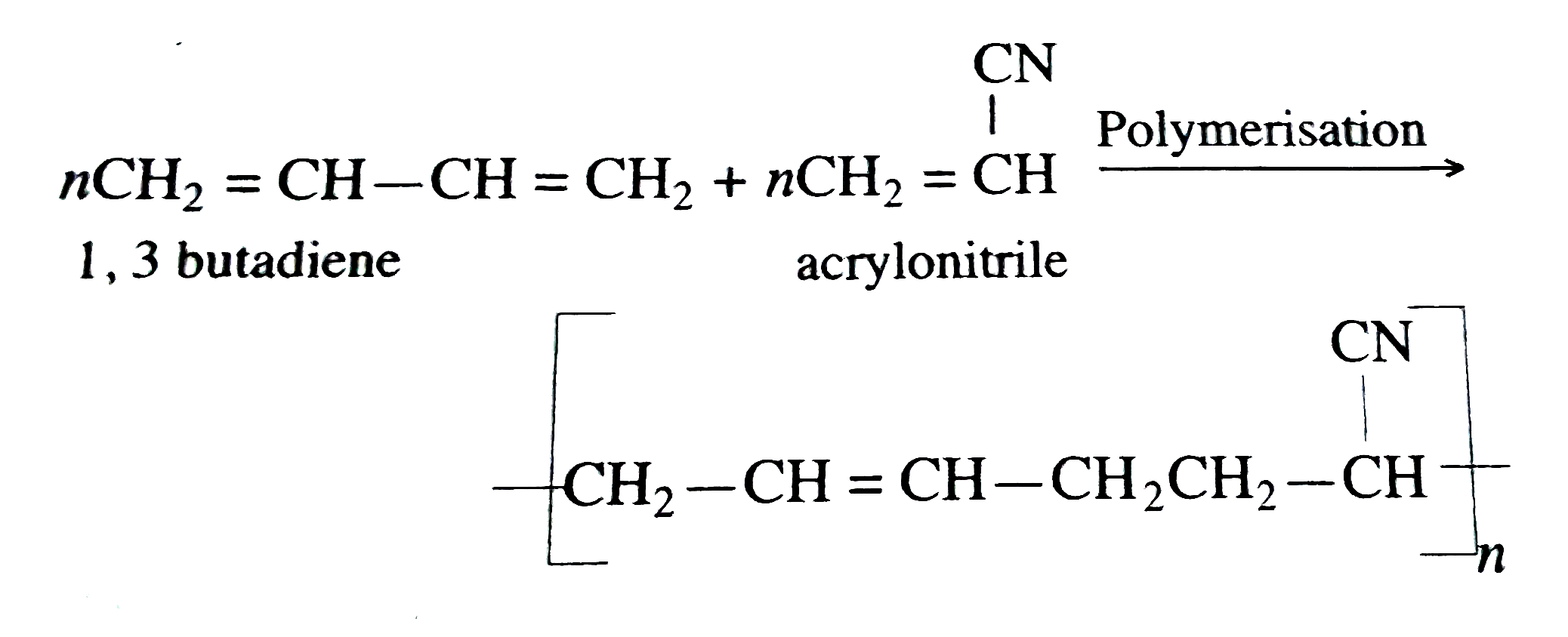 (iii) Soaps are sodium or potassium salts of fatty acids. They are formed by treating NaOH with FAT or oil. `"Fat"//"Oil"+NaOHoverset(Delta) to underset(("glycerol"))underset(CH_(2)OH)underset(|)overset(CH_(2)OH)overset(|)(CHOH)+overset(O)overset(||)underset(("soap"))(RC-overset(-)ONa^(+))` |
|
| 15. |
How is nitro benzene from benzene? |
Answer» Solution :When benzene is heated with a NITRATING MIXTURE `(Con. HNO_(3)+Con. H_(2)SO_(4))` at 330 K, electrophile substitution takes place to form nitro benzene.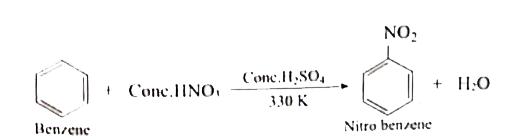
|
|
| 16. |
How is nitrobenzene converted to benzoic acid? |
|
Answer» Solution :Nitrobenzene is converted to aniline which on diazotisation GIVES benzene diazonium chloride. This on treating with potassium cyanide in the presence of cuprous catalyst gives benzonitrile and it gives BENZOIC acid on hydrolysis. `C_(6)H_(5)NO_(2)overset(SN)underset(HCl)rarr C_(6)H_(5)NH_(2)overset(NaNO_(2))underset(HCl)rarr C_(6)H_(5)N=NCl overset(KCN)underset(CuCN)rarr C_(6)H_(5)CN overset(H_(3)O^(+))rarr C_(6)H_(5)COOH` |
|
| 17. |
How is nitric acid prepared by Ostwald's process ? |
|
Answer» Solution :Preparationof nitric ACID by Ostwald's process (a) `4NH_(3(g))+5O_(2(g)) overset(Pt//Rh."gauge catalyst")underset(500K, 9"bar") to 4NO_((g))+6H_(2)O_((g))` (b) `2NO_((g))+O_(2_(g)) hArr 2NO_(2(g))` `2NO_(2(g))+H_(2)O_((g)) to 2HO_(3(1))+NO_((g))` |
|
| 18. |
How is nickel detected and estimated in a salt ? Give the reaction involved. |
| Answer» Solution :This is done by adding DIMETHYLGLYOXIME solution in PRESENCE of `NH_(4)OH` when a red PPT. is obtained. | |
| 19. |
How is neoprene prepared? Give its use. |
|
Answer» SOLUTION :The free radical polymerisation of the monomer 2 - chloro buta 1, 3 - diene (chloroprene) GIVES neoprene. `nCH_(2)=underset(Cl)underset(|)C-CH=CH_(2)overset("free radical")underset("Polymerisation")RARR[--CH_(2)-underset(Cl)underset(|)C=CH-CH_(2)--]_(n)` It is USED in the manufacture of chemical container, conveyer BELTS. |
|
| 20. |
How is neoprene prepared ? |
Answer» Solution :Neoprene is FORMED by the FREE RADICAL POLYMERISATION of chloroprene. 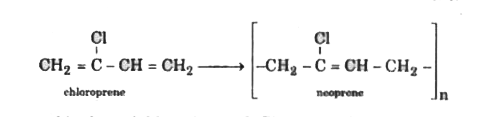
|
|
| 21. |
How is n-propyl alcohol prepared from propene ? |
|
Answer» SOLUTION :PROPENE on addition with HBr in PRESENCE of peroxide followed by base HYDROLYSIS gives propanol.<BR>`CH_3CH = CH_2 +HBr overset("peroxide")(to) ` `CH_3 -CH_2 - CH_2 - Br overset(AgOH)(to)CH_3CH_2CH_2OH` |
|
| 22. |
How is molar conductivity of an aqueous electrolyte solution measured experimentally |
|
Answer» Solution :Molar conductivity: The conductivity of a colume of solutin containgin on egram molecular weight of the ELECTROLYTE placed between two parallel electrodes separated by a DISTANCE ofunit length of 1 meter is called molar conductivity `(^^_(m))` Relation between conductivity and molar conductivity : `^^_(m)=k/c,therefore c=` constant `to ` The conductance of a solutin measured in a conductivity cell. `to ` By using the conductivity cells Resistance `(R )=(l)/(kxxA)` l = distance between electrodes, A = Area of cross section, k= conductivity `G ^(**)=l/A=` cell constant `to` Cell constant is measured by measuring the resistance of the cell containing a solution WHOSE conductivity is known. `to` Cell constant determined is used for measuring the resistance (or) conductivity. `therefore` molar conductivity `^^_((m))=x/c` `^^_((m))=(k(Scm^(-1)))/(100(Lm^(-3)"molarity(mole/lit)"))` |
|
| 23. |
How is molar conductivity related to concentration of the electrolyte ? How will you account for this variation for weak and strong electrolytes ? |
|
Answer» Solution :The molar CONDUCTANCE of an electrolytic solution DECREASES with increase in concentration. At low concentrations, the molar conductivity of strong electrolytes is found to obey, the following EQUATION : `^^_(m)=^^_(m)^(oo)-bsqrtC` where b is a constant and `^^_(m)` is called the molar conductivity at infinite dilution. Thus, `^^_(m)=^^_(m)^(oo)` at infinite dilution, i.e., when `Cto0` The variation of molar conductivity with concentration can be studied by plotting the values of `^^_(m)` against square root of concentration `(sqrtC)`. It has been observed that the variation of `^^_(m)` with concentration depends to a great extent on the type of electrolyte. In case of strong electrolytes, the change in `^^_(m)` with `(sqrtC)` is small. In case of strong electrolytes, the plots can be extrapolated to zero concentration. This gives the limiting value of molar conductance when the con- centration approaches zero and this value is called, molar conductance at infinite dilution. The plot of `^^_(m)` versus `(sqrtC)` for KCI solution is shown in Fig. It is denoted by `^^_(m)^(oo)`. However, in the case of weak electrolytes, we cannot obtain the molar conductance at infinite dilution `(^^_(m)^(oo))` by extrapolation of the `^^_(m)` versus `(sqrtC)` plots. The behaviour of `CH_(3)COOH` solution is also shown in figure. 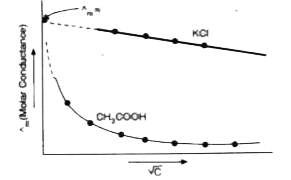 The variation of `^^_(m)` with dilution can be explained on the basis of number of ions in solution. The number of ions furnished by an electrolyte in solution depends upon the degree of dissociation with dilution. With the increase in dilution, the degree of dissociation increases and as a result molar conductance increases. (`^^_(m)^(oo)` corresponds to degree of dissociation equal to 1 i.e., the whole of the electrolyte dissociates.) The degree of dissociation may be defined as `alpha=(^^_(m)^(c))/(^^_(m)^(oo))` Where `alpha` is the degree of dissociation, `^^_(m)` is the the molar conductance at concentration C and `^^_(m)^(oo)` is the molar conductance at infinite dilution. However, in the case of strong electrolytes, there is no increase in the number of ions with dilution because strong electrolytes are completely ionised in solution at all concentrations (by definition). But there are strong forces of attraction between the ions of opposite charges called inter-ionic forces. DUE to these inter-ionic forces, the conducting power of the ions is less in concentrated solutions. With dilution, the ions go far apart from one another and inter-ionic forces decreases. Therefore, molar conductance increases with dilution. |
|
| 24. |
How is methyl cyanide converted to ethanol? |
|
Answer» Solution :Methyl cyanide on reduction gives ETHANAMINE. This is a PRIMARY amine which on treatment with `HNO_(2)` gives ethanol. `CH_(3)CN overset(LiAlH_(4))rarr CH_(3)CH_(2)NH_(2) overset(NHO_(2))rarr CH_(3)CH_(2)OH + N_(2) + H_(2)O` |
|
| 25. |
How is methyl isocyanide changed to methyl cyanide? |
| Answer» Solution :`underset("Methyl isocyanide")(CH_(3)-N-=C)underset(250^(@)C)OVERSET("Heat")(to) underset("Methyl cyanide")(CH_(3)-C-=N)` | |
| 26. |
How is methyl alcohol converted to ethyl alcohol? |
|
Answer» Solution :ETHANOL can be OBTAINED from methanol in the following sequence of STEPS. `CH_3OH OVERSET(HI)(rarr)CH_3Ioverset(KCN)(rarr)CH_3CNoverset(H_3O^(+))(rarr)CH_3COOHunderset(H_2O)overset(LiAlH_4)(rarr)CH_3CH_2OH`. |
|
| 27. |
How is methanol prepared, now-a-days, commercially? |
| Answer» Solution :Most of the methanol is now prepared by CATALYTIC hydrogenation of carbon monoxide at high PRESSURE and high TEMPERATURE. `CO + 2H_2 undersetA(300 atm, 600 K)overset(ZnO,Cr_2O_3)(rarr) CH_3OH`. | |
| 28. |
How is melamine prepared? Give its use? |
Answer» SOLUTION :Melamine and formaldehyde are the MONOMERS. They undergo condensation polymerisation to form melamine formaldehyde resin.  Uses : It is USED in MAKING unbreakable CROCKERY. |
|
| 29. |
How is methylamine prepared by Hoffmann bromamide degradation reaction ? Give equation. |
|
Answer» Solution :When acetanoide is treated with `Br_(2)` and AQ. NaOH gives METHYL amine `UNDERSET("Acetamide")(CH_(3)-overset(O)overset(|)C-NH_(2))+Br_(2)+4NaOH_((aq))overset(Delta)rarr underset("methylamine")(CH_(3)NH_(2)+2NaBr)+Na_(2)CO_(3)+2H_(2)O` |
|
| 30. |
How is magnitude ofdelta _0 affected by (i) nature of ligands (ii) oxidation state of metal ion. |
|
Answer» SOLUTION :Greater the strength of the LIGAND greater is the value of ` DELTA _0` (ii) HIGER the ionic CHARGEON the central metal ion. Greater will be value of `detal _0` |
|
| 31. |
How is leaching carried out in case of low grade copper ores? |
|
Answer» SOLUTION :The leaching of the low grade copper ores is carried out with ACIDS in presence of air when copper dissolves giving `Cu^(2+)` ions. Thus, `2CU(s)+2H_(2)SO_(4)(aq)+O_(2)(G) to 2CuSO_(4)(aq)+2H_(2)O(l)` or `Cu(s)+2H^(+)(aq)+(1)/(2)O_(2)(g) to Cu^(2+)(aq)+H_(2)O(l)`. |
|
| 32. |
How is m-nitroaniline obtained from nitrobenzene? |
Answer» SOLUTION : 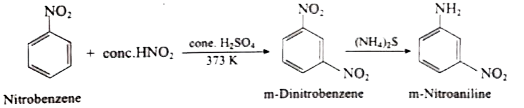
|
|
| 33. |
How is m-nitroaniline obtained from nitrobenzene ? |
Answer» SOLUTION :
|
|
| 34. |
How is leaching carried out in the case of low grade copper ores? Name the method used for refining fo copper metal. |
|
Answer» Solution :Copper is extracted by hydrometallurgy from LOW grade ores. It is leached out using ACID or bacteria. The solution containing `Cu^(2+)` ions is treated with scrap iron or `H_2`. `Cu^(2+)(aq)+H_2(G) to Cu(s)+2H^(+) (aq)` |
|
| 35. |
How is leaching carried out in case of low grade copper ores ? |
|
Answer» Solution :The EXTRACTION of metals by using their aqueous solution is called hydrometallurgy. Example : Au, Ag, Cu etc. are extracted by this method. The copper from low grade ORES and scraps is extracted by hydrometallurgy. It is leached out using acid or BACTERIA. The solution CONTAINING `Cu^(2+)` is treated with scrap iron or `H_2`. `Cu_((aq))^(2+)+ H_(2(g)) to Cu_((s)) + 2H_((aq))^(+)`. |
|
| 36. |
How isleachingcarriedin caseof lowgradecopperores ? |
|
Answer» Solution :Theleachingof thelowgradecopperores iscarriedoutwith acidsin presenceofairwhencoppergoesintosolutionas `CU^(2 +) `ions. Thus, `2 Cu(s) +2H _ 2 SO _ 4(aq)+O _ 2 (g) to2CuSO_ 4 (aq)+2 H_2O (l) ` or`Cu (s)+2H ^( +) (aq)+(1)/(2)O _ 2(g) toCu^( 2+)(aq) +H _ 2 O(l) ` |
|
| 37. |
How is KMnO_(4) [Potassium permanganate] is prepared from MnO_(2)? Write equations. |
|
Answer» Solution :Preparation of `KmNO_(4)` : Potassium permanaganate is pepared by the fusion of `MnO_(2) ` with an ALKALI METAL hydroxide and an oxidizing agent like `KNO_(3)` . It forms dark green `K_(2)MnO_(4)` which disproportionates in a NEUTRAL of acidic solution to give permanganate (i) `2MnO_(2)+4KOH+O_(2)overset("KNO_(3))to2K_(2)MnO_(4)+2H_(2)O` (ii) `3MnO_(4)^(2-)+4H^(+)to 2MnO_(4)^(-)+MnO_(2)+2H_(2)O` or `3K_(2)MnO_(4)+2H_(2)SO_(4)to underset"Potassium Permanganate"(2KMnO_(4))` |
|
| 38. |
How is K_(2)Cr_(2)O_(7) manufactured from chromite ore. |
|
Answer» SOLUTION :(i) Chromite ore in to sodium chromate . `4FeO Cr_2O_3 + 8 Na_2 CO_3 + 7O_2 overset(DELTA)(RARR)2Fe_2O_3 + 8Na_2CrO_4 + 8 CO_2` (ii) Sodium chromate in to sodium DICHROMATE. `2Na_2CrO_4 + H_2SO_4 to Na_2Cr_2O_7 + Na_2SO_4 + H_2O` (iii) Sodium dichromate in to potassium dichromate `Na_2Cr_2O_7 + 2KCl to K_2Cr_2O_7 + 2NaCl` |
|
| 39. |
How is K_a of phenol compared to that of ethanol. |
| Answer» SOLUTION :`K_a` of PHENOL is GREATER than that of ETHANOL | |
| 40. |
How is it that alcohol (ethanol) and water are miscible in all proportions? |
|
Answer» SOLUTION :(i) Both are POLAR and HENCE MISCIBLE. (II) they form hydrogen bonds with each other. This further increases their miscibility. |
|
| 41. |
How is human kidney dialysis take place? |
|
Answer» Solution :(i) KIDNEY malfunction RESULTS in the building up of ELECTROLYTE concentration within the blood to toxic levels. (ii) In the dialysis, recycling of patient.s blood is done through considerable length of SEMIPERMEABLE tube in an isotomic SALINE solution. |
|
| 42. |
How is helium separated from noble gas mixture by Dewar's adsorption method? |
|
Answer» Solution :MIXTURE of noble gases to be SEPARATED is PASSED into the Dewar.s bulb. Heavier noble gases `Ar, Kr and XE` get adsorbedHe is pumped out. OR 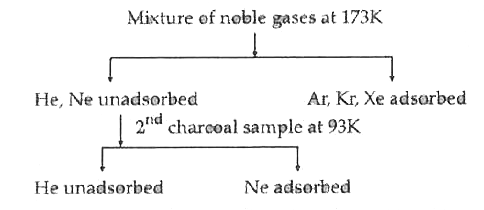
|
|
| 43. |
How is Grignard reagent prepared? |
|
Answer» Solution :Grignard reagent is an aklyl MAGNESIUM halide, `R-MG-X` obtained by the reaction of alkyl halide `R-X` with magnesium `(Mg)` in dry ether. `underset("alkyl halide")(R-X)+Mg overset("dry ether")(to)underset("alkyl")overset(delta-)(R)- underset ("magnesium")overset(2 delta+)(R)-underset ("Iodide")overset(delta-)(X)` When an alkyl halide like `CH_(3)I` is added from a DROPPING funnel to a flask CONTAINING pieces of pure `Mg` in pure and dry ether (diethyl ether) and a trace of iodine, Grignard reagent, `CH_(3)-Mg-I` is formed. `underset("methyl iodide")(CH_(3)-I)+Mg overset("dry ether")(to) underset ("methyl")overset(delta-)(CH_(3))-underset("magnesium")overset(2delta+)(Mg)-underset ("iodide")(delta-)(I)` OR `(overset(delta-)(CH_(3))-overset(2delta+)(Mg)-overset(delta-)(I))` ETHYL iodide when treated with magnesium in presence of dry ether forms ethyl magnesium iodide. `C_(2)H_(5)I+Mgoverset("dry ether")(to) underset("ethyl magnesium iodide")(C_(2)H_(5)-Mg-I)` OR `overset(delta-)((C_(2)H_(5)))-overset(2delta+)(Mg)-overset(delta-)(I)` |
|
| 44. |
How is glucose prepared by commercial method? How is peptide linkage formed ? |
|
Answer» Solution :Preparation of glucose by commerical method : When starch is boiled with dilute `H_(2)SO_(4)` at 393 K under PRESSURE it undergoes hydrolysis to give glucose. Excess of `H_(2)SO_(4)` is neutralized by adding chalk powder. Colour IMPURITIES are removed by adding activated CHARCOAL. The coloured impurities are absorbed on charcoal. On cooling crystals of glucose separate out which are removed by filtration. `underset("(Starch)")((C_(6)H_(10)O_(5))_(n))+nH_(2)O overset("dil. "H_(2)SO_(4))underset("393 K, 2-3 ATM")rarr underset("(Glucose)")(nC_(6)H_(12)O_(6))` Formation of peptide linkage : Peptide bond or peptide linakge is an amide formed between `-COOH` and `NH_(2)` group by elinination of `H_(2)O.` 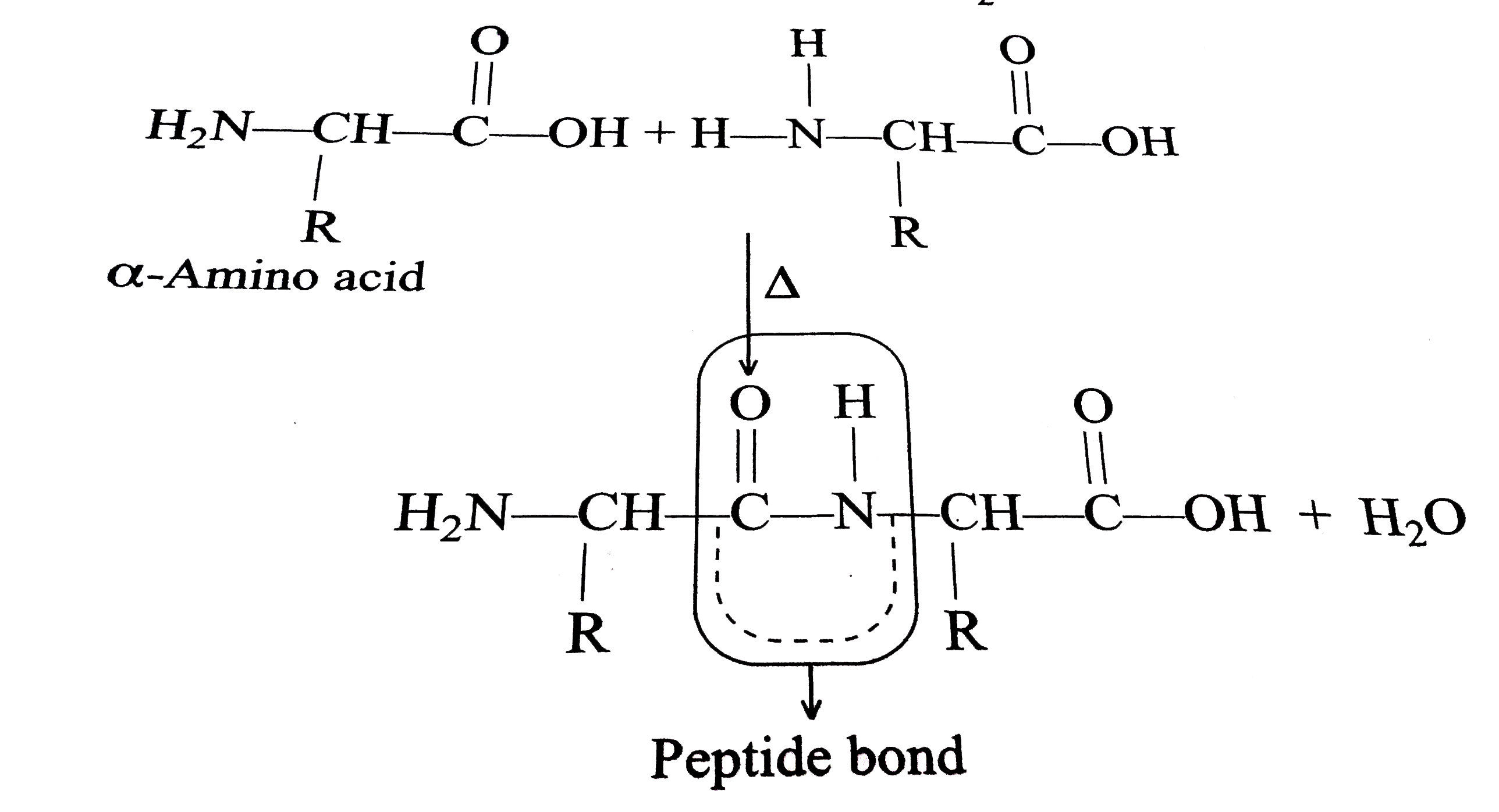
|
|
| 45. |
How is glycerol reacts with fuming nitric acid? (or) How wouid you convert glycerol into nitroglycerine? |
Answer» SOLUTION :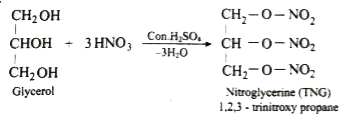
|
|
| 46. |
How is glycerol obtained commercially ? State its two uses. |
|
Answer» SOLUTION :(i) Glycerol is prepared in a large scale by the hydrolysis of oils or fats either by using alkali or by super heated steam. (ii) During this process, soap is formed,along with the byproduct glycerol and this process is called saponification. `underset(CH_(2)OCOR)underset(|)overset(CH_(2)OCOR)overset(|)(CHOCOR + 3NaOH) to underset("Glycerol")underset(CH_(2)OH)(CHOH + 3RCOONa darr)` Uses of glycerol: (i) Glycerol is used as a sweetening agent in confectionery adn beverages. (ii) It is used in the manufacture of cosmetics and transparent SOAPS. (iii) It is used in making printing inks and stamp PAD ink and lubricant for WATCHES and clocks. (iv) It is used in the manufacture of explosive like dynamite and cordite by making it with chaina CLAY |
|
| 47. |
How is free energy change of a cell reaction related to (i) its emf (ii) equilibrium constant of the cell reaction? |
|
Answer» Solution :(i) `-Delta_(R)G=nFE_(cell)` where n is number of ELECTRONS involved in the cell reaction. (ii) `-DeltaG^(@)=RT" ln "K` where K is equilibrium constant. |
|
| 48. |
How is fructose prepared from inulin? |
|
Answer» Solution :Fructose is PREPARED commercially by hydrolysis oflnulin (a polysaccharide) in acidic medium. `underset("INULIN")((C_(2)H_(12)O_(5)))_(N)+nH_(2)Ooverset(H^+)rarrunderset("Fruclose")(nC_(6)H_(12)O_(6))` |
|
| 49. |
How is formic acid distinguished from acetic acid ? |
|
Answer» SOLUTION :The only carboxylic acid that has -CHO group is formic acid. Formic acid REDUCES Fehling.s solution and Tollens. reagent, but not acetic acid `HCOOH + 2CuO to H_2O+ CO_2 + Cu_2O darr`(RED) `HCOOH + Ag_2O to H_2O + CO_2 + 2AG darr` (white) |
|
| 50. |
How is formic acid prepared ? |
|
Answer» Solution :a) FORMIC acid is prepared by the oxidation of methyl alcohol. `CH_(3) OH overset(K_(2) Cr_(2) O_(7)) UNDERSET(H_(2) SO_(4))(to) H CHO overset(K_(2) Cr_(2) O_(7)) underset(H_(2) SO_(4)) (to) HCOOH` b) It is also prepared by HEATING a mixture of carbon monoxide and SODIUM hydroxide at `210^(@)`Cunder pressure. `CO + NaOH to HCOONa overset(HCl) (to) HCOOH` |
|