

Saved Bookmarks
This section includes 7 InterviewSolutions, each offering curated multiple-choice questions to sharpen your Current Affairs knowledge and support exam preparation. Choose a topic below to get started.
| 1. |
How is take test for aluminium ion based upon adsorption ? |
| Answer» Solution :`Al_(2)O_(3)xH_(2)O` has the CAPACITY to ADSORB the colour of blue litmus from the solution . | |
| 2. |
How is surface area of the reactant affect the the rate of the reaction? |
|
Answer» Solution :(i)In HETEROGENEOUS reaction, the surface area of solid reactantsplay an important ROLE in deciding the RATE (ii)For a given mass of a reactant , when the practical size DECREASE surface area increase. Increase in surface area of reactant leads to more Collision per litre per second and hence the rate of reaction is increased (iii)For example, powered CALCIUM carbonate reacts much faster with dilute HCI then with the same mass of `CaCO_3` as marble |
|
| 3. |
How is surface area of the reactant affect the rate of the reaction? |
|
Answer» Solution :(i) in heterogeneous reactions, the surface area of the solid reactants PLAY an important role in deciding the rate. (ii) For a given mass of a reactant, when the particle size decreases surface area increases. INCREASE in surface area of reactant leads to more collisions per litre per second and hence the rate of reaction is INCREASED. (iii) For example, powdered calcium carbonate reacts MUCH faster with dilute HCl than with the same mass of `CaCO_(3)` as marble. |
|
| 4. |
How is stability of coordination compound determined in a aqueous solution? |
|
Answer» SOLUTION :By USING STABILITY CONSTANT. More stability constant, more stability. |
|
| 5. |
How is spectrochemical series is used to identify the type of ligands ? |
|
Answer» Solution :`(i) I^(-) lt Br^(-) lt SCN^(-) lt Cl lt S^(2-) lt F^(-) lt OH^(-)~~` urea `OH^(2-) lt H_(2) lt NCS^(-) lt EDTA^(4-) lt NH_(3) lt EN lt NO_(2)^(-) lt CN^(-) lt CO` The above series is known as spectrochemical series. `(ii)` The ligands present on the right side of the series such as carbondyl cause RELATIVELY larger crystal field SPLITTING and are called strong ligands (or) strong field ligands. `(iii)` The ligands on the left side are called weak field ligand and causes relatively smaller crystal field splitting. |
|
| 6. |
How is solubility product is used to decide the precipitation of ions? |
|
Answer» Solution :(i) When the PRODUCT of molar concentration of the constituerx ions i.e., IONIC product exceeds the solubility PRODUCE then the compounds gets precipitated. (II) When the ionic produce `gt K_(sp)` precipitation will occur and the solution is super saturated. ionic product `lt K_(sp)` no precipitation and the solution is unsaturated. ionic product `= K_(sp)` equilibrium exists and the solution is saturated. In this way the solubility product finds USEFUL to decide whether an ionic compound gets precipitated when solution that contain the constituent ions are mixed. |
|
| 7. |
How is SO_2 an air pollutant ? |
|
Answer» Solution :(i) `SO_2` is STRONGLY irritating to the respiratory tract. `SO_2` at a concentration of 5 ppm causes throat and eye irritation CAUSING cough, tears and redness in eyes. It causes breathlessness and affects larynx, i.e., voice box. (ii) Even at low concentration, it has a damaging effect on the plants. If exposed for a long time, it slows down the formation of chlorophyll resulting in injury to the LEAVES INCLUDING loss of green colour. This is called chlorosis. (iii) SO, dissolves in rain water and produces acid rain which damages building materials especially MARBLE `(CaCO_3)` `CaCO_3 + H_2SO_3 to CaSO_3 + H_2O + CO_2 ` (iv) It corrodes metals particularly iron and steel. It also deteriorates fabrics, leather, paper, etc., and affects the colour of paints. |
|
| 8. |
How is SO_(2) an air pollutant ? |
|
Answer» Solution :`SO_(2)` acts as an air pollutant because of the following reasons : (i) `SO_(2)` is strongly irritating to the respiratory tract. `SO_(2)` at a concentration of 5 ppm causes throat and eye irritation (resulting in cough, tears and redness in eyes). It causes breathlessness and affects larynx, i.e., voice box. (ii) EVEN at a low concentration of 0.03 ppm, it has a very damaging effect on the plants. If exposed for a long time, i.e., a few days or WEEKS, it slows down the formation of chlorophyll resulting in injury to the LEAVES including loss of green colour. This is CALLED chlorosis. (iii) `SO_(2)` dissolves in rain water and produces acid rain which damages BULDING materials especially marble `(CaCO_(3))`. ltbgt `CaCO_(3) + H_(2)SO_(3) rarr CaSO_(3) + H_(2)O + CO_(2)` It corrodes metals particularly iron and steel. It also brings about fading and deterioration of fabrics, leather, paper, etc. and affecting the colour of paints. |
|
| 9. |
How is smoke precipitated using cottrel precipitator. |
Answer» Solution :SMOKE is an aerosol of NEGATIVE CHARGED carbon and dust particles in air. 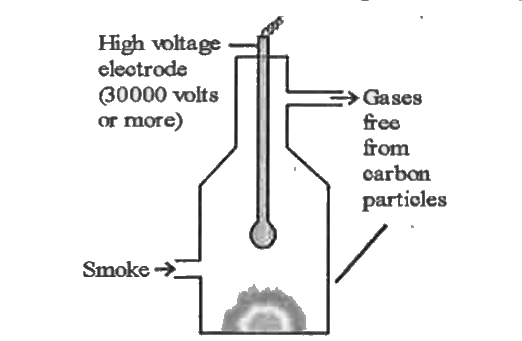 Precipitation of smoke partices is carried out by cottrel PRECIPITATOR. Smoke is ALLOWED to pass through a chamber containing plates charged to a very high potential, charged particles of the smoke get precipitated. |
|
| 10. |
How is Schiff's base prepared? |
|
Answer» SOLUTION :AROMATIC aldehydes react with PRIMARY amines (aliphatic or aromatic) in the presence of an acid to form schiff's BASE. EXAMPLE : 
|
|
| 11. |
How is salicylic acid converted to phenol? |
Answer» SOLUTION :Salicylic acid on DECARBOXYLATION GIVEN phenol. 
|
|
| 12. |
How is pyrophosphoric acid related to orthophosphoric acid? |
Answer» Solution :Pyrophosphoric acid is an anhydride of ORTHOPHOS phoric acid and is obtained by removal of a WATER molecule from TWO molecules of orthophosphoric acid.
|
|
| 13. |
How is radius ratio is useful in determination of structure of an lonic compound ? |
|
Answer» Solution :(i) The structure of an ionic compound depends upon the stoichiometry and the size of the ions. (ii) Generally in ionic crystals, the bigger anions are present in the CLOSE packed arrangements the cations occupy the voids. (iii) The ratio of radius of CATION and anion `(r_(c^(+)))/(r_(A^(-)))` PLAYS an important ROLE in determining the structure. (iv) For EG, 
|
|
| 14. |
How is radon obtained ? |
|
Answer» Solution :RADON is obtained by the radio ACTIVE DISINTEGRATION of RADIUM - 226. `""_(88)^(226)Ra rarr ""_(86)^(222)Rn+""_(2)^(4)He` |
|
| 15. |
How is pure copper obtained from its principle ore ? Write the chemical reactions occurring during the extraction. |
|
Answer» Solution :(i) `2CuFeS_(2)+O_(2) to Cu_(2)S+2FeS+O_(2)` (ii) `Cu_(2)S+3O_(2) to 2Cu_(2)O+2SO_(2)` (III) `Cu_(2)O+C to 2Cu+CO` (IV) `2Cu_(2)O+Cu_(2)S to 6Cu+SO_(2)` |
|
| 16. |
How is pure ozone obtained from ozonised oxygen? |
| Answer» SOLUTION :In order to obtain pure OZONE, from ozonised oxygen, it is cooled with liquid air when ozone (b.pt. 160.6K) condenses as deep BLUE liquid while oxygen (b.pt. 90K) remains as a GAS at this TEMPERATURE. Pure ozone is obtained by the fractional distillation of deep blue liquid. | |
| 17. |
How is pure alumina obtained from bauxite by leaching process. |
|
Answer» Solution :` Al_(2)O_(3)+ 2NaOH + 3H_(2)OTO 2NA[Al(OH)_(4)]` `2NaAl(OH)_(4) +CO_(2) to A1_(2)O_(3), xH_(2)O+ 2NaHCO_(3)`. `Al_(2)O_(3), xH_(2)tounderset(1470K)(Al_(2)O_(3)+xH_(2)O` |
|
| 18. |
How is PTFE familiar commercially? |
|
Answer» Solution :PTFE is polytetrafluoroethylene, also called TEFLON. It is a polyfluorocarbon. Mechanical strength of PTFE remains UNCHANGED over a wide range of temperature. Hence it is used in non stick cook ware. It is resistant to acids, BASES, organic and inorganic substances. Hence it is used as corrosion resistant COATING. |
|
| 19. |
How is propanoic acid is prepared starting from (a) an alcohol (b) an alkylhalide (c) an alkene |
|
Answer» SOLUTION :Preparation of propanoic ACID from, (a) Alcohol: `underset("(propan-1-ol)")(CH_3-CH_2-CH_2-OH) OVERSET(H^(+)//K_2Cr_2O_7)(to) underset("(propanoicacid)")(CH_3-CH_2-COOH)` (b) Alkylhalide : `underset("(ethyl bromide)")(CH_3-CH_2-Br) overset("Mg/ether")(to) underset("(ethyl magnesium bromide)")(CH_3-CH_2-MGBR) underset((ii)H^(+) // H_2O)overset((i) CO_2)(to) underset("(propanoic acid)")(CH_3CH_2COOH ) + MgBr(OH) ` (c ) Alkene : `underset("ETHENE ")(CH_2 =CH_2) overset(HCl)(to) underset("ethyl chloride")(CH_3-CH_2-Cl) underset(-NaCl)overset(NaCN)(to) underset("ethylcyanide")(CH_3-CH_2-CN) underset("excess")overset(H^(+)//H_2O)(to) underset("propanoicacid")(CH_3CH_2COOH)` |
|
| 20. |
How is propionic acid obtained from alkaline hydrolysis of ethyl cyanide? |
|
Answer» Solution :When ETHYL cyanide is boiled with AQUEOUS sodium HYDROXIDE, sodium PROPIONATE is obtained, which on treating with dilute hydrochloric ACID, gives propionic acid. `CH_(3)-underset("ethyl cyanide")(CH_(2)-C)-=N+NaOH+H_(2)Ooverset(Delta)(to)CH_(3)-underset("sodium propionate")overset(O)overset(||)(C)-ONa+NH_(3)` `CH_(3)-CH_(2)-overset(O)overset(||)(C)-ONa+HCl to underset("propionic acid")(CH_(3)-CH_(2))-overset(O)overset(||)(C)-OH+NaCl` |
|
| 21. |
How is propan-1-0l prepared from (1) propanal (2) propanoic acid? |
|
Answer» SOLUTION :(1) Propanal: When propanal is hydrogenated at `413K` in te PRESENCE of finely divided nickel, propan -1-ol isobtained. `underset("Propanal") (CH_(3))-CH_(2)-CHO+H_(2)underset(413K)overset("Raney Ni")(to) underset("Propan-1-ol")(CH_(3)-CH_(2))-CH_(2)-OH` (2) Propanoic ACID: When propanoic acid is REDUCED in the presence of `LiAlH_(4)` propan-1-ol is formed. `underset("Propanoic acid")(CH_(3)_CH_(2))-COOH underset((ii)H_(3)O^(+))overset((i)LiAlH_(4))(to) underset("Propan-1-ol")(CH_(3)-CH_(2))-CH_(2)-OH` |
|
| 22. |
How is propan - 2 - ol prepared by hydration of an alkene? |
|
Answer» SOLUTION :PROPENE with cold `80%` `H_(2)SO_(4)` gives isopropyl hydrogensulphate which further on boiling with water gives (isopropyl ALCOHOL) Propan - 2- ol. `UNDERSET("propene")(CH_(3))-CH=CH_(2)+underset("cold 80% conc.")(HOSO_(3)H)rarrunderset("isopropyl hydrogen sulphate")(CH_(3)-underset(""OSO_(3)H)underset("|")"CH"-CH_(3))` `CH_(3)-underset(""OSO_(3)H)underset("|")"CH"-CH_(3)+H_(2)overset("boil")rarrunderset("Propan - 2- ol.")underset("isopropyl alcohol")(CH_(3)-underset(OH)underset("|")"CH"-CH_(3))` |
|
| 23. |
How is prepared from N-alkyl formamide? |
Answer» SOLUTION :`CH_3NC` by REACTION with `POCl_3` in PYRIDINE. 
|
|
| 24. |
How is potassium permanganate prepared from pyrolusite? OR Write the preparation of KMnP_(4). |
|
Answer» Solution :Pottassium permanganate, `KMnO_(4)` is prepared from pyrolusite ore. `MnO_(2)` by following steps: When pyrolusite aore `(MnO_(2))` is fused with alkali metal hhdroxide (`KOH` or `K_(2)CO_(3)`) in the presence of an oxidising agentlike `KNO_(3)` or `KClO_(3)` in air, a green coloured potassium manganate `K_(2)MnO_(4)` is obtained. (i) `2MnO_(2)+4KOH+O_(2) to 2K_(2)MnO_(4)+2H_(2)O` (ii) `2MnO_(2)+2K_(2)CO_(3)+O_(2) to 2K_(2)MnO_(4)+2CO_(2)` (iii) `MnO_(2)+2KOH+KNO_(3) to K_(2)MnO_(4)+KNO_(2)+H_(2)O` (iv) `3MnO_(2)+6KOH+KClO_(3)to3K_(2)MnO_(4)+KCl+3H_(2)O` The fused `K_(2)MnO_(4)` is oxidised to `KMnO_(4)` is carrid out by `H_(2)SO_(4)` or by passing `CO_(2)` or `Cl_(2)` or`O_(3)` through the solution. `3K_(2)MnO_(4)+2H_(2)SO_(4)to2K_(2)SO_(4)+2KMnO_(4)+2H_(2)O+MnO_(2)` `3K_(2)MNO_(4)+4CO_(2)+2H_(2)Oto2KMnO_(4)+MnO_(4)+4KHCO_(3)` `2K_(2)MnO_(4)+Cl_(2)to2KMnO_(4)+2KCl` `2K_(2)MnO_(4)+H_(2)O+O_(3)to2KMnO_(4)+2KOH+O_(2)` (b) By electrolytic oxidation:k The aqueous of `K_(2)MnO_(4)` is electrolysed between iron electrodes SEPARATED by a diaphragm, so that manganate ion `MnO_(4)^(2-) undergoes oxidation at anode forming permanganate ion `MnO_(4)` At anode: `underset("Green")(MnO_(4)^(2-)to underset("PURPLE")(MnO_(4)^(-))+e^(-)` At CATHODE: `2H^(+)+2e^(-)toH_(2(g))` During ELECTROLYSIS, `OH^(-)` are oxidised at anode liberating oxygen `(O_(2))` which also oxidises `MnO_(4)^(2-)` to `MnO_(4)^(-)`. `2OH^(-)toH_(2)O+[O]+2e^(-)` `2K_(2)MnO_(4)+H_(2)O+[O]to2KMnO_(4)+2KOH` Finally, the electrolytic solution is filtered and evaporated to obtained deep purple BLACK crystals of `KMnO_(4)`. |
|
| 25. |
How is potassium permanganate (KMnO_(4)) prepared from MnO_(2) ? Write the equations. |
|
Answer» Solution :By fusion of `MnO_(2)` with an alkali metal hydroxide and an oxidizing agent `KNO_(3)` gives `K_(2)MnO_(4)` which on acidification gives PERMANGANATE. `2MnO_(2)+4KOH+O_(2)RARR 2K_(2)MnO_(4)+2H_(2)O` `3MnO_(2)^(-2) + 4H^(+)rarr2MnO_(4)^(-)+MnO_(2)+2H_(2)O` |
|
| 26. |
How is potassium permanganate ( KMnO_4) prepared from MnO_2 ? write the equation. |
|
Answer» Solution :By fusion of `MnO_2` with an alkali metal hydroxide and an oxidising agent `KNO_3` gives `K_2MnO_4`, which on acidification gives permanganate. `2MnO_2 + 4KOH + O_2 to 2K_2MnO_4 + 2H_2O` `3MnO_(4)^(2-) + 4H^(+) to 2MnO_(4)^(-) + MnO_(2) + 2H_2O` OR `MnO_2 underset("Oxidised with air")overset("Fused with KOH")(rarr)MnO_(4)^(2-)` `MnO_(4)^(2-) underset("In alkaline solution")overset("Electrolytic oxidation")(rarr)MnO_(4)^(-)` |
|
| 27. |
How is potassium dichromate prepared from chromite are ? |
|
Answer» Solution :Step -1: Potassium dichromate is prepared by fusion of chromite ore `[FeOCr_(2)O_(3)]` with sodium carbonate with excess of air. `4FeO.Cr_(2)O_(3)+8Na_(2)CO_(3)+7O_(2)rarr2Fe_(2)O_(3)+8Na_(2)CrO_(4)+8CO_(2)` Step - 2: The yellow solution of sodium CHROMATE is filtered and acidified with sulphuric acid. Orange solution of sodium dichromate is obtained. `2Na_(2)CrO_(4)+2H^(+)rarrNa_(2)Cr_(2)O_(7)+H_(2)O+2Na^(+)` Step - 3: The sodium dichromate solution is treated with potassium chloride solution to GET potassium dichromate. `Na_(2)Cr_(2)O_(7)+2KClrarrK_(2)Cr_(2)O_(7)+2NaCl` Orange crystals of potassium dichromate crystalises out. |
|
| 28. |
How is polythene prepared ? |
| Answer» Solution :`UNDERSET("Ethene")(nCH_2)=CH_2 overset("POLYMERISATION")to underset("POLYTHENE")((-CH_2-CH_2)_n)` | |
| 29. |
How is phenylhydrazine prepared from aniline? |
| Answer» Solution :By REDUCTION of benzenediazonium CHLORIDE with `SnCl_(2)//HCL` or `Na_(2)SO_(3)`. | |
| 30. |
How is phenylaminomethane obtained from phenylnitrile ? |
Answer» SOLUTION :
|
|
| 31. |
How is phenolphthalein prepared from phenol? |
Answer» Solution :On HEATING phenol with phthalic in PRESENCE of CONC. `H_2SO_4`. PHENOLPHTHALEIN is OBTAINED. 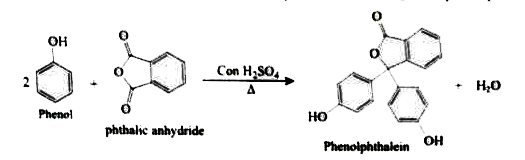
|
|
| 32. |
How is phenol treated with Nickel? |
Answer» SOLUTION :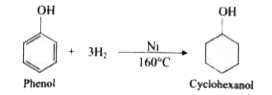
|
|
| 33. |
How is phenolphthalein obtained? |
| Answer» Solution :By HEATING phenol with phthalic anhydride in presence of conc. `H_(2)SO_(4)`. | |
| 34. |
How is phenol prepared from cumene ? |
Answer» SOLUTION :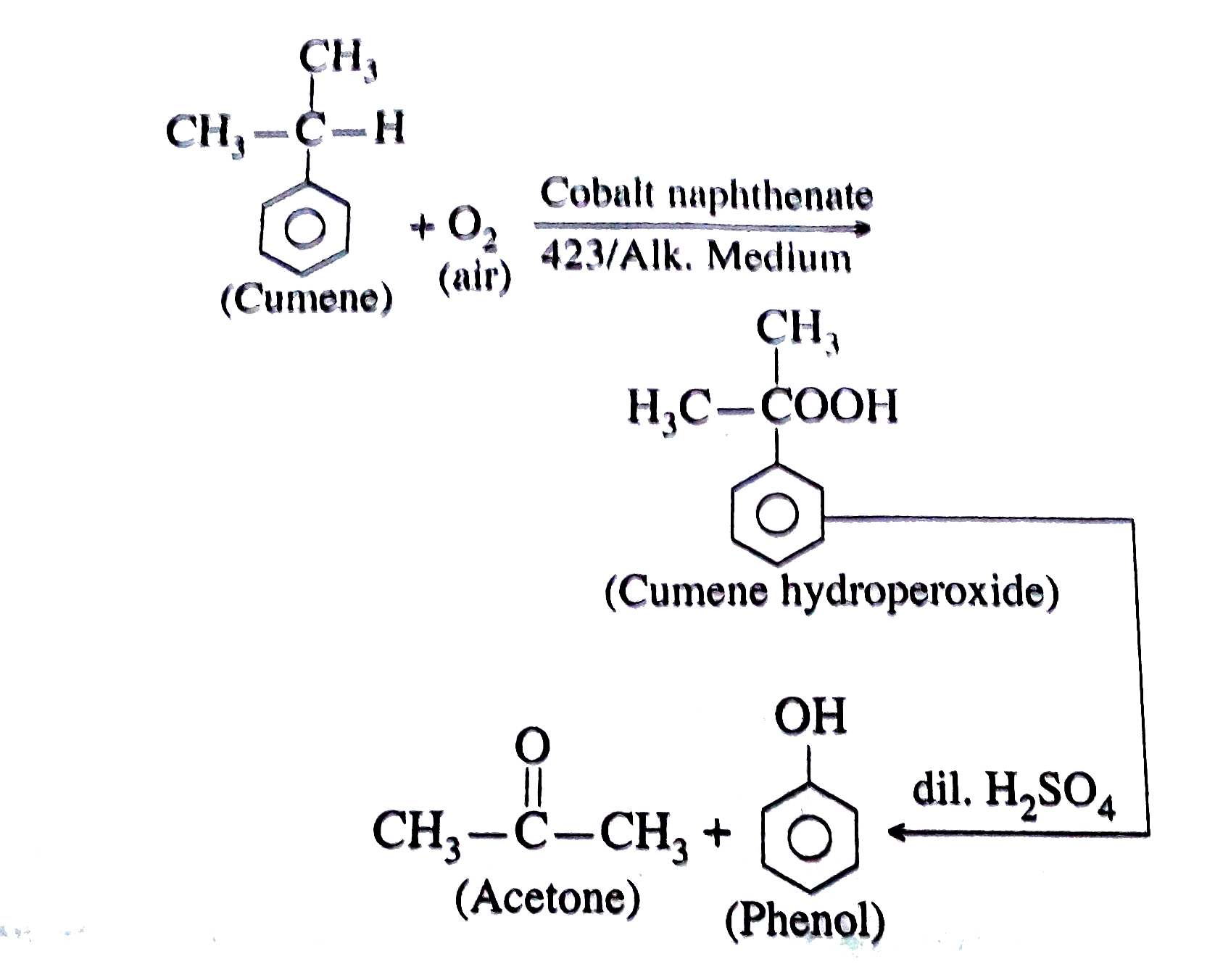
|
|
| 35. |
How is phenol obtained from benzene sulphonie acid? |
Answer» SOLUTION :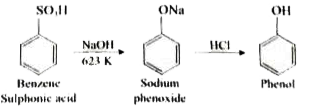
|
|
| 36. |
How is phenol prepared from Aniline? Write the equation. |
Answer» Solution :Aniline is treated with NITROUS acid `(NaNO_(2) + HCl)` at `0-5^(@)C` benzene DIAZONIUM chloride is FORMED when diazonium salt is warmed with dil acid phenol is formed.  Phenol from Aniline (equations): 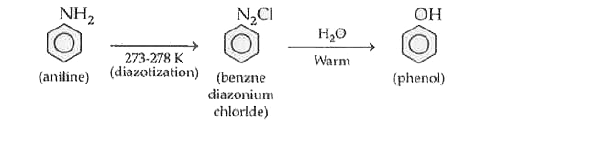
|
|
| 37. |
How is phenol prepared from (1) benzeene sulphonic acid 92) aniline (diazotization) (March'15) and (3) chlorobenzene and steam? |
Answer» Solution :(1) Preparation of phenol from benzene sulphonic acid: Benzene sulphonic acid is treated with the requistite quantity of soda as `(Na_(2)CO_(3))` or `NaOH` and the solution is EVAPORATED to obtained sodium benzene sulphonate salt. Dry sodium benzene sulphonate is fused with an excess of caustic soda `(NaOH)` at about `573K` when sodium phenioxide is formed. The fused mass of sodium phenoxide on treatment with DILUTE `H_(2)SO_(4)` gives phenol.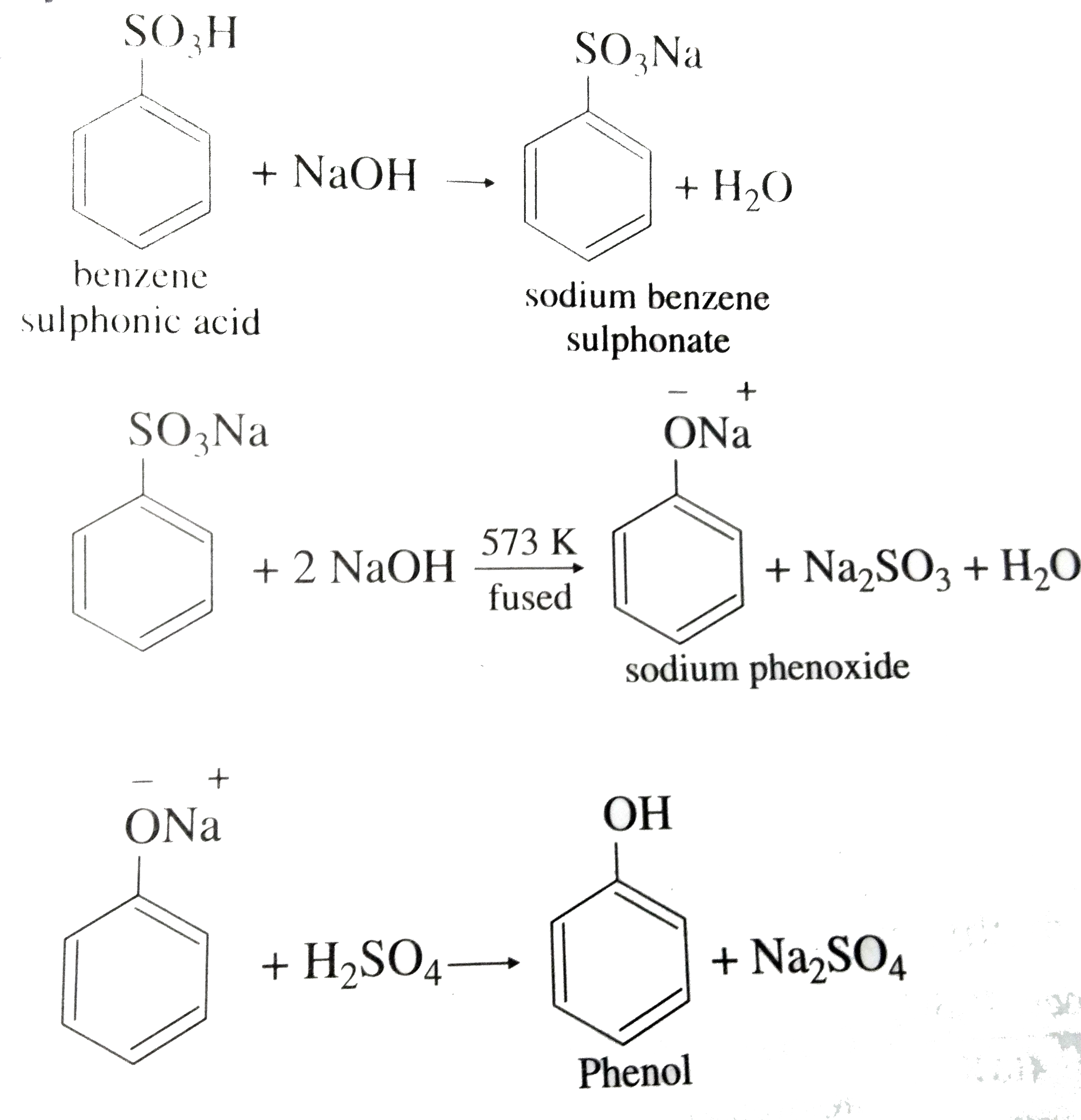 (2) Preparation of phenol from ANILINE (diazotization): When aniline is treated with sodium nitrite and hydrochloric acid at low TEMPERATURE `(0^(@)C-5^(@)C)` benzene diazonium chloride is formed. This reaction is called diazotization. An aqueous solution of benzene diazonium chloride on warming with dil. `H_(2)SO_(4)` gives phenol. 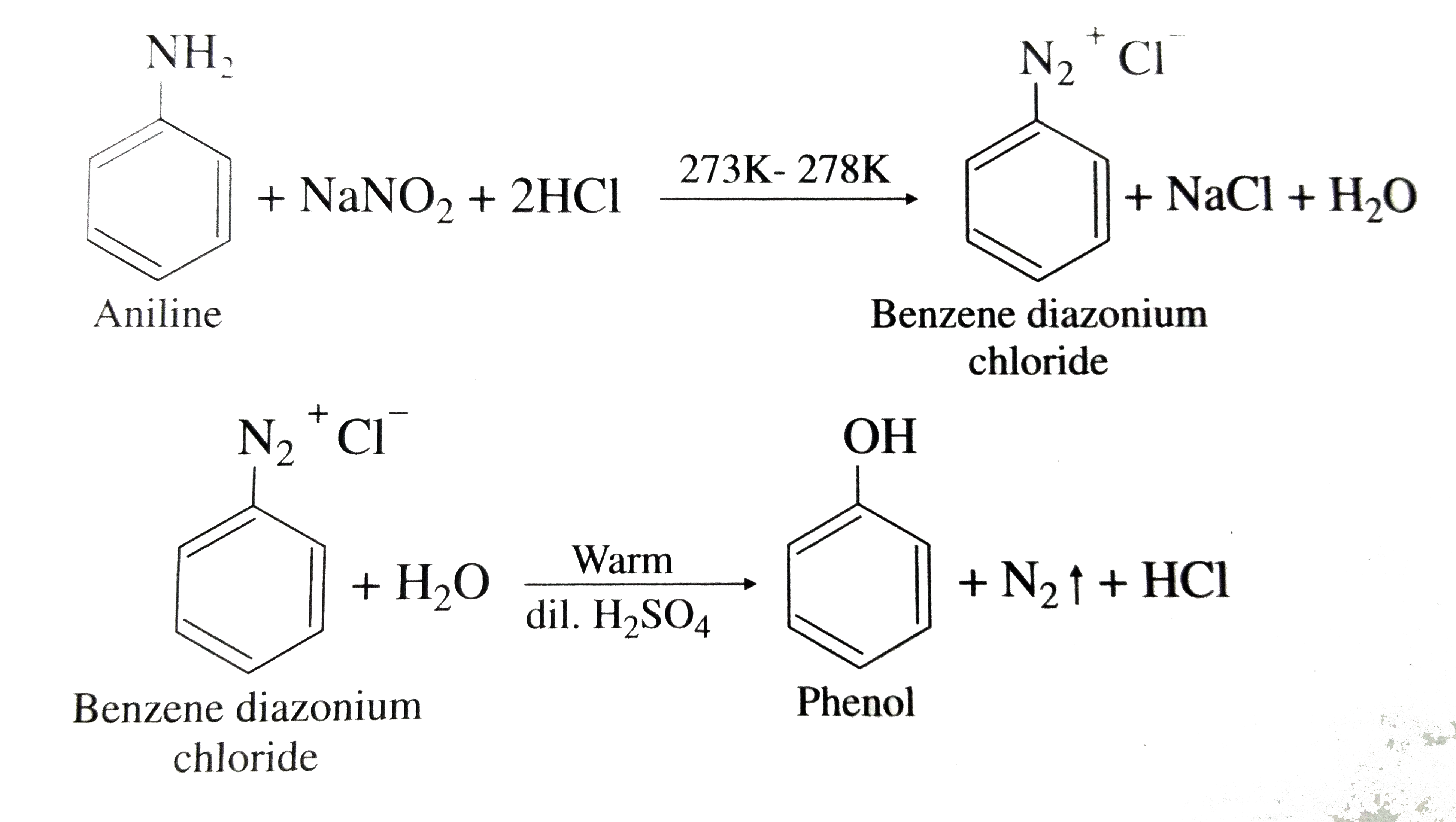 (3) PREPARATIONOF phenol from chlorobenzene and steam: Chlorobenzene is treated with steam in the presence of calcium phosphate or silica `(SiO_(2))` as a catalyst when phenol is obtained. 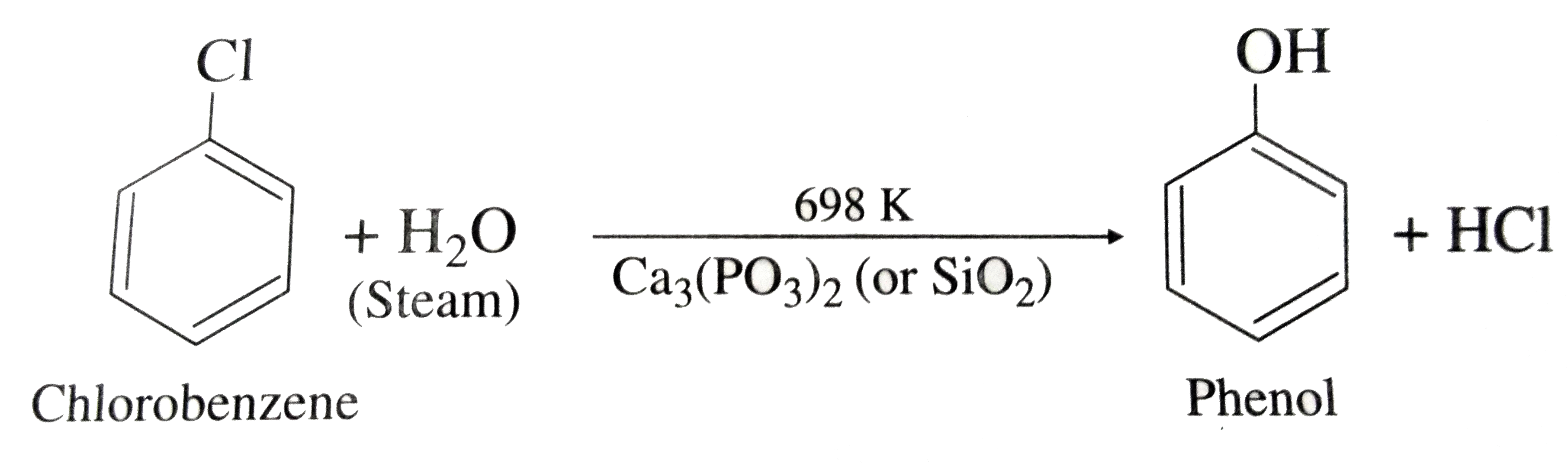
|
|
| 38. |
How is phenol prepared form (i) chloro benzene (ii) isopropyl benzene |
|
Answer» Solution :(i) From Chloro BENZENE: According to Dow.s process, when Chlorobenzene is hydrolysed with 6 8% NaOHat 300 BAR and 633K in a closed vessel, sodium phenoxide is formed which on TREATMENT with dilute HCl gives phenol. 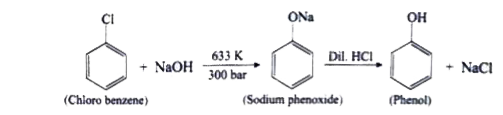 (ii) For isopropyl benzene: On passing air to a mixture of CUMENE (isoprophy benzene) and 5% aqueous sodium carbonate solution, cumene hydro peroxide is formed by oxidation. It is treated with diluteacid to get phenol and ACETONE. 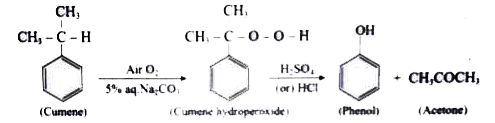
|
|
| 39. |
How is phenol obtained from aniline? |
Answer» SOLUTION :
|
|
| 40. |
How is phenol manufactured by Cumene process? |
|
Answer» Solution :Step - (1) : Conversion of Cumene to Cumene hydroperoxide Cumene isoxidized with oxygen (or) air in the presence of a metal CATALYST, at `130^(@)C`. Cummene hydroperoxide is formed. 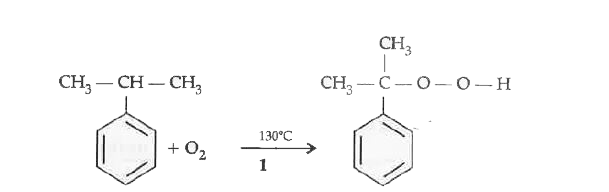 Step - (2) : Conversion of cumene hydroperoxide to phenol. On HEATING cumene hydroperoxide with dilute sulphuric acid at 373 K, phenol is formed. 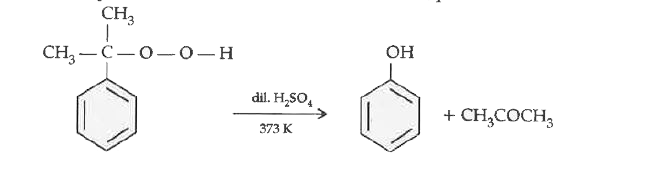
|
|
| 41. |
How is phenol isolated from coal tar? |
|
Answer» SOLUTION :Middle oil `(170-230^(@)C)` contains mainly phenols napthalene and traces of pyridine. Its cooled Napthalene crystallises. It is removed by filtration. Crude phenol is washed with dilure `H_(2)SO_(4)` then treated with sodium hydroxide solution. Sodium phenate formed in aqueous solution is separated, acidified to get phenol. `C_(6)H_(5)OH+NaOHtoC_(6)H_(5)ONa+H_(2)O` `C_(6)H_(5)ONa+HCl toC_(6)H_(5)OH+NaCl` (For acidification `CO_(2)` or `H_(2)SO_(4)` can be USED) |
|
| 42. |
How is phenol converted into salicylaldehyde? |
Answer» SOLUTION :The REACTION of phenol with chloroform in the presence of alkali give salicylaldehydes. The REACTIONS is called REIMER- Tiemann reaction. 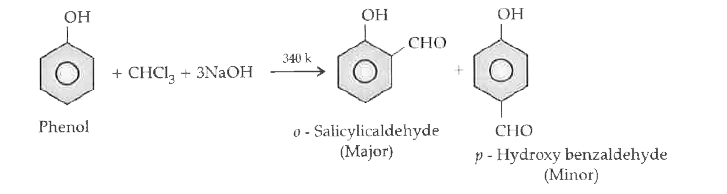
|
|
| 43. |
How is ozone estimated quantitatively? |
|
Answer» Solution : Ozone oxidises potassium IODIDE to iodine as : `2KI + O_3 + H_2O to KOH + O_2+ I_2` The LIBERATED iodine may be titrated against a standard solution of sodium THIOSULPHATE. `I_2 + 2Na_2S_2O_3 to Na_2 S_4O_6 + 2NaI` Thus to estimate `O_3`quantitatively, ozone is allowed to react with known amount of excess potassium iodide solution buffered with a borate buffer (pH = 9.2). The liberated `I_2`is titrated against `Na_2S_2O_3`solution using starch as an INDICATOR. From this amount of ozone can be calculated. |
|
| 44. |
How is ozone prepared? What happens when ozone react with lead sulphide? |
|
Answer» Solution :It is prepared by passing silent electric discharge through pure and DRY oxygen. `10%` of oxygen is converted into OZONE. `3O_(2)rarr 2O_(3)(g)" "DeltaH=+"142 kJ/mol"` The apparatus USED to PREPARE the ozone is called ozonizer. |
|
| 45. |
How is oxygen replenished in our atmosphere ? |
|
Answer» Solution :Oxygen is replenished in our ATMOSPHERE through photosyntheis in plants. During photosynthessis `CO_(2)` of the air (PRODUCED as a result of combination of fuels and breathig of animals and human beings) is CONSUMED and `O_2` is generated. `xCO_(2)+yH_(2)Ooverset("Sunlight")underset("CHLOROPHYLL")to underset("Carbohydrate")(C_x(H_2O)_(y))+ xO_(2)` |
|
| 46. |
How is oxygen prepared in the laboratory? |
|
Answer» SOLUTION :Oxygen is PREPARED in the laboratory by heating potassium CHLORATE in PRESENCE of manganese DIOXIDE `(MnO_(2))` as a catalyst at 623 K. `2KClO_(3)overset(MnO_(2))rarr2KCl+3O_(2)` |
|
| 47. |
How is ore of aluminium concentrated? |
|
Answer» Roasting |
|
| 48. |
How is orange-I prepared? |
|
Answer» |
|
| 49. |
Suggests method for the quantitative estimation of ozone (O_3). |
| Answer» Solution :When `O_3` is treated with excess potassium iodide solution containing a borate buffer having pH = 9.2, IODINE is liberated.`2l^(-)+H_2O+O_3to2OH^(-)+l_2+O_2` The iodine thus liberated is titrated against STANDARD sodium THIOSULPHATE solution. From the, titre value, theamount of `O_3` present can be estimated. | |
| 50. |
How is O_3 estimated quantitavely? |
|
Answer» Solution :Ozone `O_3` reacts with excess of KI solution, buffered with borate buffer `(pH9.2)` to liberate `I_2` QUANTITATIVELY. `O_(3(g))+2I^(ɵ)+H_2O_(1)to2^(ɵ)OH_(aq)+I_(2(s))+O_(2(g))` The `I_2` thus liberated is titrated against `Na_2S_2O_3` solution using starch as an INDICATOR, `2S_2O_3^(2-)toS_4O_6^(2-)+2e^(ɵ)` `UNDERLINE(I_2+2e^(ɵ)to2I^(ɵ))` `underline(2S_2O_3^(2-)+I_2toS_4O_6^(2-)+2I^(ɵ))` |
|