

Saved Bookmarks
This section includes 7 InterviewSolutions, each offering curated multiple-choice questions to sharpen your Current Affairs knowledge and support exam preparation. Choose a topic below to get started.
| 1. |
How is flurobenzene prepared from benzenediazonium chloride? Name the reaction. |
|
Answer» Solution :When benzen DIAZONIUM chloride is TREATED with fluorobric acid, benezene diazonium tetra fluoroborate is PRECIPITATED which on heating decomposes to give fluorobenzene. `{:(C_6H_5-overset(+)(N_2)Cbarl+HBF_4 toC_6H_5-overset(+)(N_2)BbarF_4overset(TRIANGLE)(to)C_6H_5-F+BF_3+N_2),(" Fluoroboric acidBenzenediazonium fluoroborateFluorobenzene "):}` Name of the reaction : Baltz -shiemann reaction. |
|
| 2. |
How does the increase in the amount of CO_2 in the atmosphere lead to global warming ? |
| Answer» Solution :The visible and some ultraviolet radiations (which have short wavelengths) from the sun reach the EARTH by passing through `CO_2` present in the atmosphere and as a result, the earth becomes heated. However, when the earth becomes cool, the energy is remitted from the earth surface in the form of infrared radiations (which have longer WAVELENGTH and have a heating effect). `CO_2` does not allow these radiations to pass through itself and becomes heated by absorbing them. Some of this heat is dissipated into the atmosphere while the remaining part is radiated back to the earth. As a result, the temperature of the earth increases. In this way `CO_2` helps to maintain the temperature on the earth required for the existence of living ORGANISMS. However, if the amount of `CO_2` in the air increases due to some human activity, the temperature of the earth increases more than required. This phenomenon is calledglobal WARMING. | |
| 3. |
How is ferrimagnetism arises in substances? Give an example of substance showing ferrrimagnetism. |
|
Answer» Solution :They CONTAIN unpaired ELECTRON and are strongly attracted by the MAGNETIC FIELD. Ex : `Fe, Co` |
|
| 4. |
How is ethyl methanoate converted into propan-2-ol? |
|
Answer» Solution :Ethyl methanoate on reaction with EXCESS of `CH_(3)MgI` FOLLOWED by hydrolysis with dil `H_(2)SO_(4)` gives propan-2-ol. `underset("Ethyl methanoate")(H-OVERSET(O)overset(||)(C)-OC_(2)H_(5)) underset(-Mg(OC_(2)H_(5))I)overset(CH_(3)MgI)to underset("Ethanal")([H-overset(O)overset(||)(C)-CH_(3)]) overset(CH_(3)MgI)to CH_(3)-overset(OMgI)overset(|)(C)H-CH_(3) underset(-Mg(OH)I)overset(H^(+)//H_(2)O)to underset("Propan-2-ol")(CH_(3)-overset(OH)overset(|)(C)H-CH_(3))` |
|
| 5. |
How is ethyl iodide prepared from ethanol ? |
| Answer» Solution :`C_(2)H_(5)OH OVERSET(I_(2)//P)to C_(2)H_(5)I` | |
| 6. |
How is ethyl iso-propyl ether prepared ? |
Answer» SOLUTION : Sodium ISOPROPOXIDE on treating with ethyl HALIDE gives ethyl iso-propyl ether. Alkyl halide is to be primary because with other alkyl halides, alkenes are FORMED. If ethoxide and isopropyl halide are taken, elimination takes place and `CH_3-CH = CH_2`is formed. |
|
| 7. |
How is ethyl bromide converted into ethylbenzene by Friedel - Crafts reactions ? Give the equations. |
Answer» SOLUTION :By TREATING ETHYL bromide with benzene in presence of ANHYDROUS `AICI_(3)` 
|
|
| 8. |
How is ethyl iodide converted into diethyl ether? |
|
Answer» Solution :DIETHYL ETHER can be obtained by Williamson.s synthesis : `C_(2)H_(5)Ona+C_(2)H_(5)ON a rarr C_(2)H_(5)OCH_(3)+NAI` |
|
| 9. |
How is ethyl acetate react with PCI? |
| Answer» SOLUTION :`UNDERSET("ETHYL acetate ")(CH_3 - undersetoverset(||)(O)(C )- OC_2H_5 ) + PCl_5to underset("ACETYL chloride")(CH_3 - undersetoverset(||)(O)(C ) -Cl) + underset("ethyl chloride")(C_2H_5Cl) + underset("phosphoyl chloride")(POCl_3)` | |
| 10. |
How is ethanol obtained from 2- butene? |
| Answer» Solution :`underset("But-2-ene")(CH_(3)-CH=CH-CH_(3))OVERSET((1)O_(3))underset((2)Zn//H_(2)O)rarr underset("ETHANAL")(CH_(3)-overset(O)overset(||)C-H)overset(LiAlH_(4))rarr underset("ETHANOL")(CH_(3)CH_(2)OH)` | |
| 11. |
How is ether distinguished from ethanol using iodine and alkali ? |
| Answer» Solution : Ethanol gives yellow COLOURED solid IODOFORM with iodine and alkali. ETHER does not FORM iodoform. | |
| 12. |
How is elevation in boiling point related to molal elevation constant ? |
|
Answer» Solution :`DELTA T_b = K_b m` where `Delta T_b` = ELEVATION in BOILING point `K_b`= MOLAL elevation constant |
|
| 13. |
How is ethanoic acid industrially obtained from ethanol? |
| Answer» Solution :`underset("Ethanal")(CH_(3)CHO)+(1)/(2)O_(2)overset(CO("OOCCH"_(3))_(2))underset("HEAT")rarr underset("Ethanoic acid")(CH_(3)COOH)` | |
| 14. |
How is electrical energy generated by performing a chemical reaction ? |
|
Answer» |
|
| 15. |
How is dinitrogen prepared on a commercial scale ? |
|
Answer» Solution :(i) On a commercial scale, dinitrogen is prepared by the fractional DISTILLATION of liquid air. (ii) Liquid dinitrogen distils out FIRST having BOILING point 77.2 K leaving BEHIND liquid dioxygen having boiling point 90 K. |
|
| 16. |
How is double salt different from a complex ? |
Answer» SOLUTION :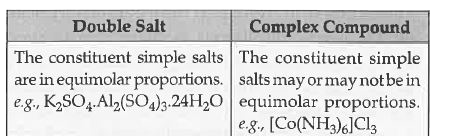
|
|
| 17. |
Howis electrical conductance of a conductorrelated with lengthand areaa crosssection of the conductor |
|
Answer» `G=l.a.K^(-1)` |
|
| 18. |
How is dinitrogen obtained from bleaching powder and ammonia? |
|
Answer» Solution :By ADDING a SUSPENSION of bleaching POWER `CaOCl_(2)` to ammonia solution, dinitrogen is obtained. `3CaOCl_(2)+2NH_(3) rarr 3CaCl_(2)+3H_(2)O+N_(2).` |
|
| 19. |
How is dilute sulphuric acid prepared? |
| Answer» SOLUTION :Dissolution of SULPHURIC ACID with water is highly exothermic. Hence care is TAKEN in preparing dilute sulphuric acid. Concentrated acid is added slowly into water with stirring. | |
| 20. |
How is diethyl ether prepared by continuous therfification process? Why is the process so called? |
|
Answer» Solution :Etherification is a reactioin in which is simple either `(R-O-R)` is formed from an alcholol on distilling it with concentrated `H_(2)SO_(4)` by intermolecular dehydration reaction. `2R-O-H underset(Delta)overset(conc. H_(2)SO_(4))(to)R-O-R+H_(2)O` When an EXCESS of ethyl alcohol is distilled with concentrated `H_(2)SO_(4)` at `413K` DIETHYL ether is formed. `underset("ethyl alcohol")(2C_(2)H_(5)OH)underset(413K)overset(conc. H_(2)SO_(4))(to) underset("diethyl ether")(C_(2)H_(5)-O-)C_(2)H_(5)+H_(2)O` This reaction takes place in two STEPS: Step 1: Ethyl alcohol reacts with concentrated `H_(2)SO_(4)` and forms ethyl hydrogen sulphate. `underset("ethyl alcohol")(C_(2)H_(5)OH+HO-underset("conc.")(SO_(3)H) overset("room temp")(to) underset("ethyl hydrogen sulphate")(C_(2)H_(5)-O-SO_(3)H+)H_(2)O` Step 2: Ethyl hydrogen sulphate then reacts WILTH an excess of ethyl alcolol at `413 K` and forms diethyl ether. `C_(2)H_(5)-O-SO_(3) H+C_(2)H_(5)OHoverset(413K)(to) underset("diethyl ether")C_(2)H_(5)-O-C_(2)H_(5)+H_(2)SO_(4)` The ether produced is distilled over. The regenerated `H_(2)SO_(4)` is reused in the first step. Thus a small AMOUNT of `H_(2)SO_(4)` can convert a large amount of alcohol into ether and the process becomes continuous. Hence the process is called continuous etherification process. |
|
| 21. |
How is dieyhyl ether prepared by continuous etherification process ? |
|
Answer» Solution :This method is used for the preparation of simple ethers in which excess of alcohol (ethyl alcohol) reacts with concentrated sulphuric acid to produce ether continously. `C_(2)H_(5)OH+HOSO_(3)Hoverset(-H_(2)O///140^(@)C)tounderset("Ethyl hydrogen SULPHATE")(C_(2)H_(5)-HSO_(4))` `underset(C_(2)H_(5)OH//H_(2)SO_(4))to C_(2)H_(5)-O-C_(2)H_(5)` First of all, one molecule of ethyl alcohol reacts with conc, sulphuric acid to GIVE ethyl hydrogen sulphate. Then in next STEP, second molecule of ethyl alcohol reacts with ethyl hydrogen sulphate to give diehyl ether and sulphuric acid is regenerated. In this PROCESS, sulphuric acid that is regenerated in second step can be again used in first step to make ether and the process will be continude by adding a small amount of acid. This is way, the reaction is KNOWN as continous etherification process. |
|
| 22. |
How is diethyl ether prepared? |
|
Answer» SOLUTION :Ethanol undergo DEHYDRATION in presence of Conc. `H_(2)SO_(4)` at 413 K at form diethylether. `C_(2)H_(5)OH underset(413K)overset(H_(2)SO_(4))to C_(2)H_(5)OC_(2)H_(5)` |
|
| 23. |
How is DDT prepared? |
| Answer» Solution :DDT is PREPARED by CONDENSATION of CHLOROBENZENE with chloral, i.e., trichloroacetaldehyde, in presence of CONC. `H_(2)SO_(4)`. | |
| 24. |
How is dehydrogenation reaction of alcohol carried? Give example. |
|
Answer» Solution :Dehydrogenation of alcohols is CARRIED with reduced Cu at 573 K. (i) Primary Alcohol form ALDEHYDES. `CH_(3)-CH_(2)-OHoverset(Cu//573)(to)CH_(3)-overset(O)overset(||)(C)-CH_(3)+H_(2)` (iii)Tertiary alcohols do not dehydrogenates since a molecule of `H_(2)` cannot be removed. |
|
| 25. |
How is DDT prepared ? |
Answer» Solution :DDT is PREPARED by HEATING chloral with chlorobenzene in the presence of CONC. `H_(2)SO_(4)` 
|
|
| 26. |
How is dacron prepared ? Which film is used in making magnetic recording tapes ? |
Answer» Solution :Dacron is prepared by the condensation polymerisation of ethylene glycol and terephthalic acid. 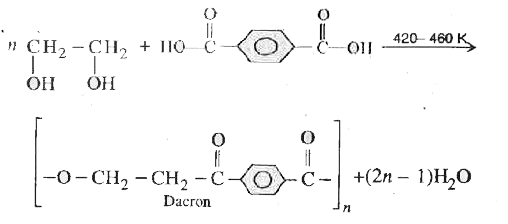 Mylar FILM(or Dacron film) is USED for making magneitc recording TAPES. |
|
| 27. |
How is dacron obtained from ethylene glycol and terephthalic acid? |
Answer» Solution :Dacron is obtained by condensation POLYMERISATION of ETHYLENE glycol and terephthalic ACID with the elimination of WATER molecules:
|
|
| 28. |
How is dacron prepared ? Name the type to which this polymer belongs? |
| Answer» SOLUTION : CONDENSATION POLYMER, step-growth polymer | |
| 29. |
How is dacron obtained from ethylene glycol and terephthalic acid ? |
Answer» Solution :Dacron is OBTAINED by condensation polymerization of ethylene GLYCOL and terephthalic acid with the elimination of water molecules. The REACTION is CARRIED out at `420-460 K` in presence of a catalyst consisting of a mixture of zinc acetate and antimony trioxide.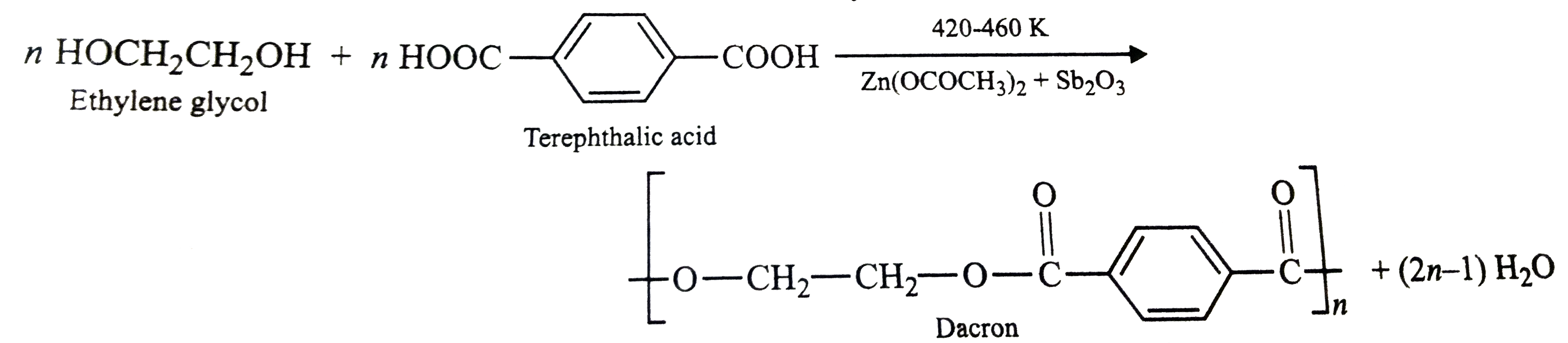
|
|
| 30. |
How is cyclopentanol prepared from (1) cyclopentanone (2) cyclopentene? |
Answer» Solution :(1) Cyclopentanone: When Cyclopentanone is reduced in the presence of sodium=amalgam and WATER, cyclopentanol is obtained. 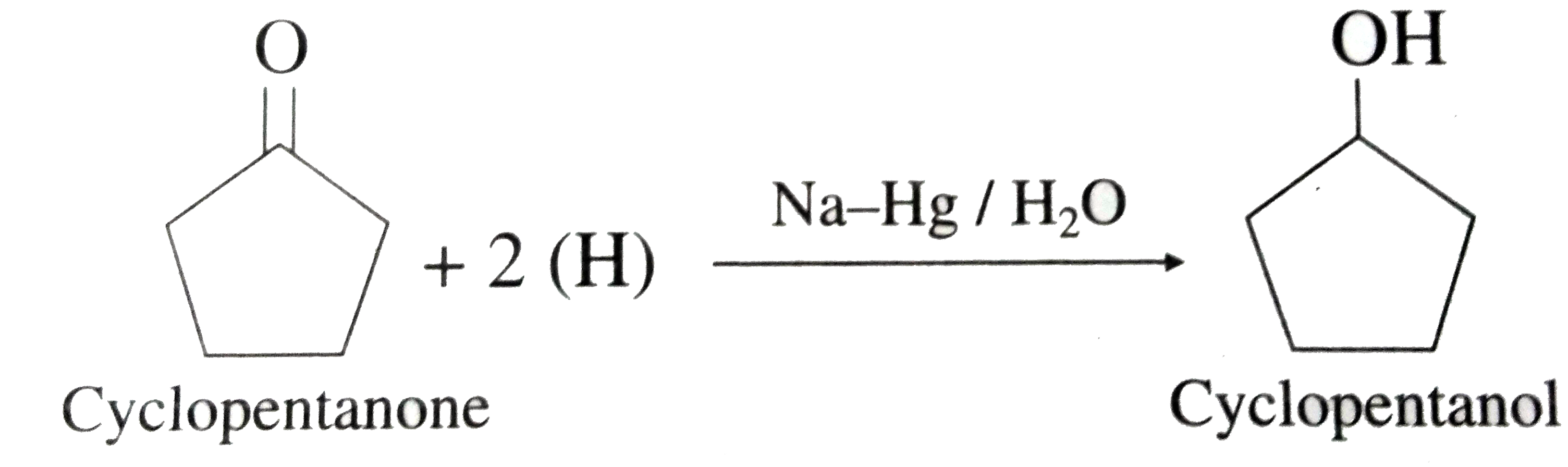 (2) Cyclopentene: When cyclopentene is TREATED with cold CONCENTRATED sulphuric acid, CYCLOPENTYL hydrogen sulphate is FORMED. Cyclopentene hydrogen sulphate on heating with water gives cyclo-pentanol. 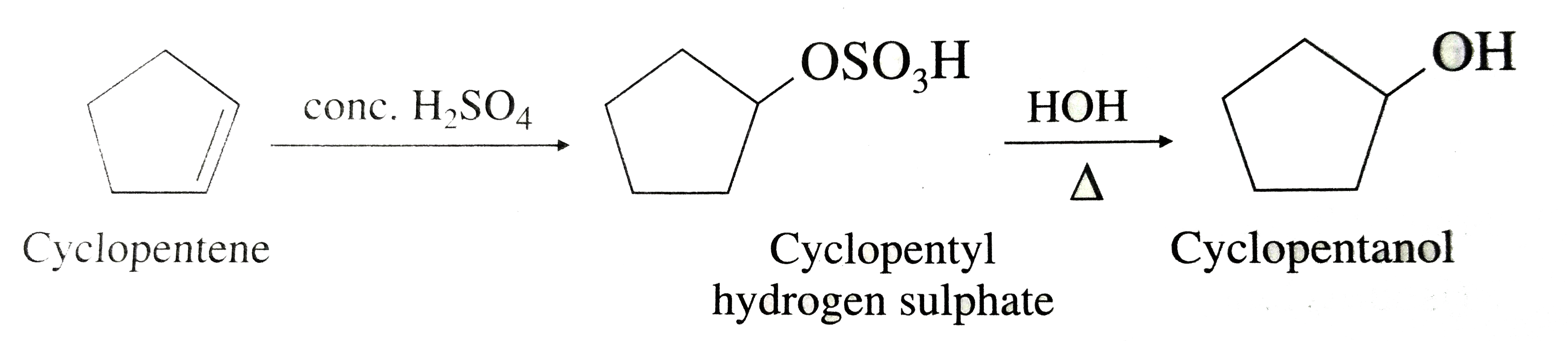
|
|
| 31. |
How is copper extracted from low grade copper ores? |
|
Answer» Solution :Hydrometallurgy is used for the extraction of copper from low grade copper ores. It is leached out USING acid. The solution containing `Cu^(2+)` is treated with scrap iron, zinc or hydrogen gas. The reactions may be expressed as under. `Cu^(2+) (aq) +H_(2) (G) to Cu(s) +2H^(+) (aq)` `Cu^(2+) +FE (s) to Fe_(2) (aq) + Cu (s)`. |
|
| 32. |
How is copper extracted from low grade copper ores ? |
|
Answer» Solution :The extraction of metals by using their aqueous solution is called hydrometallurgy. Example : AU, Ag, Cu etc. are extracted by this method. The copper from low grade ores and SCRAPS is extracted by hydrometallurgy. It is leached out using acid or bacteria. The solution containing `Cu^(2+)` is treated with scrap iron or `H_2`. `Cu_((aq))^(2+)+ H_(2(G)) to Cu_((s)) + 2H_((aq))^(+)`. |
|
| 33. |
How is copper extracted from low gade ores or scraps ? |
|
Answer» Solution :Copper is EXTRACTED by hydrometallurgy from low grade ores. It is leached out using ACID or bacteria. The solution contianing copper IONS `(Cu^(2+))` is treated with SCRAP iron or `H_2` as : `Cu^(2+) (aq)+ H_2(g) to Cu(s)+ 2H^(+) (aq)` In this way, copper is OBTAINED. |
|
| 34. |
How iscopperextractedfromalow gradeoreof it? |
|
Answer» Solution : Copperisextractedbyhydrometallurgy. The lowgradeoresareleachedwith an acid (i.e., DIL.`H _2 SO _4 `)whenmetal goes intosolutionas` Cu ^(2 + ) `ions. ` "" ` Lowgradecopperore`overset ( H^(+)) toCu^(2 + ) (aq)` Coppermetal isthenobtainedbytreatingthe` Cu ^( 2+ ) `ionssolutionswith eitherscrap iron or`H_2`gas. Since` E ^(@) `of` Fe^( 2+)//Fe ` ( - 0`*`44V) or thatof`H ^(+)//H_2`(0`*`0 V) redox coupleis LOWER than thatof` Cu^( 2 +)//Cu ( +0 *34 V ) `,THEREFORE,` Fe orH_ 2`can displaceCu from` Cu^( 2+) `ions ` "" Cu^( 2+ ) (aq) + Fe (s) toCu (s) +Fe ^( 2 + ) (aq) ,` ` Cu^( 2+ )(aq) +H_2(g) toCu(s)+2H^( + ) (aq) ` |
|
| 35. |
How is common ion effect related to the solubility of the electrolyte? |
| Answer» SOLUTION :COMMON ION EFFECT decreases the solubility of the ELECTROLYTE. | |
| 36. |
How is coagulation brought about by addition of electrolytes? |
|
Answer» Solution : (i) A negative ion causes the precipitation of positively charged sol and VICE versa. (ii) When the valency of ion is high, the precipitation power is increased. For example, the precipitation power of some CATIONS and anions varies in the following order `Al^(3+) gt Ba^(2+) gt Na^(+) , "Similarly " [Fe(CN)_6]^(3-) gt SO_4^(2-) gt Cl^-` (iii) The precipitation power of electrolyte is DETERMINED by finding the minimum concentration (millimoles/lit) required to cause precipitation of a sol in 2 hours. (iv) This value is called FLOCCULATION value. The smaller the flocculation value greater will be precipitation. |
|
| 37. |
How is classification of amines different from that of alcohols? |
Answer» Solution :CLASSIFICATION of amines is MADE on the basis of the nature of NITROGEN atom (whether it has one, two or no hydrogen atom) to which the ALKYL groups are attached. The classification of alcohols, on the other hand, is made on the basis of the nature of CARON atom to which the -OH group is attached. 
|
|
| 38. |
How is CO converted into methanol? |
| Answer» Solution :`underset("monoxide")underset("Carbon")(CO+2H_(2))overset(ZnO)underset(Cr_(2)O_(3))rarr underset("METHANOL")(CH_(3)OH)` | |
| 39. |
How is chlorine react with Benzaldehyde? (i) In the presence of catalyst (ii) in the absence of catalyst |
Answer» SOLUTION :
|
|
| 40. |
How is chlorine react with Benzaldehyde? (i) In the presence of catalyst(ii) in the absence of catalyst |
Answer» SOLUTION :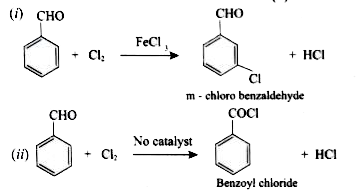
|
|
| 41. |
(i) How is chlorine prepared by using MnO_(2) (ii) Complete the reaction. NH_(3)"(excess)"+Cl_(2)rarr |
|
Answer» Solution :(i) Heating `MnO_(2)` with conc. `HCL` `MnO_(2)+4HCl RARR MnCl_(2)+Cl_(2)+2H_(2)O` OR Self explanation of reaction (ii) `NH_(3)+3Cl_(2)" (ecess)" rarr NCl_(3)+3HCL` |
|
| 42. |
How is chlorine prepared using KMnO_4 ? |
| Answer» SOLUTION :`2KMnO_4+16HCl to2KCl+2MnCl_2+8H_2O+5Cl_2` | |
| 43. |
How is chemical volcano formed ? |
|
Answer» Solution :CHEMICAL volcano is formed when solid ammonium DICHROMATE is heated. Vapours of `Cr_(2)O_(3)` which are green in COLOUR look like volcano. `(NH_(4))_(2)Cr_(2)O_(7) overset(Heat)to N_(2)+4H_(2)O+Cr_(2)O_(3)` |
|
| 44. |
How is chlorine prepared in the laboratory usingKMNo_(4) ? |
|
Answer» SOLUTION :In the laboratory CHLORINE is PREPARED by the action of conc. HCL on solid `KMnO_(4)` solid. `KMnO_(4)+16HCl to 2KCl +2MnCl_(2)+8H_(2)O +5Cl_(2)`. |
|
| 45. |
How is chemical reduction different from electrolytic reduction ? Name a metal each which is obtained by Chemical reduction. |
|
Answer» Solution :Chemical reduction is a PROCESS involving electron gain or electronation. Chemical reduction is achieved by HEATING metal oxide generally with CARBON or CO. ELECTROLYTIC reduction is a technique forcarrying out reduction by coupling it through electrodes and external circuit. Iron is obtained by chemical reduction. |
|
| 46. |
How is CH_(3)OH conveted into CH_(3)COOH (in one step)? |
| Answer» Solution :`underset("Methanol")(CH_(3)OH) underset(-1//2H_(2))OVERSET(NA)to CH_(3)O^(-)Na^(+) underset("under pressure")overset(CO)to CH_(3)COONa underset(-NaCl)overset(HCl//H_(2)O)to underset("ETHANOIC acid")(CH_(3)COOH)` | |
| 47. |
How is chemical reduction different from electrolytic reduction ? Name a metal each which is obtained by Electrolytic reduction. |
|
Answer» Solution :Chemical reduction is a process involving electron gain or electronation. Chemical reduction is achieved by heating metal oxide generally with carbon or CO. Electrolytic reduction is a technique forcarrying out reduction by coupling it through electrodes and external CIRCUIT. Sodium is EXTRACTED from FUSED sodium chloride by electrolytic reduction. |
|
| 48. |
How is cell constant calculated from conductance values? |
| Answer» SOLUTION :CELL constant=specific CONDUCTANCE/observed conductance. | |
| 49. |
How is 'cast iron' different from 'pig iron'? |
|
Answer» Solution :The iron obtained from blast furnace is called pig iron. It contains about 4% carbon and many other impurities (e.g., S, P, Si, Mn) in smaller amount. Cast iron, on the other hand, is MADE by melting pig iron with scrap iron and coke using HOT air blast. It has slightly lower carbon content (about 3%) and is extremely hard and brittle. |
|
| 50. |
How is cast iron different from pig iron? |
|
Answer» <P> Solution :The IRON obtained from blast furnace is pig iron. It contains about 4% of carbon and many impurities in smaller AMOUNT (e.g. S, P, Si, Mn, etc.)Cast iron is obtained by melting pig iron with scrap iron and coke using hot air blast. It contains slightly lower carbon content (about 3%) and is EXTREMELY hard and BRITTLE. |
|