Saved Bookmarks
This section includes 7 InterviewSolutions, each offering curated multiple-choice questions to sharpen your Current Affairs knowledge and support exam preparation. Choose a topic below to get started.
| 1. |
Gabriel synthesis is used for the preparation of |
|
Answer» Primary aromatic amines |
|
| 2. |
Give an example each of solid-in-gas and liquid-in-gas solutions. |
| Answer» SOLUTION :NAPHTHALENE vpoures in AIR, HUMIDITY in air. | |
| 3. |
Give an example eachfor antifertility drug and antiseptics . |
|
Answer» SOLUTION :i. DETTO II. NORETHINDRONE |
|
| 4. |
Gabriel phthalimide synthesis is used in the preparation of primary amine from phthalimide. Which of the following reagents is not used during the process? |
|
Answer» KOH |
|
| 5. |
Given an example each for (a) Artificial sweetening agents (b) Narcotic analgesics. |
|
Answer» SOLUTION :(a) Ortho-sulphobenzimide (SACCHARIN) OR Aspartame (or) Alitame (or) Sucralose (Trichloro derivative of sucrose) (B) Morphine (or) Heroin (or) Codein |
|
| 6. |
Gabriel phthalimide synthesis is used for the preparation of underline("secondary amines") |
| Answer» Solution :GABRIEL phthalimide synthesis is used for the PREPARATION of PRIMARY AMINES. | |
| 7. |
Gabriel phthalimide synthesis is used for the preparation of........ |
| Answer» SOLUTION :`1^@` ALIPHATIC AMINES | |
| 8. |
Give an equation for the reaction ofchlorine with hydrogen sulphide. |
| Answer» SOLUTION :`Cl_(2(G))+H_(2)S_((g))rarr2HCl_((g))+S_((s))` | |
| 9. |
Gabriel phthalimide synthesis is used for the preparation of: |
|
Answer» PRIMARY aromatic AMINE |
|
| 10. |
Give an example as Cannizzaro.s reaction. |
| Answer» SOLUTION :UNDERSET"FORMALDEHYDE"(2HCHO)+NaOHrarrunderset("METHYLALCOHOL")"CH_3OH | |
| 11. |
Gabriel Phthalimide Synthesis. |
|
Answer» Solution :Gabriel Phthalimide Synthesis : Phthalimide is reacted with alc. KOH to form potassium phthalimide. In this step N-H proton is REMOVED to give imide ION. It is then heated with alkyl halide to give N-alkyl phthalimide which on alkaline HYDROLYSIS give a primary AMINE. 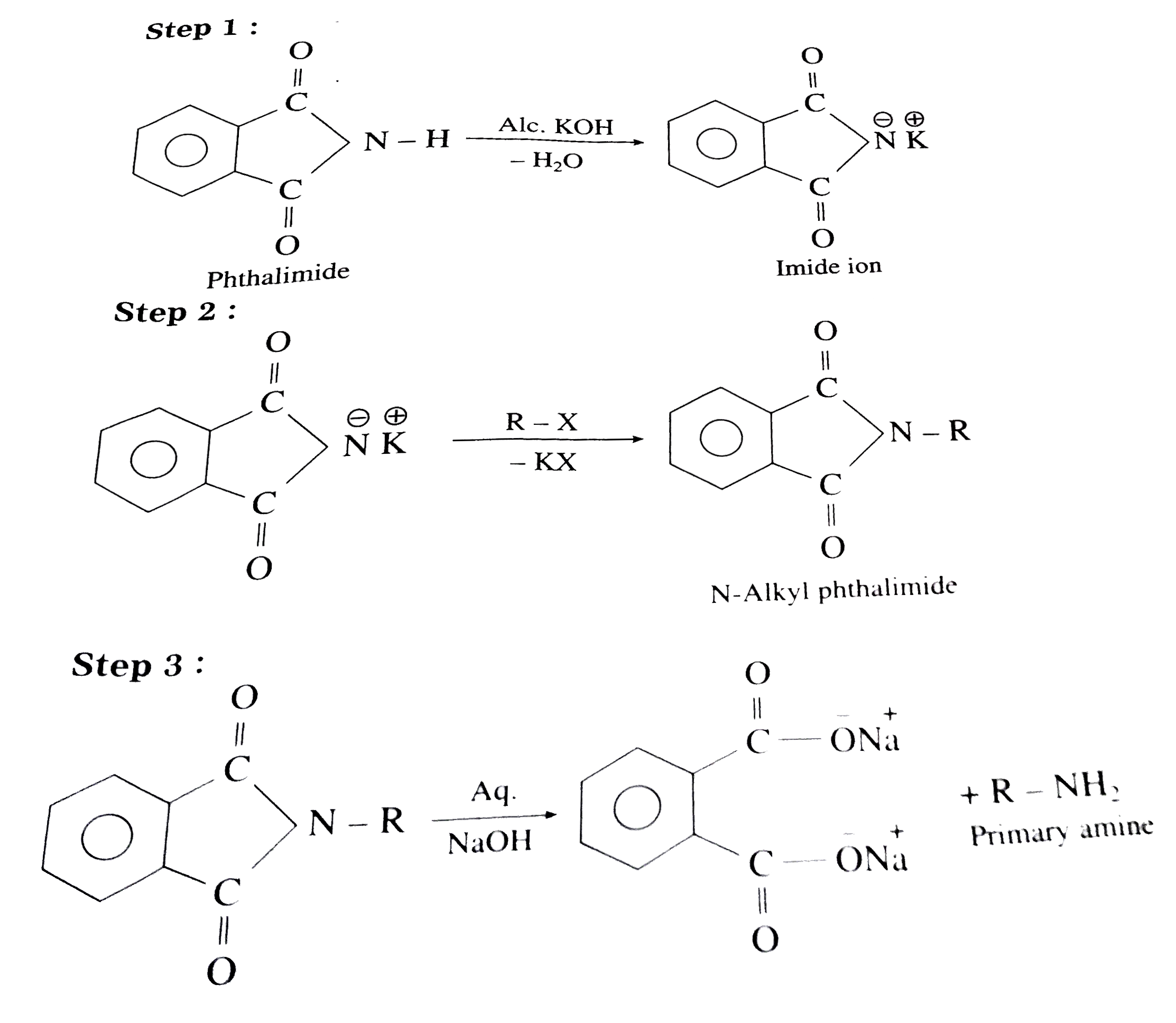
|
|
| 12. |
Write about VSEPR theory. |
|
Answer» Solution :VSEPR theory was proposed by Gillespy and Nyholm. It predicts the shapes of molecules without reference to the hybridisation. The important POINTS in the theory are : 1) The shape of a molecule depends upon the number of electron pairs (bond pairs) present on the central atom. If there are only 'bond pairs' and no 'lone pairs' on the central atom, the molecules ASSUMES a regular geometrical shape. 2) If there are 'lone pairs' also on the central atom, then the structure gets distorted and the bond angle changes. 3) A 'lone pair of electrons' occupy more space around the central atom than a bond pair, because the 'lone pair' is attracted by only one nucleus, while the 'bond pair' is attracted by two nuclei. 4) The electron pairs orient in space so as to have minimum repulsions among them, which determines the 'bond angles'. 5) The order of repulsion between various electron pairs is `l.p-l.p GT l.p-b.p gt b.p-b.p` 6) The magnitude of repulsion between bond pairs of electrons depends on the electronegativity differences between the central atom and the other atoms. 7) The order of repulsion between different bonds is : Tiple bond `gt` Double bond `gt` SINGLE bond 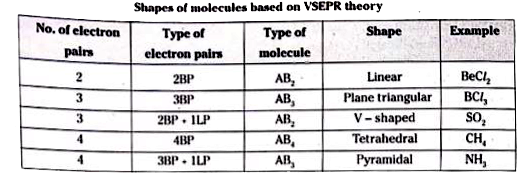 Applications : 1. Structure of `NH_(3)` molecule : In `NH_(3)` molecule, the central 'N' atom contains 3 bond pairs one lone pair. In total, there are four pair of electrons. Hence, according to VSEPR theory, the expected structure of the molecule in tetrahedral with a bond angle of `109^(@)28^(1)`. But, because ofthe presence of lone pair, the shape of the molecule gets distorted. Therefore, the real structure of the molecule is pyramidal with a bond angle of `107^(@)`. 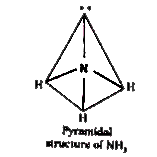 2. Structure of `H_(2)O` molecule : In`H_(2)O` molecule, the central 'O' atom contains two bond pair and two lone pairs. In total there are four pair of electrons. Hence, according to VSEPR theory, the expected structure of the molecule is tetrahedral with a bond angle of `109^(@)28^(1)`. But, because of the presence of lone pair, the shape of the molecule gets disorted. Therefore, the real structure of the molecule is V - shape with a bond angle of `104.5^(@)`. 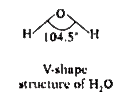
|
|
| 13. |
Gabriel phthalimide synthesis is used for the preparation of …………………. |
|
Answer» |
|
| 14. |
Give an account of the important applications of the concept of adsorption. |
| Answer» | |
| 15. |
Gabriel phthalimide synthesis can be used for the preparation of amine from |
|
Answer» `CH_(3)CH_(2)BR` |
|
| 16. |
Gabriel phthalimide synthesis is not used for the preparation of |
|
Answer»
|
|
| 17. |
Give an account of neucleophilic substitution reactions in haloarenes? |
Answer» Solution :The NUCLEOPHILIC substitution REACTION have LOW reactivity in HALOARENES.
|
|
| 18. |
Gabriel-Phthalimide reaction is useful for preparation of |
|
Answer»
 It is used to propore `1^(@)` amine from R-X |
|
| 19. |
Give all the characteristics of non-ideal solution. |
|
Answer» Solution :Characteristics of a non-ideal solution (i) The magnitude of solute-solvent INTERACTIONS is DIFFERENT from solute-solute and solvent-solvent interactions. (ii) It does not obey Raoult.s law at all temperatures and concentrations. `(iii) DELTA V` (MIXING) `ne ` 0 (iv) `Delta H `(mixing)`ne` 0. |
|
| 20. |
Give A^(@)(1/3 Al^(3+))=63 Omega^(-1) cm^(2) mol^(-1) and Lambda^(@)(1/2 SO_(4)^(2)) = 80 Omega^(-1). The value ofLambda^(oo)Al_(2)(SO_4)_3 would be |
|
Answer» `143 OMEGA^(-1) CM^(2) mol^(-1)` `=3 XX 63 =189 Omega^(-1) cm^(2) mol^(-1)Lambda^(@)""_((SO_4^(2-)))=2Lambda^(@)""_((1/2SO_(4)^(2-)))` `=2 xx 80 =160 Omega^(-1) cm^(2) mol^(-1) =858 Omega^(-1) cm^2 mol^(-1)` |
|
| 21. |
Gabriel phthalimide reaction is used for the preparation of _______amines |
|
Answer» PRIMARY AROMATIC |
|
| 22. |
Give all the characteristics of an ideal solution. |
|
Answer» Solution :(i) It obeys Raoult.s law at all temperatures and concentration (ii) `DELTA H_("(mix)") = 0 ` (III)`Delta V_("(mix)") = 0` (iv) Magnitude of SOLUTE-solvent interactions is same as magnitude of solute- solute and solvent-solvent interactions. |
|
| 23. |
Gabriel phthalimidereactionis usedfor thepreparationof |
|
Answer» `1^(@)` aromaticamine |
|
| 24. |
Gabriel phthalimide reaction is used for the preparation of |
|
Answer» PRIMARY aromatic-AMINES |
|
| 26. |
Gabriel phthalimide reaction can be out lined as follows How many of the following amines can be prepared by this method |
|
Answer» Not that the step II is `S_(N)2`. |
|
| 27. |
Givea testto identify the presenceof alcohol . |
| Answer» Solution :Phenolic OH GROUP a violet COLOURATION with neutral `FeCl_(3)` but alcoholic OH does not. | |
| 28. |
Gabriel phthalimide is used for preparation of |
|
Answer» AROMATIC amines |
|
| 29. |
Give a test for sulphates. |
|
Answer» (ii) It can ALSO be detected using lead acetate solution. Here a white precipitate of lead sulphate is obtained. (iii) `BaCl_(2)+H_(2)SO_(4) RARR underset("(White precipitate)")underset("Barium sulphate")(BASO_(4)""darr+2HCl)` (iv) `(CH_(3)COO)_(2)Pb+H_(2)SO_(4)rarrunderset("(White precipitate)")underset("Lead SUPHATE")(PbSO_(4)""darr+2CH_(3)COOH)` |
|
| 30. |
Givea structurefor eachof the followingcompounds(Morethan one answermay bepossible ) (a) A chiral ether C_(5)H_(10)O_(2) thatexistsin onlytwostereoisomericforms. (b ) A chiralalcoholC_(4) H_(6)O (c ) A diol C_(4)H_(10)O_(2) thatexistsin onlytwosteroiosomericforms. |
Answer» SOLUTION :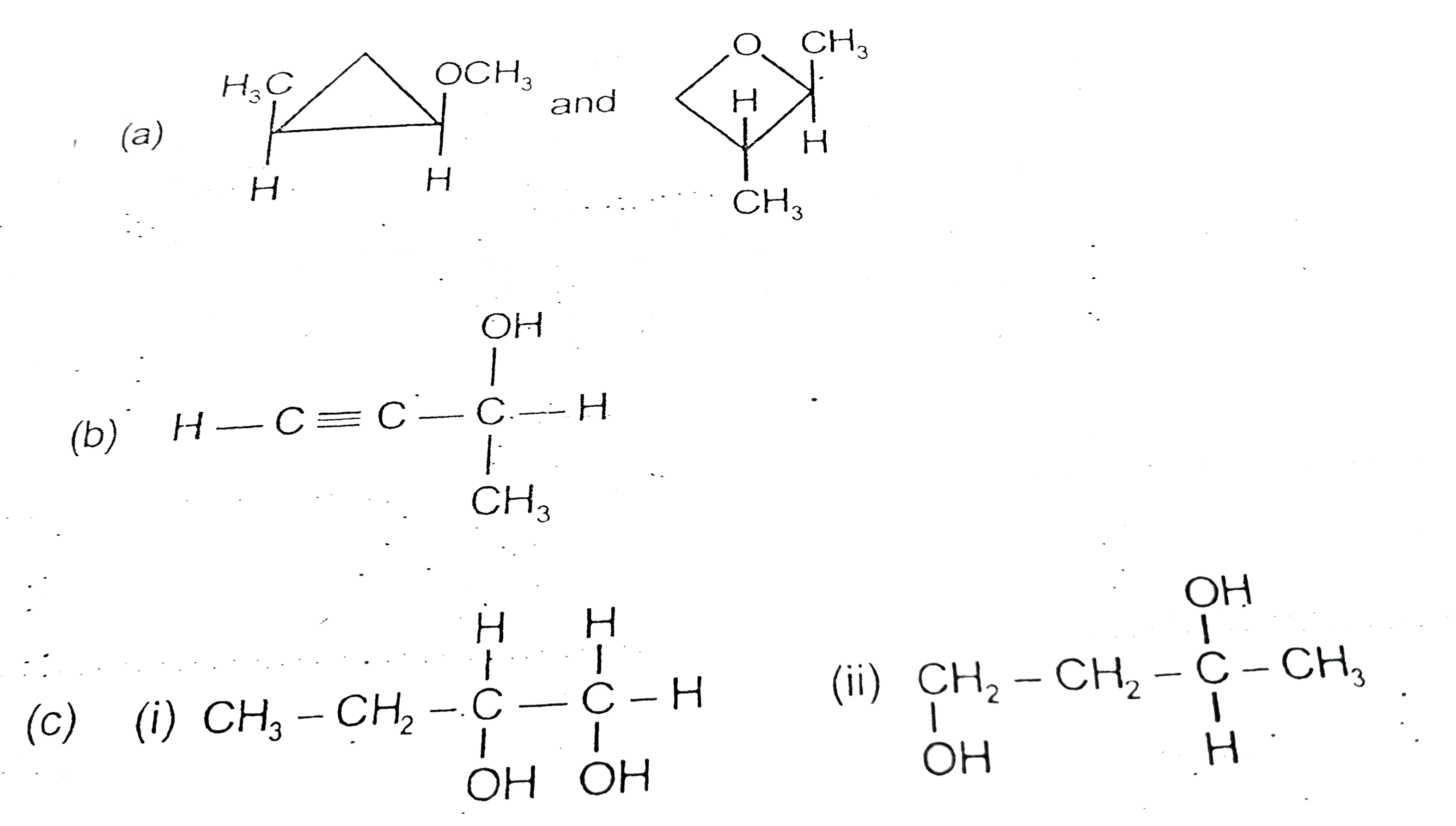
|
|
| 31. |
Give a suitable example of Hell-Volhard-Zelinsky reaction. |
|
Answer» <P> Solution :Caroxylic acids containing `alpha`-hydrogens on TREATMENT with `Cl_(2)` or `Br_(2)//`red P undergo Hell-Volhard-Zelinsky reaction to give `alpha`-haloacids. <BR> `underset("Propanoic acid")(CH_(3)CH_(2)COOH) overset(Br_(2)//"red P")to underset("2-Bromopropanoic acid")(CH_(3)CHBrCOOH) overset(Br_(2)//"red P")to underset("2,2-Dibromopropanoic acid")(CH_(3)CBr_(2)COOH)` |
|
| 32. |
Ga is below Al in the periodic table, but atomic radius of Ga is less than Al. It is because of |
|
Answer» Lanthanoid contraction |
|
| 33. |
Give a suitable example of acetylation. |
Answer» Solution :When ANILINE reacts with ACETYL chloride in presence of NaOH, we get ACETANILIDE. This process is called acetylation. 
|
|
| 34. |
Give a reason for the following : (i) Chloroacetic acid is more acidic than acetic acid. (ii) Cacboxylic acids have higher boiling points than alcohols. 4-nitrobenzoic acid is more acidic than 4- methoxybenzoic acid. |
|
Answer» Solution :(i) For ANSWER, consult SECTION 17. (ii) In CARBOXYLIC acids, the extent of intermolecular hydrogen bonding is more than in alcohols. That is why , boiling points are higher. For example, b-p. of `CH_(3)COOH` is 391K. While that of `CH_(3)CH_(2)OH` is 371 K. (iii) For answer, consult section 17. |
|
| 35. |
Gabrial synthesis is used for the preparation of |
|
Answer» `1^(@)` aromatic AMINES |
|
| 36. |
g of a ethane are confined in a bulb of one-litre capacity. The bulb is so weak that it will burst is the pressure exceeds 10 atm. At what temperature will the pressure of the gas each the bursting value ? |
|
Answer» Solution :pV = nRT pV `= ("WT. of "C_(2)H_(6))/("mol. Wt. of " C_(2)H_(6)).RT` `therefore T = (10 xx 1 xx 30)/(0.0821 xx 5)` = 730.81 K `= (730.81 - 273)^(@)C` `= 457.81^(@)C`. (R = 0.0821 lit. atm/K/mole) |
|
| 37. |
Give a reason to support that sulphuric acid is a dehydrating agent. A double salt which contains fourth period alkali metal (A) on heating at 500K gives (B). Aqueous solution of (B) gives white precipitate with BaCl_(2) and gives a red colour compound with alizarin. Identify A and B. |
|
Answer» SOLUTION :(i) A double salt which contains fourth period alkali metal (A) is potash a alum `"K"_(2)"SO"_(4)cdot"Al"_(2)(SO_(4))_(3)cdot24"H"_(2)O` (ii) On heating potash alum (A) 500 K give anhydrous potash alum (or) burnt alum (B). `underset((A))underset(("Potash alum"))("K"_(2)"SO"_(4)cdotAl_(2)(SO_(4))_(3)cdot24"H"_(2)"O")overset(500K)to underset((B))underset(("Burnt alum"))("K"_(2)"SO"_(4)cdotAl_(2))(SO_(4))_(3)+24H_(2)"O"` (iii) Aqueous solution of burnt alum, has sulphates ion, potassium ion and aluminium ion. SULPHATE ion reacts with `BaCl_(2)` to form white precipitate of Barium Sulphate: `(SO_(4))^(2-)+BaCl_(2)to BaSO_(4)+2CL^(-)` Aluminium ion reacts with ALIZARIN solution to give a red colour compound. |
|
| 39. |
Fusion mixutre is |
|
Answer» `Na_(2)CO_(3) + K_(2)CO_(3)` |
|
| 40. |
Give a reason to support that sulphuric acid is a dehydrating agent. |
|
Answer» Solution :Sulphuric acid is highly soluble in water and has STRONG affinity TOWARDS water and hence it can be used as a dehydrating agent. When dissolved in water it FORMS mono `(H_(2)SO_(4).H_(2)O)` and di `(H_(2)SO_(4).2H_(2)O)` hydrates and the reaction is exothermic. The dehydration property can also be illustrated by its reaction with organic compounds such as sugar, OXALIC acid and formic acid. `underset(("Sucrose"))(C_(12)H_(22)O_(11))+H_(2)SO_(4) rarr 12C+H_(2)SO_(4).11H_(2)O` `underset(("Formic acid"))(HCOOH)+H_(2)SO_(4) rarr CO+H_(2)SO_(4).H_(2)O` `underset(("Oxalic acid"))((COOH)_(2))+H_(2)SO_(4) rarr CO+CO_(2)+H_(2)SO_(4).H_(2)O` |
|
| 41. |
Fusion enthalpy of solid KCl is.... |
|
Answer» Not definite and not CHARACTERISTIC |
|
| 42. |
Give a reactionto show glucosemolecule contains . (i) Fivehydroxyl (-OH) groups. (ii) A terminal aldehydic group. |
|
Answer» Solution :(i) It REACTS with ACETYL CHLORIDE or acetic anhydride , to from a penta acetyl DERIVATIVE . (ii) With bromine water it given a carboxylic acid havingsame numberof carbon ATOMS as in glucose . OR Whenglucoseis heatedwith nitric acidit fromsdicarboxylicacidhavingsame numberof carbonatoms as in glucose . |
|
| 43. |
Give reason for chemical inertness of noble gases. |
| Answer» Solution :They have OCTATE electronic CONFIGURATION (ns?np) in the valence shell. | |
| 44. |
Fused AlF_3 and fused NaF are electrolysed in a series of cells with same quantity of charge. Which statements are correct ? |
|
Answer» Equal molar of Al and Na are formed d) Equal volumes of `F_2 ` gases are released |
|
| 45. |
Fusel oil is a mixture of : |
|
Answer» Alcohols |
|
| 46. |
Fuschin is , |
|
Answer» pink dye of para - ROSA -aniline hydrochloride |
|
| 47. |
Give a note on measurement of limiting molar conductivity of solution of weak electrolyte. |
|
Answer» Solution :* At infinite dilution (i.e., concentration `c to` zero) electrolyte dissociates completely `(alpha=1)`, but at such low concentration the CONDUCTIVITY of the solution is so low that it cannot be measured accurately. * Also, value of `Lamda_(m)^(@)` can.t be measured by extrapolation of graph of `Lamda_(m) to c^(1//2)`. * Therefore, `Lamda_(m)^(@)` for WEAK electrolytes is obtained by USING KOHLRAUSCH law of independent migration of ions. * `Lamda_(m)^(@)` value can be obtained on the basis of individual `lamda^(@)` value of individual ions. * Calculation of dissociation CONSTANT of electrolyte like Acetic acid can be obtained from the value of `Lamda_(m)^(@)` and obtained `Lamda_(m)` value. |
|
| 48. |
Give a reaction between nitric acid and a basic oxide. |
|
Answer» Solution :LIKE other acids it REACTS with BASES and basic oxides to form salts and WATER `ZnO + 2HNO_(3) rarr Zn(NO_(3))_(2)+H_(2)O` `3FeO+10HNO_(3) rarr 3FE(NO_(3))_(3)+NO+5H_(2)O` |
|
| 49. |
Give a mathematical expression that relates cell constant, specific conductance and specific resistance. |
|
Answer» Solution : `kappa=1/R.l/a=1/rho` Where `kappa` is SPECIFIC CONDUCTANCE `""` R is RESISTANCE and `l/a` is cellconstant. `""rho` is specific resistance. |
|
| 50. |
Give a note on effect on conductivity of solution when change in concentration of solution. |
|
Answer» Solution :* Both conductivity and molar conductivity change with the CONCENTRATION of the electrolyte. * Conductivity always decreases with decrease in the concentration, both for weak and strong electrolytes. * This can be explained by the fact that the number of IONS per UNIT volume that carry the current in a solution decreases on dilution. * The conductivity of a solution at any given concentration is the conductance of one-unit volume of solution kept between two platinum electrodes with unit area of cross section and at unit length. * conducitivyt of solution : Molar conductivity of a solution at a given concentration is the conductance of the volume V of solution containing one mole of electrolyte kept between two electrodes with area of cross section A and distance of unit length. * If conductivity area of conductivity=A, Distance between two Pt electrode=l, then `G=kappa((A)/(l))` But if A=1 and l=1, then `therefore G=kappa((1)/(1))` So G=`kappa`=conductivity of solution * Molar conductivity and volume of solution : At given concentration, two Pt electrode which have cross sectional area A and having unit length of volume, then the volume of solution between two Pt electrode which has 1 mol electrolyte, has conductivity `(Lamda_(m))`. `(Lamda_(m)=(kA)/(l))` If A=1 and l=1 then, `Lamda_(m)=kappa` If solution has l=1, A=V=1 mol electrolyte, then `Lamda_(m)kappaV` Molar conductivity of a solution at a given concentration is the conductance of the volume V of solution containing one mole of electrolyte kept between two electrodes with the area of cross section A and distance of unit length. * Effect on molar conductivity when change in concentration of solution: If the concentration of solution decreases, then volume of solution has 1 mol of electrolyte INCREASES and so molar conductivity increases. So, volume increases then concentration decreases. So molar conductivity `Lamda_(m) prop(1)/("Concentration of solution")` * Decrese in concentration of solution means dilution of solution and decrease in conductivity of SOLUTIO is more than that of the volume. * `Lamda_(m)` can be defined as the conductance of the electrolytic solution kept between the electrodes of a conductivity cell at unit distance but having area of cross section large enough to accommodate sufficient volume of solution that contains one mole of the electrolyte. * Limit molar conductivit : When molar conductivity of solution is about zero, then molar conductivity is known as limiting molar conductivity which is denoted by `Lamda_(m)^(@)`. The variation in `Lamda_(m)` with concentration is different for strong and weak electrolytes. |
|