Saved Bookmarks
This section includes 7 InterviewSolutions, each offering curated multiple-choice questions to sharpen your Current Affairs knowledge and support exam preparation. Choose a topic below to get started.
| 1. |
For the following cell Zn(s)|ZnSO_(4)(aq)||CuSO_(4)(aq)|Cu(s) when the concentration of Zn^(2+) is 10 times the concentration of Cu^(2+), the expression for DeltaG (in 1 mol^(-1)) is [F is faraday constant, R is gas constant, T is temperature, E^(@)(cell)=1.1V] |
|
Answer» `2.303RT+1.1F` `ZN+Cu^(2+)toZn^(2+)+Cu` `DELTAG=DeltaG^(@)+2.303RTlogQ` `=DeltaG^(@)+2.303RTlog([Zn^(2+)])/([Cu^(2+)])` `DeltaG^(@)=-nFE_(cell)^(@)=-2F(1.1)` `thereforeDeltaG=-2F(1.1)+2.303RTlog10` `=2.303RT-2.2F` |
|
| 2. |
For the following compounds, which is the strongest base and which the strongest acid ? |
|
Answer» II = strongest BASE, I = strongest acid |
|
| 3. |
For the following compounds, the correct statement(s) with respect to nucleophilic substitution reaction is(are) |
|
Answer» Compound IV undergoes inversion of configuration  Option (a) is correct as compound (iv) undergoes inversion of configuration. Option (c) is correct because both (I) and (III) can follows `S_(N^(2))` mechanism provided the medium is highly polar as well as protic. (d). Option (d) is also correct because both I & II can follows `S_(N^(2))` mechanism provided provided the medium is polar aprotic and nucleophile is STRONG. (b). Option (b) is not correct because the order of reactivity is not correct for `S_(N^(1))` and `S_(N^(2))` MECHANISMS. |
|
| 4. |
For the following cell Zn(s)|ZnSO_4 (aq) ||CuSO_4 (aq)|Cu(s) When [Zn^(2+)] is ten times of [Cu^(2+)] the expression Delta G( in J mol^-1) is |
|
Answer» 2.303 RT +1.1F `DELTA G=Delta G^@+2.303RT LOG""([Zn^(2+)])/([Cu^(2+)])` and `Delta G^@=-nFE^@=2 times 1.1F` find `Delta G (E_(CELL)^@=1.1V)]` |
|
| 5. |
For the following cell Zn//Zn^(2+) // Cd^(2+) // CdE_("cell") = 0.30V and E_("cell")^@ = 0.36V. Then the value of [Cd^(2+)]//[Zn^(2+)] is |
|
Answer» 10 |
|
| 6. |
Forthe followingcell reaction Ag|Ag^(+)|AgCI|CI^(-)|CI_(2) Pt triangle G_(f)^(@)(Ag^(+))=78 Kj // mol E^(@) of the cellis E^(@) ofthe cell is |
|
Answer» `-0.50 V` The cell reactionare as follows At ANODE `Ag rarr Ag^(+) +e^(-)` At cathode `AgCI+e^(-) rarr Ag(s) +CI^(-)` net cell reaction `AgCI rarr Ag^(+) +CI^(-)` `therefore triangle G_("reaction")^(@) = Sigma triangle G_(R )^(@)` `=(78-129 )-(-109)=+58 kJ // "mol"` `58xx10^(3) j=-1xx96500xxE_("cell")^(@)` `E_("cell")^(@)=(-58xx1000)/(96500)=-0.6 V` |
|
| 7. |
For the following cell reaction, Ag|Ag^(+)|AgCl|Cl^(Theta)|Cl_(2),Pt DeltaG_(f)^(o)(AgCl)=-109kJ//mol DeltaG_(f)^(o)(Cl^(Theta))=-129kJ//mol DeltaG_(f)^(o)(Ag^(+))=78kJ//mol E^(o) of the ell is:- |
|
Answer» `-0.60V` |
|
| 8. |
For the following cell reaction,Ag | Ag^(+) | AgCl | Cl^(-) | Cl_(2) , PtDelta G_(f)^(0) (AgCl) =-109 kJ//molDelta G_(f)^(0) (Cl ) = -129kJ//molDelta G_(f)^(0) (Ag^(+)) = 78 kJ//mol E^@ of the cell is |
|
Answer» `-0.60v` |
|
| 9. |
For the following acids the rate of decarboxylation on heating would be I. CH_(6)H_(5)-overset(O)overset(||)(C)-CH_(2)-COOH "" (II) C_(6)H_(5)-overset(O)overset(||)(C)-COOH III. CH_(3)-CH_(2)-COOH "" IV. HOOC-CH_(2)-COOH |
|
Answer» IIIgtIgtIVgtII |
|
| 10. |
For the following: (a) I^(-) (b) Cl^(-) (c) Br^(-) The increasing order of nucleophilicity would be |
|
Answer» `BR^(-) LT CL^(-) lt I^(-)` |
|
| 11. |
For the following Assertion and Reason the correct option is: Assertion: For hydrogenation reactions, the catalytic activity increases from Group 5 to Group 11 metals with maximum activity shown by Group 7-9 elements. Reason: The reactants are most strongly adsorbed on group 7-9 element |
|
Answer» Both assertion and reason are true and the reason is the correct explanation for the assertion. Group 7-9 elements exhibit maximum adsorption PROPERTY he reactants must get adsorbed REASONABLY strongly on to the CATALYST to become active. However, they must not get adsorbed so strongly that they are immobilized and other reactants are left with no space on the catalyst’s surface for adsorption.Hence, assertion is true but reason is false. |
|
| 12. |
For the following : (a) I^(-) (b) Cl^(-) (c ) Br^(-) the increasing order of nuclkeophilicity would be …… |
|
Answer» `BR^(-)LT CL^(-)lt I^(-)` |
|
| 13. |
For the fission reaction ._(92)U^(235) + ._(0)n^(1) rarr ._(56)Ba^(140) + ._(y)E^(x) + 2 ._(0)n^(1) The value of x and y will be |
|
Answer» `X = 93 and y = 34` |
|
| 14. |
For the folliwng reaction if equal mass of A and B are taken : A+2BrarrC Which of the following is/are correct? (M_(A) and M_(B) are molar masses of A and B respectively) |
|
Answer» If `M_(A)=2M_(B)`, then none of the reactant will be left. (A) `A+2BrarrC` `(100)/(200)(100)/(200)` `0.5 1` (B) If `M_(B)gt(M_(A))/(2)`, then B will be limiting. |
|
| 15. |
For the first row transition metals, the E^(@) values are {:(e^(@),V,Cr,Mn,Fe,Co,Ni,Cu),((M^(2+)//M),-1.18,-0.91,-1.18,-0.44,-0.28,-0.25,+0.34):} Explain the irregularity in the above values. |
| Answer» Solution :This is because `E^(@)` values are the sum of sublimation ENTHALPY , ionization enthalpy , hydration enthalpy etc. The irregularity is due to the IRREGULAR variation of ionization enthalpies `(IE_(1)+IE_(2))` and also the sublimation enthalpies which are RELATIVELY MUCH lower for Mn `( 240 kJ mol^(-1))` and `V ( 470 kJ mol^(-1))` | |
| 16. |
For the first row transition metals, the E^(@) values are {:(,E^(@),V,Cr,Mn,Fe,Co,Ni,Cu),(,(M^(2+)//M),-1.18,0.90,-1.18,-0.44,-0.28,-0.25,+0.34):} What is the reason for the non regularity in the above values? |
|
Answer» non regular variation of ionization enthalpies |
|
| 17. |
For the first order thermal decomposition reaction, the following data were obtained: C_(2)H_(5)Cl(g) to C_(2)H_(4)(g)+HCl(g) {:("Time/second","Total pressure/atm"),(""0,""0.30),(""300,""0.50):} Calculate the rate constant. [Given : log 2 = 0.301, log 3 = 0.4771, log 4 = 0.6021] |
|
Answer» Solution :Apply the relation for first order REACTION for gaseous state `K=(2.303)/(t)"LOG"(p_(i))/(2p_(i)-p_(t))` Substituting the values, we have `k=(2.303)/(300)"log"(0.3)/(0.6-0.5)=(2.303)/(300)log3=(2.303)/(300s)xx0.4771=0.0037s^(-1)` |
|
| 18. |
For the first order thermal decomposition reaction, following data was obtained: Calculate the rate constant. |
|
Answer» SOLUTION :For first THERMAL REACTION: `k= 2.303/t LOG (p_(i))/(2p_(i)-p_(t))` `t= 300s, p_(i) = 0.30 atm, p_(t) = 0.50 atm`. `k=2.303/t log (0.30)/(2 xx 0.30 -0.50) = 2.303/(300s)log(0.30)/(0.10)` `=2.303/(300s)log3 = (2.303)/(300s) xx 0.4771 = 0.0036 s^(-1)` |
|
| 19. |
For the first order reactions: |
|
Answer» the degree of DISSOCIATION is equal to `(1-e^(kt))` `k=1/tlog_(e)1/(1-infty)` or `kt = log_(e)1/(1-infty)` `=-log_(e)1(1-infty)` `e^(-kt) = (1-infty)` `therefore alpha=(1-e)^(-kt)` |
|
| 20. |
For the first order reaction. N_2O_5(g) rightarrow N_2O_4(g) + 1/2 O_2(g), the volume of O_2 produced is 15 mL and 40 mL after 8 minutes and at the end of the reaction respectively. The rate constant is equal to |
|
Answer» `1/8` in `80/50` |
|
| 21. |
For the first order reaction ,the time required for completion of 50% reaction is 100 seconds.The rate the constant will be….. |
|
Answer» `6.93xx10^(-3) " mol "^(2) " LIT "^(-2)s^(-1)` |
|
| 22. |
Forthe firstorderreactionwithhalf lifeis 150seconds ,thetimefortheconcentration of thereactant tofallfromm/ 10tom/100willbeapproximately |
|
Answer» 600 s ` thereforeT=~3xxt_(1//2)=~450 "to"600s` |
|
| 23. |
For the first order reaction , plot of log_(10)(a-x) against tine 't' is a straight line with slope equal to __________. |
|
Answer» `-2.303 K` |
|
| 24. |
For the first order reaction the half life period is (if k is rate constant and a is initial concentration ) : |
|
Answer» `(LN2)/(k)` |
|
| 25. |
For the first order reaction : H_(2)O_(2)(aq)rarrH_(2)O(l)+(1)/(2)O_(2)(g). the half life of reaction is 30 min. If the volume of O_(@)(g) collected at a certain pressure and temperature is 100 ml after a long time from the start of reaction, then what was the volume of O_(2)(g) collected at the same pressure and temperature, after 60 min from the start of reaction? |
| Answer» Answer :B | |
| 26. |
For the first order reaction given below select the set having correct statements 2N_(2)O_(5)(g) rarr 4NO_(2)(g) + O_(2)(g) (1) The concentration of the reactant decreases exponentially with time (2) the reaction proceeds to 99.6 % completion in eight half life duration (3) the half life of the reaction depends on the intial concentration of the reactant (4) the half life of the reaction decrease with increasing temperature |
|
Answer» 1,2 |
|
| 27. |
For the first order reaction, half-life is 14 s. The time required for the initial concentration to reduce to 1//8th of its value is |
|
Answer» 28 s |
|
| 28. |
For the first order reaction, calculate the ratio of the time taken to complete 99% of the reaction to the time taken to complete 90% of the reaction. |
|
Answer» `t_(99%) = (2.303)/k log (100)/1=2.303/k XX 2 = 4.606/k` `t_(90%) = (2.303)/k log 100/10 = 2.303/k xx 1=2.303/k` `t_(99%)/t_(90%)=4.606/2.303 = 2`. |
|
| 29. |
For the first order reaction Following observation is made:where V_(t) (in ml) is volume of N_(2) collected at time t and V_(oo) (in ml) is volume of N_(2) collected after a long time. what is the time taken (in minutes) for 75% reaction completion? (log 2 = 0.3) |
|
Answer» 2.5 |
|
| 30. |
For the first order reaction Ato product. When the concentration of A is 2.5xx10^(-2) M the activation energy is 20K. Cal/mole. If the conc. of [A] is doubled, at same temperature the activation energy becomes equal to |
|
Answer» 40K. cal/mole |
|
| 31. |
For the first order reaction, A(g) to B(g) + C(g) + D(s) taking place at constant pressure and temperature condition. Initially, volume of the container containing only A, was found to be 100 l and after time 13.86 minute. it was 150 l. Rateconstant for the reaction is (Use ln 2 = 0.693). |
|
Answer» `5xx10^(-2) "min"^(-1)` `{:(t=0,, a,-,-,-),(t ,,(a-x),x,x,-):}` `PV = nRT` `V prop n` (at const. P & T) `V_(0) prop a` `V_(t) prop (a+x)` `implies x prop (v_(t)-v_(0))` `K = 1/t 1n(V_0)/(2V_(0)-V_(t))` `=2/(13.86) 1n 100/(200-150)` `=1/20 min^(-1)`. |
|
| 32. |
For the first order reaction ArarrB+C , carried out at 27^(@)C if 3.8xx10^(-16)% of the reactant molecules exists in the activated state, the E_(a)(activation energy) of the reaction is : |
|
Answer» `12kJ//mol` |
|
| 33. |
For the first order reaction :A(g) to 2B(g) + C(g) the half life for the decomposition of Ais 3 min at300 K . Calculate the time (in min ) in which partialpressure of A(g) will drop from 2 bar to 0.5 bar at 400 K. Given activation energy of the reaction is 840 R. [Take : In 2=0.7] |
|
Answer» |
|
| 34. |
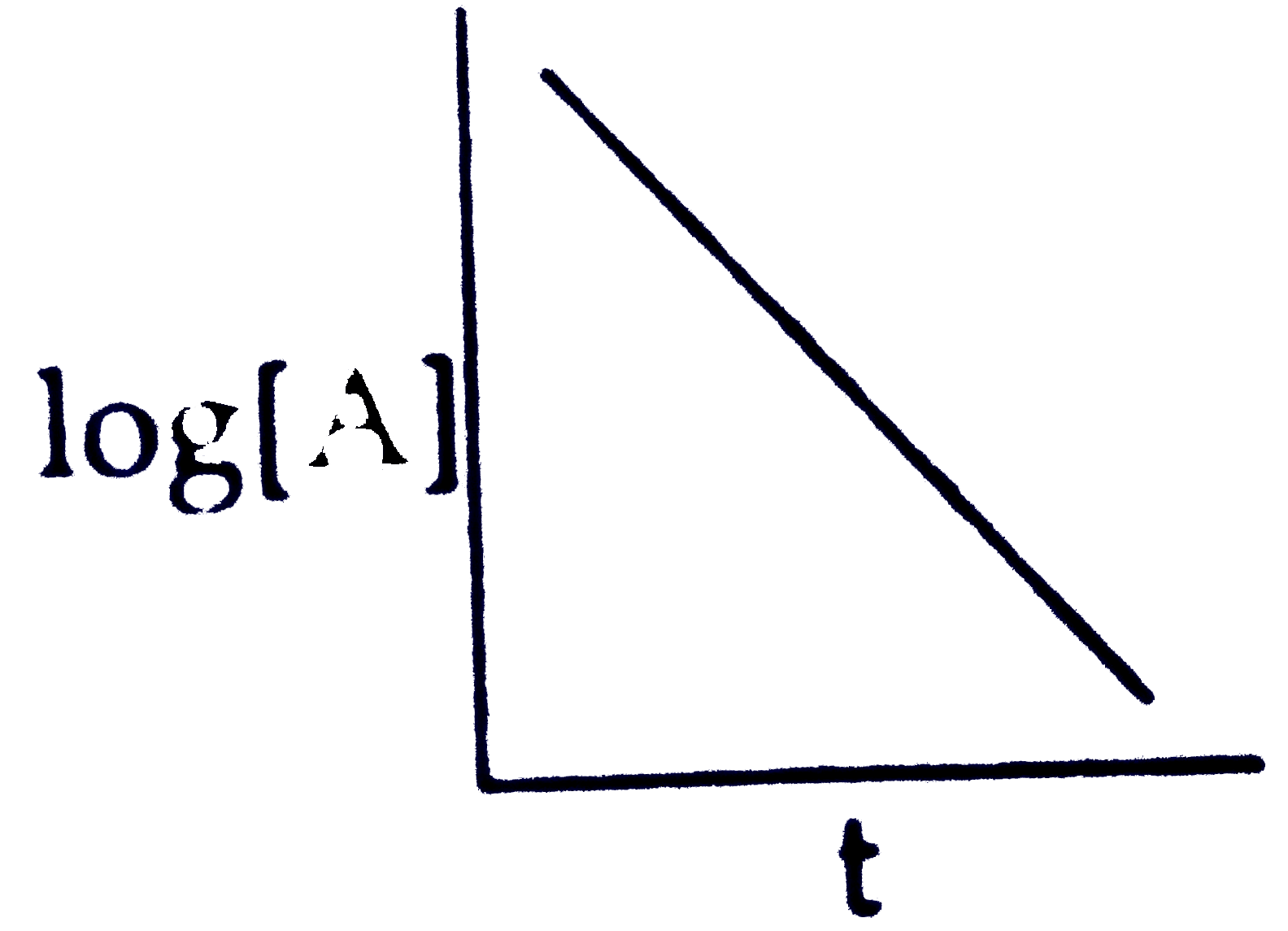
For the first order reaction A to Products, which one of the following is the correct plot of log[A] versus time? |
|
Answer»
|
|
| 35. |
For the first order reaction 2" N"_(2)"O"_(5)(g)to4" NO"_(2)(g)+O_(2)(g) |
|
Answer» the concentration of the reactant decreases EXPONENTIALLY with time `t_(1//2)=(0.693)/k` As k increases with increasingtempeature, therefore, `t_(1//2)` of a FIRST order reactionis INDEPENDENT of initial concentration. Amount left after 8 half - LIVES `=([A]_0)/(2^8)` `1/(256)"of"[A]_0=0.004"of"'[A]_0` `:." Amount reacted"=0.996" of "[A]_0," i.e," 99.6%" of"[A]_0`. Hence, (d) is correct. |
|
| 36. |
For the first order reaction: |
|
Answer» The concentration of reactants decreases exponentially with time a) For first order reaction, concentration of reactants decreases exponentially with time (True statement). `[A]=[A]_(0)e^(-kt)` ALSO `t_(1/2)= (0.693)/k` b) the `t_(1//2)` period decreases with increasing temperature because reaction rate generally increases with increase in temperature. (True statement) d) The reaction proceeds to `99.6%` completion in eight half life duration. (True statement). `k=(2.303)/(t_(99.6%)) log 100/0.4 = (2.303 log 250)/(t_(99.6%))` ..........(i) `k=0.693/t_(1//2)`...........(ii) Divide eqn. (i) to with (ii) `(2.303 xx 2.4)/(t_(99.6))= 0.693/t_(1//2)` `t_(99.6) = (2.303 xx 2.4)/(0.693) xx t_(1//2)` `=7.975 xx t_(1//2) ~~ 8 xx t_(1//2)`. Statement (C) is incorrect. |
|
| 37. |
For the first order reaction 2N_(2)O_(5(g))to4NO_(2(g))+O_(2(g)) |
|
Answer» the concentration of the reaction decreases exponentially with time `(0.3010xxt)/(t_(1//2))=log25+log10,(0.3010xxt)/(t_(1/2))=log5^(2)+log_(10)^(10)=2log_(10)^(5)+1` `=2xx0.6990+1=2xx0.7+1=1.4+1,(0.3010xxt)/(t_(1/2))=2.4,t=t_(1/2)xx2.4/0.3t_(1/2)=8xxt_(1//2)` |
|
| 38. |
For the first order decomposition reaction: 2N_(2)O_(5) (g) to 4NO_(2) (g) + O_(2) (g) Initiallythe total pressure is foundto be 650 torr and after a very long time total pressure is found to be 1550 torr. If after 4 minutes from the start of the reaction partialpressure of O_(2)= 100 torr , calculate half life of the decomposition in minutes. ["Given" : In 3= 1.1 "and" In 2= 0.7][Assume initially O_(2) is absent] |
|
Answer» |
|
| 39. |
For the first order reaction 2 N_(2)O_(5)(g) to 4 NO_(2) (g) + O_(2)(g) |
|
Answer» The concentration of the reaction DECREASES exponentially with time `t_(1//2) prop (1)/(K) , "" K UARR` on increasing T . After eight half-lives , `C = (C_(0))/(2^(8))` `implies` % completion = `(C_(0) - (C_(0))/(2^(8)))/(C_(0)) xx 100 = 99.6%`. |
|
| 40. |
For the first order gas phase decomposition reaction, A(g) to B(g) +C(g) if P_0 is the initial pressure of A and P_t is total pressure after time t, then |
|
Answer» `K = 2.303/t LOG (P_0)/(P_t)` |
|
| 41. |
For the first order reaction, |
|
Answer» the degee of dissociations is equal to `(1 - E^(-kt))` |
|
| 42. |
For the feasibility of a redox reaction in a cell, the e.m.f. should be |
|
Answer» POSITIVE `DeltaG^(o)=-nFE^(o)` Where n is the number of electrons INVOLVED, F is the value of faraday and `E^(o)` is the cell emf. `DeltaG^(o)` can be negative if `E^(o)` is positive. |
|
| 43. |
For the extraction of chromium from Cr_(2)O_(3) the process adopted is ___________ process. |
|
Answer» CARBON reduction |
|
| 44. |
For the expression: dG = Vdp - SdT, which of the following is correct? |
|
Answer» <P>`((delG)/(DELT))_(p)=V` |
|
| 45. |
For the exothermic reaction, A + B to C +D. Delta H is the heat of reaction and Ea is the activation energy. The activation energy for the formation of A + B will be |
|
Answer» `E_a` i.e. ACTIVATION energy for the FORMATION of A + B(`E_r` activation energy for reverse reaction) `=E_a + DeltaH` |
|
| 46. |
For the estimation of nitrogen, 1.4 g of an organic compound was digested by Kjeldahl method and the evolved ammonia was absorbed in 60 mL of (M)/(10) sulphuric acid. The unreacted acid required 20 mL of (M)/(10) sodium hydroxide of complete neutralization. The percentage of nitrogen in the compound is: |
|
Answer» `6%` let it contain `x m` mole of `N` atom. organic compound `rarr NH_(3)` `2NH_(3)+ underset("initial taken.")underset(6 "mmole")(H_(2)SO_(4)) rarr (NH_(4))_(2)SO_(4).(1st)` `H_(2)SO_(4)underset("reacted")underset("2 mmole")(+2NaPH) rarr Na_(2)SO_(4)+2H_(2) (2nd)` Hence `m` moles of `H_(2)SO_(4)` reacted in `2nd` equation `=1` `rArr m` moles of `H_(2)SO_(4)` reatced from `1st` equation `= 6-1 = 5m` moles `rArr m` moles of `NH_(3)` in `1st` equation `= 2 xx 5 = 10 m` moles `rArr m` moles of `N` atom in the organic compound `= 10 m` moles `rArr %` of `N = (0.14)/(1.4) xx 100 = 10%` |
|
| 47. |
For the estimation of nitrogen 1.4g of an organic compound was digested by Kjeldahl method and the evaloed ammonia was absorbed in 60mL of (M)/(10) sulphuric acid. The unreacted acid required 20mL of (M)/(10) sodium hydroxide for complete neutralisation . The percentage of nitrogen in the compound is |
|
Answer» `6%` `20ML` of `(M)/(10)NaOH=(20)/(2)mL` of `(M)/(10)` `H_(2)SO_(4)` `:.` Volume of `(M)/(10)H_(2)SO_(4)` used for neutralisation of `NH_(3)=60-10=50mL` |
|
| 48. |
For the estimation of nitrogen, 1.4 g of an organic compound was diagesed by Kjeldahl method and the evolved ammonia was absorbed in 60 mL of M/10 sulphuric acid. The unreacted acid required 20 mL of M/10 sodium hydroxide for complex neutralization. The percentage of nitrogen in the compound is |
|
Answer» `6%` let it CONTAIN X m mole of N atom. `" Oraganic compund " RARR underset(" X m mole")(NH_(5))` `2NH_(3) + underset(" intitally taken") underset(6m " mole")(H_(2)SO_(4)) rarr(NH_(4))_(2)SO_(4)(1st)` `underset("REACTED")underset(" 2 m mole")(H_(2)SO_(4) + 2 NaOH) rarr Na_(2)SO_(4)+2H_(2)O(2nd)` Hence m moles of `H_(2)SO_(4)` reacted in 2nd EQUATION = 1 `rArr ` m moles of `H_(2)SO_(4)` reacted from 1st equation `= 6- 1= 5 m` moles `rArr ` m moles of `NH_(3)` in 1st equation `= 2 xx 5 = 10 m` moles `rArr m` moles of N atom in the organic compound `= 10m` moles `rArr` mass of `N = 10 xx 10^(-3) xx 14 = 0.14 g` `rArr %` of `N = (0.4)/(1.4) xx 100 = 10%` |
|
| 49. |
For the estimation of N, 1.4g of an organic compound was digested by Kjeldahl method and the evolved ammonia was absorbed in 60mL of (M)/(10)H_(2)SO_(4). The unreacted acid required 20mL of (M)/(10) NaOH for complete neutralisation. The percentage of N in the compound is |
|
Answer» 0.06 |
|
| 50. |
For the estimation of potassium permangnate using standard ferrous ammonium sulphate solution: (i) Write the chemical equation for the reaction involved. (ii) Write the equivalent mass of potassium permanganate. (iii) Name the indicator used. (iv) Mention the colour change at the end point. |
|
Answer» SOLUTION :(i)`K_2Cr_2O_7 + 4H_2SO_4 to K_2SO_4 + Cr_2(SO_4)_(3) + 4H_2O xx 32` OR `K_2Cr_2O_7 + 6FeSO_4 + 7H_2SO_4 to K_2SO_4 + Cr_2(SO_4)_(3) + 3Fe_(2)(SO_4)_(3) + 7H_2O` (ii)392 (III) DIPHENYLAMINE (iv) Green to violet. |
|