Saved Bookmarks
This section includes 7 InterviewSolutions, each offering curated multiple-choice questions to sharpen your Current Affairs knowledge and support exam preparation. Choose a topic below to get started.
| 1. |
For the galvanic cell : Pt(s) abs(Fe^(2+), Fe^(2+) ) abs(Fe^(2+))Fecell reaction will be : |
|
Answer» `3FE^(2+) + FE(s)rarr 2Fe^(3+)` |
|
| 2. |
For the galvanic cell: Fe(s) | Fe^(3+) (0.02M) || Cu^(2+) (0.1 M)| Cu(s) The E.M.F of cell at 298 K is 0.404 V. The value of DeltaG^(@), (in kJ) for the cell reaction per mole of Fe(S) reacted at 298 K is [(2.303 xx R xx 298)/(96500) = 0.06, 1F = 96500 C] (log 2=0.3) |
|
Answer» |
|
| 3. |
For the Galvanic cell, Ag|AgCl(s) |KCl (0.2 M)|| KBr (0.001 M) |AgBr(s) |Ag Calculate the emf generated and assign correct polarity to each electrode for a spontaneous process after taking into account the cell at 25^(@) C. Given K_(sp)(AgCl) = 2.8 xx 10^(-10), K_(sp)(AgBr) = 3.3 xx 10^(-13) |
|
Answer» Solution :`AgCl `AGBR `[Ag^(+)]_(LHS) = (K_(sp)(AgBr))/[Br^(-)] = (3.3 xx 10^(-13))/(0.001) = 3.3 xx 10^(-10)` M `{:("Cell", "Cell Reaction", E^(@)),(LHS,Ag to Ag^(+)+e^(-),E_(Ag//Ag^(+))^(@) =xv),(RHS, Ag^(+) + e^(-) to Ag, E_(Ag^(+)//Ag)=-E_(Ag//Ag^(+))^(@) =-xV):}` `K= ([Ag^(+)]_(LHS))/([Ag^(+)]_(RHS))` `E_("cell") = E_("cell"^(@)) -(0.0591)/N log K = 0-(0.0591)/1 log (1.4 xx 10^(-9))/(3.3 xx 10^(-10)) = -0.0371` V To make `E_("cell")` POSITIVE, LHS cell should be cathode (+ve half cell). |
|
| 4. |
For the galvanic cellAg | AgCl (s), KCl(0.2 M)||KBr(0.001 M), AgBr(s)|Ag,calculate the emf generated and assign correct polarity to each electrode for a spontaneous process after taking into account the cell reaction at 25^@C.K_(sp)(AgCl) = 1.8 xx 10^(-10), K_(sp)(AgBr) = 3.3 xx10^(-13) |
|
Answer» SOLUTION :Calculate `[AG^+]` from `K_(sp)`values for both the HALF cells and then calculate `E_("cell") ` for `Ag|Ag^(+) (c_1) | Ag^(+) (c_2) | Ag ` 0.037V |
|
| 5. |
Compare the stability of + 2 oxidation state of the elements of the first transition series. |
|
Answer» `Mn gt Fe gt CR gt CO` |
|
| 6. |
For the four successive transition elements [Cr, Mn, Fe and CO) the stablility of +2 oxidation states will be there in which of the following order ? |
|
Answer» `Mn GT FE gt Cr gt CO` |
|
| 7. |
For the four successive transition elements (Cr, Mn, Fe and Co) ,the stability of +2 oxidation state will be there in which of the following order ? |
|
Answer» `Cr gt Mn gt Co gt Fe` |
|
| 8. |
For the formation of SO_3 in the following reaction, it is given that 2SO_2 + O_2 to 2SO_3 "" E_a= Activation energy SO_2 + 1//2O_2 to SO_3 ""E'_a = Activation energy |
|
Answer» `E_a GT E_a^1` |
|
| 9. |
For the formation of NH_3 from N_2 and H_2,(triangleE-triangleH) is : |
|
Answer» RT |
|
| 10. |
For the formation of covalent bond, the difference in the value of electronegativities should be |
|
Answer» EQUAL to or LESS than `1.7` |
|
| 11. |
For the formation of 3.65 g of hydrogen chloride gas, what volumes of hydrogen gas and chlorine gas are required at N.T.P. conditions? |
|
Answer» 1.12 lit, 1.12 lit `therefore" For FORMATION of 3.65 g HCl, "H_(2) or Cl_(2)" required"` `=(22.4)/(2xx36.5)xx3.65L=1.12L` |
|
| 12. |
For the formation of 3.65 g of hydrogen chloride gas, what volumes of hydrogen and chlorine gas are required at N.T.P conditions ? |
|
Answer» 1.12 L, 1.12 L To obtained `2 xx 36.5 g ` of HCL `H_2` REQUIRED at NTP = 22.4 L To obtained 3.65 g of HCl `H_2` required at NTP ` = (22.4 xx 3.65)/(2 xx 36.5) = 1.12 L` `Cl_2 ` required= 1.12L (same) |
|
| 13. |
For the formation of 3.65 g of hydrogen chloride gas, what volume of hydrogen and chlorine gas are required to N.T.P. conditions? |
|
Answer» 1.12L, 1.12L To prepare `2xx36.5 g` of HCL, `H_(2)` and `Cl_(2)` REQUIRED at N.T.P. are 22.4 L each `:.` To prepare 3.65 g of HCl, `H_(2)` and `Cl_(2)` required at N.T.P. are `= (22.4)/(2xx36.5)xx3.65` `=1.12L` Thus, 1.12 L of `H_(2)` and 1.12 L of `CL_(2)` are required |
|
| 14. |
For the following type of revrsible reaction N_(2) O_(4(g))hArr 2NO_(2(g)) |
|
Answer» EQUILIBRIUM is possible only in a closed SYSTEM at a given TEMPERATURE |
|
| 15. |
For the foramation of NH_(3) using Haber's process, identify the correct statement. |
|
Answer» Both yield of the reaction as well as rate of ammonia formation will be more at HIGH temperature. |
|
| 16. |
For the following three reaction (i), (ii) and (iii), equilibrium constants are given (i) CO_((g))+H_(2)O_((g))iffCO_(2(g))+H_(2(g)),K_(1) (ii) CH_(4(g))+H_(2)O_((g))iffCO_((g))+3H_(2(g)),K_(2) (iii) CH_(4(g))+2H_(2)O_((g))iffCO_(2(g))+4H_(2(g)),K_(3) Which of the following relations is correct? |
|
Answer» `K_(3)K_(2)^(3)=K_(1)^(2)` `K_(1)=([CO_(2)][H_(2)])/([CO][H_(2)O])""...(i)` `CH_(4(g))+H_(2)O_((g))iffCO_((g))+3H_(2(g))` `K_(2)=([CO][H_(2)]^(3))/([CH_(4)][H_(2)O])""...(ii)` `CH_(4(g))+2H_(2)O_((g))iffCO_(2(g))+4H_(2(g))` `K_(3)=([CO_(2)][H_(2)]^(4))/([CH_(4)][H_(2)O]^(2))""...(iii)` From EQUATIONS (i), (ii) and (iii) , `K_(3)=K_(1)xxK_(2)` |
|
| 17. |
For the following three reaction a, b and c, equilibrium constants are given : (i) CO(g) * H_(2)O_(g) hArr CO_(2)(g) * H_(2)(g), K_(1) (ii) CH_(4)(g) * H_(2)O(g) hArr CO(g) * 3H_(2)(g), K_(2) (iii) CH_(4)(g)+2H_(2)O(g) hArr CO_(2)(g)+4H_(2)(g), K_(3) |
|
Answer» `K_(1)sqrt(K_(2))=K_(3)` Hence (c ) is the CORRECT answer. |
|
| 18. |
For the following reactions: (A). CH_(3)CH_(2)CH_(2)Br+KOHoverset((alc))toCH_(3)CH=CH_(2)+KBr+H_(2)O (B). Which of the following statements is correct? |
|
Answer» (A) is ELIMINATION, (B) and (C) are substitution reactions. |
|
| 19. |
For the followingreactions. .A overset( 600K)to " Product"A underset( " catalyst") overset( 400K) to " Product"It was found that the E_ais decreased by 40kJ / mol in the presence of catalyst. If the rateremains uncharged the activations energyfor catalyzed reactions is [Assume per exponnetial factor is same:] |
|
Answer» 105 kJ/ mol |
|
| 20. |
For the following reactions The correct decreasing order of enthalpy of formation of carbocation is |
|
Answer» `DeltaH_1 GT DeltaH_2 gt DeltaH_3 gt DeltaH_4` |
|
| 21. |
For the following reactions A. CH_3CH_2CH_2Br + KOH rarr CH_3CH = CH_2 + KBr + H_2O Which of the following statements is correct? |
|
Answer» A is elimination, B and C are substitution reactions |
|
| 22. |
For the following reaction occuring in dilute aqueous solution at 298K. [Ni(H_(2)O)_(6)]^(2+) +2NH_(3) hArr [Ni(NH_(3))_(2)(H_(2)O)_(4)]^(2+)+2H_(2)O ""…….(i) In K_(c)=11.60 and DeltaH^(@)=-33.5 KJ"mol"^(-1) [Ni(H_(2)O)_(6)]^(2+) +en hArr[NI(en)(H_(2)O)_(4)]^(2+) + 2H_(2)O "".......(ii) InK_(c) =17.78and DeltaH^(@)=-37.2 KJ "mol"^(-1) Note : en is ethylenediamine (a neutral bidentate ligand) (R=8.314510 JK-1 "mol"^(-1)=0.0820584 L atm K_(1)"mol"^(-1)) Calculate the value of DeltaG^(@), DeltaS^(@) and DeltaS^(@) . at 298 K for reaction(iii) occuring in a dilute equeous solution: [Ni(NH_(3))_(2) (H_(2)O)_(4)]^(2+)+ en hArr [Ni(en) (H_(2)O)_(4)]^(2+) + 2NH_(3) ""........(iii) |
|
Answer» |
|
| 23. |
For the following reaction, the moles ofrequired to produce 990 gm H_2O are __________. 2C_(57)H_(110)O_(6) + 163O_(2)(g) to 114CO_(2)(g) + 110 H_(2)O(l) |
|
Answer» MOLE of` C_(57)H_(110)O_(6)=(2)/(110)xx "moles of "H_(2)O` |
|
| 24. |
For the following reaction, the mass of water produced from 445 g of C_(57)H_(110)O_(6) is : 2C_(57)H_(110)O_(6)(s) + 163O_(2)(g) to 114CO_(2)(g) + 110 H_(2)O(l) |
| Answer» ANSWER :A | |
| 25. |
For the following reaction : N_(2)O_(5)(g)+O_(2)(g)overset(40%)rarr2NO_(2)(g)+O_(3)(g) NO_(2)(g)+O_(2)(g)overset(50%)rarrNO(g)+O_(3)(g) If initially 20 moles of N_(2)O_(5) and 30 moles of O_(2) are taken then calculate sum of moles of O_(2) and O_(3) after the reaction. |
|
Answer» 16 `NO_(2)(g)+O_(2)(g)overset(50%)rarrNO(g)+O_(3)(g)` For `1^(st)` reaction: `N_(2)O_(5)(LR) ` `n_(N_(2)O_(5))/(1)xx0.4=n_(O_(3))=n_(O_(3))` FORMED `=n_(NO_(2))` formed/2 mole 16 22 `n_(NO_(2))+0.5=n_(O_(3))` formed `=16xx0.5=8` mole `n_(O_(2))` used `=n_(NO_(2))` used `=16xx0.5=8` mole `n_(O_(3))` total form =8+8=16 `n_(O_(2))+n_(O_(3))` after reaction =14+16=30 |
|
| 26. |
For the following reaction R - CN overset(H_(3)O^(+)) to R-COOH |
|
Answer» there is protonation of electronegative NITROGEN |
|
| 27. |
For the following reaction: Initial concentration: overset(10"mol"//L)(2A)+overset(2"mol"//L)(B)to"product" t_(1//2) of the overall reaction is the time when |
|
Answer» HALF of A CHANGES to product |
|
| 28. |
From the rate expression for the following reactions, determine their order of reaction and the dimensions of the rate constants. H_(2)O_(2(aq))+3I_((aq))^(-)+2H^(+)rarr 2H_(2)O_((l))+I_(3)^(-)" Rate" = K[H_(2)O_(2)][I^(-)] |
|
Answer» `"2, L MOL"^(-1)s^(-1)` |
|
| 29. |
For the following reaction in gaseous phase CO(g)+1/2O_(2) rarr CO_(2) K_(P)/K_(c) is |
|
Answer» <P>`(RT)^(1//2)` `Deltan_(g)=1-1.5=-0.5` `K_(p)=K_(c)[RT]^(1//2)THEREFORE(K_(p))/(K_(c))=[RT]^(-1//2)` |
|
| 30. |
For the following rate law determine the unit of rate constant. Rate k[A]^((1)/(2))[B]^(2)=[R]^((5)/(2)) |
|
Answer» Solution :The total order of reaction `n = 1/2 + 2 = 5/2 = 2.5 ` Rate `K[A]^(1/2) [B]^(2)= [R]^(5/2)` `therefore k=(Rate)/([5]^((5)/(2)))` `therefore` UNIT of k=`("unit of rate")/(("unit of concentration")^((5)/(2)))` `=((mol L^(-1))^(1)s^(-1))/((mol L^(-1))^((5)/(2)))` `(mol L^(-1))^(-(3)/(2))s^(-1)` `=(mol)^(-(3)/(2))(L^(-1))^(-(3)/(2))S^(-1)` `=(mol)^(+(3)/(2))(L)^(-(3)/(2))S^(-1)` If the order of reaction =`(5)/(2)` then unit of rate CONSTANT k is `L^((+3)/(2)) mol^((-3)/(2))s^(-1)` |
|
| 31. |
For the following question, enter the correct numerical value, (in decimal-notation, truncated/rounded-off to the second decimal place, e.g., 6.25, 7.00, - 0.33, 30.27, - 127.30) using the mouse and the onscreen virtual numeric keypad in the place designated to enter the answer. The ammonia prepared by treating ammonium sulphate with calcium hydroxide is completely used by NiCl_(2).6H_(2)O to form a stable coordination compound. Assume that both the reactions are 100% complete. If 1584 g of ammonium sulphate and 952 g of NiCl_(2).6H_(2)O are used in the preparation, the combined weight (in grams) of gypsum and the nickel-ammonia coordination compound thus produced is ........... (Atomic weights in g mol^(-1): H = a, N = 14, O = 16, S = 32, Cl = 35.5, Ca = 40, Ni = 59) |
|
Answer» `{:("Mass of CaSO"_(4).2H_(2)O" (gypsum)"=12xx172g=2064g,"(Molecular mass of "CaSO_(4).2H_(2)=172")"),("Mass of "[Ni(NH_(3))_(6)]Cl_(2)=4xx232g=928g,"(Molecular mass of "[Ni(NH_(3))_(6)]Cl_(2)=232")"),("combined weight (in G) "=2064+928=2992,):}` |
|
| 32. |
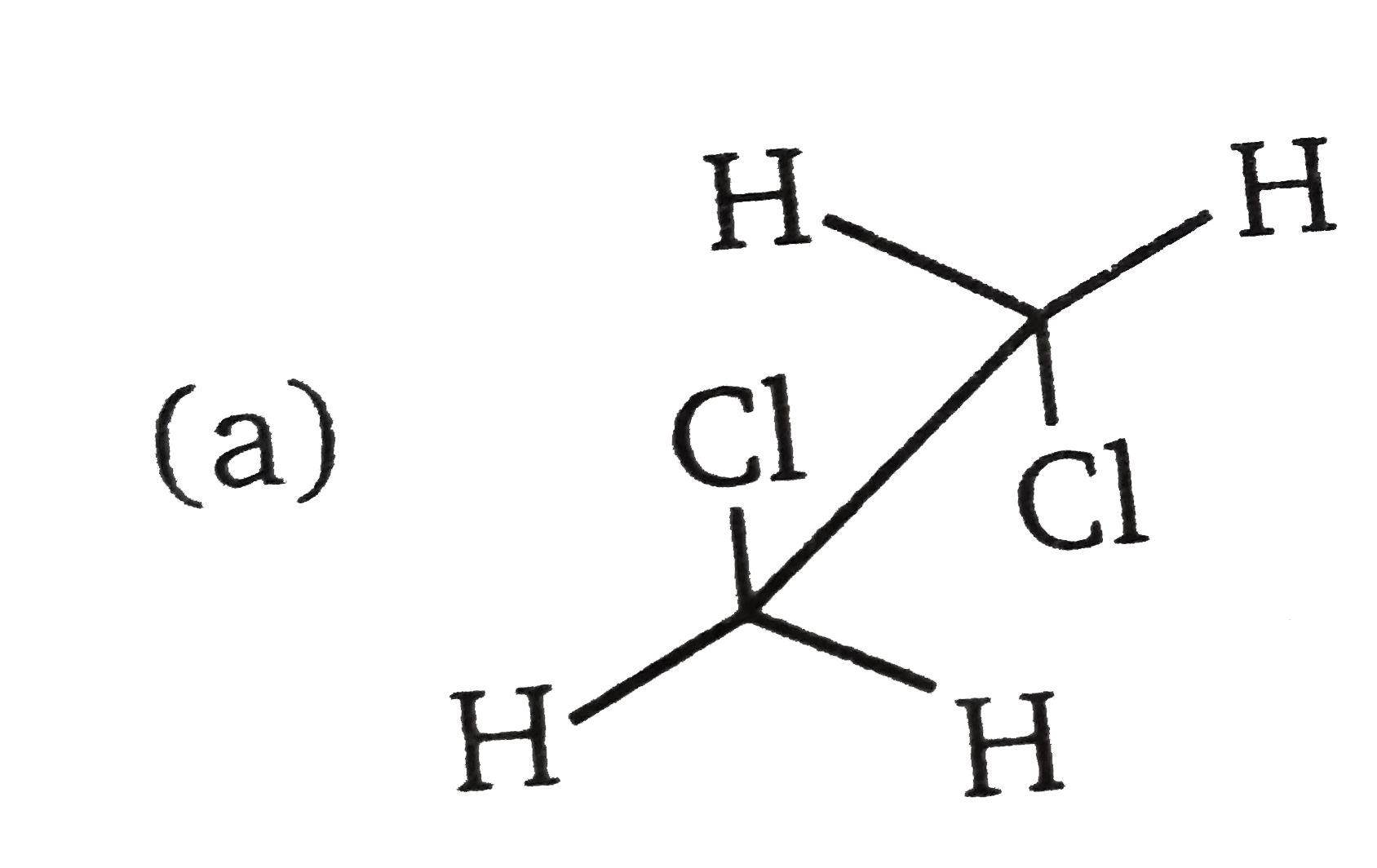
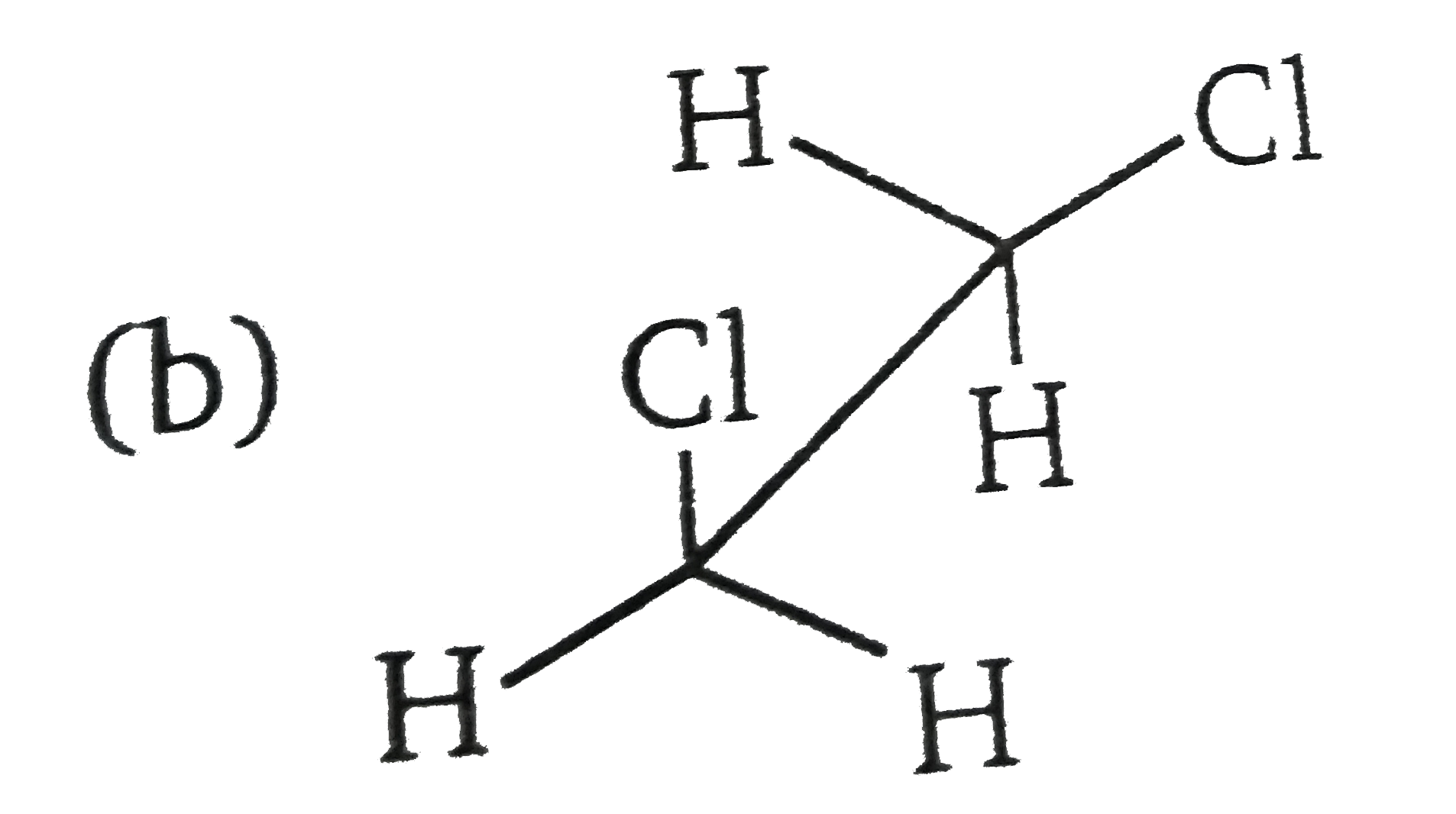
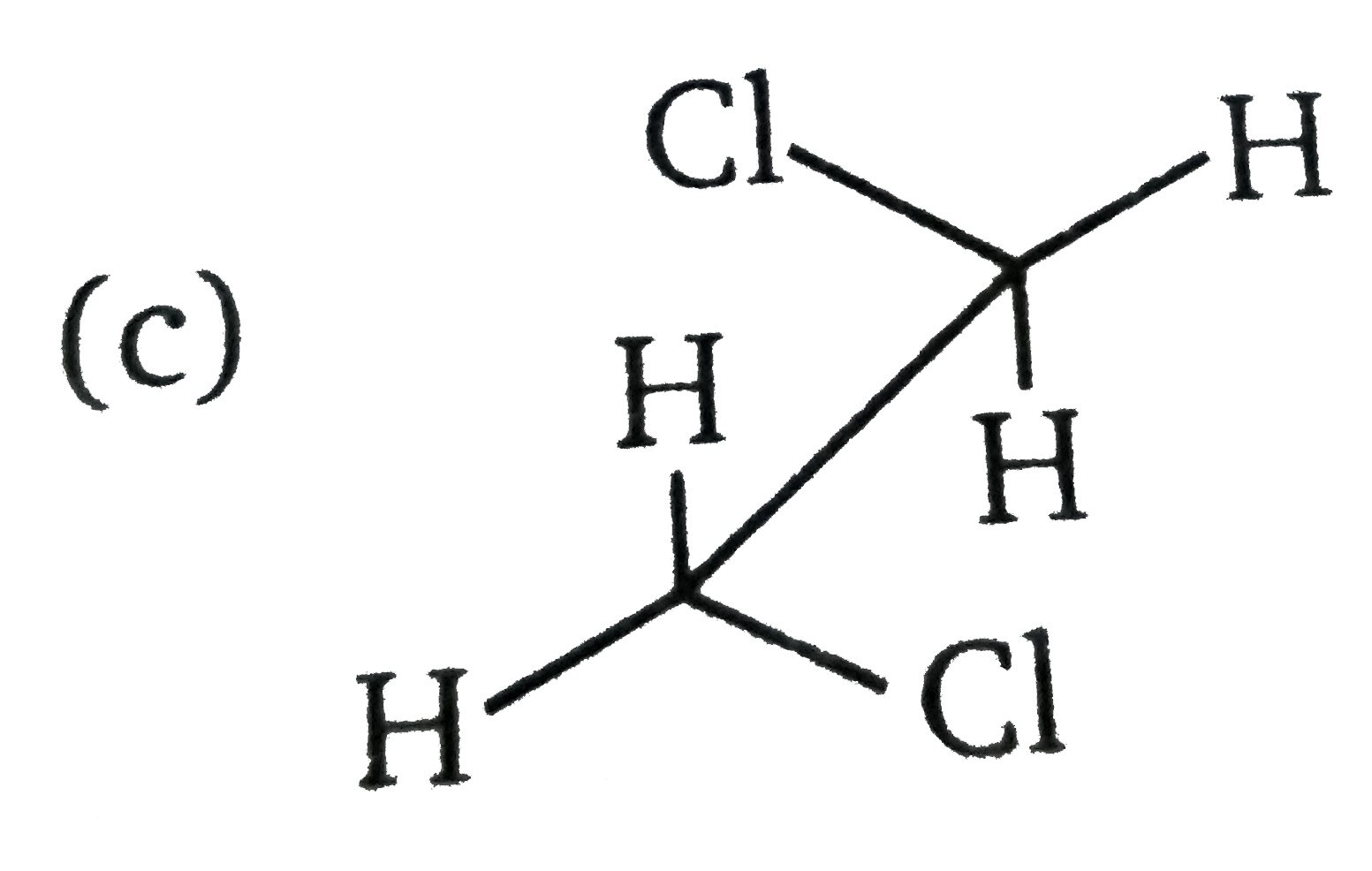
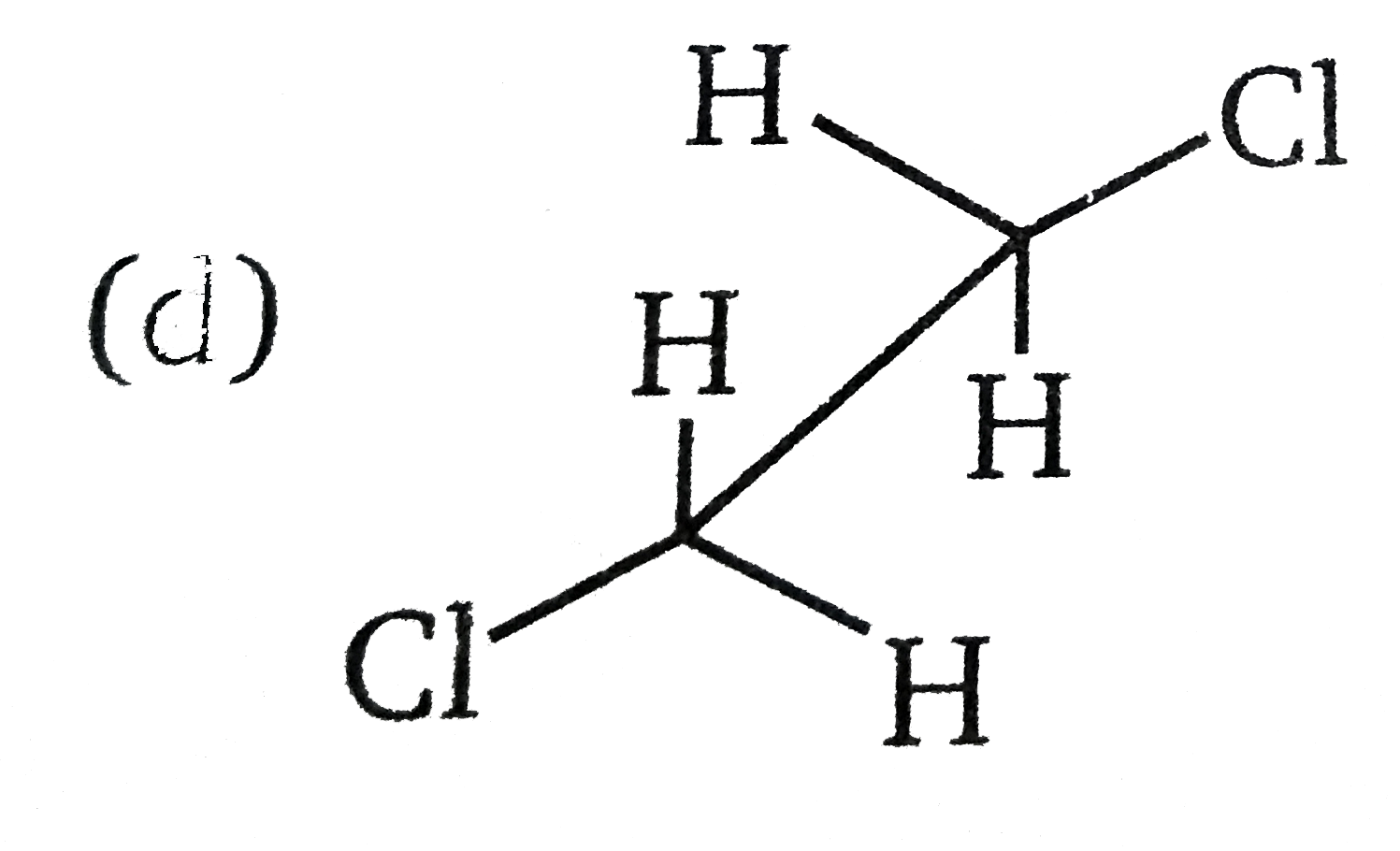
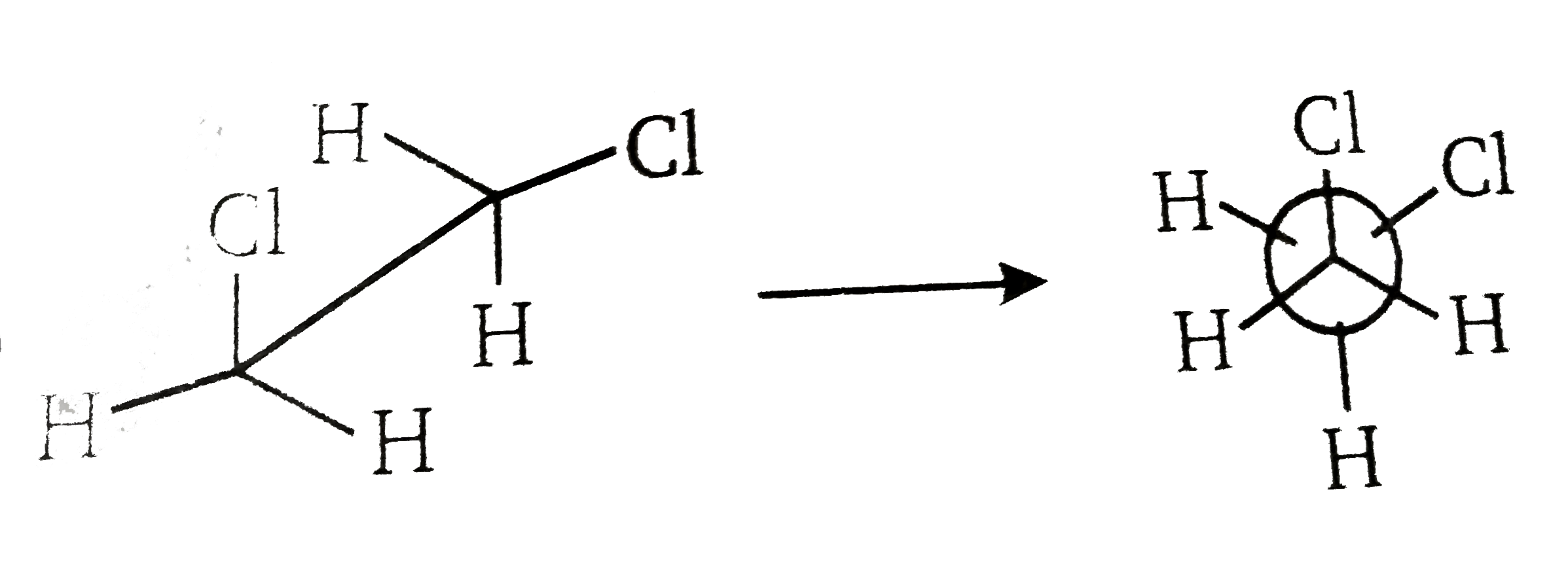
For the following Newman projection |
|
Answer»
|
|
| 33. |
For the following homogeneous gas reaction 4NH_(3)+5O_(2)hArr 4NO+6H_(2)O, the equilibrium constant k_(c) has the dimension of |
|
Answer» CONC `""^*+(10)` |
|
| 34. |
For the following : I^(-), Cl^(-), Br^(-), the increasing order of nucleophilicity would be : |
|
Answer» `CL^(-)ltBr^(-)LTI^(-)` |
|
| 35. |
From the following graph, identify order of reaction and mention the unit of its rate constant. |
Answer» SOLUTION :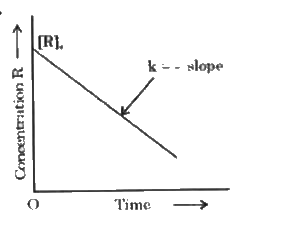 It is a FIRST ORDER REACTION and its UNIT of rate constant is `s^(-1)` |
|
| 36. |
For the following gaseous fraction H_(2)+I_(2)hArr2HI, the equlibrium constant |
|
Answer» <P>`K_(p)gtK_(C)` |
|
| 37. |
For the following gases equilibrium, N_(2)O_(4) (g)hArr2N_(2) (g), K_(p) is found to be equal to K_(c). This is attained when: |
| Answer» Answer :D | |
| 38. |
For the following flow diagram : Which of the following option describes the reagents, products and the reaction conditions given in parentheses as small alphabets ? |
Answer» 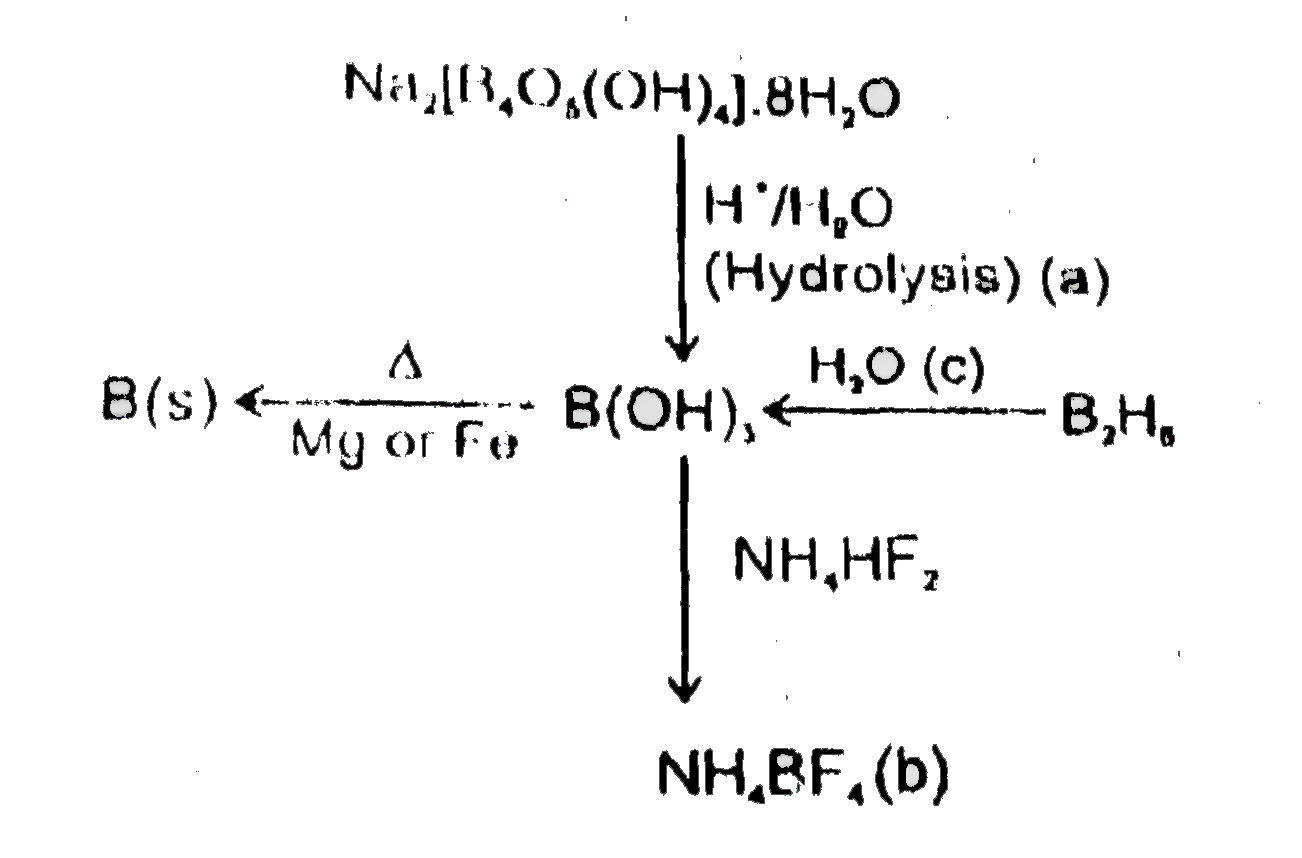
|
|
| 39. |
For the following equilibrium reaction , N_2O_4(g) hArr 2NO_2(g) NO_2 is 50% of total volume at given temperature . Hence vapour density of the equilibrium mixture is |
|
Answer» 34.5 |
|
| 40. |
For the following equilibrium in a closed rigid vessel A(g)hArrB(g)+C(g) D(g)hArrE(g)+B(g) If some E(g) is introduced into the vessel, then at the new equilibrium. |
|
Answer» [A] increaes |
|
| 41. |
For the following electrochemical cell at 298 K Pt(s)|H_(2),(g,1" bar")|H^(+)(aq,1M)||M^(4+)(aq)|M^(2+)(aq)|Pt(s) E_(cell)=0.092V when ([M^(2+)(aq)])/([M^(4+)(aq)])=10^(x) Given E_(M^(4+)//M^(2+))^(@)=0.151V,2.303(RT)/(F)=0.059V the value of x is |
|
Answer» `-2` At anode: `H_(2)(g)to2H^(+)(aq)+2E^(-)` `underline("At cathode:"M^(4+)(aq)+2e^(-)TOM^(2+)(aq))` Overall reaction: `H_(2)(g)+M^(4+)(aq)toM^(2+)(aq)+2H^(+)(aq)` `E_(cell)=E_(cell)^(@)-(0.059)/(2)"LOG"([M^(2+)][H^(+)]^(2))/([M^(4+)])` `E_(cell)^(@)-E_(M^(4+)//M^(2+))^(@)-E_(H^(+)//H_(2))^(@)` `=0.151-0=0.151V` `therefore0.092=0.151-(0.059)/(2)log(10^(x)xx1^(2))` or `0.092=0.151-0.0295log10^(x)` or `0.0295log10^(x)=0.151-0.092=0.059` or `log10^(x)=(0.059)/(0.0295)=2` `therefore10^(x)`=Antilog `2=10^(2)thereforex=2` |
|
| 42. |
For the following elementary step (CH_(3))_(3)CHr_((aq))to(CH_(3))C_((aq))^(+)+Br_((aq))^(-) the molecularity is |
| Answer» Answer :B | |
| 43. |
For the following elecrochemical cell at 298K Pt(s)|H_(2)(g,1"bar")|H^(+)(aq,1M)||M^(4+)(aq),M^(2+)(aq)|Pt(s) E_(cell)=0.092V when ([M^(2+)(aq)])/([M^(4+)(aq)])=10^(x) Given: E_(M^(4+)//M^(2+))^(0)=0.151V,2.303(RT)/(F)=0.059V the value of x is |
|
Answer» `-2` `underline("Cathode:"M^(4+)+2ehArrM^(2+))` Net CELL reaction: `H_(2)+M^(4+)hArr2H^(+)+M^(2+)` `E_(cell)=E_(cell)^(0)-(0.059)/(2)"log"([H^(+)]^(2)[M^(2+)])/([M^(4+)]xxP_(H_(2)))` `0.092=0.151-(0.059)/(2)log10^(X)` `0.092=0.151-(0.059)/(2)x` `(0.059x)/(2)=0.151-0.092` `0.059x=0.059xx2impliesx=2`. |
|
| 44. |
For the following data answer the questions : Reaction : A+B to P The value of rate constant at 300 K is (M^(-2) sec^(-1)): |
|
Answer» `2.667xx10^(8)` |
|
| 45. |
For the following disproportionation reaction 5Br_(2)+6PH^(-) to 5Br^(-)+BrO_(3)^(-)+3H_(2)O correct statements are : |
|
Answer» EQUIVALENT weigt of `Br_(2)` when it is reduced to `Br^(-)` is 80 |
|
| 46. |
For the following data answer the questions : Reaction : A+B to P The order w.r.t A is : |
|
Answer» `5xx10^(-4)=k[2.5xx10^(-4)]^m[3xx10^(-5)]^n`…(i) `4XX10^(-3)=k[5xx10^(-4)]^m[6xx10^(-5)]^n`…(ii) `1.6xx10^(-2)=k[1XX10^(-3)]^m[3xx10^(-4)]^n`…(iii) From it m=2 |
|
| 47. |
For the following conversion which can be usedR_(2) C =O to R_(2) CH_(2) |
|
Answer» Clemmenson's REACTION |
|
| 48. |
For the following data answer the questions : Reaction : A+B to P The energy of activation for reaction (KJ/mol) is : |
|
Answer» 20.83 `lnk_2/k_1=E_a/R[1/300-1/400]` `E_a=13.83` |
|
| 49. |
For the following concentration cell, to be spontancous Pt(H_2)P_1atm. |HCl |Pt(H_2) P_2atm which of the following is correct ? |
|
Answer» `P_1 = P_2 ` `E_("cell")=0.059/2 log (p_1)/(P_2)` Also if ` p_1gt p_2 ` OXIDATION of R.H.S electrode. |
|
| 50. |
For the following cell, Zn(s)|ZnSO_(4)(aq)||CuSO_(4)(aq)|Cu(s) When the concentration of Zn^(2+) is 10 times the concentration of Cu^(2+), the expression for DeltaG ( in Jmol^(-1)) is [F is faraday constant: R is gas constant, T is temperature, E^(@)(cell)=1.1V] |
|
Answer» 2.303RT+1.1F `=-2F(1.1)+2.303RTlog_(10)10` `=2.303RT-2.2F` GIVEN `E_(Cl_(2)//Cl^(-))^(o)=1.36V,E_(Cr^(3+)//Cr)^(o)=-0.74V` `E_(Cr_(2)O_(7)^(2-)//Cr_(3+))^(o)=1.33V,E_(MnO_(4)^(-))^(o)//Mn^(2+)=1.51V` |
|