Saved Bookmarks
This section includes 7 InterviewSolutions, each offering curated multiple-choice questions to sharpen your Current Affairs knowledge and support exam preparation. Choose a topic below to get started.
| 1. |
For complete neutralization of HCl with NaOH, the heat of neutralization is |
|
Answer» `+13.70 kJ mol^(-1)` |
|
| 2. |
For complete combustion of ethanol, C_(2)H_(5)OH(l)+3O_(2)(g)rarr2CO_(2)(g)+3H_(2)O(l),the amount of heta producedas measured in bomb calorimeter, is 1364.47 kJ mol^(-1) at 25^(@). Assuming ideality the Enthalpy of combustion. Delta_(C)H, for the reaction will be(R=8.314 kJ mol^(-1)) |
|
Answer» `-1366. 95 kJ mol^(-1)` `DeltaU=-1364.47 KJ//mol` `DeltaH=DeltaU+Deltan_(g)RT` `Deltan_(g)=-1` `DeltaH=-1364.47+[(-1xx8.314xx298)/(1000)]` `=-1364.47-2.4776` `=-1366.94 KJ//mol`. |
|
| 3. |
For complete combustion of ethanol, C_(2)H_(5)OH(l) + 3O_(2)(g) rarr 2CO_(2)(g) + 3H_(2)O(l) the amount of heat produced as measured in bomb calorimeter is 1364.47 kJ mol^(-1) at 25^(@)C. Assuming ideality the enthalpy of comustion, Delta_(c)H for the reaction will be (R = 8.314 kJ mol^(-1)) |
|
Answer» `- 1366.95 kJ mol^(-1)` `Delta n_(g) = 2 - 3 = - 1` :. `Delta H = - 1364.47 + (1) xx 8.314 xx 10^(-3) xx 298` `= - 1366.93 kJ mol^(-1)` |
|
| 4. |
For colourless solution obtained in column-3 , the incorrect option is : |
|
Answer» 3,b,R `Cu^(+) , 3d^(10) implies sp^3` , diamagnetic & tetrahedral `ZN^(2+)+"excess"NH_3(aq)tounderset("Colourless solution")([Zn(NH_3)_4]^(2+))` `Zn^(2+), 3d^10 implies sp^3` tetrahedral diamagnetic |
|
| 5. |
For coagulation of AS_(2)S_(3) colloid, the coagulation value is minimum for |
| Answer» Solution :`AlCl_(3)` | |
| 6. |
For Co(II), (Choose incorrect statement): |
|
Answer» tetrahedral complexes are GENERALLY formed with monodentate anionic ligands LIKE `N_(3)^(-), OH^(-)` etc. |
|
| 7. |
For coagulation of 20ml ofa negative sol Xml of 1M NaCl , Y ml of 1M BaCl_2 and Z ml of AlCl_3 are required separately . What is the correct order of X.Y and Z, values ? |
|
Answer» |
|
| 8. |
For coagulation of 10ml of a positive sol, the volumes of IM each NaCl, Na_(2),SO_(4),Na_(3)PO_(4) and Na_(4)[Fe(CN)_(6)] required separately are P, Q, R and S ml respectively. Arrange P, Q, R and S in the descending order. |
|
Answer» Solution :For coagulation of a POSITIVE sol, negative IONS are required. As PER Hardy-Schulze rule greater the valence of the flocculating ions, greater is the flocculating power and lesser volume is required. Thus the correct order of the volume of solutions is ` P GT Q gt R gt S` . |
|
| 9. |
For [Co_(2)(CO)_(8)], what is the toal number of metal-carbon bonds and number of metal-metal bonds. |
Answer» Solution :STRUCTURE of `[Co_(2)(CO)_(8)]`  TOTAL M-C bonds=10, Total M-M bonds=1 |
|
| 10. |
For coagulating 200 mL of arsenious sulphide sol, 10 mL of 1M NaCl solution is required. Find out the flocculation volum of NaCl. |
|
Answer» Solution :10 mL of 1 M NaCl solution contain 10 milli-moles Now, 200 mL of arsenious sulphide `(As_(2)S_(3))` REQUIRE for COAGULATION NaCl = 10 milli-moles 100 mL of solution require for coagulation `NaCl=(10)/(100)xx1000=50` milli-moles |
|
| 11. |
For [Co (en)_3] Cl_3 : What type of stereoisomerism does it exhibit ? |
| Answer» SOLUTION :OPTICAL ISOMERISM. | |
| 12. |
For clear water ,its BOD should be less than |
|
Answer» 50 ppm |
|
| 13. |
For [Co (en)_3] Cl_3 : Give the IUPAC name. |
| Answer» SOLUTION :TRIS (ethane-1, 2-diamine) COBALT (III) CHLORIDE | |
| 14. |
For cis platin which option is incorrect ? |
|
Answer» It is used for cancer treatment EAN=78-2+8=84` |
|
| 15. |
For chloroform and acetone or for a solution of chloroform and acetone if p_s [observed(actual)] is compared with p_s [Theoretical (Raoult)] then which of the following is/are true ? |
|
Answer» `p_(s("ACTUAL"))LT p_(s("Reoult"))`  Due to hydrogen bond formation vapour pressure of the solution BECOME less than expected RESULTS. |
|
| 16. |
For chrome plating the electrolytic bath contains |
|
Answer» `HClO_4` and CONC. `H_2SO_4` |
|
| 17. |
For chemical reactions, the calculation of change in entropy is normally done |
|
Answer» At constant pressure |
|
| 18. |
For CH_4 + Cl_2overset(hv)(to) product, rate of reaction at t=0 is given by rate = (-d)/(dt) [CH_4] = 2 xx 10^(-4) M-"min"^(-1) ,then rate of the reaction at t = 20 min is |
|
Answer» `"rate"=(-d)/(dt)[CH_(4)]=10^(-4)` |
|
| 19. |
For CH_3-CH_2-overset(CH_3)overset(|)C=CH_2 the only correct combination is |
|
Answer» <P>(III)(iv)(P) |
|
| 20. |
For CH_3-C=CH, the only incorrect combination is : |
|
Answer» <P>(I)(iii)(R) |
|
| 21. |
For certain substances such as ammonium chloride, nitrogen peroxide, phosphorus pentachloride, etc. the measured densities are found to be less than those calculated from their molecular formula.The observed densities decreases towards a limit as the temperature is raised.This is due to the splitting of the molecular into simpler ones.The process is reversible and is called thermal dissociation. Example : NH_4Cl hArr NH_3+HClI_2hArr 2I N_2O_4 hArr 2NO_2 PCl_5hArr PCl_3+Cl_2 With increase in the number of molecules, the volume increases (pressure remaining constant) and in consequence, the density decreases.As the temperature rises, more and more dissociation takes place, and when practically complete dissociation occurs the density reaches its lowest limit. The extent of dissociation, i.e., the fraction of the total number of molecules which suffers dissociation is called the degree of dissociation.Gas density measurements can be used to determine the degree of dissociation.Let us take by general case where one molecule of a substance A splits up into n molecule of A on heating , i.e., A_n(g)hArr nA(g) t=0" " a" " 0 t=t_(eq) a-x n.x alpha=x/a rArr x=a alpha. a-a alpha naalpha Total no. of moles =a-a alpha+n a alpha =[1+(n-1)alpha]a Observed molecular weight or molar mass of the mixture M_("mixture")=M_(A_(n))/([1+(n-1)alpha]), M_(A_(n))=Molar mass of gas A_n The equation alpha=(D-d)/((n-1)d) is correctly matched for : |
|
Answer» `A hArr nB//2+nC//3` `implies D/d=1+(n-1)alpha` Hence ONE mole of reactant should PRODUCE total n moles of product |
|
| 22. |
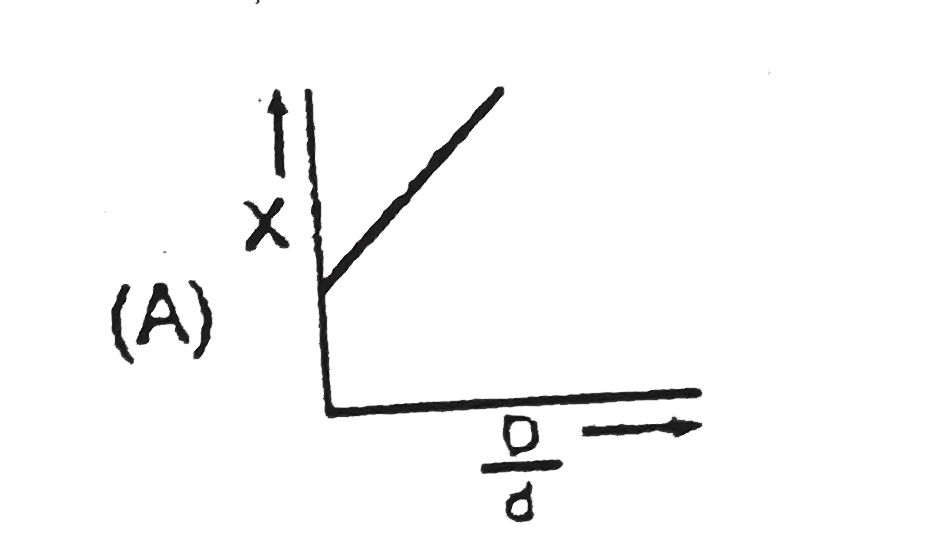
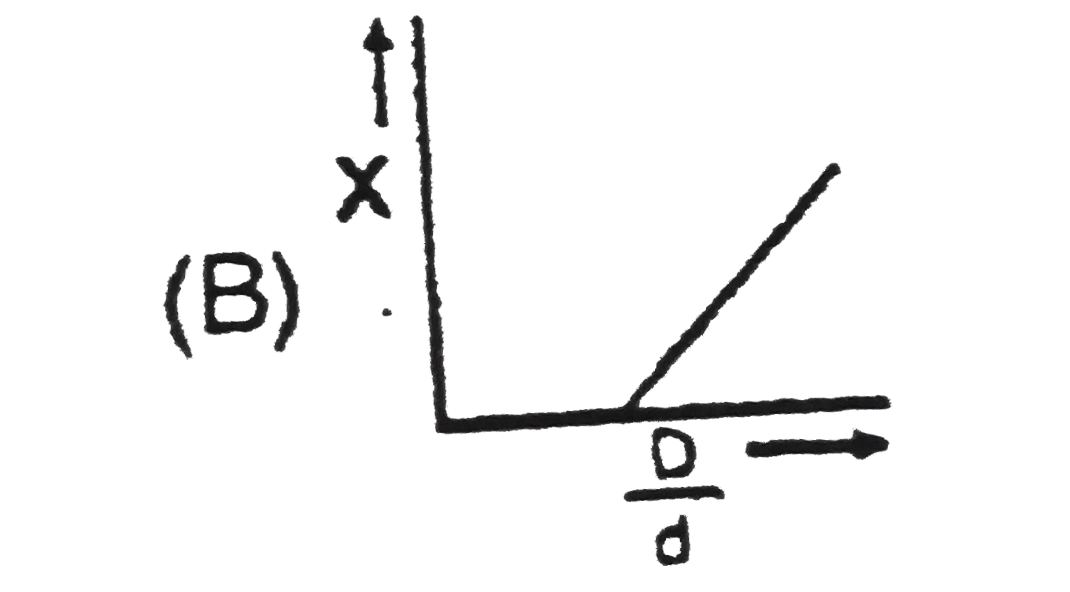
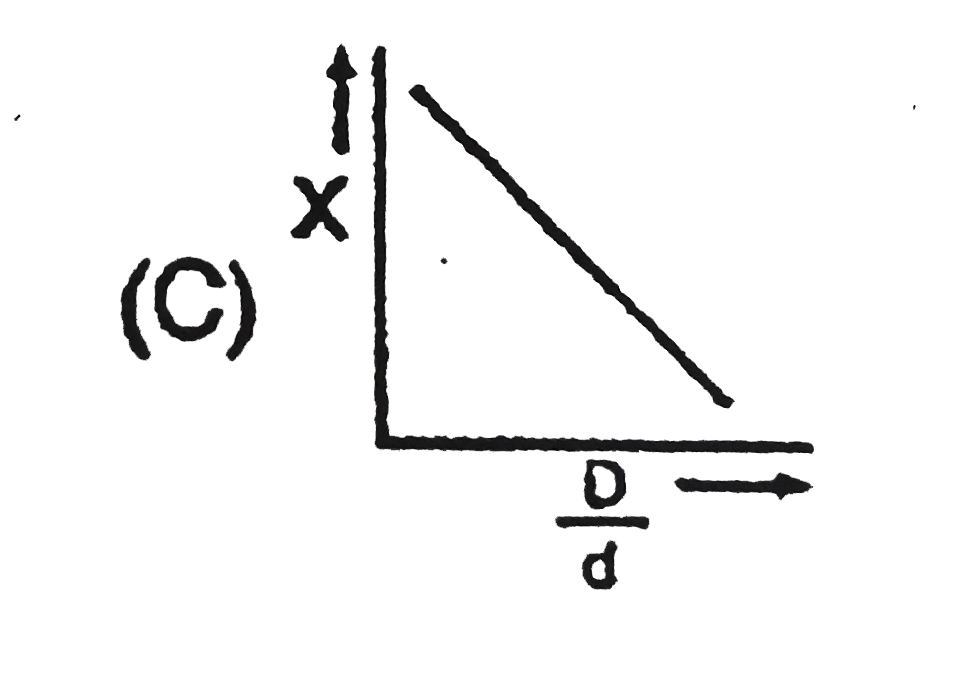
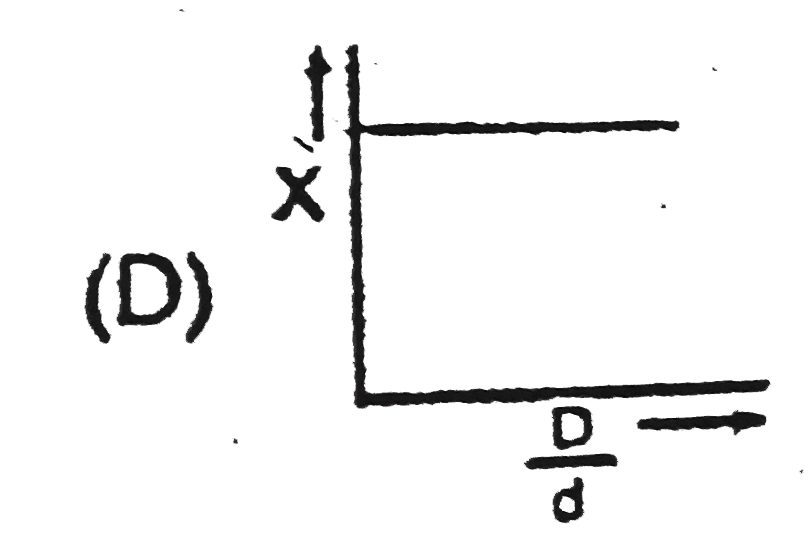
For certain substances such as ammonium chloride, nitrogen peroxide, phosphorus pentachloride, etc. the measured densities are found to be less than those calculated from their molecular formula.The observed densities decreases towards a limit as the temperature is raised.This is due to the splitting of the molecular into simpler ones.The process is reversible and is called thermal dissociation. Example : NH_4Cl hArr NH_3+HClI_2hArr 2I N_2O_4 hArr 2NO_2 PCl_5hArr PCl_3+Cl_2 With increase in the number of molecules, the volume increases (pressure remaining constant) and in consequence, the density decreases.As the temperature rises, more and more dissociation takes place, and when practically complete dissociation occurs the density reaches its lowest limit. The extent of dissociation, i.e., the fraction of the total number of molecules which suffers dissociation is called the degree of dissociation.Gas density measurements can be used to determine the degree of dissociation.Let us take by general case where one molecule of a substance A splits up into n molecule of A on heating , i.e., A_n(g)hArr nA(g) t=0 " "a" " 0 t=t_(eq) a-x n.x alpha=x/a rArr x=a alpha. a-a alpha naalpha Total no. of moles =a-a alpha+n a alpha =[1+(n-1)alpha]a Observed molecular weight or molar mass of the mixture M_("mixture")=M_(A_(n))/([1+(n-1)alpha]), M_(A_(n))=Molar mass of gas A_n x(degree of dissociation) varies with D/d in the above reaction according to : |
|
Answer»
`implies D/d=1+x"" [n=2]` which is a line with positive slope and X INTERCEPT =1 |
|
| 23. |
For certain substances such as ammonium chloride, nitrogen peroxide, phosphorus pentachloride, etc. the measured densities are found to be less than those calculated from their molecular formula.The observed densities decreases towards a limit as the temperature is raised.This is due to the splitting of the molecular into simpler ones.The process is reversible and is called thermal dissociation. Example : NH_4Cl hArr NH_3+HClI_2hArr 2I N_2O_4 hArr 2NO_2 PCl_5hArr PCl_3+Cl_2 With increase in the number of molecules, the volume increases (pressure remaining constant) and in consequence, the density decreases.As the temperature rises, more and more dissociation takes place, and when practically complete dissociation occurs the density reaches its lowest limit. The extent of dissociation, i.e., the fraction of the total number of molecules which suffers dissociation is called the degree of dissociation.Gas density measurements can be used to determine the degree of dissociation.Let us take by general case where one molecule of a substance A splits up into n molecule of A on heating , i.e., A_n(g)hArr nA(g) t=0"" a"" 0 t=t_(eq) a-x n.x alpha=x/a rArr x=a alpha. a-a alpha naalpha Total no. of moles =a-a alpha+n a alpha =[1+(n-1)alpha]a Observed molecular weight or molar mass of the mixture M_("mixture")=M_(A_(n))/([1+(n-1)alpha]), M_(A_(n))=Molar mass of gas A_n A sample of mixture of A(g),B(g) and C(g) under equilibrium has a mean molecular weight (observed ) is 80. The equilibrium is underset((mol.wt.=100))(A(g))hArrunderset((mol.wt.=60))(B(g))+underset((mol.wt.=40))(C(g)) Find the degree of dissociation alpha for A(g) |
|
Answer» `0.25` `M_(Ob)=M_(th)/(M+(n-1)ALPHA)IMPLIES 80=100/(1+alpha)implies =1/4=0.25` |
|
| 24. |
For certain substances such as ammonium chloride, nitrogen peroxide, phosphorus pentachloride, etc. the measured densities are found to be less than those calculated from their molecular formula.The observed densities decreases towards a limit as the temperature is raised.This is due to the splitting of the molecular into simpler ones.The process is reversible and is called thermal dissociation. Example : NH_4Cl hArr NH_3+HClI_2hArr 2I N_2O_4 hArr 2NO_2 PCl_5hArr PCl_3+Cl_2 With increase in the number of molecules, the volume increases (pressure remaining constant) and in consequence, the density decreases.As the temperature rises, more and more dissociation takes place, and when practically complete dissociation occurs the density reaches its lowest limit. The extent of dissociation, i.e., the fraction of the total number of molecules which suffers dissociation is called the degree of dissociation.Gas density measurements can be used to determine the degree of dissociation.Let us take by general case where one molecule of a substance A splits up into n molecule of A on heating , i.e., A_n(g)hArr nA(g) t=0 " " a"" 0 t=t_(eq) a-x n.x alpha=x/a rArr x=a alpha. a-a alpha naalpha Total no. of moles =a-a alpha+n a alpha =[1+(n-1)alpha]a Observed molecular weight or molar mass of the mixture M_("mixture")=M_(A_(n))/([1+(n-1)alpha]), M_(A_(n))=Molar mass of gas A_n If the total mass of a mixture in the above case is 300 gm, the moles of C(g) present are. |
|
Answer» `1/4` MOLE where a = MOLES of 'A'`=300/100 IMPLIES ` moles of `C=3xx0.25=3/4` |
|
| 25. |
For certain substances such as ammonium chloride, nitrogen peroxide, phosphorus pentachloride, etc. the measured densities are found to be less than those calculated from their molecular formula.The observed densities decreases towards a limit as the temperature is raised.This is due to the splitting of the molecular into simpler ones.The process is reversible and is called thermal dissociation. Example : NH_4Cl hArr NH_3+HClI_2hArr 2I N_2O_4 hArr 2NO_2 PCl_5hArr PCl_3+Cl_2 With increase in the number of molecules, the volume increases (pressure remaining constant) and in consequence, the density decreases.As the temperature rises, more and more dissociation takes place, and when practically complete dissociation occurs the density reaches its lowest limit. The extent of dissociation, i.e., the fraction of the total number of molecules which suffers dissociation is called the degree of dissociation.Gas density measurements can be used to determine the degree of dissociation.Let us take by general case where one molecule of a substance A splits up into n molecule of A on heating , i.e., A_n(g)hArr nA(g) t=0 " " a" "0 t=t_(eq) a-x n.x alpha=x/a rArr x=a alpha. a-a alpha naalpha Total no. of moles =a-a alpha+n a alpha =[1+(n-1)alpha]a Observed molecular weight or molar mass of the mixture M_("mixture")=M_(A_(n))/([1+(n-1)alpha]), M_(A_(n))=Molar mass of gas A_n The K_P for the reaction N_2O_4 hArr 2NO_2 is 640 mm at 775 K.The percentage dissociation of N_2O_4 at equilibrium pressure of 160 mm is : |
|
Answer» SOLUTION :`{:(,N_2O_4""hArr,2NO_2),("Mole before equilibrium",1,),("Mole at equilibrium",(1-x),2x):}` `K_p=(4x^2)/((1-x))xx[P/(sumn)]^(Deltan)implies 640=(4x^2)/((1-x))160/((1+x))` `4=(4x^2)/((1-x))` or `1-x^2=x^2` or `2x^2=1` `:. "" x^2=1//2 or x=0.707=70.7%` |
|
| 26. |
For cell reaction, Zn+Cu^(2+)toZn^(2+)+Cu, cell representation is |
|
Answer» `Zn|Zn^(2+)||CU^(2+)|Cu` `Zn|Zn^(2+)||Cu^(2+)|Cu`. |
|
| 27. |
For CaCO_(3)(s)iffCaO(s)+CO_(2)(g)" at "977^(@)C, DeltaH=176 " kJ mol, then "DeltaE is |
|
Answer» Solution :`Deltan=1-0=1` `DeltaE=DeltaH+DeltanRT` `DeltaE=+176-1xx(8.314)/(1000)xx1240=165.6 kJ`. |
|
| 28. |
For carbylamine reaction, we need alcoholic KOH and |
|
Answer» any PRIMARY AMINE and CHLOROFORM |
|
| 29. |
For C_(6)H_(5)CHO which of the following is incorrect |
|
Answer» On OXIDATION it YIELDS benzoic acid  On reduction it gives benzylalcohol and not phenol. |
|
| 30. |
For C_(6)H_(5)CHO which of the following is incorrect ? |
|
Answer» On oxidationit YIELDS BENZOIC acid |
|
| 31. |
For C_(12)H_(22)O_(11(aq))overset(H^(+))(to) Products, the concentration of sucrose changes from 0.06M to 0.03M in 30 minutes. Then, concentration of sucrose at the end of 60 minutes will be |
|
Answer» ZERO |
|
| 32. |
For, both lanthanides and actinides, which of the following statement is false ? |
|
Answer» Both involves the FILLING of(N - 2) F subshell |
|
| 33. |
ForProducts, the concentration of sucrose changes from 0.06 M to 0.03 M in 30 minutes. Then, concentration of sucrose at the end of 60 minutes will be |
|
Answer» ZERO |
|
| 34. |
For BaCl_(2) xH_(2)O, if 2.1 gm of compound gives 2 gm of anhydrous BaSO_(4) upon treatement with H_(2)SO_(4). Then calculate value of 'x' |
|
Answer» 1 `n_(BaCl_(2)).xxH_(2)O=n_(BaAO_(4))` `(2.1)/(208+18x)=(2)/(233)` `48.3=416+36xrArr75.3=36x` x=2.03 LTBR. `xapprox2` |
|
| 35. |
For azimuthal quantum number 1 = 2, the maximum number of electrons will be : |
|
Answer» 2 |
|
| 36. |
For azimuthal quantum number 1=3, the maximum number of electrons will be: |
|
Answer» 2 |
|
| 37. |
For Ato Products, pressure of A t = 0 and t = 10 min respectively are 760 mm & 740 mm, rate of reaction during this time interval is (inmm/min) |
|
Answer» 2 |
|
| 38. |
For AtoB, a first order reaction, k=10^(-2)"min"^(-1). If initial concentration of A is 1M, rate of the reaction after 2.31 hrs will be ("in M-min"^(-1)) |
|
Answer» `2.5XX10^(-4)` |
|
| 39. |
For Ato Products (order = 1), rate of reaction is 4xx10^(-2)"M-s"^(-1) when [A] = 0.5 M, then, rate constant of the reaction is ("in sec"^(-1)) |
|
Answer» `0.08` |
|
| 40. |
For artificial transmutation of nuclei, the most effective one is |
|
Answer» Proton |
|
| 41. |
For artificial ripening of fruit which of the following is used ? |
|
Answer» TESTOSTERONE |
|
| 42. |
For are reaction Ato product, initially 10 mole of A is taken. In 80 minutes 9.375 mole of A is found to be reacted. The rate constant of the reaction is represented as 3.5xx10^(-x)"min"^(-1). What is the value of X |
|
Answer» |
|
| 43. |
For any given series of spectral lines of atomic hydrogen let Deltabar(v)=bar(v)_("max") fl bar(v)_("min")be the difference in maximum and minimum frequencies in |
|
Answer» `4:1` For H - atom `bar(v)=R[(1)/(n_(1)^(2))-(1)/(n_(2)^(2))]` For Lyman SERIES, `bar(v)" (MAX)"=13.6(1-(1)/(oo))` `bar(v)" (min)"=13.6(1-(1)/(4))` `therefore""bar(v)_("max")-bar(v)_("min")=13.6((1)/(4))` For Balmer series, `bar(v)(max)=13.6((1)/(4)-(1)/(oo))` `bar(v)(min)=13.6((1)/(4)-(1)/(6))` `therefore bar(v)_("max")-bar(v)_("min")=13.6((1)/(9))` `(Deltabar(v)_("Lyman"))/(Deltabar(v)_("Balmer"))=(9)/(4)` |
|
| 44. |
For any first order reaction following observation is made. If at temperature (T) half life of the reaction is 6930 sec. and at temperature (T') half life of the reaction is 0.693 mu sec. then, calculate (T')/(T). |
|
Answer» 2 |
|
| 45. |
For any electron, the magnetic moment is …………….. To the orbital angular moment but ………………. To the orbital angular momentum. |
|
Answer» EQUAL, proportional |
|
| 46. |
For any chemical reaction ,value of slope of In Kto (1)/(T) graph will be……. |
|
Answer» `-(E_(a))/(2.303)` |
|
| 47. |
Foranychemicalreactionchemiststry to findoutwhichthings? |
|
Answer» SOLUTION :For any chemical reactions chemists try to find out (i)The feasibility of a chemical reaction which can be predicted by thermodynamics at constant pressure and temprature at constant pressure and temprature is `DeltaG` negatie than the reaction is spontaneous and if `DeltaG` is positive (`gt`0) than reaction is not feasible. (ii)Extant to whicha reaction will PROCEED can be determind from chemical EQUILIBRIUM. (iii)Speed of a reaction will proceed can be determined from chemical equilibrium . (iii) Speed of a reaction i.e. TIME TAKEN by a reaction to reach equilibrium. |
|
| 48. |
For anionic hydrolysis, pH is given by |
|
Answer» `pH=1/2 pK_w -1/2pK_b -1/2 LOG C` |
|
| 49. |
For anion of oxyacid, formed by removal of one water molecule from Boric acid , the only one correct combination is : |
|
Answer» (II)(i)(S) |
|