

Saved Bookmarks
This section includes 7 InterviewSolutions, each offering curated multiple-choice questions to sharpen your Current Affairs knowledge and support exam preparation. Choose a topic below to get started.
| 1. |
Explain the following observation : (i) Transition elements generally form coloured compounds. (ii) Zinc is not regaded as a transition element. |
|
Answer» SOLUTION :(i) Because the energy of excitation of an electron in d-orbital corresponds to the visible region. (II) Because Zn has completely FILLED do orbitals `(3d^(10)). |
|
| 2. |
Explain why alkynes are less reactive than alkenes toward addition of Br_(2). |
| Answer» Solution :The three memebered RING bromonium ion fromed from the alkyne (A) has a FULL double bond causing it to be more strained and LESS stable than the ONE from the alkene (B). | |
| 3. |
Explainthefollowingin not more thantwo sentwences A solution of FeCI_(3) in watergivesa brownprecipitateon standing |
|
Answer» SOLUTION :A brownprecipitateofferric HYDROXIDE is formed due tohydrolysis `FeCI_(3) + H_(2)O Fe(OH)_(3) DARR+ HCI` |
|
| 4. |
Explain the following in connection with colloids (i) Hardy-Schulze rule. (ii) Dialysis |
| Answer» | |
| 5. |
Explain why amines are more basic than amides. |
Answer» Solution :In SIMPLE amines the LONE PAIR of electrons is on nitrogen and hence available for protonation. In amides, on the other HAND,the ELECTRON pair on nitrogen is delocialized to the carbonyl oxygen through resonance. 
|
|
| 6. |
Explain the following in not more than two sentences. A solution of FeCl_(3) in water gives a brown precipitate on standing. |
| Answer» | |
| 7. |
Explain why alkyl halides are generally not prepared in the laboratory by free radical halogenation of alkanes. |
|
Answer» SOLUTION :Free RADICAL halogenation is not a suitable method for lobaratory synthesis of alkyl halides because of the following two reasons: (i) It gives a mixture of isomeric monohalogenated products whose boiling ponints are so close that they cannot be easily separated in the laboratory. (ii) Polyhalogenation may also occur to some extent THEREBY making the mixture more complex and HENCE more DIFFICULT to separate. |
|
| 8. |
Explainthe following :(i) Zincbutnot copperis usedfortherecoveryofAg from [Ag(CN)""_(2)]^(-) (ii) Partialroasting ofsulphide ore isdoneinthe metallurgyof copper. (iii) Why ischalcociteroasted and notcalcinedduringextractionof copper ? |
|
Answer» Solution :(i) The ` E^(@) `ofzinc` (Zn^( 2 +) //Zn =- 0*76 V) `is lower than thatofcopper` (Cu^( 2 +)//Cu=0*34V)`,therefore, Zn ISA morepowerfulreducing agent Cu . Further , Zn is also cheaper than Cu. Because of these two reasons , zinc but not copper is used for the recovery of silver from `[Ag(CN)_(2)]^(-)`. (ii) Partial roasting of sulphide ore forms some oxide which then reacts with the remaining sulphide ore to form copper metal by self-reducing of the oxide and sulphide . `2Cu_(2) S + 3 O_(2) to 2 Cu_(2) O + 2 SO_(2)` , `2 Cu_(2)O + Cu_(2) S to 6 Cu + SO_(2)` Thus , to bring about self reducing process , sulphide ore of copper is partially roasted . (III) Calcination is used for conversion of carbonate and HYDROXIDE ores to their respective oxides while roasting is used for conversion of sulphide ores to their respective oxides . SINCE chalcocite `(Cu_(2)S)` is a sulphide ore , therefore , it is roasted and not calcined . |
|
| 9. |
Explain why aldol condensation of aldehydes with methyl alkyl ketones involves the methyl group in the presence of basic catalyst but attack at the methylene group in the presence of acid catalysts e.g. C_(6)H_(5)-CHO+CH_(3)-CO-CH_(2)-CH_(3)overset(NaOH)underset(H_(2)O)to C_(6)H_(5)CH-CH-CO-C_(2)H_(5) C_(6)H_(5)-CHO+CH_(3)CO-CH_(2)-CH_(3)overset(H_(2)SO_(4))underset(3CH_(3)COOH)to C_(6)H_(5)-CH=underset(CH_(3))underset(|)C-CO-CH_(3) |
| Answer» Solution :Base catalysed aldol condensation proceeds through enolate ION and enolate ion `CH_(2)-CO-CH_(2)R` is morestable than the enolate `CH_(3)-overset(O)overset(||)C-CH-R`. ACID CATALYSE aldol condensation proceeds through the enol and the enol `CH_(3)-overset(OH)overset(|)C=CH_(2)-R` is more stable than the enol `CH_(2)=overset(OH)overset(|)C-CH_(2)-R`. | |
| 10. |
Explain why alcohols have higher boiling points than corresponding alkyl halides. |
|
Answer» Solution :In alkyl HALIDES the electronegativity difference between carbon and halogen atoms is comparatively less than the electro- negativity difference between oxygen and hydrogen atoms in -OH bondin ALCHOLS. Hence-OH in alcohols is more polar than C-X bond in alkyl halides. (3) Therefore intermolecular FORCES in alcohols are stronger and need higher energy to break hydrogen bonds than in alkyl halides. (4) Hence alcohols have higher boiling points than CORRESPONDING alkyl halides. |
|
| 11. |
Explain the following : (i) Protection (ii) Gold number |
| Answer» | |
| 12. |
Explain why alcohols do not react with NaBr but when H_(2)SO_(4) is added they form alkyl bromides. |
Answer» Solution : Although `Br^(-)` is a strong nucleophile yet `OH^(-)` being a strong base is a BAD leaving group. Therefore, `Br^(-)` cannot displace `OH^(-)` from ROH to form R-Br. In other words, NABR does not react with ALCOHOLS. however, when `H_(2)SO_(4)` is added, PROTONATION of alcohol occurs, i.e., -OH is converted into `-overset(+)(O)H_(2)`. since `H_(2)O` is a very weak base, therefore, it is a good leaving group. in otehr words, `Br^(-)` cann displace `H_(2)O` from protonated alcohol to form RBr.  . .
|
|
| 13. |
Explain the following : (i) o - nitrophenol is more acidic than meta - nitrophenol. (ii) Phenol gets coloured on long standing. (iii) o - nitrophenol is steam volatile while, p -nitro - phenol is not. (iv) Phenol does not undergo substitutions at the carbon oxygen bond. |
|
Answer» <P> Solution :(i) Due to Ortho Effect. Which STATES that any group PRESENT at ortho position increases the ACIDIC character.(ii) Due to oxidation by air. (iii) o - Nitrophenol have weaker intramolecular hydrogen bonding as to p - nitrophenol which have intermolecular hydrogen bonding. (iv) The carbon to which oxygen is attached is `sp^(2)` hybridised. |
|
| 14. |
Explain why (a) the dipole moment of chlorobenzene is lower than that of cyclohexyl chloride ? (b) alkyl halides, though polar, are immiscible with water ? (c) vinyl chloride is unreactive in nucleophilic substitution reactions ? (d) neopentyl bromide undergoes nucleophilic substitution reactions very slowly ? (e) 3-bromocyclohexane is more reactive than 4- bromocyclohexane in hydrolysis with aqueous NaOH ? (f) tert butyl chloride reacts with aqueous sodium hydroxide by S_(N^(1)) mechanism while n-butyl chloride reacts by S_(N^(2)) mechanism. (g) Grignard reagents should be prepared under anhydrous conditions ? |
|
Answer» Solution :(a) In chlorobenzene the C-atom of the C-CI bond is more electronegative due to `sp^(2)`-hybridisation, therefore the difference in the electronegativities of and Cl is less and the bond is less polar. On the other hand, in cyclohexyl chloride, carbon of C - Cl less electronegative due to `sp^(3)` hybridisation and hence the bond is less polar. (b) Alkyl halides are not able to form H-bonds with water, hence are immiscible with it. (c) In VINYL chloride, the NUCLEOPHILIC substitution is not possible due to resonance in the molecule, which give double bond character to the C - Cl bond. `H_(2)C = CH - overset(..)Cl: toH_(2)overset(Theta)(C)-CH= overset(o+)Cl` (d) It is because of the less stability of the intermediate stage. (E) Because, in 3-Bromocyclohexene, the lone pair of electrons of bromine can enter into resonance with the double bond.(f) Because the order of reactivity of alkyl halides towards `Sn_(N^(1))` and`Sn_(N^(2))` MECHANISM is : (i) `"tertiary"gt "secondary" gt "primary"` (ii) `"primary" gt "secondary" gt "tertiary"` (g) Because magnesium metal will react with moisture in an exothermic reaction and thus the product formed by decomposed or catch fire. |
|
| 15. |
Explain the following : (i) NO_(2) readily forms a dimer. (ii) BiCl_(3) is more stable than BiCl_(5). |
|
Answer» Solution :(i) It is because`NO_(2)` contains odd number of valence electrons. On dimerisation, it is converted to STABLE `N_(2)O_(4)` molecule with even number of electrons. (ii) In GROUP - 15 the stability of `+5` OXIDATION state decreases and that of `+3` oxidation state increases due to inert PAIR effect. Thus, `BiCl_(3)` is more stable than `BiCl_(5)`. |
|
| 16. |
Explain the following : i) Lead (Pb^(2+)) is placed in the first as well as second group of qualitative analysis. ii) The colour of mercurous chloride, Hg_(2),Cl_(2),changes from white to black when treated with ammonia. iii) During the qualitative analysis of a mixture containing Cu^(2+) and Zn^(2+) ions, H_(2)S gas is passed through an acidified solution containing these ions in order to test Cu^(2+) alone. Explain briefly. |
|
Answer» Solution :i) `PbCl_(2)` is partly soluble in WATER and hence `Pb^(2+)` ions pass to the first GROUP filtrate , i.e. to the II group . ii) Due to the formation of finely divided MERCURY. iii) `a) K_(sp)(CUS)` is less than `K_(sp)(CdS)`. b) Ionization of `H_(2)S` is further suppressed in presence of acid (common ION effect). `H_(2)S hArr 2H^(+)+S^(2-)` So, when `H_(2)S` gas is passed through acidified solution containing `Cu^(2+)` and `Zn^(2+)`, only `Cu^(2+)` ions will be precipitated due to low concentration of `S^(2-)` ions. |
|
| 17. |
Explain why alcohols and ethers of comparable moelcular mass have different boiling points? |
| Answer» Solution :Alcohols undergo intermolecular H-bonding and hence EXIST as associated moelcules. ETHERS, on the other hand, do not have H atom on the O-atom and hence do not form H-bonds. As a result, ethers exist as dicrete molecules which are held only by weak dipole-dipole attractions. since lesser energy is required to break weak dipole-dipole attactions than to break H-bonds in associated molecules of alcohols, therefore, boiling points of alcohols are MUCH HIGHER than those of ethers of COMPARABLE molecular mass. | |
| 18. |
Explain the following (i) Nitrogen is much less reactive than phosphorus. (ii) NF_(3) is an exothermic compound but NCl_(3) is an endothermic compound. |
| Answer» | |
| 19. |
Explain the following : (i) NH_(3) act as a lihand but NH_(4)^(+) does not. (ii) CN^(-) is a ambidetate ligand. |
|
Answer» Solution :(i) `NH_(3)` has ONE lone PAIR while `NH_(4)^(+)` does not. (ii) Because it has two donor atoms in a MONODENTATE ligand. |
|
| 20. |
Explain why a solution of chloroform and acetone shows negative deviation from Raoult's law. |
Answer» Solution :Solution of chloroform and acetone shows negative deviation from RAOULT. s law : Negative deviation is shown when vapour pressure of RESULTING solution is low and its boiling point is high. Chloroform and acetone on mixing form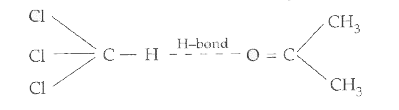 (H-Bond in acetone and chloroform molecules) Since new attractive forces which COME into existence in these solutions are RELATIVELY stronger, therefore these solutions are accompanied by evolution of HEAT `(DeltaH_("mix") = `- ve). Also because of stronger forces of attraction among molecules in solution, the molecules come closer and hence volume of solution is less than the total `(DeltaV_("max")-ve)` . |
|
| 21. |
Explain why a hexagonal close-packed structure and a cubic close packed structure for a given element would be expected to have the same density ? |
| Answer» Solution :The TWO structures have the same COORDINATION NUMBER, HENCE, the same packing FRACTION | |
| 22. |
Explain the following: (i) In nucleophilic aromatic substitution reactions, fluorides are more reactive than chlorides while in aliphatic nucleophilic substitution reactions reverse is true. (ii) Chlorobenzene forms grignard reagent in THF but not in ether. |
| Answer» SOLUTION :(i) The greater reactivity of fluorides as compared to chlorides in nucleophilic AROMATIC substitution is due to the STRONG -I-effect of the F atom which favours the initial nucleophilic attack on the aromatic ring. However, in nucleophilic aliphatic substitution, the greater reactivity of chlorides as compared to fluorides is due to greater leaving ability of `CL^(-)` ion over `F^(-)` ion. | |
| 23. |
Explain why a chelating complex is more stable than unchelated complex. |
| Answer» Solution :Chelating COMPLEX is more stable than unchelated complex because the LIGAND is attached to the metal ion from many POINTS. THUS, there is a strong force of ATTRACTION between the metal and the ligand. | |
| 24. |
Explain which of the following reactions will occur. a.overset (RCOOH) underset (pK_(a)=5) + overset (HCO_(3)^(-) underset (pK_(a)=10.3) rarr b.RCOOH + CO_(3)^(2-) rarr c.overset (PhOH) underset (pK_(a)=10) + HCO_(3)^(-) rarr d.PhOH + CO_(3)^(2-) rarr e.RCOO^(-) + overset (CO_(2)+H_(2)O) underset (pK_(a)=6.4) rarr f.PhO^(-) + CO_(2) + H_(2)O rarr g.RSH + O^(-)H rarr h.ROH + O^(-)H rarr i.ROH + RS^(-) rarr j.RSH + RO^(-) rarr |
|
Answer» Solution :The acid-base equilibrium reaction favours the side with weaker acid `(W_(A))` and weaker base `(W_(B))`. If the weaker acid is on the RIGHT side, the reaction occurs, but if the weaker acid is on the left side, the reverse reaction occurs. a.The reaction is: `OVERSET (RCOOH) underset (pK_(a)=5)` + `overset (HCO_(3)^(-)) underset (pK_(a)=10)` `rarr` `overset (RCOO^(-)) underset (Weaker conjugate base (C_(B))` + `overset (H_(2)O+CO_(2)) underset (W_(A)(pK_(a)=6.4))` b.Reaction occurs `RCOOH + CO_(3)^(2-) rarr` `overset (RCOO^(-)) underset (WC_(B))` + `overset (HCO_(3)^(-)) underset (pK_(a)=10.3 W_(A))` c. 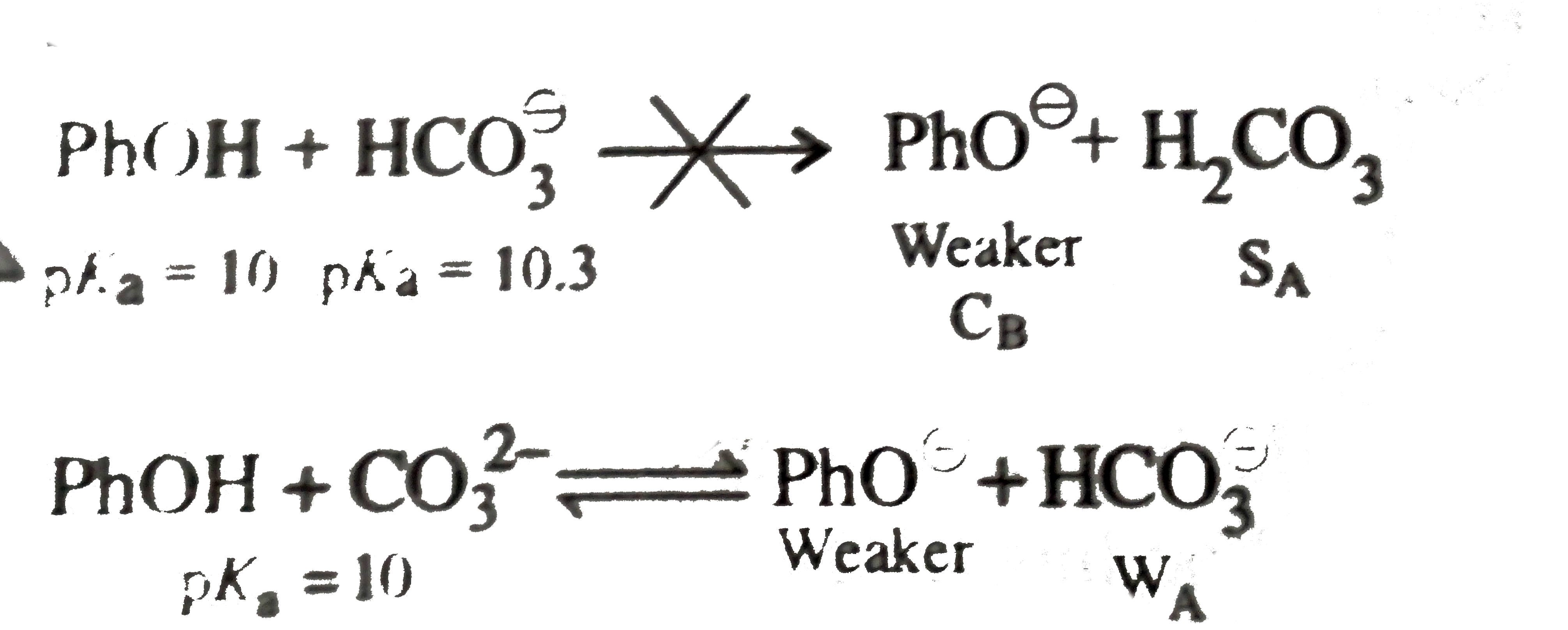 this reaction occurs if any substituted phenol that has `pK_(a) gt 10.5` does not react,e.g.,  e. 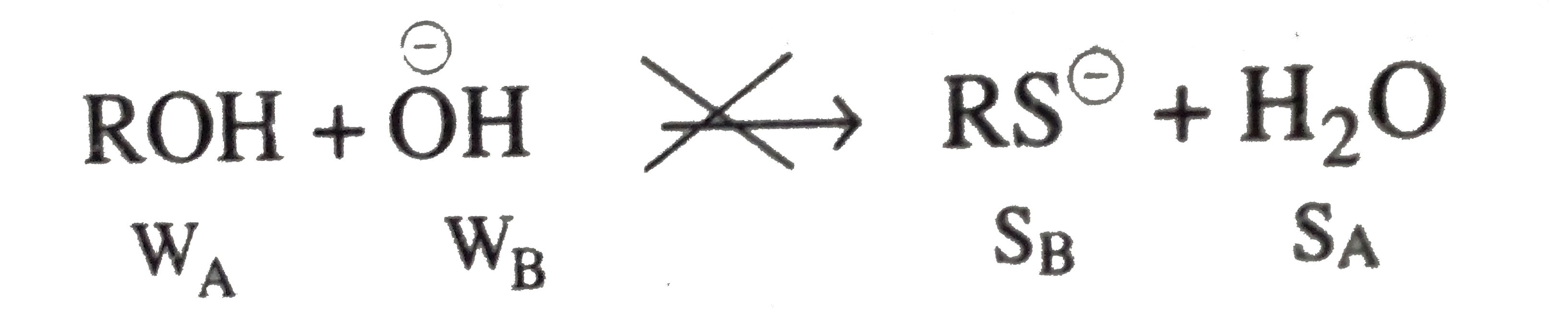 f. Reaction occurs. `PhO^(-) + `overset (H_(2)O + CO_(2)) underset pK_(a)=6.4)` `rarr` `overset (PhOH) underset (W_(A)pK_(a)=10)` + `HCO_(3)^(-)` g. Reaction occurs. RSH is a stronger acid than `H_(2)O`, and ROH.Therefore, `RS^(-)` is a weaker base than `O^(-)H` and `RO^(-)`. h.Reverse reaction occurs. `overset (ROH + O^(-)H) underset (W_(A)W_(B))` 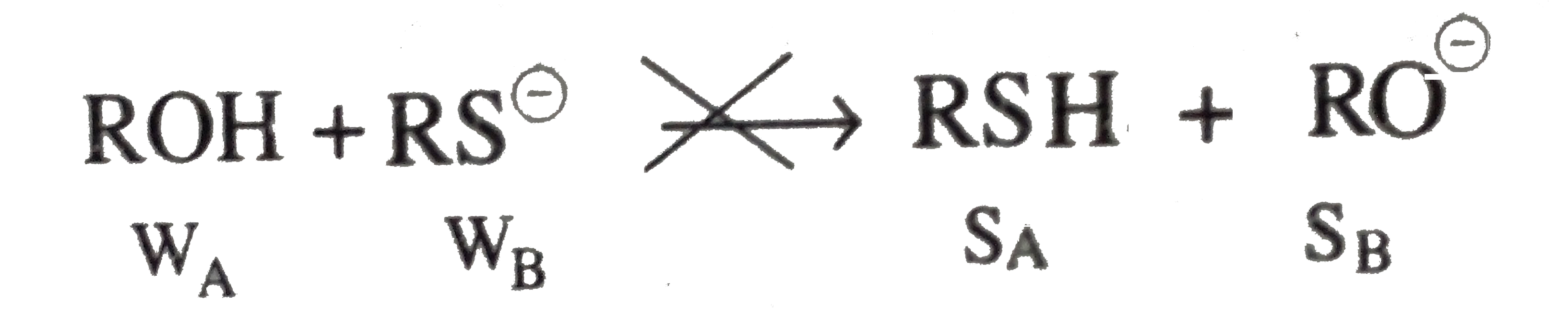 `overset (RS^(-) + H_(2)O) underset _(S_(B)S_(A))` `overset (RS^(-) + H_(2)O) underset _(S_(B)S_(A))` (Alcohols are weaker ACIDS than OH and `H_(2)O`, and `RO^(-)` is stronger base than `O^(-)H`.) However, the DIFFERENCES in acidities and basicities are small and all species are present in equilibrium. i.Reverse reaction occurs. `overset (ROH + RS^(-)) underset (W_(A)W_(B))``RSH + RO^(-)) underset (S_(A)S_(B))` RSH (thiols) are stronger acids than ROH, and `RO^(-)` is a stronger base than `RS^(-)`. j.Reaction occurs. `overset (RSH + RO^(-)) underset (S_(A)S_(B))``rarr``overset (RS^(-) + ROH) underset (W_(B)W_(A))` |
|
| 25. |
Explain, which of these compounds is a stronger acid: |
|
Answer» |
|
| 27. |
Explainwhatis themeant by the following : (i) Peptide linkage . (ii) Pyranosestructureof glucose . |
|
Answer» Solution :(i) See.S.A.T.Q.6(i).(TOPIC -2) (ii) CYCLIC structure of glucoseis pyranose strcuture . 
|
|
| 28. |
Explain the following: (i) CO is stronger ligand than NH_(3).(ii) Low spin octahedral complexes of nickel are not known.(iii) Aqueous solution of [Ti(H_(2)O)_(6)]^(3+) is coloured. |
|
Answer» SOLUTION :(i) CO has high value of crystal field splitting energy than Cl. (ii) Ni has `d^(8)` configuration which does not affect by field strength of ligand. (iii) In this CASE,`Ti^(+3)` has `t_(2G)^(1) e_(g)^(0)` configuration. It can perform d-d transition. |
|
| 29. |
Explain what is observed when: ltbtgt (a) A beam of light is passed through a colloidal solution. (b) An electric current s passed through a colloidal solution. (c ) Dialysis of a coloidal solution is carried out for a long time ltbtgt (d) An electrolyte NaCl is added t ferric hydroxide collodal solution. |
| Answer» | |
| 30. |
Explain what is observed whtn (a) an emulsion is subjected to centrifugation (b) direct current is passed through a colloidal sol (ii) Write a chemical equation showing the preparation of a positive sol. |
|
Answer» Solution :(i) (a) Demulsification OCCURS, i.e., the emulsion separates into its constituent liquids. (b) The charged colloidal particles move towards the oppositely charged electrode where they aggregate together and hence get coagulated. (ii) `FeCl_(3)` solution on BOILING undergoes hydrolysis to forms positively charged `FE(OH)_(3)` sol `FeCl_(3)+H_(2)Oto Fe(OH)_(3)HCl` |
|
| 31. |
Explain what is observed when: (i) KCl, an electrolyte, is added to an hydrated ferric hydroxide sol.(ii) An electric current is passed through a colloidal solution. (iii) A beam of light is passed through a colloidal solution. |
|
Answer» Solution :(i) Ferric hydroxide `FE(OH)_(3)` is a positively charged SOL, so it GETS coagulated by the chloride ions released from KCl solution. (II) When an electric current is passed through a colloidal solution due to charge on the colloidal particles they migrate towards the oppositely charged electrode. (iii) When a beam of light is passed through a colloidal solution the PATH of light becomes visible. |
|
| 32. |
Explain the following: (i) Gold number (ii) Dialysis. |
Answer» Solution :(i) Gold number. The different protecting colloids differ in their protecting powers. Zsigmondy introduced a term called gold number to describe the protective power of different colloids. This is defined as the number of the milligrams of the protective colloid required to just prevent the coagulation of a given gold sol when I ml of a 10% solution of sodium chloride is added to it.The coagulation of gold sol is indicated by change in the colour from red to blue. For example, gold number of egg albumin is 0.08 and that of starch is 25.It may be noted that smaller the value of the gold number greater will be protecting power of the protective colloid. For example, out of albumin and starch, starch, has less protecting power than albumin. 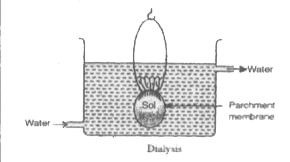 (ii) Dialysis. The method used to separate the impurities from the colloidal solution is called dialysis. Its principle is based upon the fact that colloidal particles cannot pass through a parchment of cellophane MEMBRANE while the IONS of the electrolyte can pass through it. The colloidal solution is TAKEN in a bag made of cellophane or parchment. The bag is suspended in fresh water. The impurities slowly diffuse out of the bag leaving behind pure colloidal solution. Dialysis can be used for removing HCL from the ferric hydroxide sol. |
|
| 33. |
Explain the following: i) Beta-1,3-diene gives 1,2- and 1,4-addition products. ii) Addition of HBr to H_(2)C=CHCH_(2)C-=CH gives CH_(3)CHBrCH_(2)C-=CH. iii) Alkenes in decreasing order of reactivity towards electrophilic addition. a) CICH_(2)CH=CH_(2) b) (CH_(3))_(2)C=CH_(2) c) CH_(3)CH=CH_(2) d) H_(2)C=CHCl ltbgt iv) Stereochemical structure of the reaction product of Br_(2) with a) cis-2-butene and b) trans-2-butene. v) Why alkynes are generally less reactive than alkenes shorter than that of n-butane. vi) The central carbon-carbon bond in buta-1, 3-diene is shorter than that of n-butane. vii) Arrange following alkenes in decreasing order of stability towards acid-catalysed hydrocarbons. a) 1-phyenyl-1-butene, 1-phenyl-2-phenyl-2-butene b) 2-methylpropene, cis-2-butene, trans-2-butene c) 1-hexene, 2-methyl-1-pentene, 2-hexene. |
|
Answer» Solution :i) N//A ii) The addition occurs at double bond because ISOLATED double bond is more reactive than an isolated triple bond in electrophilic additions. iii) Electron releasing alkyl groups MAKE pi-bond more electron rich and more reactive. While electrron with-drawing halogen atoms make the pi-bond more electron poor and less reactive. The order is: b) Two R GT (C ) one R gt(a) one R and a Cl gt (d) Cl on a double bonded carbon. IV) 2,3-Dibromobutane a) racemic b) meso. v) The reaction of alkyne or alkene with elecrophilic reagent proceeds through the formation of carbocation. Since the alkyl carbocation from the alkene group is more stable than the vinyl carbonation from alkyne group, the `DeltaH` for its formation is less in case of alkene and hence alkene reacts faster than alkyne. vi) Buta-1.3-diene `(H_(2)C=CH-CH=CH_(2))` has `sp^(2)-sp^(2) C-C` bond LENGTH, while n-butane has `sp^(3)-sp^(3) C-C` bond length. More `s` character in hybridisation, lesser is bond length. vii) a) 2-phenyl-2-butene gt 1-phenyl-2-butene gt 1-phenyl-1-butene. c) 2-methyl-1-pentene gt 2-hexanegt1-hexene. |
|
| 34. |
Explain : What is osmosis ? Give example. |
|
Answer» SOLUTION :Assume that only solvent molecules can pass through these semipermeable membranes. If this membrane is placed between the solvent and solution, the solvent molecules will flow through the membrane from pure solvent to the solution. This process of flow of the solvent is called osmosis. The flow will continue TILL the equilibrium is attained. Examples : (i) Raw mangoes shrivel when PICKLED in brine (salt WATER) (ii) wilted flowers revive when placed in fresh water (iii) blood CELLS collapse when suspended in saline water, etc. 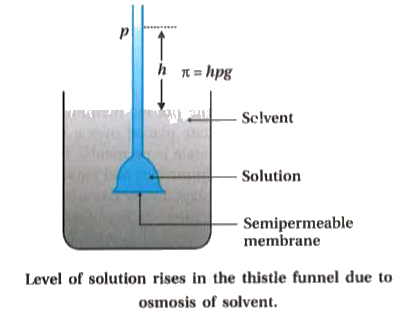
|
|
| 35. |
Explain the following . (i) Carbon - oxygen bond lengthin formicacid are 1.24 Å and1.36 Å but in sodiumformate both the carbon - oxygenbondshave same valuei.e., 1.27Å (ii)In vapour state, acetic acidshowsa relativemolecular weight of 120. |
Answer» Solution :(i) In formate ION resonace givesriseto identical bondlenghts  Wherears no suchresonance is noticedin formic acid `(H -underset(O)underset(||)(C) - OH)`and thusC - O bondsaredifferentin HCOOH. (ii) Acetion acidundergointermolecularH- BONDING toformdimericstate `(CH_(3)COOH)_(2)`and thusresultsin doublemolecularwieght . |
|
| 36. |
Explain what is observed, when an electrolyte (say NaCl) is added to ferric hydroxide sol. |
| Answer» SOLUTION :On ADDING SODIUM chloride to ferric hydroxide sol, coagulation takes PLACE and a precipitate 8 of ferric hydroxide is obtained. This is due to the reason that the positive charge of the colloidal solution is neutralised by the ADSORPTION of negatively charged chloride ions. Therefore, coagulation takes place. | |
| 37. |
Explain the following giving reasons : (i) It is difficult to separate lanthanoid elements in pure state. (ii) The transition elements form interstitial compounds. |
|
Answer» Solution :(i) It is because LANTHANOID have similar ionic SIZE and similar properties, that makes their separation difficult. (ii) The transition metals have voids in their crystal lattice into which small ATOMS like H, C, ETC., fit resulting in the formation of interstitial compounds. |
|
| 38. |
Explain what is observed, when an electric current is passed through a sol. |
| Answer» SOLUTION :On passing an electric CURRENT through a sol, the COLLOIDAL particles move towards oppositely charged electrode. This phenomenon is called electrophoresis. POSITIVELY charged particles move towards the CATHODE while negatively charged particles move towards the anode. | |
| 39. |
Explain the following: Henry's Law for the dissolution of gas in a liquid. Boiling point elevation constant for a solvent. |
|
Answer» Solution :For the explanation of Henry's LAW, Consults SECTION 3. For the explanation of elevation in BOILING POINT, CONSULT section 10. |
|
| 40. |
Explain what is observed? (i) When a beam of light is passed through a colloidel sol. (ii) An electrolyte, NaCl is added to the hydrated ferric oxide sol. (iii) Electric current is passed through a colloidal sol. (a) Describe Freundlich adsorption isotherm. (b) What do you mean by activity and selectivity of catalysts? |
|
Answer» Solution :(i) Scattering of light took place/Tyndal effect. (ii) Coagulation took place (III) Electrophoresis/Coagulation took place. `(x)/(m)=K.P^(1//n)(n gt 1)` `log m=K+(1)/(n)logp` 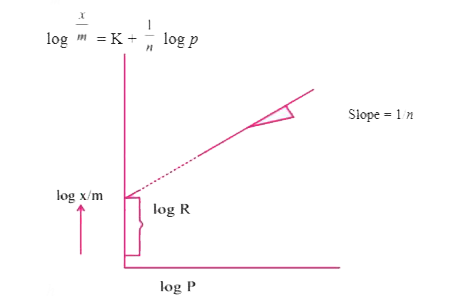 Activity means how many times catalyst is going to INCREASE the RATE of REACTION and selectivity is its ability to direct a reaction to YIELD a particular product. |
|
| 41. |
Explain the following giving one example for each : (i) Reimer - Tiemann reaction. (ii) Friedel - Craft.s acetylation of anisole. |
|
Answer» Solution :(i) Reimer - Tiemann reaction : On treating phenol with chloroform in the PRESENCE of sodium hydroxide, a `-CHO` group is INTRODUCED at the ortho POSITION in benzene ring.  (ii) Friedel - Crafts. acetylation of anisole: Anisole undergoes Friedel - Crafts. acetylation on treatment with `CH_(3)COCl` in the presence of anhydrous aluminium chloride. 
|
|
| 42. |
Explain what is observed (i) when a beam of light is passed through a colloidal solution (ii) an electrolyte, NaCl is added to ferric hydroxide sol (or hydrated ferric oxide sol in water) (iii) electric current is passed through acolloidal sol. |
| Answer» Solution :(i) Scattering of light by the colloidal particles takes place3 and the path of light BECOMES visible (TYNDALL efect). (ii) The positively charged colloidal particles of `FE(OH)_(3)` get conagulated by the oppositely charged `Cl^(-)` ions provided by naCl. (iii) On passing an electric CURRENT, colloidal particles move towerds charged oppositely chargbed electrode where they lose their charge and get coagulated. | |
| 43. |
Explain the following giving an appropriate reason in case : Structures of Xenon fluorides cannot be explained by Valence Bond approach. |
| Answer» SOLUTION :According to valence bond APPROACH, covalent bonds are formed by the overlapping of half filled atomic orbitals. But xenon has FULLY filled ELECTRONIC configuration. Hence the STRUCTURE of xenon fluorides cannot be explained by VBT. | |
| 44. |
Explain what is observed when a beam of light is passed through a colloidal sol. |
| Answer» Solution :SCATTERING of LIGHT by the COLLOIDAL PARTICLES takes place and the path of light becomes visible. This is KNOWN as Tyndall effect | |
| 45. |
Explain the following giving an appropriate reason in case : O_2and F_2both stabilise higher oxidation states of metals but O_2 exceeds F_2 in doing so. |
| Answer» Solution :`O_2 and F_2` both stabilise HIGHER oxidation states of metals but`O_2 ` exceeds `F_2` in doing so due to ABILITY of OXYGEN to form MULTIPLE BONDS to metals. | |
| 46. |
Explain what is observed when a colloidal solution of arsenious sulphide is treated as follows:(i) A beam of light is passed through it (ii) An electrolyte is added to it (ii) It is brought under the influence of electric field. Give the name of the phenomenon in each case. |
| Answer» Solution : (i) The PATH of the light becomes VISIBLE and the PARTICLES can also be seen. (Tyndall effect) (ii) By adding excess of the ELECTROLYTE, the colloidal particles change to a yellow precipitate. (Coagulation) (iii) The colloidal particles migrate towards the anode INDICATING a negative charge on them. (Electrophoresis) | |
| 47. |
Explain the following : [Fe(H_(2)O)_(6)]^(3+) is more paramagnetic than [Fe(CN)_(6)]^(3-). |
| Answer» SOLUTION :`[FE(H_(2)O)_(6)]^(3+)` has 5 unpaired electrons while `[Fe(CN)_(6)]^(3-)` has ONE unpaired electron. Therefore, `[Fe(H_(2)O)_(6)]^( 3+)` is more paramagnetic than `[Fe(CN)_(6)]^(3-)`. | |
| 48. |
Explain the following facts giving appropriate reason in each case : (i) NF_(3) is an exothermic compound whereas NCl_(3) is not. (ii) All the bonds in SF_(4) are not equivalent. |
|
Answer» Solution :(i) The high enthalpy of formation of `NCl_(3)`, is due to large difference in the size of the N and Cl atoms, as nitrogen belongs to second period and Cl atoms belongs to third period, this large difference makes the `N - Cl` bond WEAK and requires energy during its formation, so it is an ENDOTHERMIC compound. But in `NF_(3)`, since the size of the atoms is small, as both the atoms belong to second period, therefore, the `N - F` bond is strong and its formation is spontaneous, so it is an exothermic compound. (II) This is so because `SF_(4)` has see - saw shape and bonds are not equivalent on account of bond pair - lone pair repulsion . With S at the center , one of the three equatorial positions is occupied by a non bonding lone pair of ELECTRONS with two different types of F ligands, two axial and two equatorial. Axial Bonds suffer more repulsion than equatorial bonds as they are repelled by both bonding and non bonding electrons. Thus , the bonds are not equivalent in `SF_(4)`. |
|
| 49. |
Explain what is observed, when a beam of light is passed through a sol. |
| Answer» Solution :When a BEAM of light is passed through a sol, the path of the beam is illuminated by bluish light. This effect was studied in detail by TYNDALL and is known as Tyndall effect. The Tyndall effect occurs DUE to scattering of light in all directions in SPACE. | |
| 50. |
Explain the following facts : (a) Transition metals act as catalysts. (b) Chromium group elements have the highest melting points in their respective series. (c) Transition metals form coloured complexes. |
|
Answer» Solution :(a) Transition metals have incomplete d-orbitals. They combine with the reactants to form intermediate products which change into final products. Transition metals provide a large surface area to the gaseous reactants to change into the products. (b) CHROMIUM group elements have the greatest number of unpaired electrons in d-orbitals. They are THUS CAPABLE of forming maximum interatomic metallic bonds. This raises the melting point of the chromium group elements. (c) Transition metals have incompletely filled d-orbitals and have unpaired electrons which are excited to higher energy d-orbitals in the same sub-shell (from `t_(2g)` to `e_(g)`). These are called d-d transitions. During this process, the molecules ABSORB energy from the visible region. The transmitted light is the colour shown by the substance. |
|