

Saved Bookmarks
This section includes 7 InterviewSolutions, each offering curated multiple-choice questions to sharpen your Current Affairs knowledge and support exam preparation. Choose a topic below to get started.
| 1. |
Explain about (i) Analgesics (ii) Antiinflammatory drugs (iii) Antipyretics |
|
Answer» Solution :(i) Analgesics: They alleviate pain by reducing local inflammatory RESPONSE. They reduce the pain without causing impairment of consciousness. Example: Paracetamol (Crocin). (ii) Anti inflammatory drug: They are used for SHORT term pain relief and for modest pain LIKE head ache, muscle STRAIN, bruising or ARTHRITIS. Example: Ibuprofen, Aspirin. (iii) Antipyretics: These drugs have many effects such as reducing fever, and preventing platelet coagulation. Example: Aspirin. |
|
| 2. |
Explain about (i) blue colour of the sky (ii) formation of delta. |
|
Answer» Solution :(i) The blue colour of the sky in nature is due to Tyndall effect of air particles. (ii) The electrolytes in SEA and RIVER WATER COAGULATE the solid particles in river water at their intersection. By this way delta is formed. |
|
| 3. |
Explain about electrophilic substitution reaction of benzaldehyde and acetophenone |
Answer» SOLUTION :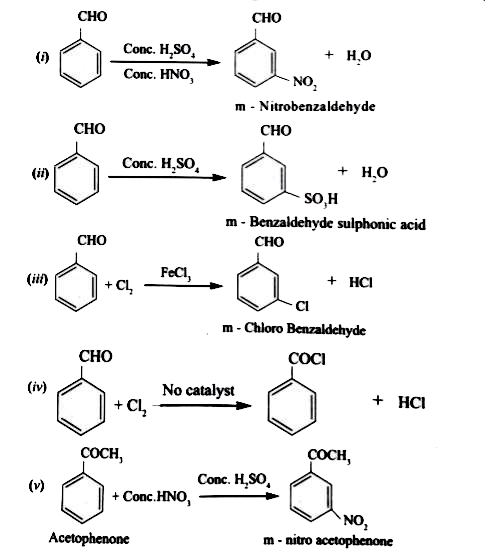
|
|
| 4. |
Explain about Electrophoresis (or) Cataphoresis (or) How would you detect the presence of charges on sol particles? (or) Explain about the method used to detect the presence of charge on sol particles. |
Answer» Solution : Electrophoresis (or) cataphoresis: 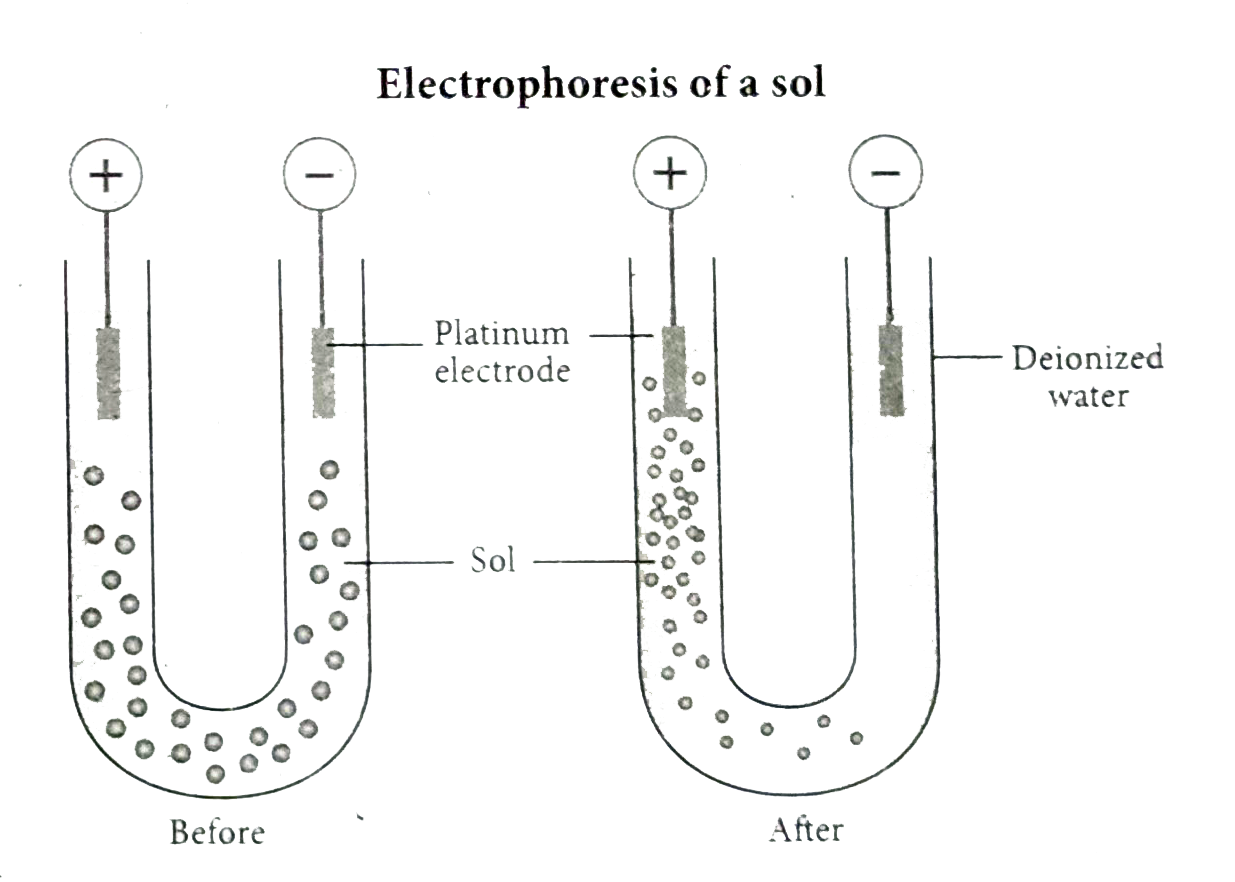 (II) If the sol particles MIGRATE to the cathode, then they possess POSITIVE charges and if the sol particles migrate to the anode, they have negative charges. Thus from the direction of migration of sol particles, we can determine the charge of the sol particles. Hence electrophoresis is used for the detection of PRESENCE of change on the sol particles.  |
|
| 5. |
Explain about electrophilic substitution in Benzoic acid with example. |
Answer» Solution :Benzoic acid UNDERGOES electrophilic substitution. The CARBOXYL group is a DEACTIVATING and meta DIRECTING group.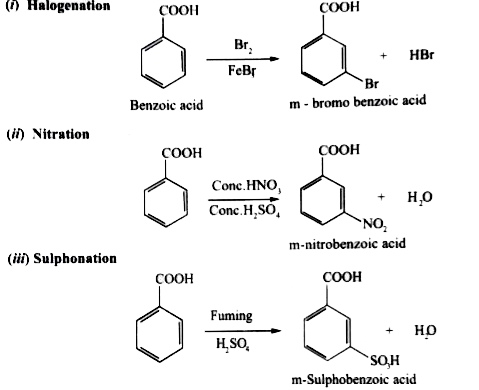
|
|
| 6. |
Explain aboutDNAfingerprintingprocess. |
|
Answer» Solution :(i) DNA fingerprinting is oneof the mostaccuratemethods for placingan individualat thescene ofa crimehas beena FINGER print. (ii)The DNAfingerprintisuniquefor everyperson and can be extractedformtracresof sample formblood,SALIVA,hairetc. By using thismethod, we candetect the individual specificvariationin human DNA. (iii) In thismethod ,theextracted DNAIS cutat specificpointsof varying lenghthsin theformationof DNAfragmentsof varying lengths whichwereanalysedby techniquecalledgel electrophoresis. Thismethodsepratesthe fragmentsbasedon theirsize. Thegel containingthe DNAfragmentsare thentransferredto a nylon sheetusinga techniquecalledblotting . Then the fragmentswillundergoautoradiography in WHICHTHEY wereexposed to DNAprobes. (iv)A piece of X -rayfilm was then exposed tothefragments , a anda darkmark was producedat any pointwhere a radioactivewithothersamples. (v) DNAfingerprintingis BASEDON slightsequencedifferencebetweenindividuals . These methods are providingdeceisivein courtcases world wide . |
|
| 7. |
Explain about Gattermann - koch reaction. |
Answer» Solution :BENZENE reacts with CARBON monoxide and HCl in the presence of `AlCl_3`and CUCL to give BENZALDEHYDE. This reaction is KNOWN as Gattermann - Koch reaction. 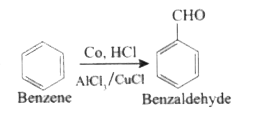
|
|
| 8. |
Explain about dispersion medium, dispersed phase and example of (i) solid foam, (ii) Gel (iii) Solid sol. |
Answer» SOLUTION :
|
|
| 9. |
Explain about dispersion medium, dispersed phase and example of (i) foam, (ii) emulsion (iii) sol. |
Answer» SOLUTION :
|
|
| 10. |
Explain about crystal field theory. |
|
Answer» Solution :`(1)` Crystal field theory assumes that the bond between the ligand and the central metal atomis purely ionic. i.e., the bond is framed due to the electronstatic attraction between the electron rich ligand and electron deficient metal. `(2)` In the coordination compounds, the central atom / ion and the ligands are considered as point charges (or) electric dipoles. `(3)` According to crystal field theory, the complex formation is considered as the following series of hypothetical steps. Step 1 : In an ISOLATED gaseous STATE, all the five d orbitals of the central metal ion are degenerate. Initially , the ligands from a spherical field of negative charge AROUND the metal. In thisfield, the energies of all the five d orbitals will increase due to the repulsion between the electrons of the metal and the ligand. Step 2 : The ligands are approaching the metal atom in actual bond directions. Consider an octahedral field, in which the central metal ion is located at the origin and six ligands are coming from the `+x`, `-x`, `+y`, `-y`,`+z` and `-z` directions. The orbitals lying along the axes `dx^(2)-y^(2)` and `dz^(2)` orbitals will experience STRONG repulsion and raise in energy to a greater EXTENT than the orbitals with lobes directed between the axes `(dxy,dyz "and" dxz)`. Thus the degenerate d orbitals now split into two sets and the process is called crystal field splitting. Step 3 : Upto this point the complex formation would not be favoured. However when the ligands approach further, there will be an attraction between the negatively chargedelectron and the positively charged metal ion that resulta in a net decrease in energy. This decrease in energy is the driving force for the complex formation. |
|
| 11. |
Explain about Debye-Huckel and Onsager equation. |
|
Answer» Solution :The influence of ion-ion interactions on the conductivity of strong electrolytes was studied by Debye and Huckel. They considered that each ion is surrounded by an ionic ATMOSPHERE of OPPOSITE SIGN, and derived an expression relating the molar conductance of strong electrolytes with the concentration by ASSUMING complete dissociations. It was further developed by Onsager. For a uni-univalent electrolyte the Debye Huckel adn Onsagar EQUATION is given below. `Lambda_m = Lambda_m^@ - (A + B Lambda_m^@) sqrt(c )` Where A and B are constants which depend only in the nature of the solvent and temperature. |
|
| 12. |
Explain about coagulation of lyophilic sols and protection of colloids. |
|
Answer» Solution :Coagulation of lyophilic sols : There are two factors which are responsible for the stability of lyophilic sols. These factors are the charge and solvation of the colloidal particles. When these two factors are removed a lyophilic sol can be coagulated. This is done (i) by adding an electrolyte and (ii) by adding a suitable solvent. When solvents such as alcohol and acetone are added to hydrophilic sols the dehydration of DISPERSED phase occurs. Under this condition a small quantity of electrolyte can bring about coagulation. Protection of colloids : Lyophilic sols are more stable than lyophobic sols. This is due to the FACT that lyophilic colloids are extensively solvated, i.e., colloidal particles are covered by a sheath of the liquid in which they are dispersed. Lyophilic colloids have a unique property of protecting lyophobic colloids. When a lyophilic sol is added to the lyophobic sol, the lyophilic particles form a LAYER around lyophobic particles and THUS protect the latter from electrolytes. Lyophilic colloids USED for this purpose are called protective colloids. |
|
| 13. |
Explain about chromyl chloride test. |
|
Answer» Solution :(i). When potassium dichromate is heated with any chloride SALT in the presence of Conc.`H_(2)SO_(4)`, orange RED vapours of chromyl chloride (`CrO_(2)CI_(2)`) is evolved. This reaction is used to confirm the presence of chloride ION in inorganic qualitative analysis. `K_(2)C_(2)O_(7)+ 4NaCI+ 6H_(2)SO_(4) to 2KHSO_(4)+ 4NaHSO_(4)+ underset("chromyl chloride")(2CrO_(2)CI_(2)uarr) + H_(2)O` (II) The chromyl chloride vapours are dissolved in sodium hydroxide solution and then acidified with acetic acid and TREATED with lead acetate. A yellow precipitate of lead chromate is obtained. `CrO_(2)CI_(2)+ 4NaOH to Na_(2)CrO_(4)+ 2NaCI+ 2H_(2)O` `underset("Sodium chromate")(Na_(2)CrO_(4))+ underset("Lead acetate")((CH_(3)COO)_(2)Pb)to underset(underset("(Yellow precipitate)")("Lead chromate"))(PbCrO_(4)darr)+ underset("Sodium acetate")(2CH_(3)COONa)` |
|
| 14. |
Explain about Bredic's are method (or) Electro dispersion method (or) How would you prepare colloids of noble metals? |
|
Answer» Solution :(i) An electrical arc is struck between electrodes dispersed in water SURROUNDED by ice. When a current of lamp/100V is passed, an arc produced forms VAPOURS of metal which immediately condense to from colloidal solution. (ii) By this method, colloidal solution of MANY metals like copper, SILVER, gold, platinum can be prepared (iii) Alkali hydroxide is an added an stabilising agent for the colloid solution. 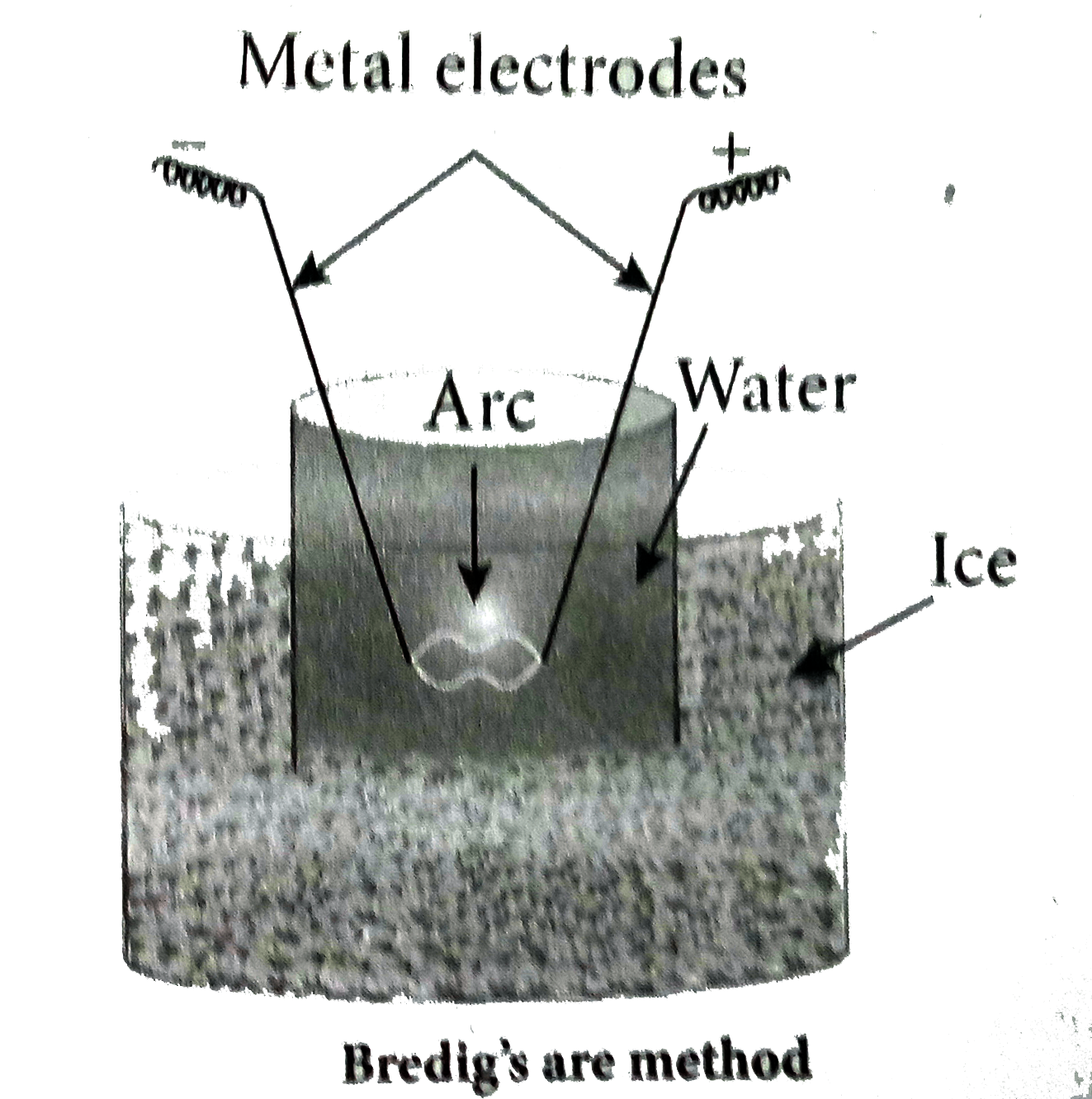
|
|
| 15. |
Explain about catalytic dehydrogenation of 1^@, 2^@ and 3^@ alcohols. |
|
Answer» Solution :(i) `underset("ETHANOL")(CH_3-CH_2OH) underset("Dehydrogenation")OVERSET("CU 573 K")to underset("ethanol")(CH_3-CHO) + H_2 uarr` (ii) `underset("Propan-2-ol")(CH_3-underset(OH)underset(|)(CH - CH_3)underset("Dehydrogenation")overset(" Cu 573 K") to underset("Propaone")(CH_3-underset(O)underset(||)C-CH_3 + H_2 uarr` (iii) 
|
|
| 16. |
Explain about antioxidants. |
|
Answer» Solution :(i) Antioxidants are substances which retard the oxidative deteriotations of food. Food containing fats and OILS is easily oxidised and TURN rancid. (ii) To prevent the oxidation of fats and oils, chemical BHT (butyl hydroxy toluene), BHA (butylated hydroxy anisole) are added as antioxidants. (iii) These materials readily undergo oxidation by reacting with free radicals GENERATED by the oxidation of oils there by stop the chain reaction of oxidation of food. (IV) Sulphur dioxide, sulphites are also used as antioxidant and also act as antimicrobial agents and ENZYME inhibitors. |
|
| 17. |
Explain about antacids? |
|
Answer» Solution :(i) Antacids neutralise the acid in the stomach that causes ACIDITY. (ii) They are used to relieve BURNING sensation in the chest, throat AREA caused by acid reflux. Example: Milk of magnesia, alumminium HYDROXIDE, RANITIDINE, Cemitidino, Omeprazole, Rabeprazole. |
|
| 18. |
Explain about anaesthetics with their types. |
|
Answer» Solution : (i) LOCAL ANAESTHETICS: It causes loss of sensation in the area in which it is applied without losing consciousness. They BLOCK pain perception that is transmitted via PERIPHERAL nerve fibres to the brain. Example : Procaine , Li do caine . OFTEN usedduring minor surgical procedures . (ii) General anaesthetics : They causea controlledand reversibleloss of consciousness byaffectingcentral nervoussystem . Example : Propofol , Isoflurane . They are often used for major surgicalprocedures . |
|
| 19. |
Explain about 3 test for aldehyde |
|
Answer» Solution : (i) Tollen.s reagent test: When an ALDEHYDE is warmed with Tollens reagent (AMMONICAL silver nitrate), a bright silver mirror is produced due to the formation of silver metal. This reaction is also CALLED silver mirror test for aldehydes. `CH_3CHO + 2 [Ag (NH_3)_2]^(+) + 3OH to CH_3COO^(-) + 4NH_3 uarr + underset("silver mirror ")(2Ag uarr + 2H_2O) ` (ii)Fehlings solution Test: Fehlings solution is prepared by mixing equal volumes of Fehlings solution ‘A’containing aqueous copper sulphate and Fehlings solution .B. containing alkaline solution of sodium potassium tartarate (Rochelle salt) When aldehyde is warmed with Fehlings solution DEEP blue colour solution is changed to red precipitate of cuprous oxide. `underset("blue")(CH_3CHO+2Cu^(2+) + 5OH) to underset("red")(CH_3COO + Cu_2O darr+ 3H_2O)` (iii) Benedict.s solution Test: Benedict.s solution is a mixture of `CuSO_4`+ sodium citrate + `NaOH. Cu^(2+)`is reduced by aldehyde to give red precipitate of cuprous oxide. `underset("blue")(CH_3CHO + 2Cu^(2+) + 5OH) to underset("red")(CH_3COO + Cu_2O + 3H_2O)` |
|
| 20. |
Explain abnormal molecular masses. |
|
Answer» Solution :When the observed molecular masses obtained from their colligative properties of the SUBSTANCES are different (higher or lower) than the theoretical or normal values calculated from their molecular formulae, then they are called abnormal molecular masses. Explanation : The colligative property depends on the number ofsolute particles in the solution but it is independent of their NATURE. Abnormal values of them arise when the dissolved solute UNDERGOES a molecular change like dissociation or association in the solution. The observed colligative property (or abnormal colligative property) may be higher or lower than the theoretical value. (i) Dissociation of thesolutemolecules : Whena solute likeans electrolyte isdissolvedin a polarsolventlikewater,it undergoesdissociation, whenresult in theincreaseinthenumberof particles inthe solution. Hence, the observed value of the colligative property BECOMES higher than the theoretical value, e.g., when one mole of KCl is dissolved in the solution then due to dissociation, `KCl toK^(+) +Cl-`, the number of particles increases, hence, the colligative properties like osmotic pressure, elevation in the boiling point, ETC. increase. (ii) Association of the solute molecules , When a solute like a nonelectrolyte is dissolved in a nonpolar solvent like benzene, it undergoes association forming molecules of higher molecular mass. Hence, the number of the particles in the solution decreases. Therefore the colligative properties like osmotic pressure, elevation in the boiling point, etc. are lower than the theoretical value, e.g.,`nA to An`. `2CH_(3)COOH to (CH_(3)COOH)_(2) 2C_(6)H_(5)COOH to (C_(6)H_(5)COOH_(2))` |
|
| 21. |
Explain abnormal molar masses. Also explain association and dissociation of solute. |
|
Answer» Solution :Dissociation : when ionic COMPOUNDS when dissolved in water dissociate into cations and anions, and increases number of soluble particles in solution which is known as dissociation. For example, if we dissolve one mole of KCl in water, we expect one mole each of `K^(+)` and `Cl^(-)` ions to be released in the solution. If we ignore interionic attractions, one mole of KCl in one kg of water would be expected to increase the boiling point by `2xx0.52 K = 1.04 K`. Now if we did not know about the degree of dissociation, we could be led to conclude that mass of one mole of KCl would be 37.25 g. This brings into light the rule that, when there is dissociation of solute into ions, the EXPERIMENTALLY determined molar mass is always lower than the true value. 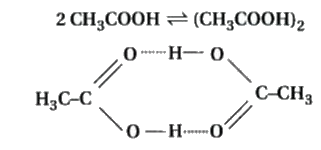 Molecules of acetic acid dimerise in benzene due to hydrogen bonding. This NORMALLY happens in solvents of low dielectric constant. In this case the number of particles is reduced due to dimerisation. Association of molecules is depicted as follows : It can be undoubtedly stated here that if all the molecules of ethanoic acid associate in benzene, then `Delta T_(B)` or `Delta T_(f)` for ethanoic acid will be half of the normal value. The molar mass calculated on the basis of this `Delta T_(b)` or `Delta T_(f)` will, therefore, be twice the expected value. Such a molar mass that is WITHER lower or higher than the expected or normal value is called as abnormal molar mass. |
|
| 22. |
Explain AAAA and ABABA and ABCABC type of three dimensional packing with the help of neat diagram. Voids : The empty spaces between the three dimensional layers are known as voids. There are two types of common voids possible. They are tetrahedral and octahedral voids. Tetrahedral void: A void formed by three spheres of a layer in contact with each other and also with a sphere on the top or bottom layer is a hole between four spheres. The spheres are arranged at the vertices of a regular tetrahedron such a hole or void is called tetrahedral void. Octahedral void: A hole or void formed by three spheres of a hexagonal layer and another three spheres of the adjacent layer is a hole between six spheres. The spheres are arranged at the vertices of a regular octahedron. Such a hole or void is called octahedral void. |
|
Answer» Solution :(i) AAAA type of three dimensional packing This type of three dimensional packing arrangements can be obtained by repeating the AAAA type two dimensional arrangements in three dimensions. i.e., spheres in one layer sitting directly on the top of those in the previous layer so that all layers are identical. All spheres of different layers of crystal are perfectly aligned horizontally and also vertically, so that any unit cell of such arrangement as simple cubic structure as shown in fig. In simple cubie packing, each sphere is in contact with 6 neighbouring spheres - Four in its own layer, one above and one below and hence the coordination number of the sphere in simple cubic arrangement is 6.  (ii) ABABA type of three dimensional packing: In this arrangement, the spheres in the first layer (A type) are SLIGHTLY SEPARATED and the second layer is formed by arranging the spheres in the depressions between the spheres in layer A as shown in figure. The third layer is a repeat of the first. This pattern ABABAB is repeated throughout the crystal. In this arrangement, each sphere has a coordination number of 8, four NEIGHBORS in the layer above and four in the layer below.  (iii) ABCABC type of three dimensional packing: In this arrangement (FCC) second layer spheres are arranged at the dips of first layer. Third layer spheres are arranged in a manner such that it cover the octahedral void. Then no longer third layer is similar to first or second layer. Third layer gives different arrangement. Fourth layer spheres are similar to first layer. If the first, second and third layer are represented as A,B,C then this type of packing gives the arrangement of layers as ABCABC... (i.e.), the first three layers do not resemble first, second and third layers respectively and the sequence is repeated with the addition of more layers. In this arrangement atoms OCCUPY `74%` of the available space and thus has `26%`vacant space. The coordination number is 12. Voids : The empty space between the three dimensional layers are known as voids. Therefore are two types of common voids possible. They are tetrahedral and octahedral voids. Tetrahedral void : A void formed by three spheres of a layer in contact with each other and also with a sphere on the top or bottom layer is a hole between four spheres. The spheres are arranged at the vertices of a regulartetrahedron such a hole or void is called tetrahedral void. Octahedral void : Ahole or void formed by three spheres of a hexagonal layer and another three spheres of the adjacent layer is a hole between six spheres. the spheres are arranged at the vertices of a regular octahedron. Such a hole or void is called octahedral void. 
|
|
| 23. |
Explain : a. Vinyl chloride is unreactive in nucliphillic 4- subsitution reactions. b. Neopenthyl bromideundergoes nucliphillic substituion reactionsvery slowly. c. 3- Bromocyclohexane is more reactive than 4- bromovyclohexane in hydrolysis with aqueous NaOH. d. ter- Butyl chloride reacts with aqueous sodium hydroxide by SN^(1) mechanishm while n- butuyl chloride reacts by SN^(2) medchanism. |
Answer» Solution :a. Vinylic and aryl halides are unreactive towards `SN` reactions due to the resonance EFFECTS. Resonanace gives rise to partial doublebondcharacterto the `(C-X)` bond, making stongerand, thereforemore diffcult to cleave than the`(c-X)` bondin `RX (R_(sp^(3))- X)` bond. It also reduces te polarity of the `(c_X)` bond and, therefore, the heterolytic cleavage of `(C-X)` bond is DIFFICULT. 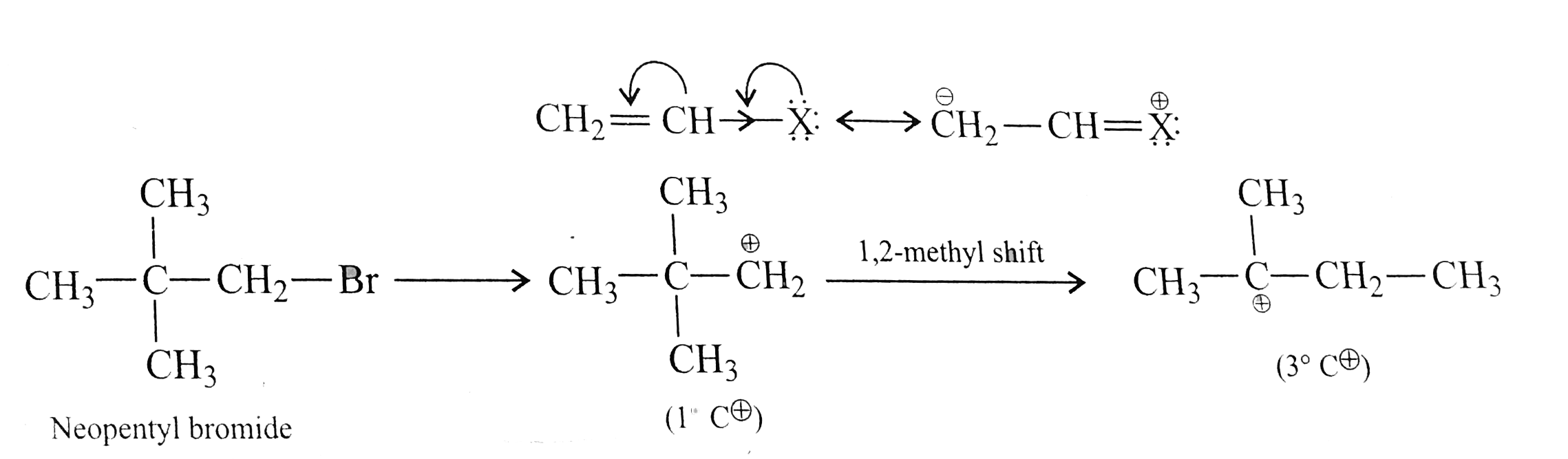 Neopentyl bromide gies `(1^(@) C^(o+))` which can rearrangeto `3^(@) C^(o+)` by `1.2`, methyl shift, but is sterically hindered and so `SN` reaction TAKES placeslowly. C. 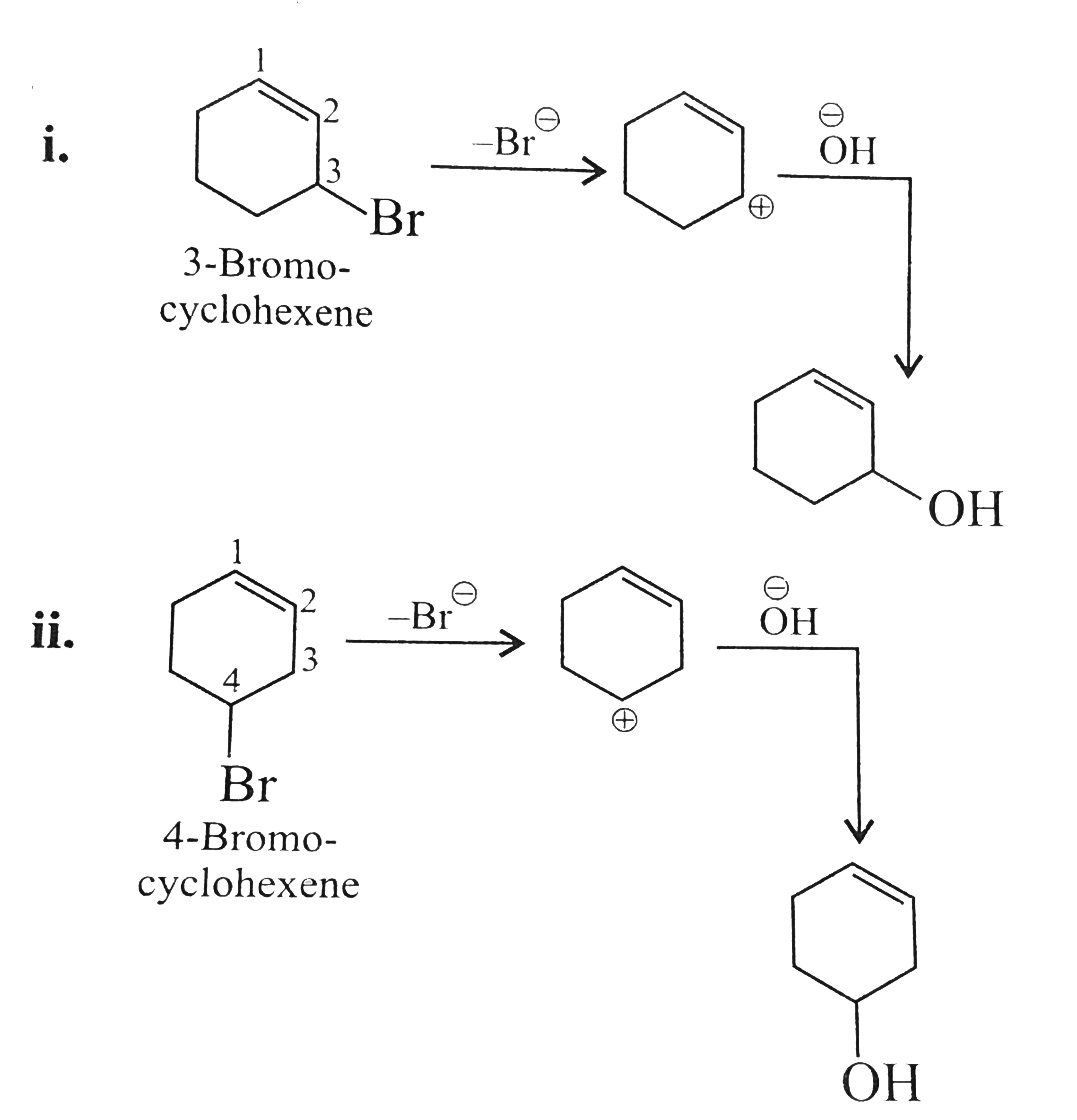 (i) gives allylic carbocation, while (ii) gives `2^(@)C^(o+)` and allylic `C^(o+)` is more stable than `2^(@) C^(o+)`. So (i) more reactive than (ii) in hydrolysis with aq. `NAOH`. 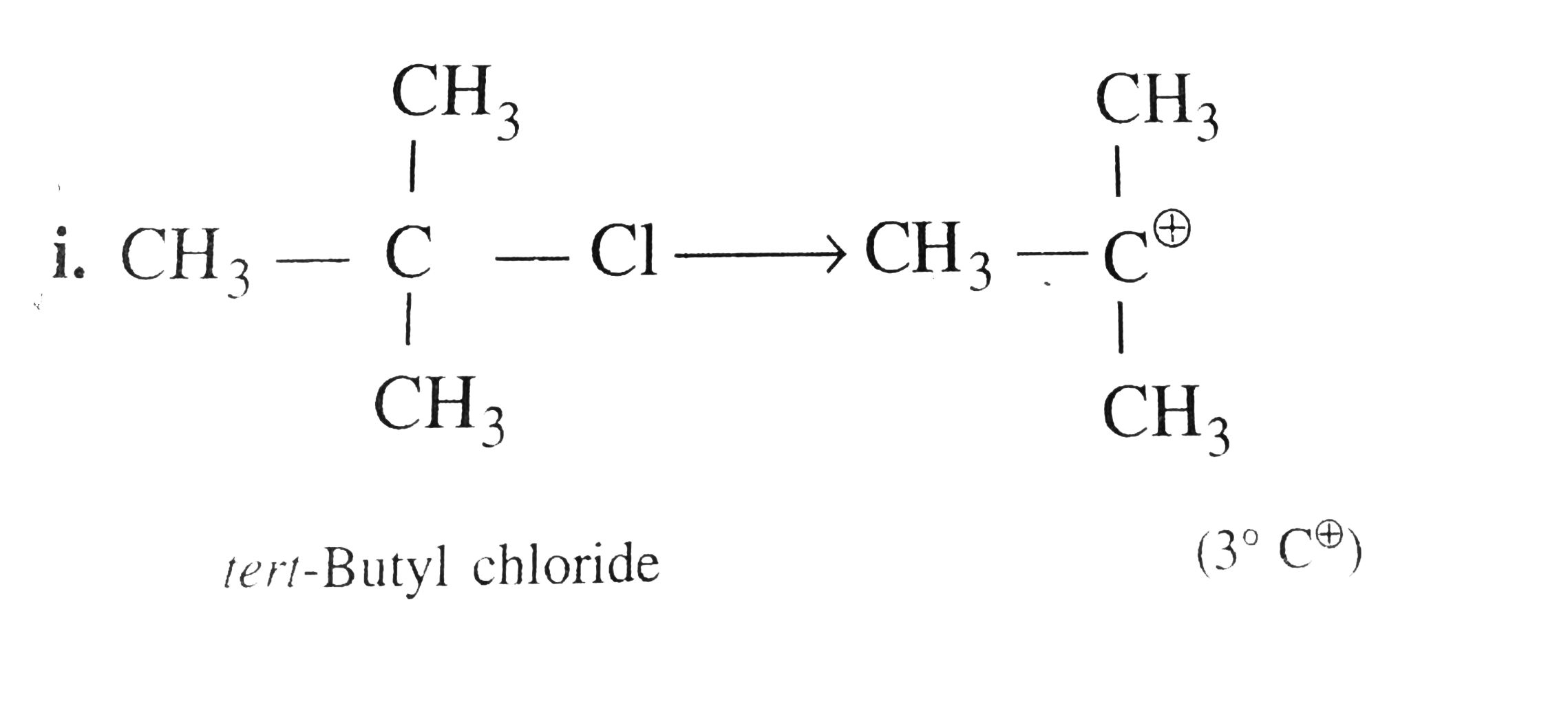 ii. `CH_(3) CH_(2) CH_(2) CH_(2) Cl rarrCH_(3) underset((1^(@) C^(o+)))(CH_(2) CH_(2)) overset(o+)(CH_(2))` Reactivity of `SN^(1)` reaction is `3^(@)C^(o+) gt 2^(@) C^(o+) gt 1^(@) C^(o+)` and reactivity of `SN^(2)` reaction is `1^(@)C^(o+) gt 2^(@)C^(o+) gt 3^(@)C^(o+)` . So (i) reacts with aq. `NaOH` by `SN^(1)` mechanism because it gives `3^(@) C^(o+)`, while (ii) undergoesby `SN^(2)` reaction becuase it gives`1^(@)C^(o+)`, ions. |
|
| 24. |
Explain AAAA and ABABA and ABCABC type of three dimensional packing with the help of neat diagram. |
|
Answer» Solution :(i) AAAA type of three dimensional packing: This type of three dimensional packing arrangements can be OBTAINED by repeating the AAAA type TWO dimensional arrangements in three dimensions. i.e., spheres in one layer sitting directly on the top of those in the previous layer so that all layers are identical. All spheres of different layers of crystal are perfectly aligned horizontally and also vertically, so that any unit cell of such arrangement as simple cubic structure as shown in fig. In simple cubic packing, each sphere is in contact with 6 neighbouring spheres -Four in its own layer, one above and one below and hence the coordination number of the sphere in simple cubic arrangement is 6. 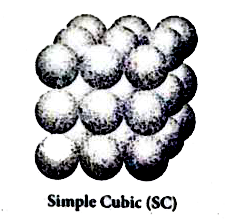 (ii) ABABA type of three dimensional packing: In this arrangement, the spheres in the FIRST layer (A type) are slightly separated and the second layer is formed by arranging the spheres in the depressions between the spheres in layer A as shown in figure. The third layer is a repeat of the first. This pattern ABABAB is repeated THROUGHOUT the crystal. In this arrangement, each sphere has a coordination number of 8, four neighbors in the layer above and four in the layer below. 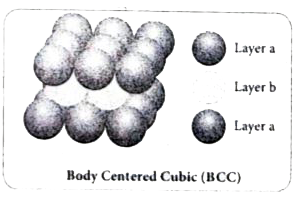 (iii) ABCABC type of three dimensional packing: In this arrangement (FCC) second layer spheres are arranged at the dips of the first layer. Third layer spheres are arranged in a manner such that it cover the octahedral void. Then no longer third layer is similar to first or second layer. Third layer gives different arrangement. Fourth layer spheres are similar to first layer. If the first, second and third layer are represented as A, B, C then this type of packing gives the arrangement of layers as ABCABC... (i.e.,), the first three layers do not resemble first, second and third layers respectively and the sequence is repeated with the addition of more layers. In this arrangement atoms occupy 74% of the available space and thus has 26% vacant space. The coordination number is 12. Voids : The EMPTY spaces between the three dimensional layers are known as voids. There are two types of common voids possible. They are tetrahedral and octahedral voids. Tetrahedral void: A void formed by three spheres of a layer in contact with each other and also with a sphere on the top or bottom layer is a hole between four spheres. The spheres are arranged at the vertices of a regular tetrahedron such a hole or void is called tetrahedral void. Octahedral void: A hole or void formed by three spheres of a hexagonal layer and another three spheres of the adjacent layer is a hole between six spheres. The spheres are arranged at the vertices of a regular octahedron. Such a hole or void is called octahedral void. 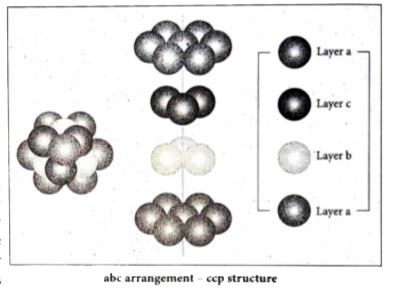
|
|
| 25. |
Explain :(a) SF_6is known but SH_6is not known. Explain. (b) SO_3has zero dipole moment. Why? (c) Noble gases have low boiling points. Explain. |
Answer» Solution : (a) Fluorine is HIGHLY electronegative and can easily cause the promotion of electrons from the filled to the vacant 3d-orbitals. 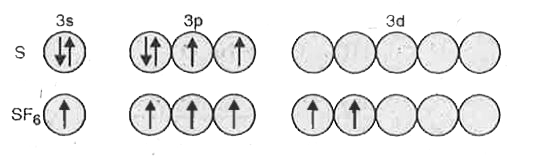 However, hydrogen is less electronegative, even less than that of S. Therefore, it cannot cause the promotion of electrons. Thus, `SF_6`is KNOWN but `SH_6`is not known. (b) In the gaseous state, `SO_3`has planar triangular structure with O-S-O bond angles of `120^@`each. Therefore, individual S-O dipole moments cancel each other and resultant dipole moment is zero. 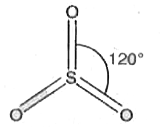 (c) Noble gases are monoatomic gases and are held together by weak van der Waals forces (dispersion forces). Therefore, they are LIQUEFIED at very LOW temperature. Hence they have low boiling points. |
|
| 26. |
Explain: a. Propanol on oxidation with acidic K_(2)Cr_(2)O_(7) can give propanal although in poor yield. b. Acid chloride (RCOCl) with R_(2)Cd and R_(2)CuLi gives ketone but with Grignard reagent (RMgX) gives 3^(@) alcohol. c. R_(2)Cd or R_(2)CuLi reacts with less reactive acid chloride but not with more reactive ketones. |
|
Answer» Solution :a. If the ALDEHYDE is more VOLATILE than the REACTANT alcohol and `H_(2)O`, it can be removed from the reaction mixture by fractional DISTILLATION as it is formed. Boiling point of propanal is `49^(@)C` and that of propanol is `97^(@)C`. So propanol on OXIDATION with acidic `K_(2)Cr_(2)O_(7)` first gives propanal. As it is formed, it is removed by distillation (less boiling point, `49^(@)C`) before it is converted to propanoic acid. b. N/A. c. N/A |
|
| 27. |
Explain a process in which a biocatalyst is used in idustrial preparation of a compound known to you. |
| Answer» Solution :ENZYMES are BIOCATALYST. Munufacture of ALCOHOL by fermentation of STARCH, sucrose, etc. INVOLVES the use of enzymes. | |
| 28. |
Explain : (1) Reversible process (2) Irreversible process. |
|
Answer» Solution : (1) Reversible process :A process carried out in such a manner that at every stage, the driving force is only infinitesimally greater than the opposing force and it can be reversed by an infinitesimal increase in force and the system exists in equilibrium with its surroundings throughout, is called a reversible process. FEATURES : (a) This is a hypothetical process. (b) Driving force is infinitesimally greater than the opposing force throughout the change. (c) The process takes place infinitesimally slowly involving infinite number of steps. (d) Throughout the process, the system exists in equilibrium with its surroundings. (e) In this process, maximum work is OBTAINED. (2) Irreversible process : It is defined as the unidirectional process which proceeds in a definite DIRECTION and cannot be reversed at any stage and in which driving force and opposing force differ in a LARGE magnitude. It is also called a spontaneous process. Features : (a) It takes place without the aid of external agency. (b) All irreversible processes are spontaneous. (c) All natural processes are irreversible processes. (d) Equilibrium is attained at the end of process. |
|
| 29. |
Explain (1) Kolbe's reaction (2) Reimer-Tiemann reaction. |
Answer» Solution :(1) Kolbe's reaction : When phenol reacts with sodium hydroxide, sodium phenoxide is obtained. Phenoxide ion being more reactive than phenol towards electrophilic substitution. Phenoxide undergoes electrophilic substitution with carbon dioxide (a weak electrophile) forms salicylic ACID as major product. 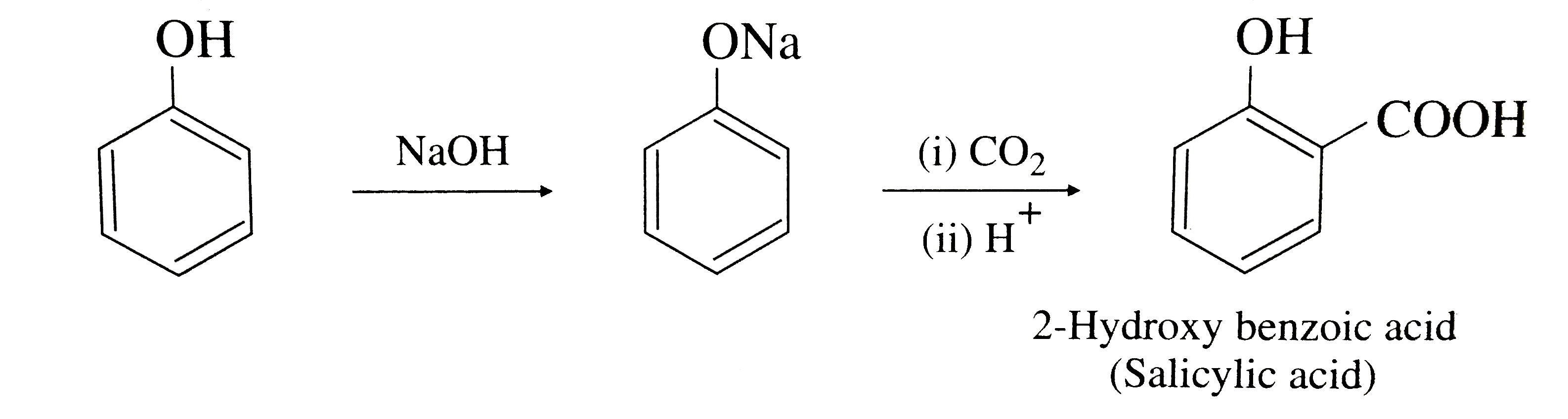 (2) Reimer-Tiemann reaction : Phenol is heated with CHLOROFORM along with aqueous NaOH, this is followed by ACIDIFICATION With dil. HCI when salicyladehyde (2-hydroxy benzaldehyde) is formed a the major product, which can be separated from p-isomer by steam distillation. The stabilityof o-isomeris dueto intramolecularhydrogen bonding. 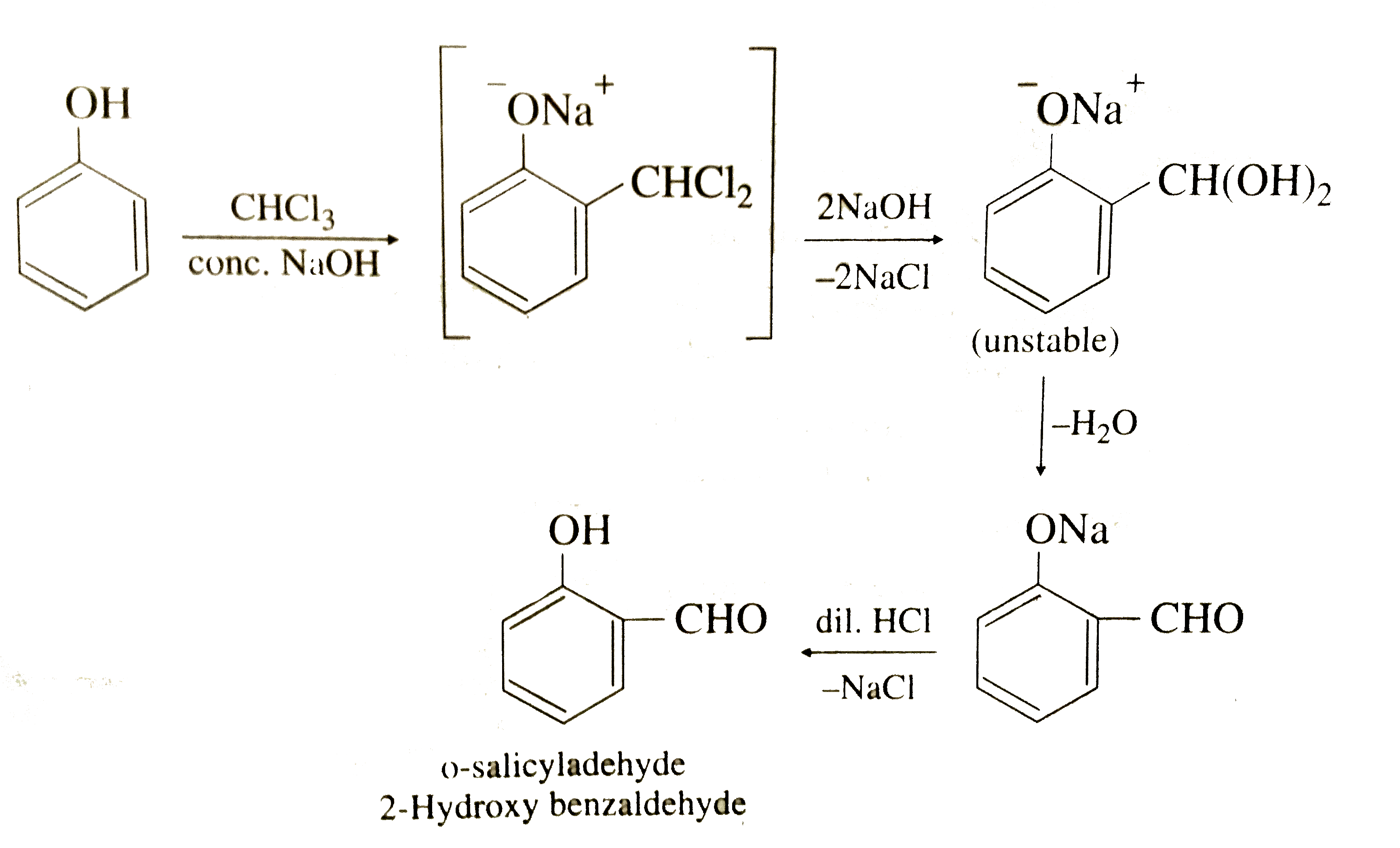
|
|
| 30. |
Explai how does nitrogen exhibit anomalous behaviour amongst group 15 elements. |
|
Answer» Solution :Anomalous behaviour of nitrogen among group 15 elements. Nitrogen is the first amongst group 15 elements, which has, (a) The smallest atomic size. (b) Highest electronegativity. (c ) The highest ionisation ENERGY. (d) Absence of d-orbitals. The difference in the nature between nitrogen and other elements of 15 group are : (i) Nitrogen is a GAS while all the other elements are solid. (ii) Nitrogen exists as diatomic molecule, `(N_(2))` while other elements exist as tetra - atomic molecules `(P_(4),As_(4),Sr_(4)," etc. ")` (iii) Being the highest electronegative element in group 15 nitrogen forms HYDROGEN bonding while other does not. (iv) Nitrogen forms `ppi-dpi` multiple bonds while other elements in the group from `ppi-dpi` multiple bonds. (v) Nitrogen shows wide range of oxidation states from -3 to +5 while other elements show limited oxidation states . (VI) `NH_(3)` is basic while other HYDRIDES are very less basic. (vii) The trihalides of nitrogen (except `NF_(3)` ) are unstable while the trihalildes of the other elements are comparatively stable. (viii) Except nitrogen, all other elements have vacant d- orbitals, and due to this nitrogen does n't undergo formation of coordination compound. |
|
| 31. |
Experimentally it was found that a metal oxide has formula M_(0.98)O .Metal M, is present as M^(2+) and M^(3+) in its oxide. Fraction of the metal which exists as M^(3+) would be : |
|
Answer» `7.01 %` LET `M^(2+)` be X so that `M^(3+)` will be 0.98 - x . Total charge must be zero. `2x + 3 ( 0.98 - x ) - 2 = 0 ` `2x + 2.94 -3x -2 =0` ` -x = - 0.94 ` or ` x = 0.94` FRACTION of metal which exists as `M^(3+)` `= 0.98 - 0.94 = 0.04` Percentage of `M^(3+) = ( 0.04 )/( 0.98) xx 100 = 4.08 %` |
|
| 32. |
Experimentally determined molecular weight of acetic acid in benzene ,comes out to be twice of its original molecular weight. This is because of ________. |
|
Answer» resonance structure |
|
| 33. |
Experiment shows that Nickel oxide has the formula Ni_(0.96)O_(1.00). What friction of Nickel exists as of Ni^(2+) and Ni^(3+) ions ? |
|
Answer» Solution :`"Let the NUMBER of "Ni^(2+)" ion "=x` Then the number of Square CLOSE packing : When the spheres of the second row are placed EXACTLY above those of the first row. This way the spheres are aligned horizontally as well as VERTICALLY. The arrangement is AAA type. Coordination number is 4. `Ni^(3+)" ion will be"=(0.96-x)` `"Total number of CATION, "=2x+3(0.96-x)` `=2x+2.88-3x` `=(-x)+2.88` `"Number of anions "O^(2-)=(-2)xx1=-2` `"Number of cations "="Number of anions"` `-x+2.88=2` `-x=-2.88+2` `x=0.88` `%" of Ni as "Ni^(2+)=(0.88)/(0.96)xx100=91.66%` `"Number of "Ni^(3+)" ion will be "=0.96-x` `=0.96-0.88=0.08` `%" of Ni as "Ni^(3+)=(0.08)/(0.96)xx100=8.33%` |
|
| 34. |
Experimentdetermination of molar mass of compounds may be made by the following methods. Match them property. |
|
Answer» |
|
| 35. |
Expalin the effect of temperature on the extent of physical and chemical adsorption . |
| Answer» Solution :physical adsorption decreases with INCREASE of TEMPERATURE, while CHEMICAL adsorption INCREASES with increase of temperature . | |
| 36. |
Expalin (i) the - OH group attached to aromatic eing in phenols and (ii) alkoxy group in the alkyl aryl ethers are ortho , para directing and activate the aromatic ring towards electrophilic substitution . |
Answer» Solution :The alkoxy in ALKYL aryl ether and hydroxy group in phenol increases the electron density in the aromatic ring (resonance structure I to V) . 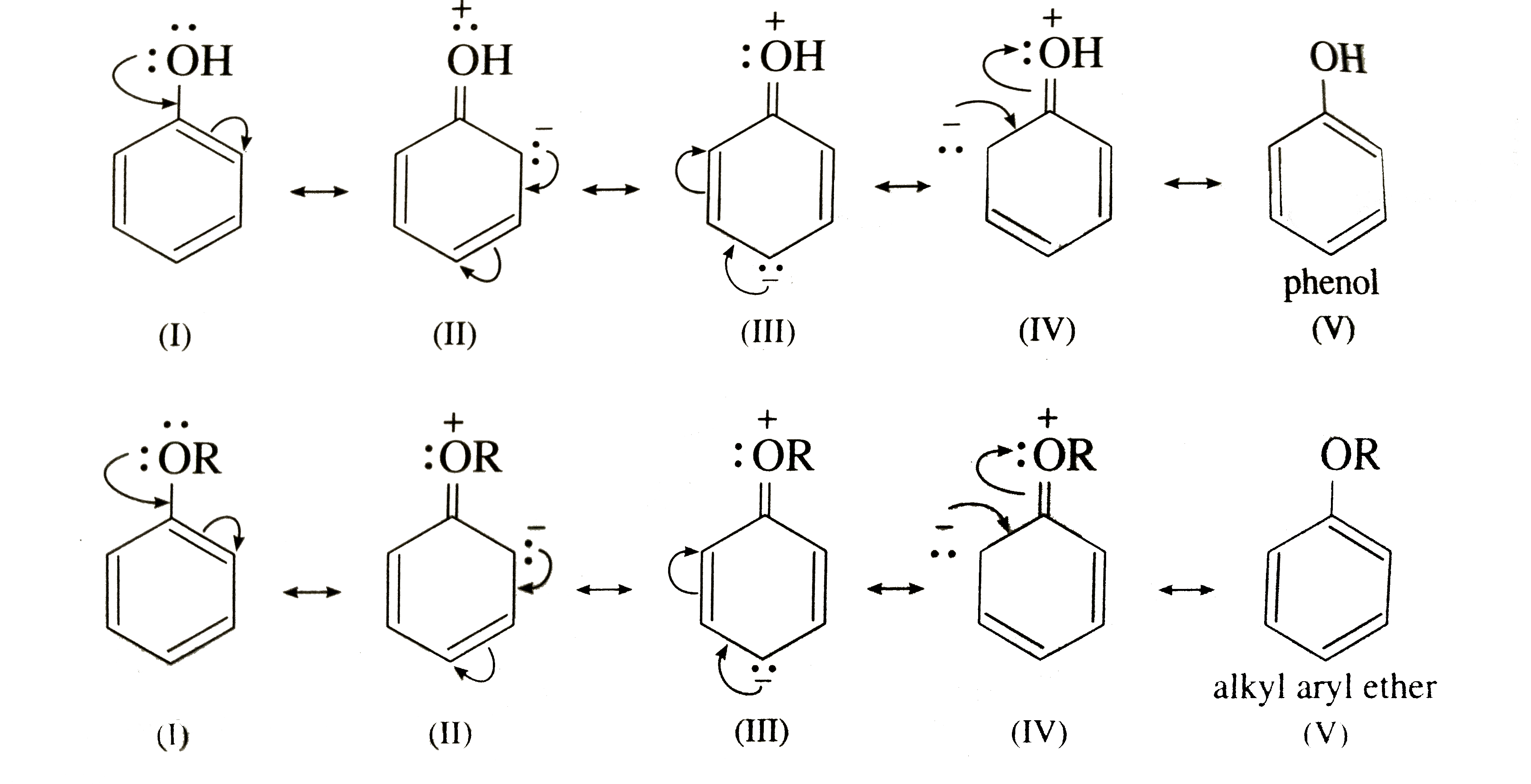 Since the electron density increases more at the two - ORTHO and one para position as compared to, m position , therefore , ELECTROPHILIC substitution TAKES place only at ortho and para POSITIONS in phenols and alkyl aryl ethers. The hydroxyl group and alkoxy group attached to benzene ring in phenol and ethers are strongly acidic as compared to - OH group attached to an alkyl group in alcohols . These groups activate the aromatic ring towards electrophilic substitution . |
|
| 37. |
Expalin SHE as a reference electrode. |
|
Answer» Solution :STANDARD Hydrogen Electrode (SHE) is used as the reference electrode. It has been assigned an ARBITRARILY emf of zero volt. It consists of a platinum electrode in contact with 1M HCl solution and 1 atm hydrogen gas. The hydrogen gas is bubbled through the solution at `25^(@)C`. SHE can act as a cathode as well as an anode. The Half cell reactions are given below. If SHE is used as a cathode, the reduction reactions is `2H^(+)(AQ,1M)+2e^(-) rarr H_(2)(g,1 atm)""E^(@)=0" volt"` If SHE is used as an anode, the oxidation reaction is `H_(2)(g,1atm) rarr 2H^(+)(aq, 1M)+2e^(-)""E^(@)="volt"` Illustration : Let us calculate the reduction potential of zinc electrode dipped in zinc sulphate solution using SHE. Step 1 : The following galvanic cell is constructed using SHE `Zn_((s))abs(Zn^(2+)(aq,1M))abs(H^(+)(aq,1M)|H_(2)(g,1atm))pt_((s))` Step 2 : The emf of the above galvanic cell is measured using a volt meter. In this case, the measured emf of the above galvanic cell is 0.76V. Calculation We know that, `E_(cell)^(@)=(E_("ox")^(@))_(Zn|Zn^(2+))+(E_(RED)^(@))_(SHE)` `E_(Cell)^(@)=0.76 " and " (E_(red)^(@))_(SHE)=0V`. Substitute these values in the above equation `rArr 0.76V=(E_("ox")^(@))_(Zn|Zn^(2+))+0V` `rArr (E_("ox")^(@))_(Zn|Zn^(2+))=0.76V` This oxidation potential corresponds to the below mentioned half cell reaction which takes PLACE at the cathode. `Zn rarr Zn^(2+)+2e^(-)` (Oxidation) The emf for the reverse reaction will give the reduction potential `Zn^(2+)+2e^(-) rarr Zn, E^(@)=-0.76V` `""therefore (E_(red)^(@))_(Zn^(2+)|Zn)=-0.76V` 
|
|
| 38. |
Expalinaboutthe cyclis structure of Glucose . |
|
Answer» Solution :(i) Fischer identifiedthat theopenchain Penta hydroxyl adhehydestrcuture of glucosethat theproposed did notcompletelyexplainits chemicalbehaviour. (ii)Unlikesimplealdehyde , glucose did not formcrystallinebisulphate compound with sodiumbisulphate. Glucose does notnot give Schiff.s TESTAND penta ACETATE derivativeof glucose wasnot oxidisedby Tollen.s reagent. Thisbehaviourcouldnot beexplainedby openchain structure. (iii)  (iv) In order to explain these is was proposed that one of thehydroxyl groupreacts withaldehydegroupto forma cyclic structure(hemiacetal form). This alsoresultsin the conversationof theachiral aldehydecarbon into a chiralone leadingthe possibilityof twoisomers. Thesetowisomersdiffer onlyin theconfigurationof `C_(1)` carbon. Theseisomersare calledanomers. (V) The twoanomericformsof glucoseare called- and `beta` - forms. Thiscyclic structure ofglucoseis similarto pyran, a cyclic compound with 5 carbon and oneoxygenatom, and henceis calledpyranoseform. (vi) The specificrotation of pure`alpha` - and `beta`- (D) glucoseare `112^(@) & 18.7^(@)` respectively. HOWEVER , whenpure form any one of thesesugars dissolved in water slowinterconversion of- D glucoseand `beta` - Dglucose via open chain form until equilibrium is estabishedgivingconstatn specific rotation `+53^(@)` . Thisphenomenone is calledmutarotation. |
|
| 39. |
Expalin : (a) Alcohols have higher boiling points than alkanes, ehters and alkyl halides of comparable molecular mass. (b) ROH with three or fewer carbon atoms are water soluble but those with five or more carbon atoms are insoluble. (c ) When volumes of ethanol and water are mixed, the total volume is less than the sum of the two individual volumes. (d) Ethanol cannotbe used as a solvent with Grignard reagent or LiAlH_(4). (e) The relative acidity of alcohols is in the order of 3^(@) lt 2^(@) lt 1^(@) lt CH_(3)OH. (f) Sodium metal cannot be used to remove last traces of water from ethanol. |
|
Answer» SOLUTION :(a) O-H bond of alocohols is highly POLARIZED. This gives rise to intrahydrogen bonding, i.e., molecules are brought nearer to each other and held together by attractive forces. No such hydrogen bonding EXISTS in alkanes, ethers and alkyl halides. This is the reason why the boiling points of alcohols are HIGHER than alkanes, ehters and alkyl halides of comparable mass. (b) The water solubility of alcohols is atributed to hydrogen bonding with water. However, with increase of carbon atoms, the hydrophobic part increases which predominates the hydrophilic part, ie., OH part of alcohols and thus, the solubility decreases. (c ) Hydrogen bonding between ethanol and water permits the TWO unlike molecules to move closer in the closer in the solution than can ethanol to ethanol and water to water molecules and thus, the total volume decreases. (d ) Ethanol being acidic readily with strongly basic R of Grignard reagent. `CH_(3)CH_(2)OH +RMgX rarr underset(" Alkane")(R-H)+CH_(3)CH_(2)OMgX` `LiAlH_(4)` reacts with alcohol to form hydrogen. `4CH_(3)CH_(2)OH +LiAlH_(4) rarrLiAl(OCH_(2)CH_(3))_(4)+4H_(2)uarr` (e) The order of decrease of acidity from `CH_(3)OH` to `3^(@)` alcohol is attributed due to `+I` effect of alkyl group which intensify the charge on the base `RO^(-)` and the removal of proton becomes difficult. (f) Ethanol beinga acidic reacts with sodium metal, although not as vigorously as water and form sodium ethoxide with evolution of hydrogen. `2CH_(3)CH_(2)OH+2Na rarr 2CH_(3)CH_(2)ONa+H_(2)` |
|
| 40. |
Expain the following: (i) Iodine dissolves more in Kl solution, than impure water (ii) KHF_(2) is well known, where as KHCl_(2) or KHBr_(2) does not excit. (iii) A mixture of He and O_(2) is used for respiration for deep see divers. |
|
Answer» SOLUTION :(i) `I_(2)` is NON polar nature and thus solubility in water (a polar solvent) is less which however becomes more if Kl is present due to complex FORMATION. `I_(2) + Kl to Kl_(3)` (soluble complex) (ii) `H_(2)F_(2)` exist as dimetric molecule due to H-bonding and thus shows diabasic nature. hence, it gives two series of salts `KHF_(2)` as `[K^(+)]` and `F^(-)` ................... H ...... `F^(-)` and KF `[K^(+)]` and `F^(-)` where as HCl and HBr do not show hydrogen bonding and thus formation of `KHCl_(2)` and `KHBr_(2)` is not possible. (iii) Unlike `M_(2)`. helium is not soluble in blood even under high pressure and a mixture of He and `O_(2)` (80.20) is used instead of ordinary air, by divers for respiration. |
|
| 41. |
Expain the SN^2 mechanism |
|
Answer» Solution :When METHYL bromide UNDERGOES hydrolysis with aqueous potassium hydroxide, methyl alcohol is formed `CH_3-Br+KOHtoCH_3-OH+KBr` This mechanism INVOLVES only one step 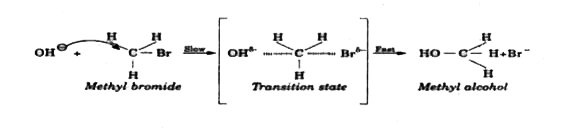 The nucleophile `OH^-` attack from the rear side of the leaving group. A transitlon stale with partial formation of C-OH BOND and partial breaking of C-Br bond takes place simultaneously. The-rate of the reaction depends both on the concentration of nucleophilc as weil as alkyl halide. Hence, it is a second order reaction. In `SN^2` reaction, complete inversion of configuration takes place. |
|
| 42. |
Exothermic reaction among the following is A)Cr_(2) O_(3) + 2All to 2 Cr + Al_(2) O_(3) B) Fe_(2) O_(3) + 2Al to 2 Fe + Al_(2) O_(3) C)3 Mn_(3) O_(4) + 8 Al to 4 Al_(2) O_(3) + 9 Mn |
|
Answer» A, B |
|
| 43. |
Existance of equatic life is an application of |
|
Answer» <P>Henry's law |
|
| 44. |
Exhaustive methylation of CH_(3)CH_(2)NH_(2) forms |
|
Answer» `(CH_(3)CH_(2))_(4)N^(+)OH^(-)` |
|
| 45. |
Excited hydrogen atoms with very large radii have been detected. How large isan H atom with an electron characterised by a quantum number of 106? How many times larger is that than the radius of an H atom in its ground state? |
| Answer» SOLUTION :11236 TIMES LARGER `(106^2)` | |
| 46. |
Excited atoms emits radiations consisting of only certain discrete frequencies or wavelengths. In spectroscopy it is often more convenient to use frequencies or wave numbers than are proportional to energy and spectroscopy involves transitions between energy levels. The line spectrum shown by and mono electronic excited atom (a finger pring of an atom) can be given as 1/(lamda)=barv=R_(A)Z^(2)[1/(n_(1)^(2))-1/(n_(2)^(2))] When Z is atomicnumber of mono electronic atom and n_(1),n_(2) are integers and if n_(2)gtn_(1), then emission spectrum is noticed and if n_(2)ltn_(1), then absorptioni spectrum is noticed. Every line in spectrum can be represented as differences of two terms (R_(A)Z^(2))/(n_(1)^(2)) and (R_(A)Z^(2))/(n_(2)^(2)) The given diagrma indicates the energ levels of certain atom. Where an electron moves from 2E. level to E level, a photon of wavelength of photon emitted during its transition from (4E)/3 level to E level. |
|
Answer» `(LAMDA)/3` |
|
| 47. |
Excited atoms emits radiations consisting of only certain discrete frequencies or wavelengths. In spectroscopy it is often more convenient to use frequencies or wave numbers than are proportional to energy and spectroscopy involves transitions between energy levels. The line spectrum shown by and mono electronic excited atom (a finger pring of an atom) can be given as 1/(lamda)=barv=R_(A)Z^(2)[1/(n_(1)^(2))-1/(n_(2)^(2))] When Z is atomicnumber of mono electronic atom and n_(1),n_(2) are integers and if n_(2)gtn_(1), then emission spectrum is noticed and if n_(2)ltn_(1), then absorptioni spectrum is noticed. Every line in spectrum can be represented as differences of two terms (R_(A)Z^(2))/(n_(1)^(2)) and (R_(A)Z^(2))/(n_(2)^(2)) H-atom in ground state (13.6eV) are excited by monochromatic radiation of photon of energy 12.1 eV. The number of spectral lines emitted in H-atom will be |
|
Answer» 1 |
|
| 48. |
Excited state configuration of Mn^(2+) is |
|
Answer» `t_(2G)^(4)` |
|
| 49. |
Exchange of co-ordination group by a water molecule in complex molecule results in: |
|
Answer» |
|