Saved Bookmarks
This section includes 7 InterviewSolutions, each offering curated multiple-choice questions to sharpen your Current Affairs knowledge and support exam preparation. Choose a topic below to get started.
| 1. |
1,1 Ethylidene dichloride to acetaldehyde |
Answer» SOLUTION :Ethylidene DICHLORIDE to ACETALDEHYDE : 
|
|
| 2. |
Ethylidene dichloride when boiled with aqueous solution of NaOH yields- |
|
Answer» FORMALDEHYDE |
|
| 3. |
Ethylidene dichloride on treatment with aq.KOH gives: |
|
Answer» `CH_3CHO` |
|
| 4. |
Ethylidene dichloride on treatment with aq. KOH gives |
|
Answer» HCHO |
|
| 5. |
Ethylidene chloride on treatment with aqueous KOH gives ? |
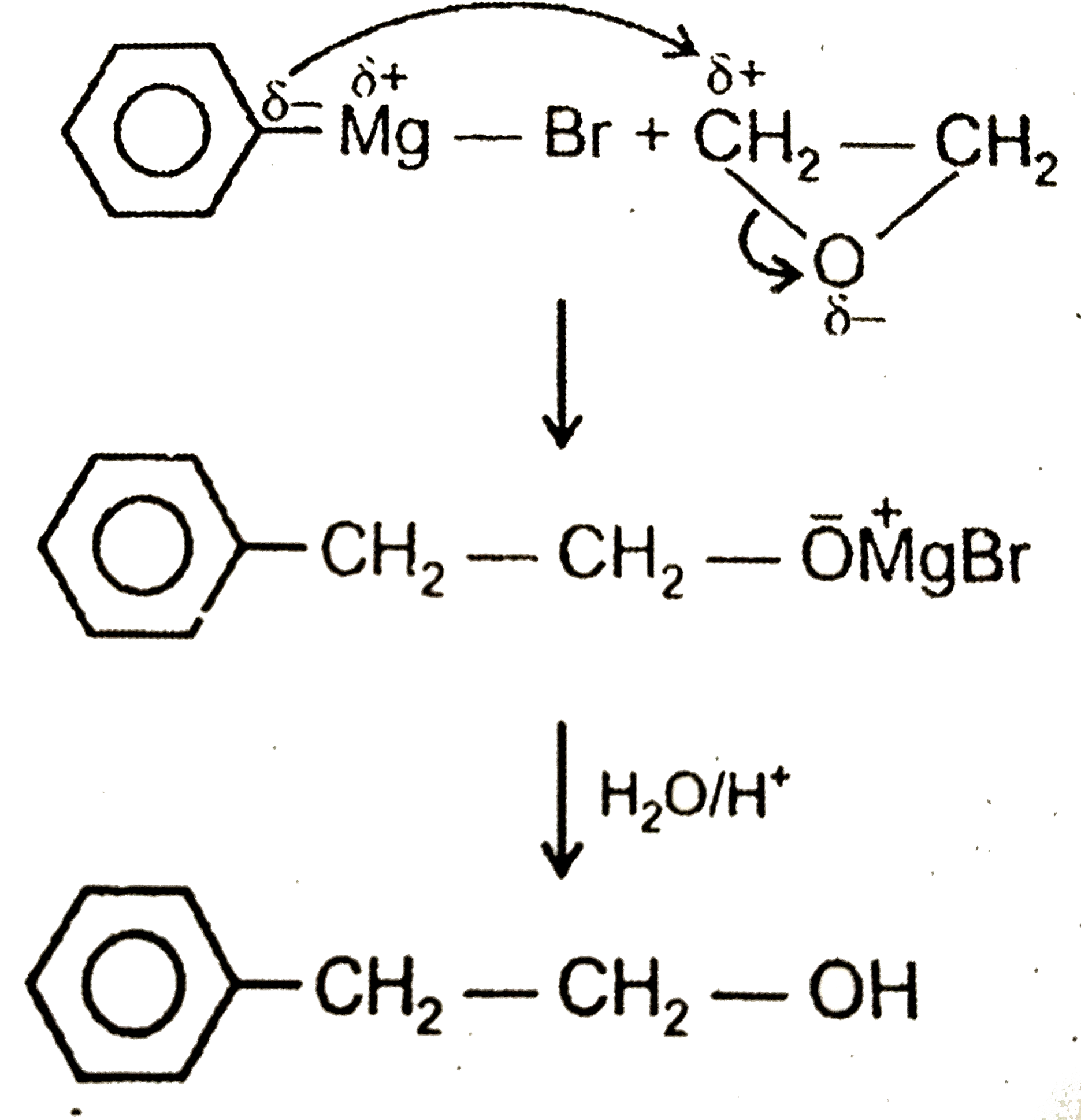
| Answer» Answer :A | |
| 6. |
Ethylidene chloride is a/an |
|
Answer» Gem-dihalide |
|
| 7. |
Ethylidene chloride on hydrolysis with aq. NaOH gives |
|
Answer» `CH_(3)CHO` |
|
| 8. |
Ethylidene chloride is a/an_____ |
|
Answer» vic-dihalide |
|
| 9. |
Ethylidene chloride and ethylene chloride are isomeric compounds. Which of the following statements is not true about these? |
|
Answer» Both of these react with alcoholic KOH and give the same product |
|
| 10. |
Ethylene undergoes combustion according to the thermochemical equation : C_(2)H_(4)(g)+3O_(2)(g) to 2CO_(2)(g)+2H_(2)O(l), DeltaH^(@)=-337 kcal Assuming 70% efficiency, how much water at 20^(@) C can be converted into steam at 100^(@)C by the combustion of 10^(3) litres of C_(2)H_(4) gas at NTP ? |
|
Answer» SOLUTION :Mole of `C_(2)H_(4)=(1000)/(22.4)=44.6` Total heat evolved `=44.6xx337=1.5xx10^(4)"KCAL"` `:.`useful heat `=0.7xx1.5xx10^(4)=1.05xx10^(4)"kcal"` Now, WATER evaporation TAKES place in two stages: `H_(2)O(1,20^(@)C) to H_(2)O(1,100^(@)C),DeltaH=80"kcal//kg"` and `H_(2)(1,100^(@)C) to H_(2)O(g,110^(@)C),DeltaH=540 "kcal//kg"` `:. H_(2)O(1,20^(@)C) to H_(2)O(g,100^(@)C),DeltaH=620"kcal//kg"` `:.` weight of water converted to steam `("amount of heat available")/("heat requiredper kg")` `=(1.05xx10^(4))/(620)=16.9kg` |
|
| 11. |
Ethylendiamine (en) |
|
Answer» Monodendate ligand and can OCCUPY one position in COORDINATION polyhedron |
|
| 12. |
Ethylidene chloride is a/an ……….. . |
|
Answer» vic-dihalide |
|
| 13. |
Ethylene readily undergoes the following type of reaction: |
|
Answer» ADDITION |
|
| 14. |
Ethylene reacts with sulphur monochloride to give |
|
Answer» ETHYLENE chloride |
|
| 15. |
Ethylene readily undergoes |
|
Answer» ADDITION reaction |
|
| 17. |
Ethyne reacts with dil H_2SO_4 inpresence of HgSO_4 to give: |
|
Answer» Ethanal |
|
| 18. |
Ethylene reacts with Baeyer's reagent to give |
|
Answer» Ethane |
|
| 19. |
Ethylene reacts with Baeyer.s reagent to give : |
|
Answer» ETHANE |
|
| 20. |
Ethylene reacts with alkaline KMnO_(4) to give : |
|
Answer» acetaldehyde |
|
| 21. |
Ethylene reacts with alkaline KMnO_(4) to form |
|
Answer» OXALIC acid |
|
| 22. |
Ethylene reacts with 1% cold alkaline KMnO_4 to give: |
|
Answer» OXALIC acid |
|
| 23. |
Ethylene-propylene rubber (EPR) is |
|
Answer» UNSATURATED and stereoregular |
|
| 24. |
Ethylene oxide when treated with Grignared reagent yeild |
|
Answer» Cyclopropyl alcohol |
|
| 25. |
Ethylene oxide when treated with followed by hydrolysis yields |
|
Answer»
|
|
| 26. |
Ethylene ontreatment with chlorine gives : |
|
Answer» ETHYLENE dichloride |
|
| 27. |
Ethylene on interaction with sulphur monochloride gives : |
|
Answer» Mustard gas |
|
| 28. |
Ethylene may be prepared by the dehydration of: |
|
Answer» ETHYL alcohol |
|
| 30. |
Ethylene may be obtained by dehydration of which of the following with concentratedH_(2)SO_(4) at 160-170^(@)C |
|
Answer» `C_(2)H_(5)OH` |
|
| 31. |
Ethylene is produced by cyclobutane…according to the reaction : C_(4)H_(8)overset(Delta)rarr2C_(2)H_(4) The rate constant is 2.48xx10^(-4)sec^(-1). Inwhat time will the molar ratio of the ethylene to cyclobutane in reaction mixture attain the value 1? |
|
Answer» `27.25` MINUTE |
|
| 32. |
Ethylene is shaken with a water solution of Br_(2) and NaC1. Which of the following will not be the possible product ? |
|
Answer» `BrCH_(2)CH_(2)C1` |
|
| 33. |
Ethylene is produced by C_4H_8oversetDeltararr2C_2H_4Cyclobutane. The rate constant is 2.48 xx 10^-4sec^-1. In what time will the molar ratio of the ethylene to cyclobutane in reaction mixture attain the value 1: |
|
Answer» 27.25 minute |
|
| 34. |
Ethylene is an unsaturated hydrocarbon which decolourises Br_(2)//C Cl_(4) and alkaline KMnO_(4) solutions. In contrast, benzene is highly unsaturated yet it does not give the above reactions. This is because |
|
Answer» ` Br_2//C Cl_4` and ALKALINE `KMnO_4` are MILD reagents |
|
| 35. |
Ethylene is converted to X on passing through a mixture of acidified aqueous solution of palladium chloride and cupric chloride. Which of the following reagents readily takes part addition reaction with X |
|
Answer» `Br_2` |
|
| 36. |
Ethylene is formed by the dehydration of |
| Answer» Solution :N/A | |
| 37. |
Ethylene is formed by dehydration of : |
|
Answer» `CH_3CHO` |
|
| 38. |
Ethylene is a member of ……...series |
|
Answer» Alkyne |
|
| 39. |
Ethylene into ethyl methyl ether |
|
Answer» Solution :ETHYLENE into ETHYL methyl ETHER `underset("ethylene")(CH_(2))=CH_(2)+HBrrarrunderset("ethyl bromide")(CH_(3)CH_(2)Br)` `CH_(3)CH_(2)Br+underset("sodium methoxide")(CH_(3)ONa)overset(DELTA)rarrunderset("ethyl methyl ether")(CH_(3)-CH_(2)-O)-CH_(3)+NaBr` |
|
| 40. |
Ethylene has high b.p. and high vapour pressure at 100^@ C and does not dissolve in water. Hence ethylene is separated by this method |
|
Answer» SIMPLE distillation |
|
| 41. |
Ethylenegylcol gives oxalic acid on oxidation with |
|
Answer» ACIDIFIED `K_(2)Cr_(2)O_(7)` `{:(CH_(2)OH ""COOH),(|""+4[O]underset(H_(2)SO_(4))overset(K_(2)Cr_(2)O_(7))to |""+2H_(2)O),(underset("Ethylene glycol")(CH_(2)OH)""underset("Oxalic acid")(COOH)):}` |
|
| 42. |
Ethylene glycol, when héated to 773 K, it forms ………………….. . |
| Answer» SOLUTION :EPOXIDE (or) 1,2-epoxy ETHANE (or) OXIRANE | |
| 43. |
Ethylene glycol on oxidation with periodic acid gives |
|
Answer» FROMALDEHYDE |
|
| 44. |
Ethylene glycol (molar mass = 62 g "mol"^(-1)) is a common automobile antifreeze. Calculate the freezing point of a solution containing 12.4 g of this substance in 100 g of water. Would it be advisable to keep this substance in the car radiator during summer ? Given : K_f for water = 1.86 K kg/mol, K_bfor water = 0.512 K kg/mol. |
|
Answer» SOLUTION :(i)Molality of the solution (m) = ` = (12.4 xx 1000)/(62 xx 100) = 2` ` Delta T_f = K_f xx m = 1.86 xx 2 = 3.72 K` Freezing point of the solution = 273.15 K - 3.72 K = 269.43 K (ii) `Delta T_b = K_bxx m = 0.512 xx 2 = 1.024 K` Boiling point of the solution = 373 K + 1.024 K = 374.02 K Yes, it is ADVISABLE to KEEP this SUBSTANCE in the car radiator during summer. |
|
| 45. |
Ethylene glycol on oxidation with per-iodic acid gives: |
|
Answer» OXALIC acid |
|
| 46. |
Ethylene glycol onheating with conc H_(2)SO_(4) gives |
|
Answer» FORMIC ACID |
|
| 47. |
Ethylene glycol is used as antifreeze in a cold climete. Mass of ethylene glycol which should be added to 4 kg of water = 1.86 K kg mol^(-1), molar mass of ethylene glycol = 62 g mol,^(-1) ) |
|
Answer» 804.32 g `=((62h MOL^(-1))xx(6K)xx(4KG))/((1.86"K kg" mol^(-1)))=800 g` |
|
| 48. |
Ethylene glycol is used as an antifreeze in a cold climate. Mass of ethylene glycol which should be added to 4 kg of water to prevent it from freezing at -6^(@)C will be : [K_(f) for water ="1.86 K kg mol"^(-1), and molar mass of ethylene glycol = "62 g mol"^(-1)] |
|
Answer» 204.30g |
|
| 49. |
Ethylene glycol is used as an antifreeze in a cold climate. Mass of ethylene glycol which should be added to 4 kg of water to prevent it from freezing at - 6^(@)C will be ( K for water = 1.86 "K kg mol"^(-1), and molar mass of ethylene glycol = 62 g "mol"^(-1) ) |
|
Answer» 400.00 g `6=(1.86xx1000xxw_(2))/(4000xx62)` `w_(2)=(6xx4000xx62)/(1.86xx1000)=800G` |
|
| 50. |
Ethylene glycol is used as an antifreeze in a cold climate. Mass of ethylene glycol which should be addedto 4 kg of water to prevent it from freezing at -6^(@)C will be (K_(f) for water = 1.86 Kkg mol^(-1), and molar mass of ethylene glycol =62 g mol^(-1)) |
|
Answer» 80.32 G `6=1xx1.86xx(W)/(62xx4)rArr w=804.32 g` |
|