

Saved Bookmarks
This section includes 7 InterviewSolutions, each offering curated multiple-choice questions to sharpen your Current Affairs knowledge and support exam preparation. Choose a topic below to get started.
| 1. |
Ethylene glycol is prepared by the hydrolysis of __________ . |
|
Answer» `{:(CH_(2)BR),(|),(CH_2Br):}` |
|
| 2. |
Ethylene glycol, glycol (ethane-1,2-diol), the simplest glycol may be prepared by |
|
Answer» `(i),(ii)` (ii) `CH_(2)=CH_(2)+HOClrarrClCH_(2)CH_(2)OHoverset(aq.NaHCO_(3))(rarr)HOCH_(2)CH_(2)OH+NaCl+CO_(2)`We can ALSO boil ethlene chlorohydrin with milk of lime: 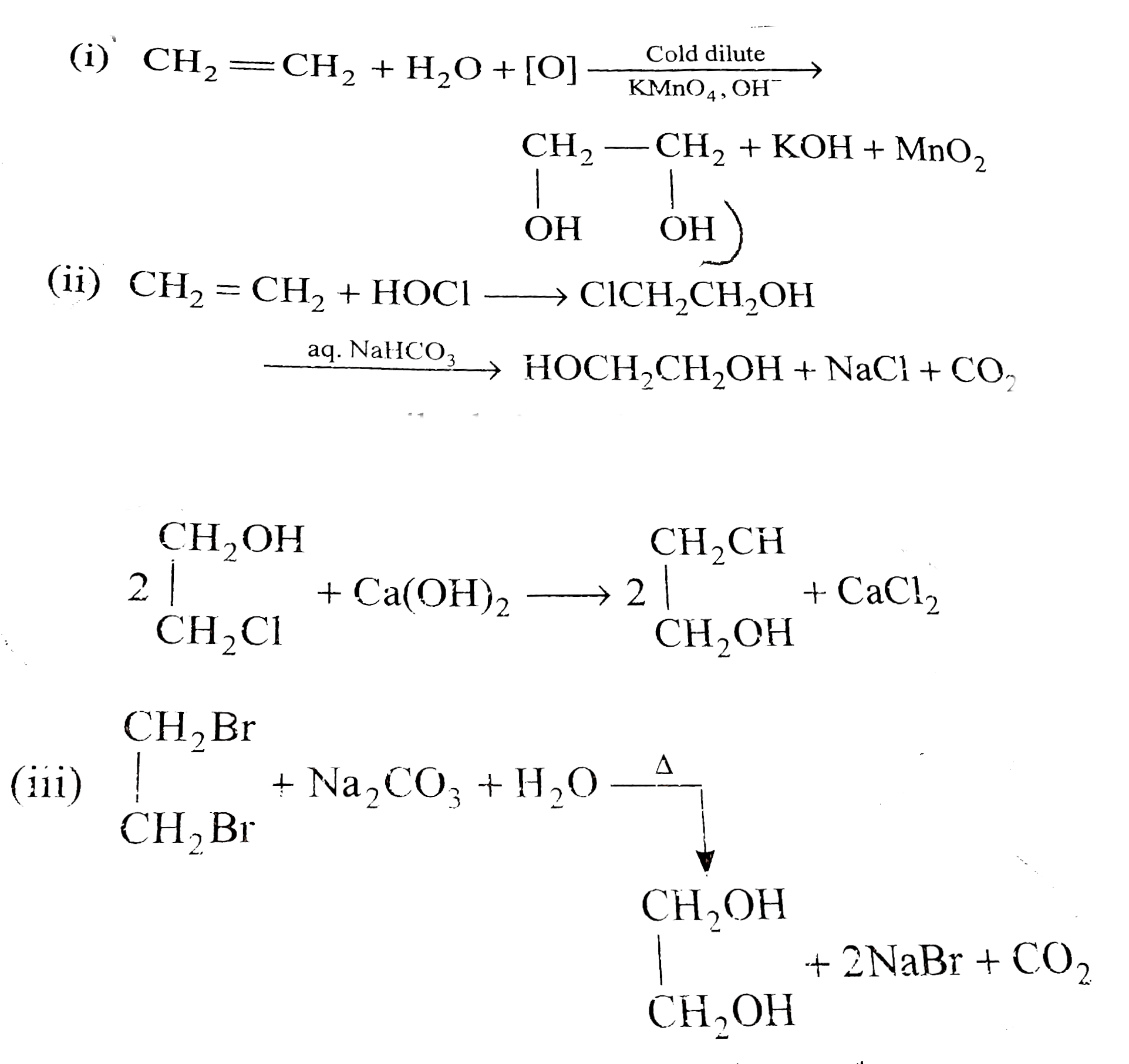 The low yield in this reaction is due to the conversion of some ethylene dibromide into vinyl BROMIDE: `BrCH_(2)CH_(2)Br+Na_(2)CO_(3)rarrCH_(2)=CHBr+NaBr+NaHCO_(3)` If aqueous sodium hydroxide is used instead of sodium carbonate, vinyl bromide is again obtained as a byproduct. the best yield of glycol is obtained by heating ethylene dibromide with potassium acetate in glacial acetic acid and subsequently hydrolysing the glycol diacetate with hydrogen chloride in methanolic solution `BrCH_(2)CH_(2)Br+2CH_(3)COOKrarrCH_(2)(OCOCH_(3))CH_(2)(OCOCH_(3))+2KBroverset(HCl)(rarr)HOCH_(2)CH_(2)OH` (iv) 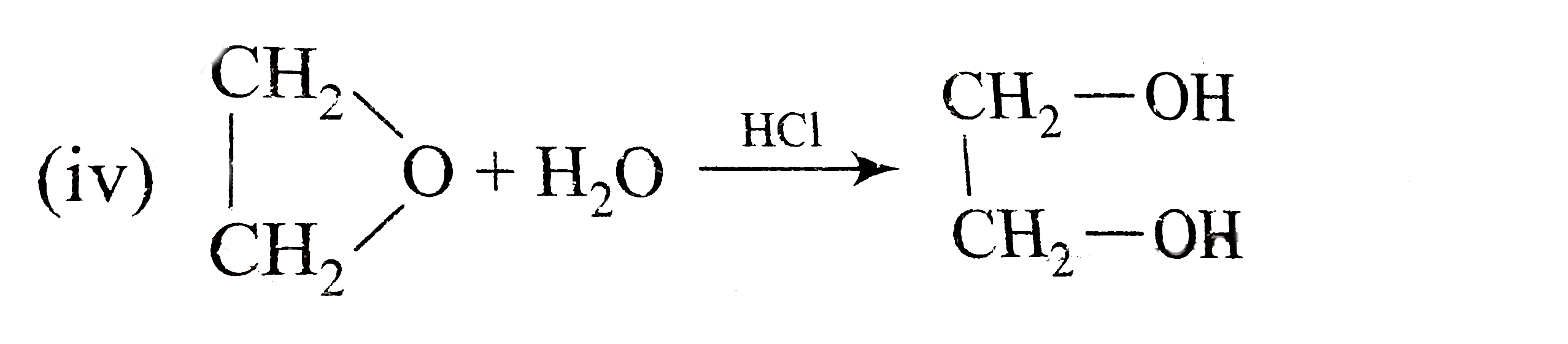 Ethylene oxide is made by passing ethylene andair over a silver catalyst at `300^(@)C`. Notice that glycol is prepared INDUSTRIALLY by this method and also by the CATALYTIC reduction of methyl glycollate: 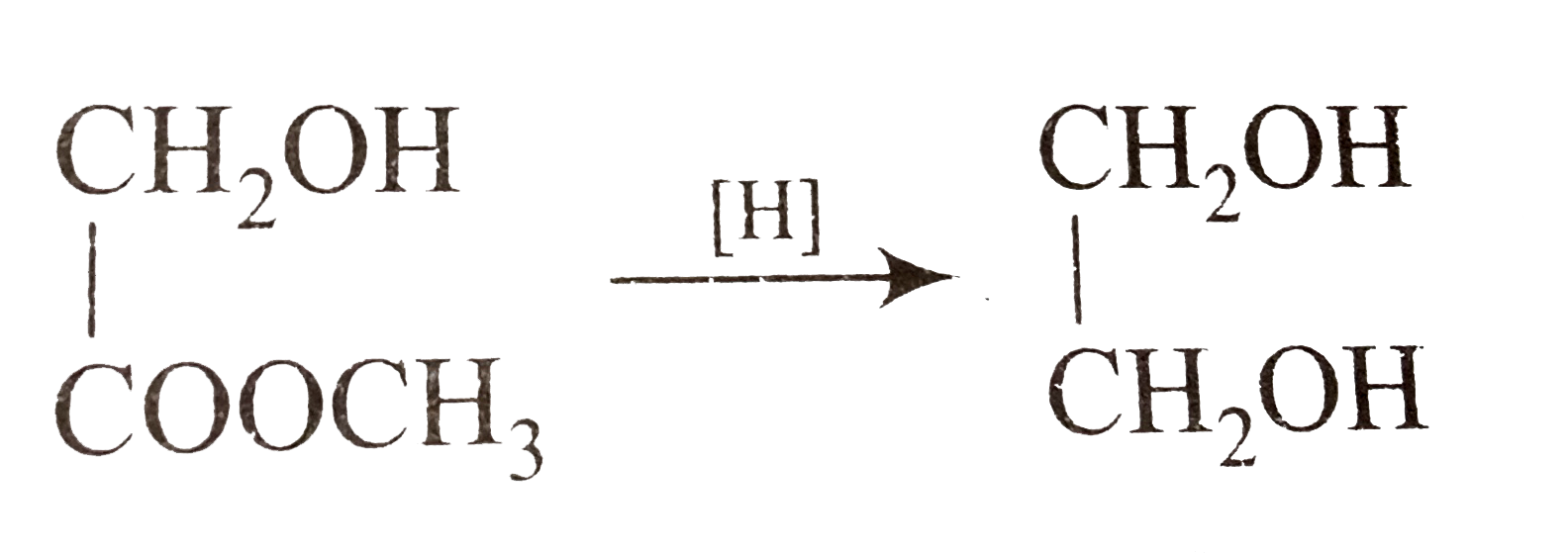 The first three methods are used for the laboratory preparation of glycol |
|
| 3. |
Ethylene glycol, CH_(2)OH*CH_(2)OH the major component of permanent antifreeze, effectively depresses the freezing point of water in an automobile radiator. What minimum weight of ethylene glycol must be mixed with 6 gallons of water to protect it from freezing at -24^(@)C. (1 gallon =3.785 lit, K_(f)=1.86) ? |
|
Answer» SOLUTION :We have, `DeltaT_(F)=K_(f)XX` molality `:.` molality `=(DeltaT_(f))/(K_(f))=(24)/(1.86)=12.90` (f.p. of `H_(2)O=0^(@)C`) Thus, `1kg` of `H_(2)O` should contain `12.90` moles of ethylene GLYCOL. `:.22.7kg` (i.e., 6 gallons) of `H_(2)O` should contain `12.90xx22.7` moles `=(12.90xx22.7xx62)g` `=18155g` `=18.155kg` of `CH_(2)OH*CH_(2)OH` `(CH_(2)OH*CH_(2)OH=62)` |
|
| 4. |
Ethylene glycol is dehydrated to diethylene glycol by _________. |
|
Answer» CONC. `H_(3)PO_(4)` |
|
| 5. |
Ethylene glycol and phthalic acid are monomers of |
|
Answer» NYLON - 6 |
|
| 6. |
Ethylene from ethyl bromide is obtained by treating it with : |
|
Answer» Hydrogen |
|
| 7. |
Ethylene forms ethylene chlorohydrin by the action of : |
|
Answer» DRY chlorine GAS |
|
| 8. |
Ethylene dibromide (C_(2)H_(4)Br_(2))and 1, 2 - dibromo propane from a series of ideal solutions over the whole range of composition. At 85^(@)C, the vapour pressure of these two liquids are 173 and 127 torr respectively. What would be the mole fraction of ethylene dibromide in a solution at 85^(@)C equilibrated with 1:1 molar mixture in the vapour? |
|
Answer» Solution :Suppose the mole fraction of ethyene dibromide in the liquid phase = x. Then mole fraction of 1, 2- dibromo PROPANE will be `=1-x`. Vapour pressure of ethylene dibromide `=x xx p^(@)=x xx"173 TORR = 173 x torr"` Vapour pressure of 1, 2- dibromo propane `=(1-x)xx"127 torr"` As they have `1:1` molar ratio in the vapour phase, `173x=(1-x)xx127 or 173x=127-127x or 300x=127 or x=(127)/(300)=0.423.` |
|
| 9. |
Ethylene dichloride and ethylidine chloride are isomeric compounds. The false statement about these isomers is that they |
|
Answer» REACT with alcoholic POTASH and give the same product While ethylidine chloride gives acetaldehyde. 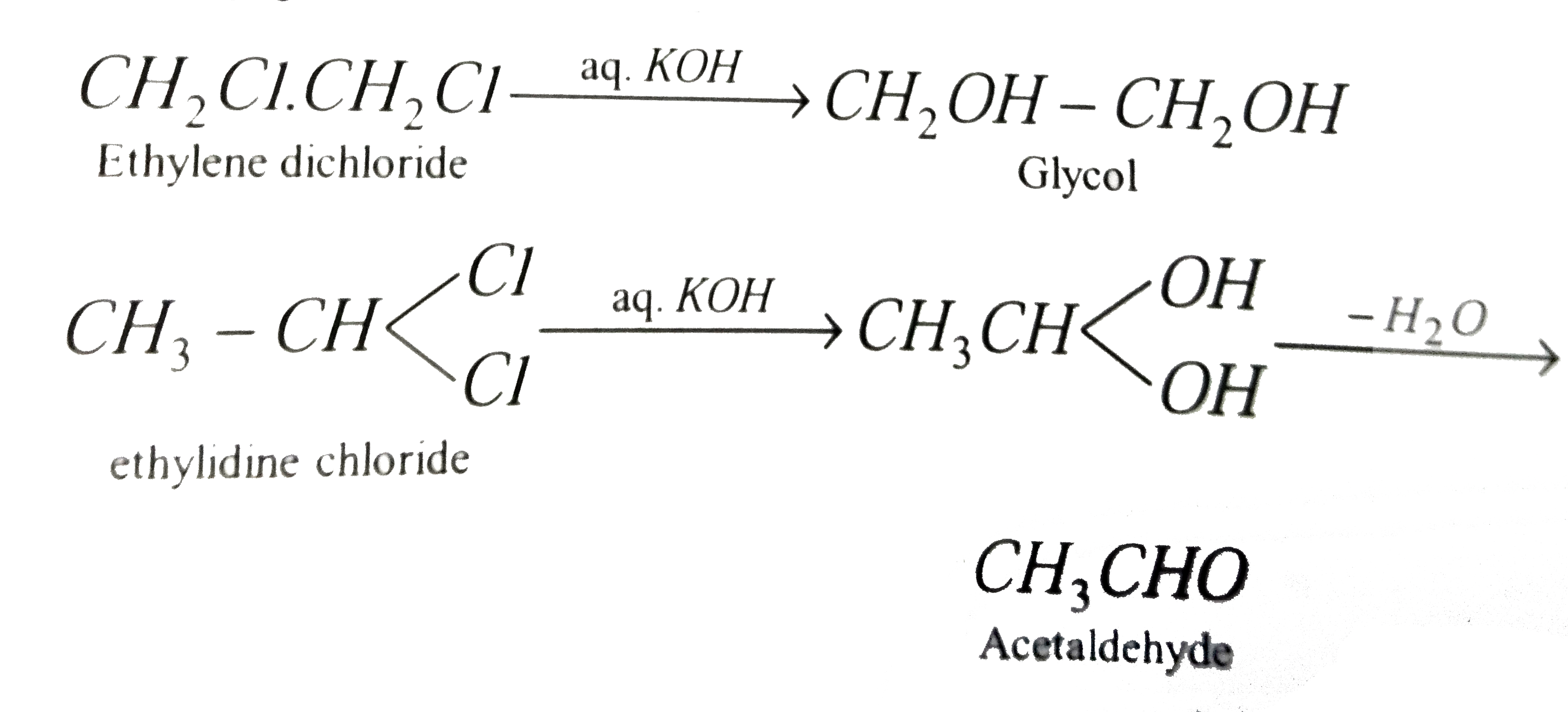
|
|
| 10. |
Ethylene dichloride can be prepared by adding HCl to : |
|
Answer» ETHANE |
|
| 11. |
Ethylene dichloride and ethylidene chloride are isomeric compounds. Identify the statement Which is not applicable to both of them: |
|
Answer» React with ALCOHOLIC potash |
|
| 12. |
Ethylene diamine tetraacetate has the structure as………. . |
|
Answer» |
|
| 15. |
Ethylene diamine is an example of a………. Ligand : |
|
Answer» monodentate |
|
| 16. |
Ethylene chloride and ethylidene chloride are isomers. Identify the correct statements. |
|
Answer» both the compounds form same product on treatment with alcoholic KOH `UNDERSET("Ethylene CHLORIDE")(ClCH_(2))-CH_(2)Cl"or"underset("Ethylidene chloride")(CH_(3)CHCl_(2)) underset(-2" HCl")overset("Alc. KOH")to underset("Acetylene")(HC-=CH)` (b) both the compounds form different products on treatment with aq. NaOH. `underset("Ethylene chloride")({:(CH_(2)Cl,),(|,),(CH_(2)Cl,):})overset(Aq." "NaOH)to underset("Ethylene glycol")({:(CH_(2)OH,),(|,),(CHCl_(2),):}) overset(Aq.NaOH)to {:(CH_(3),),(|,),(CH(OH)_(2),):}underset(-H_(2)O)to underset("Acetaldehyde")({:(CH_(3),),(|,),(CHO,):})` (c) Both the compounds form same product, i.e., ethane on reduction. `ClCH_(2)CH_(2)Cl` or `CH_(3)CHCl_(2) overset("Reduction")to underset("Ethane")(CH_(3)-CH_(3))+2HCl` (d) Both the comounds are not optically active. thus, options (a) and (c) are correct. |
|
| 17. |
Ethylene can be prepared by electrolysis of an equeous solution of |
|
Answer» SODIUM acetate |
|
| 18. |
Ethylene can be prepared by electrolysis of an aqueous solution of: |
|
Answer» SODIUM acetate |
|
| 19. |
Ethylene can be formed by electrolysis of which sodium sald |
|
Answer» OXALIC acid |
|
| 20. |
Ethylchloride to propanamine-1 |
| Answer» SOLUTION :`CH_(3)- CH_(2)-CL overset(KCN)RARR CH_(3)CH_(2)CN overset(LiAlH_(4))rarr CH_(3)-CH_(2)-CH_(2)-NH_(2)` | |
| 21. |
Ethylbenzene withbrominein the presenceofFeBr_(3)gives : |
|
Answer»
|
|
| 22. |
Ethylbenzene can be prepared from benzene by Friedel- Crafts reaction in the following manner. (i) by treating with ethyl chloride in presence of AICI_(3) (ii) by treating excess of benzene with ethyl chloride in presence of AICI_(3) (iii) by treating benzene with vinyl chloride in presence of AICI_(3) followed by reduction (iv) by acetylation of benzene followed by Clemmerisen reduction |
|
Answer» by (IV) |
|
| 23. |
Ethylbenzene to benzoic acid |
Answer» SOLUTION :
|
|
| 24. |
Ethylamine undergoes oxidation in the presence of KMNO_(4) to give: |
|
Answer» Ethylamine UNDERGOES oxidation in the PRESENCE of `KMnO_(4)` to give :acid |
|
| 25. |
Ethylamine to ethyl alcohol |
|
Answer» Solution :ETHYLAMINE to ethyl alcohol : `underset("ethylamine")(C_(2)H_(5)-NH_(2))+HO-N=Ooverset(NaNO_(2)+"dil. HCL")rarrunderset("ethyl alcohol")(C_(2)H_(5)OH)+H_(2)O+N_(2)uarr` |
|
| 26. |
Ethylaminereacts withof the followingto giveethylammonium chloride ? |
| Answer» Solution :Ethylaminebeingbasicin N/Ature.Reactswith acid. | |
| 27. |
Ethylamine reacts with nitrosyl chloride (NOCl) to form: |
| Answer» Answer :A | |
| 28. |
Ethylamine reacts with nitrosyl chloride (NOCI) to form: |
| Answer» Answer :A | |
| 29. |
Ethylamine reacts with nitrosyl chloride (NO) to form |
|
Answer» ETHYL chloride |
|
| 30. |
Ethylamine on heating with CS_(2) in presence of HgCl_(2) forms |
|
Answer» `C_(2)H_(5)NCS` |
|
| 31. |
Ethylamine is soluble in water whereas aniline is almost insoluble. Why? |
Answer» SOLUTION : Ethylamine forms H-bonds with water. Hence, it soluble in water.  In contrast, the large hydrocarbon PART of ANILINE retards the tendency of `- NH_2` group to FORM HYDROGEN bonds with water. Hence, it is almost insoluble in water. |
|
| 32. |
Ethylaminecan beobtainedby theacitonof |
|
Answer» `NH_(3) + C_(2) H_(5)L` |
|
| 33. |
Ethyl propionate is formed from ethyl iodide and what ? |
|
Answer» `C_(2)H_(5)COOH` |
|
| 34. |
Ethylamine and diethylamine cannot be differentiated by : |
|
Answer» Hinsberg test `Et-NH-Et rarr -ve` iodoform |
|
| 35. |
Ethylacetate reacts with NH_(2)NHCONH_(2) to form : |
|
Answer» `CH_(3)CONHCONHNH_(2)` |
|
| 36. |
Ethyl propanote on reduction with LiAIH_4 yields : |
|
Answer» Methanol |
|
| 37. |
Ethyl phenyl ether is reacted with cold conc. HBr gives |
|
Answer» PHENOL and ethane |
|
| 38. |
Ethyl orthoformate is formed by heating with sodium ethoxide |
|
Answer» `CHCl_(3)` 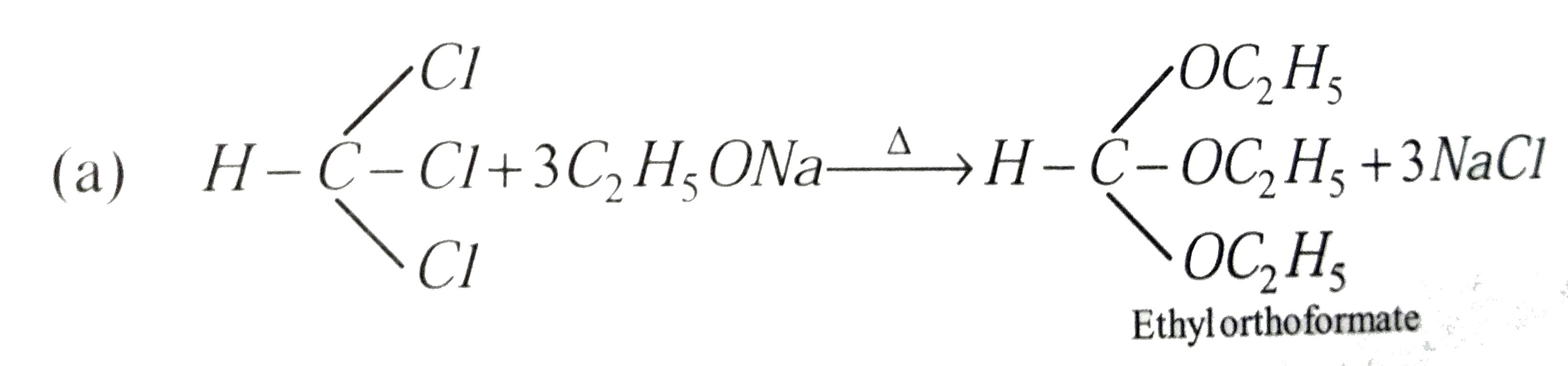
|
|
| 39. |
Ethyl methyl ketone is obtained by heatingcalcium salts of |
|
Answer» fromic ACID + propionic acid |
|
| 40. |
Ethyl phenyl ether on reaction with excess HI yields |
|
Answer» ETHYL iodide and iodobenzene |
|
| 41. |
Ethyl methyl ketone is obtained by heating calcium salts of |
|
Answer» formic acid + propionic acid `C_(2)H_(5) COCH_(3)` The structure shows the presence of 4 CARBON atoms , thus the calcium salts must be of acetic acid and propionic acid to form `C_(2)H_(5)COCH_(3)` . `(C_(2)H_(5) COO)_(2) Ca + (CH_(3)COO)_(2) Ca overset("Distill")(to) C_(2)H_(5)COCH_(3) + CaCO_(3)` |
|
| 42. |
Ethyl methyl ketone is obtained by heating calcium salt of |
|
Answer» FORMIC ACID + propionic acid |
|
| 43. |
Ethyl lcohol on oxidation with K_(2)Cr_(2)O_(7) gives |
|
Answer» Acetic acid |
|
| 44. |
Ethyl isocyanide on hydrolysis in acidic medium generates |
|
Answer» PROPANOIC ACID and ammonium salt |
|
| 45. |
Ethyl methyl carbinol is, |
|
Answer» n-BUTYL ALCOHOL |
|
| 46. |
Ethyl iodide when treated with dry silver oxide gives |
|
Answer» Ethanol |
|
| 47. |
When ethyl Iodide is treated with dry silver oxide it forms |
|
Answer» ETHYL ALCOHL |
|
| 48. |
Ethyl iodide on treatment with sodium methoxide gives |
|
Answer» `CH_3-O-CH_3` |
|
| 49. |
Ethyl iodide when heated with sodium metal in dry ether yields: |
|
Answer» `C_2H_4` |
|


