

Saved Bookmarks
This section includes 7 InterviewSolutions, each offering curated multiple-choice questions to sharpen your Current Affairs knowledge and support exam preparation. Choose a topic below to get started.
| 1. |
Decomposition of hydrogen peroxide in alkaline medium in presence of iodide (I^(-))catalyst occurs according to the equation:2H_(2)O_(2)underset("alkali")overset(I^(-))rarr2H_(2)O(l)+O_(2)(g) A proposed mechanism for this reaction involves the following steps : Step-I : H_(2)O_(2)(l)+I^(-)(aq)rarrH_(2)O(l)+IO^(-)(aq)("slow") Step-II : H_(2)O_(2)(l)+IO^(-)(aq)rarrH_(2)O(l)+IO^(-)(aq)+O_(2)(g)("fast")Write rate law for the reaction . |
|
Answer» Solution :Rate EQUATION of a reaction=rate equation of the SLOWEST STEP of the reaction. Hence , the rate equation of the reaction `=k[H_(2)O_(2)][I^(-)]` |
|
| 2. |
Decomposition of H_2O_2 was studied by titration against KMnO_4 solution. It was found that 0.4 mole of H_2O_2 was reduced to 0.2 mole in 20 minutes and to 0.1 mole in 40 minutes and to 0.05 mole after one hour. The order of reaction must be |
|
Answer» 0 |
|
| 3. |
Decomposition of H_2O_2 (Ist order) H_2O_2(aq)toH_2O(l)+1/2O_2(g) Can be monitored by titration method by pressure measurement.If {:("time(min.)",t=0,30,oo),("Pressure (mm of Hg)",200,375,400):} While when progress of same reaction was monitored by titration method or the volume of titrant consumed after 10 min was found to be 20 ml.Then complete the following table. {:("Time(min)",t=0,10,30),("Pressure(mm of Hg)",200,(b),(c )),("Volume of" KMnO_4,(a),20,(d)):} consumed (ml) |
|
Answer» `T_(1//2)=(30 "min")(ln2)/(ln8)=10` min So, we will have `{:("Time(min)",t=0,10,30),("Pressure (in MM of Hg)",200,300,375),("Volume of" KMnO_4"consumed (ML)",40,20,5):}` |
|
| 4. |
Decomposition of H_2O_2 is retarded by : |
|
Answer» Acetanilide |
|
| 5. |
Decomposition of H_(2)O_(2) is slowed down by the addition of |
| Answer» Answer :A | |
| 6. |
Decomposition of H_(2)O_(2) is favouredby |
|
Answer» acetanilide |
|
| 7. |
Decomposition of H_2O_2 is accompanied by : |
|
Answer» TRACES of acids |
|
| 8. |
Decomposition ofH_(2)O_(2) is a first order reaction. A solution of H_(2)O_(2) lebelled as "16.8 V" was left open. Due to this, some H_(2)O_(2) decomposed. To determine the new volume strength after 2.303 hours, 20 mL of this solution was diluted to 100 mL. 25 mL of this diluted solution was titrated against 37.5 mL of 0.02 M KMnO_(4) solution under acidic conditions [Given : STP is 1 atm and 273 K] Calculate the rate constant (in "hr"^(–1)) for decomposition of H_(2)O_(2). |
|
Answer» 0.6 |
|
| 9. |
Decomposition of H_(2)O_(2) is a first-order reaction. A solution of H_(2)O_(2) labelled as 20 volumes was left open. Due to this some H_(2)O_(2) decomposed. To determine the new volume strength after 6 hours, 10 mL of this solution was diluted to 100 mL. 10 mL of this diluted solution was titrated against 25 mL of 0.025 m KMnO_(4) acidified solution. Calculate the rate constant for decomposition of H_(2)O_(2). |
|
Answer» |
|
| 10. |
Decomposition of H_(2)O_(2) follows a first order reaction . In fifty minutes the concentration of H_(2)O_(2) decreases from 0.5 to 0.125 M in one such decomposition . When the concentration of H_(2)O_(2) reaches from 0.05 M , the rate of formation of O_(2) will be |
|
Answer» `6.93 xx 10^(-4) mol "min"^(-1)` `implies 2 xx t_(1//2) = 50 ` minutes `"" t_(1//2) = 25` minutes `implies K = (0.693)/(25) ` PER minute `r_(H_(2) O_(2)) = (0.693)/(25) xx 0.05 = 1.386 xx 10^(-3)` `2H_(2)O_(2) to 2H_(2)O + O_(2) "" r_(O_(2)) = (1)/(2) xx r_(H_(2)O_(2))` `r_(O_(2)) = 0.693 xx 10^(-3) "" r_(O_(2)) = 6.93 xx 10^(-4)` mol/minute `xx` LITRE |
|
| 11. |
Decomposition of H_(2)O_(2) follows a first order reaction. In fifty minutes, the concentration of H_(2)O_(2) decreases from 0.5 to 0.125 M in one such decomposition. When the concentration of H_(2)O_(2) reaches 0.05 M, the rate of formation of O_(2) will be |
|
Answer» `6.93xx10^(-2)" mol min"^(-1)` `H_(2)O_(2) to H_(2)O + (1)/(2)IO_(2)` Decrease of concentration of `H_(2)O_(2)` from 0.5 to 0.125 in 50 MINUTES means two half lives `(0*5 to 0*25 to 0*125)` i.e. `2xxt_(1//2) = 50 min or t_(1//2) = 25 min` For a 1st order reaction, `k = (0*693)/(t_(1//2)) = (0*693)/(25) min^(-1)` Rate of reaction = Rate of decomposition of `H_(2)O_(2),` i.e., `(d[H_(2)O_(2)])/(dt) = k [H_(2)O_(2)]` `= (0*693)/(25) XX 0*05 = 1*386 xx 10^(-3) mol L^(-1) min^(-1)` Rate of FORMATION of `O_(2) = (d[O_(2)])/(dt) = -(1)/(2)(d[H_(2)O_(2)])/(dt)` ` = (1)/(2) xx 1*386 xx 10^(-3)` `= 6*93 xx 10 ^(-4) mol L^(-1) min^(-1)` |
|
| 12. |
Decomposition of H_(2)O_(2) follows a first oeder reaction.In fifty minutes the concentration of H_(2)O_(2) decreases from 0.5 to 0.125 M in one such decomposition .When the concentration of H_(2)O_(2) reaches 0.05 M ,the rate of formation of O_(2) will be: |
|
Answer» `1.34xx10^(-2)` mol `min^(1)` For first order reaction K=`(1)/(50)` in `(0.5)/(0.125)` K=`(In4)/(50) min^(-1)` Now R=`K[H_(2)O_(2)]^(1)` and `H_(2)O_(2)toH_(2)O+(1)/(2)O_(2)` So rate of reaction. `R=(R_(O_(2))("Rate formation of"O_(2)))/(((1)/(2)))` or `R_(O_(2))=6.93xx10^(-4)mol L^(-1)min^(-1)` |
|
| 13. |
Decomposition of H_2O_2 followsa first order reaction. In fifty minutes the concentration of H_2O_2 decreases from 0.5 to 0.125 M in one such decomposition . When the concentration of H_2O_2 reaches 0.05M , the rate of formation of O_2 will be- |
|
Answer» `1.34 xx 10^(-2) mol.MIN^(-1)` |
|
| 14. |
Decomposition of H_(2)O_(2) can be prevented in presence of |
|
Answer» GLYCEROL |
|
| 15. |
Decomposition of ammonia on platinum surface follows the change 2NH_(3)(g) to N_(2)(g) + 3H_(2)(g) If the rate obeys (-d[NH_(3)])/(dt)=(k_(1)[NH_(3)])/(1+k_(2)[NH_(3)]), what will be the order for decomposition of NH_(3) if [NH_(3)] is very very less, K_(1)"and" K_(2) are constant? |
|
Answer» |
|
| 16. |
Decomposition of benzene diazonium chloride by using (Cu_(2)CI_(2))/(HCI) to form chlorobenzene is |
|
Answer» Rasching's reaction 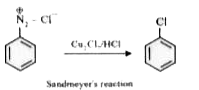
|
|
| 17. |
Decomposition of 3A(g)to2B(g)+2C(g) follows first order kinetics.Initially only A is present in the container.Pressure developed after 20 min. and infinite time are 3.5 and 4 atm respectively.Which of the following is true . |
|
Answer» `t_(50%)=20` min `IMPLIES (4P_0)/3=4` `P_0=3` atm. `P_0+x/3=3.5implies t_(50%)=20` is the half life. `x=1.5 " "t_(75%)=2xx20=40` min. `t_(87.5%)=3xxt_(50%)=3xx20=60` min `t_(99%)=2/3xxt_(99.9%)=2/3xx10xxt_(50%)=400/3` |
|
| 18. |
Decolourisation of acidified potassium permanganate occurs when H_2O_2 is added to it.This is due to: |
|
Answer» OXIDATION of `KMnO_3` |
|
| 19. |
Decolourisationof acidified permaganate in fast by Mohr'ssalt , butis solw by oxalate . Expalin . |
|
Answer» Solution :Oxalate, `""^(-)OOC-COO^(-)`, on OXIDATION GIVES `CO_(2)`. It is involves breaking of C-C bond, which requires energy. Hence decolourisation of `MnO_(4)^(-)` by `C_(2)O_(4)^(2-)` is slow. On the other hard Mohr.s SALT is a COMPLEX salt containing `FE^(2+)`ions . |
|
| 20. |
Decolorises iodine solution. Identify (A) to (D) and give the reaction involved in each case. |
|
Answer» SOLUTION :Theseobservations suggestthat thesubstance(A) issulphur (S), the gas (B) is nitrogen dioxide`(NO_(2))` , COMPOUND (C) is sodiumthiosulphute`(Na_(2)S_(2)O_(3))`and the gase(D) is sulphur dioxide `(SO_(2))`. The REACTION are as follows : `2Na_(2)underset((C))(S_(2)O_(3)) + underset("(violet)")(I_(2))to Na_(2)underset("colourless solution")(S_(4)O_(6)) + 2NaI` |
|
| 21. |
Decoloriization of coloured solution by animal charcoal is an example of: |
|
Answer» sorption |
|
| 22. |
Decinormal solution of NaCl developed an osmotic pressure of 4.6 atmosphere at 300 K. Calcualte its degree of dissociatoin (R = 0.082" L atm K"^(-1)"mol"^(-1)) |
|
Answer» |
|
| 23. |
Decinormal solution of CH_3COOH ionised to an extent of 1.3%. pH of the solution is, (log 1.3 = 0.11) |
|
Answer» 2.89 |
|
| 24. |
Decinirmal solution of NaCI develop an osmotic pressur of 4.6 atosphers at 300 K. Calculate the degreedessociation, |
|
Answer» `PI=("inRT")/Vori=(piV)/(nRT),pi=4.6 atm, n=0.1 N(or 0.1 M), T=300 K` `V=1L, R=0.0821" L atm K"^(-1)mol^(-1)` ` i=((4.6" atm")xx(1L))/((0.1"mol"^(-1))xx(0.0821"L atm K"^(-1)mol^(-1))xx(300 K))=1.87` `Step II. Calculation of degree of dissociation `(alpha)` `Naoverset(("aq"))toNa^(+)(aq)THEREFORE" VALUE of "n=2` `alpha=(i-1)/(n-1)or alpha=(1.87-1)/(2-1)=0.87xx100=87%.` |
|
| 25. |
Decide X, Y and Z correctly from the given options in the following sentences. (i) Thermal refining process is used for the refining of X metal. (ii) Zone refining process is used for purification of Y. (iii) Dyes can be separated by Z. |
|
Answer» X = IRON, Y = Ge, Z = MOND Carbonyl process |
|
| 26. |
Decide giving reason which one of the following pairsexhibits the property indicated : (i) Sc^(3+) or Cr^(3+) exhibits paramagnetism(ii) Vor Mn exhibits more number of oxidation states ( Atomic numbers : Sc = 21, Cr= 24, V = 23 , Mn = 25) |
|
Answer» Solution :(i)`. _(21) Sc = [ Ar] 3d^(1) 4S^(2) , Sc^(3+) = [Ar] -` No unparied electron `. _(24)Cr)=[Ar] 3d^(5)4s^(1) , Cr^(3+)= [Ar] 3d^(3) - `Three unpaired electron Hence, `Cr^(3+)` exhibits PARAMAGNETISM. (ii) Mn exhibits more number of oxidation states. Reason. `._(23) V = 3d^(3) 4s^(2)`. Its ox. states can be` + 2, + 3, +4, +5` `. _(25) Mn = 3d^(5) 4s^(2)` . Its ox. statescan be ` +2, +3,+4,+5,+6,+7` |
|
| 27. |
Decay of "_(92)U^(235) is ….., order reaction |
|
Answer» ZERO |
|
| 28. |
Decarboxylation of which yield 1,1,2,2-tetrabromoethane : |
|
Answer» `CH_3COOH` |
|
| 29. |
Decarboxylation of monocarboxylic acids can be carried out by : |
| Answer» Answer :C | |
| 30. |
Decarboxylation of isobutyric acid leads to: |
|
Answer» Isobutane |
|
| 31. |
Decarboxylationof isobutyricacidgivesn - alkanebutreducationof isobutyricacidwithphsphorusandhydrogeniodinegives : |
|
Answer» n- PROPANE |
|
| 32. |
Decarboxylation of malonic acid gives: |
|
Answer» HCHO |
|
| 33. |
Decarboxylation of glycine yields |
|
Answer» `CH_4` |
|
| 34. |
Decarboxylation of carboxylic acid takes place: |
|
Answer» in soda lime TREATMENT |
|
| 35. |
Debye, Huckel and Onsager equation for strong electrolytes is lambda_(c)=lambda_(infty)(A+Blambda_(infty))sqrt(C). The slope value is |
|
Answer» `lambda_(INFTY)` |
|
| 36. |
Debye Huckel Onsager theory predicts ? |
|
Answer» <P>VARIATION of velocity constant with T. |
|
| 37. |
Debye an unit of dipole moment is of the order of : |
|
Answer» `10^(-10)` ESU CM |
|
| 38. |
Debye constants A and B depend on ________. |
|
Answer» NATURE of the solvent |
|
| 39. |
Debrominaton of d-2, 3-dibromobutane gives : |
|
Answer» TRANS -2- butene |
|
| 40. |
Debrominationof mesodibromobutane will give the product as : |
|
Answer» n-butane |
|
| 41. |
Deaths due to liquor poisoning are due to the presence of |
|
Answer» ETHYL ALCOHOL |
|
| 42. |
Deamination of arylamines via diazonium salts is best achieved by_____ |
| Answer» SOLUTION :Hypophosphorus ACID `(H_(3)PO_(2))`. | |
| 43. |
Dead burnt plaster is obtained by heating Plaster of Paris. It is : |
|
Answer» `CaSO_(4)*1/2H_(2)O` |
|
| 44. |
Dead burntplaster is |
|
Answer» `CaSO_(4)` |
|
| 46. |
Deacon's process is used to manufacture …………. . |
|
Answer» `Cl_(2)`<BR>`F_(2)` |
|
| 47. |
Deacon.sprocess is used for the manufacture of: |
|
Answer» BLEACHING powder |
|
| 48. |
De-electronation in electrochemical cell is called as |
|
Answer» Anodic OXIDATION |
|
| 49. |
de Broglie (1924) predicted that small particles such as electrons should show wave -like properties along with paticle character. The wave length(lamda) associated with particle of mass m and moving with velocity v is given as lamda=h/(mv) where 'h' is plank's constant. The wave nature was confirmed by Davisson andGermer's experiment and modified equation for calculation of lamda can be given as: lamda=-h/(sqrt(2Em)) where E= kinetic energy of particle. lamda=h/(sqrt(2dVm)), where d= change of particle accelerated potnetial of V volt. If the kinetic energy of free electron is doubled,. Its de Broglie wavelengthh changes bythe |
|
Answer» `sqrt(2)` `:.v=sqrt((2xxE)/m)` `:.(v_(2))/(v_(1))=sqrt(2)` Also `lamda_(1)=1/(mv_(1)),lamda_(2)=1/(mv_(2))` `(lamda_(2))/(lamda_(1))=(v_(1))/(v_(2))implieslamda_(2)=((v_(1))/(v_(2)))xxlamda_(1)=1/(sqrt(2))xxlamda_(1)` Hence B is the correct ANSWER. |
|
| 50. |
de Broglie (1924) predicted that small particles such as electrons should show wave -like properties along with paticle character. The wave length(lamda) associated with particle of mass m and moving with velocity v is given as lamda=h/(mv) where 'h' is plank's constant. The wave nature was confirmed by Davisson andGermer's experiment and modified equation for calculation of lamda can be given as: lamda=-h/(sqrt(2Em)) where E= kinetic energy of particle. lamda=h/(sqrt(2dVm)), where d= change of particle accelerated potnetial of V volt. The ratio of de-Broglie chi wavelength of molecules of H_(2) and He at 27^(@)C adn 127^(@)C respectively is |
|
Answer» 1.633 `lamda_(H_(1))=h/(m_(H_(2))sqrt((3RT_(1))/(mH_(2))))` `lamda_(H_(e))=h/(m_(H_(e))sqrt((3RT_(2))/(mH_(e))))` `(lamda_(H_(2)))/(lamda_(H_(2)))=sqrt((T_(2)xxm_(H_(e)))/(T_(xxm_(H_(2))))` `=sqrt((400xx4xx10^(-3))/(300xx2xx10^(-3)))` `=sqrt(8/3)` `=1.633` Hence a is the correct OPTION. |
|