Saved Bookmarks
This section includes 7 InterviewSolutions, each offering curated multiple-choice questions to sharpen your Current Affairs knowledge and support exam preparation. Choose a topic below to get started.
| 1. |
Consider the reaction M_((aq))^(n+)+n e^(-)toM_((s)). The standard reduction potential values of the element M_(1),M_(2) and M_(3) are -0.34V,-3.05 and -1.66V respectively. The order of their reducing power will be:- |
|
Answer» `M_(1) gt M_(2) gt M_(3)` |
|
| 2. |
Consider the reaction, N_(2) + 3H_(2) rarr 2NH_(3) carried out ata constant temperature and pressure. If DeltaH and Delta U are the enthalpy and internal energy changes for the reaction, which of the following expressions is true ? |
|
Answer» `DELTA H = 0` `Delta n_(g) = 2 - (1 + 3) = -2` `Delta H = Delta U + Delta n_(g) RT = Delta U - 2RT` :. `Delta H lt Delta U` |
|
| 3. |
Consider the reaction HCN_((aq))hArrK_((aq))^(+)+CN_((aq))^(-). At equlibrium, the addition of CH_((aq))^(+) concentration |
|
Answer» Reduce `HNC_((aq))` CONCENTRATION |
|
| 4. |
Consider the reaction : H_(2)(g),Pt|H^(+)(aq) , E=0.1" V" The pH of the solution is |
|
Answer» Solution :`H_(2)(g)+2e^(-) to2H^(+)(aq)` `E=E^(@)-(0.0591)/(2)"LOG"[H^(+)]^(2)` `0.1=0-(0.0591)/(2)2LOG[H^(+)]` `0.1=0-0.0591" log " [H^(+)]` `-log[H^(+)]=(0.1)/(0.0591)=1.69` `pH=-log[H^(+)]=1.69=2` |
|
| 5. |
Consider the reaction given below : CH_(3)-CHDCONH_(2)+PhCOoverset(15)NH_(2)underset(Delta)overset(Br_(2)+OH^(-))to The products obtained are : |
|
Answer» `CH_(3)CHDNH_(2)` |
|
| 6. |
Consider the reaction equlibreium, 2SO_(2(g))+O_(2(g))hArr2SO_(3(g)),DeltaH^(@)-=198kJ. On the basis of Le-Chatelier's pronciple, the condition favourable for the forward reaction is |
|
Answer» LOWERING of TEMPERATURE as well as PRESSURE |
|
| 7. |
Consider the reaction equilibrium underset(("Greater volume"))("Ice")hArrunderset(("Lesser volume"))("Water-xkcal")The favourable conditions for forward reaction are |
|
Answer» LOW TEMPERATURE , HIGH PRESSURE and EXCESS of ice |
|
| 8. |
Consider the reaction, C(s)+O_(2)(g)toCO_(2)(g)+393.5kJ, the signs of DeltaH,DeltaS and DeltaG respectively are |
|
Answer» `+,-,-` `DeltaS=+ve"(SPONTANEOUS at all TEMPERATURE)"` `DeltaG=-ve""`(`because` reaction is spontaneous) |
|
| 9. |
Consider the reaction Cr_(2)O_(7)^(2-)+14H^(+)+6e^(-)to2Cr^(3+)+7H_(2)O What is the quantity of electricity in couolombs needed to reduce 1 mole of Cr_(2)O_(7)^(2-)? |
| Answer» Solution :From the given REACTION, 1 mol FO `Cr_(2)O_(7)^(2-)` ions require `6F=6xx96500C=579000C` of ELECTRICITY for reduction to `Cr^(3+)`. | |
| 10. |
Consider the reaction :Cr_(2)O_(7)^(2-) + 14H^(+) + 6e^(-) to 2Cr^(3+) + 7H_(2)O What is the quantity of electricity in coulombs needed to reduce 1 mol of Cr_(2)O_(7)^(2-) ? |
| Answer» Solution :One `Cr_(2)O_(7)^(2-)`ion requires 6 electrons for REDUCTION as shown by the above CHEMICAL equation. THUS, 1 mol of `Cr_(2)O_(7)^(2-)` ions require 6 F= 6 x 96500 C = 579000 C of electricity for reduction to `Cr^(3+)`. | |
| 11. |
Consider the reaction: Cr_(2)O_(2)^(2-)+14H^(+)+6e^(-) to 2Cr^(3+)+7H_(2)O What is the quantity of electricity in coulombs needed to reduce 1 mol of Cr_(2)O_(7)^(2-) ? |
Answer» Solution :* Reaction: * Therefore, to reduce 1 mole of `Cr_(2)O_(7)^(2-),` 6 mole electrons will be USED. So, the REQUIRED quantity of electricity will be: So, 6 mole electron=6F electricity is used. 6 F electricity=6`xx96500` COULOMB =579000 Coulomb |
|
| 12. |
Consider the reaction : Cl_(2)(aq)+H_(2)S(aq)toS(s)+2H^(+)(aq)+2Cl^(-)(aq) The rate equation for this reaction is rate =k[Cl_(2)][H_(2)S] Which of these mechanisms is/are consistent with this rate equation ? A. Cl_(2)+H_(2)StoH^(+)+Cl^(-)+Cl^(+)+HS^(-)("slow"),Cl^(+)+HS^(-)toH^(+)+Cl^(-)+S("fast") B. H_(2)SiffH^(+)+H^(+)HS^(-)("fast equilibrium"),Cl_(2)+HS^(-)to2Cl^(-)+H^(+)+S("slow") |
|
Answer» Neither A nor B |
|
| 13. |
Consider the reaction : Cl_(2)(aq)+H_(2)S(aq) to S(s)+2H^(+)(aq)+2Cl^(-)(aq) the rate equation for this reaction is rate=k[Cl_(2)][H_(2)S] Which of these mechanism is/ are consistent with this rate equation? A. Cl_(2)+H_(2)S to H^(+)+Cl^(-)+HS^(-) (Slow) Cl^(+)+HS^(-) to H^(+)+Cl^(-)+S (fast) B. H_(2)S harr H^(+)+HS^(-) (fast equilibirium) Cl_(2)+HS^(-) to 2Cl^(-)+H^(+)+S (Slow) |
|
Answer» B only Rate`=k[Cl_(2)][H_(2)S]` Now, it we consider option (B) we find Rate`=k[Cl_(2)][HS^(-)]` …(i) For equationn `H_(2)S harrH^(+)+HS^(-)` `K=([H^(+)][HS^(-)])/([H_(2)S]) or, [HS^(-)]=(K[H_(2)S])/([H^(+)])` SUBSTITUTING this value in EQUATION (i) we find Rate`=k[Cl_(2)]k([H_(2)S])/([H^(+)])=(k[Cl_(2)][H_(2)S])/([H^(+)])` THUS slow step should involve 1 molecues of `Cl_(2)` and 1 molecule of `H_(2)S` Hence only, mechanism (A) is consistent with the given rate equation |
|
| 14. |
consider the reaction CH_(3)CH_(2)CH_(2)Br+NaCNtoCH_(3)CH_(2)CH_(2)CN+NaBr. the reaction will be fastest in. |
|
Answer» Water  . .
|
|
| 15. |
Consider the reaction CI_(2) (aq)+H_(2)S(aq) rarr S(s)+2H^(+)(aq) +2CI^(-1)(aq) The rate equation for this reaction is rate = k[CI_(2)] [H_(2)S] Which of these mechanisms is /are consistent with this rate equation ? CI_(2)+H_(2)S rarr H^(+)+CI^(-)+CI^(+)HS^(-) (slow ) CI^(+)+HS^(-)+CI^(-)+S (fas)H_(2)S rarr H^(+)+HS^(-) (fast equilibrium ) CI_(2)+HS^(-) rarr 2CI^(-)+H^(+) +S (slow ) |
|
Answer» Neither (i) nor (ii) `R= K [CI_(2)][H_(2)S]` SINCE RATE of reaction DEPENDS only on the slow step `:.` Mechanism (A) is correct . `CI_(2)+H_(2)S rarr H^(+)+CI^(-)+CI^(+)+HS^(-)` (slow) `CI^(+) +HS^(-)+CI^(-)+S` (fast ) |
|
| 16. |
Consider the reaction : CH_(3)CH_(2)CH_(2)Br+NaCNrarrCH_(3)CH_(2)CH_(2)CN+NaBr This reaction will be the fastest in : |
|
Answer» WATER |
|
| 17. |
Consider the reaction CH_(3)CH_(2)CH_(2)Br+ NaCN to CH_(3)CH_(2)CH_(2)CN +NaBr This reaction will be the fastest in - |
|
Answer» water |
|
| 18. |
Consider the reaction, CH_(3)CH_(2)CH_(2)Br+NaCn to CH_(3)CH_(2)CH_(2)CN+NaBr This reaction will be the faster in |
|
Answer» ethanol |
|
| 19. |
consider the reaction: CH_(3)CH_(2)CH_(2)Br + NaCN to CH_(3)CH_(2)CH_(2)CN + NaBr This reaction will be fastest in: |
|
Answer» ethanol |
|
| 20. |
Consider the reaction: CH_(3)-CH_(2)-CH_(2)-Br+NaCNtoCH_(3)CH_(2)CH_(2)-C-=N+NaBr The correct statement is :- |
|
Answer» The REACTION will be FASTEST in water |
|
| 21. |
Consider the reaction C_(6)H_(12)O_(6) + 12H_(2)SO_(4) rarr 6CO_(2) + 12SO_(2) + 18H_(2)O How many of the following conclusion are corerct based on this equation? (A) Mass ratio of C_(6)H_(12)O_(6) and H_(2)SO_(4) present is 1 : 12 (B) Mole ratio of C_(6)H_(12)O_(6) and H_(2)SO_(4) present is 1 : 12 (C) Mass ratio of C_(6)H_(12)O_(6) and H_(2)SO_(4) reacted is 1 : 12. (D) Mole ratio ofH_(2)SO_(4) and CO_(2) in reaction mixture is 2 : 1 (E) Mass ratio of H_(2)SO_(4) and CO_(2) in reaction mixrture is 2 : 1 (F) Mole ratio of H_(2)O and C_(6)H_(12)O_(6) present in reaction mixture is 18 : 1 (G) Mole ratio of SO_(2) and CO_(2) formed 2 : 1 (G) Sum of number of moles of H_(2)SO_(4) and SO_(2) in the reaction mixture is always constant. (I) Sum of number of moles of moles of C_(6)H_(12)O_(6) and CO_(2) present in the reaction mixture is always constant. |
|
Answer» |
|
| 22. |
Consider the reaction C_(3)H_(7)-OH+Et_(3)O^(o+)BF_(4)^(-)rarr C_(3)H_(7)-O-Et+EtOEt+HBF_(4). Which of the following statements si wrong ? |
|
Answer» The NUCLEOPHILE in the reaction is `C_(3)H_(7)OH`. |
|
| 23. |
Consider the reaction : Briefly explain the choice of major product. |
| Answer» Solution : Initial reaction of the ALKENE with `H_(3)O^(+)` can form two carbocations. The more stable BENZYLIC tertiary carbocation (shown in the above mechanism) is formed in preference to the less stable PRIMARY carbocation. This is the rate deter MINING step, and thus controls the product DISTRIBUTION. Formation of the more stable carbocation is the mechanistic basis for Markovnikov.s rule. | |
| 24. |
Consider the reaction C_(2)H_(5)Cl+AgCN overset(ErOH)rarr X |
|
Answer» It GIVES propionic acid on hydrolysis |
|
| 25. |
Consider the reaction between chlorine and nitric oxide Cl_(2(g))+2NO_((g))to2NOCl_((g)) n doubling the concentration of both reactants,the rate of the reaction increases by a factor of 8.However,if only the concentration of Cl_(2) is doubled ,the rate increases by a factor of 2.The order of this reaction with respect to NO is.... |
|
Answer» 0 If we double the concentration of both,rate of reaction will increase by EIGHT time. 8r=K`[2Cl_(2)]^(x)[2NO]^(y)` …….(III)Dividing equation (II) by (iii) `THEREFORE 4=2^(y)therefore 2^(2)=2^(y)therefore y=2` |
|
| 26. |
Consider the reaction below at 298K, C("graphite")+2H_(2)(g) to CH_(4) (G) triangle_(f) H^(@) ("Kj/mol") -74.9 S_(m)^(@) ("J/mol-K")+5.6 +130.7 +186.3 Which statement below is correct? |
|
Answer» `triangle_(r)G^(@)` is -50.8 KJ and the REACTION is DRIVEN by ENTHALPY only |
|
| 27. |
Consider the reaction AtoP. The change in concentration of A with time has been shown graphically. i) Predict the order of the reaction. ii) Derive an expression for the time required for the completion of the reaction. |
|
Answer» Solution :i) The REACTION is of first order. ii) for the DERIVATION of the EXPRESSION |
|
| 28. |
Consider the reaction at 300 K H_(2)(g)+Cl_(2)(g) to 2HCl(g)""DeltaH = - 185kJ//molCalculate DeltaU if 3mole of H_(2)completely react with 3 mo,le f of Cl_(2) tofrom HCl. |
|
Answer» 0 For three moles= - `185 XX 3 = -555 ` |
|
| 29. |
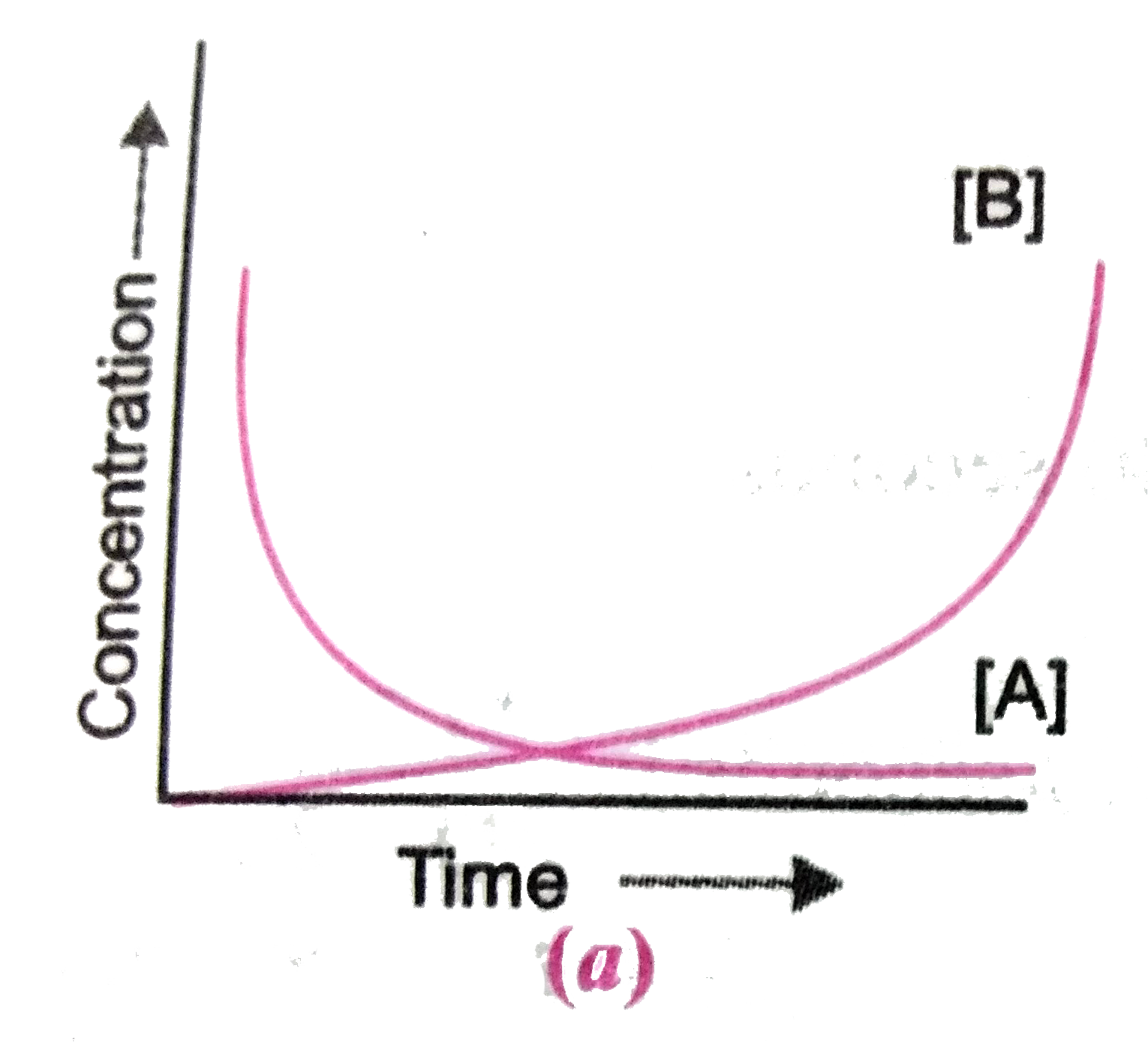
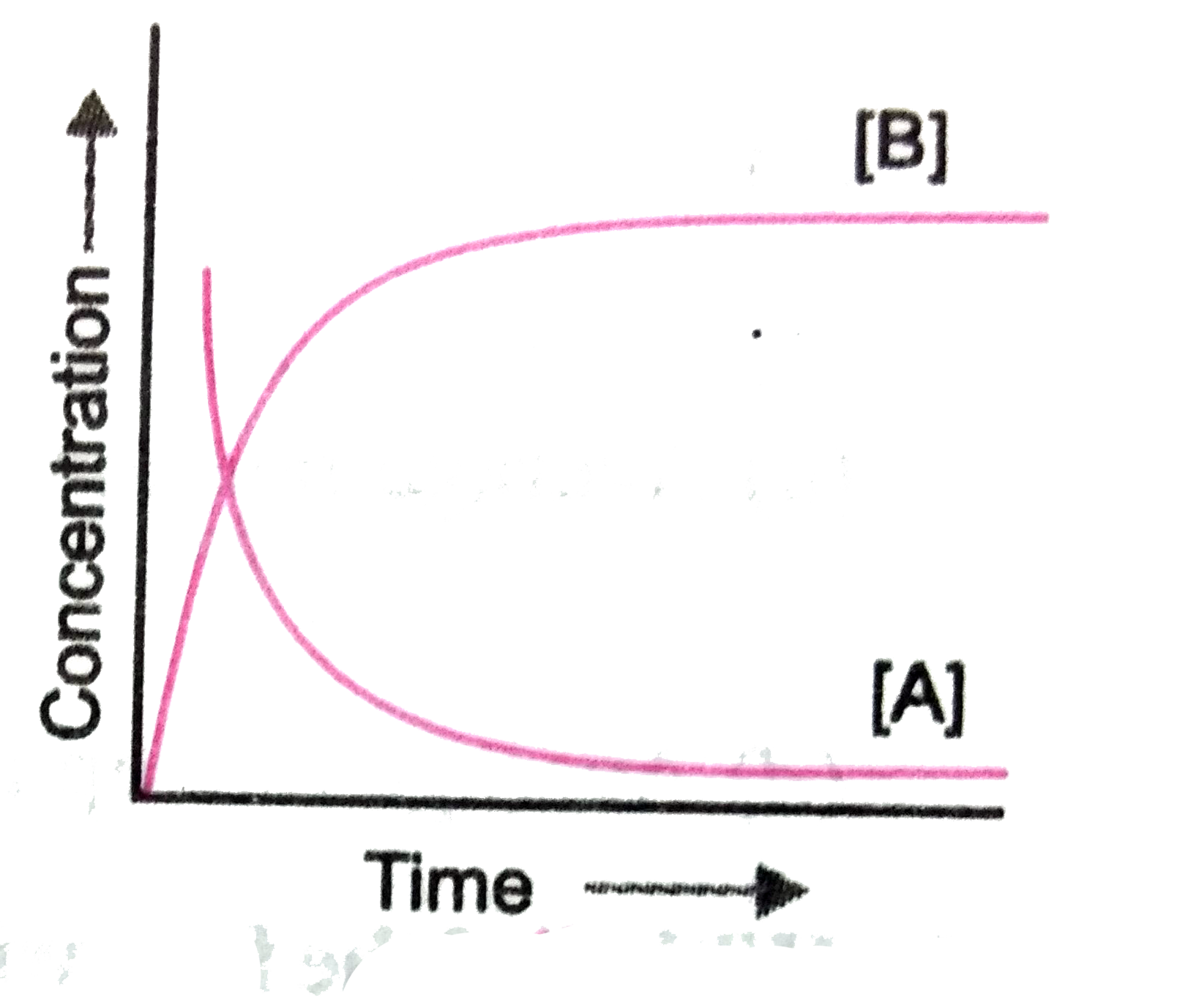
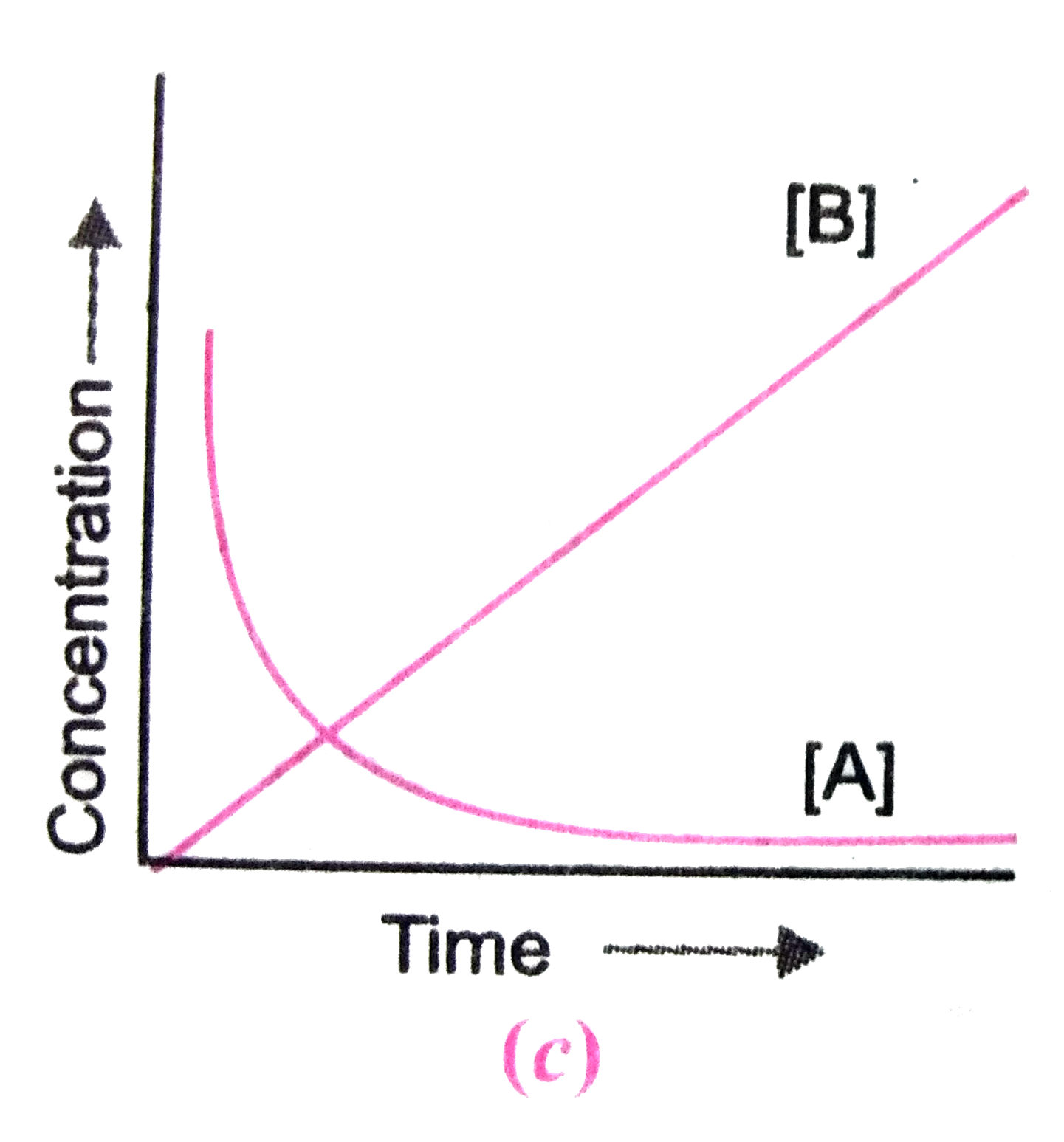
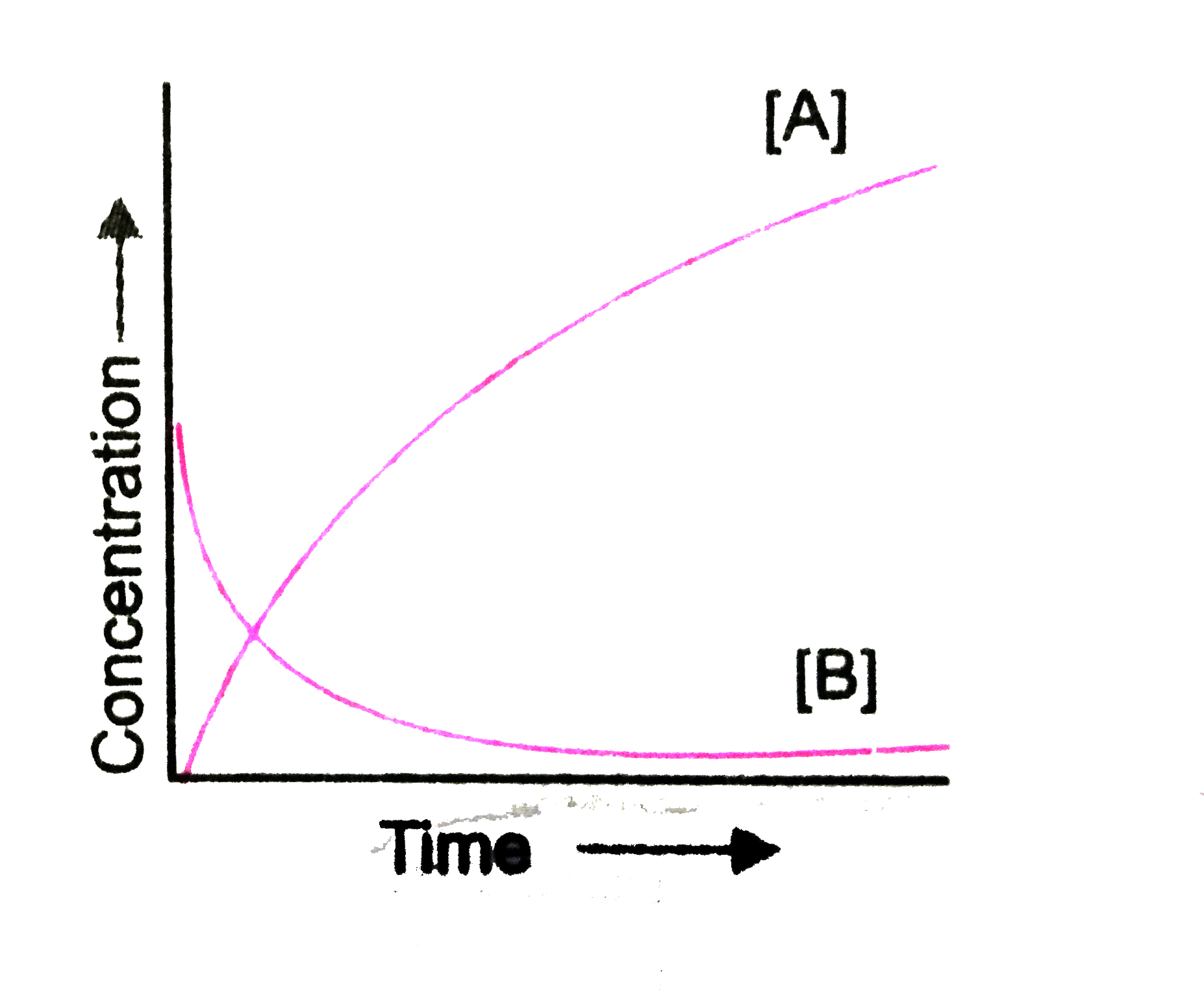
Consider the reaction AtoB .The concentration of both the reactants and the products varies exponentially with time.Which of the following figures correctly describes the changes in concentration of reactant and products with time? |
|
Answer»
|
|
| 30. |
Consider the reaction Altimplies B. The concentration of both the reactants and the products varies exponentially with time. Which of the following figures correctly describes the change in concentration of reactants and products with time? |
|
Answer»
|
|
| 31. |
Consider the reaction : AgCl (s) hArr Ag^(+) (aq) + Cl^(-) (aq) At 27^(@)C K_(C) = 1.6 xx 10^(-9) for this reaction. If final solution has a volume of 50 litre then what minimum millimoles of AgCl (s)is needed to achieve equilibrium. |
|
Answer» `K_(C) = 16 XX 10^(-10) = (x)/(50) xx (x)/(50` `n_(Ag^(+)` at equilibrium `= x = 50 xx 4 xx 10^(-5)` moles `= 2 xx 10^(-3)` moles minimum NUMBER `n_(AgCl)` required to achieve equilibrium `= 2 xx 10^(-3)` moles achieve equilibrum = 2 millimoles |
|
| 32. |
Consider the reaction aFeS_(2) + bO_(2) to cFe_(2)O_(3) + dSO_(2)Which is correct for the above reaction |
|
Answer» n-factor for `FeS_(2)` is 11 |
|
| 33. |
Consider the reaction A to B. The concentration of both the reactants and the products varies exponentially with time. Which of the following figures correctly describes the change in concentration of reactants and products with time ? |
|
Answer»
|
|
| 34. |
Consider the reaction, @A+B to products. When concentration of B alone was doubled the half life did not change. When the concentraction of A alone was doubled, the rate increased by two times. The unit of rate constant for this reaction is |
|
Answer» `s^(-1)` Order of reaction with respect to A=1 because of reaction doubles when concentration of A is doubled keeping concentration of B constant. `therefore` Order of reaction=1+1=2 and units of second order reaction are `L*mol^(-1)*sec^(-1)`. |
|
| 35. |
Consider the reaction A H_(2)O_(2)+2HIrarrI_(2)+2H_(2)O B HOCI+H_(2)O_(2)rarrH_(3)O^(+)+CI^(-)+O_(2) which of the following statement is correct about H_(2)O_(2) with referenceto thesereactions hydrogen peroxide is …………………… |
|
Answer» 1. an oxidising agent in both a and b |
|
| 36. |
Consider the reaction: ""_(92)^(238)U+""_(0)^(1)nto""_(92)^(239)Mto""_(93)^(239)Np+""_(-1)^(0)e Mis : |
|
Answer» U |
|
| 37. |
Consider the reaction : 4NO_(2)(g) + O_(2)(g) rarr 2N_(2)O_(5)(g), Delta_(f)H = -111 kJ If N_(2)O_(5)(s) is fromed instead of N_(2)O_(5)(g) in the above reaction, the Delta_(f)H is value will be (given, Delta H of sublimation for N_(2)O_(5) is 54 kJ mol^(-1)). |
|
Answer» `+ 54 kJ` `2N_(2)O_(5) (s) rarr 2N_(2)O_(5) (g) Delta H = 54 xx 2 kJ` SUBTRACTING `4NO_(2) + O_(2) rarr 2N_(2)O_(5) (s) Delta H = - 219 kJ` |
|
| 38. |
Consider the reaction : 4 NO_(2 (g)) + O_(2 (g)) to 2 N_(2)O_(5 (g)) , Delta_(r) H = -111 kJ If N_(2) O_(5 (s)) is formed instead of N_(2)O_(5 (g)) in the above reaction , the Delta_(r)H value will be : (given , Delta H of sublimation for N_(2) O_(5) is 54 kJ mol^(-1)) |
| Answer» Answer :C | |
| 39. |
Consider the reaction 2NO_((g))+O_(2(g))rarr2NO_(2(g)). If (d[NO_(2)])/(dt)=0.052 M/s then, -(d[O_(2)])/(dt) will be |
|
Answer» 0.052 M/s |
|
| 40. |
Consider the reaction, 2Cl_(2)(g) + 2H_(2)O(g)hArr4HCl(g) + O_(2)(g) DeltaH^(O) = + 113 kJ The four gases, Cl_(2), H_(2)O, HCl and O_(2), are mixed and the reaction is allowed to come to equilibrium. State and explain the effect (increase, decrease, no change) of the operation in the left column (below) on the equilibrium value of the quantity in the right column. Each operation is to be considered separately. Temperature and volume are constant unless stated otherwise. Raising the temperature Concentration of HCl |
|
Answer» |
|
| 41. |
Consider the reaction, 2Cl_(2)(g) + 2H_(2)O(g)hArr4HCl(g) + O_(2)(g) DeltaH^(O) = + 113 kJ The four gases, Cl_(2), H_(2)O, HCl and O_(2), are mixed and the reaction is allowed to come to equilibrium. State and explain the effect (increase, decrease, no change) of the operation in the left column (below) on the equilibrium value of the quantity in the right column. Each operation is to be considered separately. Temperature and volume are constant unless stated otherwise. Adding catalyst Number of moles of HCl |
|
Answer» |
|
| 42. |
Consider the reaction, 2Cl_(2)(g) + 2H_(2)O(g)hArr4HCl(g) + O_(2)(g) DeltaH^(O) = + 113 kJ The four gases, Cl_(2), H_(2)O, HCl and O_(2), are mixed and the reaction is allowed to come to equilibrium. State and explain the effect (increase, decrease, no change) of the operation in the left column (below) on the equilibrium value of the quantity in the right column. Each operation is to be considered separately. Temperature and volume are constant unless stated otherwise. Adding He Number of moles of HCl |
|
Answer» |
|
| 43. |
Considerthereaction2NO_((g) ) +O_(2(g) )to2NO_(2(g)).if(d [NO_(2)])/(dt)=0.052 M//sthen-(d[O_(2)])/(dt) will be |
|
Answer» `0.052 M//s` `-(d[O_(2)])/(dt)=(1)/(2)xx0.052 =0.026 m//s` |
|
| 44. |
Consider the reaction, 2Cl_(2)(g) + 2H_(2)O(g)hArr4HCl(g) + O_(2)(g) DeltaH^(O) = + 113 kJ The four gases, Cl_(2), H_(2)O, HCl and O_(2), are mixed and the reaction is allowed to come to equilibrium. State and explain the effect (increase, decrease, no change) of the operation in the left column (below) on the equilibrium value of the quantity in the right column. Each operation is to be considered separately. Temperature and volume are constant unless stated otherwise. Raising the temperature K_(C) |
|
Answer» |
|
| 45. |
Consider the reaction, 2Cl_(2)(g) + 2H_(2)O(g)hArr4HCl(g) + O_(2)(g) DeltaH^(O) = + 113 kJ The four gases, Cl_(2), H_(2)O, HCl and O_(2), are mixed and the reaction is allowed to come to equilibrium. State and explain the effect (increase, decrease, no change) of the operation in the left column (below) on the equilibrium value of the quantity in the right column. Each operation is to be considered separately. Temperature and volume are constant unless stated otherwise. Decreasing the volume of the container K_(C) |
|
Answer» |
|
| 46. |
Consider the reaction, 2Cl_(2)(g) + 2H_(2)O(g)hArr4HCl(g) + O_(2)(g) DeltaH^(O) = + 113 kJ The four gases, Cl_(2), H_(2)O, HCl and O_(2), are mixed and the reaction is allowed to come to equilibrium. State and explain the effect (increase, decrease, no change) of the operation in the left column (below) on the equilibrium value of the quantity in the right column. Each operation is to be considered separately. Temperature and volume are constant unless stated otherwise. Decreasing the volume of the container Partial pressure of Cl_(2) |
|
Answer» |
|
| 47. |
Consider the reaction, 2Cl_(2)(g) + 2H_(2)O(g)hArr4HCl(g) + O_(2)(g) DeltaH^(O) = + 113 kJ The four gases, Cl_(2), H_(2)O, HCl and O_(2), are mixed and the reaction is allowed to come to equilibrium. State and explain the effect (increase, decrease, no change) of the operation in the left column (below) on the equilibrium value of the quantity in the right column. Each operation is to be considered separately. Temperature and volume are constant unless stated otherwise. Adding O_(2) Number of moles of H_(2)O |
|
Answer» |
|
| 48. |
Consider the reaction, 2Cl_(2)(g) + 2H_(2)O(g)hArr4HCl(g) + O_(2)(g) DeltaH^(O) = + 113 kJ The four gases, Cl_(2), H_(2)O, HCl and O_(2), are mixed and the reaction is allowed to come to equilibrium. State and explain the effect (increase, decrease, no change) of the operation in the left column (below) on the equilibrium value of the quantity in the right column. Each operation is to be considered separately. Temperature and volume are constant unless stated otherwise. Adding O_(2) Number of moles of HCl |
|
Answer» |
|
| 49. |
Consider the reaction, 2Cl_(2)(g) + 2H_(2)O(g)hArr4HCl(g) + O_(2)(g) DeltaH^(O) = + 113 kJ The four gases, Cl_(2), H_(2)O, HCl and O_(2), are mixed and the reaction is allowed to come to equilibrium. State and explain the effect (increase, decrease, no change) of the operation in the left column (below) on the equilibrium value of the quantity in the right column. Each operation is to be considered separately. Temperature and volume are constant unless stated otherwise. Decreasing the volume of the container Number of moles of Cl_(2) |
|
Answer» |
|
| 50. |
Consider the reaction, 2Cl_(2)(g) + 2H_(2)O(g)hArr4HCl(g) + O_(2)(g) DeltaH^(O) = + 113 kJ The four gases, Cl_(2), H_(2)O, HCl and O_(2), are mixed and the reaction is allowed to come to equilibrium. State and explain the effect (increase, decrease, no change) of the operation in the left column (below) on the equilibrium value of the quantity in the right column. Each operation is to be considered separately. Temperature and volume are constant unless stated otherwise. Increasing the volume of the container Number of moles of H_(2)O |
|
Answer» |
|