

Saved Bookmarks
This section includes 7 InterviewSolutions, each offering curated multiple-choice questions to sharpen your Current Affairs knowledge and support exam preparation. Choose a topic below to get started.
| 1. |
Consider three flasks in diagram below. Assuming that connecting tube has negligible volume and all three falsks are at same temperature. If only 1 and 2 stopcocks are opened then select correct option(s). |
|
Answer» `P_(HCl)=(1)/(2)` atm `n_(NH_(3))=(PV)/(RT)=(1xx1)/(RT)` `NH_(3)+HClrarrNH_(4)Cl(s)` moles `(1)/(RT) (2)/(RT)` `0 (1)/(RT)` `n_(HCl)` remain after REACTION =`(1)/(RT)` For `HCl(g):-P_("NEW")(V+V)=nRT` `P_("new")xx2=(1)/(RT)xxRT` `(P_(HCl))_("final")=P_("new")=(1)/(2)atm=P_("total")` `P_(NH_(3))=0(LR)` |
|
| 2. |
Consider this reaction, 2H_(2)(g)+2NO(g)to N_(2)(g)+2H_(2)O(g) The rate law for this for reaction is rate =k[H_(2)][NO]^(2) . Under what conditions could these Steps represent the mechanism? Step1: 2NOtoN_(2)O_(2) Step2: N_(2)O_(2)+H_(2)to N_(2)O+H_(2)O Step3:N_(2)O+H_(2)to N_(2)+H_(2)O |
|
Answer» These STEPS cannot be the mechanism under any circumstances. |
|
| 3. |
Consider thiol anion (RS^(Theta)) and alkoxy anion (RO^(Theta)) . Which of the following statement is correct ? |
|
Answer» `(RS^(Theta))`is less BASIC but more nucleophilic than`(RO^(Theta))` |
|
| 4. |
Consider thiol anion (RS^(Θ))and alkoxy anion (RS^(Θ)), which of the following statement is correct ? |
|
Answer» `RS^(Θ)`is less basic but more NUCLEOPHILIC than `RO^(Θ)` `B.S rArr R-O^(Θ)gt R-S^(Θ)` NUCLEOPHILICITY `rArr R-O^(Θ)lt R-S^(Θ) ""` (size) |
|
| 5. |
Consider thiol anion (RS^(-)) and alkoxy anion (RO^(-)). Which of the following statements is correct? |
|
Answer» `RS^(-)` is less BASIC but more nucleophilic than `RO^(-)` |
|
| 6. |
Consider the two complexation equilibria in aqueous solution, between the cobalt (II) ion Co^(2+) (aq) and ethylenediamine (en) on the one hand and ammonia NH_(3) on the other. [CO(H_(2)O)_(6)]^(2+)+6NH_(3)hArr[Co(NH_(3))_(6)]^(2+)+6H_(2)O...(1) [Co(H_(2)O_(6))]^(2+)+3enhArr[Co(en)_(3)]^(2+)+6H_(2)O..(2) Electronicaly, the ammonia and en ligands are very similar, since both bond through N and since the liwis base strengths of their nitrogen atoms are similar. This means that DeltaH^(@) must be very similar for the two reactions, since six Co-N bonds are formed in each case. Interestingly however, the equilibrium constant is 100,000 times larger for the second reaction than it is for the first. This is the so called chelate effect: "the enhanced affinity of chelating ligands for a metal ion compared to similar non-chelating (monodentate) ligands for the same metal". The chelate effect is entropy-driven. Q. Which of the following can be classified as a chelating ligand? |
|
Answer» `edta^(-4)` |
|
| 7. |
Consider the value of all four quantum number for last electron and spin multiplicity (2s+1) for givenn two element 'X' and 'Y' in their ground state: {:(,n,,l,m,s,|2s+1|),(X:,2,0,0,+1//2,1),(Y:,2,1,-1,-1//2,4):} The according to given information the correct statement is: |
|
Answer» The BOND angle `(H-Y-H)` of possible hydride of element Y is less than `190"28'` (a0 possible hydride of N is `NH_(3)(H-N-H` bond angle is less than `109"28.`) (b) In `BeX_(2)`, Be has two vacent p-orbirtals (c) Magneti cmoment of N>Be. (number of unpaired `e^(-)` in N>Be) (d) N can exhibits variable oxidation state. |
|
| 8. |
Consider the two geometrical isomers of but-2-eneThe isomer with higher melting point and the reason for the same is respetively |
|
Answer» CIS, symmetric bonding |
|
| 9. |
Consider the sulfonation reactions of phenol shown above.For which sulfonation product is the free energy of activation lower? |
| Answer» Solution : The free energy of activation is LOWER for ORTHO substitution. We know this because at the lower TEMPERATURE, where the reaction is under kinetic CONTROL. it is formed faster. | |
| 10. |
Consider the sulfonation reactions of phenol shown above. Which sulfonation product is more stable, ortho or para? |
| Answer» Solution :The para-sulfonated phenol is more STABLE. We KNOW this because at the higher temperature, where the reaction is under equilibrium CONTROL, it is the MAJOR PRODUCT | |
| 11. |
Consider the successive ionisation energy for an element 'A' . IE_(1) , IE_(2) , IE_(3) , IE_(4), IE_(5) are 100 eV , 150 eV , 181eV, 2000 eV , 2200 eV . Select correct statement (s) for element 'A' :a)Element 'A' may be metalb)Element 'A' may from trivalent cationc)Oxideof element 'A' may be amphotericd)Element 'A' may be non-metal |
|
Answer» ELEMENT 'A' MAY be metal |
|
| 12. |
Consider the structure of the complex compound, [Cu_(4)OCI_(6)(Ph_(3)P)_(4)], as given below : src="https://d10lpgp6xz60nq.cloudfront.net/physics_images/ ##GRB_ORG_CHM_V01_QB_C05_E01_068_Q01.png## Which of the following is the correct IUPAC name of the complex ? |
|
Answer» `hexa-MU-chloride-mu_(4)-"oxidotetrakis (TRIPHENYLPHOSPHINE) tetracopper (II)"` |
|
| 13. |
Consider the structure of the complex compound, [Cu_(4)OCI_(6)(Ph_(3)P)_(4)], as given below : ##GRB_ORG_CHM_V01_QB_C05_E01_068_Q01## Which of the following is the correct IUPAC name of the complex ? |
|
Answer» `hexa-MU-chloride-mu_(4)-"oxidotetrakis (TRIPHENYLPHOSPHINE) tetracopper (II)"` |
|
| 14. |
Consider the statements: I) Maltose is also known as malt sugar II) Sucrose is also known as cane sugar III) Lactose is also known as grape sugar IV) Starch is also known as Amylum The correct statement is / are |
| Answer» Answer :A | |
| 15. |
Consider the statementltbrlt I. Bond length in N_(2)^(+) is 0.02Å greater thanin N_(2). II. Bond length of NO^(+) is 0.09Å less than in NO. III O_(2)^(2_(-)) has shorter bond length than O_(2). Which of the following statements are true? |
|
Answer» I and II |
|
| 16. |
Consider the standard electrode potential values (M2+/M) of the elements of the first transition series. {:(Ti,,V,,Cr,,Mn,,Fe,,CO,,Ni,,Cu,,Zn),(-1.63,,-1.18,,-0.90,,-1.18,,-0.44,,-0.28,,-0.25,,+0.34,,-0.76):} Explain : (i) E^(@) value for copper is positive. (ii) E^(@) value of Mn is more negative as expected from the trend. (iii) Cr^(2+) is a stronger reducing agent than Fe^(2+). |
|
Answer» Solution :(i) HIGH ionisation enthalpy to convert Cu (s) to `Cu^(2+)` (aq) is not balanced by its hydration enthalpy. (ii) `Mn^(2+)` ion has stable `d^(5)` (half-filled) configuration. (iii) `d^(4)` to `d^(3)` occurs in the case of `Cr^(2+)` to `Cr^(3+)`, it is more stable. `d^(6)` to `d^(5)` occurs in case of `Fe^(2+)` to `Fe^(3+)`. Therefore `Cr^(2+)` is a STRONGER reducing agent than `Fe^(2+)`. |
|
| 17. |
Consider the reversible reaction, HCN(aq.) ⇌H^+ + CN^-(aq.)At equilibrium the addition of CN^-(aq.) would: |
|
Answer» Reduce HCN(AQ.) concentration |
|
| 18. |
Consider the reactions The products A, B, C respectively are |
|
Answer»

|
|
| 19. |
Consider the reactions (i)"" S("rhombic") + 3//2O_(2)(g) rarr SO_(3)(g),DeltaH_(1) (ii) " "S("monoclinic") + 3//2O_(2)(g) rarr SO_(3)(g),DeltaH_(2) (iii) " "S("rhombic") + O_(3)(g) rarr SO_(3)(g),DeltaH_(3) (iv) " "S("monoclinic") + O_(3)(g) rarr SO_(3)(g),DeltaH_(4) |
|
Answer» `DeltaH_(1) LT DeltaH_(2) lt DeltaH_(4)` (MAGNITUDE only) |
|
| 20. |
Consider the reactions identify X, A, C and D |
|
Answer» X= n-propanol, A = PROPANALDEHYDE, C=sodium acetate, D=ketoxime 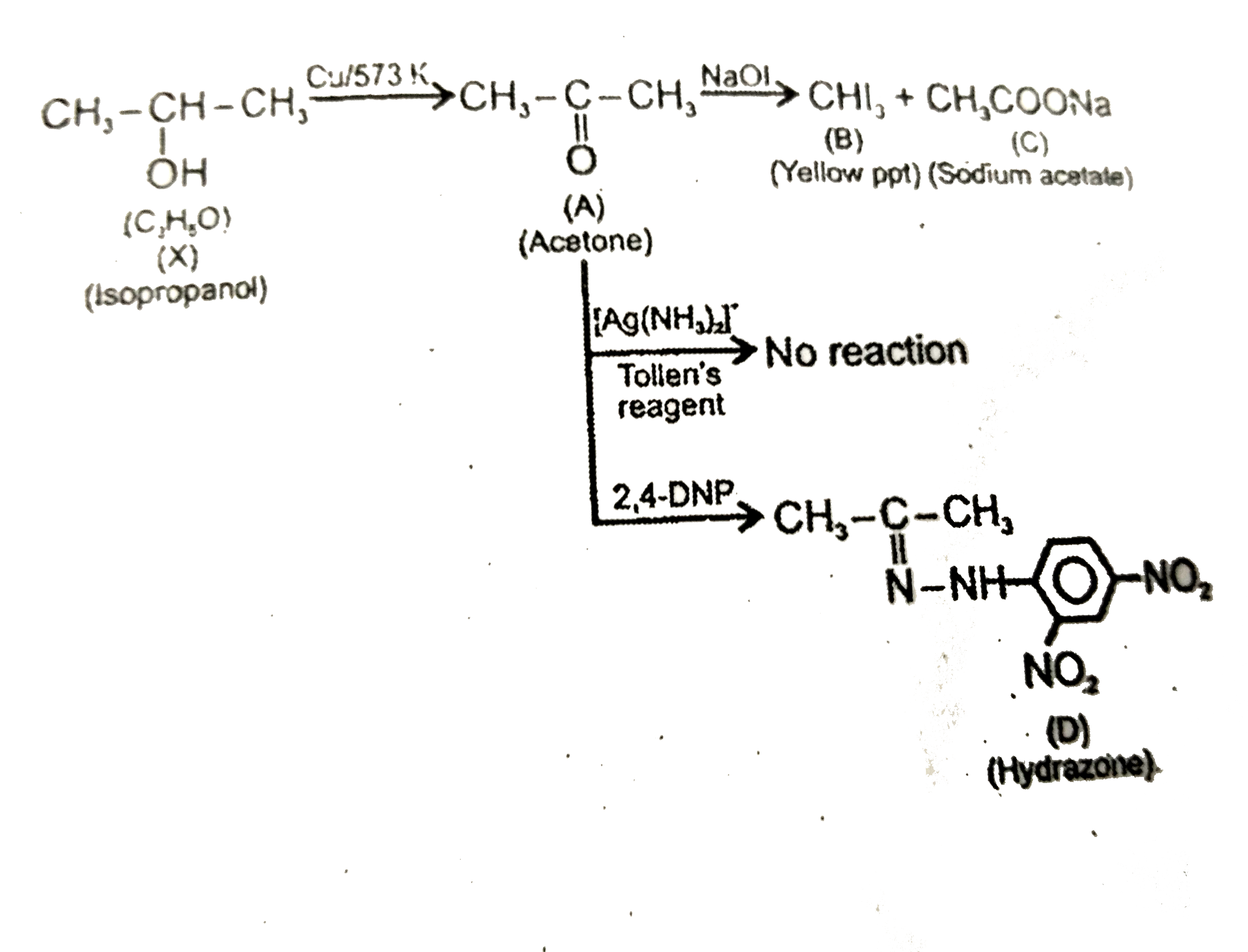
|
|
| 21. |
Consider the reactions: (i) (CH_(3))_(2)CH-CH_(2)Broverset(C_(2)H_(5)OH)to(CH_(3))_(2)CH-CH_(2)OC_(2)Hd_(5)+Br^(-) (ii) (CH_(3))_(2)CH-CH_(2)Broverset(C_(2)H_(5)O^(-))to(CH_(3))_(2)CH-CH-(2)OCH_(2)H_(5)+Br^(-) The mechanism of reactions (i) and (ii) are respectively- |
|
Answer» `S_(N)1andS_(N)2` |
|
| 22. |
Consider the reactionsC(s)+2H_(2)(g)rarrCH_(4)(g),DeltaH=-x kcalC(g)+4H(g)rarrCH_(4)(g), DeltaH=-x_(1) kcalCH_(4)(g)rarrCH_(3)(g)+H(g),DeltaH=+y kcal The bond energy of C - H bond is |
|
Answer» y KCAL `mol^(-1)` |
|
| 23. |
Consider the reactions : (1) (CH_(3))_(2)CH-CH_(2)Br overset(C_(2)H_(5)OH)rarr (CH_(3))_(2)CH-CH_(2)OC_(2)H_(5)+HBr(2)(CH_(3))_(2)CH-CH_(2)Br overset(C_(2)H_(5)O^(-))rarr (CH_(3))_(2)CH-CH_(2)OC_(2)H_(5)+Br^(-)The mechanisms of reactions (i) and (ii) are respectively : |
|
Answer» `S_(N)1` and `S_(N)2` First reaction is `S_(N)1` reaction because `C_(2)H_(5)OH` used as SOLVENT which US a weak nucleophile. Second reaction is `S_(N)2` reaction because `C_(2)H_(5)O^(-)` is strong nucleophile. |
|
| 24. |
Consider the reaction,M^(n+) (aq)+ne rarrM(s) The standard reduction potential value of the metals M_1,M_2 and M_3 are -0.34 V,-3.05 V and -1.66V respectively.The order of their reducing power will be : |
|
Answer» `M_1 GT M_2 gt M_3` |
|
| 25. |
Consider the reaction,M^(n+) (aq)+nerarrM^@(s) The standard reduction potential value of the metals M_1,M_2 and M_3 are -0.34 V,-3.05 V and -1.66V respectively.The order of their reducing power will be : |
|
Answer» `M_1 GT M_2 gt M_3` |
|
| 26. |
Consider the reaction where K_(p)=0.497at 500K. PCl_(5(g))hArrPCl_(3(g))+Cl_(2(g)) If the thre gases are mixed in a rigid containeer so that the partial pressure of each gas is initially 1 atm, which is true |
|
Answer» <P>More `PCl_(5)` will be produced Since, `Q_(p)gtK_(p),` the equlibrium shifts towards left. |
|
| 27. |
Consider the reaction where K_(p)=0.497at 500 K.PCl_(5)(g)hArr PCl_(3)(g)+Cl_(2)(g)If the three gases are mixed in a rigid container so that the partial pressure of each gas is initially 1 atm, which is true ? |
|
Answer» <P>More `PCl_(5)` will be produced `K_(p)=0.497` `Q=(P_(PCl_(3))xx P_(Cl_(2)))/(P_(PCl_(5)))=(1xx1)/(1)=1` Since `Q gt K_(p)`, the reaction will PROCEED in backward DIRECTION. Hence, more `PCl_(5)` will be produced. |
|
| 28. |
Consider the reaction. The rate constant for two parallel reactions were found to be 10^(-2) dm^(-2)mol^(-1)s^(-1) and 4xx10^(-2)dm^(-3)mol^(-1)s^(-1) . If the corresponding energies of activation of the parallel reaction are 100 and 120 kJ/mol respectively, what is the net energy of activation (E_(a)) of A |
|
Answer» 100 kJ/mol |
|
| 29. |
Consider the reaction The correct explanation is |
|
Answer» The product is formed due to nucleophilic substituion Hence elimination occurs. The product formed is resonance stabilised. |
|
| 30. |
Consider the reaction sequence B and C respectively are |
|
Answer» Anisole, isobutylene 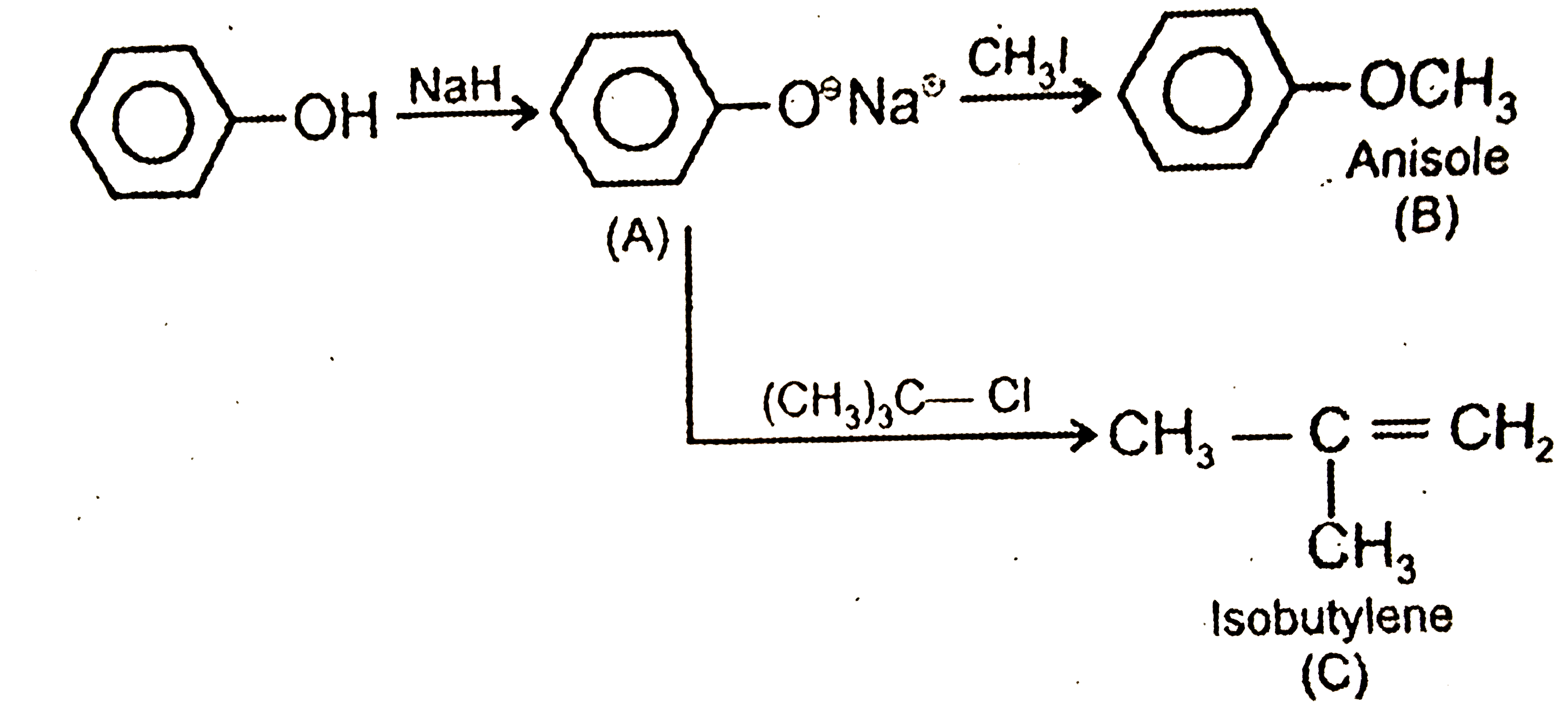
|
|
| 31. |
Consider the reaction sequence below: |
|
Answer»
|
|
| 32. |
Consider the reaction: RCHO+NH_(2)NH_(2) to RCH=N-NH_(2) What sort of reaction is it? |
|
Answer» ELECTROPHILIC addition-elimination REACTION 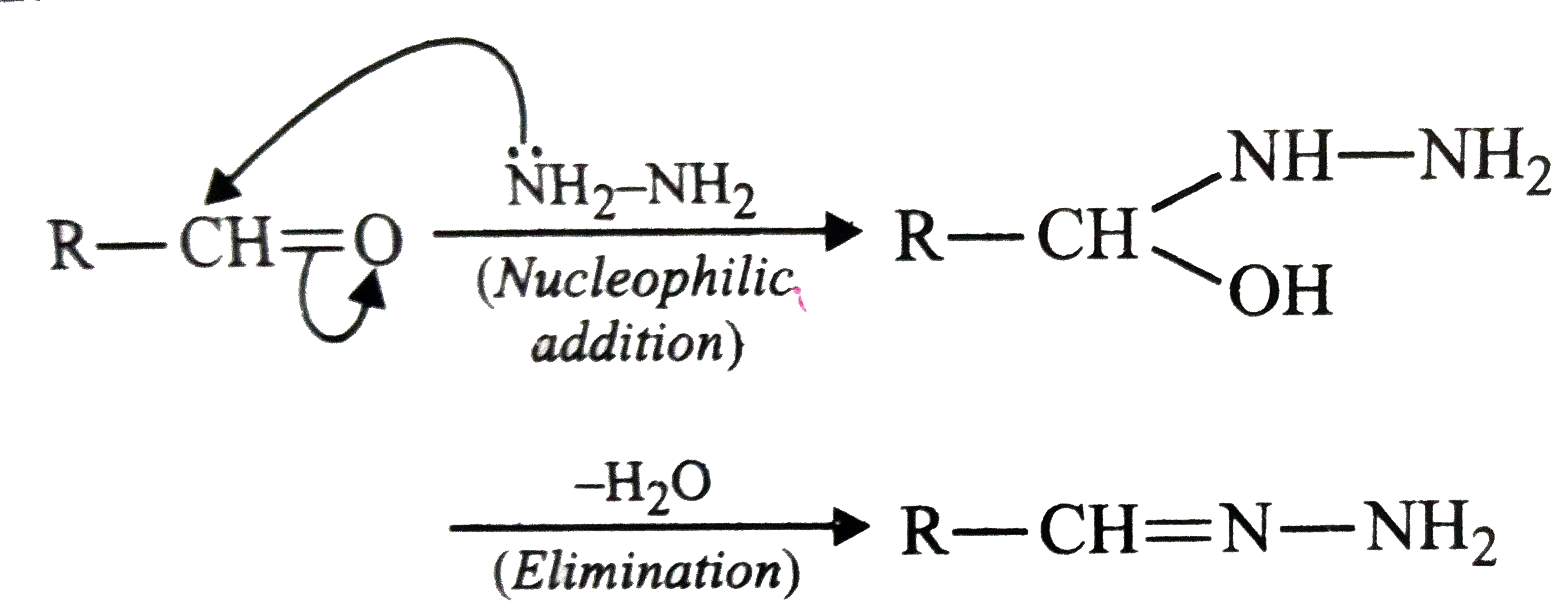 This reaction is an EXAMPLE of nucleophilic addition-elimination reaction. |
|
| 33. |
Consider the reaction : RCHO + NH_(2)NH_(2) rarr RCH = N-NH_(2) What sort of reaction is it ? |
|
Answer» Electrophilic addition - elimination REACTION. |
|
| 34. |
Consider the reaction : Provide a complete mechanism for the formation of the major product. |
Answer» SOLUTION :
|
|
| 35. |
Consider the reaction , PbO_2 to PbO , DeltaG_(298) lt 0 l SnO_2 to SnO , DeltaG_(298) gt 0 the most probable oxidation state of Pb and Sn will be |
|
Answer» `PH^(+4) , SN^(+2) ` ` UNDERSET(Pb^(+2))(DeltaG_(298) LT 0)"" underset(Sn^(+4))(DeltaG_(298) gt 0` |
|
| 36. |
Consider the reaction {:((R)-CH_(3)CHICH_(2)CH_(3)+^(137)T^(-),rarrCH_(3)CHICH_(2)CH_(3),,,),(alpha_(obs)=-15.90^(@),"containing" 2%137T^(-),,,),(,alpha_(obs)=-15.26^(@),,,):} The percentage of racemic from in the product is |
|
Answer» `10%` |
|
| 37. |
Consider the reaction: P_(4)(s)+F_(2)(g)rarrPF_(3)(g) How many gram of F_(2) are needed to produce 11.2 L of PF_(3) at NTP? |
|
Answer» 28.5gm `11.2` lit of `PF_(3)rArr0.5` mole of `PF_(3)` mole of `F_(2)` required `=(6)/(4)xx0.5=(3)/(4)` moles mass of `F_(2)` required `=(3)/(4)xx38=28-5gm` |
|
| 38. |
Consider the reaction of with aqueous HI. Give the mechanism and product of the faster reaction |
Answer» Solution : Several variations of this mechanism are acceptable, as LONG as they MAKE CHEMICAL sense and LEAD to the same diiodide. |
|
| 39. |
Consider the reaction of with aqueous HI. Explain your choice of the faster reaction. |
| Answer» SOLUTION :A significant difference between these TWO REACTANTS is the presence of a ring strain in the four-membered ring ETHER (called an oxetane). This ring strain is absent in the six-membered ring ether (called a tetrahydropyran). Relief of this ring strain would make the oxetane CLEAVAGE reaction faster than the tetrahydropyran cleavage reaction. | |
| 40. |
Consider the reaction of chloromethane with OH^(-) in aqueous solution CH_(3)Cl(aq)+OH(aq)underset(k_(r))overset(k_(f))hArrCH_(3)OH(aq)+Cl(aq) At 25°C, the rate constant for the forward reaction is 6x× 10^(-6) M^(-1) s^(-1), and the equilibrium constant K_(c) is 1 x× 10^(16). Calculate the rate constant for the reverse reaction at 25°C. |
| Answer» SOLUTION :`k_(b)=(k_(k))/(k_(eq))=(6xx10^(-6))/(1XX10^(16))=6xx10^(-22)` | |
| 41. |
Consider the reaction NO_(3^(-))+3F^(2+)4H^(+) to NO+3Fe^(3+)+2H_(2)O [Fe(H_(2)O)_(6)]^(2+)+NO to [Fe(H_(2)O)_(5)NO]^(2+)+H_2O The brown complex is formed. IUPAC name of the complex is |
|
Answer» Pentaaquanitrosyliron(II) |
|
| 42. |
Consider the reaction, N_(2)(g)+3H_(2)(g) to 2NH_(3)(g) The equility relationship between (d[NH_(3)])/(dt) and -(d[H_(2)])/(dt) is |
|
Answer» `+(d[NH_(3)])/(dt)=-(2)/(3)(d[H_(2)])/(dt)` Rate of reaction`=(1)/(2)(d[NH_(3)])/(dt)=-(1)/(3)(d[H_(2)])/(dt)` So, `(d[NH_(3)])/(dt)=-(2)/(3)(d[H_(2)])/(dt)` |
|
| 43. |
Consider the reaction nA+nB toProducts, when concentration of both reactant A and B is doubled the rate increases by eight times. However, when concentration of A is doubled keeping the concentration of B fixed the rate is doubled. The overall order of reaction is : |
|
Answer» `0` `r=K(2x)^(alpha)(2Y)^(beta)=2^((alpha+beta)).Kx^(alpha)y^(beta)`…….`(i)` `2r=K(2x)^(alpha)y^(beta)=2^(alpha)Kx^(alpha)y^(beta)`…………`(II)` `(iii)//(i) ` gives `2=2^(alpha) :.alpha=1` `(ii)//(iii)` gives `4=2^(beta) :.beta=2` OVERALL order `=1+2=3` |
|
| 44. |
Consider the reaction : N_(2)(g) +3H_(2)(g) rarr 2NH_(3)(g) The equality relationship between (d[NH_(3)])/(dt) and -(d[H_(2)])/(dt) is |
|
Answer» `+(d[NH_(3)])/(DT)=-(2)/(3) (d[H_(2)])/(dt)` or `(d[NH_(3)])/(dt) =-(2)/(3)(d[H_(2)])/(dt)` |
|
| 45. |
Consider the reaction :N_(2)+3H_(2)rarr2NH_(3) carried out at constant temperature and pressure. If DeltaH and DeltaU are the enthalpy and internal energy changes for the reactions, which of the following expression is true |
|
Answer» <P>`DELTAH = 0` `DeltaH=DeltaU+DeltanRTimplies Deltan=n_(p)-n_(R)=2-4=-2` `therefore DeltaHltDeltaU`. |
|
| 46. |
Consider the reaction : N_(2)+3H_(2)to2NH_(3) carried out at constant temperature and pressure. If DeltaHandDeltaU are the enthalpy and internal energy changes for the reaction, which of the following expressions is true ? |
|
Answer» `DeltaH=DeltaU` |
|
| 47. |
Consider the reaction: N_2(g) + 3H_2(g)to2NH_3(g) carried out at constant temperature and pressure. If Delta H and Delta Eare the enthalpy and internal energy changes for the reaction, which of the following expressions is true? |
|
Answer» `Delta H = 0 ` ` Delta N(g) = 2 -4= -2, Delta H = Delta E + Delta n(g) RT = Delta E - 2RT` ` therefore Delta H lt Delta E` |
|
| 48. |
Consider the reaction M_((aq))^(n+) + "ne"^(-) to M(s) The standard reduction potential values of the elements M_(1) , M_(2) and M_(3) " are " -0.34 V , -3.05 Vand -1.66 V respectively . The order of their reducing power will be |
|
Answer» `M_(1) GT M_(2) gt M_(3)` |
|
| 49. |
Consider the reaction: (i). (CH_(3))_(2)CH-CH_(2)Broverset(C_(2)H_(5)OH)to(CH_(3))_(2)CH-CH_(2)-O-C_(2)H_(5)+HBr (ii). (CH_(3))_(2)CH-CH_(2)Broverset(C_(2)H_(5)O^(-))to(CH_(3))_(2)CH-CH_(2)-OC_(2)H_(5)+Br^(-) The mechanisms of reaction (i) and (ii) are respectively. |
|
Answer» `S_(N^(1)) and S_(N^(2))` |
|
| 50. |
Consider the reaction: (i) (CH_(3))_(2)CH-CH_(2)Br overset(C_(2)H_(5)OH)to(CH_(3))_(2)CH-CH_(2)OC_(2)H_(5)+HBr (ii) (CH_(3))_(2)CH-CH_(2)Br overset(C_(2)H_(5)O^(-))to(CH_(3))_(2)CH-CH_(2)OC_(2)H_(5)+Br^(-) The mechanisms of reactions (i) and (ii) are respectively: |
|
Answer» `S_(N)1 and S_(N)2` |
|


_E01_318_O01.png)
_E01_318_O02.png)
_E01_318_O03.png)
_E01_318_O04.png)