Saved Bookmarks
This section includes 7 InterviewSolutions, each offering curated multiple-choice questions to sharpen your Current Affairs knowledge and support exam preparation. Choose a topic below to get started.
| 1. |
consider the reaction 2A_(g) + B_(g) hArr 2C_(g) for which K_c = 350.if 0.001 mole of each of the reactant and product are mix in a 2.0 L flux in the reaction quotient and spontaneous direction of the system will be |
|
Answer» `Q_c `= 0.002, the EQUILIBRIUM shifts to the left |
|
| 2. |
Consider the reaction 2Al (g) + 3Cl_(2) (g) rArr 2Al Cl_(3) (g). The approximate volume of chlorine that would react with 324 g of aluminium at STP is : |
|
Answer» 112 L |
|
| 3. |
Consider the reaction 2A + B to C + D Following results was obtained in experiments designed to study the rate of reaction" a) Write the rate law for the reaction b) Calculate the value of rate constant for the reactio. c) Which of the following possible reaction mechanisms is consistent with the rate law found in (a) ? I. A + B to C + E (slow) A + E to D (fast) IIgt B to C+E (slow) A + E to F (fast) A + F to D (fast) |
|
Answer» Rate = `k[A]^(p)[b]^(q)`…………….(i) `("Rate")_(1) = k[0.1]^(p)[0.10]^(q)=1.5 xx 10^(-3)`……………(i) `("Rate")_(2)=k[0.20]^(p)[0.20]^(q)=3.0 xx 10^(-3)`………..(II) `("Rate")_(3) = k[0.20]^(p)[0.40]^(q)=6.0 xx 10^(-3)`...............(iii) Divide equation (iii) by (ii) `(k[2.0]^(p)[0.20]^(q))/(k[0.10]^(p)[0.1]^(q)) = (6.0 xx 10^(-3))/(3.0 xx 10^(-3)) = 2` `[2]^(q) =[2]^(1)` or q=1 Divide equation (ii) by (i) `(k[0.20]^(p)[0.20]^(q))/(k[0.10]^(p)[0.1]^(q)) = (3.0 xx 10^(-3))/(1.5 xx 10^(-3))=2` `[2]^(p)[2]^(q)=2` or `[2]^(p)[2]^(1)=2` or `[2]^(b)[2]6(1) = [2]^(1)[2]^(0)` or p=0 Order w.r.t. p=0, Order w.r.t to q=1 a) Rate law for the reaction =`k[A]^(0)[B]^(1)` b) Value of rate constant from expt. No. 1. `k[0.10]^(0)[0.10]^(1) = 1.5 xx 10^(-3)` or k`=1.5 xx 10^(-2)` c) SINCE the order of reaction is ONE, reaction mechanism (II) is in consistent with the rate law. In this, the rate determining steps is: `B to C +E` (slow) |
|
| 4. |
Consider the reaction2A + B to2C. Supposethat ataparticularmomentduringthereaction , rateof disappearanceof Ais 0.076 m//s (a) Whatis the rateofformationof C ? ( b )What is therateof consumptionof B ? (c) What is therateof thereaction ? |
|
Answer» Rateof disappearanceof A= 0.076 `Ms^(-1)` (a) Rateof FORMATIONOF C= ? ( b) Rate ofconsumptionof B = ? (c ) Rateof reaction = ? Rateof disappearanceof `A =(d[A])/(dt) = 0.076 Ms^(-1)` (a) Rateof formationof `C= (d[C ])/(dt) = (d[A])/(dt)` `=0.076 Ms^(-1)` ( b) Ratedisappearanceof `B= (d[B])/(dt) = - (1)/(2) (d[A])/(dt)` `= (1)/(2) xx0.076 =0. 038Ms^(-1)` ( c) Rate OFREACTION`=- (1)/(2) .(d[A])/(dt) = (-d[B])/(dt) = (1)/(2) (d[C])/(dt)` `=(1)/(2)(0.076)= 0.038= (1)/(2) xx 0.076` `= 0.038 Ms^(-1)` |
|
| 5. |
Consider the radioactive disintegration ""_(82)A^(210) to B to C to ""_(82)D^(206) The sequence of emission can be |
|
Answer» `BETA, beta, beta ` |
|
| 6. |
Consider the reaction 1/2H_(2)(g)+AgCI(s)rarrH^(+)(aq)+CI^(-)(aq)+Ag(s) In which of the following galvanic ell the abvoe reaction occurs ? |
|
Answer» `AG|AgCI(s)|KCI(aq)||AgNO_(3)(Aq)|Ag(s)` undergoesreduction therefore cell MAYBE represent as `Pt|H_(2)(g)|HCI(aq)||AgCI(s)||Ag(s)` |
|
| 7. |
Consider the reaction 2A+B rarr C+D. If the rate expression is rate=K [A]^2 [B]^1 and if concentration of the reactants are increased by three times, the rate of the reaction will increase by: |
|
Answer» 9 times |
|
| 8. |
Consider the radii 0.095 nm (Na^+), 0.181 nm (CI^-), 0.074 nm (Zn^(2+)), 0.184 nm (S^(2-)) , 0.068 nm (Ti^(4+)), 0.140 nm (O^(2-)), 0.169 nm (Cs^+) . Choose the correct option from among the following. (Use radius ratio rules) |
|
Answer» `Na^+`ions are packed in octahedral HOLES between the PLANES of close-packed `Cl^-` ions |
|
| 9. |
Consider the proposed mechanism for the destruction of ozone in the stratosphere O_3 + Cl to ClO +O_2 ClO + O_3 to Cl + 2 O_2 Which of the statements about the mechanism is/are correct |
|
Answer» CL is catalyst `to` AMOUNT of Cl and ClO present at any time are equal. |
|
| 10. |
Consider the proposed mechanism for the destruction of ozone in the stratosphere: O_(3) +Cl rarr ClO. +O_(2) ClO +O_(3) rarr Cl. +2O_(2) Which of the statements about this mechanism is correct? |
|
Answer» CL. Is a CATALYST |
|
| 11. |
Consider the pathway of a well known organic reaction I and II are reacted with NaOH//Br_2 then in the solution which product exist. |
|
Answer»
|
|
| 12. |
Consider the partial decomposition of A as 2A(g)hArr2B(g)+C(g) At equilibrium 700 mL gaseous mixture contains 100 mL of gas Cat 10 atm and 300 K. What is the value of K_(p) for the reaction? |
|
Answer» `(40)/(7)` `underset("At eqm.")(2A(g))hArrunderset(400ML)(2B(g))+underset("200mL 10mL")(C(g))` for IDEAL gases valume % -=mole % `K_(p)=(((200)/(700)xx10)^(2)((100)/(700)xx10))/(((400)/(700)xx10)^(2))=(10)/(28)` |
|
| 13. |
Consider the possible formation of an aldehyde or ketone product when each of the ten compounds in the column on the left is treated with each of the reagents shown in the top row . Check the designated answer box if you believe an aldehyde or ketone will be formed . Assume that the reagents may be present in excess . For each checked reaction , try to draw the structure of the major product (s) . |
Answer» 
|
|
| 14. |
Consider the pairs of ethers A through F shown below. To the right of each pairs is a description of reaction conditions to be applied to each. One compound of the pair will react more rapidly than the other. Find out number of reactions in which first ether more rapidly cleaved than second. |
|
Answer» |
|
| 15. |
Consider the oxy acids HClO_nseries here value of n is 1 to 4. then incorrect statement regarding these oxyacids Is: |
|
Answer» ACIDIC character of oxy acids increases with INCREASING value of n |
|
| 16. |
Consider the order O^(2-) lt F^(+) lt Na^(+) lt Mg^(3+). Then correct statement(s) is/are : |
|
Answer» INCREASING order of `Z_(eff)`. |
|
| 17. |
Consider thenitrogenatom is amines, whichon of the followingstatementis correct ? |
|
Answer» It is `SP^(3)`- hybridised |
|
| 18. |
Consider the oxidation of nitric oxide to form NO_2 2NO_((g))+O_(2(g))rarr2NO_(2_((g)) (a) Express the rate of the reaction in terms of changes in the concentration of NO , O_2 and NO_2. (b) At a particular instant , when [O_2] is decreasing at 0.2 "mol L"^(-1)s^(-1) at what rate is [NO_2] increasing at that instant ? |
|
Answer» SOLUTION :(a) Rate `=-1/2(d[NO])/(dt)=(-d[O_2])/(dt)=1/2(d[NO_2])/(dt)` (b)`(-d[O_2])/(dt)=1/2(d[NO_2])/(dt)` `(d[NO_2])/(dt)=2XX(-d[O_2])/(dt)=2xx0.2" MOL L"^(-1)s^(-1) = 0.4 "mol L"^(-1)s^(-1)` |
|
| 19. |
Consider the order of a reaction. Choose the incorrect statement(s). |
|
Answer» Order of a reaction may be zero, INTEGER or FRACTIONAL |
|
| 20. |
Consider the molecule Which reagent will not give a positve test with this compound? |
|
Answer» Cold conc.`H_(2)SO_(4)`<BR>`Br_(2)//C Cl_(4)` |
|
| 21. |
Consider the isoelectric species Na^(+), Mg^(2+),F^(-) and O^(2-). The correct order of increasing length of their radii is |
|
Answer» `F^(-) LT O^(2-) lt MG^(2+) lt Na^(+)` |
|
| 22. |
Consider the isoelectronic series : K^(+), S^(2-) , Cl^(-) and Ca^(2+), the radii of the ions decrease as |
|
Answer» `Ca^(2+) gt K^(+) gt CL^(-) gt S^(2-)` |
|
| 23. |
Consider the ions : S_(2)O_(3)^(2-)(X) and S_(2)O_(4)^(2-)(Y). How many statements are correct regarding (X) and (Y).(d stands for bond length) ,brgt (a) d_(s-s):X lt Y (b) d_(s-o): X lt Y ( c) Average oxidation state of S in (X) is less than that in (Y). (d) In both (X) and (Y), the central S atom is sp^(3) hybridised. |
|
Answer» `"B.L (S-O) Y (151 pm)" gt" X(147 pm)"` |
|
| 24. |
Consider the ionic reaction : HC_(2)O_(4)^(-) +PO_(4)^(-3) hArr HPO_(4)^(2-) +C_(2) O_(4)^(2-) Identify the incorrect statement (s) |
|
Answer» The above equilibrium mixture can act as buffer (both acids have nearly the same dissociation constant ) `underset("acid")(HC_(2)O_4^(-))+underset("base")(PO_4^(-3))hArrunderset("acid")underset("conjugate")(HPO_4^(2-))+underset("base")underset("conjugate")(C_2O_4^(2-))`  Bond order =` ("No of BONDS in any one resonating structure")/("Total no. of resonating structure")` `B.O(PO_4^(3-))=5/4=1.25 , underset(("C-O bond"))(B.O(C_2O_4^(2-)))=3/2=1.5` `:Nunderset(15e^(-))overset(...)(=)O:overset(e^(-))rarrunderset(14e^(-))(NO^(+))` |
|
| 25. |
Consider the imaginary equilibrium 4A+5B hArr4X+6Y The equilibrium constant K_(c) has the unit |
|
Answer» `"MOLE"^(2)litre^(2)` `Deltan=10-9=1` `thereforeK_(c)="mol Litre"^(-1).` |
|
| 26. |
Consider the ground state of Cr atom (Z=24). The number of electrons with azimuthal quantum numbers,l=1 and 2 are respectively. |
|
Answer» 16 and14 No.of electrons `l=1` or `p(12), l=2` or `d(5)` |
|
| 27. |
Consider the graph under question 8. Which of the following options does not show instaneous rate of reactiono at 40^(th) second? |
|
Answer» `(V_(5)-V_(2))/(50-30)` |
|
| 28. |
Consider the ground state of Cr atom (Z = 24 ). The number of electrons with the azimuthal quantum numbers l= 1 and 2 are respectively |
|
Answer» 12 and 4 l = 1 means p-sub-shell and l = 2 means d-sub-shell. l=1 is for `2p^(6)` and `3p^(6). Therefore` TOTAL electrons=12 l=2 is for `3d^(5). Therefore` Total electrons=5 |
|
| 29. |
Consider the graph given in question no. 8 . Which of the following options does not show instantaneous rate of reaction at 40th second. |
|
Answer» `(V_(5)-V_(2))/(50-30)` |
|
| 30. |
Consider the graph given in the above questions. Which of the following options does not show instanetaneous rate of reaction at 40 th second ? |
|
Answer» `(V_(5)-V_(2))/(50 - 30)` |
|
| 31. |
Consider the given reaction : R-COOAg overset(Br_2//Delta)to R-Br Which one of the following acid will give maximum yield of R–Br in the above reaction: |
|
Answer» `CH_3-undersetunderset(CH_3)|CH-COOH` |
|
| 32. |
Consider the graph given in Q.9Which of the following options does not show instantaneous rate of reaction at 40^(th) second? |
|
Answer» `(V_(5) - V_(2))/(50 -30)` Thus, volume change during 50-30 SEC. interval = `V_(5) - V_(2)` and not `v_(4) - V_(2)` Hence, `(V_(4) - V_(2))/(50 - 30)` does not show Instantaneous rate of reaction at `40^(th)` second. |
|
| 33. |
Consider the graph given in Fig. in Q. 8. Which of the following options does not show instantaneous rate of reaction at 40th second ? |
|
Answer» `(V_(5)-V_(2))/(50-30)` |
|
| 34. |
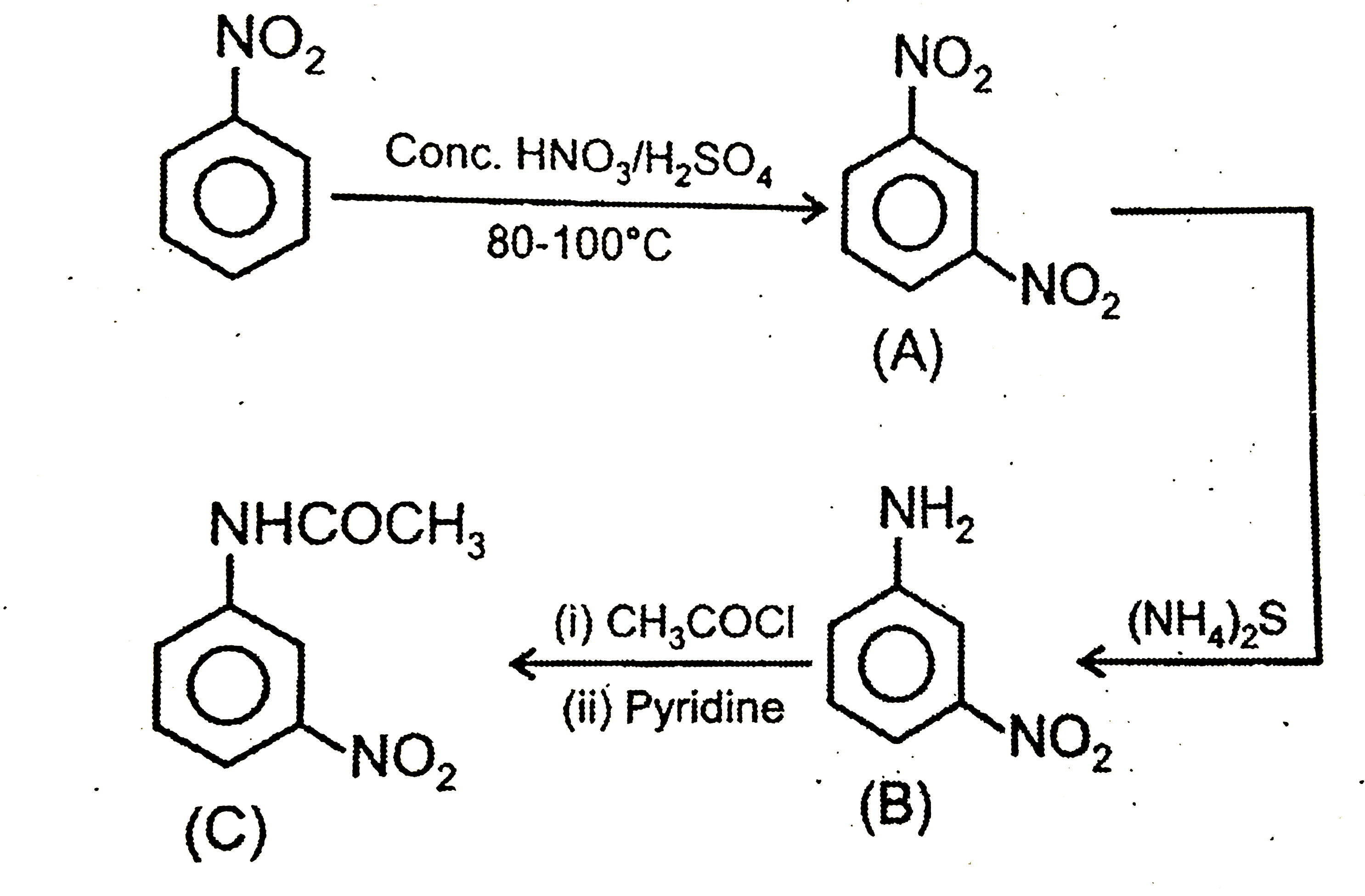
Consider the given reaction sequence Theproduct C is |
|
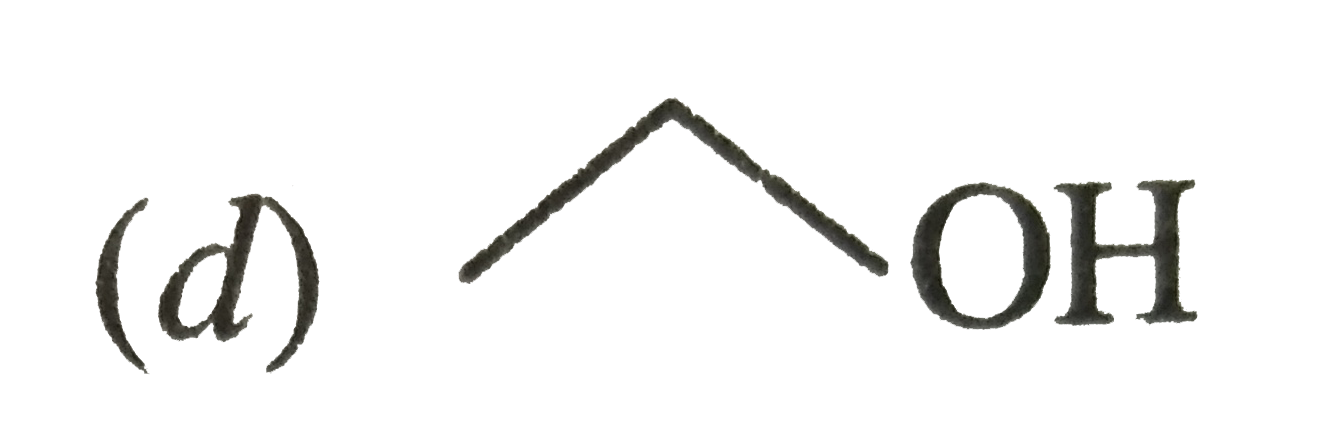
Answer»
|
|
| 35. |
consider the given reaction, 3A(g) + B(g) hArr 2C(g) at a given temperature if a mixture of 2 mol each of A, B and C exist at equilibrium and K_c =9 then volume of the flask will be |
|
Answer» 3L |
|
| 36. |
Consider the given figure showing the formation of H_(2)^(+) ion dependin on internuclear distance versus potential energy of the systemWhich is correct statement : |
|
Answer» Curve-1 REPRESENTS the most stable state of the system for `H_(2)^(+)` |
|
| 37. |
Consider the given figure and mark the correct option. |
|
Answer» Activation energy of forward reaction is `E_(1) + E_(2)` and product is less stable than REACTANT. |
|
| 38. |
Consider the given figure showing that possible levels of the energy of H_(2)^(+) ion depending on internuclear distance versus potential energy of the system. It may be easily assumed that the ground state of the molecular hydrogen ion H_(2)^(+) corresponds to the lowest level which means that |
|
Answer» curve 1 represents the most stasble STATE of the system for `H_(2)^(+)` ion |
|
| 39. |
Consider the gas-phase hydration of hexafluoroacetone, (CF_(3))_(2) CO : (CF_(3))_(2)CO(g) + H_(2)O (g) underset(k_(r))overset(k_(f))hArr(CF_(3))_(2)C(OH)_(2)(g) At 76° C, the forward and reverse rate constants are k_(f) = 0.13 M^(-1) s^(-1) and k_(r) = 6.02 x× 10^(-4) s^(-1). What is the value of the equilibrium constant K_(c) ? |
|
Answer» |
|
| 40. |
Consider the given compounds :(a)CH_(3)-CH_(2)-NH_(2)(b) CH_(3)-CH=NH (c ) CH_(3)-C=N(d) C_(2)H_(5)-NH-C_(2)H_(5) Arrange basicity of these compounds in decreasing order : |
|
Answer» `4 gt 1 gt 2 gt 3` |
|
| 41. |
Consider the Galvanic cell Zn|ZnSO_(4)||CuSO_(4)|Cu the reaction at cathode is |
|
Answer» `ZN^(2+)+2e^(-)toZn` 
|
|
| 42. |
Consider the given compound.: Correct statements is/are regarding these compound: |
|
Answer» in structure (I), both MARKED H-atoms are on axial position. (B). Aromatic aldehyde does not give fehling solution TEST. (C).  Gives IODOFORM test. (D). Since carbon is not present in `H_(2)N-NH_(2)`. it does not gives lassigne's test. |
|
| 43. |
Equilibrium constants K_1 and K_2 for the following equilibria (a) NO_((g)) + 1/2 O_(2(g)) hArr NO_(2(g)) (b) 2NO_(2(g)) hArr 2NO_((g)) + O_(2(g))are related as : |
|
Answer» `K_(2)=(1)/(K_(1))` and`K_(2)=([NO]^(2)[O_(2)])/([NO_(2)])=(1)/(K_(1)^(2))` `THEREFORE K_(2)=(1)/(K_(1)^(2))` |
|
| 44. |
Consider the galvanic cell : Pb(s)| Pb^(2+) (aq) (x_1 M)| | Cu^(2+)(aq) )x_2M) | Cu(s) E_("cell")= 0.48V which of the following graphs is correct ? |
|
Answer»
|
|
| 45. |
Consider the followng changes: M(s) to M(g). . . (1) M(s) to M^(2+)(g) +2e^(-). . . (2) M(g)to M^(+)(g)+e^(-). . . (3) M^(+)(g) to M^(2+)(g)+e^(-) . .(4) M(g) to M^(2+)(g)+2e^(-) . . . (5) The second ionization energy of M could be calculated from the enrg values associated with: |
|
Answer» 1+3+4 Hence, `M(G)to M^(2+)+2e^(-)` . . . (5) `M(g)TOM^(+)+e^(-)`. . . (3) |
|
| 46. |
Consider the followng compounds Which of the above compounds reacts with NaHCO_(3) given CO_(2). |
|
Answer» I,II and III |
|
| 47. |
Consider the followinng reactions, ethanoloverset(PCl_(5))toXoverset("alc. KOH")to Y underset((ii)" "H_(2)O,heat)overset((i)" "H_(2)SO_(4)," room temperature")toZ The product Z is: |
|
Answer» `C_(2)H_(4)` |
|
| 48. |
Consider the following values of I.E.(eV) for elements W and X: {:("Element",I.E_(1),I.E_(2),I.E_(3),I.E_(4)),(W,10.5,15.5,24.9,79.8),(X,8,14.8,78.9,105.8):} Other two element Y and Z hav outer electronic configuration ns^(2)np^(4) and ns^(2)np^(5) respectively. then according to given information which of the following compound(s) is/are not possible? |
|
Answer» `W_(2)Y_(3)` |
|
| 49. |
Consider the following vapour presure compositon graph. Hence. |
|
Answer» VAPOUR PRESSURE of A=SZ |
|