

Saved Bookmarks
This section includes 7 InterviewSolutions, each offering curated multiple-choice questions to sharpen your Current Affairs knowledge and support exam preparation. Choose a topic below to get started.
| 1. |
Consider the following value of IE(ev) for elements W and X:- {:("Element",IE_(1),IE_(2),IE_(3),IE_(4),),(W,10.5,15.5,24.9,79.8,),(X,8,14.8,78.9,105.8,):} Other two elements Y and Z have outer electronic configuration ns^(2) np^(4) and ns^(2) np^(5) respectively. Accoring to given information which of the following compound (s) is/are not possible. (a) W_(2)Y_(3) (b) X_(2)Y_(3) ( c) WZ_(2) (d) XZ_(2) |
|
Answer» a,B |
|
| 2. |
Consider the following two reactions: Cd^(2+)(aq.)+4CH_(3)NH_(2) overset(K_(1)) ot 'A",DeltaG_(1)^(@) Cd^(2+)(aq.)+2H_(2)NCH_(2)CH_(2)NH_(2) overset(K_(2)) to 'B',DeltaG_(2)^(@) According to given information the correct statement(s) is/are: |
|
Answer» `DeltaG_(2)^(@)` is more negative than `DeltaG_(1)^(@)` |
|
| 3. |
Consider the following two reactions : 1. The rate of reaction will be faaster in A when compared to B and the E^(+) attacks at meta to NO_(2) group. 2. The rate of B is faster than A and the E^(+) attacks ortho to -NHCOCH_(3) group. 3. The rate of B is faster than A and is A, E^(+) attacks at ortho to -Cl and in B, E^(+) attacks orthot to -CH_(3) group. 4. The rate of B is slower than A and in A, E^(+) attacks meta to -NO_(2) and in B, ortho to NHCOCH_(3) group. Out of these statements |
|
Answer» 1 and 4 are correct |
|
| 4. |
Consider the following two Ist order reactions: A to P ""…..(i) B to Q""......(ii) Reaction (i) is 75% completion in 4 hrs while reaction (ii) takes 16 hr for 75% completion under indentical conditions . By how many hours. Half life of (i) reaction is greater than the half life of (i)? |
|
Answer» |
|
| 5. |
Consider the following two molecules and according to the given information select correct statement(s) about AX_(2) and AY_(2) : where A:16th group of 3rd period element X: more electronegative than (A) and same group number of (A) ltbgt Y: Less atomic size than (A) and same period number of (A) |
|
Answer» The HYBRIDIZATION of central atoms are DIFFERENT in both COMPOUNDS 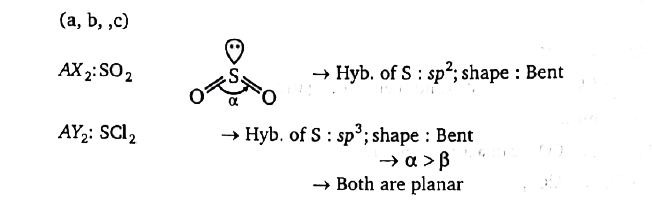
|
|
| 6. |
Magnesium Hydroxide is also known as :- |
|
Answer» MILK of lime |
|
| 7. |
Consider the following two first order reactions occurring at 298 K with same initial concentration of A:(1) A rarr B, rate constant, k = 0.693 min^(-1)(2) A rarr C, half-life, t_(1//2) = 0.693 minChoose the correct option. |
|
Answer» Reaction (1) is faster than reaction (2). rate constant `(k_1) = 0.693 min^(-1)` For reaction (2), `ArarrC,` rate constant `(K_2)=(0.693)/(t_(1//2)) implies (0.693)/(0.693)=1MIN^(-1)` So,`k_1 LT k_2` Hence,reaction (1) is slower than reaction (2). |
|
| 8. |
Consider the following two diagram : Suppose that the solute molecules on the surface of solution occupy 10% of the surface area. The correct statement is (are) |
|
Answer» If the water in the vessel-I was TRANSFERRED to a container with `10%` less surface area, the vapour pressure would be lowered to same value as the vapour pressure in vessel-II. |
|
| 9. |
Consider the following two carbonyl compounds (i) [Tc(CO)_(6)]^(+) and (ii)[Nb(CO)_(6)]^(-) Select incorrect statement(s) for given carbonyl compounds. |
|
Answer» `{t(CO)_(6)]^(+)` acts as reducing AGENT and `[NB(CO)_(6)]^(-)` acts as OXIDIZING agennt |
|
| 10. |
Consider the following transformations CH_3COOH overset(CaCO_3) to A overset("Heat")to B underset(NaOH)overset(I_2)to C The molecular formula of C is |
|
Answer» `CH_3 UNDERSET(I)underset(|)OVERSET(OH)overset(|)C - CH_3` |
|
| 11. |
Consider the following transformation: Cr(CO)_(x) to Cr(CO)_(y)(NO)_(z) If both reactant and product follow EAN rule, then calculate value of x+z-y (where x,y and z are natural numbers). |
|
Answer» |
|
| 12. |
Consider the following transformation : 2CuX_(2) overset("Room temperature")(to) 2CuX+X_(2) (uarr) Then X^(-) can be: |
|
Answer» `F^(-), BR^(-)` |
|
| 13. |
Consider the following tranformation: 2CuX_(2) overset("Room temperature")to 2CuX+X_(2)uarr Then X^(-) can be |
|
Answer» `F^(-),BR^(-)` |
|
| 14. |
Consider the following three orbitals : Correct statement(s) regarding given information is /are : |
|
Answer» Orbitals (i) and (ii) can NEVER form any type of covalent BOND (b) `p_(y)+d_(xz) implies ` Form non-bonding if internuclear axis is x-axis (c ) `d_(xz)+d_(xz) implies` Can form `delta`-bond if internuclear axis is y-axis (d) `p_(z)+d_(xz) implies ` CAn form `pi` bond, if internuclear axis is x-axis. |
|
| 15. |
Consider the following three bases of DNA and RNA: The order of acidic strength on different site will be |
|
Answer» `a gt B` |
|
| 16. |
Consider the following The concentralt in of hydrogen ions in an aqueous solution is expressed by its |
|
Answer» pH |
|
| 17. |
The above process in which alpha and beta form remain in equilibrium with acyclic form and a change in optical rotation is observed which is known as- |
|
Answer» Mutarotation |
|
| 18. |
Consider the following table regarding interhalogen compounds, XY_(n) (where Y is more electronegative than X) Thn according to given information calculate value of expression P_(2)xx((P_(3)-P_(1))/((Q_(1)+Q_(2)) |
|
Answer» <P> `=(5(7-3))/(3+2)=4` |
|
| 19. |
Consider the following system. Three different aqueous solution each having volume 100 ml are taken are kept in contact as shown. After sufficient time (Consider temp constant & 100% dissociation of strong electrolyte ) |
|
Answer» Volume of urea solution will be `100/3` ML. as T is same i.e. molar concentration should be same, for this ratio of volume should be the same as that of ratio moles. `{:("Urea",:,KCl,:,AlCl_3),(20 m "moles", " " ,30 m "moles", " " ,40 m "moles"):}` Total volume (300 ml) should be divided in 2:3:4 `V_("urea")=2/9xx300=200/3 ml` `V_(KCl)=3/9xx300=100 ml` `V_(AlCl_3)=4/9xx300=400/3`ml |
|
| 20. |
Consider the following substances (1)HCHO ""(2) CH_(3)CHO (3) CH_(3)COCH_(3)""(4) CH_(3)COC_(2)H_(5) The correct order of reactivity towards nucleophilic addition reaction is |
|
Answer» `1 gt 2 gt 3 gt 4` |
|
| 21. |
Consider the following substances 1) 2-propanol, 2) propanone, 3) methyl amine The correct sequence of increasing order of boiling point is |
|
Answer» 2 lt 3 lt 1 |
|
| 22. |
Consider the following structures (M: central metal). Choose the correct statement (s): |
|
Answer» I and II are GEOMETRICAL isomers |
|
| 23. |
Consider the following steps : CuS overset("roast in air")rarr (A) overset("roast without air")rarr (B) Which is not the correct statement : |
|
Answer» it is self REDUCTION |
|
| 24. |
consider the following statements: When a direct current is passed through an aqueous concentrated soluton of NaCl. 1. pH of the solution decreases. 2. metallic sodium will be deposited at the cathode. 3. Chlorie gas will be liberated at th anode. 4. pH of the solution increases. Which of the statements given above are correct? |
|
Answer» 1 and 2 |
|
| 25. |
Consider the following steps : Cu_2S overset"Roast in air"to A overset"Heating without air"to B Which of the following is/are the correct statement(s)? |
|
Answer» It INVOLVES self-reduction. `2Cu_2O + Cu_2S to 6Cu+ SO_2` The solidified copper obtained has blistered appearance due to the EVOLUTION of `SO_2` and therefore , it is called blister copper. |
|
| 26. |
Consider the following statements with regard to the properties of water I . Water is a good solvent for ionic compound but poor solvent for covalent compound . II . Water is a good solvent for covalent compound but poor solvent for ionic compound . III . Water has maximum density at the temperature 277 K . Which of the statements given above are correct ? |
|
Answer» I and III only Water has MAXIMUM density at `4^(@)C` or 277 K . Above or below this temperature the density will decrease. |
|
| 27. |
Consider the following statements : Statement-1: The [Co(ox)_(3)]^(3-) complex is diamagnetic and gains stability through chelation. Statement 2: The [Co(NO_(2))_(6)]^(4-) is inner orbital complex involving d^(2)sp^(3) hybridization and is paramagnetic. The complex [PtCl_(4)]^(2-) is square planar and diamagnetic. and arrange in the order of true/false : |
|
Answer» TTT |
|
| 28. |
Consider the following statements. The common features of the molecuels BF_3. CIO_2 and NO are that I. All are Lewis acids II. All are gaseous in nature III. All contain unpaired electrons IV. All do not conform to the octect rule. |
|
Answer» I and II |
|
| 29. |
consider the following statements : Statement-1: [MnCL_(6)]^(3-)," and"[CoF_(6)]^(3-) are paramagnetic having four, five and four unpaired electrons respectively. Statement-2: Valence bond theory gives a quantitative interprtation of the thermodynamic stabilities of coordination compounds. Statement-3: The crystal field splitting Delta_(0), depends upon the field produced by the ligand and charge on the metal ion. and arrange in the order of true/false. |
|
Answer» TTT |
|
| 30. |
Consider the following statements : Statement-1: Generally, square planar complexes show geometrical isomerism but do not exhibit optical isomerism because they do not possess plane of symmetry. Statement-2: Delta_(t)=(4)/(9) Delta_(0) Statement-3: In octahedral complexes each electron entering the t_(2g) orbitals stabilizes the complex ion by 0.4 Delta_(0) and each electron entering the e_(g) orbital destabilizes the complex by an amount of 0.6 Delta_(0). Select the correct statement from the codes given below. |
|
Answer» Statement-1 and statement-3 are correct (C ) `"CFSE" =-0.4 Delta_(0)xx"n"_("n"_(2g))+0.6 Delta_(0)xx"n"_("eq")+"nP"`. |
|
| 31. |
Consider the following statements : statement-1: [Cr(NH_(3))_(6)]^(3+)]^(3+) is an inner orbital complex with crystal field stabilization energy complex with crystal field stabilization energy equal to -1.2 Delta_(0). Statement -2: The complex formed by joining the CN^(-) ligands to Fe^(3+) ion has theoretical value of 'spin only' magnetic moment equal to 1.73 BM. Statement-3: Na_(2)S+Na_(2) [Fe(CN)_(5)NO]to Na_(4)[Fe(CN)_(5)NOS], In reactant and product the oxidation states of iron are same and arrange in the order of true/false. |
|
Answer» FTF CFSE = `-0.4 XX 3 Delta_(0) = -1.2 Delta_(0)`. |
|
| 32. |
Consider the following statements …………… Solids have definite volume and shape (ii) Solids are rigid and compressible(iii) Solids have weak cohesive forcesWhich of the above statemetns is/are not correct ? |
| Answer» Solution :(ii) & (iii) only | |
| 33. |
Consider the following statements: Roasting is carried out to: (i) convery sulphide to oxide and sulphate (ii) remove water of hydration (iii) melt the ore (iv) remove arsenic and sulphur impurities of these statements: |
|
Answer» (i),(ii) and (III) are correct |
|
| 34. |
Consider the following statements : Roasting is carried out to 1. convert sulphide to oxide and sulphate 2. remove water of hydration 3. melt the ore 4. remove arsenic and sulphur impurities Of these statements |
|
Answer» 1, 2, and 3 are CORRECT |
|
| 35. |
Consider the following statements regarding the given projection (True of False). |
|
Answer» |
|
| 36. |
Consider the following statements regarding aluminium paint 1. It is fairly good heat-resistant 2. It possess good electrical resistance. 3. It cannot be used for hot water pipe. Which of the substance given above is/are correct ? |
|
Answer» 1 and 3 |
|
| 37. |
Consider the following statements : (P) [Mn(H_(2)O)_(4)]SO_(4) is paramagnetic and square planar (Q) Crystal field splitting energy (i.e." "Delta_(0)), in [Cr(H_(2)O)_(6)]^(3+) is higher than in [Cr(H_(2)O)_(6)]^(2+) (R ) Wilkinson catalyst [RhCl(Ph_(3)P)_(3)], a red-violet complex is diamagnetic and square planar. (S) Hg[Co(SCN)_(4)], a deep blue complex is paramagnetic and tetrahedral. and of these select the correct set from the given options. |
|
Answer» <P>P and S only |
|
| 38. |
Consider the following statements: Phenyl diazonium salts form azo dye with I. aniline II. PhenolIII. N, N - dimethyl aniline IV. Anisole (methoxybenzene)The correct statements is |
|
Answer» 2,3,4 are CORRECT |
|
| 39. |
Consider the following statements regarding roasting.It is carriedout to A) convert sulphide to oxide and sulphate B) remove water of hydration C) melt the ore D) remove arsenic and sulphur impurities Of these statements : |
|
Answer» A, B and C are CORRECT |
|
| 40. |
Consider the following statements. (P) Blue salt K_(4)[Mn(CN)_(6)].3H_(2)O is isostructural with the hexacyanoferrate (II) and the former complex is paramagnetic but later one is diamagnetic. (Q) In the series of isoelectronic species [V(CO)_(6)]^(-), [Cr(CO)_(6)]" and "[Mn(CO)_(6)]^(+),from the vanadium to manganese complexes there is reduction in the strength of the bonding between metal and carbon and an increase in that in the carbonyl group (i.e.CO). (R ) Chlorotritriphenylphosphinerhodium (I) is a square planar diamagnetic complex which is used as a homogeneous catalyst in hydrogenation of alkenes. (S) Like [Co(NH_(3))_(4)Cl_(2)]^(+) ion, [Co(en)_(2)Cl_(2)]^(+) ion can exist in cis and trans forms adn neither can display optical activity. (T) Ni(CO)_(4)" and "NiCl_(2)(PPh_(3))_(2) have same hybridization but different, magnetic moment and effective atomic number. |
|
Answer» P, R and T (T) `[overset(+2)NiCl_(2)(PPh_(3)) implies` tetrahedral but `d^(8)` has 2 uu.p. electron. Correct statements : P,Q,R,T. |
|
| 41. |
Consider the following statements I.The pH |
|
Answer» I and II After reaction20 mmol020 mmol40 mmol Total volume =400+400=800mmol Number of moles of `H_92)SO_(4)=20mmol` Number of moles of `H^(+)` ion =`2xx20m` mol=40m mol` [H^(+)]=40/800=0.05` `pH=-log[H^(+)]=-log(0.05)=2-log(5)=2-0.7=1.3` pH=1.3 II.`K_(w)=[H^(+)][OH^(-)]` As T increases, `K_(w)` also increases III.pH=5 and `K_(a)=10^(-5)` `implies-log[H^(+)]=5` Weak monobasic acid ‘HA’ having concentration ‘C’ `HA(aq) to H^(+)(aq) + A^(-1)(aq)` At t=0C00 At equilibirium`C-CalphaCalphaCalpha` `K_(a)=([H^(+)][A^(-1)])/([HA])=(CALPHA)/(C(1-alpha))` `alpha to `degree of dissociation `therefore K_(a)=(Calpha^(2))/(1-alpha)=10^(-5) ` … (1) (given) `[H^+)]=Calpha=10^(-5)`… (2) From EQUATION (1) & (2) `alpha/(1-alpha)=1impliesalpha=1-alpha implies alpha=1/2` `% alpha=1/2 xx100=50%` IV. It is applicable |
|
| 42. |
Consider the following statements. metallic solids possess high electrical and thermal conductivity (ii) solid ice are soft solids under room temperature (iii) In non polar molecular solids constituent molecules are held together by strong electrostatic forces of attraction Which of the above statenments is/are not correct ? |
|
Answer» (i) & (II) only |
|
| 43. |
Consider the following statements : (I)Rutherford name was associated with help the development of periodic table (II)A metal M having electronic configuration 1s^2, 2s^2, 2p^6, 3s^2, 3p^6, 3d^10, 4s^1 is d-block element. (III)Diamond is not an element (IV)The electronic configuration of the most electronegative element is 1s^2, 2s^2, 2p^5 Select the correct option from the given codes 1 |
|
Answer» I,II,IV (IV)This is the configuration of F (electronegativity=4.0) which belongs to p-block and group number `17^(th)` |
|
| 44. |
Consider the following statements - In the aluminothermite process, aluminium acts as reducing agent. The process of extraction of gold involves the formation of [Au(CN)_2 ]^(-)and [Zn(CN)_4 ]^(2-) In the extractive metallurgy of zinc, partial fusion of ZnO with coke is called sintering and reduction of ore to the molten metal is called smelting.Extractive metallurgy of silver from its ore argentite involves complex formation and displacement by more electropositive metal. Choose the correct options - |
|
Answer» A and B `(b )Au+ 2CN^(-) +H_2O + 1/2O_2to[ Au(CN)_2 ]^(-) + 2 OH^(-)` `2[Au(CN )_2]^(- )+ zn to[Zn (CN)_4 ]^(2- )+ 2Au` (c )STATEMENTIS true 9 (D )`Ag_2 S + 4 NaCN overset( O_2 ) to2Na[Ag (CN)_2 ] +Na _2 S ` ` 2Na[Ag(CN)_2 ]+Znto[Zn(CN )_4 ]+2Ag ` |
|
| 45. |
Consider the following statements : (i)increase in concentration of the reactant increases the rate of a zero order reaction. (ii) rate constant k is equal to collision frequency A if E_a= 0 (iii) rate constant k is equal to collision frequency A if E_a= @ (iv) a plot of ln (k) vs (1/T) is a straight line with a positive slope. Correct statements are ............ |
|
Answer» (ii) only `k=Ae^0` if `E_a=0` (so, statement (ii) is correct , and statement (iii) is wrong `k=Ae^0` k = A LN `k=A-((E_a)/(R))(1/T)` this equation is in the form of a straight line equation y = c + mx a plot of LNK vs `(1/T)` is a straight line with negative slope so statements (iv) and (v) are wrong . |
|
| 46. |
Consider the following statements : In the chemical reaction (1) Manganese ion is oxidised(2) Manganese ion is reduced (3) Chloride ion is oxidised(4) Chloride ion is reduced which of theses statements are correct |
|
Answer» 1 and 3 |
|
| 47. |
Consider the following statements in respecdt of lanthanides : 1. The basicstrength of hydroxides of lanthanoides increases from La(OH)_(3) to Lu(OH)_(3) 2. The lanthanide ions Lu^(3+), Yb^(2+) and Ce^(4+) are diamagnetic. Which of the statement(s) given above is //arecorrect ? |
|
Answer» 1 only |
|
| 48. |
Consider the following statements. If the van der Waals' parameters of two gases are given as a//dm^(6)bar "mol"^(-2)b//dm^(3)-"mol"^(-1) Gas A""6.5""0.056 Gas B""18.0""0.011 then 1. critical volume A gt critical volume of B 2. critical pressure of Agt critical presure of B 3. critical temperature of A gt critical temperature of B Which of the above statements is/are correct? |
|
Answer» <P>1 alone `V_(C)=3b""3xx0.056=0.168dm^(3)"mol"^(-1)` `P_(C)=a/(27b^(2))""6.5/(27xx(0.056)^(2))=76.8` ATM `T_(c)=(8a)/(27Rb)""(8xx6.5)/(27xx0.0821xx0.056)=419.3K` Gas B: `V_(c)=3xx0.01=0.033dm^(3)"mol"^(-1)` `P_(C)=18.0/(27xx(0.011)^(2))=5509.6`atm `T_(C)=(8xx18)/(27xx0.0821xx0.011)=5905.6K` |
|
| 49. |
Consider the following statements. (i)Ellingham drawn on a plot by considering the temprature in the x-axis and the standard free enery change for the formation of metal oxide in y-axis (ii) The resultant plot is straight line. (iii)In the Ellingham diagram.DeltaH as slope and DeltaS as y-intercept. which of the above statement is/are not correct? |
| Answer» Answer :D | |
| 50. |
Consider the following statements : (I)An increase in pressure (caused by decrease in volume) at equilibrium results in increase in molar concentration of each gasous substances involved. (II)An increase in pressure (caused by decrease in volume) at equilibrium results in increase in no. of moles of each gaseous substance involved. (III)For the reaction A(s)hArr B(g)+C(g) at constant temperature, total pressure at equilibrium (of B(g) & C(g)) is not affected by changing the volume of container. (IV)H_2O(l)hArrH_2O(g) on temperature increase K of this reaction is increased. Tick the correct statement(s) |
|
Answer» (I) on `P uarr n/V uarr` (II):`Puarr on`, equation shifts in a direction in which no . Of moles of gases `darr` (III)`K_P=(P_B)(P_C)`(constant at constant temp) (IV) `H_2O(l) hArr H_2O(G) " " DeltaH=+ve` on `T uarr` FORWARD reaction. |
|