

Saved Bookmarks
This section includes 7 InterviewSolutions, each offering curated multiple-choice questions to sharpen your Current Affairs knowledge and support exam preparation. Choose a topic below to get started.
| 1. |
Consider the complex [co(NH_(3))_(5)CO_(3)]ClO_(4). The coordination numebr, oxidation number, number of d-electrons and number of unpaired d-electrons on the metal ion are , respectively. |
|
Answer» Solution :Coordination numbr of Co in `[Co(NH_(3))_(5)CO_(3)]ClO_(4)=6` Oxidation number of Co `[Co(NH_(3))_(5)CO_(3)]^(+)` `implies x-2=+1"":.x=+3` `Co^(3+)(Z=27)to3d^(6)"":.` Number of d-electrons =6 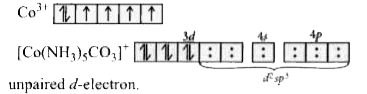 No unapired d- electron. |
|
| 2. |
Consider the complex given below [(NH_(3))_(5)overset("II")Ru(N_(2))overset("II")Ru(NH_(3))_(5)]^(4+) and the statements regarding it . (i) N-N bond length is longer than that in free N_(2) molecule. (ii) It is diamagnetic having t_(2g)^(4)e_(g)^(2) configuration of each Ru^(2+) ion . (iii) Back bonding is involved in this The correct statement(s) is/are : |
|
Answer» Only (i) |
|
| 3. |
Consider the complex [Co(NH_(3))_(5)(CO_(3))]ClO_(4), the coordination number, oxidation number, number of unpaired d-electrons respectively are : If your answer is 4, 2, 1 write your answer as 0421. |
|
Answer» C.N.=6,`d^(6)` (spin paired complex) |
|
| 4. |
Consider the complex [Co(NH_(3))_(4)CO_(3)]ClO_(4), in which coordination number, oxidation number and number of d-electrons on the metal are respectively |
|
Answer» 6,3,6 |
|
| 5. |
Consider the complex [CoH(N_(2))(PPh_(3))_(3)] havingtrigonal bipyramidal geometry in which cobalt is dsp^(3) hybridised. Select the correct statements regarding the given complex. |
|
Answer» IUPAC name of the COMPLEX is hydridodinitrogentris (triphenylphospine) cobalt (I). `PPh_(3)` and `N_(2) to S.F.L.` `Co^(+)=[Ar]3d^(8)`  Trigonal bipyramidal geometry with `dsp^(3)`hybridisation.All electrons are paired so diamagnetic `(dsp^(3))`. ACCORDING to BENT's rule, in a TBP geometry more electronegative SPECIES `(N_(2))` occupies axial position. (a) Dinitrogenhydridotris (triphenyphosphine) cobalt (I) is the correct IUPAC name. |
|
| 6. |
Consider the chemical reaction N_(2) (g) + 3H_(2)(g) to 2NH_(3) (g). The rate of this reaction can be expressed in terms of time derivated of concentration of N_(2)(g) , H_(2) (g) or NH_(3) (g) . Identify the correct relationship amongst the rate expressions . |
|
Answer» RATE = -d[`N_(2)`]/dt = `-1//3` d [ `H_(2)`] / dt = 1/2 [`NH_(3)`] /dt Further the rate of the consumption of the reactant goes on decreasing and the rate of formation of the product goes on INCREASING with TIME hence -ve and +ve sign , respectively . |
|
| 7. |
Consider the chemical reaction : N_(2)(g) +3H_(2)(g) rarr 2NH_(3)(g) The rate of this reaction can be expressed in terms of time derivative of concentration of N_(2)(g), H_(2)(g) "or" NH_(3)(g) . Identify the correct relationship amongst the rate expressions : |
|
Answer» RATE `= -(d[N_(2)])/(dt)=-1//3d[H_(2)]//dt=(1)/(2)d[NH_(3)]/dt` Rate =` -(d[N_(2)])/(dt) = -(1)/(3) (d[H_(2)])/(dt) = (1)/(2) (d[NH_(3)])/(dt)` |
|
| 8. |
Consider the chemical reaction N_(2)(g)+3H_(2)(g) rarr 2NH_(3)(g) . The rate of this reaction can be expressed in terms of time derivative of concentration of N_(2) (g) , H_(2)(g) or NH_(3)(g) . Indentifythe correct relationship amongst the rate expressions : |
|
Answer» RATE `= - d[N_(2)]//DT=-1//3d[H_(2)]//dt=1//2d[NH_(3)]//dt` `N_(2) +3H_(2) rarr 2NH_(3)` Rate =` -(d[N_(2)])/(dt) =-(1)/(3) (d[H_(2)])/(dt) = (1)/(2) (d[NH_(2)])/(dt)` |
|
| 9. |
Consider the chemial reaction N_2(g) + 3H_2(g)to 2NH_3(g). The rate of this reaction can be expressed in term of time derivatives of concentration of N_2(g), H_2(g) or NH_3(g). Identify the correct realtionship amongst the rate expressions: |
|
Answer» Rate `= -(d[N_2])/(DT) = 1/3(d[N_2])/(dt) = 1/2(d[NH_3])/(dt)` `N_2(g)+ 3H_2(g) to 2NH_2(g) ` The rate of reaction is EXPRESSED as FOLLOWING Rate `=-(d[N_2])/(dt) = -1/3(d[H_2])/(dt) = + 1/2(d[NH_2])/(dt)` In the progress of reactionsd, concentration of `N_2` and `H_2` are decreased, so negative sign is REPRESENTED in expression, while concentration of `NH_2` are decreased, so negative sign is represented in expression, while concentration of `NH_3` is increased, so POSITIVE sign is represented inexpression |
|
| 10. |
Consider the change in oxidation state ofBromine corresponding to different emf values as shown in thediagram below: BrO_(4)^(-) overset(1.82V)(rarr)BrO_(3)^(-)overset(1.5V)(rarr) HBrO overset(1.595V)(rarr) Br_(2) overset(1.0652V)(rarr)Br^(-) Then the species undergoing disproportional is |
| Answer» Answer :D | |
| 11. |
Consider the change in oxidation state of Bromine corresponding to different emf values as shown in the diagram below : BrO_(4)^(-) overset(1.82 V)(rarr)BrO_3^(-) overset(1.5V)(rarr) HBrO overset(1.595V)(rarr)Br_2 overset(1.0652V)(rarr)Br^(-) Then the species undergoing disproportional is .................. . |
|
Answer» `Br_2` 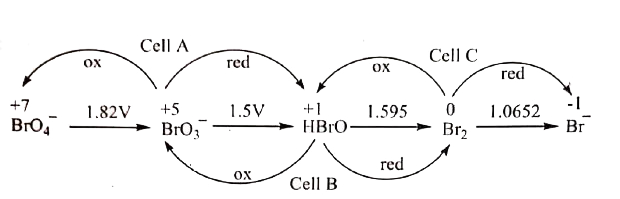 `(E_("CELL"))_A = -1.82 + 1.5 = -0.32 V` `(E_("cell"))_B = -1.5 + 1.595 = +0.095 V` `(E_("cell"))_C = 1.595 + 1.0652 = -0.529 V`. `:.` The species undergoing disproportional is `HBrO` |
|
| 12. |
Consider the change in oxidation state of bromide corresponding to different emf values as shown in the diagram below- BrO_(4)^(-) overset(1.82 V)to BrO_(3)^(-) overset(1.5V)to HBrO overset(1.595 V) to Br_(2) overset(1.0652V) to Br^(-) Then the species undergoing disproportionation is - |
| Answer» Answer :D | |
| 13. |
Consider the cell Zn|Zn^(2+) (aq) (1.0M) ||Cu^(2+) (aq) (1.0M) |Cu The standard reduction potentials are +0.35 V for 2e+ Cu^(2+) (aq) to Cu and -0.763V for 2e+Zn^(2+) (aq) to Zn Is the cell reaction spontaneous or not? |
|
Answer» Solution :Further `E_(cell)=E_(Ag^+,Ag)^@-E_(Cd^(2+),Cd)` `={E_(Ag^+,Ag)^@+0.0591/1 LOG [Ag^+]}- {E_(Cd^(2+),Cd)^@+0.0591/2log[Cd^(2+)]}` `={E_(Ag^+,Ag)^@-E_(Cd^(2+),Cd)^@}+0.0591/1 log""([Ag^+])/([Cd^(2+)]^(1/2))` `=E_(cell)^@+0.0591 log""([Ag^+])/([Cd^(2+)]^(1/2))` SINCE `[Cd^(2+)]` is in the denominator, DECREASE in `[Cd^(2+)]` will make `E_(cell)` more POSITIVE. |
|
| 14. |
Consider the cell Zn|Zn^(2+) (aq) (1.0M) ||Cu^(2+) (aq) (1.0M) |Cu The standard reduction potentials are +0.35 V for 2e+ Cu^(2+) (aq) to Cu and -0.763V for 2e+Zn^(2+) (aq) to Zn Calculatethe emf of the cell. |
| Answer» SOLUTION :In a GALVANIC CELLS , the anode is regarded as the negative ELECTRODE, The electrode `Cd|Cd^(2+)` is negative being the anode where oxidation occurs. | |
| 15. |
Consider the cell Zn|Zn^(2+) (aq) (1.0M) ||Cu^(2+) (aq) (1.0M) |Cu The standard reduction potentials are +0.35 V for 2e+ Cu^(2+) (aq) to Cu and -0.763V for 2e+Zn^(2+) (aq) to Zn Write down the cell reaction. |
|
Answer» SOLUTION :CELL REACTIONS are as FOLLOWS , RHS ELECTRODE `Cu^(2+) +2e=Cu` (reduction) LHS electrode `Zn=Zn^(2+)+2e` (oxidation) `therefore E_(cell)^@=E_(Ag^+,Ag)^@-E_(Cd^(2+),Cd)^@` `=0.80-(-0.40)` `=1.20` volts |
|
| 16. |
Consider the cell Pt|H_(2(g,1atm))|H_((aq.1M))^(+)||Fe_((aq))^(3+),Fe_((aq))^(2+)||Pt_((s)) Given that E_(Fe^(3+)|Fe^(2+))^(o)=0.771V the ratio of conc. Of Fe_((aq))^(2+) to Fe_((aq))^(3+) is, when the cell potential is 0.830V |
|
Answer» 0.101 The half-cell REACTION is `Fe_((aq))^(3+)+etoFe_((aq))^(2+)` `Fe_(FE^(3+)//Fe^(2+))=E_(Fe^(3+)//Fe^(2+))^(o)-(0.059)/(1)log(([Fe^(2+)])/([Fe^(3+)]))` `0.83=0.771-(0.0591)/(1)log(([Fe^(2+)])/([Fe^(3+)]))` `IMPLIES([Fe^(2+)])/([Fe^(+3)])=0.10039~0.1004` |
|
| 17. |
Consider the cell, Pt|H_(2(g))|H_((aq))^(+)"||"I_((aq))^(-)|I_(2(s)). If the standard cell potential is 0.54 V then the standard potential for cathode half reaction will be |
| Answer» Answer :C::D | |
| 18. |
Consider the cell reaction Zn+Cu^(2+)(aq)iff Cu + Zn^(2+) (aq). Reaction quotient is Q = ([Zn^(2+)])/([Cu^(2+)])E^(0) of the cell is 1.10V. Now, E_(cell) will be 1.159V when: |
|
Answer» `([Cu^(2+)])/([ZN^(2+)]) = 0.01` |
|
| 19. |
Consider the cellPt|Cl_(2(g))|HCl_((aq))|Br_(2(l))|Pt. If concentration of HClis increased, the cell potential will |
|
Answer» INCREASE |
|
| 20. |
Consider the cell: Cu|Cu^(2+)||Cl^(-)|Cl_(2),Pt Write the reaction that occur at anode and cathode. |
| Answer» SOLUTION :ANODE: `CutoCu^(2+)+2e^(-)` (Oxidation): Cathode: `Cl_(2)+2e^(-)to2Cl^(-)`(REDUCTION). | |
| 21. |
Consider the cell Ag|AgBr(s)|Cr^(-)||Cl^(-)|AgCl(s)|Ag at 25^(@)C the solubility product constants of AgBr & AgCl are respectively 5xx10^(-13)&1xx10^(-10). For what ratio of the concentrations of Br^(-) & Cl^(-) ions would the e.m.f. of the cell be zero? |
|
Answer» Anode: `AgtoAg_(a)^(+)+e^(-)` cathode: `underline(Ag_(c)^(+)+e^(-)TOAG)` `AghArrAg_(a)^(+)` From nearest EQ, `E_(cell)=E_(cell)^(@)-(0.059)/(1)log(([Ag^(+)]_(a))/([Ag^(+)]_(c)))implies0=0-(0.059)/(1)log(([Ag^(+)]_(a))/([Ag^(+)]_(c)))` `therefore[Ag^(+)]_(a)=[Ag^(+)]_(c)implies(K_(sp)" of " AGBR)/([Br^(-)])=(K_(sp)" of " AgCl)/([Cl^(-)])` or, `(5xx10^(-13))/(10^(-10))=([Br^(-)])/([Cl^(-)])=([Br^(-)])/([Cl^(-)])=(1)/(200)` |
|
| 22. |
Consider the cell Ag|AgBr_((s)), Br^(-)||AgCl_((s)), Cl^(-)|Ag at 25^(@)C. The solubility product and AgCl and AgBr are 1 xx 10^(-10) and 5 xx 10^(-13) respectively. For what ratio of the concentrations of Br^(-) and Cl^(-) ions would the e.m.f. of the cell be zero ? |
|
Answer» |
|
| 23. |
Consider the below given statements about alkaline earth metals. (i) Solubility of sulphates decreases down the group. (ii) Solubility of hydroxides decreases down the group (ii) Thermal stability of carbonates increases down the group (iv) Basic nature of oxides increases down the group. The correct one are. |
|
Answer» (i). (II) & (ILL) |
|
| 24. |
Consider the cell Ag | AgBr | KBr || KCl | AgCl | Ag with EMF 0.059 V . Assume that [Br^(-)] = [Cl^(-)] . Here , conclusion inferred may be |
|
Answer» The ratio of the simultaneous solubilities of AgCl and AgBr in pure water is 1000 ` (K_(sp)AgBr)/([Br^(Ɵ)]) xx 10 = (K_(sp) AgCl)/([Cl^(Ɵ)]), K_(SP) [Br^(Ɵ)] = [Cl^(Ɵ)] ` Then ` K_(sp) AgCl to K_(sp) AgBr` |
|
| 25. |
Consider the Born - Haber cycle for the formation of a ionic compound given below and identify the compound (Z) formed. |
|
Answer» MX `M_((g))^(+)+X_((g))^(-)overset(DeltaH_(5))tounderset((Z))(MX_((s)) DeltaH_(5)to`), Lattice energy. In OPTION (a) state of MX is not given. |
|
| 26. |
Consider the basicity of the following aromatic amines: (I) aniline (II) p-nitroaniline (III) p-methoxyaniline (IV) p-methylaniline the correct order of decreasing basicity is: |
|
Answer» IIIgtIVgtIgtII |
|
| 27. |
Consider the Arrhenius equation given below and mark the correct option. k="A e"^(-E_(a)//"RT") |
|
Answer» Rate CONSTANT increases exponentially with increasing activation energy and DECREASING temperature |
|
| 28. |
Consider the Arrhenius equation given below and mark the correct option. k=A e^(-E_(a)//RT) |
|
Answer» Rate constant INCREASES exponentially with increasing ACTIVATION energy and decreasing TEMPERATURE. `k=A e^(-E_(a)//RT)` `therefore k PROP e^(-1//T)` and `kprop e^(e^(-E_(a)))` `therefore k prop T` `therefore` Rate constant increases exponentialy with decreasing activation energy and increasing temperature. |
|
| 29. |
Consider the arrangement of circles of equal radii with their centres arranged as per the 2-dimensional lattice defined by a=b,theta=60^@ such that each circle is touching all its nearest neighbours.If all the void areas present are additionally occupied by smmaller circules of relevent size so that the void circles are just contacting their neighbours find the packing efficiency of the configuration in percent. |
Answer» 
|
|
| 30. |
Consider the arrangement of bulbs shown in the drawing. Each of three bulbs contains a gas at pressure shown. What is pressure of system when all stopcocks are opened. Assuming that temperature remain constant. (Neglect the volume of capollary tubing connecting bulbs) |
|
Answer» 440 torr For `O_(2)` gas `P_(1) V_(1) = P_(2) V_(2)` `P_(1) = 300` torr, `P_(2)` ? `V_(1) = 1` litre, `V_(2) = 2.5` litre `300 XX 1 = P_(2) xx 2.5` `P_(2) = 120` torr For He gas `P_(1) V_(1) = P_(2)V_(2)` `P_(1) = 600` torr, `P_(2) =` ? `V_(1) = 1` litre, `V_(2) = 2.5` litre `600 xx 1 = P_(2) xx 2.5` `P_(2) = 240` torr For `N_(2)` gas `P_(1)V_(1) = P_(2)V_(2)` `P_(1) = 400` torr, `P_(2) =` ? `V_(1) = 0.5` litre, `V_(2) = 2.5` litre `400 xx (1)/(2) = P_(2) xx (5)/(2)` `P_(2) = 80` torr Pressure of SYSTEM `= P_(O_(2)) + P_(N_(2)) + P_(He)` `= 120 + 80 + 240` `= 440` torr |
|
| 31. |
Consider the amines: 1. NH_(3) 2. RNH_(2) 3. C_(6)H_(5)NH_(2) The correct sequence of basicity is : |
|
Answer» `3lt2lt1` |
|
| 32. |
Consider the acid strength of the carboxylicacids : (i) PhCOOH (ii) o-NO_(2)C_(6)H_(4)COOH(iii)p-NO_(2)C_(6)H_(4)COOH (iv)m-NO_(2)C_(6)H_(4)COOH |
|
Answer» `i gtiigtiiigtiv` |
|
| 33. |
Consider some facts about decomposition of H_(2)O_(2). It is catalysed by iodide ion in acidic medium. It is second order reaction with respect to both H_(2)O_(2).andI^(-1). Rate equation of this particular reaction will be Rate=(-d[H_(2)O_(2)]^(2))/(dt)=k[H_(2)O_(2)]^(2)[I^-] It completes in two steps and both steps are unimolecular elementary reactions. Which of the above written facts are correct, regarding decomposition of H_(2)O_(2)? Choose the correct option. |
|
Answer» I and II `2H_(2)O_(2)overset(1^(-))underset("Alkaline medium")rarr2H_(2)O+O_(2)` Rate EQUATION is rate `(-d[H_(2)O_(2)])/(dt)=K[H_(2)O_(2)][1^(-)]` This reaction is first order w.r.t. both `H_(2)O_(2) and 1^(-).` It MAKES place in two steps and both are bimolecular elementary reactions. |
|
| 34. |
Consider thfollowing statement I Q=lt II charge is required for reductin or reduction depends on the stoichiometry of electrode reaction III charge on 1 electron =1.6021xx10^(-19) C IV charge on one mole of elctron =1.6021xx10^(-19) C (V) Quantity of electricity is coulomb VI 1F =96500 C mol^(-1)which of the statements (s) given above is /areincorrect ? choose the correct option |
|
Answer» I and II Qis in Columbs when l is in ampere and t isin second CHARGEON one electrone =`1.6021 xx1d0^(-19)` C Charge on one MOLE of electron =`96487 C mol^(-1)` `1 F = 96500 C mol^(-1)` Quantity of electricityis calledfaraday |
|
| 35. |
Consider separate solutions of 0.500 M C_(2)H_(5)OH(aq), "0.100 M "Mg_(3)(SO_(4))_(2)(aq),"0.250 M KCr(aq) and 0.125 M "Na_(3)PO_(4)(aq)" at "25^(@)C. Which statement is true about these solutions, assuming all salts to be strong electrolytes? |
|
Answer» `"0.500 M "C_(2)H_(5)OH (aq)` has the highest OSMOTIC pressure `pi(C_(2)H_(5)OH)=1xx0.5RT=0.5RT,` `pi(Mg_(3)(PO_(4))_(2))=5xx0.100RT=0.5RT` `pi(KBr)=2xx0.25RT=0.5RT,` `pi(Na_(3)PO_(4))=4xx0.125RT=0.5RT` Thus, all solution have the same osmotic pressure. |
|
| 36. |
Consider separate solutions of 0.500 M C_(2)H_(5)OH(aq), 0.100 M Mg_(3)(PO_(4))_(2)(aq),0.250M KBr(aq) and 0.125 M Na_(3)PO_(4)(aq) at 25^(@)C. Which statement is True about theses solutions, assuming all salts to be strong electrolytes ? |
|
Answer» `0.500 M C_(2) H_(5)OH(AQ)` has the highest osmotic pressure `0.1 M Mg_(3)(PO_(4))_(2)impliespi=iCRT=(5xx0.1)RT=0.5RT` `0.250M Kbrimpliespi=iCRT=(2xx0.250)RT=0.5RT` `0.125M Na_(3)PO_(4)impliespi=iCRT=(4xx0.125)RT=0.5RT` |
|
| 37. |
Consider separate solutions of 0.500 M C_(2)H_(5)OH_((aq)), 0.100 M Mg_(3)(PO_(4))_(2(aq)), 0.250 M KBr_((aq)) and 0.125 M Na_(3)PO_(4(aq)) at 25^(@)C.Which statement is true about these solutions, assuming all salts to be strong electrolytes ? |
|
Answer» `0.125 M Na_(3)PO_(4(aq))` has the highest osmotic pressure. |
|
| 38. |
Consider separate solutions of 0.500 M C_(2)H_(5)OH_((aq)), 0.100 M Mg_(3)(PO_(4))_(2)(aq), 0.125 M Na_(3)PO_(4)(aq) at 25^(@)C. Which statement is true about tese solutions, assuming all saltes to be strong electrolytes ? Solutions, assuming all salts to be strong electrolytes ? |
|
Answer» they all have the same osmotic PRESSURE For all the solution, R and T are both CONSTANT : `pipropixxc` Osmotic pressure depends upon the product of ven't Hoff factor and molar cncentration of the solution. `{:("Solution",i,c,ixc),(C_(2)H_(5)OH(aq),1,0.5,0.5),(Mg_(3)(PO_(4))_(2)(aq),5,0.1,0.5),(KBr(aq),2,0.25,0.5),(Na_(3)PO_(4)(aq),4,0.125,0.5):}` Since the product is constant, this means that all the soklutions have some osmotic pressure. |
|
| 39. |
Consider separatesolutions of 0.500 M C_(2)H_(5)OH(aq), 0.100 M Mg_(3)(PO_(4))_(2)(aq), 0.125 M Na_(3)PO_(4)(aq)at 25 0 C. Which statement is true about these solutions, assuming all salts to be strong electrolytes ? |
|
Answer» They all have same osmotic pressure. `pi=icRT` `pi[C_(2)H_(5)OH]=1xx0.500xxR XX T=0.5"RT"` `pi[Mg_(3)(PO_(4))_(2)]=5xx0.100xxRxxT=0.5RT` `pi[KBR]=2xx0.250xxRxxT=0.5RT` `pi[Na_(3)PO_(4)]=4xx0.125xxRxxT=0.5RT` Therefore, all have same osmotic pressure. |
|
| 40. |
Consider separate solution of 0.5 M C_(2)H_(5)OH(aq), 0.1 M Mg_(3)(PO_(4))_(2)(aq), 0.25 M KBr(aq) and 0.125 M Na_(3)PO_(4)(aq) at 25^(@)C which statement is true about these solutions, assuming all salts to be strong electrolytes ? |
|
Answer» They all have the same osmotic PRESSURE |
|
| 41. |
Consider para sulphony benzene diazonium reacting with para amino phenol which of the following statements are correct : |
|
Answer» A coupling is an electrophilic substitution. |
|
| 42. |
Consider H_(3)PO_(2),H_(3)PO_(3),H_(3)PO_(4) and H_(4)P_(2)O_(7) . Which of the above oxoacids resultsinto two series of salts ? |
|
Answer» `H_(3)PO_(2)` 
|
|
| 43. |
Consider given compounds & write the number of compounds which have higher HOC than |
|
Answer» |
|
| 44. |
Consider gas to be characterised by Vander Waal's equation. {:(,"Column - I",,"Column - II",),((A),Z = 1,(P),H_(2) " gas at room temperature and moderate pressure",),((B),Z gt 1,(Q),"Any gas at very low pressure and high temperature.",),((C),Z lt 1,(R),"Any gas showing more compressibility than expectedd from ideal behaviour",),((D),Z = (3)/(8),(S),"Gas at critical point",),(,,(T),"Gas at Boyle's temperature and at different pressures.",):} |
|
Answer» |
|
| 45. |
Consider following two reactions Ato"Product", (d[A])/(dt)=k_(1)[A]_(0)^(0) Bto"Product", (d[B])/(dt)=k_(1)[A]_(0)^(0) k_(a) and k_(2) are expressed are expressed in termof molarity (mol L^(-1))and time (s^(-1)) as : |
|
Answer» `s^(-1),M s^(-1)L^(-1)` |
|
| 46. |
Consider following vapour pressure composition graph. Hence- |
|
Answer» V.P. of A = SZ |
|
| 47. |
Consider following transformations! I. XeF_(5)+NaFto Na^(+)[XeF_(7)]II. 2PCI_(5) (s)to[PCI_(4)] [PCI_(5)]III A(H_(2)O)_(5)Н_(2)Oto[AI(H_(2)O)_(5)+H_(2)H_(2)O possible transformations are: |
| Answer» Answer :A | |
| 48. |
Consider following statements – (i) Froth floatation technique is used to concentrate sulphide ore. (ii) Froth floatation technique is based upon differential wettability of ore and impurity in water.(iii) Red Bauxite is concentrated by Bayer's process (iv) Carbon is used as reducing agent during extraction of zinc from zinc blende. Correct statements are – |
| Answer» Answer :D | |
| 49. |
Consider following solutions: I. 1M aqueous glucose solution. II. 1M aqueous sodium chloride solution III. 1M aqueous ammonium phosphate solution. IV. 1M benzoic acid in benzene. Select correct statements for the above solutions. |
|
Answer» All are ISOTONIC solutions |
|