

Saved Bookmarks
This section includes 7 InterviewSolutions, each offering curated multiple-choice questions to sharpen your Current Affairs knowledge and support exam preparation. Choose a topic below to get started.
| 1. |
Conc. HNO_3 stains wood yellow because. |
|
Answer» The wood is BURNED by acid |
|
| 2. |
Conc. HNO_(3) oxidizes phosphorus : |
|
Answer» `H_(3)PO_(4)` |
|
| 3. |
Conc. HNO_3 stains and wool yellow because. |
|
Answer» The SKIN and wool is burned by acid |
|
| 4. |
Conc. HNO_3 reacts with iron to: |
|
Answer» RENDER iron passive |
|
| 5. |
Conc. HNO_3 oxidizes phosphorus to |
|
Answer» `HPO_3` |
|
| 6. |
Conc. HNO_(3) oxidises cane sugar to : |
|
Answer» `CO_(2)and H_(2)O` |
|
| 7. |
Conc. HNO_(3) is treated with iron. The metal is passive because |
|
Answer» it is a TRANSITION metal |
|
| 8. |
Conc. HNO_3 is heated with P_2O_5 to form: |
|
Answer» `N_2O` |
|
| 11. |
conc. H_2SO_4 reacts with C_2H_5OH at 443K to form |
|
Answer» `CH_3COCH_3` |
|
| 12. |
Conc. H_(2)SO_(4) reacts with C_(2)H_(5)OH at 170^(@)C to form |
|
Answer» `CH_(3)COCH_(3)` |
|
| 13. |
Conc. H_2SO_4 is similar to conc. H_3PO_4, in that |
|
Answer» both will oxidize `I^(-)" to "I_(2)` |
|
| 14. |
Conc. H_2SO_4 is diluted |
|
Answer» by adding WATER in `H_(2)SO_(4)` |
|
| 15. |
Conc. H_2SO_4 is not |
|
Answer» HYGROSCOPIC |
|
| 16. |
Conc, H_2SO_4 is added to the following compounds, Mark the compound which will give CO_2. |
|
Answer» FORMIC acid |
|
| 17. |
Conc. H_(2)SO_(4) is added followed by heating to each of the following test tubes labelled (I) to (IV). Identify in which of the above test tube the following change will be observed. Support your answer with the help of chemical equation: (a) formation of black substance (b) evolution of brown gas (c ) evolution of colourless gas (d) formation of a brown substance which on dilution becomes blue. (e) disappearance of yellow powder along with evolution of colourless gas. |
|
Answer» Solution :(a) `underset("White")(C_(12)H_(22)O_(11))rarr underset("Black substance")(12C)+11H_(2)O` (b) `2NaBr+2H_(2)SO_(4)rarr underset("Brown gas")(Br_(2)uarr)+Na_(2)SO_(4)+SO_(2)+2H_(2)O` (c ) `2KCl+H_(2)SO_(4)""underset("(Colourless gas")(2HCluarr+K_(2)SO_(4))` (d) `Cu+2H_(2)SO_(4)rarr CuSO_(4)+SO_(2)+H_(2)O` (e ) `3S+2H_(2)SO_(4)rarr underset("(Colourless gas)")(3SO_(2)uarr+2H_(2)O)` |
|
| 18. |
Conc. H_(2)SO_(4) heated with excess of C_(2)H_(5)OH at 1406^(@)C to form |
|
Answer» `CH_3CH_2-O-CH_3` |
|
| 19. |
Conc. H_(2)SO_(4) heated with excess of C_(2)H_(5)OH at 140^(@) C to form |
|
Answer» `CH_(3)CH_(2)-O-CH_(3)` |
|
| 20. |
Conc. H_2SO_4 displaces HCl from chloride because: |
|
Answer» Conc. `H_2SO_4` is STRONGER than HCl |
|
| 21. |
Conc. H_2SO_4 can be diluted by |
|
Answer» adding boiling water to conc. `H_2SO_4` |
|
| 22. |
Conc. H_(2)SO_(4) chars paper, wood and sugar because it removes...............from them. |
| Answer» SOLUTION :WATER MOLECULES | |
| 23. |
Conc. H_2 SO_4 is diluted |
|
Answer» By adding water in `H_(2)SO_(4)` |
|
| 24. |
Compute the heat of reaction at 1000^(@) C foir 1/2H_(2)(g) + 1/2 Cl_(2)(g) to HCl(g), DeltaH_(298 K)^(@) = 92.236 kJ mol^(-1) C_(P)^(@)(H_(2),g) = 29.0284 - 0.8355 xx 10^(-3)T + 2.0097 xx 10^(-8) T^(2) C_(P)^(@) (Cl_(2),g) = 31.6555 + 1.0134 xx 10^(-2) T - 4.0337 xx 10^(-8) T^(2) C_(P)^(@)(HCl, g) = 28.1359 + 1.8078 xx 10^(-3) T + 1.5453 xx 10^(-8) T^(2) |
|
Answer» <P> Solution :`DeltaH_(1273 K)^(@) = DeltaH_(298 K)^(@) + int_(298 K)^(1273 K) {(DeltaC_(p))DT}`where, `DeltaCO_(P) = C_(P)^(@)(HCl,g) -1/2C_(P)^(@)(H_(2),g) -1/2C_(P)^(@)(Cl_(2),g)` `=(28.1359 - 1/2 xx 29.0284 - 1/2 xx 31.6556) + (1.8078 + 1/2 xx 0.8355 - 1/2 xx 10.134) xx 10^(-3) T + (1.5453 - 1/2 xx 2.0097 + 1/2 xx 4.0337) xx 10^(-6) T^(2)` Hence, `DeltaH_(1273 K)^(@) =[-92.236 xx 10^(2) + (-2.2061) -(2.8415 xx 10^(-3))(1273^(3)/3 - 298^(3)/3)] J"mol"^(-1)` `=-92236 - 2151.0 + 2176.2 + 1736.0 = -94827 J "mol"^(-1) = -94.827 kJ "mol"^(-1)` |
|
| 25. |
Finkelstein reaction for the preparation of alkyl iodide is based upon the fact that: |
|
Answer» Sodium iodide is soluble in METHANOL, while sodium chloride is insoluble in methanol. |
|
| 26. |
Compute the percentage void space per unit volume of unit cell in zinc-fluoride structure. |
|
Answer» SOLUTION :Since, anions OCCUPY fcc POSITIONS and half of the tetrahedral HOLES are occupied by cations. Since, there are four anions and 8 tetrahedral holes per unit cell, the fraction of volume occupied by spheres/unit volume of the unit cell is `=4 xx (4/3 pi r_(a)^(3) +1/2 xx 8 xx (4/3 pi r_(c )^(3)))/(16sqrt(2)r^(3)) = pi/(3sqrt(2))[1+(t_(c)/t_(a))^(3)]` `therefore` For tetrahedral holes. `r_(0)/r_(a) = 0.225 = pi/(3sqrt(2))(1 + (0.225)^(3)) = 0.7496` `therefore` Void volume =1-0.7496 = 0.2504 / unit volume of unit cell. % Void space = 25.04 % |
|
| 27. |
Compute the heat of formation of liquid methyl alcohol in kJ mol^(-1), using the following data. Heat of vaporisation of liquid CH_(3)OH = 38 kJ/mol. Heat of formation of gaseous atoms from the elements in their standard states , H, 218 KJ/mol, C, 715 KJ/mol , O, 249 KJ/molAverage Bond energies C-H , 415 KJ/mol , C – O, 356 KJ/mol , O – H, 463 KJ/mol |
| Answer» SOLUTION :`-266 KJ MOL^(-1)` | |
| 28. |
Conant Finkelstein reaction for the preparation of alkyl iodide is based upon the fact that |
|
Answer» SODIUM IODIDE is soluble in METHANOL, while sodium chloride is insoluble in methanol |
|
| 29. |
Compute Delta_(r)G for thereactionH_(2)O (l, 1, atm, 323 K ) to H_(2)O (g, 1 atm, 232K)Given that :Delta_(vap) H at 373K = 40.639 kJmol^(-1), C_(p)(H_(2)O, l)= 75.312 JK^(-1) mol^(-1), ""C_(p)(H_(2)O, g) = 33.305 J K^(-1)mol^(-1). |
|
Answer» <P> `40639 = DeltaH_(323)-(33.305 - 75.312) XX 50` `DeltaH_(323) = 42739. 35 J//mol` |
|
| 30. |
Compute the heat of formation of liquid methyl alcohol in kilojoules per mole using the following data. The heat of vaporisation of liquid methyl alcohol =38 "kJ/mole". The heats of formation of gaseous atoms from the elements in their standard states: H,218 "kJ/mole", C,715 "kJ/mole", O, 249 "kJ/mole". Average bond energies : C-H=415 "kJ/mole" C-O=356 "kJ/mole" O-H=463 "kJ/mole". |
|
Answer» Solution :`C+2H_(2)+(1)/(2)O_(2) to CH_(3)OH,DELTAH=?` For reactants : HEAT of atomisation of 1 mole of `C=715 kJ` Heat of atomisation of 4moles of `H=4xx218 kJ` Heat of atomisation of 1 mole of `O=249 kJ` For products: Heat of formation of 3 MOLES of C-H bonds `=-3xx415 kJ` Heat of formation of 1 mole of C-O bonds `=-356 kJ` Heat of formation of 1 mole of O-H bonds `=-463 kJ` Heat of CONDENSATION of 1 mole of `CH_(3)OH` to liquid `=-38 kJ` On adding, we get `DeltaH` of formation of `CH_(3)OH` (l). `DeltaH=-266 "kJ mole"^(-1)`. |
|
| 31. |
Compute the charge on one mole of electrons. |
|
Answer» Solution :One mole of electrons = `6.02 XX 10^(23)` electrons Charge on one electron = `1.6021 xx 10^(-19)` `THEREFORE`Charge on one mole of electrons = `6.02 xx 10^(23) MOL^(-1)xx 1.6021 xx 10^(-19) C = 96487 C mol^(-1)` |
|
| 32. |
Compund (A), C_(5)H_(11)NO is not soluble in cold alkaline or acidic solutions. When (A) is refluxed in NaOH solution, a gas (B) is evolved and salt (C) is formed. Acetyl chloride reacts with (B) to give (D), (C_(4)H_(9)NO). (B) reacts with HNO_(2) to give a yellow oil (E). Give structures of (A) to (E) with reason. |
|
Answer» |
|
| 33. |
Compund A reacts with PCl_(5) to give B which on treatment with KCN followed by hydrolysis gave propanoic acid. What is A and B respectively |
|
Answer» `C_(3)H_(8) and C_(3)H_(7)Cl` |
|
| 34. |
Comproportionationn occurs between: |
|
Answer» `Cl^(-)(aq.)+ClO^(-)(aq.)+OH^(-)(aq.)` |
|
| 35. |
Compressibility factor (Z) for N_(2)" at "-50^(@)C and 800 atm pressure is 1.95 calculate mole of N_(2) gas required to fill a gas cylinder of 100 L capacity under the given conditions. |
|
Answer» Solution :We have `Z=(PV)/(NRT)` `THEREFORE" mole of "N_(2) =(PV)/(ZRT)` `=(800xx100)/(1.95xx0.0821xx223)=2240.8` |
|
| 36. |
Compressibility factor (Z) is plotted against pressure at different temperature for same gas |
|
Answer» `T_(4) gt T_(3) gt T_(2) gt T_(1)` |
|
| 37. |
Compressibility factor (Z) for H_2 (g) at STP is |
|
Answer» `Z = 1` |
|
| 38. |
Compressibility factor under critical state of a gas is |
|
Answer» `frac{5}{8]` |
|
| 39. |
Compreshension -I The experimental values of colligative properties of many solutes in solution resembles calculated value of colligative properties. However in same cases, the experimental value of colligative property differ widely than those obtained by calculation. Such experimental values of colligative properties are known as Abnormal values of colligative properties are : (i) Dissociation of solute : It increases the colligative properties. (ii) Association of solute : It decreases the colligative properties e.g. : Dimerisation of acetic acid in benzene One mole I_(2) (solid) is added in 1 M, 1 litre Kl solution . Then |
|
Answer» Osmostic pressure of solution increases |
|
| 40. |
Compreshension-II In non-ideal solutions, at one of the intermediate compostions, the total vapour pressure is highest and the boiling point is lowest. At this point, the composition of the liquid and vapour phase is same. So, if liquid mixture vapouriese at this point and vapours are condensed, teh condensate contains same compositon as present in original liquid mixture. it means at this point liquid behaves like a pure liquid and is called an Azeotropic mixture. Choose the correct answer : |
|
Answer» Ideal solutions cannot be separated into their components by fractional distillation |
|
| 41. |
Compreshension -I The experimental values of colligative properties of many solutes in solution resembles calculated value of colligative properties. However in same cases, the experimental value of colligative property differ widely than those obtained by calculation. Such experimental values of colligative properties are known as Abnormal values of colligative properties are : (i) Dissociation of solute : It increases the colligative properties. (ii) Association of solute : It decreases the colligative properties e.g. : Dimerisation of acetic acid in benzene 4 different 100 ml solutions are prepared by mixing 1 mole each of NaCl (NH_(2))_(2)CO.Na_(2)SO_(4) and K_(4)[Fe(CN)_(6)] at temperature T. Correct order of osmotic pressure is |
|
Answer» `(NH_(2))_(2)CO` solution `gt` NACL solution `gt Na_(2)SO_(4)` solution `gt K_(4)[Fe(CN)_(6)]` solution |
|
| 42. |
Compreshension -I The experimental values of colligative properties of many solutes in solution resembles calculated value of colligative properties. However in same cases, the experimental value of colligative property differ widely than those obtained by calculation. Such experimental values of colligative properties are known as Abnormal values of colligative properties are : (i) Dissociation of solute : It increases the colligative properties. (ii) Association of solute : It decreases the colligative properties e.g. : Dimerisation of acetic acid in benzene If degree of dissociation of an electrolyte A_(2)B_(3) is 25% in a solvent, then |
|
Answer» Normal BOILING point =EXPERIMENTAL boiling point |
|
| 43. |
Comprehension # 2 The clouds consist of charged particles of water dispersed in air. Some of them are +vely charged, others are -vely charged. When +vely charged clouds come closer they cause lightening and thundering whereas when +ve and -ve charged colloids come closer they cause heavy rain by aggregation of minute particles. It is possible to cause artificial rain by throwing electrified sand or silver iodide from an aeroplane and thus coagulating the mist hanging in air. Smoke screen is a cloud of smoke used to hide military, naval police etc. it consists of fine particles of TiO_(2). Smoke screens consist of |
|
Answer» fine PARTICLES of `TiO_(2)` dispersed in air by AEROPLANES |
|
| 44. |
Comprehension # 2 The clouds consist of charged particles of water dispersed in air. Some of them are +vely charged, others are -vely charged. When +vely charged clouds come closer they cause lightening and thundering whereas when +ve and -ve charged colloids come closer they cause heavy rain by aggregation of minute particles. It is possible to cause artificial rain by throwing electrified sand or silver iodide from an aeroplane and thus coagulating the mist hanging in air. Smoke screen is a cloud of smoke used to hide military, naval police etc. it consists of fine particles of TiO_(2). When excess of AgNO_(3) is treated with Kl solution, Agl forms |
|
Answer» `+ve " CHARGED SOL"` |
|
| 45. |
Comprehension # 1 Many lyophilic sols and few lyophobic sols when coagulated under some special conditions changes into semi rigid mass, enclosing whole amount of liquid within itself, it is called gel and the process is called gelation, Gelatin Agar-agar, gum-Arabic can be converted into gels by cooling them under moderate concentration conditions. Hydrophobic sols like silicic acid. Al(OH)_(3) are prepared by double decomposition and exchange of solvent method. Types of Gel : (i) Elastic gel : Those gel which have elastic properties. Ex : Gelatin, Strach, Agar-agar etc. (ii) Non-elastic gel : Those gel which are rigid. Ex : Silica gel. Properties of Gel : 1. Syneresis/weeping of gel : The spontaneous liberation of liquid from a gel is called syneresis or weeping of gels. It is reverse of swelling. Ex : Gelatin, Agar-Agar show syneresis at low concentration while sillicic acid shows it at high concentration. 2. Imbibition or swelling of gel : When gel is kept in a suitable liquid (water) it absorb large volume of liquid. The phenomenon is called imbibition or swelling of gel. 3. Thixotropic : Some gels when shaken to form a sol, on keeping changes into gel are termed as thixotropic gel and phenomenon is called thixotropy. Ex : Gelatin and silica liquify on shaking changing into corresponding sol and sol on keeping changes back into gel. Some types of gels like gelatin and silica liquify on shaking thereby changing into sols. The sols on standing change back into gels. This process is know as |
|
Answer» synersesis |
|
| 46. |
Compoune (A) C_5H_(10)O_5, give a tetra-acetate with Ac_2O and oxidation of (A) with Br_2 - H_2O gives an acid, C_5H_(10)O_6. Reduction of (A) with HI and red phosphorous gives 3-methylbutane. What is structure of (A)? |
Answer» Solution :The formation of tetracetate INDICATES of 4OH group and OXIDATION with bromine water indicates presence of CHO group. REDUCTION with red phosphorous and HI indicates presence of one carbon in the side chain. Thus, the STRUCTURE of (A) WOULD be 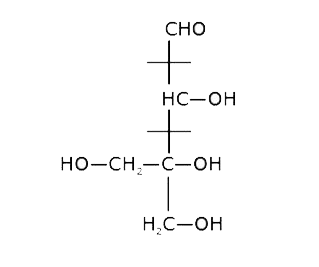
|
|
| 47. |
{:("Compound",,,,"Total stereoisomer"),((A)[Co(en)_(2)Cl]^(+),,,,(P)2),((B)[Co(en)_(3)]Cl_(3),,,,(Q)3),((C)[Pt(NH_(3))_(2)Cl_(2)],,,,(R)4),((D)[Pt(NH_(3))_(3)Cl_(3)]^(+),,,,(S)5):} Correct code :- |
|
Answer» A=R, B=P, C=R, D=R |
|
| 48. |
compounds X istreatedwith NH_(2) OH and followedby reductiongives : (CH_(3))_(2) CHCH_(2)overset(NH_(2))overset(|)(CHCH_(2) (CH_(3))_(3) Thecompound X is |
|
Answer» `(CH_(3))_(2)CHCH_(2) overset(NOH)overset(||)(C CH_(2)) C(CH_(3))_(3)` `(CH_(3))_(2)CH- CH_(2)- overset( NOH) overset(||)( C )CH_(2)C (CH_(3))_(2)overset( " Reduction ") (to) ` `(CH_(3))_(2)CH- CH_(2)-overset( NH_(2) )overset(|)( C H) -CH_(2). C(CH_(3)) _(3)+ H_(2) O` |
|
| 49. |
Compounds with spinonly magnetic moment equivalent to five unpaired electrons are |
|
Answer» `K_(4)[Mn(CN)_(6)]` `CN^(-)` is a strong field ligand, so pairing will TAKE place i.e. `t_(2g)^(2,2,1) e_(g)^(0,0)` B. `[Fe(H_(2)O)_(6)]Cl_(3),Fe^(3+)=[Ar]3d^(5)4s^(0)` `H_(2)O` is a weak field ligand so pairing will not occur. i.e. `t_(2g)^(1,1,1), e_(g)^(1,1)` c. `K_(3)[FeF_(6)],Fe^(3+)=[Ar]3d^(5) 4s^(0)` `F^(-)` is a weak field ligand, so, pairing will not occur. i.e `t_(2g)^(1,1,1) e_(g)^(1,1)` d. `K_(4)[MnF_(6)], Mn^(2+)=[Ar]3d^(5)4s^(0)` `F^(-)` is a weak field ligand so, pairing will not occur. i.e. `t_(2g)^(1,1,1)e_(g)^(1,1)` HENCE b, c and d complexes will SHOW spin only magnetic moment equivalent to five unpaired electrons. |
|
| 50. |
Compound(s) without carboxylic acid group in it are : |
|
Answer» BARBITURIC acid |
|