Saved Bookmarks
This section includes 7 InterviewSolutions, each offering curated multiple-choice questions to sharpen your Current Affairs knowledge and support exam preparation. Choose a topic below to get started.
| 1. |
Compound (A) with molecular formula C_(2)H_(4)O reduces Tollen's reagent. (A) on treatment with HCN gives compound (B). Compound (B) on hydrolysis with an acid gives compound ( C) with molecular formula C_(3)H_(6)O which is an optically active compound. Compound (A) on reduction with N_(2)H_(4)//C_(2)H_(5)ONa gives a hydrocarbon (D) of molecular formula C_(2)H_(6). Identify (A), (B), ( C) and (D) and explain the reactions. |
|
Answer» Solution :(i) COMPOUND (A) with molecular formula `C_(2)H_(4)O` reduces Tollen's reagent. (ii) (A) on TREATMENT with HCN gives compound (B). `underset((A))(CH_(3)CHO)+HCNtounderset((B))(CH_(3)-underset(OH)underset(|)(CH)-CN)` (iii) Compound (B) on hydrolysis with an acid gives compound (C) with molecular formula `C_(3)H_(6)O_(3)` which is an optically active compound. `underset((B))(CH_(3)-underset(OH)underset(|)(CH)-CN)underset(Delta)overset(H^(+)H_(2)O)tounderset((C))(CH_(3)-underset(OH)underset(|)(CH)-COOH)` (IV) Compound (A) on reduction with `N_(2)H_(4)//C_(2)H_(5)ONa` gives a hydrocarbon (D) of molecular formula `C_(2)H_(6)`. `underset((A))(CH_(3)CHO)underset(N_(2)H_(4)//C_(2)H_(5)ONa)overset([H])tounderset((D))(CH_(3)CH_(3))` 
|
|
| 2. |
Compound 'A' with molecular formula C_(4)H_(9)Bris treated with aq. KOH solution. The rate of this reaction depends upon the concentration of the compound 'A' only. When another optically active isomer 'B' of this compound was treated with aq. KOH solution, the rate of reaction was found to be dependent on concentration of compound and KOH both. (i) Write down the structural formula of both compounds 'A' and 'B'. (ii) Out of these two compounds, which one will be converted to the product with inverted configuration. |
|
Answer» Solution :(i) Compound `A = CH_(3) - underset(BR)underset(|)overset(CH_(3))overset(|)C - CH_(3) "Compound " B = CH_(3) - CH_(2) - underset(Br)underset(|)CH - CH_(3) ` Tert, alkyl halides react by `S_(N)1`mechanism. The rate depends upon the concentration of alkyl halide only. B MUST be secondary alkyl halide because primary isomer is not optically active. Here `S_(N)2`mechanism takes place. (ii) Compound B, because in `S_(N)2`mechanism, inversion of configuration takes place. |
|
| 3. |
Compound (A) , which is an alkyl cyanide reacts with ethylmagnesium iodide to give compound (B). Compound (B) reacts with dilute HCl to yield 3-pentanone. What is the structural formula of (A) ? |
|
Answer» `CH_(3)CN` 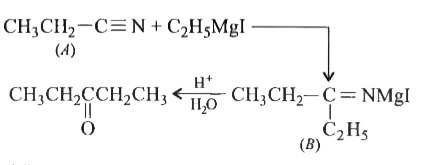
|
|
| 4. |
Compound 'A' when treated with conc. HCl and anhydrous ZnCl_(2) at room temperature instantaneouslygives compound 'B' with molecular formula C_(4)H_(9)Cl. When compound 'B' is further boiled with aqueous KOH, it gives back compound 'A'. 'A' overset(HCl+"anhydrous Zn"Cl_(2)) to underset([C_(4)H_(9)Cl]) B underset(Delta)overset(aq. KOH) to 'A' Identify the compound 'A' and 'B'. |
|
Answer» `CH_(3)-CH_(2)-CH_(2)-CH_(2)-OH , CH_(3)-CH_(2)-CH_(2)-CH_(2)-CL` |
|
| 5. |
Compound 'A' was prepared by oxidation of compound 'X' with alkaline KMnO_(4). Compound 'A" on reduction with lithium aluminium hydride gets converted back to compound 'B'. When compound C. To which family the compounds 'A', 'B' and 'C' belong to? |
|
Answer» Solution :(i). Since compound 'A" is obtained by oxidation of compound 'B' and reduction of compound 'B' with `LiAlH_(4)` gives BACK compound 'A', therefore, both COMPOUNDS 'A' and 'B' have the same number of carbon atoms. (II) Since compound 'A' when heated with compound 'B' in presence of `H_(2)SO_(4)`, produces fruity smell of Compound 'C', therefore, 'C' must be an ester, 'A' must be a carboxylic acid and 'B' must be an alcohol. 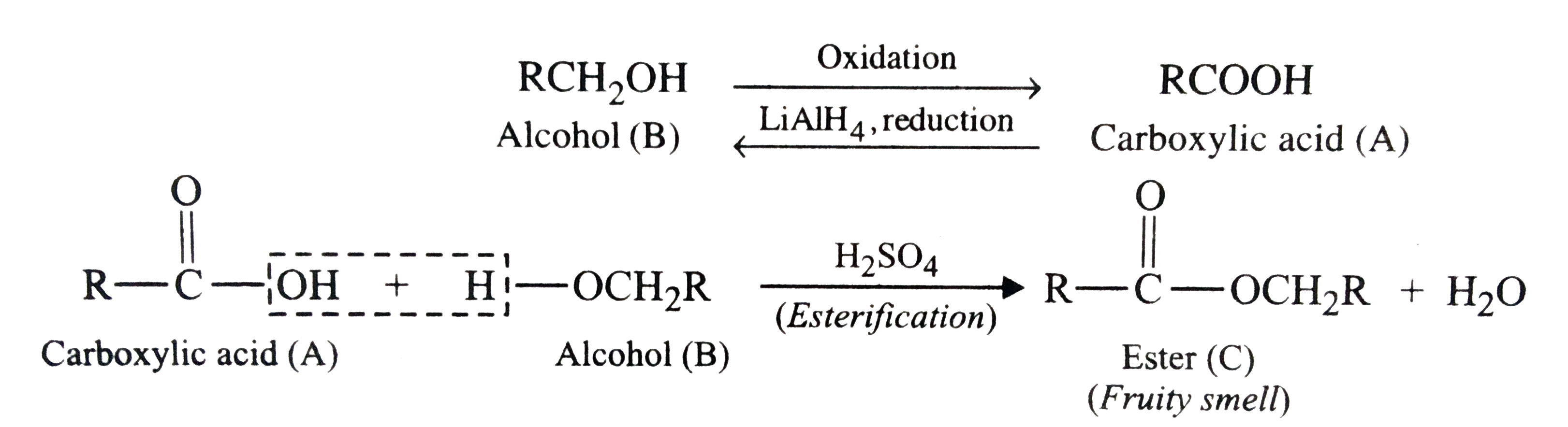 THUS, 'A' is a carboxylic acid, 'B' is an alcohol and 'C' is an ester. |
|
| 6. |
Compound A treated with NaNH_(2) followed by CH_(3)CH_(2)Br gave compound B. Partial hydrogenation of compound B produced compound C, which on ozonolysis gave a carbonyl compound D, (C_(3)H_(6)O). Compound D did not respond to iodoform test with I_(2) // KI and NaOH. Find ont the structure of C. |
|
Answer» `CH_(3)-CH_(2)-CH_(2)-CH=CH-CH_(3)`<BR>`CH_(3)-CH_(2)-CH=CH-CH_(2)-CH_(3)` |
|
| 7. |
Compound 'A' undergoes auto oxidation in the presence of cobalt mapthenate as catalyst at 423 K in alkaline medium followed by heating with dil H_(2)SO_(4) to give compound 'B' and acetone as byproduct of the reaction. Compound 'B' is isolated by distillation and further heated the nitrating mixture giving picric acid . Identify the compound 'A' and 'B'. |
|
Answer» PHENOL, Trinitrotoluence |
|
| 8. |
Compound A reacts with "PCl"_(5) to give B which on treatment with KCN followed by hydrolysis gave propionic acid. What is A and B respectively? |
|
Answer» `C_(3)H_(8)and C_(3)H_(7)`Cl |
|
| 9. |
Compound a reacts with PCI_5 to give B which on treatment with KCN followed by propanic acid as the product. What is A ? |
|
Answer» ETHANE |
|
| 10. |
Compound A reacts with PCI_5 to give B which on treatment with KCN followed by hydrolysis gave propionic acid. What are A & B respectively? |
|
Answer» `C_2H_5OH, C_2H_5OCl, C_2H_5ONa` |
|
| 11. |
Compound (A) reacts with ethylmagnesium bromideto give a product which on hydrolysis yields 3-methyl-3-pentianol. What is the structural formula of (A) ? |
|
Answer» `CH_(3)CH_(2)CH_(2)CHO` |
|
| 12. |
Compound (A) on treatment with NaNH_(2) followed by CH_(3)CH_(2)Br gave compound 'B' produced compound C, which on ozonolysis gave a carbonyl compound 'D', (C_(3)H_(6)O). Compound 'D' did not response to iodoform test with I_(2)//KI and NaOH. Find out the structures of 'A','B','C' and 'D'. |
|
Answer» Solution :A) `CH_(3)CH_(2)C-=CH, (B) CH_(3)CH_(2)-C-=C-CH_(2)CH_(3)` c) `CH_(3)CH_(2)CH=CH=CH_(2)CH_(3)` . D) `CH_(3)CH_(2)CHO` |
|
| 13. |
Compound 'A' react with CH_3-Cl gives B. B react with dil. H_2SO_4 gives ethyl alcohol and CH_3-OH. The compound A is |
|
Answer» `C_2H_5-OH` |
|
| 14. |
Conpound (A) underset(HIO_(4))overset(2 mol of)(rarr) 2 mol of glyoxalic acid. The compound (A) is: |
|
Answer»
|
|
| 15. |
Compound (A) on reduction with LiAIH_4 gives a hydribe (P) containing 21.72% hydrogen along with other products.The one mole of hydride (P) and 2 moles of ammonia at higher temperature gives a compound (Q) which is known as inorganic benzene. (A) hydrolyses incompletely and forms a compound (R) and H_3BO_2 Which of the following statement is incorrect for the compound (A) ? |
|
Answer» It has trigonal planar geometry 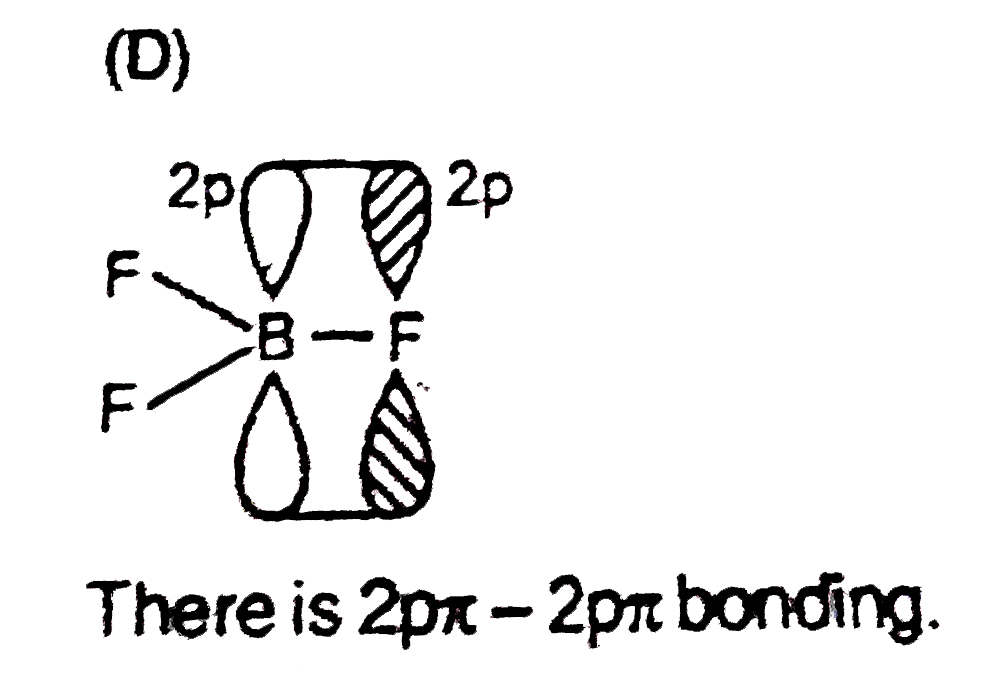 There is `2p pi-2p pi` bonding `4BF_3(A)+3LiAIH_4overset("Ether")to2B_2H_6(P)+3LiAlF_4, B_2H_6 +3O_2 to _2O_3 + 3H_2O`+HEAT Molecular WEIGHT of compound (P)=21.76+6=27.76 % of H in compound (P) i.e., `B_2H_6=6/(27.76)xx100=21.72` `B_2H_6+NH_3 oversetDeltatoB_3N_3H_6` (INORGANIC benzene) +`H_2` 1:2 |
|
| 16. |
Compound (A) on reduction with LiAIH_4 gives a hydribe (P) containing 21.72% hydrogen along with other products.The one mole of hydride (P) and 2 moles of ammonia at higher temperature gives a compound (Q) which is known as inorganic benzene. (A) hydrolyses incompletely and forms a compound (R) and H_3BO_2 The hybridisation of central atom of compound (R) is : |
|
Answer» `SP^2` 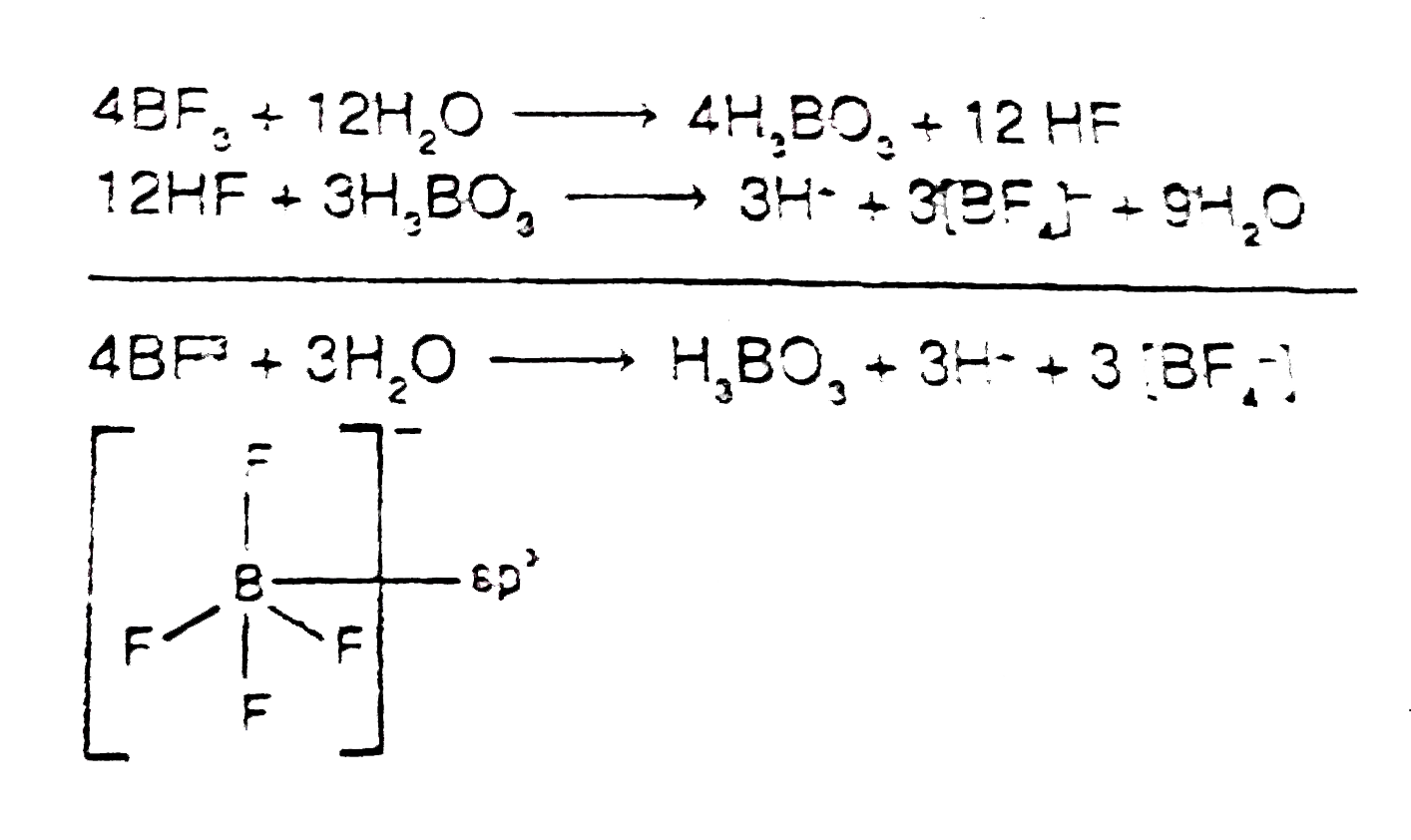
|
|
| 17. |
Compound (A) on reduction with LiAIH_4 gives a hydribe (P) containing 21.72% hydrogen along with other products.The one mole of hydride (P) and 2 moles of ammonia at higher temperature gives a compound (Q) which is known as inorganic benzene. (A) hydrolyses incompletely and forms a compound (R) and H_3BO_2 In hydride (A) (select correct statement): |
|
Answer» The central atom has trigonal PLANAR geometry 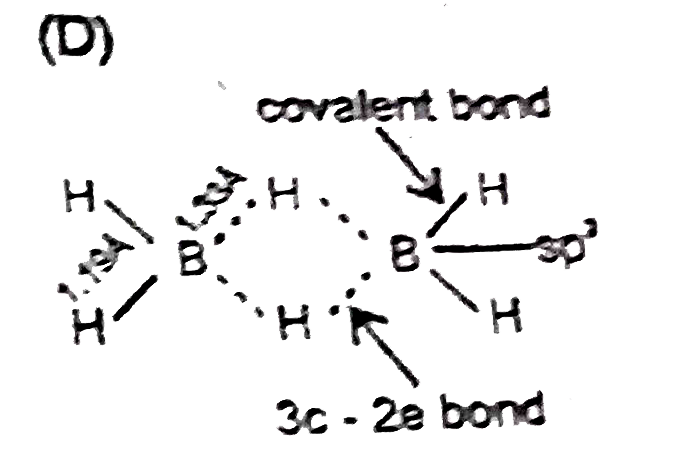
|
|
| 18. |
Compound A on reaction with PCl_(5) followed by ammonia gives B. B reacts with bromine and caustic potash forms C. C on reaction with HCl and NaNO_(2) at 0^(@)C and then boiling produces orthocresol. Compound A is |
|
Answer» o-toluic acid 
|
|
| 19. |
Compound (A) on reaction with iodine in the solvent diglyme gives a hydride (B) and hydrogen gas. The product (B) is instantly hydrolysed by water or aqueous alkali forming compound ( C) and liberating hydrogen gas. The compound ( C) in aqueous solution behaves as a week mono basic acid. But in presence of certain organic polyhydroxy compound behaves as a strong monobasic acid. The hydride (B) in air catches fire spontaneously forming oxide which gives coloured beads with transition metal compounds. Which of the following statement is correct for the hydride (B)? |
|
Answer» One mole of it react with two moles of `HCI`. (B)`B_(2)H_(6)+NH_(3) underset("low temperature")overset("excess"NH_(3))toB_(2)H_(6).2NH_(3)` `B_(2)H_(6).2NH_(3)` is ionic compound and comprises `[H_(3)NtoBH_(2)larrNH_(3)]^(+)` and `[BH_(4)]^(-)` ions. ( C)`B_(2)H_(6)+2(Me)_(3)N to 2[Me_(3)N.BH_(3)]` (D)`B_(2)H_(6)+6H_(2)O to 2B(OMe)_(3)+6H_(2)` Reactions involved `(A)2Na[BH_(4)](A)+I_(2)underset("solution")overset("in diglyme")to B_(2)H_(6) , (B)+H_(2)+2NaI` `B_(2)H_(6)+6H_(2)Oto2H_(3)BO_(3)( C)+3H_(2)` `B(OH)_(3)+2H_(2)O hArrH_(3)O^(+) + [B(OH)_(4)]^(-) , pK=9.25` 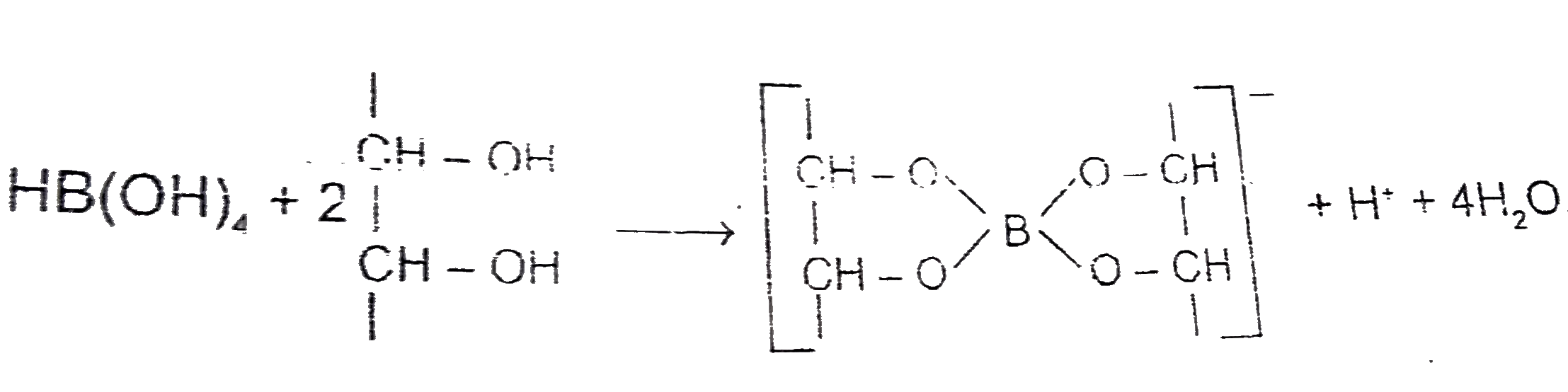 `B_(2)H_(6)(B)+3O_(2)toB_(2)O_(3)+3H_(2)O` `CoO + B_(2)O_(3)to Co(BO_(2))_(2)`(cobalt metaborate -blue colour bead). |
|
| 20. |
Compound (A) on reaction with iodine in the solvent diglyme gives a hydride (B) and hydrogen gas. The product (B) is instantly hydrolysed by water or aqueous alkali forming compound ( C) and liberating hydrogen gas. The compound ( C) in aqueous solution behaves as a week mono basic acid. But in presence of certain organic polyhydroxy compound behaves as a strong monobasic acid. The hydride (B) in air catches fire spontaneously forming oxide which gives coloured beads with transition metal compounds. Aqueous solution of product (C) can be titrated against sodium hydroxide using phenolphthalein indicator only in presence of: |
|
Answer» `cis-1,2 DIOL` The added compound must be a cis-diol, to enhance the acid properties. The cis-diol forms very stable complex with the `[B(OH)_(4)]^(-)` thus removing it from solution.The REACTION is reversible and thus removal of one of the products shifts the equilibrium in the forward direction and thus all the `B(OH)_(3)` reacts with `NaOH` in effect it acts as a strong acid in the presence of the cis-diol. `B(OH)_(3)+NaOH to Na[B(OH)_(4)]+NaBO_(2)+2H_(2)O` 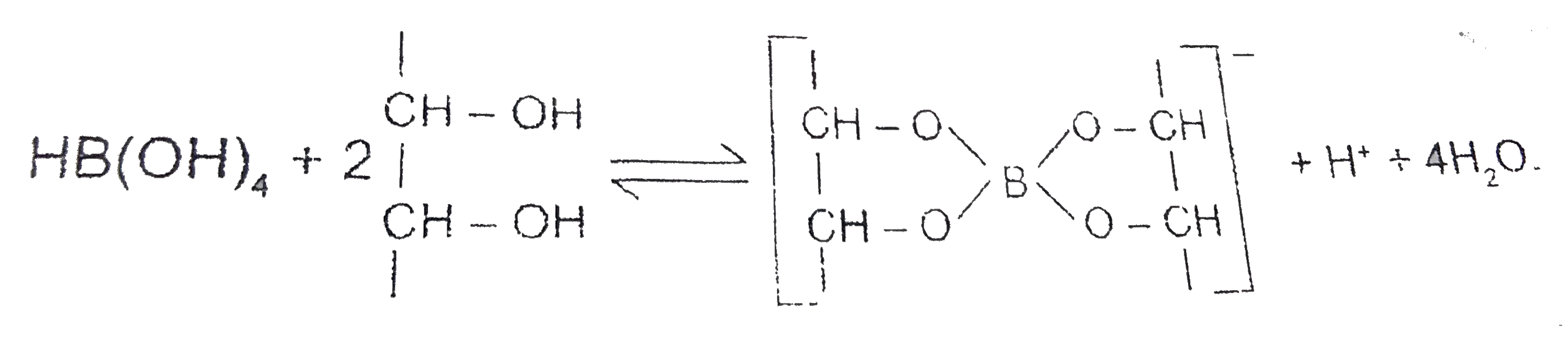 Reactions involved `(A)2Na[BH_(4)](A)+I_(2)underset("solution")overset("in diglyme")to B_(2)H_(6) , (B)+H_(2)+2NaI` `B_(2)H_(6)+6H_(2)Oto2H_(3)BO_(3)( C)+3H_(2)` `B(OH)_(3)+2H_(2)O hArrH_(3)O^(+) + [B(OH)_(4)]^(-) , pK=9.25` 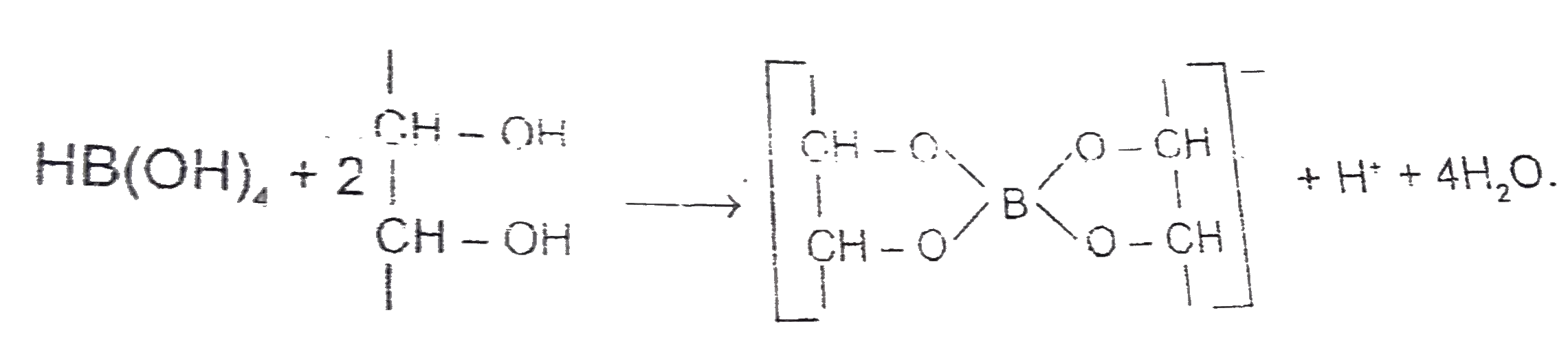 `B_(2)H_(6)(B)+3O_(2)toB_(2)O_(3)+3H_(2)O` `COO + B_(2)O_(3)to Co(BO_(2))_(2)`(cobalt metaborate -BLUE colour bead). |
|
| 21. |
Compound (A) on reaction with iodine in the solvent diglyme gives a hydride (B) and hydrogen gas. The product (B) is instantly hydrolysed by water or aqueous alkali forming compound ( C) and liberating hydrogen gas. The compound ( C) in aqueous solution behaves as a week mono basic acid. But in presence of certain organic polyhydroxy compound behaves as a strong monobasic acid. The hydride (B) in air catches fire spontaneously forming oxide which gives coloured beads with transition metal compounds. Which of the following statement is correct for the product (C)? |
|
Answer» It is an odd electron molecule. `B(OH)_(3)+H_(2)O to [B(OH)_(4)]^(-)+H^(+)` In the solid state, the `B(OH)_(3)` UNITS are hydrogen bonded TOGETHER in to two dimensional sheets with almost hexagonal SYMMETRY. The layered are quite a large distance apart `(3.18 A)` and thus the crystal breaks quite EASILY into very FINE particles. 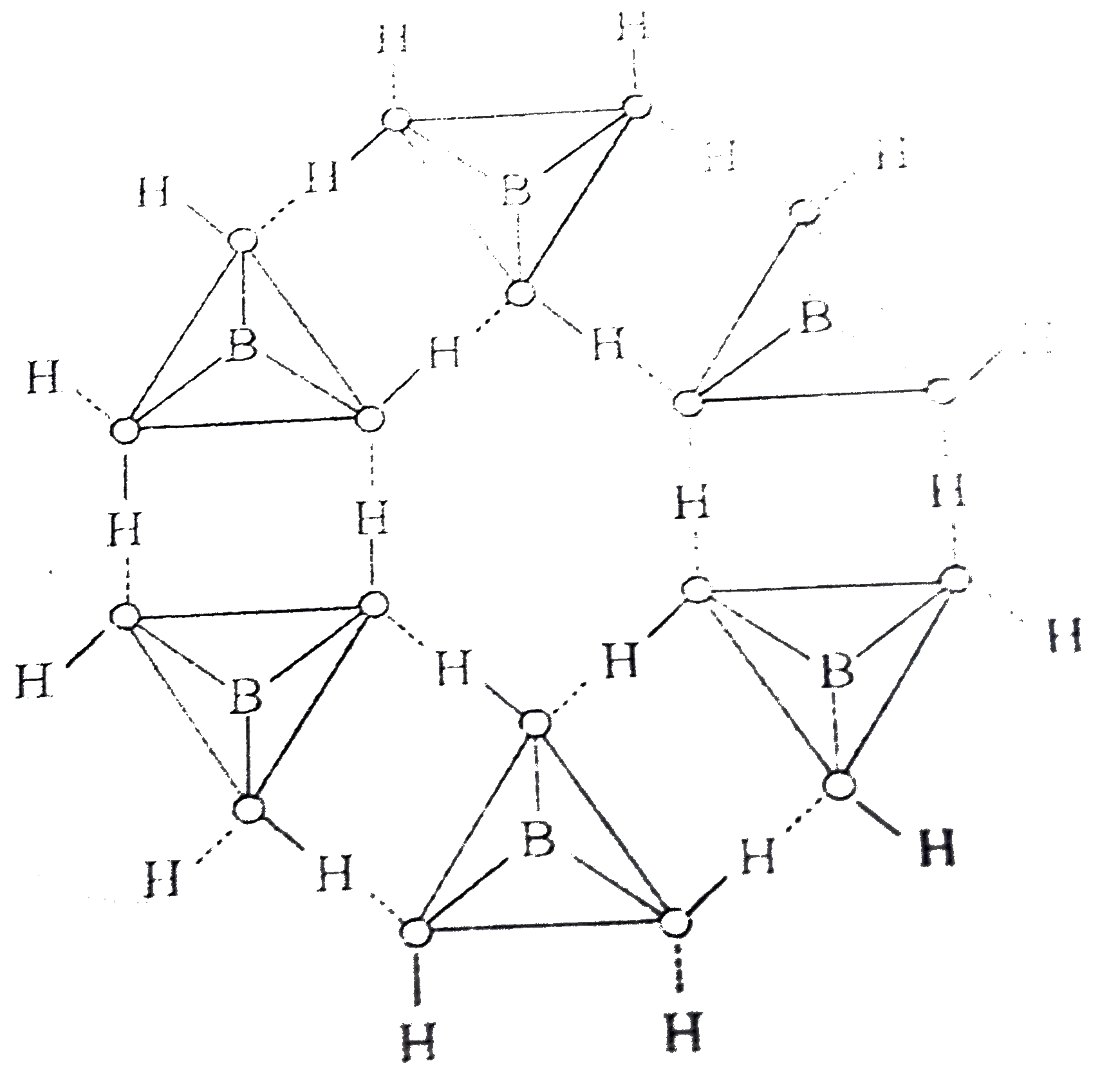 Reactions involved `(A)2Na[BH_(4)](A)+I_(2)underset("solution")overset("in diglyme")to B_(2)H_(6) , (B)+H_(2)+2NaI` `B_(2)H_(6)+6H_(2)Oto2H_(3)BO_(3)( C)+3H_(2)` `B(OH)_(3)+2H_(2)O hArrH_(3)O^(+) + [B(OH)_(4)]^(-) , pK=9.25` 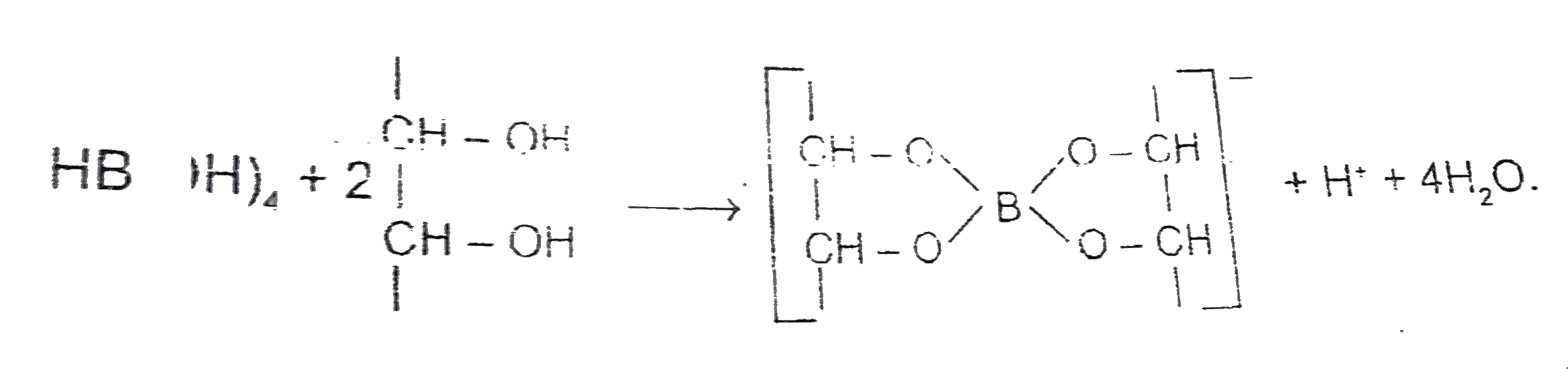 `B_(2)H_(6)(B)+3O_(2)toB_(2)O_(3)+3H_(2)O` `CoO + B_(2)O_(3)to Co(BO_(2))_(2)`(cobalt metaborate -blue colour bead). |
|
| 22. |
Compound A on oxidation with OsO_4//NaHSO_3 following by reaction with HIO_4 gives hexane 1,6 - di al .The structure of compound A can be given as |
|
Answer»
|
|
| 23. |
Compound 'A' on halogenation gives B. Which is reacted with NaNO_(2) in dimethyl sulphoxide gives 2-nitrobutane. The compound 'A' is |
|
Answer» `CH_(3)CHOHCH_(2)CH_(3) ` |
|
| 24. |
Compound A on elimination gives 2-methyl 2-butene. The compound A is |
|
Answer» neo-pentyl bromide <BR>iso-pentyl bromide or `(CH_(3))_(2) CH-CHBr-CH_(3) overset("KOH//alc")to (CH_(3))_(2) C=CH-CH_(3)+Br+H_(2)O` Neopentyl bromide also give 2-methyl 2-butenek on elimination by REARRANGMENT REACTION. `(CH_(3))_(3)C C_(2)-Br overset("KOH//alc")to (CH_(3))_(2) C=CH-CH_(3)+Br+H_(2)O` |
|
| 25. |
Compound (A) of molecular formula C_(9)H_(7)O_(2)Cl exists in ketoform and predominantly in enolic form (B). On oxidation with KMnO_(4), (A) gives m-chlorobenzoic acid. Identify (A) and (B). |
|
Answer» Solution :`DU` in `A= ((2n_(C )+2)-(n_(H)+n_(X)))/2=((2xx9+2)-(7+1))/2=6^(@)`. Since `(C:H~~1:1)`, it must contain contain benzene ring. `A` exists in KETO and predominantly in enolic FORM `B`. Hence, compound `A` must be carbonyl compound which has `alpha-H` atom because it is enolised. A on oxidation gives m-chlorobezoic acid, so carbonyl compound must be at m-position w.r.t. `(Cl)` group. Reactions: 
|
|
| 26. |
Compound (A) of molecular formula C_(3)H_(6)O liberates hydrogen with sodium metal. (A) with P//I_(2) gives (B). Compound (B) on treatment with silveer nitrite gives ( C) which gives blue color with nitrous acid. Identify (A), (B), ( C) and explain the reactions. |
|
Answer» Solution :(i) Compound (A) molecular formula `C_(3)H_(8)O` is isopropyl alcohol, `CH_(3)-underset(OH)underset(|)(CH)-CH_(3)` (ii) Isopropyl alcohol REACTS with `P//I_(2)` to GIVE Isopropyl Iodide (B). `CH_(3)-underset((A))underset(OH)underset(|)(CH-CH_(3)) overset(P)underset(I_(2)) to underset(P) to underset((B))(AgNO_(2))` (iii) (B) reacts with `AgNO_(2)` to form (C), (C) in turn reacts with nitrous acid to form pseudonitrol (blue colour). 
|
|
| 27. |
Compound A of molecular formula C_(3)H_(6)O does not reduce Tollen's reagent and Fehling's solution. Compound A undergoes Clemmensed reduction to give compound B of molecular formula C_(3)H_(8). Compound A in the presence of conc. H_(2)SO_(4) condenses to give an aromatic compound C of molecular formula C_(9)H_(12). Identify A, B and C. Explain the reactions. |
|
Answer» Solution :(i) COMPOUND A of molecular FORMULA `C_(3)H_(6)O` does not REDUCE Tollen's reagent and Fehling's solution. (ii) Compound A undergoes Clemmensen reduction to give compound B of molecular formula `C_(3)H_(8)`.  (iii) Compound A in the presence of conc. `H_(2)SO_(4)` CONDENSES to give an AROMATIC compound C of molecular formula `C_(9)H_(12)`. 
|
|
| 28. |
CompoundA of molecular formulaC_(7)H_(6)O reduces Tollen's reagent when A reacts with 50% NaOHgives compound B of molecularformulaC_(7)H_(8)O and C of molecular formulaC_(7)H_(5)O_(2)NaCompound C on tretatmentwith dil HCL gives compoundD of molecular formulaC_(7)H_(6)O_(2) . whenD is heatedwithsodalime givescompound E.IdentifyA, B, C,D & E.writethe correspondingequations . |
|
Answer» SOLUTION :Compound A of MOLECULARFORMULA ` C_(7)H_(6)O` reducesTollen's reagent when A reactswith 50%NaOHgivescompound Bof molecularformula ` C_(7)H_(8)O` and Cof molecularformula ` C_(7)H_(5)O_(2) Na` . Compound C on treatment withdil HCIgivescompound D of molecularformula ` C_(7) H_(6)O_(2)`. when D is heatedwith sodalimegivescompound E. IdentifyA,B,CD &E . Writethe corresponding equations. ` (##SUR_CHE_XII_V02_QP_E01_043_S01.png" width="80%"> Compound A - Benzaldehyde Compound B - BENZYL alcohol Compound C - Sodiumbenzoate Compound D - Benzoicacid Compound E - Benzene |
|
| 29. |
Compound 'A' of molecula formula C_(4)H_(10)O on treatment with Lucas reagent at room temperature gives compound 'B'. When compound 'B' is heated with alcoholic KOH, it gives isobutene. Compound 'A' annd 'B' are respectively |
|
Answer» 2-methyl-2-propanol ad 2-chloro-2-methyl-propane `underset("2-Methyl-2-propanol (A) M.F. "C_(4)H_(10)O" "(3^(@)" alcohol"))(CH_(3)-underset(CH_(3))underset(|)overset(CH_(3))overset(|)(C)-OH) underset(+"anhyd. "ZnCl_(2)" (Lucas reagent)")overset("conc. HCl")to underset("2-Chloro-2-methyl-propane (B)")(CH_(3)-underset(CH_(3))underset(|)overset(CH_(3))overset(|)(C)-CL)` |
|
| 30. |
Compound A of molecular formula C_(2)H_(8) is treated with chlorine and then with NaOH to get compound B of molecular formula. C_(2)H_(8)O. B on oxidation by acidified K_(2)Cr_(2)O_(7) gives compound C of molecular formula C_(7)H_(6)O. Compound C on treatment with 50% caustic soda gives the compound B and also D. Find A,B,C and D. Explain the reactions. |
|
Answer» Solution :(i) An organic compound A is identified as toluene from its molecular formula. (ii) (A) on reaction with chlorine gives benzyl chloride whicih on further reactions with NaOH produces (B). `C_(6)H_(5)-CH_(3) overset(Cl_(2))UNDERSET(-HCl) to C_(6)H_(5)CH_(2)Cl overset(NaOH)underset(-NaCl) to underset((B)) (C_(6)H_(5)CH_(2)OH` (III) B on oxidation with ACIDIFIED `K_(2)Cr_(2)O_(7)` gives (C). `C_(6)H_(5)CH_(2)OH overset(K_(2)Cr_(2)O_(7)//H^(+))underset(NaOH) to underset((C))(C^(6)H^(5)CHO) + H_(2)O` (iv) Benzaldehyde on treatment with 50% caustic soda gives (D) and (B). `underset((C))(C_(6)H_(5)CHO) + C_(6)H_(5)CHO overset(50%)underset(NaOH) to underset(B)(C_(6)H_(5)CH_(2)OH) + underset((D))(C_(6)H_(5)COOH)` 
|
|
| 31. |
Compound A of formula C_(8)H_(14)Oreacts with LiAIH_(4)to yield two isomeric products B and C, both in equal yield. Heating either B or C with conc. H_(2)SO_(4)produces D with for mula C_(8)H_(14) . Ozonolysis of D produces a keto aldehyde after Zn//H_(2)O treatment. Oxidation of this keto aldehyde with aq. Cr (VI) produces The structure of A is |
|
Answer»
|
|
| 32. |
Compound A of formula C_(8)H_(14)Oreacts with LiAIH_(4)to yield two isomeric products B and C, both in equal yield. Heating either B or C with conc. H_(2)SO_(4)produces D with for mula C_(8)H_(14) . Ozonolysis of D produces a keto aldehyde after Zn//H_(2)O treatment. Oxidation of this keto aldehyde with aq. Cr (VI) produces The structure of D is |
|
Answer»
|
|
| 33. |
Compound A of formula C_(8)H_(18) forms mainly 3-chloro 2,2,3-tri methyl penetane on monohalogenation. The compund (A) is |
|
Answer» n-octane `CH_(3)-underset(CH_(3)) underset(|) overset(CH_(3) ) overset(|)C-overset(CH_(3)) overset(|)(CH)-CH_(2)-CH_(3)` contaisn only on `3^(@)` on monohalogenation gives MAINLY `CH_(3)-underset(CH_(3)) underset(|) overset(CH_(3) ) overset(|)C-overset(CH_(3)) overset(|)(CX)-CH_(2)-CH_(3)` Ease of abstraction of hydrogen is `3^(@) gt 2^(@) gt 1^(@) H` |
|
| 34. |
Compound A of formula C_(8)H_(14)Oreacts with LiAIH_(4)to yield two isomeric products B and C, both in equal yield. Heating either B or C with conc. H_(2)SO_(4)produces D with for mula C_(8)H_(14) . Ozonolysis of D produces a keto aldehyde after Zn//H_(2)O treatment. Oxidation of this keto aldehyde with aq. Cr (VI) produces The compounds B and C are |
|
Answer» enantiomers |
|
| 35. |
Compound A of formula C_(8)H_(14)Oreacts with LiAIH_(4)to yield two isomeric products B and C, both in equal yield. Heating either B or C with conc. H_(2)SO_(4)produces D with for mula C_(8)H_(14) . Ozonolysis of D produces a keto aldehyde after Zn//H_(2)O treatment. Oxidation of this keto aldehyde with aq. Cr (VI) produces The structures of B and C are |
|
Answer»
|
|
| 36. |
Compound A of formula C_(3)H_(8)O is treated with acidic KMnO_(4) to form product B of formula C_(3)H_(6)O, which form shining silver mirror on warming with ammonical AgNO_(3), whenB is treated with NH_(2) CONHNH_(2) in HCland sodium acetate gives the product C. Identity hte structure of C. |
|
Answer» `CH_(3) - UNDERSET ( CH_(3)) underset(|) (C) = N - NH - OVERSET(O) overset(||) (C) - NH_(2)` |
|
| 37. |
Compound 'A' (molecular formula C_(3)H_(8)O) is treated with acidified potassium dichromate to form a product 'B' (molecular formula C_(3)H_(6)O). 'B' forms a shingingsilver mirror on warming with ammoniacal silver nitrate. 'B' when terated with an aqueous solution of H_(2)NCONHNH_(2) ans sodium acetate gives a product 'C'. The structure of 'C' is : |
|
Answer» `CH_(3)CH_(2)CH = N NHCONH_(2)` 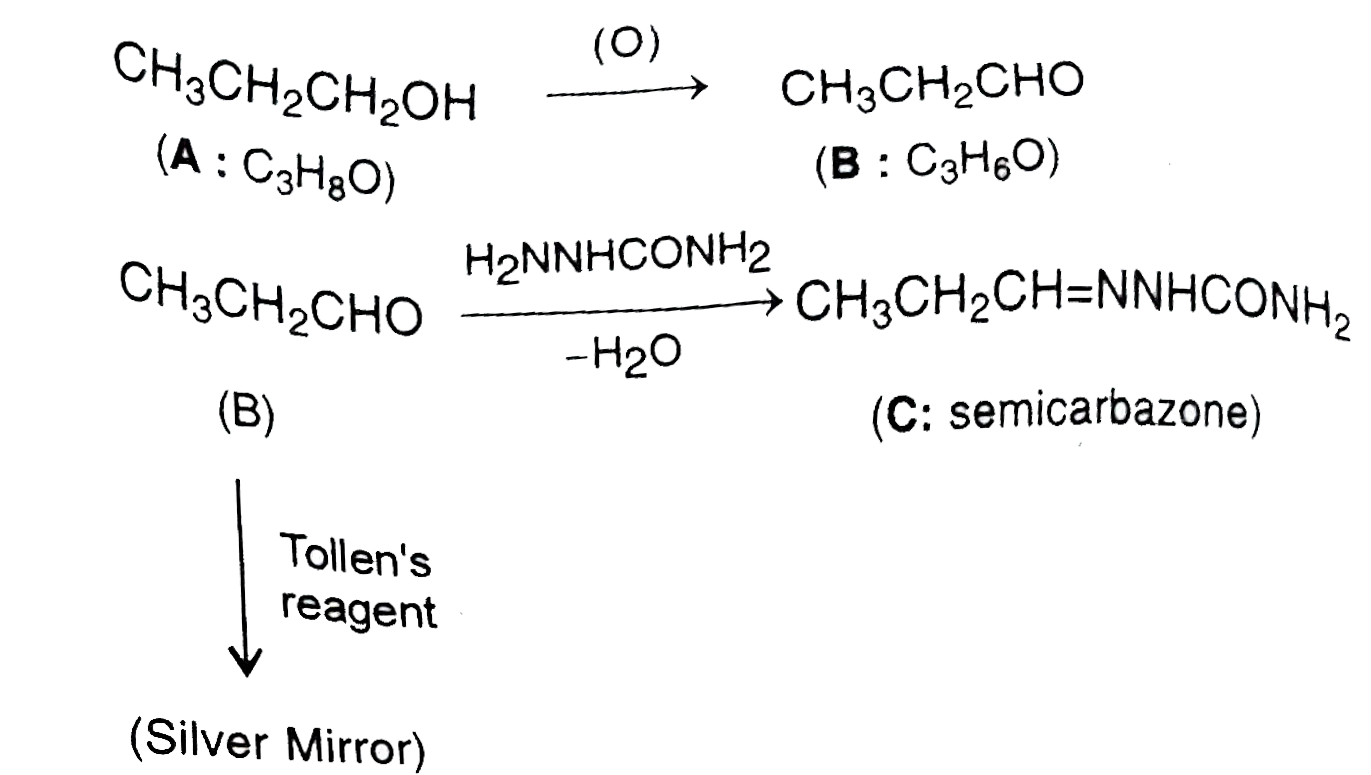
|
|
| 38. |
Compound A (molecular formula C_(3)H_(8)O) is treated with acidified potassium dichromate to form a product B (molecular formula C_(3)H_(6)O), B forms a shining silver mirror on warming with ammoniacal silver nitrate. B when treated with an aqueous solution of H_(2)NCONHNH_(2).HCl and sodium acetate gives a product C. Identify the structure of C. |
|
Answer» `CH_(3)CH_(2)CH = N NHCONH_(2)` |
|
| 39. |
Compound 'A' (molecular formula C_3H_8O)is treated with acidified potassium dichromate to form a product 'B' (molecular formula C_3H_6O).'B' forms a shining silver mirror on warming with ammoniacal silver nitrate. 'B'whentreated with an aqueous solution of H_2NCONHNH_2, HCl and sodium acetate gives a product 'C'. Identify the structure of C : |
|
Answer» `(CH_3)_2C = NNHCONH_2` |
|
| 40. |
Compound (A) [molecular formula (C_(3)H_(8)O)] is treated with acidified potassium dichromate to form a product (B) [molecular formula (C_(3)H_(6)O)]. (B) forms a shining silver mirror on warming with ammoniacal silver nitrate. (B) when treated with an aqueous solution of H_(2)NCONHNH_(2) and sodium acetate gives a product (C ). Identify the structure of (C ). |
|
Answer» a.`CH_(3)CH_(2)CH=N.NHCONH_(2)` So, compound A is `1^(@)` ALCOHOL. 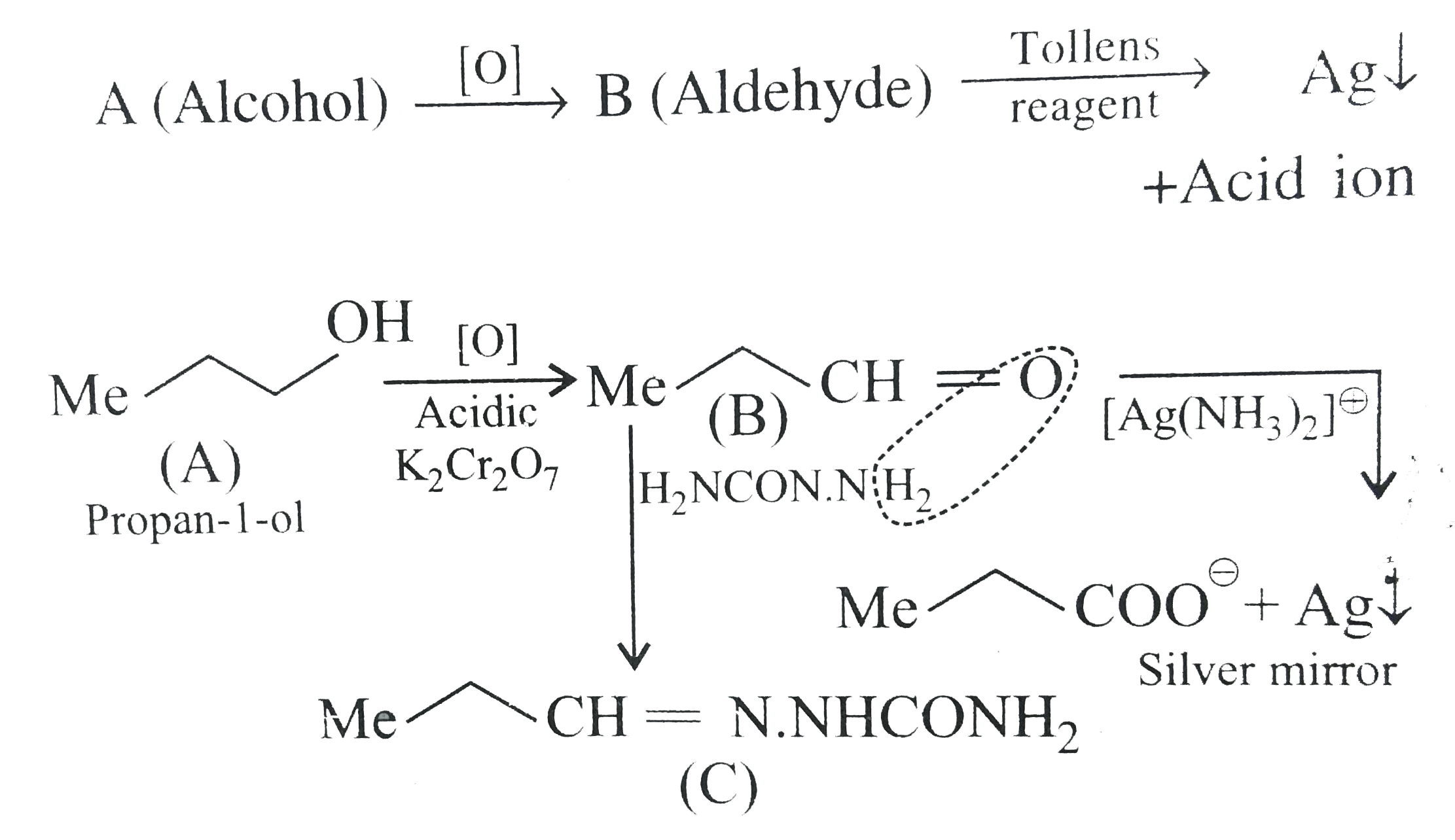 Hence the ANSWER the answer is `(a)`. |
|
| 41. |
Compound A (molecular formula C_(3)H_(8)O) is trated with acidified potassium dichromate to form a product B (molecular formula C_(3)H_(6)O). B form a shining silver mirror on warming with ammonical silver nitrate. B when treted with an aqueous solution of H_(2)NCONHNH_(2).HCl and sodium acetate gives a productC. Identify the structure of C |
|
Answer» `CH_(3)CH_(2)CH = NNNHCONH_(2)` Reaction of (B) INDICATES that it is an aldehyde which thus should be `C_(2)H_(5)CHO` or `CH_(3)CH_(2)CHO` hence C shouldbe `CH_(3)CH_(2)CH = "NNHCONH"_(2)` |
|
| 42. |
Compound 'A' (moelcular formula C_(3)H_(8)O) is treated with acidified potassium dichromate to form a product 'B' (molecular formula C_(3)H_(6)O). 'B' forms a shining silver mirror on warming with ammoniacal silver nitrate. 'B' when treated with an aqueous solution of H_(2)NCONHNH_(2). HCl and sodium acetate gives a product 'C'. identify the structure of 'C'. |
|
Answer» `CH_(3)CH_(2)CH=N NHCONH_2` `underset("1-Propanol (A) "(M.F.C_(3)H_(8)O))(CH_(3)CH_(2)CH_(2)OH) underset(H_(2)SO_(4))overset(K_(2)Cr_(2)O_(7))to underset("PROPANAL (B) "(M.F.C_(3)H_(6)O))(CH_(3)CH_(2)CHO) underset("Sod. acetate "(-HCl,-H_(2)O))overset(H_(2)NCONHNH_(2).HCl)to CH_(3)CH_(2)CH=N NHCONH_(2)`. |
|
| 43. |
Compound Ais thefollowingreactionis A overset(NH_(3)//Delta)to B overset(Br_(2)+KOH)to Butan -1- amine |
|
Answer»
`CH_(3)- CH_(2)-CH_(2) - CH_(2) - CONH_(3)overset(Br_(2) + KOH) to underset("Butan - 1- amine")(CH_(3) - CH_(2) - CH_(2) - CH_(2) - NH_(2))` |
|
| 44. |
Compound A is thelightcrystalinesolid .IT gives thefollowing tests: i. ITdissolvesin dilute sulphuric acid, NO gas isproduced ii. A dropof MnO_(4) is added to theabovesolution .The pinkcolour disappears iii. Compound A is heatedstrongly .Gases B and C , with pungent smell , come out Abrown D is leftbehind iv . THe gas mixture (B and C) is passedinto a dchromate solution .The solutionturn green v. THe greensolutionfrom step (iv) gives a whiteprecipitateE with a soluttionof bariumnitrate . vi. Residue D fromstep (iii) isheated on charcoal in a reducingflame it gives a magnetic subsytance .Name thecompounds A,B,C, D and E |
|
Answer» SOLUTION :A: `FeSo_(4):B : SO_(2) ,C: SO_(4),D: Fe_(2)O_(3),E : 7H_(2)O` It isagaina problem involving`FeSO_(4),7H)_(2)O` 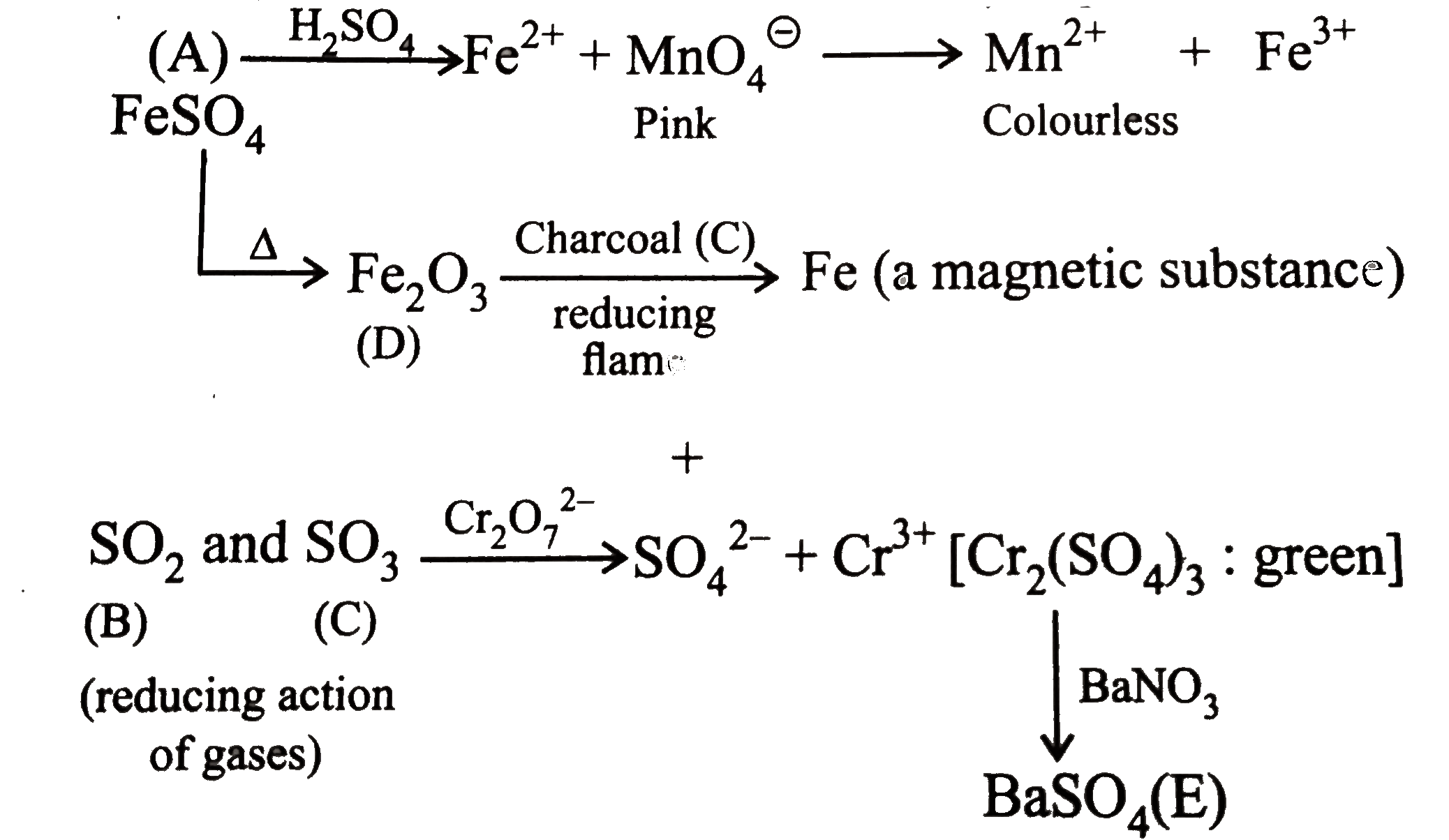
|
|
| 45. |
Compound A is used in the manufacture of opticals. A on heating gives B. B further heating to form C. A reacts with hydrochloric acid to give D. Identify A,B and C Explain the reaction. |
|
Answer» Solution :(i) Compound (A) is borax, which is USED in the manufacture of opticals. (II) Borax(A) on HEATING to give borax glass (B). Borax glass on further heating to give sodium metaborate (C). `underset(("Borax"))(Na_(2)B_(4)O_(7)).10H_(2)Ounderset(-10H_(2)O)overset(Delta)(to)underset((B))underset(("Borax glass"))(Na_(2)B_(4)O_(7))overset(Delta)(to)underset((C))underset(("Sodium metaborate"))(2NaBO_(2))+B_(2)O_(3)` (iii) Borax (A) reacts with HYDROCHLORIDE acid to give boric acid. `underset((A))underset(("Borax"))(Na_(2)B_(4)O_(7))+2HCl+7H_(2)otounderset((D))underset(("Boric acid"))(4H_(3)BO_(3))+2NaCl` 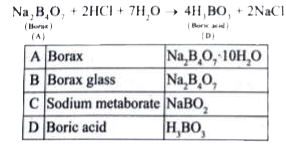
|
|
| 46. |
Compound A is reacted with KCN and followed by reduction using SnCl_(2) + HCl and successive hydrolysis gives propanal. The compound A is |
|
Answer» `C_(2)H_(5) - X` |
|
| 47. |
Compound 'A' is reacted with HX produces 'B' which is heated with silver nitrate gives 2-nitropropane. The compound 'A' is |
|
Answer» `CH_(3)CH_(2)CH_(3)` |
|
| 48. |
Compound A is reactedwith C_(2)H_(5)-X gives B . The compound B is reduced by di-isobutyl aluminium hydride gives butanal. The compound A is |
|
Answer»
|
|
| 49. |
Compound A is obtained by following reaction. CH_(3)COOC_(2)H_(5) overset((i) C_(2)H_(5)ONa) underset((ii)H_(3)O^(+)) to [A] How many following statement(s) is(are) true about A ? (i) It gives red colour with blue litmus solution. (ii) It decomposes NaHCO_(3), solution and evolves CO_(2)gas. (iii) It decolourises bromine water colour. (iv) It reacts with 2,4-dinitrophenyl-hydrazine (v) Product A will undergo acid catalysed halogenation. |
|
Answer» `CH_(3)-overset(O)overset(||)C-OC_(2)H_(5) to [""^(-)CH_(2) - overset(O)overset(||)C-OC_(2)H_(5) |
|
| 50. |
Compound 'A'is oxidisedby trifluoroperoxy aceticgives 'B'followedbyreductionwithFe+ conc. HClgivesbutan - 2 amine . The compound'A' is . |
|
Answer»
` CH_(3) - underset(NO_(2))underset(|)(CH) - CH_(2) - CH_(3)overset("Fe + conc. HCL") to CH_(3) underset(NH_(2)) underset(|)(CH) - CH_(2)- CH_(3)` |
|