

Saved Bookmarks
This section includes 7 InterviewSolutions, each offering curated multiple-choice questions to sharpen your Current Affairs knowledge and support exam preparation. Choose a topic below to get started.
| 1. |
Complexes [Co(NH_(3))_(5)SO_(4)]Br and Co(NH_(3))_(5)Br]SO_(4) can be distinguised by : |
|
Answer» conductance MEASUREMENT |
|
| 2. |
Complex which have minimum number of metal-nitrogen linkage: |
|
Answer» `[overset(II)Ni(EDTA)^(2-)]` |
|
| 3. |
Complexation is shown by : |
|
Answer» Ag |
|
| 4. |
Complex which has maximum stereo isomers : where to AA to Symmetrical bidented ligandAB to unsymmetrical bidented ligand a, b, c, d, e, f - Monodented ligand |
|
Answer» [M(AA)abcd] |
|
| 5. |
Complex of HgCo.4SCN has two isomers XgtY then, which of the following option is incorrect ? |
|
Answer» X and Y are DIFFERENT in structure |
|
| 6. |
Complex lipids. |
| Answer» Solution :Complex LIPIDS are the esters of long chain FATTY ACIDS and can be HYDROLYSED. | |
| 7. |
Complex lipids contains |
|
Answer» PHOSPHORIC acid |
|
| 8. |
Complex ions [NiCl_(6)]^(4-),[Ni(CN)_(6)]^(4-) similar in their given properties: |
|
Answer» OXIDATION state, geometryq |
|
| 9. |
Complex ion [FeN_(3)(O_(2))(SCN)_(4)]^(4-) is maned as : (coordination number of central metal ion in complex is six) |
|
Answer» Azidosuperoxidotetrathiocyanato-S-ferrate(II) |
|
| 10. |
Complex ion. |
| Answer» Solution :A COORDINATION ionic compound which is an electrically CHARGED ion carrying positive or negative charge and formed by coordinate COVALENT bonds between central metal atom or metal ion and number of anions or neutral molecules (ligands) surrounding it is called a complex ion. For EXAMPLE, `[Cu(NH_(3))_(4)]^(2+)` | |
| 11. |
Complex in which effective atomic number is not equal to atomic number of the noble gas |
|
Answer» `[NI(CN)_4]^(2-)` |
|
| 12. |
Complex forming tendency increases with: |
|
Answer» INCREASE in SIZE of cation |
|
| 13. |
Complex formation or cyanide method is used for the extraction of |
|
Answer» Cu |
|
| 14. |
Complex formation or cyanide method is used for the extraction of : |
|
Answer» Cu |
|
| 15. |
Complex compounds(s) which is optical active and does ot dpeend upon the orientation of the ligands around metal cation: (i) [CoCl_(3)(NH_(3))_(3)] (ii) [Co(en)_(3)]Cl_(3) (iii) [Co(C_(2)O_(4))_(2)(NH_(3))_(2)]^(-) (iv) [CrCl_(2)(NH_(3))_(2)(en)]^(+) |
|
Answer» (ii), (iii) and (IV) 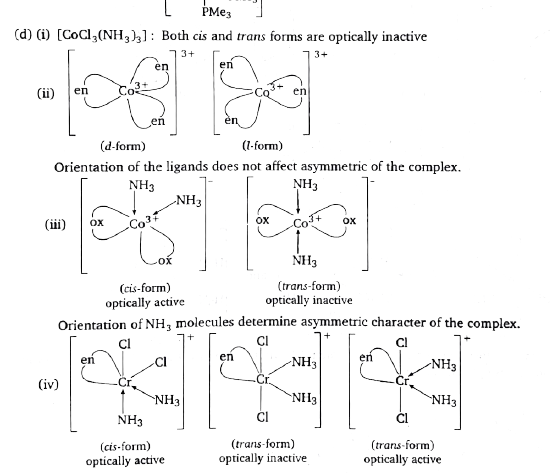 Hence, orientation of LIGANDS DETERMINE asymmetric nature of the COMPLEX. |
|
| 16. |
Complex fertilizer is that supplies to the soil: |
|
Answer» S, K and N |
|
| 17. |
Complex compounds which have same molecular formula but have different structural arrangements of ligands around central metal atom or ion are called structural isomers and phenomenon is named as structural isomerism. Which of the following compounds is/are polymerisation isomerof [Fe(NO_(2))_(3)(NH_(3))_(3)]. (P) [Fe(NO_(2))(NH_(3))_(5)][Fe(NO_(2))_(5)(NH_(3))] (Q) [Fe(NO_(2))_(2)(NH_(3))_(4)]_(2)[Fe(NO_(2))_(5)(NH_(3))] (R ) [Fe(NO_(2))(NH_(3))_(5)][Fe(NO_(2))_(4)(NH_(3))_(2)]_(2) (S) [Fe(NO_(2))_(2)(NH_(3))_(4)][Fe(NO_(2))_(4)(NH_(3))_(2)] Choose the correct code : |
| Answer» Answer :D | |
| 18. |
Complex compounds that have the same molecular formula but have different structural/space arrangements of ligands around central metal atom/ion are called isomers, these are of two types namely structural and stereoisomers. Q. Complex species that exhibits isomerism is: |
|
Answer» `[AG(NH_(3))_(2)]^(+)` |
|
| 19. |
Complex compounds which have same molecular formula but have different structural arrangements of ligands around central metal atom or ion are called structural isomers and phenomenon is named as structural isomerism. Select incorrect match : |
|
Answer» `[CO(NO_(2))(H_(2)O)(EN)_(2)]Cl_(2), [CoCl(NO_(2))(en)_(2)]Cl.H_(2)O-"Hydrate isomerism"` |
|
| 20. |
Complex compounds which have same molecular formula but have different structural arrangements of ligands around central metal atom or ion are called structural isomers and phenomenon is named as structural isomerism. How many more coordination isomers are possible of the following complex compound. [PtCl_(2)(NH_(3))_(4)][Pt(SCN)_(4)] |
|
Answer» 5 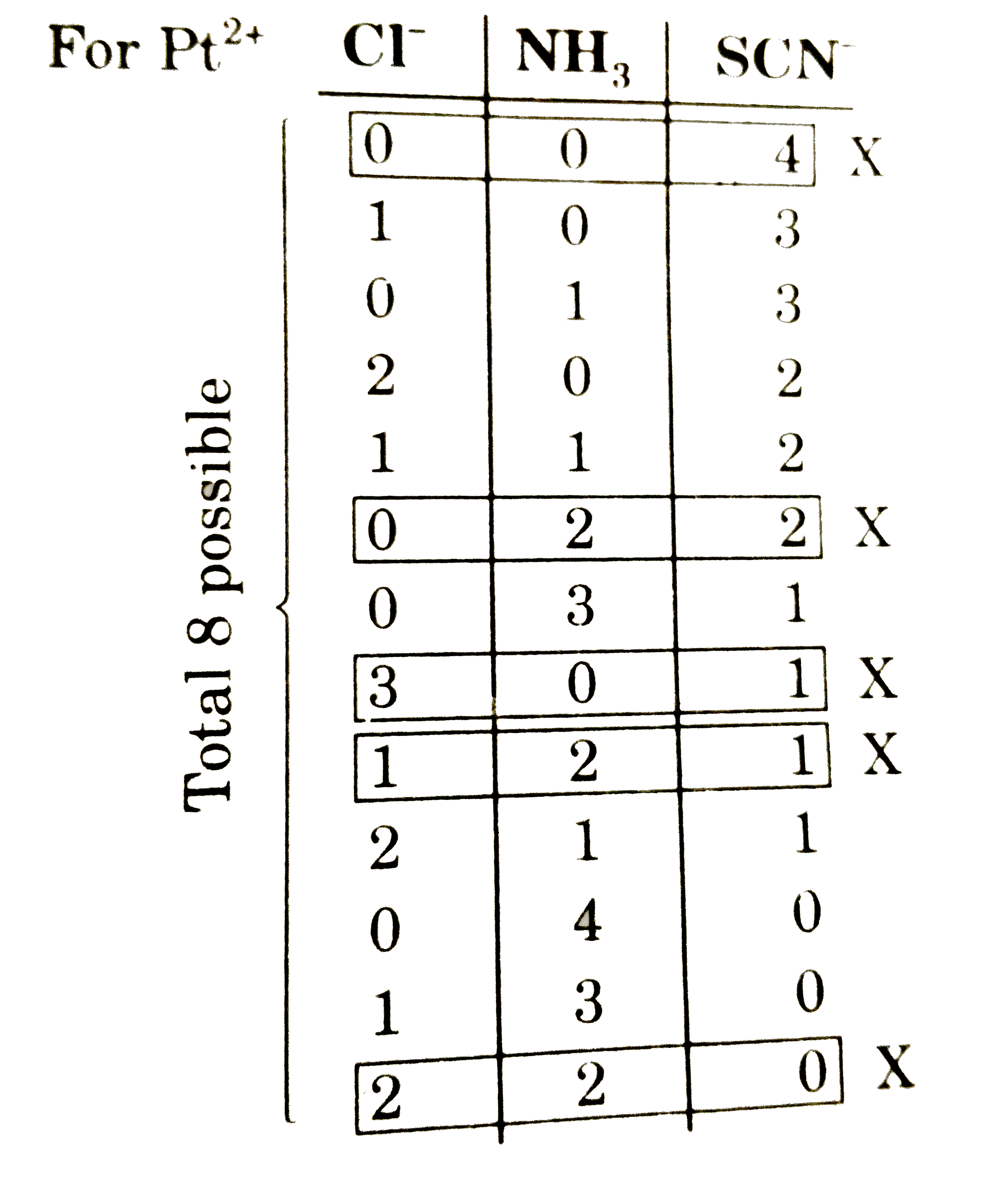
|
|
| 21. |
Complex compounds that have the same molecular formula but have different structural/space arrangements of ligands around central metal atom/ion are called isomers, these are of two types namely structural and stereoisomers. Q. Type of isomerism exhibited by [CrCl_(2)(NO)_(2))_(2)(NH_(3))_(2)]^(-) complex ion are: |
|
Answer» IONISATION optical |
|
| 22. |
Complex compounds that have the same molecular formula but have different structural/space arrangements of ligands around central metal atom/ion are called isomers, these are of two types namely structural and stereoisomers. Q. Which of the following is different among structural isomers? |
|
Answer» OXIDATION state |
|
| 23. |
Complex compound(s) having even number of space (stereo) isomer is/are: (Where AA-symmetrical bidentate ligand and a,b,c,d,e-monodentate ligands) |
|
Answer» `[M(A A)_(2)b_(2)]^(N+-)` |
|
| 24. |
Complex compounds of transition metals are familier, but not inner transition elements. Why? |
| Answer» Solution :Transition METAL IONS have EMPTY d-orbitals. Because the ions are small and highly CHARGED the complex compounds formed are STABLE. Inner transition metal ions have empty f-orbitals. The ions are large and hence the complex compounds formed are relatively less stable. | |
| 25. |
Complex compounds can exhibit isomerism like structural and stereo. The complexes containing coordination No. 1, 2, 3 cannot exhibit geometrical isomerism. Geometrical and optical isomerism is common in the complex having coordination number 4 and 6 Ma,b, shows facial and meridonial isomerism. The two compounds pentam mine sulphato cobalt(III) bromide and Pentaammine sulphato cobalt (III) chloride represent |
|
Answer» LINKAGE isomerism |
|
| 26. |
Complex compounds can exhibit isomerism like structural and stereo. The complexes containing coordination No. 1, 2, 3 cannot exhibit geometrical isomerism. Geometrical and optical isomerism is common in the complex having coordination number 4 and 6 Ma,b, shows facial and meridonial isomerism. [Co(NH_(3))_(5)(NO_(2))]Cl_(2)and[Co(NH_(3))_(5)ONO]Cl_(2) are |
|
Answer» LINKAGE isomers |
|
| 27. |
Complex compounds are molecular compounds which retain their indentities even when dissolved in water. They do not give all the simple ions in solution but instead furnish complex ions. The complex compounds are often called coordination compounds because certain groups called ligands are attached to the central metal ion by coordinate or dative bonds. Coordination compounds exhibit isomerism, both structural and stereoisomerism. The struculre, magnetic property, colour and electrical properties of complexes are explained by various theories. The oxidation number, coordination number and magnetic moment in the following complex Na_(3)[Cr(CN)_(6)] is : |
|
Answer» `O.N=+3,C.N.=6,M.M.=SQRT(15)BM` |
|
| 28. |
Complex compounds can exhibit isomerism like structural and stereo. The complexes containing coordination No. 1, 2, 3 cannot exhibit geometrical isomerism. Geometrical and optical isomerism is common in the complex having coordination number 4 and 6 Ma,b, shows facial and meridonial isomerism. Number of geometrical isomers posible for complex [Pt(NH_(3))(Py)(Cl)(Br)] is |
|
Answer» 2 |
|
| 29. |
Complex compounds are molecular compounds which retain their indentities even when dissolved in water. They do not give all the simple ions in solution but instead furnish complex ions. The complex compounds are often called coordination compounds because certain groups called ligands are attached to the central metal ion by coordinate or dative bonds. Coordination compounds exhibit isomerism, both structural and stereoisomerism. The struculre, magnetic property, colour and electrical properties of complexes are explained by various theories. which of the following pairs, both the complexes have the same geometry? |
|
Answer» `[NiCl_(4)]^(-2),[Ni(CN)_(4)]^(-2)` |
|
| 30. |
Complex compounds are molecular compounds which retain their identities even when dissolved in water. They do not give all the simple ions in solution but instead furnish complex ions. The complex compounds are often called coordination compounds because certain groups called ligands are attached to the central metal ion by coordinate or dative bonds. coordination compounds exhibit isomerism, both structural and stereoisomerism. the structure, magnetic property, colour and electrical properties of complexes are explained by various theories: Q. In which of the following pairs, both the complexes have the same geometry? |
|
Answer» `[NiCl_(4)]^(2-),[Ni(CN)_(4)]^(2-)` |
|
| 31. |
Complex compounds are molecular compounds which retain their indentities even when dissolved in water. They do not give all the simple ions in solution but instead furnish complex ions. The complex compounds are often called coordination compounds because certain groups called ligands are attached to the central metal ion by coordinate or dative bonds. Coordination compounds exhibit isomerism, both structural and stereoisomerism. The struculre, magnetic property, colour and electrical properties of complexes are explained by various theories. Arrange the following compounds in order of of their molar conductance : i) K[Co(NO_(2))_(4)(NH_(3))_(2)] ii) [Cr(ONO)_(3)(NH_(3))_(3)] iii) [Cr(NO_(2))(NH_(3))_(5)]_(3)[Co(NO_(2))_(6)]_(2)iv) Mg[Cr(NO_(2))_(5)(NH_(3))] |
|
Answer» `iiltivltiltiii` |
|
| 32. |
Complex compounds are molecular compounds which retain their identities even when dissolved in water. They donot give all the simple ions in solution but instead finish complex ions. The structure, magnetic property, colour and electrical properties of complex are explained by various theories The Ox.No, CN and magnetic moment in the following complex is [Cr(C_(2)O_(4))_(2)(NH_(3))_(2)]^(-) |
|
Answer» `+3,6sqrt15BM` CN of `Crto6` `mu=sqrt(3(3+2))BM=sqrt(15)BM""("":.Cr^(3+)` has 3 UNPAIRED electrons) |
|
| 33. |
Complex compounds are molecular compounds which retain their identities even when dissolved in water. They do not give all the simple ions in solution but instead furnish complex ions. The complex compounds are often called coordination compounds because certain groups called ligands are attached to the central metal ion by coordinate or dative bonds. coordination compounds exhibit isomerism, both structural and stereoisomerism. the structure, magnetic property, colour and electrical properties of complexes are explained by various theories: Q. The oxidation number, coordination number and magnetic moment in the following complex is: [Cr(C_(2)O_(4))_(2)(NH_(3))_(2)^(-)] |
|
Answer» O.N.=+3,C.N.=6, M.M.=`SQRT(15)BM` |
|
| 34. |
Complex compounds are molecular compounds which retain their identities even when dissolved in water. They do not give all the simple ions in solution but instead furnish complex ions. The complex compounds are often called coordination compounds because certain groups called ligands are attached to the central metal ion by coordinate or dative bonds. coordination compounds exhibit isomerism, both structural and stereoisomerism. the structure, magnetic property, colour and electrical properties of complexes are explained by various theories: Q. Arrange the following compounds in order of their molar conductance: (i) K[Co(NO_(2))_(4)(NH_(3))_(2)] (ii) [Cr(ONO)_(3)(NH_(3))_(2)] (iii) [Cr(NO_(2))(NH_(3))_(5)]_(3)[Co(NO_(2))_(6)]_(2) (iv) Mg[Cr(NO_(2))_(5)(NH_(3))] |
|
Answer» `(II) LT (i) lt (IV) lt (III)` |
|
| 35. |
Complex compound is made up of |
|
Answer» SIMPLE CATION and COMPLEX anion |
|
| 36. |
Complex compound [Cr(NCS)(NH_(3))_(5)][ZnCl_(4)] will be : |
|
Answer» Colourless and DIAMAGNETIC |
|
| 37. |
Complex compound [Cr(NCS)(NH_(30)_(5)][ZnCl_(4)] will be, |
|
Answer» colourless and diamagnetic |
|
| 38. |
Complex compound [Co(SCN)_(2)(NH_(3))_(4)]Cl exhibits: |
|
Answer» IONIZATION isomerism |
|
| 39. |
Complex compound are molecular compounds which rectain their identities even when dissolved in water. They do not give all the simple ions in solution but instead furnish complex ions with complicated structures. The complex compounds are often called coordination compounds because certain groups called ligands are attached to the central metal ion by coordinate or dative bonds. Coordination compounds exhibit isomerism, both structural and stereoisomerism. The structure, magnetic property, colour and electrical properties of complexes are explained by various theories. In which of the following pairs, both the complexes have the same geometry but different hybridisation ? |
|
Answer» `K_(2)[NiCl_(4)],K_(2)[Ni(CN)_(4)]` |
|
| 40. |
Complex compound are molecular compounds which rectain their identities even when dissolved in water. They do not give all the simple ions in solution but instead furnish complex ions with complicated structures. The complex compounds are often called coordination compounds because certain groups called ligands are attached to the central metal ion by coordinate or dative bonds. Coordination compounds exhibit isomerism, both structural and stereoisomerism. The structure, magnetic property, colour and electrical properties of complexes are explained by various theories. The oxidation number and coordination number and EAN of chromium in the following complex is : [Cr(C_(2)O_(4))_(2)(NH_(3))_(2)]^(-1) |
|
Answer» `O.N.=+4, C.N.=4" and "EAN=36` |
|
| 41. |
Complex compound are molecular compounds which rectain their identities even when dissolved in water. They do not give all the simple ions in solution but instead furnish complex ions with complicated structures. The complex compounds are often called coordination compounds because certain groups called ligands are attached to the central metal ion by coordinate or dative bonds. Coordination compounds exhibit isomerism, both structural and stereoisomerism. The structure, magnetic property, colour and electrical properties of complexes are explained by various theories. Arrange the following compounds in order of their Molar conductance : (P) K[Co(NO_(2))_(4)(NH_(3))_(4)(NH_(3))_(2)]"" (Q) {Cr(ONO)_(3)(NH_(3))_(3)] (R ) [Cr(NO_(2))(NH_(3))_(5)]_(3)[Co(NO_(2))_(6)]_(2) (S) Mg[Cr(NO_(2))_(5)(NH_(3))] |
|
Answer» <P>`Q LT P lt S lt R` |
|
| 42. |
Complex/complex ion 'x' is the most stable amongest following. Then 'x' must be |
|
Answer» `Fe(CO)_(5)` |
|
| 43. |
Complex [CoCl_(2)(en)_(2)]^(+) can |
|
Answer» exist as cis and TRANS ISOMERS |
|
| 44. |
Complex (a) Na_(2)[Fe(CN)_(5)NO] (b) [Fe(H_(2)O)_(5)NO]SO_(4) (c ) K_(4)[Fe(CN)_(6)] Which of the following statement are wrong ? |
|
Answer» (a) is USED in detation of `S^(2-)` |
|
| 45. |
Completion of diazotisation can be checked with |
|
Answer» starch paper |
|
| 46. |
Complete the the following reaction? (i) BrF_(5)overset(OH^(Theta))rarr? (ii) IC l overset(OH^(Theta))rarr ? |
|
Answer» SOLUTION :(i) `BrF_(5)overset(OH^(Theta))rarr 5F^(Theta)+underset("(Bromate ion)")(BrO_(3)^(Theta))` (II) `IC l overset(OH^(Theta))rarr Cl^(Theta)+underset("(Hypoiodite ion)")(OI^(Theta))` |
|
| 47. |
Complete the reactions with appropriate products. CH_(3)CHO+NH_(2)OH to X (i)CH_(3)CHO+NH_(2)OH to X (ii) CH_(2)=CH_(2)+PdCl_(2)+H_(2)O overset(CuCl_(2)) to Y (iii) CH_(3)CH_(2)CH_(2)CH_(2)OH overset(CrO_(3)-H_(2)SO_(4))to Z |
|
Answer» `X=CH_(3)CH=NOH, Y=CH_(3)CHO, Z=CH_(3)CH_(2)CH_(2)COOH` |
|
| 48. |
Complete the sentence----- The Rio Summit recommended a list of development practices called---------. |
| Answer» SOLUTION :AGENDA 21 | |
| 49. |
Complete the reactions : R-CH_2-OHoverset(cu)underset(300^(@)C)to |
| Answer» SOLUTION :`R-CHO+H_2` | |