

Saved Bookmarks
This section includes 7 InterviewSolutions, each offering curated multiple-choice questions to sharpen your Current Affairs knowledge and support exam preparation. Choose a topic below to get started.
| 1. |
Comment on the statement: Colloid is not a substance but it is a state of substance. |
| Answer» SOLUTION :The statement is true. Because the same substance may exist as a colloid under certain conditions and as a crystalloid under certain other conditions. For EXAMPLE, NaCl in water behaves as a crystalloid while in benzene, it behaves as a colloid. Similarly, DILUTE soap solution behaves like a crystalloid while concentrated solutions behayes as a colloid. It is the size of the particles which matters. That is the state in which the substance EXISTS. If the size of the particles lies in the RANGE lnm to 100 nm, it is in the colloidal state. | |
| 2. |
Comment on the statement : Colloid is not a substance but it is a state of substance. |
| Answer» Solution :Colloid : Colloid is a homogeneous mixture of two substance in which one substance is dispersed in another substance, Colloidal substance does not represent a seperate class of substance. It is a state of a substance which is dependent on the size of the particle. A colloid is FORMED when the size of the solute particle lies between 1 NM to 1000nm. Example : Soap DISSOLVES in water to form colloidal soap solution. WHEREAS it dissolves in alcohol to form a true solution. This SHOWS that a substance can be brought into a colloidal state by different methods. | |
| 3. |
Comment on the nature of two S-O bonds in SO_2 molecule. Are the two S:O bonds in this molecule equal? |
Answer» Solution :`SO_2` molecule has a bent STRUCTURE .with BOND ANGLE `119.5^@` 
|
|
| 4. |
Comment on the nature of two S-O bonds formed in SO_(2) molecule ? Are the two S-O bonds in this molecule equal ? |
| Answer» Solution :In `SO_(2)`, S is `sp^(2)`-hybridized. TWO of the THREE `sp^(2)`-ORBITALS form two `sigma`-bonds with OXYGEN atoms while the third contains the lone pair of electrons. S is now left with one half-filled p-orbital and one half-filled d-orbital. These form one `p pi - p pi` and one `p pi - d pi` double BOND with oxygen atom. Thus, the two S-O bonds appear to be different but actually they are equal (bond length = 143 pm) due to resonance. | |
| 5. |
Comment on the nature of two S-O bonds formed in SO_2 molecule. Are the two S-O bonds in this molecule equal ? |
|
Answer» <P> SOLUTION :In the structure of `SO_2`S is `sp^2`-hybridised. Two of the three `sp^(2)`-orbtials form two o-bonds while the third CONTAINS the lone pair of electrons. S is now left with one half-filled p-orbital and one half-filled d-orbtials. They form one`p pi - p pi and" one " p pi - d pi ` double bond with oxygen atom. Thus, `SO_2` has BENT structure with OSO bond ANGLE of `119.5^(@)`. Due to resonance, the two `pi`-bonds are equal (143 pm). |
|
| 6. |
Comment on the nature of two S-O bonds formed In SO_2 molecule. Are the two S-O bonds in this molecule equal? |
Answer» Solution :`S` in `SO_2` molecule is `sp^2` hydridised with 1 line pair of electron. 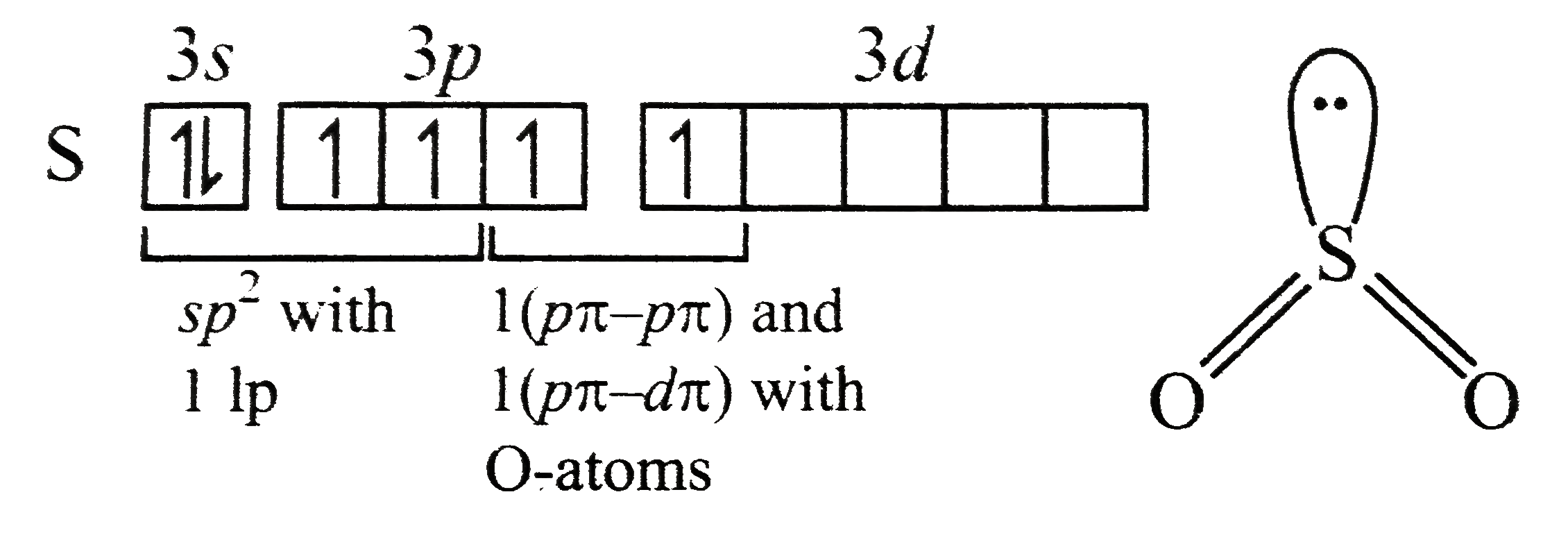 Two of the three `sp^2` orbitals form two `sigma`-bonds with O-atoms and third contains the lone pairs of electrons. After this, there is ONE UNPAIRED electron in 3p and 3d orbitals, which form one `ppi-ppi` and one `ppi-dpi` bond with O- atoms. Thus `SO_2` has a BENT structure. Due to RESONANCE, the two `S=O` have equal bond length. |
|
| 7. |
Comment on the nature of two S-0 bonds formed in SO_(2) molecule. Are the two S-O bonds in this molecule equal ? |
Answer» SOLUTION :`SO_(2)`has two resonating structures. Hence, both S-O bonds are equivalent and have equal STRENGTH : 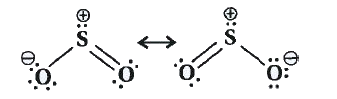
|
|
| 8. |
Comment on the inter-conversion of dichromate and chromate |
|
Answer» Solution :DICHROMATE `Cr_(2)O_(7)^(2-)` is aqueous solutions is orange red chromate `Cr_(2)O_(4)^(2-)` is aqueous solutions is yellow. When an alkali is added to dichromate, it is converted to chromate. ACIDIFICATION of chromate solution GIVES back dichromate. Both dichromate and chromate exist in equilibrium and are inter-converted by CHANGING the PH value of the solution. The inter-conversion of dichromate and chromate is a non-redox reaction. |
|
| 9. |
Comment on the conversion of methyl chloride into acetaldehyde |
| Answer» SOLUTION :Stephen.s REACTION | |
| 10. |
What is the effect of catalyst on activation energy ? |
|
Answer» SOLUTION :(a) In the presence of a catalyst, the ACTIVATION energy is lowered. (B) Rate of the forward REACTION is increased. |
|
| 11. |
Comment on the enthalpy of mixing and volume of mixing in case of dilute solutions. |
| Answer» SOLUTION :`Delta_(MIX) H = 0 " and " Delta_(mix) V = 0` | |
| 12. |
Comment on thecatenation capacity of sulphur. |
|
Answer» Solution :Catenation ability of sulphur is HIGHEST among chalcogens. Sulphur is next to carbon in the tendency to CATENATE. Catenation ability of sulphur is OBSERVED in polysulphids and polythionic acids. Among `M-M` BONDS of chalcogens, `S-S` bond is stronger and hence HIGHER catenation ability. |
|
| 13. |
Comment on each of the following observations: (a) When an aqueous solution of potassium cyanide is added to aluminium sulphate Al(OH)_(2) is precipitated. (b) The carbide MgaCs liberated propyne (CH_(3)C=CH) on treatment with water. (c) Magnesium silicate reacts with ammonium bromide in liquid ammonia to form silane,(d)is hydrolysed by aqueous alkali at the same rate as the corresponding Si-D compound. |
|
Answer»
`OH^(-)` formed causes precipitation of `Al_(2)(SO_(4))_(3)` as `Al(OH)_(3)` `AI^(3+)+3OH^(-)to Al(OH)_(3)downarrow` (b) `Mg_(2)C_(3)to2Mg^(2+)+C_(3)^(4-)` `C_(3)^(4)`onis decomposed by. `H_(2)O`giving `CH_(3)C=CH` `C^(3-)-C=C+4H_(2)OtoCH_(2)-C=CH+4OH` `Mg^(2+)+4OHto2Mg(OH)_(2)` Net:`Mg_(2)C_(3)+4H_(2)Oto2Mg(OH)_(2)+CH_(3)-C=CH` (c) Solutions of `NH_(4)Br` (in general ammonium halide) in `NH_(3)` may be used as acids and `SiH_(4)` (Silane) is formed when `NH_(4)Br` in `NH_(3)` reacts with `Mg_(2)Si` (magnesium silicide) `Mg_(2)Si+ 4NH_(4)Brto SiH_(4)+2MgBr_(2)+4NH_(3)` (d) Si-Hor Si-D bond is not broken in rate determining step, it is probable that there is attack of OH on Si. |
|
| 14. |
Comment on artificial rain. |
| Answer» Solution :It is POSSIBLE to cause ARTIFICIAL RAIN by throwing electrified sand or spraying a soution carrying charge OPPOSITE to the ONE on clouds from an aeroplane. | |
| 15. |
Comlete the following table. |
|
Answer» |
|
| 16. |
Comlete the following chemical reactionRCH_2OH underset(2.H_(3)O^(+))overset(1."Alkine "KMnO_(4))to |
| Answer» SOLUTION : R-COOH. | |
| 17. |
Combustion of methane |
|
Answer» is an EXOTHERMIC process |
|
| 18. |
Combustion of glucose takes place according to the equation, C_(6)H_(12)O_(6)+6O_(2)rarr6CO_(2)+6H_(2)O, DeltaH=-72 kcal.How much energy will be required for the production of 1.6 g of glucose (Molecular mass of glucose = 180 g) |
|
Answer» 0.064 KCAL |
|
| 19. |
Combustion of carbon is exothermic, but coal stored in coal depots does not bum automatically because of: |
|
Answer» HIGH threshold energy barrier |
|
| 20. |
Combination of proteins with nucleic acids gives |
|
Answer» ENZYMES |
|
| 21. |
Combination between Pt(IV), NH_3 and Cl^(-) results in the formation of seven complexes. One of these complexes is [Pt(NH_3)_6]Cl_4 (i) Writethe formulae and IUPAC names of the other six complexes . (ii)Which will have highest molar conductivity ? (iii) Which of these is non-ionic ? (iv)What is thethe C.N of Pt in these complexes ? |
|
Answer» Solution :(i) The structures and IUPAC names of other SIX complexes are : (a) `[Pt(NH_3)_(5)CL]Cl_3` : pentaammine chloridoplatinum (IV) chloride . (b) `[Pt(NH_3)_(4)Cl_2]Cl_2` : tetraamminechloridoplatinum (IV) chloride . (c) `[Pt(NH_3)_(5)Cl_3]Cl` : triamminetrichloridoplatinum (IV) chloride (d) `[Pt(NH_3)CL_4]` : diamminetetrachloridoplatinum (IV) (e) `[Pt(NH_3)Cl_5]^(-)` : amminepentachloridoplatinate(IV) (f) `[PtCl_6]^(2-)` : hexachloridoplatinare (IV) (ii) The complex `[Pt(NH_3)_6]Cl_4` has the maximum MOLAR conductivity asit forms maximum ion (five) in SOLUTIION. (iii) The compound (d) is non-ionic. (iv) The C.N of Pt in all the complexes is 6. |
|
| 22. |
Combination in which Ph_(3)C-OH will be formed |
| Answer» Answer :A | |
| 23. |
Columns 1,2 and 3 contain starting materials, reaction conditions, and type of reactions, respectively. Column 1 (I) Toluene (II) Acetophenone (III) Benzaldehyde (IV) Phenol Column 2 (i) NaOH//Br_(2) (ii) Br_(2)//hv (iii) (CH_(3)CO)_(2)O //CHCOOK (iv) NaOH//CO_(2) Column 3 (P) Condensation (Q) Carboxylation (R) Substitution (S) Haloform For the synthesis of benzoic acid, the only CORRECT combination is |
| Answer» Answer :A | |
| 24. |
Coluor of LiCl due to metal excess defect is pink. |
|
Answer» If both STATEMENT- I and Statement- II are true, and Statement - II is the correctexplanation of Statement– I. |
|
| 25. |
Columns 1,2 and 3 contain starting materials, reaction conditions, and type of reactions, respectively. Column 1 (I) Toluene (II) Acetophenone (III) Benzaldehyde (IV) Phenol Column 2 (i) NaOH//Br_(2) (ii) Br_(2)//hv (iii) (CH_(3)CO)_(2)O //CHCOOK (iv) NaOH//CO_(2) Column 3 (P) Condensation (Q) Carboxylation (R) Substitution (S) Haloform The only CORRECT combination that gives two different carboxylic acids is |
|
Answer» <P>(IV) (iii) (Q) |
|
| 26. |
Columns 1,2 and 3 contain starting materials, reaction conditions, and type of reactions, respectively. Column 1 (I) Toluene (II) Acetophenone (III) Benzaldehyde (IV) Phenol Column 2 (i) NaOH//Br_(2) (ii) Br_(2)//hv (iii) (CH_(3)CO)_(2)O //CHCOOK (iv) NaOH//CO_(2) Column 3 (P) Condensation (Q) Carboxylation (R) Substitution (S) Haloform The only CORRECT combination in which the reaction proceeds through radical mechanism is |
| Answer» Answer :D | |
| 27. |
{:("ColumnI","Column II"),((i) "Ohm's law", (a)E_("cell") = E_("cell")^@ - (0.0591)/(A) "log" ([C]^1[D]^m)/([A]^x[B]^y)),((ii) "Kohlraush's law",(b) m = ZIT),((iii)"Nernst equation",(c ) V = IR),((iv)"Faradays first law",(d) (Lambda_m^@)_(A_xB_Y) = x(Lambda_m^@)_(A^(y^+)) + y(Lambda_m^@)_(B^(x-))):} Using the code given below, match the column I and Column II. |
|
Answer» `{:(A,B,C,D),(c,d,a,b):}` |
|
| 28. |
Column(I) contains some reagents which when taken in excess produce precipitate with radical given in column (II).Accordingly match the column (I) with column (II). {:(underset(("Reagent"))(Column-I),underset(("Radical"))(Column-II)),((A)KCN(aq),(p)Pb^(2+)),((B)NaOH(aq),(q)Ag^(+)),((C )Kl(aq),(r)Hg_2^(2+)),((D)K_2CrO_4(aq),(s)Cu^(2+)):} |
|
Answer» `Hg+Hg(CN)_2darr` black, not soluble in excess reagent, `Cu(CN)_2darr` (yellow) `OVERSET("Excess")toK_3[Cu(CN)_4]` (soluble complex) (B)`Pb(OH)_2darr` white `overset("Excess")(Na_2)[Pb(OH)_4]`(soluble complex ) `Ag_2Odarr` brown, `Hg_2Odarr` black, `Cu(OH)_2darr` blue (C )`Pbl_2darr`yellow `overset("Excess")to [Pbl_4]^(2-)` soluble complex only with CONCENTRATED solution of KI(4M). `AgIdarr`yellow `overset("excess")to` No reaction `Hg_2l_2darr"Green"overset("Excess")to[Hgl_4]^(-)+Hgdarr`black `ubrace(Cu l darrwhite+I_3^(-))to`white ppt in brown COLOURED solution (D)`PbCrO_4darr`yellow `Ag_2CrO_4darr`(brick red/brownish red) `Hg_2CrO_4darr` red (with hot soluton of `K_2CrO_4`) In COLD, brown precipitate is obtained |
|
| 29. |
{:(,"Column-I(Reaction)",,"Column-II(Method of determining order of reaction)"),("(a)",2N_(2)O_(5)(g)rarr2N_(2)O_(4)(g)+O_(2)(g),,"(p)Tiration by" Na_(2)S_(2)O_(3)),("(b)",S_(2)O_(8)^(2-)+2I^(-)rarr2SO_(4)^(2-)+I_(2),,"(q) Titration by" KMnO_(4)),("(c)",2H_(2)O_(2)rarr2H_(2)O+O_(2),,"(r)Titration by NaOH"),("(d)",C_(12)H_(22)O_(11)+H_(2)OrarrC_(6)H_(12)O_(6)+C_(6)H_(12)O_(6),,"(s)Measuring pressure of the mixture in insert medium"),("(e)",CH_(3)CHO(g)rarrCH_(4)(g)+CO(g),,"(t)Measuring angle of rotation"),("(f)",CH_(3)COOC_(2)H_(5)+H_(2)Ooverset(H^(+))rarrCH_(3)COOH+C_(2)H_(5)OH,,(u) "Measuring pressure of the gas in" "CCl"_(4) "medium use the fact that" N_(2)O_(4) dissolves in "CCl"_(4) "medium"):} |
|
Answer» |
|
| 30. |
{:(,"Column I(Substance)",,"Column II(Eq. wt)"),((A),KMnO_(4)"in acidic solution",(p),"Mol."wt//6),((B),KMnO_(4)"in alkaline solution",(q),"Mol." wt//5),((C ),KMnO_(4)"in neutral solution",(r ),"Mol."wt//3),((D),K_(2)Cr_(2)O_(7)" in acidic medium ",(s ),"Mol. "wt//1):} |
| Answer» SOLUTION :(a) `A-s,B-r,C-q,D-p`(b)`A-q,B-s,C-r,D-p` (c )`A-r, B-s,C-p,D-q`(d ) `A-p, B-s,C-q,D-r` | |
| 31. |
{:(,"Column-I(Reaction)",,"Column-II(Product)"),((A),"Chloroform reac with" HNO_(3) "acid to form an insecticide",(p),"gammaxene"),((B),"Silver acetate gets converted i nto methyl bromide on reaction with" Br_(2) "In" C Cl_(4),(r),"Diphenyl trichloro ethane"),((C),"Chrobenzene in the presence of conc" H_(2)SO_(4) " reacts with trichloro acetaldehyde",(r),"Chloropicrin"),((D),"Benzene react with "Cl_(2) "in presence of sun light.",(s),"Compund containing Oxygen"),(,,(t),"Borodience Hunsdiecker reaction"):} |
|
Answer» <P> |
|
| 32. |
{:(,"Column-I(Order)",,"Column-II(Unit of rate constant)"),("(a)","Zero",,(p)L^(2)mol^(-2)s^(-1)),("(b)","First",,(q)L mol^(-1) s^(-1)),("(c)","Second",,(r) mol L^(-1)s^(-1)),("(d)","Third",,(s)s^(-1)):} |
|
Answer» |
|
| 33. |
{:(,"Column-I(Order)",,"Column-II(Property)"),("(a)","Zero",,"(p)Half life" prop1/a^(2)),("(b)","First",,"(q)Half life" prop1/a),("(c)","Second",,"(r)Half life is doubled on doubling the initial concentration"),("(d)","Third",,(s)underset("If concentration is halved or doubled")"50% reaction takes same time even"):} |
|
Answer» |
|
| 34. |
{:("COLUMN-I(Molecule)","COLUMN-II(Bond Angle)"),("A)" BF_(3),"p)" 88^(@)),("B)" NF_(3),"q)" 96^(@)),("C)" PF_(3),"r)" 103^(@)),("D)" ClF_(3),"s)" 120^(@)):} |
|
Answer» `{:("a)"BF_(3) rarr 120^(@) (sp^(2) hy),"b)" NH_(3) rarr 103^(@) (sp^(3)) "LP-BP repulsion",),("C)" PF_(3) rarr 96^(@)(sp^(3))"same as","d)" CIF_(3) rarr 88^(@)(sp^(3)d) "same as",):}` |
|
| 35. |
{:(,"Column I(Ion)",,"Column II ( Magnetic moment)"),((A),Cu^(2+),(p),2.9BM),((B),Fe^(2+),(q),4.0 BM),((C ),Ni^(2+),(r ),1.8 BM),((D),Co^(2+),(s),5.0 BM):} |
| Answer» SOLUTION :(a) `A-r,B-s,C-p,D-q` (b) `A-p,B-q,C-r,D-s`(c )`A-s,B-q,C-p,D-r` (d) `A-q,B-r,C-s,D-p` | |
| 36. |
{:("COLUMN-I(Compound)","COLUMN-II(Use)"),("A) Teflon","p) In making photosensitive paper, films & plates."),("B)" C_(2)H_(4)Br_(2),"q) In the manufacture of tear gas "),("C) Chlorine","r) insulating material"),("D) Iodine","s) anti-knock compound"):} |
|
Answer» B) `C_(2) H_(4) Br_(2) rarr` anti knock compound C ) CHLORINE `rarr` in the manufacture of tear gas D) IODINE `rarr` in making photo sensitive PAPER, films and plates |
|
| 37. |
{:("Column-I","Column-II"),("Species","Characteristics"),((A)Co^(3+)(Z=27),(p)"Total number of fully filled orbitals is nine"),((B)Sc^(3+)(Z=21),(q)"The value of magnetic moment (spin only) is greater than or equal to 3.87 BM"),((C )Cr^(3+)(Z=24),(r)"Number of electrons with (n+l=3) is eight"),((D)Ni^(2+)(Z=28),(s) "Number of electrons with (m=0) may be either 11 or 12 "),(,(t)"No unpaired electron"):} |
|
Answer» so no of FULLY filled ORBITALS is 10. no of unpaired electrons =4 So, magnetic moment is greater than 3.87 no of electrons with n+l=3 i.e. 3s, 2p are eight. (B)`Sc^(3+):1s^2 2s^2 2p^6 3s^2 3p^6 ` no of fully filled orbitals is 9. no of unpaired electrons =zero no of electrons with n+l=3 i.e. 3s, 2p are eight. no of electrons with m=0 are ten. (C )`Cr^(3+):1s^2 2s^2 2p^6 3s^2 3p^6 3d^3` no of fully filled orbitals is 9. no of unpaired electrons =3 no of electrons in 3s & 2p are eight no of electrons with m=0 may be 11 (D)`NI^(2+):1s^2 2s^2 2p^6 3s^2 3p^6 3d^8` so no of fully filled orbitals is 12. no of unpaired electrons =2 no of electrons in 3s & 2p is eight no of electrons with m=0 may be 11 or 12 |
|
| 38. |
{:("Column-I","Column-II"),("Quantities","Factors on which dependency exist"),((A)"Molar conductance", (p)"Temperature"),((B)"emf of a cell in operation",(q)"Concentration of species involved"),((C )"Electrode potential ",(r)"Nature of substance involved "),((D)"Standard reduction potential ",(s)"No . of electrons lost or gained in the reaction "),(,(t)"is on additive property"):} |
|
Answer» `lambda_M` DEPEND upon T,M, nature of substance and have additive property. (B)& ( C) `E_(cell)=E_(cell)^@-(2.0303 RT)/(nF)` log Q `E_(cell)` depend upon T,Q,n & nature of substance. (D) `E_("RED")^(@)` depend upon nature of substance. |
|
| 39. |
{:(,"column I",,,"column II"),(,P.,"Zero order reaction",1.,t_(1//2)alpha(1)/([A]_(0))),(,Q.,"First order reaction",2.,t_(100%)=[A]_(0)//k),(,R.,"second order reactions",3.,"Involves at least two reactants"),(,S.,"Pseudo unimolecular reaction",4.,[A]=[A]_(0)e^(-kt)):} |
|
Answer» <P>`{:(,P,Q,R,S),(,2,1,4,2):}` |
|
| 40. |
{:("COLUMN-I","COLUMN-II"),("(Oxy-acid of S)","(Oxidation state of'S'')"),((A)H_(2)SO_(3),(p)+2),((B)H_(2)S_(2)O_(6),(q)+3),((C )H_(2)S_(2)O_(3),(r )+4),((D)H_(2)S_(2)O_(4),(s) +5):} |
|
Answer» `(C) H_(2)SO_(4)to HO-underset(O)underset(||)overset(O)overset(||)S-OH, O.S.=+6 (D) H_(2)S_(2)O_(4) to HO-overset(O)overset(||)S-overset(O)overset(||)S-OH, O.S.=+3` |
|
| 41. |
{:(,"Column I",,"Column II"),(,"(Metal ion configuration in weak ligand field)",,("CFSE, "Delta_(0)" value")),(("A"),d^(4),(p),0.0),(("B"),d^(5),(q),-0.4),(("C"),d^(6),(r),-0.6),(("D"),d^(7),(s),-0.8):} |
|
Answer» A-r, B-s, C-p, D-q |
|
| 42. |
{:("COLUMN-I","COLUMN-II"),(("Examples of Solution"),"(Types of solution)"),((A)"Acetone+Aniline",(p)-ve"deviation from ideal behaviour"),((B)"Water"+CH_(3)OH,(q)-ve"deviation from ideal behaviour" ),((C)"Benzene +toluence",(r)"Ideal solution"),((D)"n-Hexane+n-heptane",(s)"Colloids"):} |
|
Answer» |
|
| 43. |
{:("COLUMN-I","COLUMN-II"),("(Elements)","(Covalency)"),((A)'O' " atom in "O_(3),(p)1),((B)'S' " atom in hyposulphorous acid",(q)2),((C )'N'" atom in "NO^(+)and N_(2)O_(4),(r )3),((D)'N' " atom in "N_(3)H,(s) 4):} |
Answer»  , Middle = 3, Oxygen (a) = 2, Oxygen (b) = 1 , Middle = 3, Oxygen (a) = 2, Oxygen (b) = 1 B) `H_(2)S_(2)O_(4)=` Hyposulphurous ACID C)  D) `H-overset(* *)N=overset(o+)N=overset(* *o+)(N: )` D) `H-overset(* *)N=overset(o+)N=overset(* *o+)(N: )`
|
|
| 44. |
{:(Column-I,Column-II),("Colligative properties","Aqueous solution Assume" m =M),((a)DeltaT_(f) =0.3 xx K_(f),(p)0.1m -Ca(NO_(3))_(2)),((b)DeltaT_(b) =0.28 xx K_(b),(q)0.14 m -NaBr),((c)pi =0.19 xx RT,(r)0.1m-MgCI_(2)(alpha=0.1)),((d)(P^(0)-P)/(P^(0))=(((DeltaT_(f))/(K_(f))))/(((1000)/(18))+((DeltaT_(f))/(K_(f)))),(s)0.28m-Urea),(,(t)0.1m-HA("monobasic acid"K_(a)=0.81)):} |
|
Answer» `Ca(NO_(3))_(2)` `i = 3` For `0.1 m rArr 1m = 0.2` |
|
| 45. |
{:("Column-I","Column-II"),("electrolyte","I(van't off factor)"),((A)"Urea, Glucose, Fructose", (p)"1:0.8:1"),((B)NaCl"," MgCl_2","K_2SO_4,(q)"1:2:3"),((C )Al_2(SO_4)_3 Na_3PO_4"," K_4[Fe(CN)_6],(r)"1:1:1"),((D)"Glucose,"NaCl","CaCl_2,(s)"2:3:3"):} |
|
Answer» <P> `i=1+(n-1)PROP` `(A)tor` I is same for glucose , UREA , fructose i=1 `(B)tos " " NaCl " " i=2 " " k_2SO_4 " " i=3` `MgCl_2 " " i=3` `( C) to p " " Al_2(SO_4)_3 " " i=5` `Na_3PO_4 "" i=4` `k_4[Fe(CN)_6] " " i=5` `(D)toq " " "glucose" i=1 " " NaCl " " i=2` `CaCl_2 " " i=3` |
|
| 46. |
{:("COLUMN-I","COLUMN-II"),("(Compound)","(Use)"),((A)SO_(2),(p)"Antichlor"),((B)"Hypo",(q)"reducing agent"),((C )"Ozone",(r )"Purification of water"),((D)H_(2)SO_(4),(s) "Dehydrating agent"):} |
|
Answer» B) `Na_(2)S_(2)O_(3)+H_(2)O+Cl_(2) to Na_(2)SO_(4)+underset("(antichlor)")(2HCl+S)` C) `H_(2)O_(2)+O_(3) to 2H_(2)O+O_(2)` - Reducing agent. D) `H_(2)C_(2)O_(4) overset("CONC."H_(2)SO_(4))to CO_(2)+CO+H_(2)O`, `C_(12)H_(22)O_(11) overset("Conc."H_(2)SO_(4))to 12C+11H_(2)O` - DEHYDRATING agent |
|
| 47. |
{:(,"Column-I",,"Column-II"),("(a)","Zero",,(p)k=1/(2t)[1/(a-x)^(2)-1/a^(2)]),("(b)","First",,(q)k=1/t[1/(a-x)-1/a]),("(c)","Second",,(r)k=x/t),("(d)","Third",,(s)k=1/tloge(a/((a-x)))):} |
|
Answer» |
|
| 48. |
{:("Column I","Column II"),((A)"Yellow ppt of "PbCrO_4,(p)"Blue or green colour to flame"),((B)"Sodium nitroprusside",(q)"Brown ring test"),(( C)"Nitrate ion",(r)"Chromyl chloride test"),((D)Cu"salt and "BO_3^(-3) "ion",(s)"Voilet colour with"Na_2S):} |
|
Answer» (B)`to` violet COLOUR with `Na_2S` (C )`to` brown ring test (D)`to` blue or green colour to flame |
|
| 49. |
{:("Column I","Column II"),((A)XeF_4(s)+H_2O(l)to,(p)"Show disproportionation reaction"),((B)P_4(s)+OH^(-)(aq)+H_2Oto,(q)"One of the products is a monobasic Lewis acid." ),(( C)B_2H_6(g)+H_2O(l)to,(r)"One of the products is a gas"),((D)Br_2(g)+K_2CO_3(aq)to,(s)"One of the products has a trigonal pyramidal molecular structure "),(,(t)"One of the gaseous products is used is used in Holme's singnals in sea ".):} |
Answer» 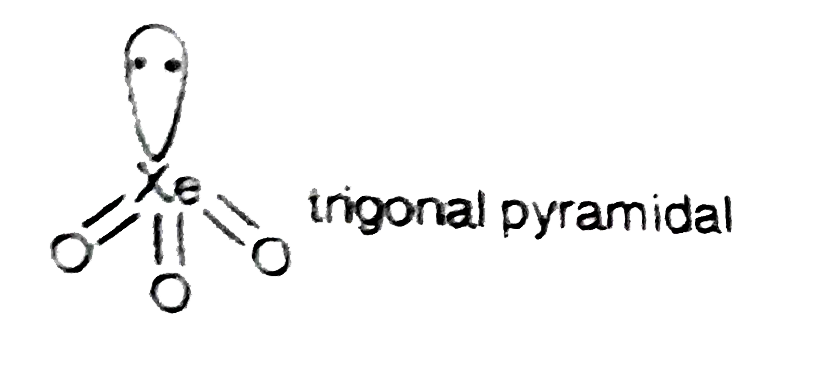 (B)`overset(0)(P_4)+3OH^(-)(aq)+3H_2O(aq)+3H_2O(l)tooverset(-3)(PH_3)(g)+overset(+1)(3H_2PO_2^(-))(aq)` 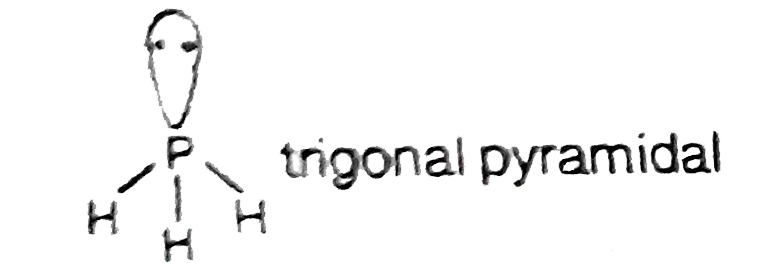 The spontaneous combustion of phosphine evolved dense white fumes which SURVE as singals. (C )`B_2H_6(g)+6H_2O(l)to2H_3BO_3(aq)+6H_2(g)` `B(OH)_3+2H_2OhArr [B(OH)_4]^(-)+H_3O^(-)`(MONOBASIC Lewis acid ) 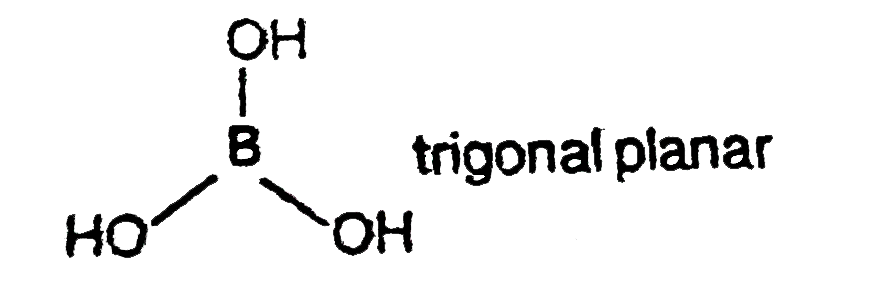 (D)`overset0(3Br_2)(g)+3Na_2CO_3(aq)tooverset(-1)(5NaBr)(aq)+overset(+5)(NaBrO_3)(aq)+3CO_2(g)` 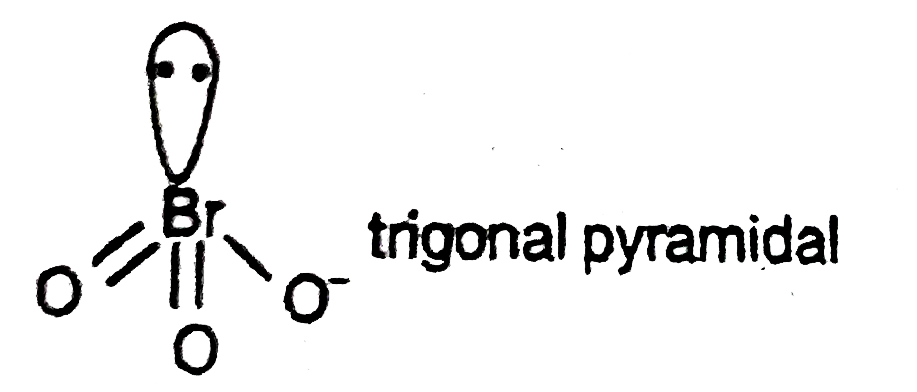
|
|
| 50. |
{:(,"Column-I",,"Column-II"),("(a)",underset("much time faster a reaction proceed at" 25^(@)Cthan at 0^(@)C)"If the activation energy is 65 kJ then how",,"(p) 2"),("(b)",underset(0.0693 min^(-1) "if we start with" 20molL^(-1) "it is reduced to" 2.5 mol L^(-1)"in how many minutes")"Rate constant of a first order reaction is",,"(q) 0"),("(c)",underset("reactions are same ratio of rates at the start of reaction is how many times of 0.693")"Half lives of first order and zero order",,"(r) 11"),("(d)",underset([A](M) 0.0677 0.136 0.272 t_(1//2)(sec) 240 480 960 "order of the reation is")"The half life periods are given",,"(s)30"):} |
|
Answer» |
|