Saved Bookmarks
This section includes 7 InterviewSolutions, each offering curated multiple-choice questions to sharpen your Current Affairs knowledge and support exam preparation. Choose a topic below to get started.
| 1. |
CH_(3)C-=C CH_(3) underset((ii)H_(2)O //Zn)overset((i)X)to H_(3)C underset(O)overset(C)(||)-underset(O)overset(C)(||)CH_(3) In the above reaction X is |
|
Answer» `HNO_(3)` 
|
|
| 2. |
CH_3C-=C CH underset((ii)H_2O // Zn)overset((i)X)to CH_3-undersetunderset(O)(||)C-undersetunderset(O)(||)C-CH_3 X in the above reaction is |
|
Answer» `HNO_3` |
|
| 3. |
CH_3Br overset(KCN)(to) (A) overset(H_3O^+)(to) (B) overset(PCl_5)(to) (C ) product (C ) is |
|
Answer» acetylchloride |
|
| 4. |
CH_(3)Br+Nu^(-) to CH_(3)-Nu+Br^(-). The decreasing order of the rate of the above reaction with nucleophiles (Nu^(-)) A to D is [Nu^(-)=(A)PhO^(-), (B)AcO^(-), (C)HO^(-), (D)CH_(3)O^(-)] |
|
Answer» `AgtBgtCgtD` `CH_(3)COOHgtC_(6)H_(5)OHgtH_(2)OgtCH_(3)OH` The BASIC character will follows the order `CH_(3)COO^(-)ltC_(6)H_(5)O^(-)ltOH^(-)ltCH_(3)O^(-)` The stronger the acid, the WEAKER the conjugate base formed. |
|
| 5. |
CH_(3)Br+Nu^(-)rarrCH_(3)Nu+Br^(-) The decreasing order of the rate of the above reaction with nucleophiles (Nu^(-)) I to IV is : [Nu^(-)=(I)PhO^(-),(II)AcO^(-),(III)HO^(-),(IV)CH_(3)O^(-)] |
|
Answer» `IVgtIIIgtIIgtI` `CH_(3)O^(-)gtOH^(-)gtPhO^(-)gtAcO^(-)` |
|
| 6. |
(CH_(3))_(4)N^(+) is neither an electrophile, nor nucleophilic because it |
|
Answer» Does not have electron pair for donation as well as can not attract electron pair |
|
| 7. |
(CH_3)_3SiOH is more acidic than (CH_3)_3COH, even though carbon is more electronegative than silicon-explain. |
| Answer» SOLUTION :Because of d-orbital resonance, the conjugate BASE of `(CH_3)_3Si OH` is RELATIVELY more STABLE, | |
| 8. |
(CH_3)_3CONa on reaction with CH_3Br will give : |
|
Answer» `(CH_3)_3COC(CH_3)_3` |
|
| 9. |
(CH_(3))_(3)CMgCl on reaction with D_(2)O produces : |
|
Answer» `(CH_(3))_(3)CD` |
|
| 10. |
(CH_3)_3CCloverset(NaCl)rarrAoverset(dil.H_2SO_4)rarrBCompound B is |
|
Answer» `(CH)_3COOOH` `CH_3-OVERSET(CH_3)overset(|)underset(CH_3)underset(|)C-Cl-overset(CN^(-))underset((-HCl))rarrCH_3-overset(CH_2)overset(||)underset(A)underset(CH_3)underset(|)Coverset(dil.H_2SO_4)underset(hydration)rarrCH_3-overset(CH_3)overset(|)underset(B)underset(CH_3)underset(|)C-OH` |
|
| 11. |
(CH_(3))_(3)CMgBr on reaction with D_(2)O produces |
|
Answer» `(CH_(3))_(3)CD`<BR>`(CH_(3))_(3)COD` |
|
| 12. |
(CH_3)_3CMgCl on reaction with D_2O gives : |
|
Answer» `(CH_3)_3CD` |
|
| 13. |
(CH_3)_3"CCl" (I) & (CD_2)_3C Cl(II)Both undergo reaction by SN^1 mechanism. Which statements belowis correct |
|
Answer» Both have same REACTIVITY |
|
| 14. |
(CH_(3))_(3)C-overset(O)overset("||")C-CH_(2)-overset(O)overset("||")C-O-C_(2)H_(5)overset(C_(2)H_(5)oversetΘO(1"Mole"))underset(PhCH_(2)Br)rarroverset(H^(oplus)"//"H_(2)O)underset(Delta)rarr" Final product": |
|
Answer» `(CH_(3))_(3)C-overset(O)overset("||")C-CH_(2)-overset(O)overset("||")C-OH` |
|
| 15. |
(CH_(3))_(3)C-OH on treatment with NaCl in aqueous medium gives |
|
Answer» No REACTION |
|
| 16. |
(CH_(3))_(3)C-MgClon reaction with D_(2)Oproduces: |
|
Answer» `(CH_(3))_(3)CD` |
|
| 17. |
(CH_(3))_(3)C-CHO does not undergo aldol condensation. Comment. |
| Answer» SOLUTION :This is DUE to the ABSENCE of `ALPHA-` hydrogen in the COMPOUND. | |
| 18. |
(CH_(3))_(3)C C(CH_(3))_(3) overset(Na,"ether")rarr R'-X overset(Mg)rarr D overset(H_(2)O)rarr E. What is E? |
|
Answer» |
|
| 19. |
(CH_(3))_(3)C-Br on treatement with mosit silver oxide give |
|
Answer» `(CH_(3))_(3)C-OH` |
|
| 20. |
(CH_(3))_(3) SiCl is used during polymerizationof organosilicons because |
|
Answer» The chain length of organosilicon polymers can be controlled by adding`(CH_(3))_(3)SiCl` |
|
| 23. |
(CH_(3))_(3)-C-CH(OH)CH_(3) overset("Conc." H_(2_)SO_(4)) to X (major product) |
|
Answer» `(CH_(3))_(3)"C C"H = CH_(2)` |
|
| 24. |
(CH_3)_3- C- CH(OH) CH_3 overset(Conc. H_2SO_4)to X (major product) |
|
Answer» `(CH_3)_3 C CH = CH_2` 
|
|
| 25. |
(CH_(3))_(2)underset(NH_(2))underset(|)C.CH_(2).CO.CH_(3) |
|
Answer» Diacetone 
|
|
| 26. |
(CH_(3))_(2)CHOH overset("Mild")underset("oxidation[O]")rarr (X) overset((i)CH_(3)Mgl)underset((ii)"Hydrolysis")rarr (Y) In the above sequence of reaction, (Y) is: |
|
Answer» ISOBUTYL alcohol |
|
| 27. |
(CH_(3))_(2)CHNH_(2) is reactedwithexcess aceticanhydride , thecompoundfomred is |
|
Answer» `(CH_(3))_(2)CHNCOCH_(3)` |
|
| 28. |
(CH_(3))_(2)CHNH_(2) is |
|
Answer» `1^(0)` AMINES |
|
| 29. |
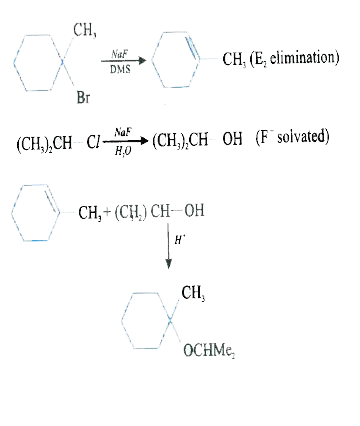
(CH_3)_2CHCloverset(NaF)underset(H_2O)rarr(Y) X+Yoverset(H^+)rarr(Z) Compound (X) and (Z) are respectively |
|
Answer»
|
|
| 30. |
(CH_3)_2CH-oversetoverset(OH)|CH-CH_3 overset(Al_2O_3)to X Give the IUPAC name of major product formed in the reaction |
|
Answer» 3-methyl 2-butene |
|
| 31. |
(CH_(3))_(2)CH-Ioverset(Na//A"ether")toA The compound A is |
|
Answer» `(CH_(3))_(2)CHCH_(2)CH_(2)CH_(3)` |
|
| 32. |
(CH_(3))_(2)C=CHCOCH_(3) can be oxidised to (CH_(3))_(2) C=CHCOOH by |
|
Answer» chromic acid |
|
| 33. |
(CH_(3))_(2)C=CHCOCH_(3) can be oxidised to (CH_(3))_(2)C=CHCOOH by |
|
Answer» Chromic acid |
|
| 34. |
(CH_(3))_(2)C=CHCOCH_(3) can be oxidised to (CH_(3))_(2)C=CHCOOH by: |
|
Answer» Chromic ACID |
|
| 35. |
(CH_3)_2C=CHCOCH_3 and be oxidised to (CH_3)_2=CHCOOH by: |
| Answer» Answer :D | |
| 36. |
(CH_(3))_(2)C=C(CH_(3))_(2) underset("KOH(heat)")overset("X")rarr (CH_(3))_(2)C=O+O=C(CH_(3))_(2) in the above reaction 'X' is |
|
Answer» `HNO_(3)` |
|
| 37. |
(CH_3)_2C-underset(CH_3)underset|CH underset(H_2)overset"Catalyst"toOptical isomers |
|
Answer» 2 |
|
| 38. |
(CH_(3))_(2)C-NH_(2) and (CH_(3))_(3) N are pair of opticalisomers2 identical 3) chain isomers(4) function isomers (5) notidential . |
|
Answer» 1,4 |
|
| 39. |
(CH)_(3))_(2)C- MgBr reaction with H_(2)O produced |
|
Answer» `(CH_(3))_(2) CH` |
|
| 40. |
(CH_3)_2-undersetunderset(OH)|C-CH_2-C(CH_3)_3 underset"dichromate"overset"acidic " tothe main product is |
|
Answer» `CH_3-oversetoverset(CH_3)|C=CH-undersetunderset(CH_3)|oversetoverset(CH_3)|C-CH_3` |
|
| 41. |
(CH_3)_2 CHOH overset("mild oxidation")(to) X underset(H_2O)overset((i)CH_3MgBr)(to) YHere Y is |
|
Answer» ISO BUTYL ALCOHOL |
|
| 42. |
(CH_3)_2-CH-NO when boiled with HCl"/"H_2O gives compound 'X'. Identify 'X'. |
|
Answer» `CH_3COOH` |
|
| 43. |
(CH_(3))_(2)C = CHCOCH_(3) can be oxidised to (CH_(3))_(2) C = CH - COONaby |
|
Answer» `NaOH + KOH` |
|
| 44. |
CH_(3)-Xnu^(-) to CH_(3)-Nu+X^(-) The decreasing order of the rate of above reaction with X is 1 Cl "" 2 F "" 3 Br ""4 I |
|
Answer» `1 GT 2 gt 3 gt 4` |
|
| 45. |
CH_3-undersetunderset(O)(||)C-undersetunderset(O)(||)C-CH_3underset(("excess"))overset(PhMgBr)to overset(H_2O)to"No of product" ( X) overset("Fractional distillation")tono offractions (Y) X and Y are respectively |
|
Answer» 3,2 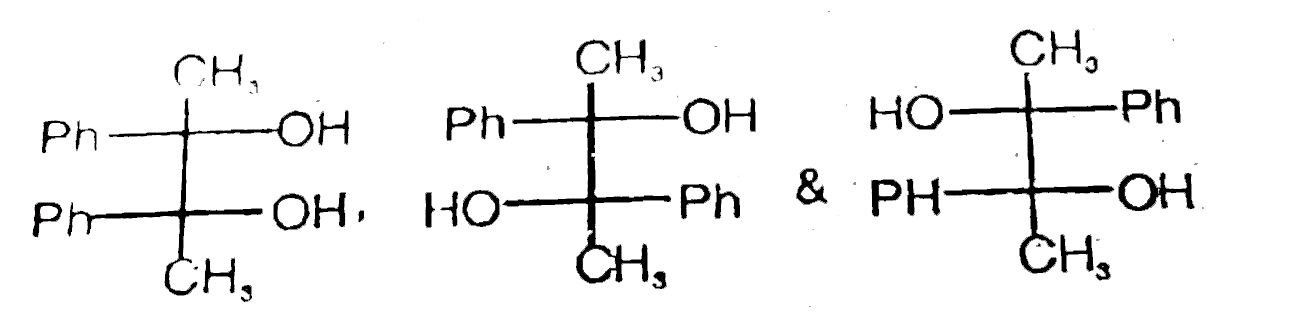
|
|
| 46. |
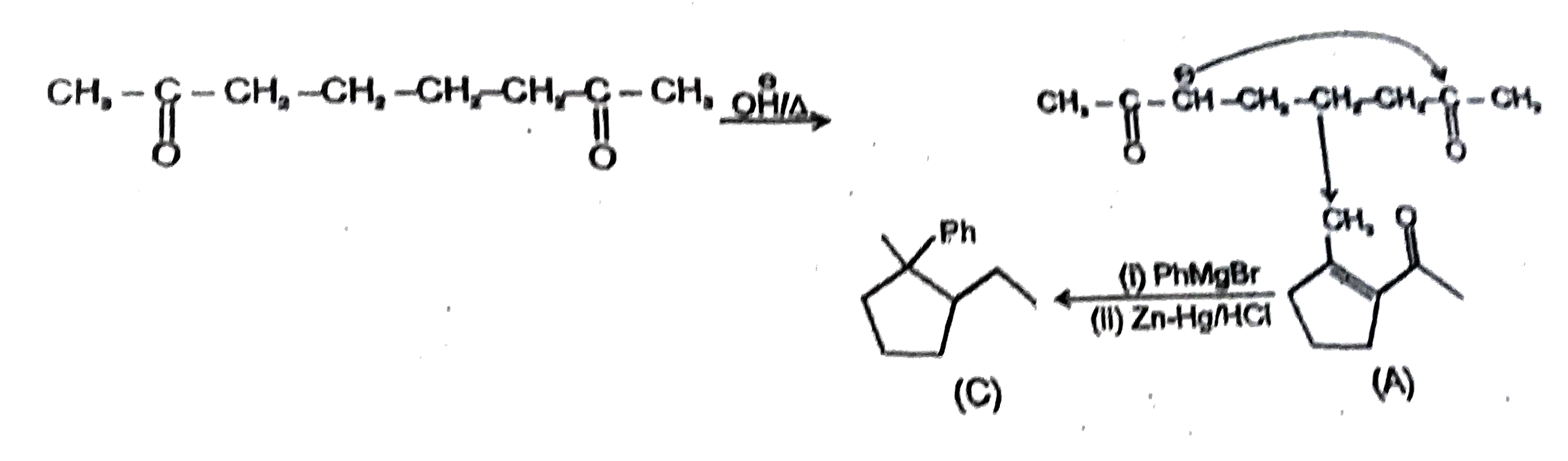
CH_3-undersetunderset(O)(||)C-(CH_2)_4-undersetunderset(O)(||)C-CH_3 " " underset(H^+)overset(Ooverset(Theta)H//Delta)toAoverset(Ph-MgBr)toBunderset(Conc.HCl)overset(Zn-Hg)toC The product 'C' is: |
|
Answer»
|
|
| 47. |
CH_3 - undersetoverset(||)(O)(C ) - CH_3 overset(conc. HNO_3)(to) A + B . In this reaction A and B are …. |
|
Answer» `CH_3COOH + HCOOH` |
|
| 48. |
CH_(3)-underset(O)underset(||)(C)-CH_(3)underset(Na_(2)CO_(3))overset(I_(2))rarr(A)overset("Ag powder")rarr(B)underset(Hg^(++))overset(H_(2)SO_(4))rarr(C) Product A,B & C are - |
|
Answer» Iodoform, Acetylene & Acetaldehyde |
|
| 49. |
CH_(3)- underset(OH)underset(|)CH- CH_(3) underset(Na_2Cr_2O_7//H_2SO_4)overset([O])to X, What is X? |
|
Answer» Propanone |
|
| 50. |
CH_(3)-underset(OCH_(3))underset(|)(CH)-overset(O)overset(||)(C)-underset(CH_(3))underset(|)(CH)-OCH_(2)-CH_(3) The IUPAC name of this compound is |
|
Answer» 2-ethoxy-4-methoxy-pentan-3-one |
|