Saved Bookmarks
This section includes 7 InterviewSolutions, each offering curated multiple-choice questions to sharpen your Current Affairs knowledge and support exam preparation. Choose a topic below to get started.
| 1. |
An ideal gas is expanded from (p_(1)V_(1)T_(1)) to (p_(2)V_(2)T_(2)) under different conditions. The correct statement (s) among the following is (are) |
|
Answer» <P>The work done by the gas is less when it is expanded reversibly from `V_(1)` to `V_(2)` under adiabatic conditions as compared to that when expanded reversibly from `V_(1)` to `V_(2)` under isothermal conditions. |
|
| 2. |
An ideal gas is expanded from (p_(1),V_(1),T_(1))" to "(p_(2),V_(2),T_(2)) under different conditions. The correct statement (s) among the following is (are) |
|
Answer» The WORK done by the gas is less when it is expanded reversibly from `V_(1)" to "V_(2)` under adiabatic conditions as compared to that when expanded reversibly from `V_(1)" to "V_(2)` under isothermal conditions |
|
| 3. |
An ideal gas is allowed to expand both reversibly and irreversibly in an isolated system. If T_(i) is the initial temperature and T_(f) is the final temperature, which of the following statements is correct - |
|
Answer» `T_(F)gtT_(i)` for reversible process but `T_(f)=T_(i)` for irreversible process |
|
| 4. |
An ideal gas is expanded from (P_(1), V_(1), T_(1)) to (P_(2), V_(2), T_(2)) under different conditions. The correct statement(s) among the following is (are) |
|
Answer» The work done by the gas is less when it is expanded reversibly from `V_(1)` to `V_(2)` under adiabatic conditions as compared to that when expanded reversibly from `V_(1)` to `V_(2)` under isothermal conditions 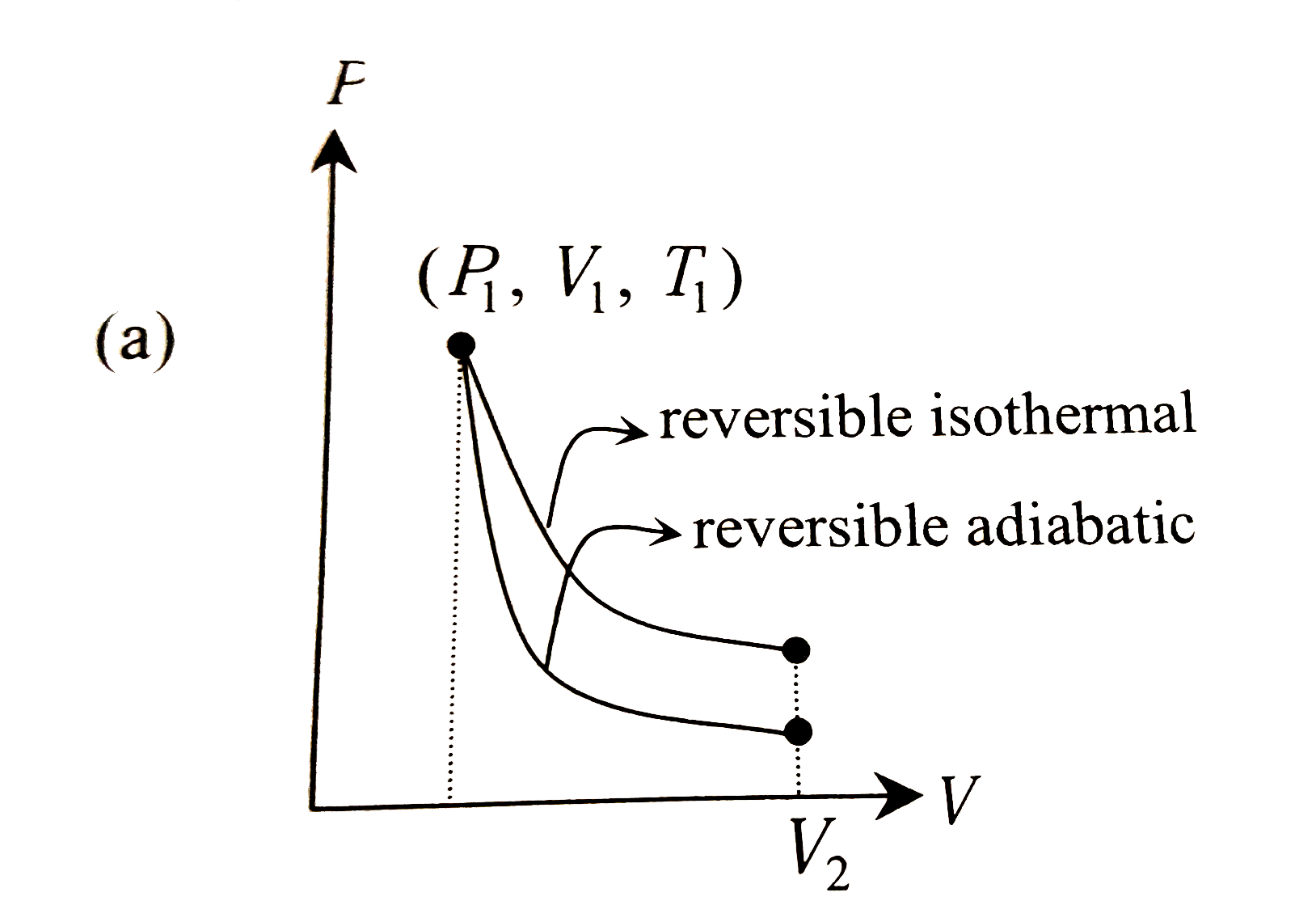 AREA under curve in reversible isothermal is more. So, more work will be done by gas. (b)`T_(1)=T_(2)impliesDeltaU=nC_(v)DeltaT=0` In reversible adiabatic expansion, `T_(2)ltT_(1)` `THEREFORE DeltaT=-ve therefore DeltaU=-ve` (c ) In free expansion,`P_(EXT)=0 therefore W=0` If carried out isothermally `(DeltaU=0)implies q=0` (Adiabatic), From 1 law If carried out adiabatically `(q=0)implies DeltaU=0` (Isothermal), From 1 law (d)  During irreversible compression, maximum work is done on the gas (corresponding to shaded area) |
|
| 5. |
An ideal gas is expanded form (P_(1) V_(1) T_(1)) to (p_(2),V_(2) T_(2) used different conditions. The correct statement (s) among the following is (are) |
|
Answer» The WORK done by the gas is less when it is expanded revesibly from `V_(1),(to) V_(2)` under abiabitc conditions as COMPARED to that when expanded reversibly form `v_(1) (to)V_(2)`under isothemal conditions. |
|
| 6. |
An ideal gas from same initial state participates in two different thermodynamic processes (AC -Reversible, AB-Irreversible) as shown in figure. If the entropy of surroundings remain constant in these processes, then which of the following are correct ? |
|
Answer» `(DeltaS_(GAS))_(AB) gt (DeltaS_(gas))_(AC)` |
|
| 7. |
An ideal gas expands in volume from 1xx10^(-3)m^(3) " to "1xx10^(-2)m^(3)at 300 K against a constant pressure of 1xx10^(5)Nm^(-2).The work done is |
|
Answer» 270 kJ `=-1xx10^(5)xx9xx10^(-3)=-900 J` |
|
| 8. |
An ideal gas expands against a constant external pressure of 2 atmosphere from 20 litre to 40 litre and absorbs 10 kJ of heat from surrounding .What is the change in internal energy of the system? |
|
Answer» 4053J |
|
| 9. |
An idealgas (C_(P)//C_(V)=gamma)is expandedso that the amountof heattransferredto thegas theis equalto the decreasein itsinternalenergy .Whatis therelationshipbetweentemperatureand volumeof gasin thisprocess? |
|
Answer» `T. V^(2(gamma-1))= "constant"` `- dU = dU + pdV` `- 2n C_(V)DT=(nRT)/(V) d V` `int(dT)/(T)= (R)/(2C_(V))int(dV)/(V)+ "constant"` `therefore T V ^(gamma-1)="constant"` |
|
| 10. |
An ideal gas behaving 2moles ( fixed) is subjected to the changes as shown is ( P-V) diagram.Select the correct option ( s) from the following diagram. |
|
Answer» TEMPERATURE "A" `((16)/(R ))`, Pressure at "C" ( 60 R ) |
|
| 11. |
An ideal gas at constant temperature and pressure expands, then its |
|
Answer» <P>Internal ENERGY remains same |
|
| 12. |
An ideal equimolar binary liquid solution of A and B has a vapour pressure of 900 mm of Hg. It is distilled at a constant temperature till (2)/(3) (i.e 66.67 % ) of the original amount. If themole fraction of A is 0.3 in residue and that of B in condensate 0.4 and also the vapour pressure of residue is 860 mm Hg which of the following is correct ? |
|
Answer» Mole fraction of A is more than that of B in vapour phase, above residue as well as above condensate. `P_(A)^(@) = 1000 mm Hg` and `P_(B)^(0) = 800 mm Hg` As 'A' is more volatile, hence (A) and (D) are incorrect. In CASE of 'C' `P_(A) = 0.3 xx 1000 = 300 mm Hg`, |
|
| 13. |
An hypothetical compound does not react with sodium metal. Which type of compound behave like this? |
|
Answer» Alcohol |
|
| 14. |
An ideal drug should not have the following quality |
|
Answer» Be toxic |
|
| 15. |
An He atom at 25^@Cis released from the surface of the earth to travel upwards.Assuming that it undergoes no collisions with other molecules, how high will it travel before coming to rest? |
| Answer» SOLUTION :USE `3/2 KT = MGH` | |
| 16. |
An 'f' block element without any f electron is |
|
Answer» Ce |
|
| 17. |
An halokane is made totreat with excess of alcholic ammonia to give mainly |
|
Answer» `1^(@)` amine |
|
| 18. |
An extremely hot copper wire reacts with steam to give : |
|
Answer» CUO |
|
| 19. |
An explosion takes place when conc. H_(2)SO_(4) is added to KMnO_(4) due to formation of |
|
Answer» `Mn_(2)O_(7)` (a) `(MnO_(3))_(2)SO_(4)overset("heat")rarr Mn_(2)O_(7),` (b) and (c) are not formed |
|
| 20. |
An explosion takes place when conc. H_2SO_4 is added to KMnO_4 Which of the following is formed |
|
Answer» `Mn_2O_7` |
|
| 21. |
An explosive compound (A) reacts with water to produce NH_(4)OH and HOCl. Then, the compound (A), is : |
|
Answer» `TNG` |
|
| 22. |
An explosion take place when conc. H_(2)SO_(4) is added to KMnO_(4). Which of the following is formed? |
|
Answer» `Mn_(2)O_(7)` |
|
| 23. |
An explosion takes palce when conc.H_2SO_4 is added toKMnO_4. Which of the following is formed : |
|
Answer» `Mn_2O_7` |
|
| 24. |
An experiment is done as shown in diagram then final pressure after stop cock is opened. [Assume reaction : NH_(3) (g) + HCl (g) rarr NH_(4)Cl (s) ] |
|
Answer» <P>3 atm `N = (PV)/(RT) = (1 XX 22.4)/(0.0821 xx 273 xx 2) = (1)/(2)` MOLE `HCl (g)` `n = (PV)/(RT) = (1 xx 44.8)/(0.0821 xx 54.6) = 1` mole `{:(NH_(3) (g),+,HCl (g),rarr,NH_(4)Cl(s),),((1)/(2),,1,,0,),(0,,(1)/(2),,(1)/(2),):}` `n_(HCl) = (1)/(2)` mole `P = (0.5 xx 0.0821 xx 546)/(67.2)` `P = (1)/(3)` atn |
|
| 25. |
An experiment requires minimum beta-activity produced at the rate of 346 beta-particles per minute. The t_((1)/(2)) " of" ""_(42)^(99)No, which is a beta-emitter, is 66.6 hours. Find the minimum amount of ""_(42)^(99)Mo required to carry out the experiment in 6.909 hours. |
|
Answer» Solution :`beta` activity `= -(d(N))/(dt)= 346 xx 60 beta`-particles/h `therefore -(d(N))/(dt)= lamda (N)= (0.6932)/(t_((1)/(2))) xx N` or `346 xx 60= (0.6932)/(66.6) N` or `N= 2 xx 10^(6)` Again, `lamda= (2.303)/(t) "LOG" (N^(0))/(N)` `therefore (0.6932 )/(66.6) = (2.303)/(6.909) "log" (N^(0))/(N)= (1)/(3) "log" (N^(0))/(N)` SUBSTITUTING the VALUE of N in the above equation, log `(N^(0))/(N)= (3 xx 0.6932)/(66.6)= 0.0312` or `(N^(0))/(N)= 1.074` or `N^(0)= 1.074 xx N = 1.074 xx 2 xx 10^(6)= 2.148 xx 10^(6)` `therefore` no. of moles of `Mo= (2.148 xx 10^(6))/(6.022 xx 10^(23))= 3.567 xx 10^(-18)` and wt. of `Mo= (3.567 xx 10^(-18) xx 99)g` (Mo= 99) `=3.53 xx 10^(-16)g` |
|
| 26. |
An exothermic reaction is one which |
|
Answer» Takes PLACE only on heating |
|
| 27. |
An exothermic reaction is one in which the reacting substances |
|
Answer» Have more ENERGY than the products For endothermic reactions `H_(p) GT H_(R)`. |
|
| 28. |
An exothermic reaction has a large positive entropy change. The reaction will be - |
|
Answer» POSSIBLE `to` SPONTANEOUS at all TEMPERATURES |
|
| 29. |
An exothermic reaction A to B has an activation energy of X kJ mol^(-1) of A. If the energy change in the reaction is Y kJ, then the activation energy of the backward reaction will be |
|
Answer» `-X` `= X + Y`. |
|
| 30. |
An exothermic reaction A rarr Bhas an activation energy of 17 kJ per mole of A . The heat of reaction is 40 kJ . The activation energy for the reverse reaction B rarr Ais |
|
Answer» SOLUTION :(C ) For exothermic REACTION `E_(a)` (BACKWARD ) `= E_(a) ` (forward) + Heat of reaction ( magnitude only ) =17+40=57 kJ |
|
| 31. |
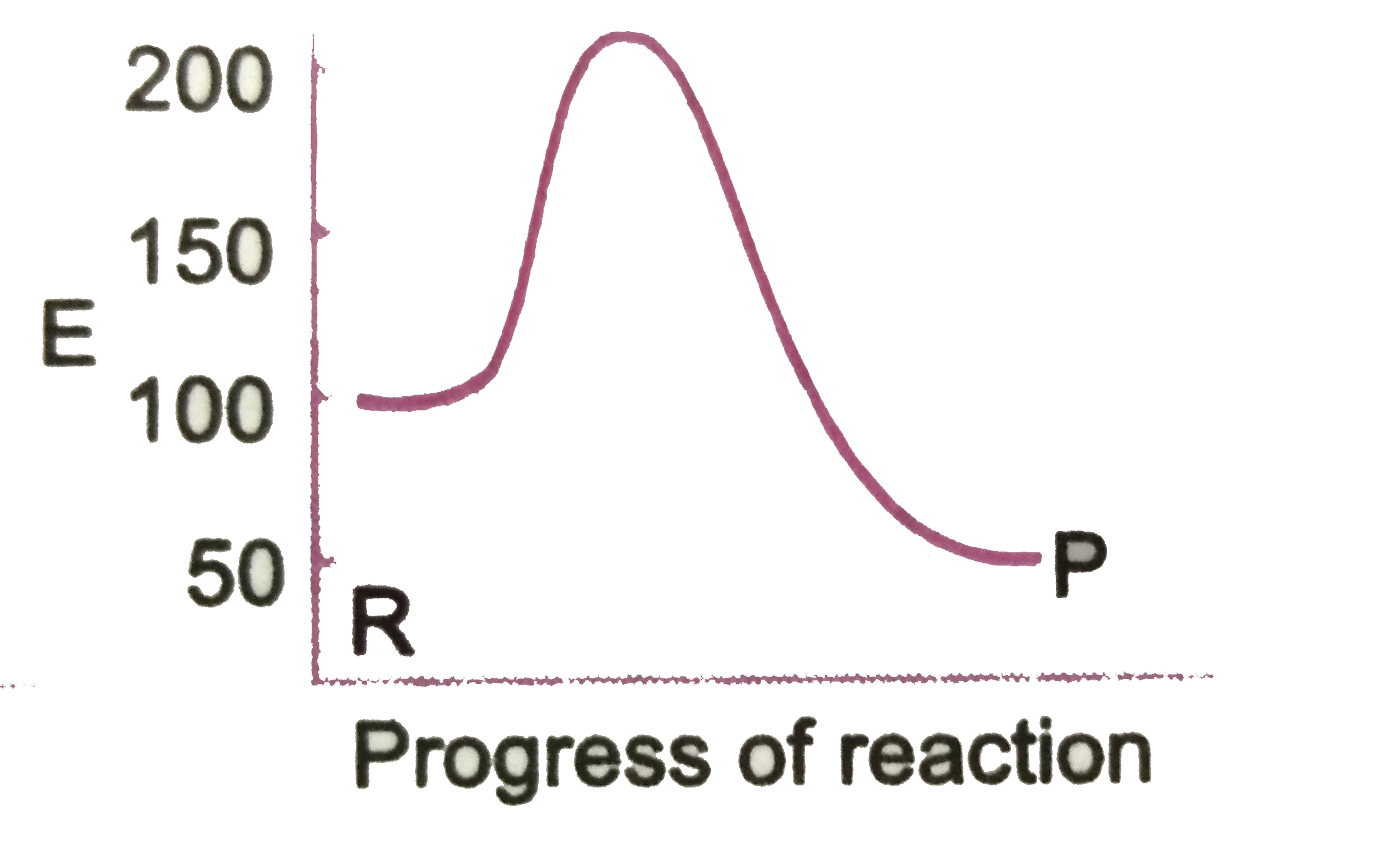
An exothermic chemical reaction proceeds by two stages. reactants overset("stage 1")to" intermediate "overset("stage 2")to" products" The activation energy of stage 1 is 50" kJ mol"^(-1). The overall enthalpy change of the reaction is -100" kJ mol"^(-1). Which diagram could represent the energy level diagram for the reaction ? |
|
Answer»
|
|
| 32. |
An excess of silver nitrate is added to 100ml of a 0.01M solution of penta aquachloridochromium (III) chloride . The number of moles of AgCl precipitated would be ………….. . |
|
Answer» `0.02` |
|
| 33. |
An excess of silver nitrate is added to 100 ml of a 0.01 M solution of pentaaquachloridochromium (III) chloride. The number of moles of AgC1 precipitated would be |
|
Answer» 0.02 |
|
| 34. |
An excess of Na_(2)S_(2)O_(3) react with aqueous CuSO_(4) to give |
|
Answer» `CuS_2O_3` |
|
| 35. |
An excess of Hg was added to 10^(-3) M acidified solution of Fe^(3+) ions. It was found that only 4.6 % of the ions remained as Fe^(3+) at equilibrium at 25^(@)C. Calculate E^(@) for 2Hg//Hg_(2)^(2+) at 25^(@)C for 2Hg+2Fe^(3+) hArr Hg_(2)^(2+)+2Fe^(2+) |
|
Answer» |
|
| 36. |
An excess of AgNO_(3) is added to 100 mL of a 0.01 M solution of dichlorotetraaquachromium (iii) chloride. The number of moles of AgCl precipitated would be |
|
Answer» 0.002 MOLARITY`=(WT)/("mol. Mass")xx(1000)/(VOL.)` `(wt)/("mol mass")="molarity"xx(vol.)/(1000)=(0.01xx100)/(1000)` =0.001 |
|
| 37. |
An excess of AgNO_(3) is added to 100 mL of 0.01 M solution of dichlorotetraaquachromium (III) chloride. The number of moles of AgCl precipitated would be : |
|
Answer» 0.001 Thus, 1 mole of the complex produces 1 mole of `Cl^(-)` ions and hence will PRECIPITATE out 1 mole of AgCl. 100 ML of 0.01 M complex solution contains moles of the complex `= (0.01)/(1000)xx100=0.001` mole and will precipitate out 0.001 mole of AgCl. |
|
| 38. |
An excess of AgNO_3 is added to 100 mL of a 0.01 M solution of dichlorotetraaqua chromium (III) chloride. The number of moles of AgCl precipitated would be |
|
Answer» 0.002 |
|
| 39. |
An example of tetrabasic acid is: |
|
Answer» Orthophosphorus acid |
|
| 40. |
An example of trihydric alcohol is _________. |
|
Answer» TRIMETHYL carbinol |
|
| 41. |
An example of tetra atomic molecule is |
|
Answer» WHITE P |
|
| 42. |
An example of substance for metallic or insutating properties depending on temperature |
| Answer» Answer :C | |
| 45. |
An example of secondary cell is _______ |
|
Answer» DANIEL cell |
|
| 46. |
An example of salt that will not hydrolyse is |
|
Answer» `NH_4 CI` |
|
| 47. |
An example of reversible reaction is |
|
Answer» `PB(NO_3)_2(AQ)+2NAL(aq) hArr PbI_2(s) +2NaNO_3(aq)` |
|
| 48. |
An example of positively charged colloid is______. |
|
Answer» clay |
|
| 49. |
An example of solid solution is : |
|
Answer» Amalgem |
|