

Saved Bookmarks
| 1. |
An ideal gas is expanded from (P_(1), V_(1), T_(1)) to (P_(2), V_(2), T_(2)) under different conditions. The correct statement(s) among the following is (are) |
|
Answer» The work done by the gas is less when it is expanded reversibly from `V_(1)` to `V_(2)` under adiabatic conditions as compared to that when expanded reversibly from `V_(1)` to `V_(2)` under isothermal conditions 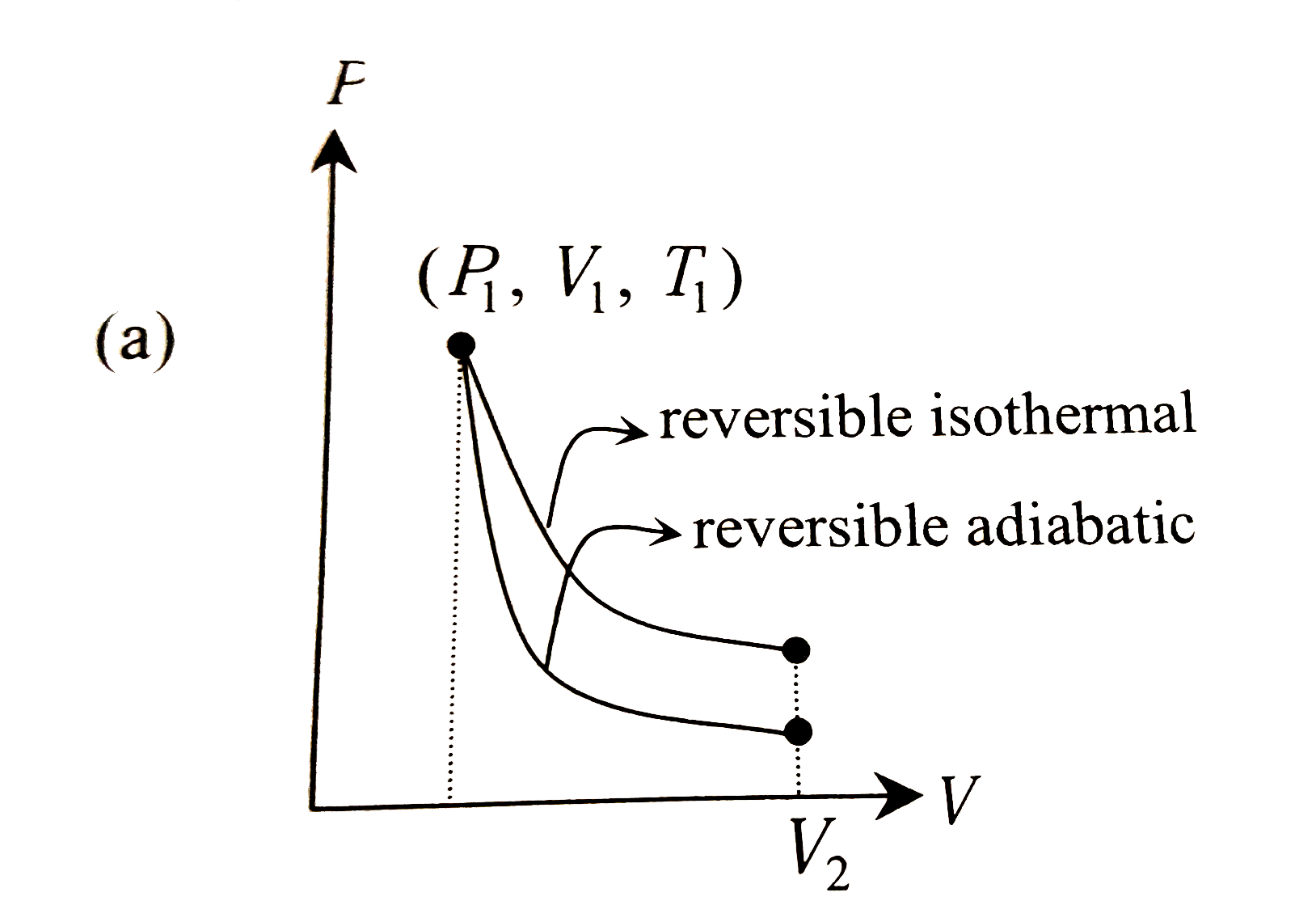 AREA under curve in reversible isothermal is more. So, more work will be done by gas. (b)`T_(1)=T_(2)impliesDeltaU=nC_(v)DeltaT=0` In reversible adiabatic expansion, `T_(2)ltT_(1)` `THEREFORE DeltaT=-ve therefore DeltaU=-ve` (c ) In free expansion,`P_(EXT)=0 therefore W=0` If carried out isothermally `(DeltaU=0)implies q=0` (Adiabatic), From 1 law If carried out adiabatically `(q=0)implies DeltaU=0` (Isothermal), From 1 law (d)  During irreversible compression, maximum work is done on the gas (corresponding to shaded area) |
|