Saved Bookmarks
This section includes 7 InterviewSolutions, each offering curated multiple-choice questions to sharpen your Current Affairs knowledge and support exam preparation. Choose a topic below to get started.
| 1. |
Among them intensive property is |
|
Answer» Mass |
|
| 2. |
Among the unit cells given below, which two are highly symmetric and unsymmetric respectively |
|
Answer» HEXAGONAL CUBIC |
|
| 3. |
Among the triatomic molecules/ions, BeCl_(2), N_(3)^(-), N_(2)O, NO_(2)^(+), O_(3), SCl_(2), ICl_(2)^(-), I_(3)^(-) and XeF_(2), the total number of linear molecule (s)/ions(s) where the hybridization of the central atom does not have contribution from the d-orbital (s) is |
|
Answer» Thus, there are only four molecules/ions (i-iv) where the hybridization of the central ATOM does not have contribution from d-orbitals. |
|
| 4. |
Among the triatomic molecules/ions BeCl_(2),N_(3)^(-),N_(2)O, NO_(2)^(+), O_(3), SCl_(2), lCl_(2)^(-),l_(3)^(-) and XeF_(2), the total number of linear molecules (s)/ion(s) where the hybridisation of the central atom does not have contribution from the d- orbitals (s) is [atomic number of S=16, Cl=17, I=53 and Xe=54] |
|
Answer» |
|
| 5. |
Among the transiton metals of the first series ( leaving zinc which is not considered as a transition metal ), the lowest meltaing point is shown by "…................" |
|
Answer» |
|
| 6. |
Amongthe transitionmetals of 3dseriesthe onethat has highestnegative ((M^(2+))/(M)) standardelectrodepotentialis |
|
Answer» TI |
|
| 7. |
Among the transition elements the element with lowest melting point belongs to |
|
Answer» GROUP IIIB |
|
| 8. |
Among the three possible isomers of dibromo benzenes, the highest melting point is possessed by |
|
Answer» o-dibromobenzene  HIGHEST more STABLE `m.p mu=0 ` HIGHEST more STABLE `m.p mu=0 `
|
|
| 9. |
Amongthe three isomericdichlorobenzenes, whichhas thehighest boilingpointandhighestmeltingpoint ? |
| Answer» Solution :Boiling point of o-dichlorobenzene is greater than the boiling point of m -and p-dichlorobenzenes DUE to its greater polar nature. Boiling point order is : `o - gt m - gt p -` dichlorobenzene. Melting points of p- dichlorobenzene is greater than that of o- and m-dichlorobenzenes. It is due to symmetry of para-isomer of dichlorobenzene that fits in crystal lattice BETTER as COMPARED to o- and m-isomers. Melting points DECREASE in the order : `p- gt o- gt m-` dichlorobenzene | |
| 10. |
Among the three isomeric alkanes (C_(5)H_(12)), identify the one that on chlorination yields (a) Four isomeric monochlorides, (b) Three isomeric monochlorides, (c ) A single monochloride |
|
Answer» Solution :(a) `CH_(3) - underset(underset(CH_(3))(|))(CH)-CH_(2)-CH_(3)` In methylbutane, there are FOUR DIFFERENT carbon atoms and hence four different hydrogen atoms. Thus, four isomeric products are possible. (b) `CH_(3)-CH_(2)-CH_(2)-CH_(2)-CH_(3)` In pentane, there are three different carbon atoms and hence three different hydrogen atoms. Then, three isomeric products are possible. (c ) `H_(3)C- underset(underset(CH_(3))(|))overset(overset(CH_(3))(|))(C )-CH_(3)` In dimethylpropane, all the hydrogen atoms are equivalent. Hence only ONE isomeric products is possible |
|
| 11. |
Among the three conformations of ethane, the order of stability follows the sequence |
|
Answer» Eclipsed `gt` gauche `gt` staggered |
|
| 12. |
Among the three iso meric alkanes (C_5H_12), identify the one that on chlorination yields a) Four isomeric monochlorides b) Three isomeric monochlorides c) A single monochloride |
|
Answer» Solution :a) `CH_3-underset(CH_3)underset(|)(C)H-CH_2-CH_3` In methylbutane, there are four DIFFERENT carbon atoms and hence four different hydrogen atoms. Thus, four ISOMERIC products are POSSIBLE. b) `CH_3-CH_2-CH_2-CH_2-CH_3` In PENTANE, there are three different carbon atoms and hence three different hydrogen atoms. Then, three isomeric products are possible. c) `H_3C-underset(CH_3)underset(|)overset(CH_3)overset(|)(C)-CH_3` In dimethylpropane, all the hydrogen atoms are equivalent. Hence only one isomeric product is possible. |
|
| 13. |
Among the sulphide oers of Ag,Hg,Pb,Fe Cu anZn how many of them can be extracted by self reduction process. |
|
Answer» |
|
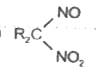
| 14. |
Among the structures given below which one represents nitrolic acid? |
|
Answer» `R_2-N-N=O` |
|
| 15. |
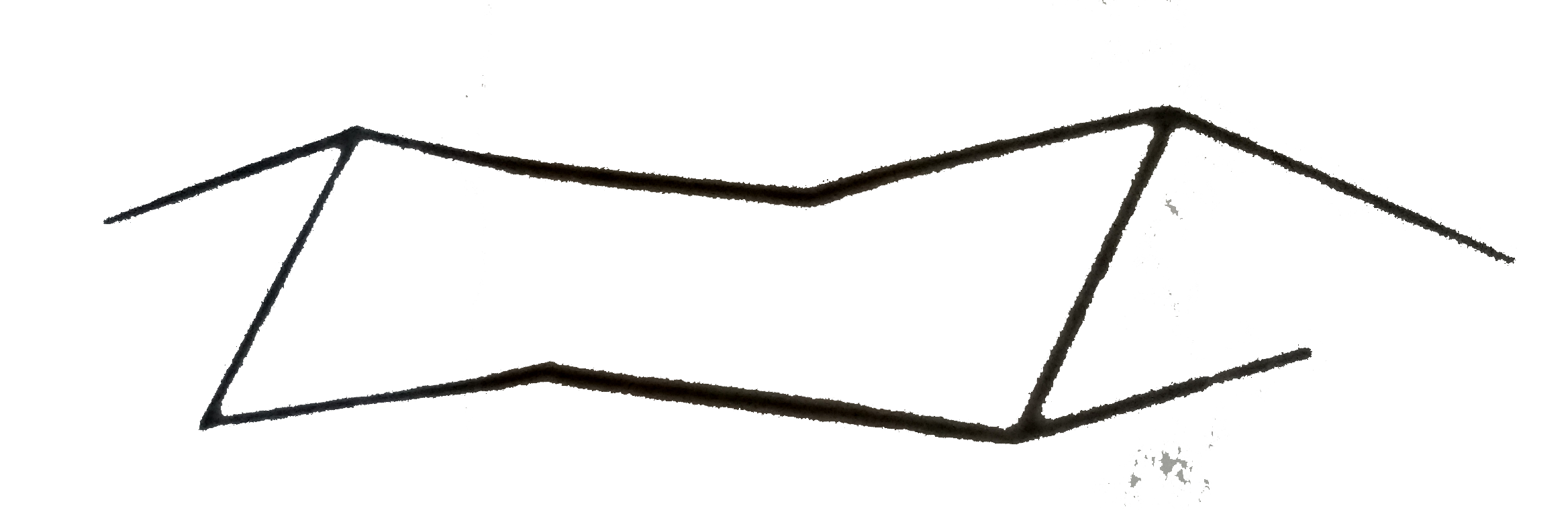
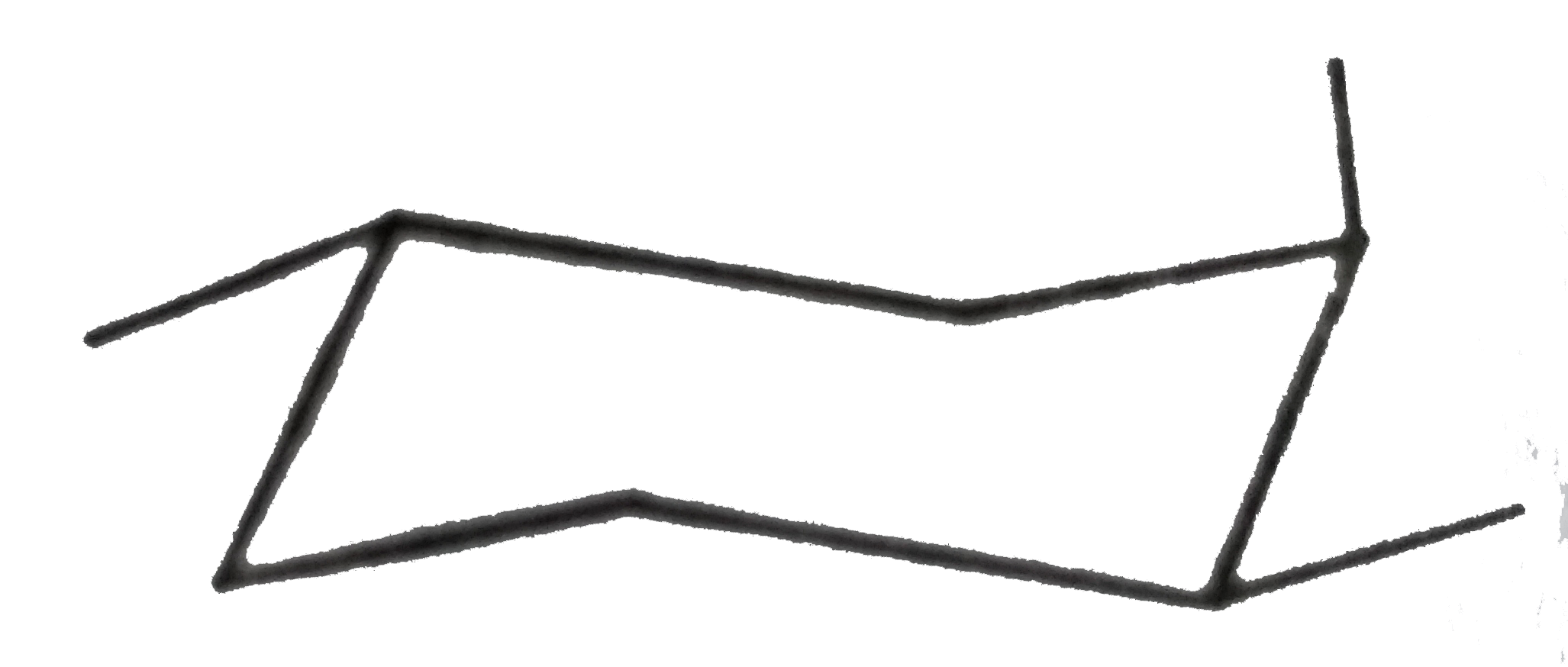
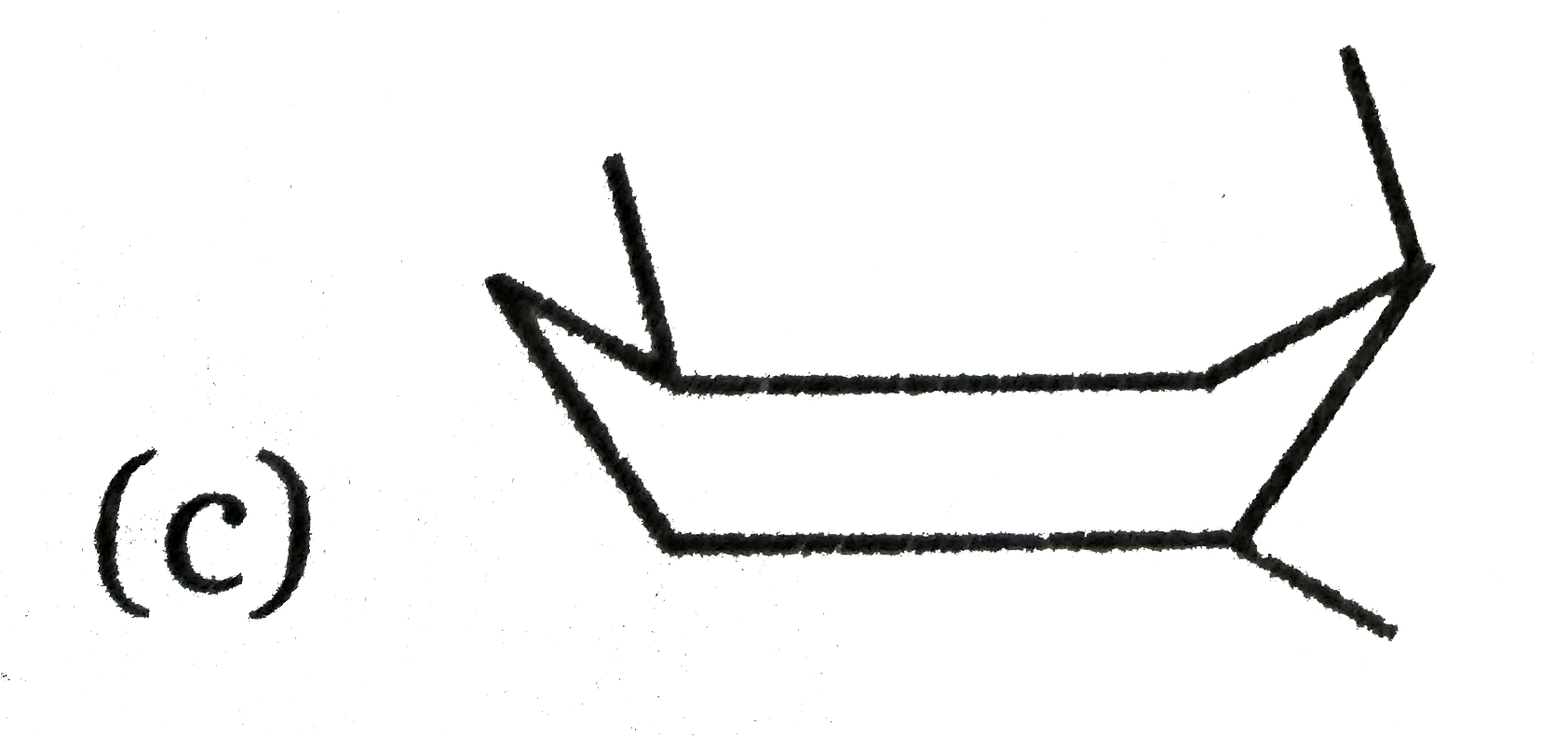
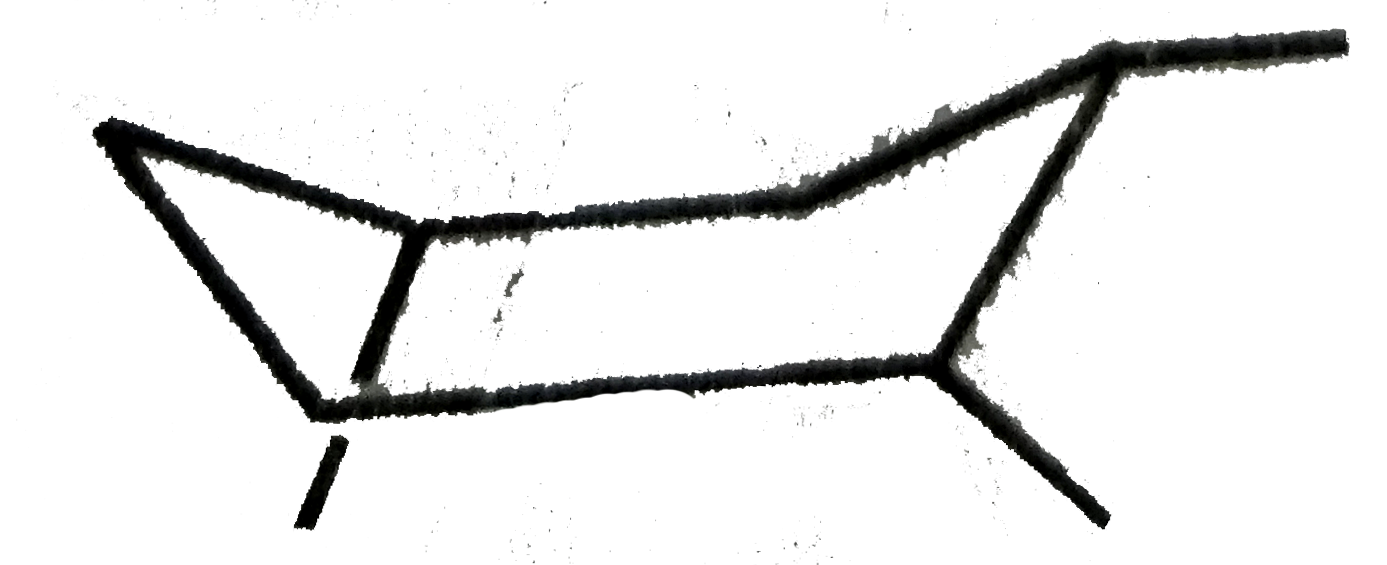
Among the structure shown below, which has lowest potential energy ? |
|
Answer»
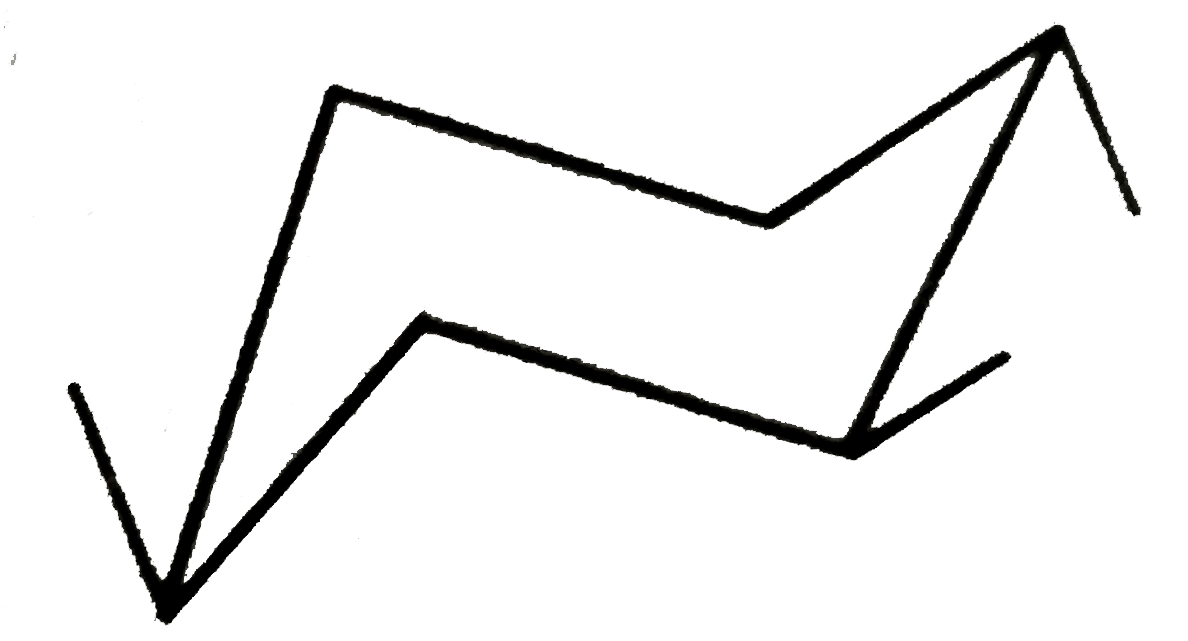 E,e,e, from is most STABLE. E,e,e, from is most STABLE.
|
|
| 16. |
Among the species given below, the total number of diamagnetic species is _________. H atom, NO_(2)monomer,O_(2)^(-) (superoxide), dimeric sulphur in vapour phase, Mn_(3)O_(4),(NH_(4))_(2)["FeCl"_(4)], (NH_(4))_(2)["NiCl"_(4)],K_(2)MnO_(4), K_(2)CrO_(4) |
Answer» 
|
|
| 17. |
Among the species: Ce^(4+), Eu^(2+), Tb^(4+), Yb^(2+), Sm^(2+), Tm^(2+), Pr^(4+), Nd^(4+), find the number of ions whichhave sufficient stability to be studied in aqueous chemistry. |
|
Answer» `Eu^(2+), Tb^(4+) rarr (f^(7))` `Yb^(2+) rarr (f^(14))` `sm^(2+) rarr (f^(6))` `Tm^(2+) rarr (f^(13)` `PR^(4+) rarr (f^(1))` `ND^(4+) rarr (f^(2))` |
|
| 18. |
Among the reactions (a) - (d) , the reactions (s) that does /do not occur in the blast furnace during the extraction of iron is / are (a) CaO+SiO_2rarrCaSiO_3 (b) 3Fe_2O_3+COrarr2Fe_3O_4+CO_2 (c) FeO+SiO_2rarrFeSiO_3 (d) FeOrarrFe+1/2O_2 |
| Answer» ANSWER :A | |
| 19. |
Among the reactions, F_(2_((g)))+2bareto2F^(-)(g) and Cl_(2_((g)))+2bareto2Cl^(-)(g), which is more feasible? Why? |
|
Answer» SOLUTION :`F_(2_((g)))+2bareto2F^(-)(g)` is more feasible. FORMATION of halide from halogen involves bond DISSOCIATION enthalpy and electron gain enthalpy. Elethalpy is more for cholrine and its bond dissociation energy is also more. HENCE, it is relatively DIFFICULT to form chloride. |
|
| 20. |
Among the paraffins it is generally found that with an increase in the molecular weight: |
|
Answer» The freezing POINT decreases |
|
| 21. |
Among the phosphatic fertilizers, superphosphate of lime is a mixture of Ca(H_2PO_4)_2 and: |
|
Answer» `CaSO_4. 2H_2O` |
|
| 22. |
Among the oxyacids of halogens, the one with high percentage of oxygen is............ |
| Answer» SOLUTION :`HClO_4` | |
| 23. |
Among the oxyacids of chlorine, the strongest oxidising agent |
|
Answer» `HClO_(4)` |
|
| 24. |
Among the oxo-acid of chlorine the correct order ofincreasing acid strength is |
|
Answer» `HClO_4 lt HClO ltHCIO_2 lt HClO_3 ` |
|
| 25. |
Among the oxides of nitrogen : N_(2)O_(3), N_(2)O " and "N_(2)O_(5) , the molecules having nitrogen-nitrogen bond is/are |
|
Answer» `N_(2)O_(3)" and "N_(2)O_(4)` 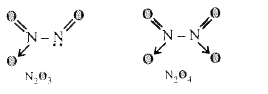
|
|
| 26. |
Among the oxides of nitrogen : N2O, N_2O_4 and N_2O_5, the molecules having nitrogen-nitrogen bonds are ............ |
|
Answer» `N_(2)O_(4)` and `N_(2)O_(5)` |
|
| 27. |
Among the oxides, Mn_(2)O_(7)(I), V_(2)O_(3) (II), V_(2)O_(5) (III),CrO(IV) and Cr_(2)O_(3)(V), the basic oxides are |
|
Answer» I and II |
|
| 28. |
Among the oxides Mn_(2)O_(7) (I), V_(2)O_(3) (II), V_(2)O_(5) , (III) CrO (IV) and Cr_(2)O_(3) (V) the basic oxides are |
|
Answer» I and II |
|
| 29. |
Among the nucleophiles (CH_3)_3CO^-, CH_3CH_2O^(-) " and " (CH_3)_2CHO^- the tendency to show SN^2 reaction is maximum for |
|
Answer» `CH_3O` |
|
| 30. |
Among the noble gases only xenon is well known to form chemical compounds. |
| Answer» Solution :AMONG the NOBLE gases, XENON has the largest size and SMALLEST ionization enthalpy. | |
| 31. |
Among the naturally occuring carbohydrates, furanose ring is found in the |
|
Answer» GLUCOSE UNIT of cane sugar |
|
| 32. |
Among the metals Ti,V,W,Zr th and Au the number of metals purified van arkel method are……. |
|
Answer» |
|
| 33. |
Among the metals Na,Mg ,Al,Zn,Cu,Sn ,Fe and Pb number of metals that can be ectreated by the eletroysis ,even from aqueos solution,is…………………. |
|
Answer» |
|
| 34. |
Among the metals, Fe, Zn, Pb, Ag and Pt which do not give a metal nitrate on treatment with concentrated HNO_(3) ? |
|
Answer» Fe and Zn |
|
| 35. |
Among the listed molecules : SO_(2), SF_(4), ClF_(3), BrF_(5) " and " XeF_(4) which of the following of the following shapes does not describe of any the molecules mentioned ? |
|
Answer» Bent `SO_(2)`- bent, `SF_(4)`-see-saw `ClF_(3)`- T-shape `BrF_(5)`-SQUARE pyramidal `XeF_(4)`-Squar PLANAR. |
|
| 36. |
Among the ligands NH_(3), en, CN^(-) and CO the correct order of their increasing field strength, is : |
|
Answer» `NH_(3) lt en lt CN^(-) lt CO` `NH_(3) lt en lt CN^(-) lt CO` |
|
| 37. |
Among the ligands : eta^(2)-C_(2)H_(4), eta^(5)-C_(5)H_(5)^(-), eta^(1)-C_(5)H_(5)^(-), eta^(3)-C_(5)H_(5)^(-), eta^(3)-C_(3)H_(5)^(-), eta^(1)-C_(4)H_(6), eta^(7)-C_(7)H_(7)^(+), eta^(4)-C_(4)H_(4), eta^(4)-C_(4)H_(4)^(2-), eta^(2)-C_(4)H_(4), eta^(6)-C_(6)H_(6) The number of species which are : 2e^(-) donors=x 4e^(-) donors=y 6e^(-) donors=z Find the value of 2x-y+z. |
|
Answer» y=4 z=4 |
|
| 38. |
Among the latest discovery in cytology is : |
|
Answer» RESPIRATION |
|
| 39. |
Among the lanthanoids, the one obtained buy synthetic method is |
|
Answer» Lu |
|
| 40. |
Among the isomers of pentane (C_(5)H_(12)), write the one which on photochemicalchlorination yields a single monochloride . |
|
Answer» SOLUTION :Neopentane `CH_(3) - UNDERSET(CH_(3))underset(|) overset(CH_(3))overset(|)C - CH_(3)` As all the hydrogen are equivalent, a singlemonochloridewill be obtained . |
|
| 41. |
Among the isomeric alkanes of molecularr formula C_(5)H_(12), identify the one that on photochemical chlorination yields. (i) A single monochloride (ii) Three isomeric monochlorides. (iii) four isomeric monochlorides. |
|
Answer» Solution :(i). `underset("NEOPENTANE")(CH_(3)-underset(CH_(3))underset(|)overset(CH_(3))overset(|)(C)-CH_(3))` -All the H atoms are equivalent. Therefore, REPLACEMENT of any one of them will give the same product. (ii). `underset("n-Pentane")(overset(a)(C)H_(3)overset(b)(C)H_(2)overset(c)(C)H_(2)overset(b)(C)H_(2)overset(a)(C)H_(3))` - There are THREE sets of equivalent hydrogens designated as a,b and c. The replacement of any one of the equivalent hydrogens of each set will give the same product. therrefore, three isomeric monochlorides are POSSIBLE. (III). `overset(a)(C)H_(3)-underset("a"CH_(3))underset(|)overset(b)(C)H-overset(c)(C)H_(2)-overset(d)(C)H_(3)`- three are four types of equivalent hydrogens designated as a, b, c and d. therefore, four isomeric monochlorides are possible. |
|
| 42. |
Among the isomeric alkanes of molecular formula C_(5)H_(12), identify the one that on photochemical chlorination yields.(i) A single monochloride(ii) Three isomeric monochlorides(iii) Four isomeric monochlorides |
Answer» Solution :The possible isomers of alkane with MOLECULAR FORMULA `C_(5)H_(12)` are :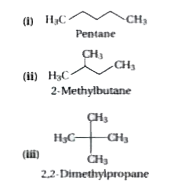 In (i), there are three different hydrogen atoms and thus it will YEILD three different products. 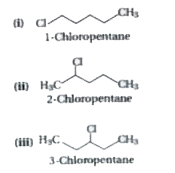 In (iii), all NINE hydrogens are equivalent. So, it will yield only a sing monochloro product. 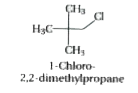 In (ii), there are four different hydrogens. So, it will yeild four different products. 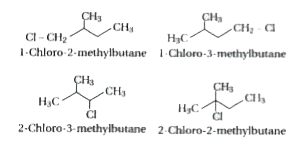
|
|
| 43. |
Among the isomers of Dimethylcyclohexanes, the chiral ones are |
|
Answer» 1, 2-trans and 1,3-cis |
|
| 44. |
Among the isomeric alkanes of molecular formula C_(5)H_(12), identify the one that on photochemical chlorination yields- (3). Four isomeric monochlorides. |
Answer» Solution :It has FOUR different types ofequivalent HYDROGENS designated as a, b, C and d. So, it will form four isomeric MONOCHLORO derivatives. 
|
|
| 45. |
Among the isomeric alkanes of molecular formula C_(5)H_(12), identify the one that on photochemical chlorination yields- (1). A single monochloride. |
|
Answer» Solution :All the H-atoms are equivalent. So, it forms a SINGLE MONOCHLORO derivative. `CH_(3)-underset(CH_3)underset(|)overset(CH_3)overset(|)(C)-CH_(3)` (2,2-dimethylpropane) |
|
| 46. |
Among the isomeric alkanes of molecular formula C_(5)H_(12), identify the one that on photo chemical chlorination yields (i) a single monochloride. (ii) three isomeric monochlorides.(iii) four isomeric monochlorides. |
|
Answer» SOLUTION :(i) `underset("Neopentane (gives single monochloride )") (CH_(3)- underset(CH_(3))underset(|)overset(CH_(3))overset(|)C-CH_(3))` All the H atoms are equivalent. Therefore, replacement of anyone of them will give the same product on PHOTOCHEMICAL chlorination. (II) `underset("n-Pentane")(overset(a)CH_(3)overset(b)CH_(2)overset(c)CH_(2)overset(b)CH_(2)overset(a)CH_(3))` (gives three isoeric monochlorides ) There are three sets of equivalent hydrogens designated as a, b and c. The replacement of any one of the equivalent hydrogens of cach sct will give the same product. Therefore, three ISOMERIC monochlorides are possible. (iii) `overset(a)CH_(3) -underset(overset(a)CH_(3))underset(|)overset(b)CH - overset(c)CH_(2) - overset(d)CH_(3)` (gives FOUR isomeric monochlorides ) There are four types of equivalent hydrogens designated as a, b, c and d. Therefore, four isomeric monochlorides are possible on photochemical chlorination. |
|
| 47. |
Among the hydrides of the members of oxygen family, which has (1) Lowest boiling point (ü) Highest reducing character (ii) Highest thermal stability (iv) Weakest acidic character? |
| Answer» SOLUTION :`(i) H_2S (II) H_2Po (III) H_2O (IV) H_2O` | |
| 48. |
Among the hydrides of group 15, which is (i) most basic (ii) most stable (iii) most volatile (iv) strogest reducing agent ? |
| Answer» SOLUTION :`(i) NH_3 (II) NH_3 (III) PH_3 (IV) BiH_3` | |