

Saved Bookmarks
This section includes 7 InterviewSolutions, each offering curated multiple-choice questions to sharpen your Current Affairs knowledge and support exam preparation. Choose a topic below to get started.
| 1. |
A particle of mass one microgram is confined to move along one direction (x-axis) within a region 1 mm is extension. What is the uncertainity in its velocity ? |
|
Answer» `3.313 XX 10^(-20) cm^(-1)` |
|
| 2. |
A particle of chagre equal to that of anelectron and mass 208 times the mass of the electron moves in a circular orbit around nucleus of chagre +3e. Assuming that the Bohar of the atom is applicableto this system ,(a) dervie am expression for the radius of the radius of the nth boharorbit ,(b) find the value of n for which the radius wavelenght of the raditatio emitted when the revolvingparticle jumps from the thrid orbit to the first. |
|
Answer» (a) `(1)/(4lambdaepsilon_(0)).(3e.e)/(r^(2))=(208me.(V^(2))/(r))"".......(i)` `mvr=(nh)/(2pi)""....(2)` `r=(208)/(3e^(2)).(4piepsilon_(0))(v^(2)r^(2))` `=(N^(2)h^(2))/(k.4pi^(2).3e^(2).208me)` (b) `r=r_(0).n^(2)=6.9xx106n^(2)=0.53xx10^(-10)m` `n^(2)~~625` `n=25` (c)`DELTAE=(1)/(2)m(V_(3)^(2)-V_(1)^(2))=(HC)/(lambda)` putting the value of`V_(3)` and `V_(1)` from eq.(1) and (2) `lambda=55.2xx10^(-12)m` |
|
| 3. |
A particle of charge equal to that of an electron and mass 208 times the mass of the electron moves in a circular orbit around a nucleus of charge +3e. Assuming that the Bohr model of the atom is applicable to this system, (a) derive an expression for the radius of the n^(th) bohr orbit, (b) find the value of n for which the radius of the orbit is approximately the same as that of the first Bohr orbit for the hydrogen atom, and (c ) find the wavelength of the radiation emitted when the revolving particle jumps from the third orbit to the first. |
|
Answer» (b) `DeltaE_(2rarr4)=2.7=IE[(1)/(4)-(1)/(16)]` `IE=2.7xx(16)/(3)eV` (C ) `Deltaoverset("max")E_(4rarr1)=IE[(1)/(k)-(1)/(1)]` `DeltaE_(4rarr3)=IE[(1)/(16)-(1)/(9)]` |
|
| 4. |
A particle is moving three times as fast as an electron. The ratio of the de Broglie wavelength of the particle to that of the electron is 1.813 xx 10^(-4). Calculate the particle’s mass and identify the particle. |
| Answer» Answer :A | |
| 5. |
A particle having a wavelength of 6.6 xx 10^(-6) m is moving with a velocity of 10^(4) m/sec. Find the mass of the particle. Planck's constant is 6.62 xx 10^(-34) kg m^(2) sec^(-1) |
| Answer» SOLUTION :`10^(-32) KG` | |
| 6. |
A particle X moving with a certain velocity has a debroglie wave length of 1Å, If particle Y has a mass of 25% that of X and velocity 75% that of X, debroglies wave length of Y will be - |
| Answer» SOLUTION :`upsilon_B = (h)/((m_A)/(4)* V_B 3.3/4) = (16)/(3) (h)/((MV)_A) = 5.3 A^0` | |
| 7. |
A pale yellow precipitate is insoluble in water, con. Acids and ammonia. However it is soluble in hyop (Na_(2) S_(2)O_(3). 5H_(2)O) solution. The molecular formula of the compound is |
| Answer» Answer :D | |
| 8. |
A pair of gasses having same number of molecules are |
|
Answer» 22 gm of `CO_(2)` and 72 gm of `N_(2)` |
|
| 9. |
A pair of gases having same number of molecules are |
|
Answer» 22 gm of `CO_(2)` and 72 gm of `N_(2)` |
|
| 10. |
(A) Packing fraction of Fcc and hcp unit cell are same. (R) Both fcc and hcp unit cell have same packing pattern i.e. ABCABCABC……. |
|
Answer» If both (A) and (R) are CORRECT, and (R) is the correct EXPLANATION of (A). |
|
| 11. |
A pair of functional isomers |
|
Answer» `CH_3CH_2CH_2OH, CH_3CH(OH)CH_3` Same molecular FORMULA but different functional group. |
|
| 12. |
(A) p-NH_(2)C_(6)H_(5)SO_(3)H gives blood red colouration while performing Lassaigne's test for nitrogen. (R) Sodium fusion extract containing NaCNS gives bloodred colour on treatment with FeCI_(3). |
|
Answer» If both ASSERTION and REASON are correct and reason is the correct EXPLANATION of the assertion |
|
| 13. |
A p-type material is electrically... |
|
Answer» <P>positive |
|
| 14. |
A p-subshell which consists of p_(x), p_(y) and p_(z) orbitals contains only one electrons. In which one of these three orbitals should the electron be located? Justify your answer. |
| Answer» SOLUTION :In any ONE because they are DEGENERATE | |
| 15. |
A: Oxygen molecule is paramagnetic in nature whose magnetic moment is sqrt(8) BM R: Oxygen molecule has two unpaired electrons in bonding molecular orbitals |
|
Answer» Both a and R are TRUE and R is the corret explanation of A |
|
| 16. |
(A): Oxidation state of carbon in C_(6)H_(12)O_(6) is zero. (R) : Oxidation state of carbon in all organic compounds is zero. |
|
Answer» Both A and R are true and R is the correct EXPLANATION |
|
| 17. |
A overset(O_(3)NO_(2))(rarr) PAN, then ratio of sigma and pi bonds in the starting substance "A" is |
|
Answer» `7:2` |
|
| 18. |
A organic compound having molecular formula C_(3)H_(4), react with sodium metal to give a colourless and odourless gas. Select the correct statements about organic compound. |
|
Answer» It gives Bromine WATER test 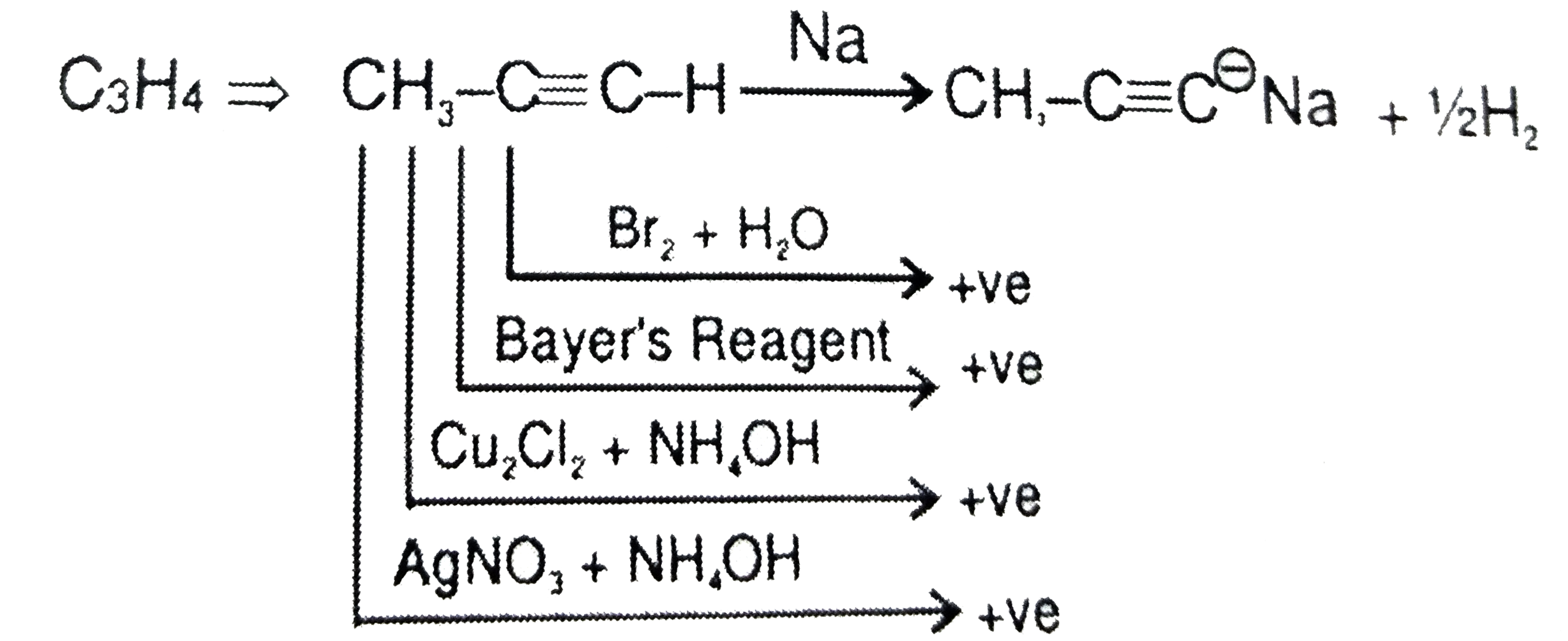
|
|
| 19. |
An open steel vessel has an ideal gas at 27^@C. What fraction of the gas is escaped if the vessel and its contents are heated to 127^@C? (neglect the expansion of steel) |
|
Answer» Solution :LET one mole of the gas is taken in the vessel of constant volume (V). From the ideal gas equation, at two conditions of temperature, `n_(1)T_(1) = n_(2)T_(2)` `1 xx 300 = n_(2) xx 400` Number of moles finally LEFT in the vessel `(n_(2))` `n_(2) = (300)/(400) =(3)/(4)` THe fraction of gas escaped from the vessel UPON HEATING ` = 1-3//4 = 1//4` |
|
| 20. |
(A) : One molar solution is always more concentrated than one molal solution (R) : The amount of solvent in 1 M and 1m aqueous solution is not equal. |
|
Answer» If both (A) and (R) are CORRECT and (R) is the correct EXPLANATION for (A) |
|
| 21. |
A one litre solution contains 0.08 mole of acetic acid (K_(a) = 1.75 xx 10^(-5)) . To this solution , 0.02 mole of NaOH is added . Then the pH of resulting solution is[log 1.75 =0.243] |
|
Answer» 5.234 |
|
| 22. |
One litre of buffer solution contains 0.1 mole of acetic acid add 1 mole of sodium acetate. Find its pH if pK_(a) of CH_(3)COOH is 4.8. |
|
Answer» SOLUTION :`pH= pK_a + LOG"" (["salt"])/(["acid"])` [ Salt ] =[Acid] =1 `thereforepH = 4.8= pK_a ` moleof NaOHadded to the solution = 4/40 = 0.1  After ADDING 0.1 mole of CAUSTIC SODA to the buffer solution `pH = 4.8 + log""(1.1)/( 0.9 ) = 4.8 + log 1.222 = 4.886` |
|
| 23. |
(A): Oil rises into the wick of an oil lamp. (R): The rise of oil into the wick is due to the surface tension. |
|
Answer» Both A and R are correct and R is the correct explanation of A. |
|
| 24. |
(A): O-Hydroxy benzaldehyde is steam volatile but not P-hydroxy benzaldehyde (R) : Intramolecular hydrogen bond is present in orthohydroxy benzaldehyde but intermolecular hydrogen bond in parahydroxy benzaldehyde |
|
Answer» Both (A) and (R) are TRUE and (R) is the correct EXPLANATION of (A) |
|
| 25. |
(a). Number of 'X' which can show geometrical isomerism. (b). Number of 'X' which can show optical isomerism. |
Answer» 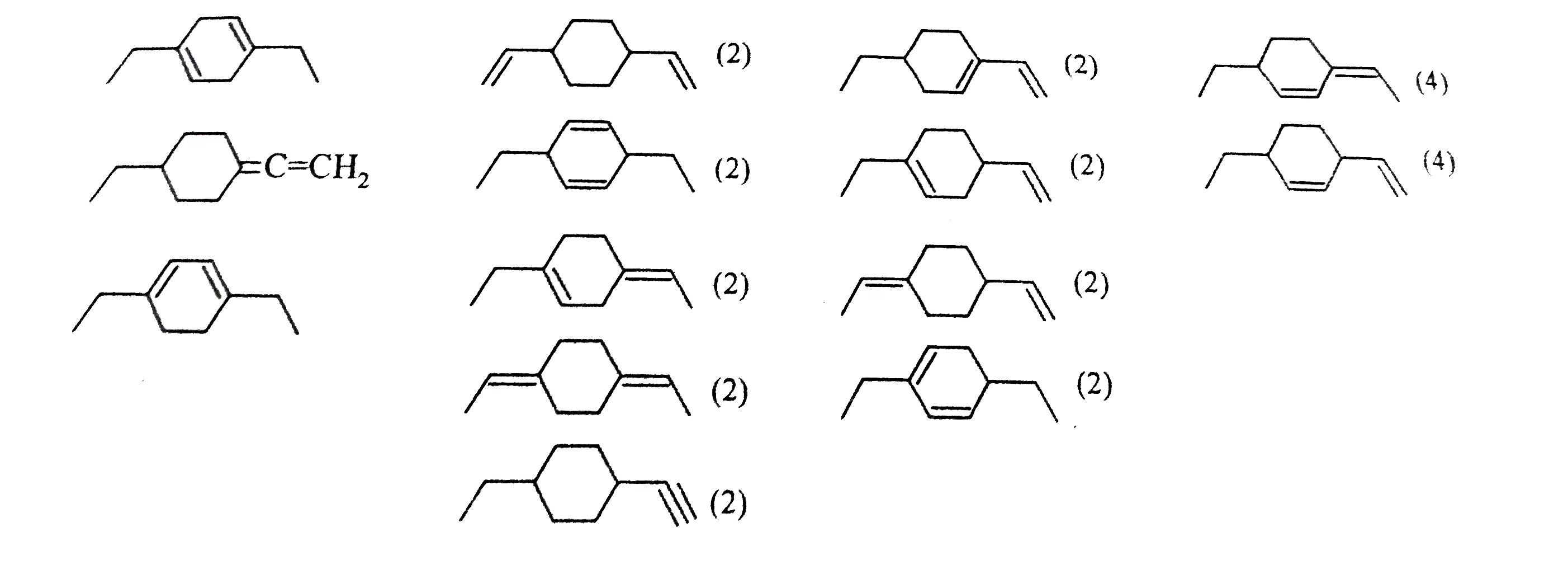
|
|
| 26. |
(a). Number of stereoisomers possible for reactants(P). (b). Number of stereoisomers formed during reaction (A) as major product (Q). (c). Number of stereoisomers formed during reaction(B) as major product (R). (d). Number of stereoisomers formed during reaction (C) as major product (S). |
Answer» 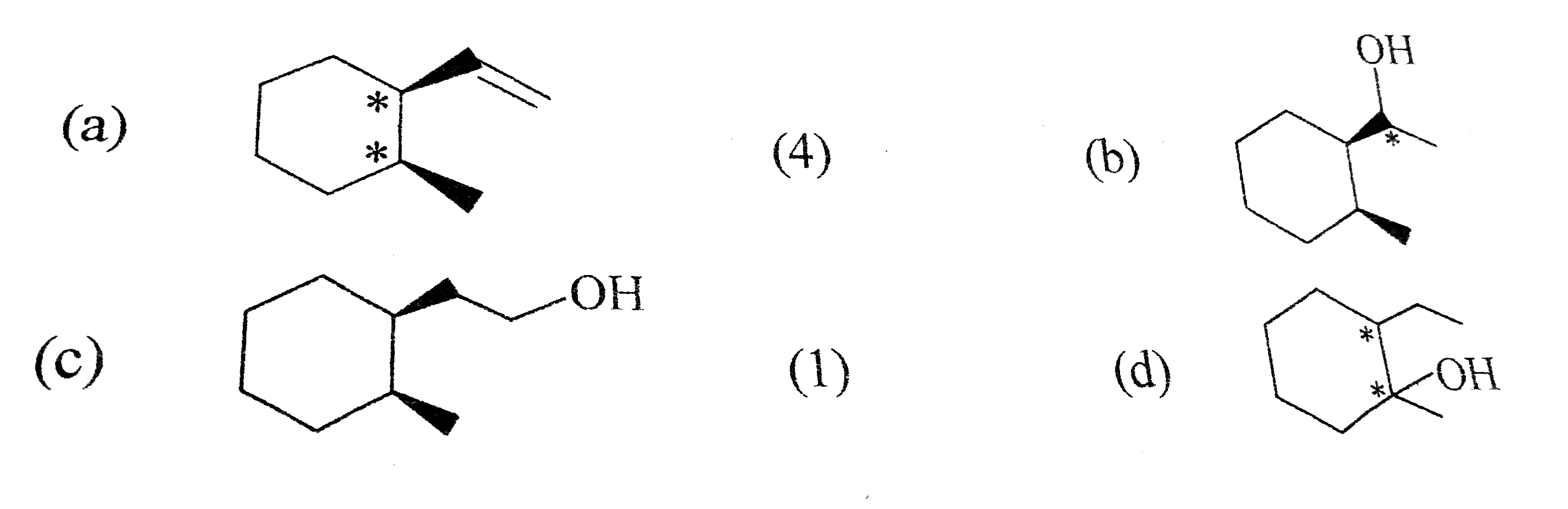
|
|
| 27. |
(a). Number of organic product formed formed during this reaction (b). Number of stereoisojmers possible for major organic product of this reaction are: (c). Oxidation state of Os before reaction (d). Oxidation state of Os after reaction. |
Answer» 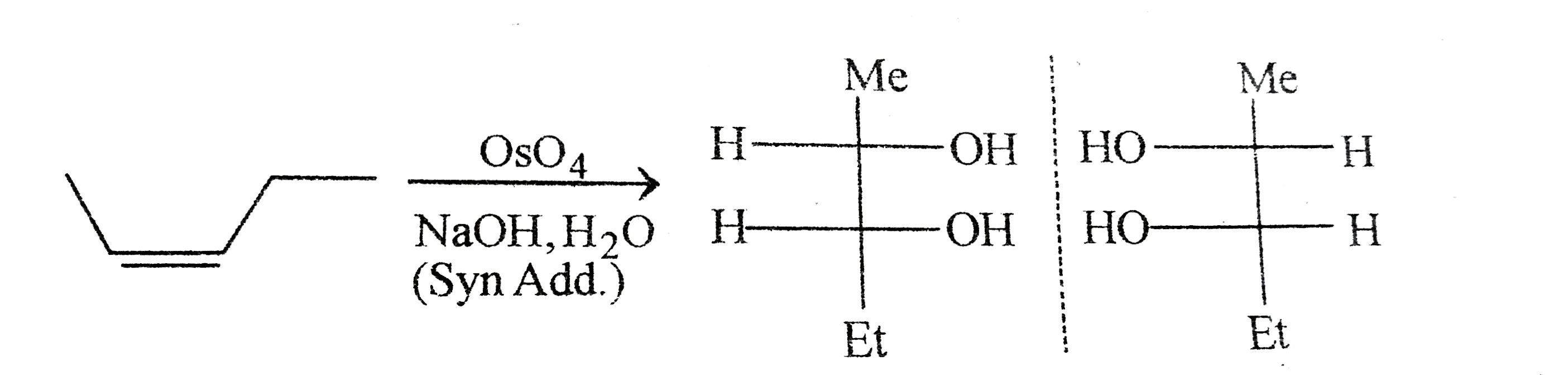 (a). 2 (B). 3 (c) 8 (d). 6. |
|
| 28. |
A nucleophilic reagent will readily attack |
|
Answer» Ethylene |
|
| 29. |
A nonmetallic element of group-13, used in making bullet proof vests is extremely hard solid of black colour. It can exist in many allotropic forms and has unusually high melting point. Its trifluoride acts as Lewis acid towards ammonia. The element exhibits maximum covalence of four. Identify the element and write the reaction of its trifluoride with ammonia. Explain why does the trifluoride acts as a Lewis acid. |
|
Answer» SOLUTION :In group-13, BORON is only non-metallic and extremely hard and ALSO used for making bullet proof vests. Boron exists in many allotropic forms. It usually shows high melting point and does not have. d-orbital. It can show maximum covalence of 4 by using 2s and 2p orbitals. In trivalent halides of boron, octet of boron is not COMPLETED hence acts as Lewis ACID. It reacts with Lewis base and forms adduct. 
|
|
| 30. |
(A): Nowadays surface of the earth gets heated up. (R): CO_2 and water vapour partly reflects IR radiation back to earth's surface. |
|
Answer» Both (A) and (R) are TRUE and (R) is the correct EXPLANATION of (A) |
|
| 31. |
A normal solution : |
|
Answer» CONTAINS ONE GRAM equivalent mass of the SUBSTANCE in one litre solution |
|
| 32. |
A non- metallicelement of group 13, used in making bullet proof vests is extremely hardsolid of black colour. It canexist in many allotropic forms and has unusally high melting point. Its frifluride acts as Lewis acid towards ammonia. The element exhibits maximum covalency of four. Identify the element and write the reaction of itstrifluoride with ammonia. Explain why does the trifloride act as a Lewis acid. |
Answer» Solution :The only non-metallic element of group13 is boron. It is an extremely hardblacksubtanceand is usediin making bullet proofvests. It existsin many allotropic FORMS and has USUALLY high MELTINGPOINT. Since B has only s- andp-orbitals but no d-orbitalstherefore at the maximum it can exhibit a covalency of four.  Since B in `BF_(3)` has only six electrons in its VALENCE shell, therefore, it needs two more electrons to completeits octet. Thus, `BF_(3)`acts as a LEWIS acid. |
|
| 33. |
A non-metallic element of group 13, used in making bullet prrof vests is extremely hard solid of black colour. It can exist in many allotroic forms and has unusally high melting point. Its trifluoride acts as Lewis acid towards ammonia. The element exhibits maximum covalency of four. Identify the element and write the reaction of tits triffuoride with ammonia. Explain why does the trifuoride act as Lewis acid. |
|
Answer» Solution :The only non-metallic element of group 13 is BORON. It is an extremely hard substance and is USED in making bullet proof vests. It exists in MANY allotropy forms and usually high melting point. Since B has only s and p-orbitals but no d-orbitals. The maximum covalency of boron is 4. In trivalent state, the number of electrons around the central atom in a molecule will be six as in case of `BF_(3)`. Such electron deficient molecules have tendency to accept a PAIR of electron to ACHIEVE stable electronic configuration and behave as Lewis acid. `BF_(3)` easily accepts lone pair of electron from `NH_(3)` 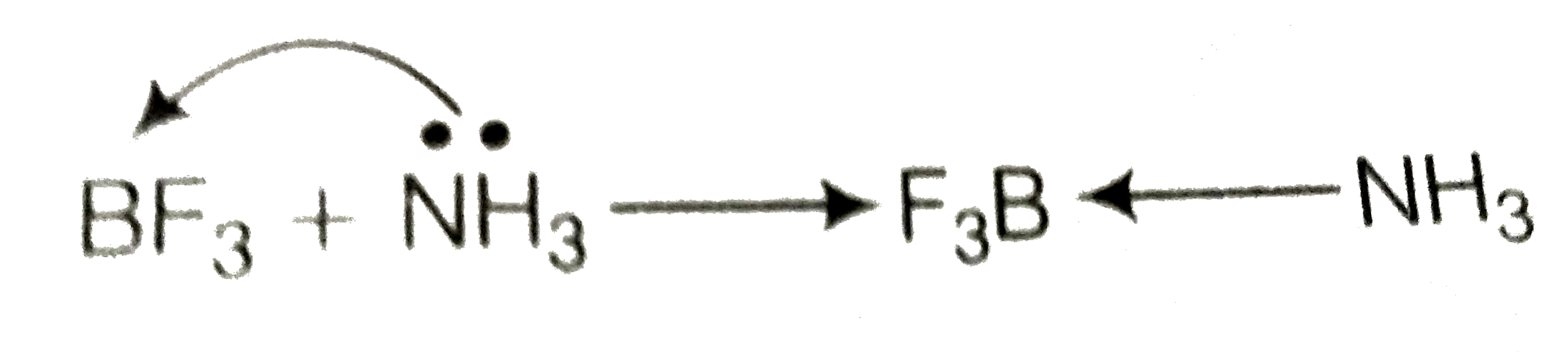
|
|
| 34. |
(A) : NO_(3)^(-) is planar whereas NH_3 has pyramidal shape (R) :In NO_(3)^(-)sp^2 hybridisation whereas in NH, sp hybridisaton takes palce with a lone pair |
|
Answer» Both (A) and (R) are TRUE and (R) is the CORRECT EXPLANATION of (A) |
|
| 35. |
(A) Nitrogen cannot be estimated in nitrobenzene by Kjeldahl's method. (R) Nitrobenzene evolves ammonia gas on acid treatment. |
|
Answer» If both ASSERTION and REASON are CORRECT and reason is the correct explanation of the assertion |
|
| 36. |
(A) NH_3CI and RCOONa are colloidal electrolyte. (R) the substances which behave as electrolyte below a certain concentration limit, beyond this limit colloidal sol is formed, are called colloidal electrolyte. |
|
Answer» IF both (A) and (R) are CORRECT and (r) is the correct EXPLANATION for (a). |
|
| 37. |
A neutral white sodium salt (A) on heating liberates a gas (B), leaving a highly alkaline residue (C). The gas (B) is colourless, odourless and turns lime water milky. (A) is |
|
Answer» `NaNO_(3)` `CO_(2)+Ca(OH)_(2)rarrCaCO_(3)+H_(2)O` |
|
| 38. |
A neutral atom of element has 2K, 8K and 5M electrons. Find out the following : (a) Atomic No. of the element (b) Total No. of s electrons (c) Total No. of p- electrons(d) No. of protons in the nucleus and (e) Valency of the element. |
|
Answer» Solution :The electronic CONFIGURATION of the ELEMENT with with 2K, 8L and 5M electrons will be `1s^(2)2S^(2) 2p_(x)^(2) 2p_(y)^(2) 2p_(z)^(2) 3s^(2) 3p_(x)^(1) 3p_(y)^(1) 3p_(z)^(1)` (a) Total no. of electrons `=2+8+5=15 :.` Atomic No. of the element `=15` (b) Total no. of s-electrons `=2+2+2=6` (c) Total no. of p-electron `=6+3=9` (d) Since the atom is neutral, `:.` No. of protons = No. of electrons = Atomic No. `=15` (e) Since the element has only three half-filled atomic orbitals, therefore, valency of the element `=3`. |
|
| 39. |
A neutral atom of an element has 2 K, 8L and 5M electrons. Find out the following. (v) Valency of the element. |
|
Answer» Solution :The ELECTRONIC configuration of the element with 2K, 8L and 5M electrons will be `1s^2 2s^2 2p_x^2 2p_y^2 2p_z^2 3s^2 3p_x^1 3p_x^1 p_y^1 3p_z^1` Vanlency of the element = 3. |
|
| 40. |
A neutral atom of an element has 2 K, 8L and 5M electrons. Find out the following. (iv) Number of protons in the nucleus. |
|
Answer» Solution :The ELECTRONIC CONFIGURATION of the element with 2K, 8L and 5M ELECTRONS will be `1s^2 2s^2 2p_x^2 2p_y^2 2p_z^2 3s^2 3p_x^1 3p_x^1 p_y^1 3p_z^1` SINCE, the atom is neutral, `:.` Number of protons = Number of electrons = ATOMIC number = 15. |
|
| 41. |
A neutral atom of an element has 2 K, 8L and 5M electrons. Find out the following. (ii) Total number of s-eelctrons. |
|
Answer» Solution :The ELECTRONIC CONFIGURATION of the ELEMENT with 2K, 8L and 5M ELECTRONS will be `1s^2 2s^2 2p_x^2 2p_y^2 2p_z^2 3s^2 3p_x^1 3p_x^1 p_y^1 3p_z^1` Total number of s-electrons = 2 + 2 + 2 = 6. |
|
| 42. |
A neutral atom of an element has 2 K, 8L and 5M electrons. Find out the following. (iii) Total number of p-electrons. |
|
Answer» Solution :The electronic configuration of the element with 2K, 8L and 5M ELECTRONS will be `1s^2 2s^2 2p_x^2 2p_y^2 2p_z^2 3s^2 3p_x^1 3p_x^1 p_y^1 3p_z^1` TOTAL number of p-electrons = 6 + 3 = 9 . |
|
| 43. |
A neutral atom of an element has 2 K, 8L and 5M electrons. Find out the following. (i) Atomic number of the element. |
|
Answer» SOLUTION :The electronic configuration of the element with 2K, 8L and 5M electrons will be `1s^2 2s^2 2p_x^2 2p_y^2 2p_z^2 3s^2 3p_x^1 3p_x^1 p_y^1 3p_z^1` Total NUMBER of electrons = `2 + 8 + 5 = 15` `:.` ATOMIC number of the element = 15. |
|
| 44. |
A neutral atom has 2K, 8L and 5M electrons, choose correct one |
|
Answer» ATOMIC number is 15 |
|
| 45. |
A neon dioxide mixture contains 70.6 g dioxygen and 167.5 g neon. If pressure of the mixture of gases in the cylinder is 25 bar. What is the partial pressure of dioxygen and neon in the mixture? |
|
Answer» |
|
| 46. |
A neutral atom (At.no. gt 1) has |
|
Answer» ELECTRON and PROTON |
|
| 47. |
A neon-dioxygen mixture contains 70.6 g dioxygen and 167.5 g neon.If the pressure of the mixture ? (Atomic mass of Ne=20 u) |
|
Answer» Solution :No. of moles of DIOXYGEN `(n_(o_(2)))=("Mass of "O_(2))/("Molar mass of "O_(2))=(70.6g)/(32 gmol^(-1))=2.21 mol` No. of moles of neon `(n_(Ne))=("Mass of" Ne)/("Molar mass of" Ne)=(167.5 g)/(20 g mol^(-1))=8.375 mol` Mole fraction of dioxygen`=(overset(n)""O_(2))/(overset(n)""O_(2)+overset(n)""He)=(2.21)/(2.21+8.375)=0.21` Mole fraction neon =1-0.21=0.79 Partial PRESSURE of `O_(2)`=Moll fraction of `O_(2)XX"Total pressure"=0.21xx25" bar"=5.25 "bar"` Partial pressure of Ne =Mole fraction of Ne`xx`Total pressure `=0.79xx25 bar=19.75 "bar"` |
|
| 48. |
A neon - dioxygen mixture contains 70.6 g dioxygen and 167.5 g neon. If pressure of the mixture of gases in the cylinder is 25 bar. What isd the partial pressure of dioxygen and neon in the mixture ? |
|
Answer» Solution :Calculation of moles of Dioxygen gas, Where, molecular mass of `O_(2)=32G MOL^(-1)` mole `=("Mass")/("Molecular Mass")=(70.6 g)/(32g mol^(-1))` `therefore n(O_(2))=2.206 ~~2.21` mol Caslculation of mole NUMBER of Neon gas : Mole = n (Ne) `= ("Weight")/("Molar Mass")` `= (167.5 g)/(20 g mol^(-1))=8.375` mol Total moles of mixture `= n(O_(2))+n (Ne)` `= (2.21+8.375)` mol = 10.585 mol Mole FRACTION of `O_(2)chi (O_(2))=("Moles of "O_(2))/("Total Moles")` `= (2.21 mol)/(10.585 mol)=0.2087` Partial PRESSURE of `O_(2)p(O_(2))` `= chi (O_(2))xx` total Pressure (P) `=(2.21mol)/(10.585 mol)xx25` bar `= 5.2196` bar `~~ 5.22` bar Partial Pressure of `N_(2)` gas `(P_(N_(2)))` `= chi_(Ne)xx` total Pressure, `= 25xx((8.375)/(10.585))` = 19.7803 bar OR `rho_(Ne)=P_("total")-rho_(O_(2))` `= (25.5.2196)` bar = 19.7804 bar |
|
| 49. |
A natural gas sample contains 84% ( by volume) of CH_(4),10% of C_(2)H_(6), 3% of C_(3)H_(8) and 3% N_(2). If a series of catalytic reactions could be used for converting all the carbon atoms into butadiene, C_(4)H_(6), with 100% efficiency, how much butadiene could be prepared from 100 g of the natural gas? |
|
Answer» |
|
| 50. |
(a) Name the type of intermolecular forces existing in the molecules of BCl_(3),NCl_(3) and NHCl_(2). (b) Which of these is most likely to exist in the condensed state and which one is least likely? |
|
Answer» Solution :(a) `BCl_(3)`, being symmetrical molecule has London forces only. `NCl_(3)`,being pyraimdal has a NET dipole moment, i.e, it is polar and HENCE dipole-dipole forces are present in addition to London forces. `NHCl_(2)` has hydrogen bonding becauseof the presence of N-H BOND in addition to London forces. (b) Due to presence of hydrogen bonding which is a strong bond compared to dipole-dipole and London forces, `NHCl_(2)` is most likely to be in comdensed PHASE. `BCl_(3)` has weakest intermolecular forces and hence is least likely to be in condensed phase, i.e., it is likely to be GASEOUS. |
|