Saved Bookmarks
This section includes 7 InterviewSolutions, each offering curated multiple-choice questions to sharpen your Current Affairs knowledge and support exam preparation. Choose a topic below to get started.
| 1. |
A NaCl crystal is found to have CsCl structure. Guess how it might have happened? |
| Answer» SOLUTION :NaCl must have been SUBJECTED to HIGH pressure | |
| 2. |
(a). Na_(2)SO_(4) is soluble in water whereas BaSO_(4) is insoluble. Why? (b). When Mg metal is burant in air, a white powder is left behind as ash. What is the white powder? |
|
Answer» Solution :a. The lattice enthalpy of `Na_(2)SO_(4)` is less than its hydration enthalpy whereas the lattice enthalpy of `BaSO_(4)` (because of `+2` charge of `ba^(2+))` is very higa as compared to its hydraton enthalpy. That is why `Na_(2)SO_(4)` is soluble in water whereas `BaSO_(4)` is INSOLUBLE. b. Magnesium on burning in air REACTS with oxygen and nitrogen resulting in the FORMATION of `MGO` and `Mg_(3)N_(2)`. `2 Mg+O_(2)rarr2MgO` `3 Mg+N_(2)rarrMg_(3)N_(2)` White powder is the mixure of `MgO` and `Mg_(3)N_(2)`. |
|
| 3. |
(A): NaCl is bad conductor in the solid state (R) : Na+ and Ct ions are not free in the solid state |
|
Answer» Both (A) and (R) ARC true and (R) is the correct EXPLANATION of (A) |
|
| 4. |
(A) : Na_2SO_4 is more soluble in water while BaSO_4, is less soluble (R) : Lattice energy of Na_2 SO_4is greater than that of BaSO_4 |
|
Answer» Both (A) and (R) are true and (R) is the CORRECT EXPLANATION of (A) |
|
| 5. |
A moving electron has 4.55 xx 10^(-25) joules of kinetic energy. Calculate its wavelength (mass = 9.1 xx 10^(-31) kg and h = 6.6 xx 10^(-34) kg m^(2) s^(-1)) |
| Answer» SOLUTION :`7.25 XX 10^(-7) m` | |
| 6. |
A mother cell disintegrate into sixty identical cells and each daughter cell further disintegrate into 24 smaller cells. The smallest cells are uniform cylindrical in shape with diameter of 120 Å and each cell is 6000 Å long. Determine molar mass of the mother cell if density of the smallest cell is 1.12 g//cm^(3) : |
|
Answer» `(6000xx10^(-8)cm) = 6.785xx10^(-17)cm^(3)` mass of ONE smallest cell `=7.6xx10^(17) g` implies MOLAR mass of MOTHER cell `=7.6xx10^(-17)xx24xx60xx6.023xx10^(23)=6.6xx10^(10)"amu"` |
|
| 7. |
A monoprotic acid in a 0.1 M solution ionizes to 0.001 % . Its ionizationconstant is |
|
Answer» `1.0xx 10^(-3) ` |
|
| 8. |
A monoclinic crystal has dimensions |
|
Answer» `a NE b ne c, alpha=gamma=90^(@), beta=90^(@)` |
|
| 9. |
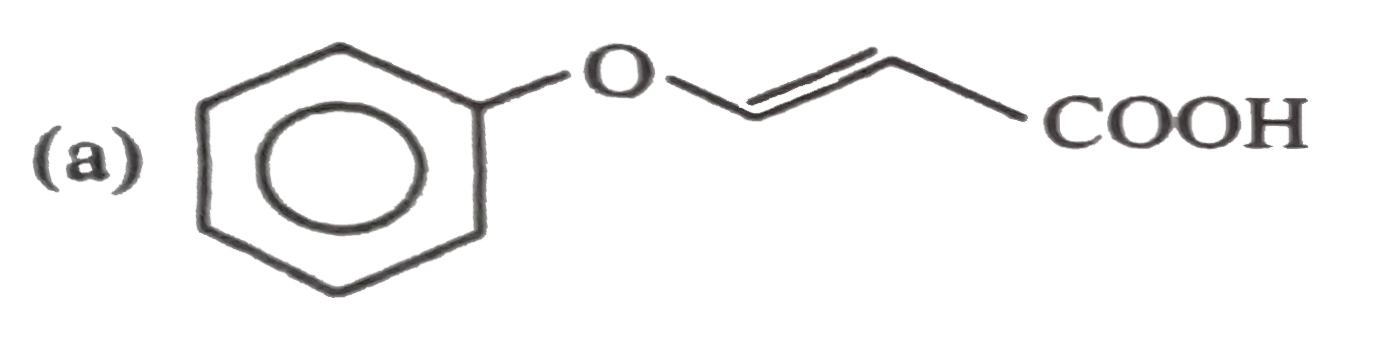
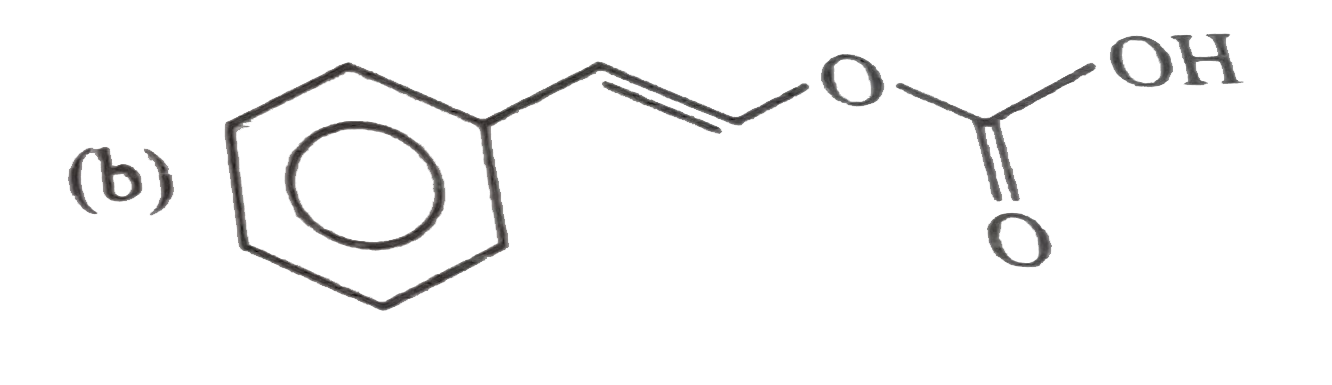
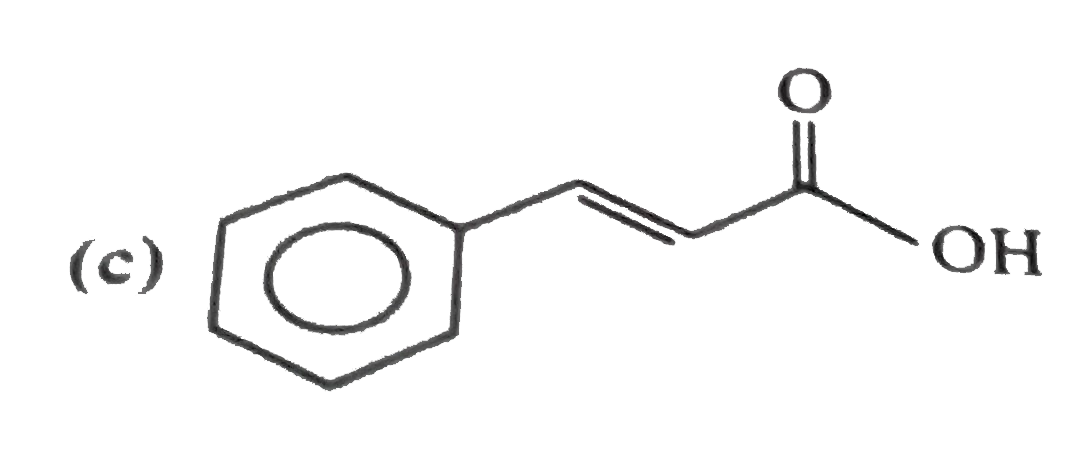
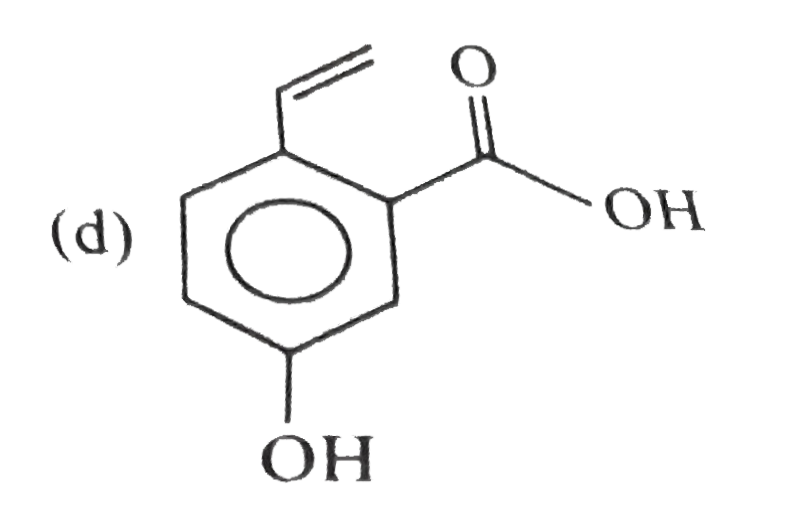
A monocarboxylic acid decolourise Br_(2) - H_(2)O, on heating with soda lime derivate of styrene is formed , with neutral FeCl_(3) , a buff coloured precipitate is formed . Acid could be : |
|
Answer»
|
|
| 10. |
A monobasic acid is dissociated to 25% in 0.1N solution. When 100mL of the acid is neutralised by 0.1 N KOH solution, heat evolved was 120 cal. Calculate heat of dissociation per mole of acid. |
|
Answer» |
|
| 11. |
A monoatomic anion of unit charge contains 45 neutrons and 36 electrons. Find the atomic number, mass number of the iron with its identification. |
| Answer» Solution :`Z = 35, A = 80, BR^(-)` ION | |
| 12. |
A mono atomic ideal gas undergoes a process in which the ratio of P to V at any instant is constant and equal to 1. What is molar heat capacity of the gas. |
|
Answer» `(4R)/(2)` `pv^(-1)`= constant, `pv^(n)`= constant `rArr n = -1` mono atomic GAS `C_(V) = (3)/(2) R` Molar heat capacity `C_(V) + (R )/(1-n) rArr C_(V) +(R )/(1-(-1)) = (4R)/(2)` |
|
| 13. |
A molecule XY_(4) has four bond pairs and 2 Ione pairs of electrons for its central atom. Predict the shape of the molecule. |
|
Answer» |
|
| 14. |
A molecule (X) has (i) four sigma bonds formed by the overlap of sp^(2) and s orbitals, (ii) one sigma bond formed by sp^(2) and sp^(2) orbials and (iii) one pi bond formed by P_(z) and P_(z) orbitals. Which of the following is X? |
| Answer» Answer :D | |
| 15. |
A molecule with two sigma, two pi^(-) bonds and one lone pair of electrons in the valence shell of X (central atom) |
|
Answer» trigonal PLANAR geometry |
|
| 16. |
A molecule was known by its made of synthesis of contain 10 atoms of carbon per molecule, along with unknown number of chlorine, hydrogen and oxygen. Analysis indicates that it contains 60.5% carbon 5.55% hydrogen, 16.1% oxygen and 17.9% chlorine. Derive molecular formula. |
|
Answer» |
|
| 17. |
A molecule of O_(2) and that of SO_(2) travel with the same velocity. What is the ratio of their wavelengths ? |
| Answer» Solution :`lamda_(O_(2))//lamda_(SO_(2)) = 2` (because `lamda = (H)/(MV) " i.e., " lamda prop (1)/(m)` and mass of `SO_(2)` molecule viz. 64 u, is DOUBLE than that of `O_(2)` molecule viz. 32 u) | |
| 18. |
A molecule MX_3has zero dipole moment. The % of's' character in the hybridized orbitals of M is |
|
Answer» 0.25 |
|
| 19. |
A molecule having3 bond pairs and 2 lone pairs will have ? |
|
Answer» T - SHAPE GEOMETRY |
|
| 20. |
A molecule AX_(2) has two Ione pairs ove A. Its shape is |
|
Answer» Tetrahedral |
|
| 21. |
A molecule as a whole is asymmetric if it does not possess |
|
Answer» Plane of symmetry only B) Centre of symmetry only C) Axis of symmetry and alternatig axis of symmetry only |
|
| 22. |
A mole of N_(2)H_(4) loses ten moles of electrons to form a new compound X. Assuming that all the nitrogen appears in the new compound. What is the oxidation state of nitrogen in Y? (There is no change in the oxidation number of hydrogen) |
| Answer» ANSWER :C | |
| 23. |
A mole is defined as the amount of substance that contains as many specified elementary particles as the number of atoms in.......g of carbon 12 isotope. |
|
Answer» |
|
| 24. |
A mole is define so A) the amount of substance containing the same number of chemical units as the number of atoms in exactly 12g of C^(12) B) the amount of substance containing Avogadro number of chemical units C) the unit for expressing amount of a substance |
|
Answer» The amount of SUBSTANCE CONTAINING the same number of chemical units as the number of ATOMS in exactly 12G of `C^(12)` |
|
| 25. |
(A) : Molar volume of ideal gas at latest STP conditions is 22.711 lit (R): Latest STP conditions are 273.15 K and 1 bar |
|
Answer» Both A and R are CORRECT and R is the correct explanation of A |
|
| 26. |
(A) : Molarity of 0.02 N solution of HNO_(3) is 0.02 M (R) : Molarity and normality of a soltuion are never equal. |
|
Answer» If both (A) and (R) are correct and (R) is the correct explanation for (A) |
|
| 27. |
A molal solution is one that contains one mole of the solute in : |
|
Answer» 1000 G of the solvent |
|
| 28. |
(A): Modern periodic table is called Bohr's periodic table. (R) : Modern periodic table is the graphical representation of Aufbau priniciple |
|
Answer» Both (A) and (R) are TRUE and (R) is the proper explanation of (A) |
|
| 29. |
A mixutre of Cu, Fe, and Al was reacted with 13.33 g of NaOH. During chlorination with the same amount of meta mixture entered into reaction with 12.5 L of chlorine measured at STP, while for treating the same amound of the metal mixture at STP, while for treating the same amound of the metal mix mixutre 343.64 " mL of " HCl, havig a density of .1g mL^(-1) and containing 10% by mass of HCl were required. Determine the mass percentage of the metals in the mixture. |
|
Answer» Solution :Out of Al, Fe, and Cu, Al reacts with NaOH. (a). `2Al+2NaOH+10H_2Oto2Na[Al(OH)_4.H_2O]` `1 mol` of `Al -= 1` " mol of "`NaOH` `-=((13.33)/(40))` " mol of "`NaOH` `-=((13.33)/(40))` " mol of "`Al` `(13.33)/(40)xx27g of Al=9g of Al` (b). `2Al+6"HCl"to2AlCl_3` Cu does not REACT with HCl. 2 " mol of "`Al-=6 mol` of `AlCl_3` `(9)/(27) mol =[(9)/(27)xx3]xx36.5-=36.5-=36.6 g` of HCl is used for Al (c). `Fe+2"HCl"toFeCl_2+H_2` (d). TOTAL moles of HCl required to react with Al and Fe `=MxxV_L` Weight of `HCl=((10xx10xx1.1)/(36.5)xx(343.64)/(1000))xx36.5` =Weight of HCl used for `Fe=37.8-36.5-=1.3g HCl` 2 " mol of "`HCl-=1` " mol of "`Fe=56 of Fe` `((1.3)/(36.5))mol` of `HCl-=((56)/(2)xx(1.3)/(36.5))-=0.997g Fe` All these metals reacts with with `Cl_2` `2Fe+3Cl_2to2FeCl_3` Volume of `Cl_2` at `STP=((3)/(2)xx(0.997)/(56))xx22.4L` `=0.598 L` at `STP` (V). `2Al+3Cl_2to2AlCl_3` Volume of `Cl_2 at STP=((3)/(2)xx(9)/(27))xx22.4` `=11.2 L` of `Cl_2` (vi). `Cu+Cl_2toCuCl_2` Volume of `Cl_2 at STP=(12.5-11.2-0.598)` `=0.702 L of Cl_2` Weight of `Cu=(0.7)/(22.4)xx63.5=1.99 g Cu` `Al=9g,Fe=0.997,Cu=1.99g` Total weight `=11.987g` `%Al=75.09,%Fe=8.31,%Cu=16.6` |
|
| 30. |
A mixture when rubbed with oxalic acid smells like vinegar. It contains salt of : |
|
Answer» sulphate `{:(2CH_(3)COONA,+,(COOH)_(2),),("Sod. acetate",,"oxalic aicd",),(,,darr,),(2CH_(3)COOH,+,(COONa)_(2),),("Acetic acid.",,"Sod. OXALATE",),(("vinegar smell"),,,):}` |
|
| 31. |
A mixture of X and Y was loaded in the column of silica. It was eluted by alcohol-water mixture. Compound Y eluted in preference to compound X. Compare the extent of adsorption of X and Y on column. |
| Answer» SOLUTION :A compound which is more strongly adsorbed on the COLUMN is eluted later than the compound which is weakly adsorbed. Since compound Y is eluted is PREFERENCE to compound X, THEREFORE, compound X is more strongly adsorbed than the compound Y. | |
| 32. |
A mixture of which pair of species react with water to produce a pure colourless gas gives white fumes with HCl ? |
|
Answer» Calcium hydride, calcium carbide `M_(3)N_(2)+6H_(2)Oto3M(OH)_(3)+2NH_(3)` |
|
| 33. |
A mixture of water and AgCI is shaken until a saturated solution is obtained. Now the solution is filtered and 100mL of clear solution of filtrate is mixed with 100 mL of 0.03M NaBr. Should a precipitate from ? K_(SP) of AgCI and AgBr are 1xx10^(-10) and 5xx10^(-13). |
|
Answer» |
|
| 34. |
A mixture of two miscible liquids can be separated by simple distillation, when they |
|
Answer» they have low B.P's |
|
| 35. |
A mixture of two liquids A and B having boiling point of A is 70 ^(@) C and boiling points of Bis 100 ^(@)Cdistills at101 .2^(@) Cas single liquids hence this mixture is |
|
Answer» IDEAL SOLUTION |
|
| 36. |
A mixture of two gases, H_(2)S and SO_(2) is passes throgh three beakers successivly. The first beaker contains Pb^(2+) ions, which absobs all H_(2)S to form PbS. The second beaker contains 25mL of 0.0396 N I_(2). Whichocidises all SO_(2) to SO_(4)^(2-) . The thirdbeaker contains 10 mL of 0.0345 N thisulphate solutionti retainany I_(2) carried over from the second absorber. Thesolution from first absorber was made acidic and treated with 20 mL of 0.0066 M K_(2) Cr_(2) O_(7), acidic and treated with 20mL of 0.006M K_(2) Cr_(2)O_(7) which convertedS^(2-) to SO_(2). The excess dichromate was reacted with solid KIand the liberated iodine required 7.45mL of 0.0345N Na_(2)S_(2)O_(3) solution. The solution in the second andthrid absorbers were combined and the resulatantiodide was treated with 2.44 mL fo the same solution of thisulphate. Calculate the conventrations fo SO_(2) and H_(2)S in (mg)/"litre"of the sample. |
|
Answer» conc. Of `H_(2)S = 0.125 MG.."litre"` |
|
| 37. |
A mixture of two gases A and B in the mole ratio 2:3 is kept in a 2 litre vessel. A second 3 litre vessel has the same two gasesin the mole ratio 3:5. Both gas mixtures have the same temperature and same pressure. They are allowed to intermix and the final temperature and pressure are the same as the initial values, the final volume beingh 5 litres. Given theat the molar masses are M_(A) and M_(B) . what is the mean molar mass of the final mixture : |
|
Answer» `(77M_(A)+123M_(B))/(200)` |
|
| 38. |
A mixture of SO_(3) , SO_(2) and O_(2) gases is maintained at equilibrium in 10 litre flask at a temperature at which K_(c) " for the reaction ," 2SO_(2) (g) + O_(2) (g) hArr 2 SO_(3) (g)"is100 mol"^(-1)litre. At equilibrium . (a) if no. of moles of SO_(3) and SO_(2) in the flask are same, how many moles of O_(2) are present ? (b) if no. of moles of SO_(3) in the flask are twice the number of moles of SO_(2) in the flask are twice the number of moles of SO_(2), how many moles O_(2) are present ? |
|
Answer» Solution :` 2 SO_(2) (g) + O_(2) (g) hArr 2 SO_(3) ," " K_(c) = ([SO^(2)])/([SO_(2)]^(2)[O_(2)] = 100)(Given)` (a) As ` [ SO_(3)] = [ SO_(2)] ,:. 100 = 1/([O_(2)]) or [O_(2)] = 1/ 100 molL^(-1)` `:. O_(2) " PRESENT in 10 LITRE " = 1/100 XX 10 = 0*1 ` MOLE (B)If ` [ SO_(3) ] = 2 [ SO_(2)] , i.e, ([SO_(3)])/([ SO_(2)] )= 2 " then "100= 4/ ([O_(2)] ) or [O_(2)] = 4/100 "mol"L^(-1)` ` :. O_(2) " present in 10 litre "= 4/100 xx 10= 0*4` mole |
|
| 39. |
A mixture of SO_(2) and O_(2) in the molar ratio 16:1 is diffused through a pin hole for successive effusion three times to give a molar ratio 1:1 of diffused mixture. Which one are not correct if diffusion is made at same P and T in each operation? (I) Eight operation are needed to get 1:1 molar ratio. (II) Rate of diffusion for SO_(2):O_(3) after eight operations in 0.707. (III) Six operations are needed to get 2:1 molar ratio for SO_(2) and O_(2) in diffusion mixture. (IV) Rate of diffusion for SO_(2) and O_(2) after six operations is 2.41. |
|
Answer» `I`, `II`, `III` or `XlogF_(1)=log[(n'_(SO_(2)))/(n'_(O_(2)))xx(n_(O_(2)))/(n_(SO_(2)))]` `:. Xlogsqrt((M_(O_(2)))/(M_(SO_(2))))=log[(n'_(SO_(2)))/(n'_(O_(2)))xx(n_(O_(2)))/(n_(SO_(2)))]` `X logsqrt((32)/(64))=log(1)/(1)xx(1)/(16)` `:. X=8`, also `(n_(1))/(n_(2))=(r_(1))/(r_(2))=sqrt((32)/(64))=0.707` If `X=6`, then `6 log sqrt((32))/(64))=log[(n'_(SO_(2)))/(n'_(O_(2)))xx(n_(O_(2)))/(n_(SO_(2)))]` `=log[(n'_(SO_(2)))/(n'_(O_(2)))xx(1)/(16)]` `(n'_(SO_(2)))/(n'_(O_(2)))=2:1` RATE of diffusion is `(r_(1))/(r_(2))=sqrt((M_(2))/(M_(1)))`, i.e., `0.707` in each OPERATION. |
|
| 40. |
A mixture of Pu^(239) and Pu^(240)has a specific acticity of 6xx10^(9) sps per gsample. The half lives of the isotopesare 2.44xx10^(4)year and6.58xx10^(3) years respectively. Calcualte the composition of mixture. |
|
Answer» |
|
| 41. |
A mixture of propene and methane is obtained by the cracking of |
|
Answer» But-1- ene |
|
| 42. |
A mixture of potassium chlorate oxalic acid and suplhuric acid is heated during the reaction which element undergoes maximum change in the oxidation number ? |
|
Answer» S Maximum CHANGE in O.N of CI =+5 -(-)=+6 |
|
| 43. |
A mixture of potassium chlorate, oxalic acid and sulphuric acid is heated. During the reaction which element undergoes maximum change in the oxidation number? |
|
Answer» S |
|
| 44. |
A mixture of phenol and benzoic acid will completely dissolve in an aqueous solution of: |
|
Answer» `HCI` |
|
| 45. |
A mixture of o-nitrophenol and p-nitrophenol can best be separated by |
|
Answer» Simple disillation |
|
| 46. |
A mixture of one mole of CO_(2) and one mole of H_(2) attains equilibrium at a temperature of 250^(@)C and a total pressure of 0.1 atm for the change CO_(2(g)) +H_(2(g)) harr CO_((g))+H_(2)O_((g)). Calculate K_(P) if the analysis of final reaction mixture shows 0.16 volume fraction of CO |
|
Answer» <P>0.46  volume FRACTION = pressure fraction = mole fraction `X_(CO)=X_(H_(2)O)=0.16` `X_(CO_(2))=X_(H_(2))=(1-2 XX 0.16)/(2)=0.34` `K_(P)=((X_(CO) xx P)(X_(H_(2)O) xx P))/((X_(CO_(2)) xx P)(X_(H_(2)O) xx P))` `=(0.16 xx 0.16)/(0.34 xx 0.34)=0.22` |
|
| 47. |
A mixture of NO_(2) and N_(2)O_(4) has a vapour density of 38*3 at 300 K . What is the number of moles of NO_(2) in 100 g of the mixture ? |
|
Answer» SOLUTION :Suppose `NO_(2) = x g . " Then " N_(2) O_(4) = ( 100 - x) g ` `" Moles of " NO_(2)= x/46,"Moles of " N_(2)O_(4)=(100-x)/92` `"Mole fraction of "NO_(2)(x//46)/(x//46 + ( 100 - x ) //92)` `= x/46 xx92/(100+x)=(2x)/(100+x)` Mole fraction of `N_(2)O_(4) = 1 - (2x)/(100+x) = (100 - x)/(100+x) ` Molar mass of mixture `= (2x)/(100 + x) xx 46 + ( 100-x)/(100+x) xx92 = 9200/(100+x) ` `:. 9200/(100+x) = 2 xx 38*3 = 76*6` or` 76*6 x = 9200 = 1540 or x = 20*10 g ` ` :." Moles of " NO_(2) = (20*10)/46 = 0. 437` |
|
| 48. |
A mixture of o-nitrophenol and p-nitrophenol can be separated by |
|
Answer» sublimation |
|
| 49. |
A mixture of Nitrogen and Hydrogen (1:3 mole ratio) is at an initial pressure of 200atm. If 20% of the mixture reacts by the time equilibrium is reached, the equilibrium pressure of the mixture is |
|
Answer» <P>Data insufficient from stoichiometry 4 MOLE reactants reacted to give 2 moles of `NH_(3)` 20% of 200 atm = 40 atm reacted to give 20 atm of products (`:. P prop n`) Pressure of reactants LEFT = 200 - 40 = 160 atm Total pressure at EQULIBRIUM = 160+20=180atm |
|
| 50. |
A mixture of NaOH and Na_(2)CO_(3) is titrated with 50mL of 0.5N H_(2)SO_(4) for phenolpthalein indicator. Then it requires another 20mL of the same acid for methyl orange indicator. Determinine the weight of mixture. |
|
Answer» |
|