

Saved Bookmarks
This section includes 7 InterviewSolutions, each offering curated multiple-choice questions to sharpen your Current Affairs knowledge and support exam preparation. Choose a topic below to get started.
| 1. |
A mixturefo H_(2) and O_(2)having total volume 55 mL is sparked in an Eudiometry tube and contraction of 45 mL is observed after cooling. What can be composition of reacting mixture? |
|
Answer» 30 ml `H_(2)` and 25 ml `O_(2)` |
|
| 2. |
A mixture contains two components A and B. The solublities of A and B in water near their boiling point are 10 grams per 100 mL and 2 g per 100 mL respectively. How will you separate A and B from this mixture ? |
| Answer» Solution :Fractional crystallization. When the SATURATED HOT solution of this mixture is allowed to COOL, the less soluble component B crystallizes out first leaving the more soluble component A in the mother LIQUOR. | |
| 3. |
A mixture contains equal volumes of 0.IM KCN and 0.05M HCl solutions. Can it act as buffer ?Why? |
|
Answer» Solution :The MIXTURE acts as a buffer. COMBINATION of KCN with HCl, HCN is produced KCN + HCl `to` KCl + HCN Milliequivalents of HCN is 0.05 V. Milliequivalents of KCN is (0.1V-0.05V =) 0.05V. The solution contains EQUAL quantities of weak acid HCN and its conjugate base CN. Hence the GIVEN mixture is an acidic buffer solution. |
|
| 4. |
A mixture contains four solid organic compounds A,B,C,D. On heating, only C changes from solid to vapour state. C can be separated from the rest in the mixture by |
|
Answer» Distillation |
|
| 5. |
A mixture contains benzoic acid and nitrobenzene. How can this mixture be separated into its constituents by the technique of extraction using an appropriate chemical reagent ? |
| Answer» SOLUTION :The mixture is shaken with a dilute solution of `NaHCO_(3)` and EXTRACTED with ether or chloroform when nitrobenzene GOES into the organic layer. DISTILLATION of the solvent gives nitrobenzene. The filtrate is acidified with dil. HCl when benzoic acid gets precipitated. The solution is cooled and benzoic acid is obtained by filtration. | |
| 6. |
A mixture contains 20 gof caustic soda, 20 gof sodium carbonate and 20 g of sodium bicarbonate in one litre. What will be the titre value if 55 mL of this mixutre is used for titration against 1 N HCl if ? (a) First titrated with phenolphthalein. (b) Methyl orange added after first ene point. (c ) Methyl orange added from the very beginning. |
|
Answer» |
|
| 7. |
A mixture contains 16g of oxygen, 28g of nitrogen and 8g of methane. Total pressure of the mixture is 740mm. What is the partial pressure of nitrogen in mm? (E-1999) |
| Answer» ANSWER :B | |
| 8. |
A mixture contains 16 g of oxygen, 28 g of nitrogen and 8 g of CH_(4). Total pressure of mixture is 740 mm. What is the partial pressure of nitrogen in mm? |
|
Answer» <P>185 MM `implies P_(N_2) = X_(N_2) xx 740 = 1/2 xx 740 = 370 mm`. |
|
| 9. |
A mixture containing O_(2),SO_(2) and SO_(3) in the volume ratio 0.5:0.3:0.2 is allowed to diffuse through a pinhole at 27^(@)C Calculate the composition of mixture leaving initially . |
|
Answer» |
|
| 10. |
A mixture containing KCl and NaCl was dissolved and total halide was determined by titration with silver nitrate. A sample weighing 0.3250 g required 51 mL of 0.1 N solution. Calculate the percentage of each salt in the sample. |
|
Answer» |
|
| 11. |
A mixture containing As_(2)O_(3) and As_(2)O_(5) required 20.10mL of 0.02N iodine for titration. The resulting solution is then acidified and excess of KI was added. The liberated iodine required 1.113g hypo (Na_(2)S_(2)O_(3),5H_(2)O) for complete reaction. Calculate madd of the mixture. The reactions are: As_(2)O_(3)+2I_(2)+2H_(2)O rarr As_(@)O_(5)+4H^(+)+4I^(-) As_(2)O_(5)+4H^(+)+4I^(-) rarr As_(2)O_(3) +2I_(2) +2H_(2)O |
|
Answer» `0.2496g` LET Meq of `As_(2)O_(3)` and Meq of `As_(2)O_(5)` in mixture be a and b respectively. On addition of `I_(2)` to mixture `As_(2)O_(3)` is converted to `As_(2)O_(5)`. Meq of `As_(2)O_(3) =` Meq of `I_(2)` used `=1.005` Meq of `As^(5+)` formed or `a = 1.005` .....(1) After the REACTION with `I_(2)`, mixture contains all the arsenic in `+5` oxidation state which is then titrated using `KI+` HYPO. Thus, Meq. of `As_(2)O_(3)` as `As^(+5) +` Meq. of `As_(2)O_(5)` as `As^(+5) =` Meq. of liberated `I_(2) =` Meq. of hypo used or `a +b = (1.113)/(248) xx 1000` or `a+b = 4.481` By equations (1) and (2), `b = 4.481 - 1.005 =` `3.476 :.` Wt. of `As_(2)O_(3) =` `("Meq" xx Eq.Wt)/(1000) = (1.005 xx 198)/(4 xx 1000) = 0.0497g` and Wt. of `As_(2)O_(5) = (3.476xx 230)/(4 xx 1000) = 0.1999g` |
|
| 12. |
A mixture containing As_(2)O_(3) and As_(2)O_(3) requried 20 " mL of " 0.05 N I_(2) for titration. The resulting solution is then acidified and excess KI was added. The liberated I_(2) required 1.24 g hypo (Na_(2)S_(2)O_(3).H_(2)O) for complete reaction. Calculate the mass of the mixture. The reactions are As_(2)O_(3)+2I_(2)+2H_(2)OtoAs_(2)O_(3)+4H^(o+)+4I^(ɵ) As_(2)O_(5)+4H^(o+)+4I^(ɵ)toAs_(2)O_(3)+2I_(2)+2H_(2)O |
|
Answer» Solution :l" EQ of "`I_(2)` used `=20xx0.05=1.0` Let a and b are m" Eq of "`As_(2)O` and `As_(2)O_(5)` RESPECTIVELY on addition of `I_(2)` to mixture `As_(2)^(3+)` is converted `As_(2)^(5+)`. `thereforem" Eq of "As_(2)O_(3)-=m" Eq of "I_(2) used-=1.0-=m" Eq of "As_(2)^(5)` formed. `thereforea=1.0` After reaction with `I_(2)`, mixture contains all the ARSENIC in `+5` oxidation state which is then titrated using `KI+` hypo. THUS, `m" Eq of "As_(2)_(3) as As_(2)^(5+) m" Eq of "As(2)O_(5) as As^(5+)=m" Eq of "I_(2)` liberated `=m" Eq of "`hypo used `thereforea+b=(1.24)/(248)xx10^(3)` Ew of `Na_(2)S_(2)O_(5) as 5H_(2)O=(248)/(1)` `thereforea+b=5`...(ii) weight of `As_(2)O_(3)=1.0xx10^(-3)xx(198)/(4)=0.0495g` `{:(As_(2)^(3+)toAs_(2)^(5+)+4e^(-)),(Ew of As_(2)O_(3)=(198)/(4)):}` Weight of `As_(2)O_(3)=4xx10^(-3)xx(230)/(4)` `(Ew of As_(2)O_(5)=(230)/(4))` `=0.23 g` Weight of mixture`=0.0495+0.23=0.2795g` |
|
| 13. |
A mixture containg As_(2)O_(3) and As_(2)O_(5) and required 20.10mL of 0.05N iodine for titration. The resulting solution is then acidified and excess fo KI was added. The liberated iondine required 1.1113g hypo (Na_(2)S_(2)O_(3) 5H_(2)O) for complete reaction. Calculate mass of mixture. The reactions are: AsO_(3) + 3l_(2) + 2H_(2)O rarr As_(2)O_(5) + 4H^(+) + 4I^(-) As_(2) O_(5) + 4H^(+) + 4l^(-) rarr As_(2) O_(3) + 2l_(2) + 2H_(2)O |
|
Answer» |
|
| 14. |
A misture of camphor and benzoic acid can be separated by : |
|
Answer» Sublimation `underset("(Soluble)")(C_(6)H_(5)COOH+NaOH rarr C_(6)H_(5)COONa+H_(2)O)` `C_(6)H_(5)COONa+HCl rarr underset("(Regenerated)")(C_(6)H_(5)COOH)+HCl` |
|
| 15. |
A miscible mixture of C_(6)H_(6)+CHCl_(3) can be separated by |
|
Answer» SUBLIMATION |
|
| 16. |
A miscible mixture of benzene and chloroform can be separated by : |
|
Answer» sublimation |
|
| 17. |
A mineral haematite (Fe_(2)O_(3)) contains unwanted material called gangue in addition to Fe_(2)O_(3). If 5 kg of the ore contains 2.78 kg of iron, what is the percentage purity of Fe_(2)O_(3) ? |
|
Answer» `underset(bar(112+48(=160G)""2xx56=(112G)))(Fe_(2)O_(3)=2Fe)` 112 g of iron are present in `Fe_(2)O_(3) = 160 g` 2.78 kg (2780 g) of iron are present in `Fe_(2)O_(3)=(160)/(11)xx2780=3971.4g=3.9714g` Step II. Percentage purity of haematite mineral `= ("Mass of "Fe_(2)O_(3))/("Mass of mineral")=(3.9714)/(5.0)xx100=79.43%`. |
|
| 18. |
A mineral consists of an equimolar mixture of the carbonates of two bivalent metals. One metal is present to the extent of 12.5% by weight. 2.8gm of the mineral on heating lost 1.32gm of CO_(2). What is the % by weight of the other metal? |
|
Answer» 87.5 |
|
| 19. |
A mineral consists of an equimolar mixture of the carbonates of two bivalent metals. One metal is present to the extent of 13.2% by weight. 2.58g of the mineral on heating lost 1.232g of CO_(2). Calculate the % by weight of the other metal. |
|
Answer» `{:("moles"," "n,n,),(,M_(1)CO_(3),rarrM_(1)O+CO_(2),),(,""n,""n,),(,M_(2)CO_(3),rarrM_(2)O+CO_(2),),(,""n,""n,):}` `88n=1.232impliesn=0.014` `(0.014)(60+x)+0.014(60+y)=2.58` `x+y=64.285""...(i)` `(0.014xx x)/(2.58)=(13.2)/(100)` `x=24.32, y~=40` `%M_(2)=(0.014xx40)/(2.58)xx100=21.7` |
|
| 20. |
A mineral acid used as disinfectant is |
|
Answer» Phosphoric acid |
|
| 21. |
A microscope using suitable photons is employed to located an electron in an atom within a distance of 0.1 Å. What is the uncertainty involved in the measurement of its velocity? |
|
Answer» SOLUTION :Here, we are given: `DELTA x = 0.1 Å = 0.1 xx 10^(-10) m = 10^(-11) m` `h = 6.626 xx 10^(-34) kg m^(2) s^(-1), m = 9.11 xx 10^(-31) kg` Applying uncertainty principle, `Delta x. (m Delta v) = (h)/(4pi)` i.e., `Delta v = (h)/(4pi xx m xx Delta x) = (6.626 xx 10^(-34) kg m^(2) s^(-1))/(4 xx 3.14 xx 9.11 xx 10^(-31) kg xx 10^(-11) m) = 5.79 xx 10^(6) ms^(-1)` |
|
| 22. |
A microscope using suitable photons is empolyed to locate an electron in an atom within a distance of 0.1Å. What is the uncertainity involved in the measurement of its velocity? |
|
Answer» `0.79xx10^(6)MS^(-1)` |
|
| 23. |
A microscopeusingsuitablephotonsisemployedto locatean electronin anatomwithina distanceof 0.1 A.whatis theuncertaintyinvolvedin themeasurementofitsvelocity . |
|
Answer» Solution :Accordingto uncertaintyprinciple `Delta x = Delta p= (h )/(4pi)` `Delta xm Delta v = (h)/(4pi)` `Delta v = (h )/( (4pi ) (Delta x)(m ))` where`Delta x= 0.1A` `0.1 XX 10^(10) m` `h=6.626 xx 10^(34)Js` `m_(e )= 9.11 xx 10^(31) kg` `pi= 3.14` `=5.797 xx 10^(6) ms^(1)= 5797nms^(1)` |
|
| 24. |
(A) : Mg^(2+) and Al^(3+) are isolectronic but the magnitude of ionic radius of Al^(3+) is less than that in Mg^(2+). (R ) : The effective nuclear charge on the outermost electrons in Al^(3+) is greater than that in Mg^(2+). |
|
Answer» Both Aand R are CORRECT. R is the correct EXPLANATION of A. |
|
| 25. |
A meteal crystallises into two cubic phases, face-centred (FCC) and body -centred cubic (BCC)whose unit celllengths are 3.5 and 3.0 Årespectively.Calculate the ratio of the densitiesof FCC and BCC. |
|
Answer» <P> Solution :`(p_("FCC"))/(p_("BCC"))= (Z_("FCC"))/((a^(3)) _("FCC")) XX ((a^(3))_("BCC"))/(Z_("BCC")) = (4 xx (3.0)^(3))/(2 xx (3.5)^(3)) = 1.26 ` |
|
| 26. |
A metallic ion m^(2+) has na electronic configurationof 2,8,14 and theionicweightis56amu. The number ofneutronin itsnucleusis |
|
Answer» 30 |
|
| 27. |
A metallic ion M^(2+) has an electronic configuration of 2, 8, 14 and the ionic weight is 56 amu. The number of neutrons in its nucleus is |
|
Answer» 30 Hence, protons = 26, NEUTRONS `= A - Z = 56 - 26 = 30` |
|
| 28. |
A metallic element exists as a cubic lattice. Each edge of the unit cell is 2.88Å. The density of the metal is 7.20 gcm^(-3). How many unit cells there will be in 100g of the metal ? |
|
Answer» Solution :VOLUME of unit cell = `(2.88 Å )^(3) = 23.9 XX 10^(-24) cm^(3)` Volume of 100 g of the metal = `(m)/(RHO)` `= 100= 13.9 cm^(3)` Number of unit cells in this volume = `(139 cm^(3))/(23.9 xx 10^(-24) cm^(3)) = 5.82 xx 10^(23)` |
|
| 29. |
A metallic element exists as a cubic lattice. Each edge of the unit cell is2.88 Å .The density of the metal is 7.20 g cm^(-3). How many unit cells there will be in 100g of the metal? |
|
Answer» Solution :VOLUME of unit cell = `(2.88 Å )^(3) = 23.9 xx 10^(-24) cm^(3)` Volume of 100 g of the METAL = `(m)/(RHO)` `= 100= 13.9 cm^(3)` Number of unit cells in this volume = `(139 cm^(3))/(23.9 xx 10^(-24) cm^(3)) = 5.82 xx 10^(23)` |
|
| 30. |
A metallic element crystallizes into a lattice containing sequenceof layers of ABABAB….. Any packing of spheres leaves out voids in the lattice. What precentage by volume of this lattice is empty space. |
|
Answer» Solution : ABAB….. Type of packing means hexagonal close packing. A UNIT cell ( with lifted layers)is shown in the FIG 1.61. suppose the radius of each sphere =r Volumeof the unit cell = Base area ` xx` height (h) Base area of regular hexagon = Area of SIX equilateral triangle s. each with side a ( i.e,2r) =` 6 xx sqrt3/4 a^(2)` Height h =2 ` xx` Distance between closest packed layers. ` 2xx SQRT(2/3) a` voluvme of unit cell =` ( 6 xx sqrt3/4 a^(2)) ( 2xx sqrt(2/3) a)= 3sqrt2 a^(3)` putting a = 2r, volume of the unit cell` =3 sqrt 2 ( 2r)^(3)= 24 sqrt(2) r^(3)` No. of atoms in hcp per unit cell =` 12xx 1/6` (corners)` + 2 xx 1/2` ( FACE centres)+ 3(in the body) = 6 Volume of six spheres ` = 6 xx 4/3 pi r^(3) = 8 pi r ^(3)` packing fraction = `( 8 pi r^(3))/(24 sqrt2 r^(3)) = pi/( 3sqrt2)= 3.143/(3xx 1.414)= 0.74` % volume occupied = 74 % % volume empty space = 26 % 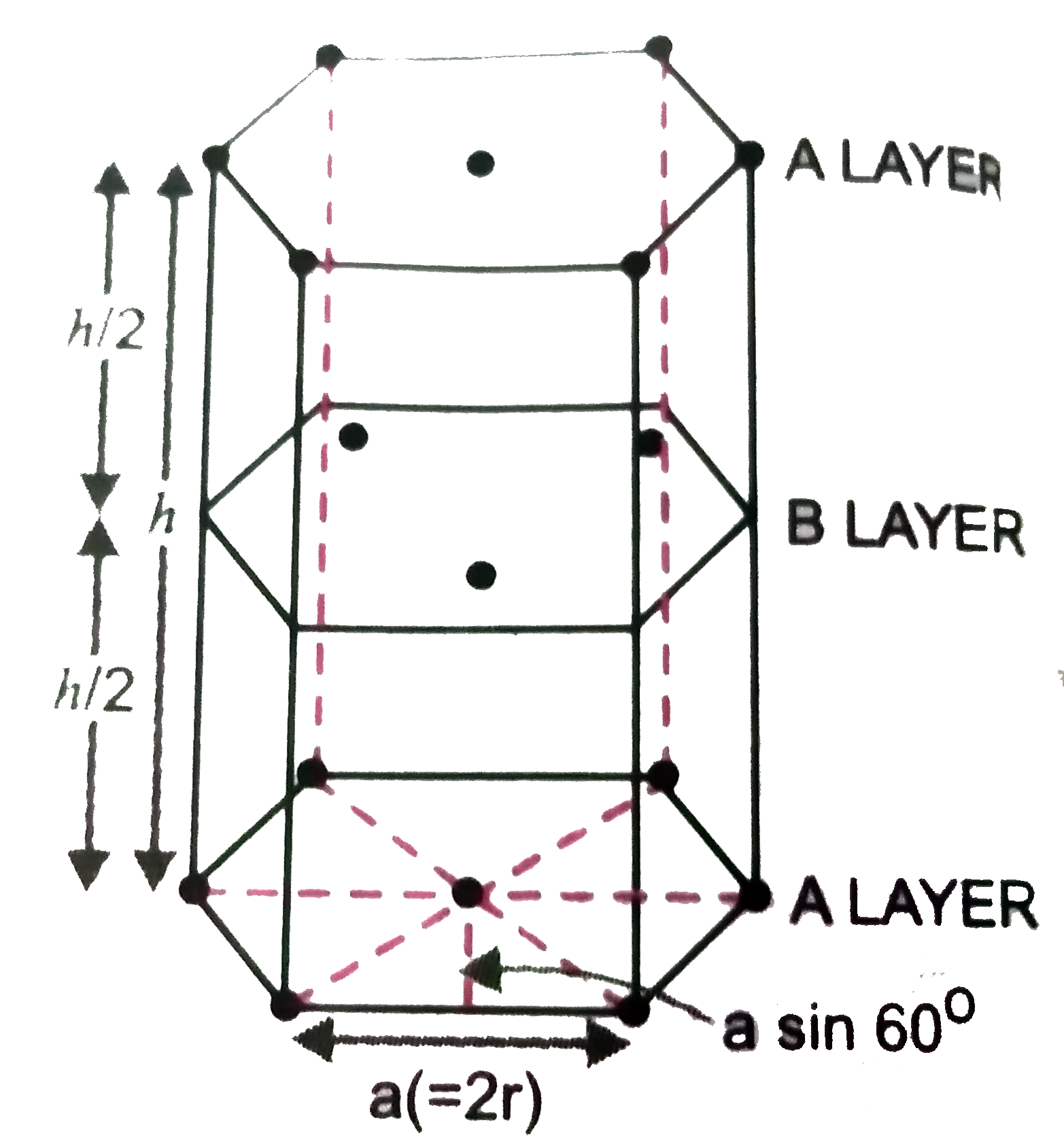
|
|
| 31. |
A metallic cystal has the bcc type staking pattern. What percentage of volume of this lattice is empty space ? |
| Answer» Solution :In bcc, `68%`SPACE is occupied and remaining `32%` is EMPTY. | |
| 32. |
A metallic crystal has the bcc type stacking pattern. What percentage of volume of this lattice is empty space ? |
| Answer» SOLUTION :In bcc, `68%`space is occupied and remaining `32%` is empty. | |
| 33. |
A metallic carbide on treatment with water gives a colourless gas which burns readily in air and gives a precipitate with ammoniacal silver nitrate solution. The gas evolved is |
|
Answer» METHANE |
|
| 34. |
A metal X reacts with water to produce a highly combustible gas Y, and a solution Z. another metal P reacts with Z to give the same gas Y. X,Y,Z and P respectively are |
|
Answer» <P>`ZN,H_(2),Zn(OH)_(2),AL` `underset((Z))(NaOH)+underset((P))(Zn) to Na_(2)ZnO_(2) +underset((Y))(H_(2))` |
|
| 35. |
A metal X reacts with aqueous NaOH solution to form Y and a highly inflammalbe gas. Solution Y is heated and CO_(2) is poured through it. Z precipitates out and Na_(2)CO_(3) is formed. Z on the heating gives AI_(2)O_(3). Identify X,Y and Z. X Y Z |
|
Answer» `Al, NaAIO_(2), AI(OH)_(3)` `underset((Y))(2NaAIO_(2)) + CO_(2) + 3H_(2)O to underset((Z))(2AI(OH)_(3)) + Na_(2) CO_(3)` `underset((Z))(2AI(OH)_(3)) to AI_(2)O_(3) + 3H_(2) O` |
|
| 36. |
A metal X reacts with water to produce a highly combustible gas Y, and a solution A. Another metal P reacts with Z to give the same gas Y, Z, Y, Z and P respectively are |
|
Answer» `Zn , H_(2), Zn(OH)_(2)Al` `underset(Z) (2NaOH)+ underset(P) (Zn) to Na_(2) ZnO _(2) + underset(Y) (H_(2))` |
|
| 37. |
A metal 'X' Produces an oxide and nitride on burning in air , but do not liberate hydrogen with alkali ,Another metal 'y' produces an oxide and niotride on buring in air ,but liberate hydogen with alkalies ,then ,X' and 'Y' arae |
|
Answer» NA,Mg |
|
| 38. |
A metal which shows properties similar to that of magnesium is |
|
Answer» K |
|
| 39. |
A metal surface having v_(0) as threshold frequency is incident by light of frequency v, then select the correct statement |
|
Answer» `u = sqrt((2H.c(lambda_(0)-LAMBDA))/(m lambda_(0)lambda))` |
|
| 40. |
A metal salt solution forms a yellow precipitate with potassium chromate in acetic acid, a white precipitate with dilute sulphuric acid but does not give precipitate with sodium chloride or iodide. The white precipitate obtained when sodium carbonate is added to the metal salt solution will consist of |
|
Answer» lead carbonate |
|
| 41. |
A metal salt solution forms a yellow/precipitate with K_(2)CrO_(4) in acetic a while precipitate with dil H_(2)SO_(4) but gives no preciptate with NaCI or Nal. The white precipitate obtained when Na_(2)CO_(3) |
|
Answer» `CaCO_(3)` 
|
|
| 42. |
A metal oxide has the formula X_(2)O_(3). It can be reduced by hydrogen to give free metal and water. 0.159g of metal oxide requires 6 mg of hydrogen for complete reduction. The atomic mass of metal is amu is |
|
Answer» `15.58` 1 MOLE `rarr 3xx2gm` `?rarr6mg` = 1m boles = `("wt.")/("M.wt.")=(0.1596)/("M.wt")` implies M.wt. = 159.6 `2x+48=159.6impliesx=55.8` |
|
| 43. |
A metal oxide has the fomula M_2O_3. It can be reduced by hydrogen to give free metal and water. 0.16g of the metal requires 6mg of H_2for complete reduction. The atomic mass of the metal is .n? times the atomic number of calcium. The value of .n. is |
|
Answer» 6g gives`H_2`2 moles of metal `:. 6XX10^(-3)` gm of `H_2`GIVE 0.002 moles of .M. `0.002 = (0.16)/("M.Wt")` `:.` M.Wt `=(0.16)/(0.002)=80` |
|
| 44. |
A metal nitrate reacts with KI solution to give a block precipitate which on addition of excess of KI solution forms an orange coloured solution. The cation of metal nitrate is : |
|
Answer» `HG^(2+)` `Bi(NO_(3))_(3) + 3 Kl rarr underset(("Black"))(Bl_(3) (s)) + 3KNO_(3)` `Bl_(3) + Kl rarr underset("ORANGE coloured solution")(K [Bl_(4)])` |
|
| 45. |
A metal M readily forms water soluble sulphate MSO_(4) , water insoluble hydroxide M(OH)_(2) and oxideMOwhich becomes inert on heating . The hydroxide is soluble in NaOH. The metal M is |
|
Answer» Be |
|
| 46. |
A metal (M), shows ABAB arrangement of atoms in solid state, then what is the relatin between radius of atom (r) and edge length (a) and height (c) of HCP unit cell |
|
Answer» `a = 2R` |
|
| 47. |
A metal M readily forms water soluble sulphate MSO_(4), water insoluble hydroxide M(OH)_(2) and oxide MO which becomes inert on the hydrogen is soluble in NaOH. The metal M is... |
| Answer» ANSWER :A | |
| 48. |
A metal M readily forms water soluble MSO_(4) water insoluble M(OH)_(2) and oxide MO which becomes inert on heating. The hydroxide is soluble in NaOH. Then M is: |
|
Answer» `Be` `Be(OH)_(2)+2NaOHrarrNa_(2)BeO_(2)+2H_(2)O` other facts given are true for `Be` and not for others. |
|
| 49. |
A metal M readily forms its sulphate MSO_(4) which is water soluble. It forms oxide Mo which becomes inert on heating. It forms insouble hydroxide which is soluble NaOH. The metal is |
|
Answer» Mg |
|
| 50. |
A metal M reacts with sodium hydroxide to give a white precipitate X which is soluble in excess of NaOH to give Y. Compound X is soluble in HCI to form a compound Z. Identify M.X,Y and Z M , X , Y, Z |
|
Answer» `Si, SiO_(2),Na_(2)siO_(3),SiCI_(4)` `underset((X))(2AI(OH)_(3)) 6HCI to underset((Z))(2AICI_(3)) + 6H_(2) O` |
|