

Saved Bookmarks
This section includes 7 InterviewSolutions, each offering curated multiple-choice questions to sharpen your Current Affairs knowledge and support exam preparation. Choose a topic below to get started.
| 1. |
The current in the forward bias is known to be more (-mA) than the current in the reverse bias (~mu A) . What is the reaction then to operate the photodiodes in reverse bias ? |
|
Answer» SOLUTION :Consider the case of an n-type semiconductor. Obviously , the majority carrier density (n) is considerably larger than the minority hole density p (i.e., `n gt gt p`) . On illumination , LET the EXCESS electrons and holes GENERATED be `Delta n` and `Delta p` , respectively : `n. = n + Deltan` `p. = p + Deltap` Here n. and p. are the electron and hole concentrations at any particular illumination and n and p are carriersconcentration when there is no illumination , Remember `Delta n = Delta p` and `n gt gt p` . Hence the fractional CHANGE in the majority carriers (i.e., `(Deltan)/(n)`) would be much less than that in the minority carriers (i.e., `(Deltap)/(p)`) . In general , we can state that the fractional change due to the photoeffects on the minority carrier dominated reverse bias current is more easily measurable than the fractional change in the forward bias current . Hence , photodiodes are preferably used in the reversible bias condition for measuring light intensity. |
|
| 2. |
The coefficient of viscosity of a liquid of sigma = 1.0 CGS units as determined by measuring the terminal velocity of a spherical solid ball of density p= 1.5 CGS units inside the liquid. If the ball of radius 1.00cm attain terminal velocity 1cm/s, then the viscosity (in CGS units) of the liquid as calculated from the observations of the experimental is: [Take g=10m//s^(2) ] |
|
Answer» `(100)/( 9)` |
|
| 3. |
(i) Write two characteristics of a material used for making permanent magnets. (i) Why is core of an electromagnet made of ferromagnetic materials ? |
|
Answer» Solution :(i) A material used for making permanent MAGNETS should have high retentivity so that the magnet is strong and high coercivity so that the magnetisation is not erased by STRAY magnetic fields. (ii) The core of an ELECTROMAGNET is made of a ferromagnetic material like SOFT iron which has high permeability. On placing a soft iron rod in a solenoid and passing a CURRENT the magnetism of the solenoid is increased thousand fold and a strong electromagnet is prepared. |
|
| 4. |
निम्न में से कौनसी संख्या 3.4 तथा 3.5 के मध्य स्थित है : |
|
Answer» `3.523` |
|
| 5. |
Light rays from a point source situated at a depth of h below water can emerge in air through a define circular section. If refractive index of water is (4)/(3), the value of the radius of the circular section will be |
|
Answer» `(SQRT7)/(3)H` |
|
| 6. |
In a Young's double-slit experiment, monochromatic light is replaced by white light. Then |
|
Answer» all bright fringes will become WHITE |
|
| 7. |
Assertion : Charge is quantized . Reason: Charge , which is less than 1 C is not possible . |
|
Answer» If both assertion and REASON are true and the reason is the correct explanation of the assertion. Explanation : Q = `pm` ne and charge lesser than 1 C is POSSIBLE . |
|
| 8. |
A source of alternating emf of 220 V-50 Hz is connected in serieswith a resitanceof 200 Omegaan inductance of 100 mH anda capacitance of 30 mu Fdoesthe current lead or lag the voltageand by what angle ? |
|
Answer» Solution :`X_L=2pivL=31.4pi` `X_C=1//2pivC=106.1 Omega` SINCE `X_C GT X_L` currents LEADS the voltage or voltage lags the current `tan PHI=(X_C-X_L)/R=0.3734` `phi=20.5^@` (Since `phi` is positive , current leads the voltage) Given , `V_(rms)`=200 V, f=50 Hz , R=200 W `L=100xx10^(-3)` = 0.1 H, `C=30xx10^(-6) F=3xx10^(-5)` F  Interactive reactance `X_L=2pifL` i.e., `X_L=2xx3.142xx50xx0.1W` i.e., `X_L`=31.42 W Capacitance reactance , `X_C=1/(2pifC)` i.e., `X_C=1/(2xx3.1742xx50xx3xx10^(-5))` i.e., `X_C=1000/9.426=106.08Omega` Reactance of the circuit , `X_L-X_C` = 31.42-106.08 i.e., `X_L-X_C`=-74.6 W `rArr tan phi = (X_L-X_C)/R` i.e., `tan phi =(-74.66)/200`=0.3733 Hence `f=-20^@ 30.` i.e., the current leads the voltage by `20^@30.`. |
|
| 9. |
If the audio signal is transmitted directly into space, the length of transmitting antenna required will be |
|
Answer» EXTREMELY small |
|
| 10. |
How will you define RMS value of an alternating current ? |
| Answer» Solution :RMS value of ALTERNATING current is defined as that value of the STEADY current which when flowing throught a given CIRCUIT for a given TIME produces the same circuit for the dame time | |
| 11. |
Do electromagnetic waves carry energy and momentum ? |
| Answer» Solution :Yes, electromagnetic WAVES CARRY energy as well as momentum. | |
| 12. |
A particleis projected witha velocity bar(v) = ahat(i) + bhat(j) . Findthe radiusof curvature of thetrajectory of the particle at (i) pointof projection (ii) highestpoint . |
|
Answer» <P> Solution :(i) Letthe angleof projection be `theta` .At thepoint of projection `P, a_(n) = g cos theta_(0)` . Hencethe radiusof curvatureatP is `r_(p) =(v_(p)^(2))/(alpha_(n)) = (v_(0)^(2))/(g cos theta_(0))` Since`tan theta _(b) = b//a , cos theta_(0) = (a)/(sqrt(a^(2) + b^(2))`, we have `r_(p) = (a^(2) + b^(2))^(3//2) g//a` (ii) At thehighestposition Q, thevelocityof the PARTICLE is `v_(Q) = v_(0) cos theta_(0)` Sinceit moves HORIZONTALLY athighestpoint`Q.bar(a_(n)) = bar(g) (BOT bar(v))` Hencethe radius of curvature at Q is . `t_(Q) = (v_(Q)^(2))/(a_(n)) = (v_(0)^(2) cos^(2) theta)/(g)` where`v_(0) cos theta = v_(x)= a` (given) Then , `r_(Q) = (a^(2))/(g)` 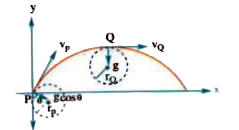
|
|
| 13. |
If a circuit made up of a resistance 10 and inductance 0.01H, and alternating emf 200 V at 50 H is connected, then the phase difference between the current and the emf in the circuit is : |
|
Answer» `TAN^(-1)(pi)` |
|
| 14. |
The acceleration (a) of a particle depends on displacement (s) as a a = 5 + s . Initially s = 0, v = 5, then velocity v correspondig to the displacement is given by |
|
Answer» `V = 5 + s` |
|
| 15. |
Describe the simplest diffraction pattern. |
Answer» SOLUTION : According to FIGURE, keeping the edges of the two razor blades parallel to each other a light bulb can be seen from that edge, the bright and dark fringes appear around the bulb filament. Looking at the finger of the hand, you can see the diffraction pattern. Looking at the light bulb from the KHADI cloth, bright and dark fringes can be seen around the lighted part of the bulb. If there is a pinhole on the far and opaque SCREEN in front of the sodium LAMP then light and dark fringes are seen on the screen. |
|
| 16. |
In an electronic communication system, what is attenuation ? |
| Answer» Solution :ATTENUATION is the reduction in the strength of a signal ( WHETHER digital or ANALOG ). | |
| 17. |
Deduce the expression, N=N_(0e)^(-lambdat), for the law of radioactive decay. |
|
Answer» Solution :Radioactive decay LAW: The RATE of decay of radioactive nuclei is directly proportional to the number of undecayed nuclei at that time. Derivation of Formula Suppose initially the number of atoms in radioactive element is No and N the number of atoms after time t. After time t, let dN be the number of atoms which disintegrate in a short intervaldt, then rate of disintegration will be `(dN)/(dt)`, this is also called the activity of the substance/element. According to Rutherford-Soddy law `(dN)/(dt), alphaN` or `(dN)/(dt), =- lambdaN` ..(i) where `lambda`is a constant, called decay constant or disintegration constant of the element. Its unit is `s^(–1)`. Negative sign shows that the rate of disintegration decreases with increase of time. For a given element/substance `lambda` is a constant and is different for different elements. Equation (i) may be rewritten as `(dN)/N=(-lambdadt)` Integrating `log_e, N=-lambdat+C`...(ii ) where C is a constant of INTEGRATION. At `t=0, N=N_0` `therefore log_e N_0=0+C * * C = log_e N_0` `therefore` Equation (ii) gives `log_eN=-lambdat+log_e N_0` or `log_eN-log_eN_0=-lambdat` 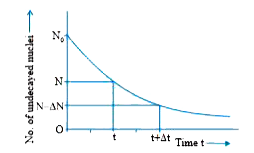 According to this equation, the number of undecayed atoms/nuclei of a given radioactive element decreases EXPONENTIALLY with time (i.e., more rapidly at first and slowly afterwards). Mark of `N=N_0/16` in terms of `T_(1//2)` is shown in fig. |
|
| 18. |
A prism of refractive index mu = 1.5 and prisim angle 15^@ is arranged with another prism ( refractive index mu_2 = 1.75. If this combination gives the dispersion without deviation, the what should be the prism angle of second prism ? |
|
Answer» SOLUTION :Deviation = zero Hence, `delta=delta_1+delta_2=0` `(mu_1-1)A_1+(mu_2-1)A_2=0` `A_2(1.75-1)=-(1.5-1)15^@` `A_2=-(0.5)/(0.75)xx15^@` `A_2=-10^@` negative sign represents that second prism is inversely CONNECTED with first prism. |
|
| 19. |
(a) Describe briefly how a diffraction pattern is obtained on a screen due to a single narrow slit illuminated by a monochromatic souce of light. Hence obtain the conditions for the angular width of secondary maxima and secondary minima. (b) Two wavelengths of sodium light of 590nm and 596nm are used in turn to study the diffraction taking place at a single slit of aperture 2xx10^(-6)m. The distance between the slit and the screen is 1.5m. Calculate the separation between the positions of first maxima of the diffraction pattern obtained in the two cases. |
Answer» Solution :(a)  The path difference (NP-LP), between the TWO edges of the slit, is given by `NP-LP=NQ=asintheta~~atheta` We, therefore, get maxima and minima, at different POINTS of the screen, depending on the path difference between the contributions from the wavelets, aminating from different points of the slit. This results in a diffraction pattern on the screen. The path difference between two points `M_(1)`, `M_(2)`, in the slit plane, seperated by a distance .y. , is `ytheta`. At the central point, .C., on the screen , `.theta.` is zero. All parts of the slit contribute in phase. Hence .C. is a maximum. At all points where `.theta~=(n+(1)/(2))(lambda)/(a)`, we get (secondary) maxima of varying intensity. This is because of the non-zero contribution of a (decreasing) part of the slit at these points. At all points where `theta~~(nlambda)/(a)`, we get minima. This is because of a net (almost) zero contribution of the whole slit at these points. (b) ANGULAR width of the secondary maxima `=2(2n+1)(lambda)/(a)` `:.` Linear width `=[(2n+1)(lambda)/(a)]D` `:.` Linear SEPARATION ,between the FIRST maxima `(n-1)` of the two wavelengths, on the screen is `(3(lambda_(2)-lambda_(1)))/(a)xxD` `:.` Separationn `=(3(596-590)xx10^(-9))/(2xx10^(-6))xx1.5m` `=13.5xx10^(-3)m(=13.5mm)` |
|
| 20. |
Using Biot - Savart'slaw, derive an expression for magnetic field at any point on axial line of a current carrying circular loop. Hence, find magnitude of magnetic field intensity at the centre of circular coil. |
|
Answer» Solution :Consider a circular loop of radius R, carrying a current I. Plane of the coil is Y-Z plane (i.e., perpendicular to the plane of paper), while the axis of the loop OX lies in the plane of paper. Consider the circular loop to be divided into large number of current elements `Ivec(dt)`. Two such elements `N_(1)M_(1) and N_(2)M_(2)`, diametrically opposite to each other, PRODUCE the magnetic FIELDS `VEC(dB_(1)) and vec(dB_(2))` perpendicular to both `vecr and vec(dl)` and given by right hand rule as, `|vec(dB_(1))|=|vec(dB_(2))|=(mu_(0))/(4pi).(Idl sin 90^(@))/(r^(2))=(mu_(0))/(4pi)(Idl)/((R^(2)+x^(2)))` These fields may be resolved into components along x -- axis and y - axis. Obviously components along y - axis balance each other but components along x - axis are all summed up. Hence, magnetic field DUE to whole current loop will be : `B=oint dB sin phi=oint(mu_(0))/((R^(2)+x^(2))).(R)/(SQRT((R^(2)+x^(2))))=(mu_(0)IR)/(4pi(P^(2)+x^(2))^(3//2))oint dl` `=(mu_(0)IR)/(4pi(R^(2)+x^(2))^(3//2)).2piR=(mu_(0)IR^(2))/(2(R^(2)+x^(2))^(3//2))` 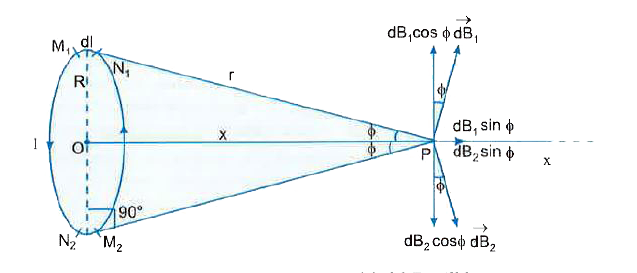 For a point at the centre of circular coil x = 0, so value of field B will be `B=(mu_(0)IR^(2))/(2R^(3))=(mu_(0)I)/(2R)` |
|
| 21. |
Determine the spin angular momentum of an atom in the state D_(2) if the maximum value of the magnetic moment projection in thatl state is equal to four Bohr magnetons. |
|
Answer» Solution :The expression for the PROJECTION of the MAGNETIC moment is `mu_(Z)= gm_(J)mu_(B)` where `m_(J)` is the projection of `vec(J)` on the `Ƶ`-axis. Maximum value of the `m_(J)` is `J`. THUS `gJ=4` Since `J=2`, we get `g=2`. Now `2=1+(J(J+1)+S(S+1)-L(L+1))/(2J(J+1))` `=1+(6+S(S+1)-6)/(2xx6), as L=2` `=1+(S(S+1))/(12)` ltnrgt Hence `S(S+1)=12 or S=3` Thus `M_(s)= ħsqrt(3xx4)=2sqrt(3) ħ`. |
|
| 22. |
The solid angle subtended at any point inside the surface due to small area dS is: |
|
Answer» `(dScostheta)/r^2` |
|
| 23. |
Two point charges (q_(1) and q_(2)) are placed on x-axis, figure shows graph potential (V) on x-axis. With x-co-ordinate: |
|
Answer» `q_(1)GT0` |
|
| 24. |
For the displacement-time graph shown in figure, the ratio of the magnitudes of the speeds during the first two second and the next four second is |
|
Answer» `1:1` |
|
| 25. |
The operating point of transistor amplifier should be in |
|
Answer» middle of its ACTIVE region |
|
| 26. |
Consider the circuit shown in figure. When the switch is in position a, for what value of r wil the circuit have a time costant of 10 mus? |
| Answer» Answer :A | |
| 27. |
A uniform rod of mass m, length l rotates about its end point O in horizontal plane. If the rod is rotating with a constant angular speed on a frictionless surface and the ratio of restoring force developed in the rod at points A and C is (F_(A))/(F_(C))=1+n/27, where 'n' is an integer value, find n |
|
Answer» `IMPLIES (F_(A))/(F_(C))=32/27` `impliesn=5` |
|
| 28. |
Condition for a function to be polynomial |
|
Answer» POWERS of VARIABLE MUST be POSITIVE |
|
| 29. |
Ray optics is valid, when characteristic dimensions are much larger than the wavelenght of light. |
|
Answer» much smaller than the wavelenght of light |
|
| 30. |
Two peojectiles are fired from the same point with same velocity at angles alpha and beta with the horizontal. They are aimed at a target distant, R from the point of projection. One falls a distance x short of R while other a distance y beyond R. If theta is the correct angle of projection then |
|
Answer» `THETA = sin^(-1)[("xsin"2ALPHA+"ysin 2" beta)/(x+y)]` |
|
| 31. |
All these magnetic materialsloss their magneticpropertieswhen |
|
Answer» |
|
| 32. |
At time t=0 some radioactive gas is injected into a sealed vessel . At time T some more of the gas is injected into the vessel. Which one of the following graphs best represents the logarithm of the activity A of the gas with time t ? |
|
Answer»
|
|
| 33. |
A photon incident on a metal of photo electric work function 2 ev produced photo electron of maximum kinetic energy 2 ev. The wave length associated with the photon is |
|
Answer» `6200A^(@)` |
|
| 34. |
Light of wavelength lambda from a point source falls on a small circular obstacle of diameter .d.. Dark and bright circular rings around a central bright spot are formed on a screen beyond this obstacle. The distace between the screen and obstacle is D. Then, the condition for the formation of rings is |
|
Answer» `LAMBDA APPROX (D)/(4)` |
|
| 35. |
If a direct current of value a ampere is superimposed on an alternative current I = b sin omega t flowing through a wire, what is the effective value of the resulting current in the circuit ? |
|
Answer» |
|
| 36. |
A charged particle would continue to move with a constant velocity in a region wherein, |
|
Answer» `vecE=0,vecBne0` 2. If `vecE=0`, then `F_(E)=0andsintheta=0ortheta=0^(@)or180^(@)andBne0` ALTHOUGH `F_(m)=0`. 3. If E = 0 and B = 0, then LORENTZ force `qvecE+q(vecvxxvecB)=0` for this case `vecEne0,vecBne0`. 4. In Lorentz force, `vecF=qvecE+q(vecVxxvecB)`, if F = 0 then `vecE=0andvecB=0`. So option (A, B and D) are TRUE. |
|
| 37. |
An LCR series ac circuit is at resonance with 10 V each across L, C and R. If the resistance is halved, the respective voltage across L, C and R are |
|
Answer» 10 V, 10 V and 5 V |
|
| 38. |
why a concavo-convex lens having both radii of curvature same bahaves as a plane glass plate ? |
|
Answer» SOLUTION :USING 1/f=`(mu_2/mu_1-1)``(1/R_1-1/R_2)` If`R_1=R_2 |
|
| 39. |
If Young.s double slit apparatus is shifted from air to water, then |
|
Answer» FRINGE WIDTH decreases |
|
| 40. |
Discuss the method of charging of two spheres by without contact method. |
|
Answer» Solution :(i) Bring two metal spheres, A and B, supported on INSULATING stands, in contact as SHOWN in figure (a). (II) Bring a positively charged rod near one of the spheres, say A, taking care that it does not touch the sphere. 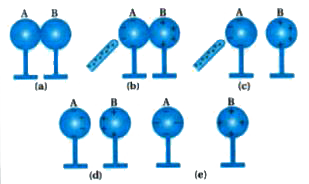 The free electrons in the spheres are attracted towards the rod. This leaves an excess of positive charge on the rear surface of sphere B. Both kinds of charges are bound in the metal spheres and cannot escape. They, therefore, reside on the surfaces, as shown in figure (b). The left surface of sphere A, has an excess of negative charge and the right surface of sphere B, has an excess of positive charge. As the negative charge starts building up at the left surface of A, other electrons are repelled by these. In a SHORT time, equilibrium is reached under the action of force of attraction of the rod and the force of repulsion due to the accumulated charges. Figure (b) shows the equilibrium situation. The accumulated charges remain on the surface, as shown, till the glass rod is held near the sphere. If the rod is removed, the charges are not acted by any outside force and they redistribute to their original neutral state. (iii) Separate the spheres by a SMALL distance while the glass rod is still held near sphere A, as shown in figure (c). The two spheres are found to be oppositely charged and attract each other. (iv) Remove the rod. The charges on spheres rearrange themselves as shown in figure (d). Now, separate the spheres quite apart. The charges on them get uniformly distributed over them, as shown in figure (e). (v) In this process, the metal spheres will each be equal and oppositely charged. This is charging by induction. |
|
| 41. |
The new angular fringe separation when apparatus is dipped in water is |
|
Answer» `0.135^(@)` `d = (lambda)./(theta^(1))` in water `therefore (theta^(1))/(theta)= (lambda.)/(lambda) therefore theta^(1) = (lambda.)/(lambda) theta` But `(lambda.)/(lambda) = (C_(w))/(C_(a)) = 1/(mu_(w)) = 3/4` then `theta. = 3/4theta = 0.135^(@)`. |
|
| 42. |
The thickness of air column which will have one more wavelength of yellow light (6000 Å) than in the same thickness of vaccum will be (refractive index of air is 1.0003) : |
|
Answer» Solution :Here `mu_(a) = 1.0003 = (lambda_(v))/(lambda_(a))` Let there be .t. thickness having n waves in vaccum and (n+ 1) waves in air `therefore t = n lambda_(v) = (n + 1) lambda_(a)` ....(1) `therefore (lambda_(v))/(lambda_(a)) = ( n+ 1)/(n) = 1.0003` or `1 + 1/n = 0.0003` or `1/n = 0.0003` `n = 1/0.0003` ....(2) `therefore t = (1)/(0.0003) xx 6000 xx 10^(-10)` or `t = 2 xx 10^(-3) = 2 mm`. |
|
| 43. |
A flat circular coil of 200 turns of diameter 25 cm is laid on a horizontal table and connected to a ballistic galvanometer. The complete circuit is having resistance of 800Omega. When the coil is quickly turned over, the spot of light swings to a maximum reading of 30 divisions. When a 0.1mu F capacitor charged to 6 V is discharged through the same ballistic galvanometer, a maximum reading of 20 division is obtained. Calculate the vertical component of the earth's magnetic induction. |
|
Answer» |
|
| 44. |
A potentiometer can be used to measure |
|
Answer» EMF of newly designed cell |
|
| 45. |
Define dielectric strength of a dielectric. |
| Answer» Solution :SEE POINT NUMBER 61 under the heading “Chapter At A Glance". | |
| 46. |
A man with a telescope can just observe the point A on the circumference of the base of an empty cylindrical vessel. When the vessel is filled completely with a liquid of refractive index 1.5, the man can just observe the middle point B of the base of the vessel without moving either the vessel or the telescope. If the diameter of the base of the vessel is 10 cm, what is the height of the vessel? |
|
Answer» Solution :When the vessel is empty, a light ray from the point A enters the telescope T following the straight path AO [Fig. 2.55]. When the vessel is filled with the liquid, aray of light from the point B moves along BO and after REFRACTION in AIR enters the telescope. Let h be the height of the vessel. `"Here" angleBOC = i and angleAOC = r` According to the FIGURE, `(SINI)/(SINR) = (1)/(mu) or, mu = (sinr)/(sini)` `or, "" 1.5 = ((AC)/(AO))/((BC)/(BO)) = (AC)/(AO) xx (BO)/(BC) = (AC)/(BC) xx (BO)/(AO)` `or, "" 1.5 = (10)/(5) xx (sqrt(BC^(2) + CO^(2)))/(sqrt(AC^(2) + CO^(2))) = 2 xx (sqrt(25 + h^(2)))/(sqrt(100 + h^(2)))` `or, " " 2.25 = (4(25 + h^(2)))/(100 + h^(2))` `or, "" h = 8.45 cm` 
|
|
| 47. |
What should be minimum length of tube so that third resonancee can also be heard . |
|
Answer» `l_(3) =421` for third resonance `l_(3) + epsilon = (5V)/(4f_(0)) get l_(3) = 124CM` . |
|
| 48. |
Some properties and observations related to sound are given in column A, while the processes, physical quantities and units related to them are given in column B. |
|
Answer» |
|
| 49. |
The potential difference V and current I flowing through an a.c. circuit are given as V= 50 cos omega t and I =2 sin omega t, where omegais the angular frequency of a.c. The power dissipated in the circuit is. |
| Answer» ANSWER :D | |
| 50. |
Graph of force per unit length between long parallel current carrying conductors, and the distance between them is |
|
Answer» straight line |
|


