

Saved Bookmarks
This section includes 7 InterviewSolutions, each offering curated multiple-choice questions to sharpen your Current Affairs knowledge and support exam preparation. Choose a topic below to get started.
| 1. |
Water rises in a vertical capillary tube up to a height of 2.0 cm. If the tube is inclined at an angle of 60^@ with the vertical, then up to what length the water will rise in the tube ? |
| Answer» Answer :B | |
| 2. |
In which of the following cases the centre of mass of a rod is certainly not at its centre? |
|
Answer» the DENSITY continuously increases from left to right |
|
| 3. |
A charger of 5C experiences a force of 5000 N when it is moved in a uniform electric field. The potential difference between two points separated by a distances of1 cm is |
|
Answer» 10 V |
|
| 4. |
A block is thrown with 14ms^(-1) over a long stationary plank as shown. Beofre the block comes at rest with respect to plank |
|
Answer» WORK done by kinetic FRICTION on the block be -180J `V_("block")=14-5xx2=4` `V_("block")=0+2xx2=4` `W_("block")=-(1)/(2)xx2xx(14^(2)-4^(2))=-180J` `W_("block")=(1)/(2)xx5xxu^(2)=40J` `W_("system")=-140J` |
|
| 6. |
For the circuit shown E=50 V R_(1)=10 Omega , R_(2)= 20 Omega, R_(3) = 30 Omega L = 2.0 mH . The current through R_(1) and R_(2) are ________ . And _______ immediate after the switch is closed. |
|
Answer» |
|
| 7. |
Two polaroids are alignedwith theiraxesof transmission making an angle of 9^(@) with the firstpolaroid .What fractionof the maximum possiblelight (if all polaroid were at the same angle ) passesthrough all three? |
|
Answer» 1 |
|
| 9. |
Assertion: A point charge is lying at the centre of a cube. The electric flux eminating from each surface of the cube is 1//6^(th) total flux. Reason:According to Gauss theorem, total electric flux through a closed surface enclosing a charge is equal to 1//epsilon_0 times the magnitude of the charge enclosed. |
|
Answer» Both ASSERTION and REASON are true and Reason is the correct explanation of Assertion |
|
| 10. |
Give the relation between the rms value and peak value of AC . |
| Answer» Solution :`I_(RMS) = I_(0) //sqrt(2)`. THEREFORE , `I_(rms) = 0.707 I_(0)`. | |
| 11. |
The half-life period of a radio-active element X is same as the mean life time of another radioactive element. Initially they have the same number of atoms. Then |
|
Answer» X will decay FASTER than Y |
|
| 12. |
A small amount of solution containing Na^(24) radionulide with activity A= 2.0.10^(3) distintegrations per second was injected in the bloodstream of man. The activity of 1 cm^(3) of blood sample taken t= 5.0 hours later turned out to be A'= 16 disintegrations per miunute per cm^(3). The half life of of the radionuclide is T=15 hours. Find the volume of the man's blood. |
|
Answer» Solution :LET `V=` volume of blood in the body of the human beign. Then the total activity of the blood is `A'V`. Assuming all this activity is due to the inhected `Na^(24)` and taking ACCOUNT of the decay of this radionuclide, we get `VA'=Ae^(-lambdat)` Now `lambda=(IN2)/(15) per hour, t= 5 hour` Thus `V=(A)/(A')e^(In 2//3)=(2.0xx10^(3))/((16//60))e^(-In2//3)C c= 5.95 litre` |
|
| 13. |
In the network shown A, B and C are at potentials of 70 V, zero V and 10 V respectively. The false one is 1) Point D is at a potential of 40 V 2) The currents in the sections AD, DB, DC are in the ratio 3:2:1 3) The current in the section AD, DB, DC are in the ratio 1:2:3 4) The network draws a total power of 200 W |
|
Answer» SOLUTION :LET V = potential at D `70-V=10i` `V-0=20i_(2)` `V-10=30(i_(1)-i_(2))` Solved for `i_(1), i_(2) and V` 
|
|
| 14. |
ABCDEGA is a planar body of mass m of uniform thickness and same material. The dimensions are as shown in the figure. The moment of inertia of the body about an axis passing through point A and perpendicular to planar body is I_(1) and that of about an axis passing through C and perpendicular to planer body is I_(2). If I_(1) //I_(2) is k. Find the value of k |
|
Answer» |
|
| 15. |
If vec A = vec B +vec C ,vec A,vec B and vec C are 5,4,3 units, the angle between vec Aand vec B is |
|
Answer» `sin^-1 3/4` |
|
| 16. |
Read the following passage and then answer questions (a) to (d) on the basis of your under- standing of the passage and the related studied concepts. We are familiar with Ampere.s circuital law which states that for an open surface with a boundary around a current the line integral of magnetic field around the entire boundary of an open surface is equal to mu_(0) times the total current passing through the surface i.e. ointvecB.vec(dl)=mu_(0)I Later on, Maxwell showed that for logical consistency, a changing electric field must also produce a magnetic field. In this context Maxwell introduced the concept of a displacement current given as per relation I_(D)=in_(0)(dphi_(E))/(dt) Thus, as per generalisation made by Maxwell, the source of a magnetic field is not just the conduction electric current due to following charges but also the time rate of change of electric field. In this way, Maxwell modified Ampere.s circuital law and in its modified the law is expressed as: ointvecB.vec(dl)=mu_(0)[I_(C )+I_(D)]=mu_(0)[I_(C )+in_(0)(dphi_(E))/(dt)] In all respects, the displacement current has the same physical effects as the conduction current. It is observed that in same cases, e.g., steady electric field in a wire, displacement current may be zero. In other cases, e.g., a capacitor being charged, both conduction and displacement currents may be present in different regions of space. In most of the cases, conduction current and displacement current may be present simultaneously in the same region of space because there exist no perfectly conducting or perfectly insulating medium. Moreover, there may be large regions of space where there is no conduction current but there is only a displacement current due to time varyingelectric field. What did Maxwell suggest to make Ampere.s circuital law logical consistent? |
|
Answer» SOLUTION :(b) Mexwell introduced the concept of displacement CURRENT and as per Ampere - Maxwell.s law, `ointvecB.vecdl=mu_(0)[I_(C )+I_(D)]mu_(0)I_(C )+in_(0)(dphi_(E))/(dt)` |
|
| 17. |
The major carrier of current in a p-type semiconductor will be |
|
Answer» neutrons |
|
| 18. |
A step up transformer has _____ gt_____ and _____lt_____ . |
| Answer» SOLUTION :`E_S` and `E_P, I_S` and `I_P` | |
| 19. |
Read the following passage and then answer questions (a) to (d) on the basis of your under- standing of the passage and the related studied concepts. We are familiar with Ampere.s circuital law which states that for an open surface with a boundary around a current the line integral of magnetic field around the entire boundary of an open surface is equal to mu_(0) times the total current passing through the surface i.e. ointvecB.vec(dl)=mu_(0)I Later on, Maxwell showed that for logical consistency, a changing electric field must also produce a magnetic field. In this context Maxwell introduced the concept of a displacement current given as per relation I_(D)=in_(0)(dphi_(E))/(dt) Thus, as per generalisation made by Maxwell, the source of a magnetic field is not just the conduction electric current due to following charges but also the time rate of change of electric field. In this way, Maxwell modified Ampere.s circuital law and in its modified the law is expressed as: ointvecB.vec(dl)=mu_(0)[I_(C )+I_(D)]=mu_(0)[I_(C )+in_(0)(dphi_(E))/(dt)] In all respects, the displacement current has the same physical effects as the conduction current. It is observed that in same cases, e.g., steady electric field in a wire, displacement current may be zero. In other cases, e.g., a capacitor being charged, both conduction and displacement currents may be present in different regions of space. In most of the cases, conduction current and displacement current may be present simultaneously in the same region of space because there exist no perfectly conducting or perfectly insulating medium. Moreover, there may be large regions of space where there is no conduction current but there is only a displacement current due to time varyingelectric field. Define displacement current. |
|
Answer» Solution :(a) Displacement current is the current set up in SPACE due to a TIME varying electric FIELD. Mathemtically, `I_(D)=in_(D)=(dphi_(E))/(dt)` where `(dphi_(E))/(dt)=`time RATE of change of electric flux of a given region in space. |
|
| 20. |
A particle perfroming S.H.M. gas a period of 6 sec and its maximum velocity during the oscillation is 6.28 cm/sec. Find the time required by it to cover adistance of 3 cm from its mean position. |
|
Answer» SOLUTION :`x=asinomegat=asin((2pit)/T)` `3=6sin((2pit)/6)1/2= SIN((2pit)/6)` `sin (pi/6)=sin((2pit)/6)` `pi/6=(2pit)/6 t=1/2sec.` |
|
| 21. |
Read the following passage and then answer questions (a) to (d) on the basis of your under- standing of the passage and the related studied concepts. We are familiar with Ampere.s circuital law which states that for an open surface with a boundary around a current the line integral of magnetic field around the entire boundary of an open surface is equal to mu_(0) times the total current passing through the surface i.e. ointvecB.vec(dl)=mu_(0)I Later on, Maxwell showed that for logical consistency, a changing electric field must also produce a magnetic field. In this context Maxwell introduced the concept of a displacement current given as per relation I_(D)=in_(0)(dphi_(E))/(dt) Thus, as per generalisation made by Maxwell, the source of a magnetic field is not just the conduction electric current due to following charges but also the time rate of change of electric field. In this way, Maxwell modified Ampere.s circuital law and in its modified the law is expressed as: ointvecB.vec(dl)=mu_(0)[I_(C )+I_(D)]=mu_(0)[I_(C )+in_(0)(dphi_(E))/(dt)] In all respects, the displacement current has the same physical effects as the conduction current. It is observed that in same cases, e.g., steady electric field in a wire, displacement current may be zero. In other cases, e.g., a capacitor being charged, both conduction and displacement currents may be present in different regions of space. In most of the cases, conduction current and displacement current may be present simultaneously in the same region of space because there exist no perfectly conducting or perfectly insulating medium. Moreover, there may be large regions of space where there is no conduction current but there is only a displacement current due to time varyingelectric field. Does displacement current need a conductor to flow. |
| Answer» Solution :(d) Displacement current does not NEED a CONDUCTOR for its FLOW in SPACE. | |
| 22. |
Read the following passage and then answer questions (a) to (d) on the basis of your under- standing of the passage and the related studied concepts. We are familiar with Ampere.s circuital law which states that for an open surface with a boundary around a current the line integral of magnetic field around the entire boundary of an open surface is equal to mu_(0) times the total current passing through the surface i.e. ointvecB.vec(dl)=mu_(0)I Later on, Maxwell showed that for logical consistency, a changing electric field must also produce a magnetic field. In this context Maxwell introduced the concept of a displacement current given as per relation I_(D)=in_(0)(dphi_(E))/(dt) Thus, as per generalisation made by Maxwell, the source of a magnetic field is not just the conduction electric current due to following charges but also the time rate of change of electric field. In this way, Maxwell modified Ampere.s circuital law and in its modified the law is expressed as: ointvecB.vec(dl)=mu_(0)[I_(C )+I_(D)]=mu_(0)[I_(C )+in_(0)(dphi_(E))/(dt)] In all respects, the displacement current has the same physical effects as the conduction current. It is observed that in same cases, e.g., steady electric field in a wire, displacement current may be zero. In other cases, e.g., a capacitor being charged, both conduction and displacement currents may be present in different regions of space. In most of the cases, conduction current and displacement current may be present simultaneously in the same region of space because there exist no perfectly conducting or perfectly insulating medium. Moreover, there may be large regions of space where there is no conduction current but there is only a displacement current due to time varyingelectric field. Inhow many ways a magnetic field produced in free space without the presence of permanent magnet? |
|
Answer» Solution :(c ) Magnetic FIELD in space may be produced in space under FOLLOWING two conditions : (i) When CURRENT flows through a conductor, magnetic field is SET up around it. (ii) When electric field in a given region is varying with time, it also produces a magnetic field in the region. |
|
| 23. |
A charge of 2C is placed on the x -axis atI m from theorigin along - ve x - axis. Infinite number of charges each of magnitude 2C are placed on x-axis at I m, 2m, 4m ………. From origin along +ve x-axis. The first charge is positive and altenate charges are of opposite in nature. The electic fields intensity at the origin. |
|
Answer» `(1)/(10PI epsilon_(o))`ALONG + ve x-axis |
|
| 24. |
The relative magnetic permeability of the medium is 2.5 and the relative electrical permittivity of the medium is 2.25 Compute the refractive index of the medium. |
|
Answer» Solution :DIELECTRIC constant ( relative PERMEABILITY of the medium ) is `epsi _(r) =2.25` Magneic permeability is `mu_(r) =2.5` Refractive INDES of the medium , `n= sqrt(epsi _r mu_r) = sqrt( 2.25 xx 2.5) = 2.37` |
|
| 25. |
A mass of 1 kg carrying a change of 2 C is accelerated through a potential of 1 V. The velocity acquired by it is |
|
Answer» `sqrt2ms^(-1)` `V^(2)=(2qV)/m` `v=sqrt((2qV)/m)=sqrt((2xx2xx1)/1)` `v=2ms^(-1)` |
|
| 26. |
The production of emf in a thermocouple with its junctions at different temperature is called …effect. |
| Answer» Answer :B | |
| 28. |
(A ): A charged particle free to move in an electric field always move along an electric line of force. (R ): The electric line of force diverge from a positive charge and converge at a negative charge. |
|
Answer» Both .A. and .R. are true and .R. is the CORRECT EXPLANATION of .A. |
|
| 29. |
A body of mass 5kg rests on a rough horizontal surface of coefficient of friction 0.2. The body is pulled through a distance of 10m by a horizontal force of 25N. The kinetic energy acquired by the body is (g= 10ms^(-2)) |
| Answer» ANSWER :C | |
| 30. |
Ocean contains enormous amount ofheat energy. Can we drive a ship across the ocean by .utilising this energy ? |
| Answer» Solution :No. This not possible because no sink (cooler body) is available. The engine of the DRIP, at the start of its CYCLE will draw some heat 2jfroni the WATER, convert a part of it into work and the rest heat is to be rejected to the sink. But no sink is available. This may also be explained with the help of efficiency expression of CARNOT’s cycle. We know that `eta=T_2/T_1` but when `T_1=T_2,eta=0` Thus without a temperature difiference, conversion of thermal energy into mechanical work is IMPOSSIBLE | |
| 31. |
A heat engine takes in 300 K cal of heat from a reservoir at 627^(@)C and gives it to a sink at 27^(@)C. The work done by the engine is |
|
Answer» `4.2xx10^(6)J` `=3xx10^(6)xx4.2J=12.6xx10^6J` `W=Q(1-(T_(2))/(T_(1)))` `=12.6xx10^(6)(1-(300)/(900))=12.6xx10^(6)XX(2)/(3)` `=8.4xx10^(6)J`. |
|
| 32. |
A mover pushes a large crate (mass m=75 kg) from the inside of the truck to the back end (a distance of 6 m), exerting a steady push of 300 N. if he moves the crate this distance in 20 s, what is his power output during this time? |
|
Answer» SOLUTION :The work done on the CRATE by the mover is `W=Fd=(300N)(6m)=1,800J`. If this much work is done is 20 s, then the POWER delivered is `P=W//t=(1,800J)//(20s)` =90Wgt Note that `P=W//t=Fd//t=Fv`, the formula P=Fv is often useful. |
|
| 33. |
(A) : Magnetism is relativistic. (R) : When we move along with the charge so that there is no motion of charge relative to us we find no magnetic field associated with the charge. |
|
Answer» Both 'A' and 'R' are TRUE and 'R' is the correct EXPLANATION of 'A'. |
|
| 34. |
A cube of side l is placed in a uniform field E, where E= E hat(i).The net electric flux through the cube is |
| Answer» Answer :A | |
| 35. |
(a) The density of the nuclear matter is tremendously larger than the physical density of the material. Explain. (b) The nuclear forces are not coulomb forces between nucleons. Explain. (c) Draw a plot of the potential energy between a pair of nucleons as a function of distance between them inside a nucleus. |
|
Answer» (b) Coulombian force between two protons is repulsive. However, within a nucleus a number of protons and neutrons EXIST together within a very small space. So it is clear that nuclear force is not coulomb force but is an EXTREMELY short range force which is attractive in nature and is responsible for maintaining all the nucleons together. 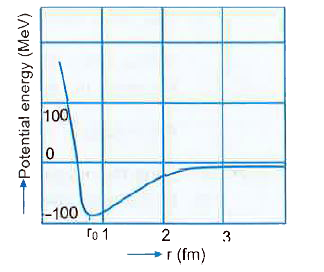 (c) The plot of POTENTIAL energy between a pair of nucleons as a fraction of function between them is drawn here. |
|
| 36. |
A light bulb is rated at 100W for a 220 V supply. Find The resistance of the bulb |
|
Answer» SOLUTION :(a) We are given P = 100 W and V = 220 V. The resistance of the BULB is `R=(V^(2))/(P)=((220V)^(2))/(100W)=484Omega` (b) The peak voltage of the SOURCE is `v_(m)=sqrt(2)V=311V` (c) SINCE, P = I V `I=(P)/(V)=(100W)/(220V)=0.454A` |
|
| 37. |
In certain isobars the number of protons of one isobar is equal to the number of protons in another. a.What is the name given to such isobars? b. Give one example. |
| Answer» SOLUTION :a. Isomers `""` B. `""^(99)TC and ""^(99m)Tc`. | |
| 38. |
The lower end of a capillary tube is at a depth of 12 cm ant the water rises 3 cm in it. The mouth pressure required to blow an air bubble at the lower end will be X cm of water column, where X is |
|
Answer» 3 |
|
| 39. |
A galvanometer of resistance G is converted into a voltmenter to measrue upto V volts by connecting a resistance R_(1) in series with the coil. If a resistance R_(2) is connected series with it, then it can measure upto 1//2 volts. Find the resistance, in terms of R_(1) and R_(2), required to be connected to convert in into a voltmeter that can read upto 2V. Also find the resistance G of the galvanometer in terms of R_(1) and R_(2) |
|
Answer» Solution :Let G be the resistance of galvanometer and `l_(g)` be the CURRENT through galvanometer for full scale DEFLECTION. If this galvanometer is converted into voltmenter to measure upto V volts, then `R_(1)=(Vl2)/(l_(g))-G=(V)/(2l_(g))-G` Substracting (ii) from (i), we get `R_(1)-R_(2)=(V)/(l_(g))-(V)/(2l_(g))=(V)/(2l_(g))` or `(V)/(l_(g))=2(R_(1)-R_(2))` Multiply (ii) with 2 and substracting from (i), we get `R_(1)-2R_(2)=-G+2G=G, i.e., G=R_(1)-2R_(2)` Let `R_(3)` resistance be connected in series to CONVERT the galvanometer into a voltmenter of range 0 to 2V then `R_(3)=(2V)/(l_(g))-G=2xx2(R_(1)-R_(2))-(R_(1)-2R_(2))=3R_(1)-2R_(2)` |
|
| 40. |
When the door of the Chapel of the Mausoleum in Hamilton, Scotland, is slammed shut, the last echo heard by someone standing just inside the door reportedly comes 15 s later. (a) If that echo were due to a single reflection off a wall opposite the door, how far from the door is the wall? (b) If, instead, the wall is 32.0 m away, how many reflections (back and forth) occur? |
| Answer» SOLUTION :`(a) 2.6 KM, (B) 159.8 ~~ 1.6 XX 10^2` | |
| 41. |
If a loop of chain is spunat high speed, it will roll like a hoop without collapsing. Consider a chain oflinear mass density p thatmu is rollingwithoutslipping at a high speed v_(0) (a) Show that the tension in the chain is F = muv_(0)^(2) |
|
Answer» |
|
| 42. |
If a loop of chain is spunat high speed, it will roll like a hoop without collapsing. Consider a chain oflinear mass density p thatmu is rollingwithoutslipping at a high speed v_(0) (b) If the chain rolls over a small hump, a transverse wave pulse will be generated in the chain. At whatspeedwill it travel alongthe chain ? |
| Answer» | |
| 43. |
A metallic wire is drawn to reduce its diameter to half its original value. Its resistance becomes |
|
Answer» TWO times |
|
| 44. |
Find the value of critical angle for a material of refractive index sqrt(3). |
|
Answer» SOLUTION :Here, `n = sqrt(3)` `sin i_(c ) = (1)/(n) = (1)/(sqrt(3)) = 0.5773` `THEREFORE "critical ANGLE", i_(c ) = 35.3^(@)` |
|
| 45. |
If the angular speed of the armature of a dynamo is doubled then the amplitude of the induced e.m.f. will become _________. |
|
Answer» |
|
| 46. |
{:("List-I","List-2"),((a)"Surface Tension",(e)"Gas constant "),((b)"Specific heat ", (f) "Areal velocity "),((c)"Latent heat" ,(g) "Spring constant "),((d) "Kinematic viscosity " ,(h) " Gravitational potential"):} |
|
Answer» a - E`""` B- g `""`C -H `""` d-f |
|
| 47. |
If a loop of chain is spunat high speed, it will roll like a hoop without collapsing. Consider a chain oflinear mass density p thatmu is rollingwithoutslipping at a high speed v_(0) (c)How far around the loop (in degrees) will a transverse pulse travelin the time the hoop rolls through one complete revolution ? |
|
Answer» |
|
| 48. |
Where do we use Kirchoff's laws in preference to ohm's law ? |
| Answer» Solution :Ohm.s law is USED to SOLVE simple circuits, HOWEVER, when an electrical circuit contain many sources of EMF, Kirchoff.s law gives quick and easy solution. | |
| 49. |
The gyro-magnetic ratio of an electron in an H-atom, according to Bohr model, is |
|
Answer» INDEPENDENT of which ORBIT it is in |
|
| 50. |
When a helium nucleus revolves in a circular orbit of radius 0.8 m,if it takes 2 sec to comlete one revolution.find magnetic field produced at the centre would be _____ T. |
|
Answer» `10^(-18)mu_(0)` `thereforeB=(mu_(0)I)/(2a)=(mu_(0)Qf)/(2a)""(becauseI=Qf)` `thereforeB=(mu_(0)xx2xx1.6xx10^(-19)XX1)/(2xx0.8)` `thereforeB=2xxmu_(0)xx10^(-19)T` |
|